
Life, 1912-12-19 · page 28 of 40
Life — December 19, 1912 — page 28: what you’re looking at
What you’re looking at
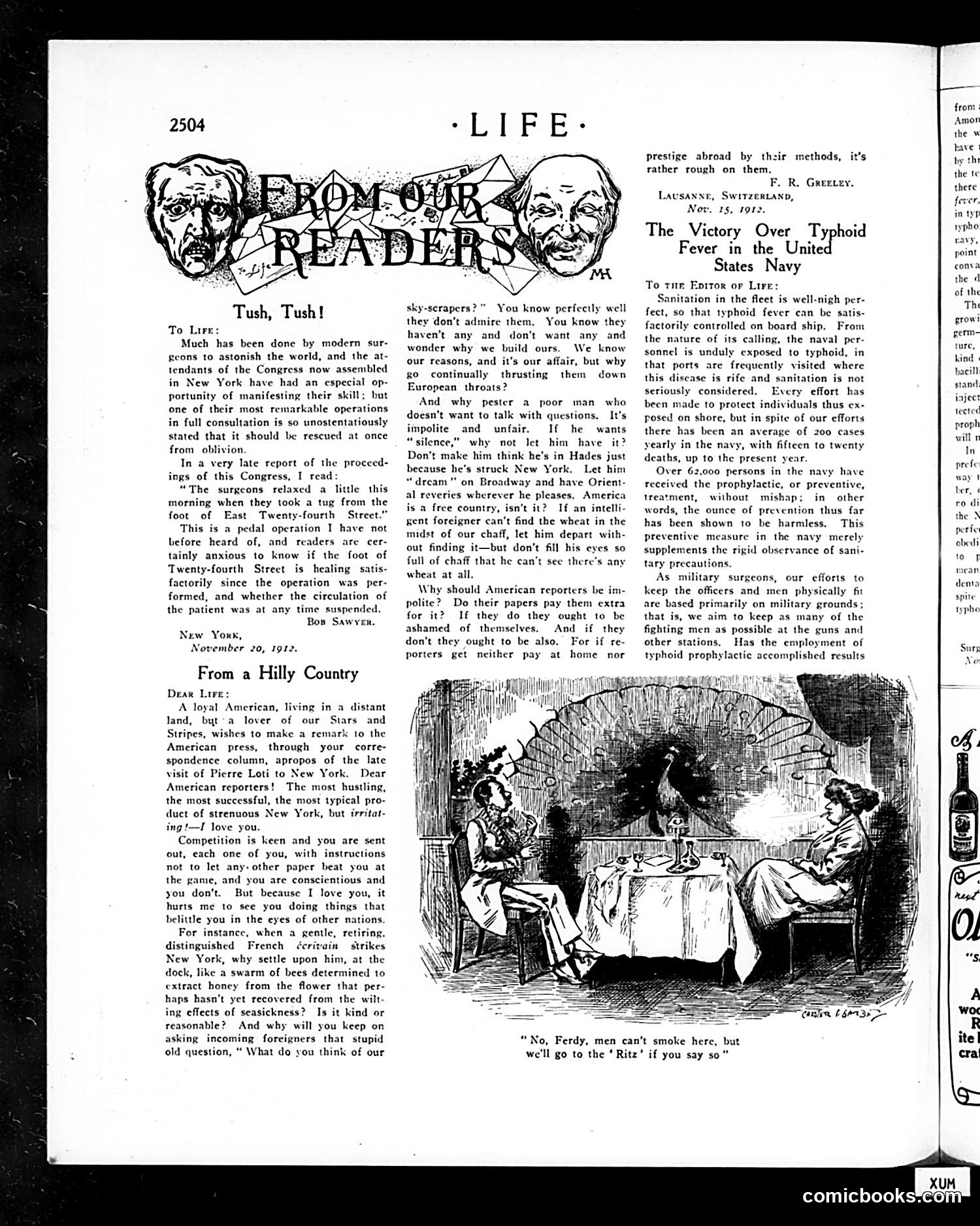
This page contains three readers' letters satirizing different subjects: **"Tush, Tush!"** mocks surgical congresses through wordplay—a surgeon's report mentions taking "a tug from the foot of East Twenty-fourth Street," which the writer treats as an actual medical procedure, humorously questioning whether the "patient" (the street itself) has healed. **"From a Hilly Country"** criticizes American newspaper reporters' behavior toward visiting French writer Pierre Loti. The letter complains that aggressive reporters pester foreign visitors with invasive questions (like "what do you think of our skyscrapers?") and prevent them from peaceful reflection, arguing this rudeness damages America's international reputation. **"The Victory Over Typhoid Fever"** begins a serious letter praising naval sanitation improvements that have controlled typhoid disease among sailors. The cartoon shows two people in conversation; the caption reads "No, Ferdy, men can't smoke here, but we'll go to the 'Ritz' if you say so"—likely satirizing wealthy New Yorkers' casual attitude toward venue restrictions.
📄 Transcribed text from this page (OCR, searchable)
Machine-transcribed from the original scan — historical spelling and the odd misread are preserved.
Tush, Tush! To Lire: Much has been done by modern sur- geons to astonish the world, and the at- tendants of the Congress now assembled in New York have had an especial op- portunity of manifesting their skill one of their most remarkable operations in full consultation is so unostentatiously stated that it should be rescued at once from oblivion In a very late report of the proceed ings of this Congress, I read: “The surgeons relaxed a little this morning when they took a tug from the foot of East Twenty-fourth Street.” This is a pedal operation I have not before heard of, and readers are cer- tainly anxious to know if the foot of Twenty-fourth Street is healing satis- factorily since the operation was per- formed, and whether the circulation of the patient was at any time suspended. Bos Sawyer. New York, November 20, 1912. From a Hilly Country Deaw Lire: A loyal American, living in a distant land, byt’a lover of our Stars and Stripes, wishes to make a remark to the American press, through your corre- spondence column, apropos of the late visit of Pierre Loti to New York. Dear American reporters! The most bustling, the most successful, the most typical pro- duct of strenuous New York, but irritat- ing!—I love you. Competition is keen and you are sent out, each one of you, with instructions not to let any-other paper beat you at the game, and you are conscientious and you don’t. But because I love you, it hurts me to see you doing things that belittle you in the eyes of other nations For instance, when a gentle, retiring. distinguished French écrivain strikes New York, why settle upon him, at the dock, like a swarm of bees determined to extract honey from the flower that per- haps hasn't yet recovered from the wilt ing effects of seasickness? Is it kind or reasonable? And why will you keep on asking incoming foreigners that stupid old question, “ What do you think of our sky-serapers?” You know perfectly well they don’t admire them, You know they haven't any and don't want any and wonder why we build ours. We know our reasons, and it’s our affair, but why go continually thrusting them down European throats? And why pester a poor man who doesn’t want to talk with questions. It's impolite and unfair. If he wants “silence,” why not let him have it? Don’t make him think he’s in Hades just because he's struck New York. Let him “dream” on Broadway and have Orient al reveries wherever he pleases. America is a free country, isn’t it? If an intelli- gent foreigner can’t find the wheat in the midst of our chaff, let him depart with- out finding it—but don’t fill his eyes so full of chaff that he can’t see there’s any wheat at all. Why should American reporters be im- polite? Do their papers pay them extra for it? If they do they ought to be ashamed of themselves. And if they don't they ought to be also. For if re- porters get neither pay at home nor if sia i prestige abroad by thzir methods, it’s rather rough on them. F. R. Greetey. The Victory Over Typhoid Fever in the Unite States Navy To tir Epitor oF Lire: Sanitation in the fleet is well-nigh per- fect, so that typhoid fever can be satis- factorily controlled on board ship. From the nature of its calling, the naval per- sonnel is unduly exposed to typhoid, in that ports are frequently visited where this disease is rife and sanitation is not seriously considered. Every effort has been made to protect individuals thus ex- posed on shore, but in spite of our efforts there has been an average of 200 cases yearly in the navy, with fifteen to twenty deaths, up to the present year. Over 62,000 persons in the navy have received the prophylactic, or preventive, treatment, without mishap; in other words, the ounce of prevention thus far has been shown to be harmless. This preventive measure in the navy merely supplements the rigid observance of sani- tary precautions. military surgeons, our efforts to keep the officers and men physically fit are based primarily on military grounds; that is, we aim to keep as many of the fighting men as possible at the guns and other stations, Has the employment of typhoid prophylactic accomplished results “No, Ferdy, men can’t smoke here, but we'll go to the ‘Ritz’ if you say so” from Amor the fave | by thi the te there fever, in ty7 typho ravy, point conva the d of the Th growi germ- ture, kind | bacill stand inject rected proph will n In pref way | ter, « ro di the ) perfe obedi tof rocan dena spite typhe comicbookseaed