
Life, 1912-12-19 · page 27 of 40
Life — December 19, 1912 — page 27: what you’re looking at
What you’re looking at
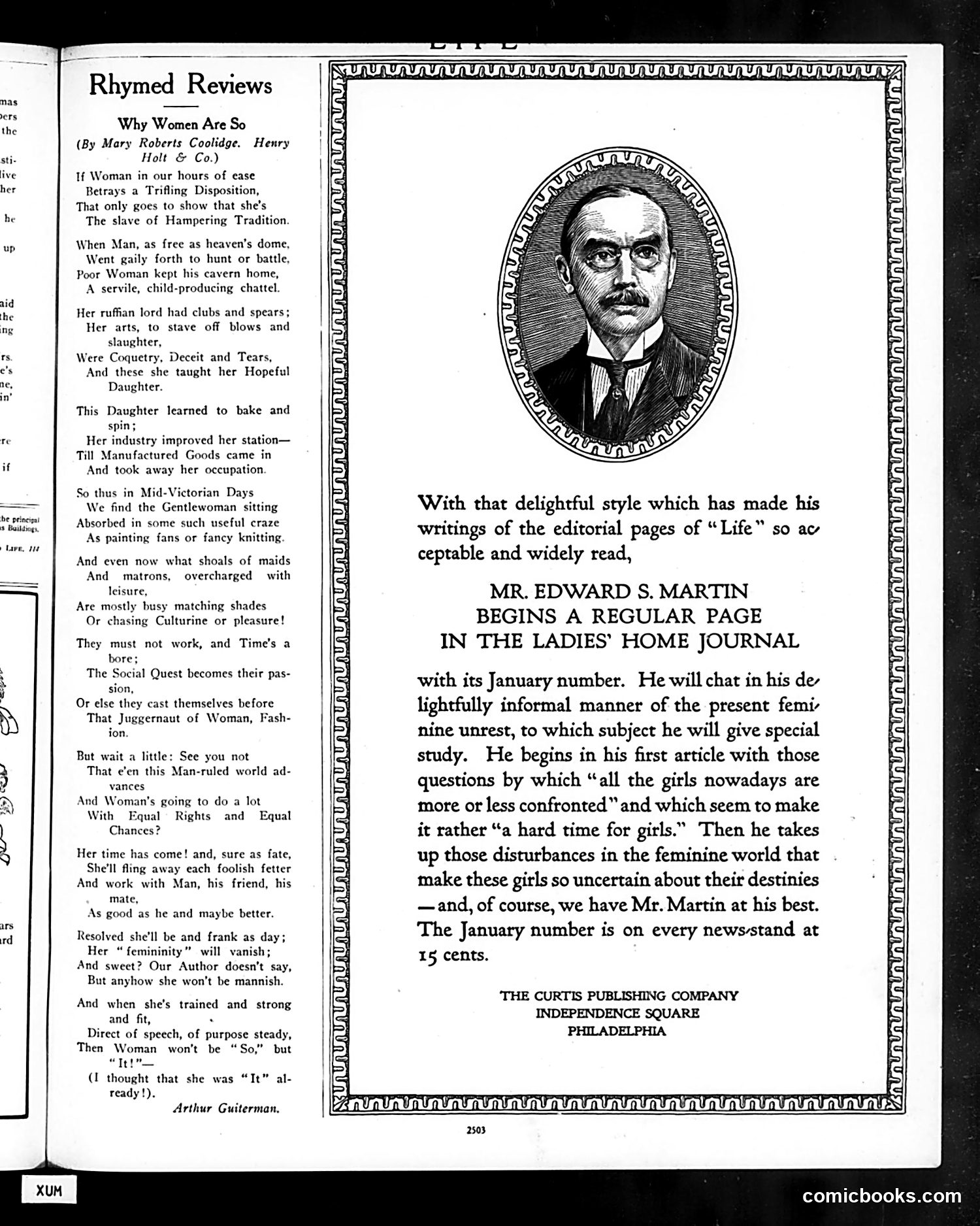
This page contains a satirical poem reviewing Mary Roberts Coolidge's book "Why Women Are So," written by Arthur Guiterman for *Life* magazine. The poem traces women's historical subjugation—from serving as domestic slaves producing children, to being taught "Coquetry, Deceit and Tears" as survival tools, to Victorian idleness with "fancy knitting" and fashion obsession. Guiterman's satire mocks both women's enforced dependency and the leisure-class uselessness it created. The poem's turning point celebrates coming change: women will gain "Equal Rights and Equal Chances," becoming "frank," "resolved," and "strong"—though the final joke undercuts this, suggesting women were already "It" (slang for the ultimate desirable quality), implying their liberation may merely shift rather than solve their social role. The page also announces Edward S. Martin's new column in *Ladies' Home Journal*, addressing "feminine unrest"—the contemporary anxiety about women's changing social position during the early 20th-century suffrage era.
📄 Transcribed text from this page (OCR, searchable)
Machine-transcribed from the original scan — historical spelling and the odd misread are preserved.
be peincizal § Balding, Lave, 114 “Rhymed Reviews Why Women Are So (By Mary Roberts Coolidge. Henry Holt & Co.) Tf Woman in our hours of ease Betrays a Trifling Disposition, That only goes to show that she’s The slave of Hampering Tradition. When Man, as free as heaven's dome, Went gaily forth to hunt or battle, Poor Woman kept his cavern home, A servile, child-producing chattel. Her ruffian lord had clubs and spears; Her arts, to stave off blows and slaughter, Were Coquetry, Deceit and Tears, And these she taught her Hopeful Daughter. This Daughter learned to bake and spin; Her industry improved her station— Till Manufactured Goods came in And took away her occupation. So thus in Mid-Victorian Days. We find the Gentlewoman sitting Absorbed in some such useful craze As painting fans or fancy knitting. And even now what shoals of maids And = matrons, overcharged with leisure, Are mostly busy matching shades Or chasing Culturine or pleasure! They must not work, and Time’s a bor The Social Quest becomes their pas- sion, Or else they cast themselves before That Juggernaut of Woman, Fash- ion. But wait a little: See you not That e’en this Man-ruled world ad- vances an’s going to do a lot iqual Rights and Equal Chances? Her time has come! and, sure as fate, She'll fling away each foolish fetter And work with Man, his friend, his mate, As good as he and maybe better. Resolved she'll be and frank as day; Her “ femininity” will vanish; And sweet? Our Author doesn’t say, But anyhow she won't be mannish. And when she's trained and strong and fit, . Direct of speech, of purpose steady, Then Woman won't be “So,” but “Try (I thought that she was “It” al- ready !). Arthur Guiterman, With that delightful style which has made his writings of the editorial pages of “Life” so ac ceptable and widely read, MR. EDWARD S. MARTIN BEGINS A REGULAR PAGE IN THE LADIES’ HOME JOURNAL with its January number. He will chat in his de lightfully informal manner of the present femi nine unrest, to which subject he will give special study. He begins in his first article with those questions by which “all the girls nowadays are more or less confronted” and which seem to make it rather “a hard time for girls.” Then he takes up those disturbances in the feminine world that make these girls so uncertain about their destinies —and, of course, we have Mr. Martin at his best. The January number is on every newsstand at 15 cents. ‘THE CURTIS PUBLISHING COMPANY INDEPENDENCE SQUARE comicbooks.com