
Life, 1912-12-19 · page 22 of 40
Life — December 19, 1912 — page 22: what you’re looking at
What you’re looking at
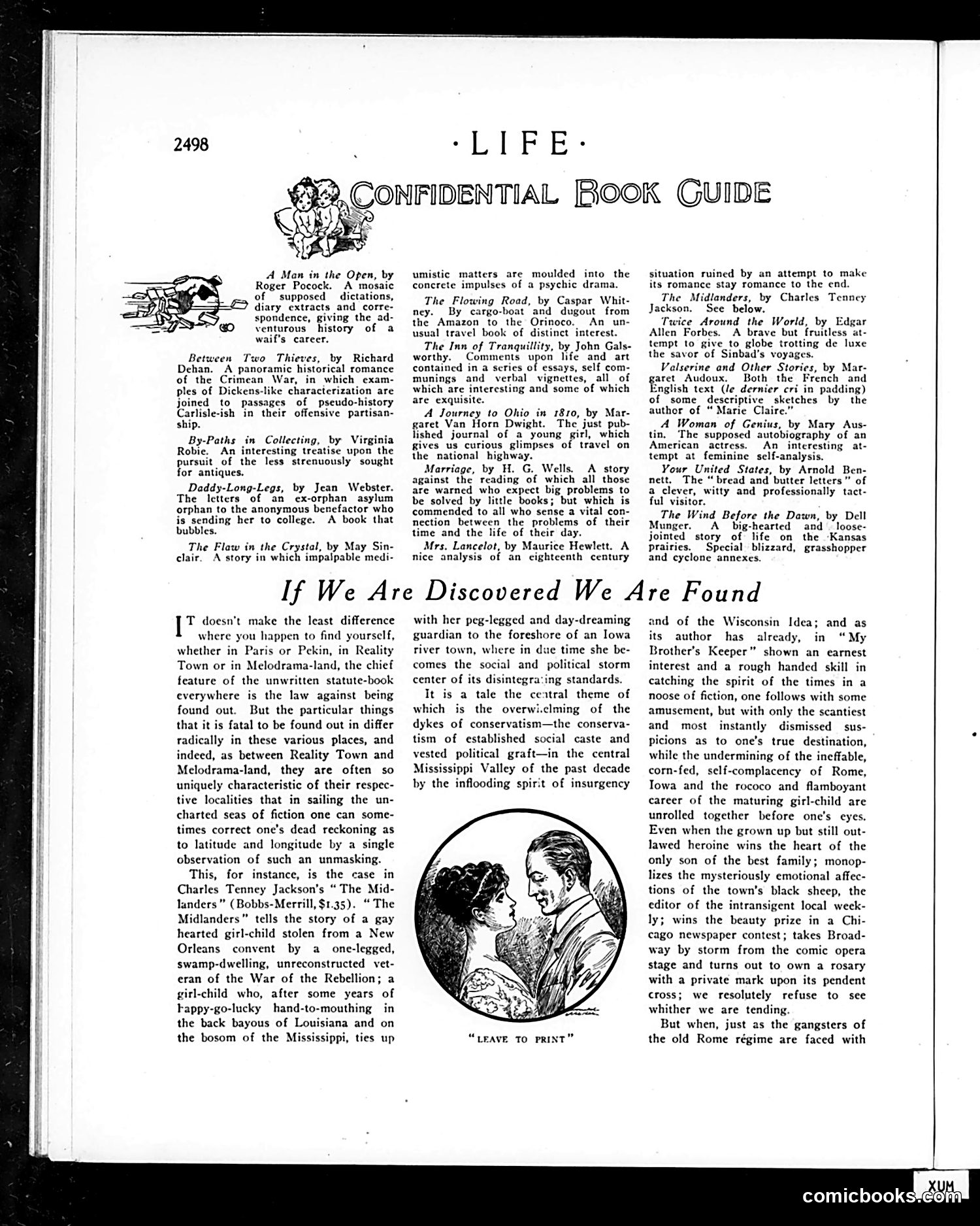
This page is a **book review section** from Life magazine's "Confidential Book Guide," reviewing new publications including works by H.G. Wells, John Galsworthy, and others. The main article, "If We Are Discovered We Are Found," discusses Charles Tenney Jackson's novel *The Midlanders*. Jackson explores how different fictional settings have distinct moral codes—what's scandalous varies between "Reality Town" and "Melodrama-land." The plot involves a girl stolen from a New Orleans convent by a one-legged man during the Civil War era, examining themes of social class, political upheaval, and reputation in the Mississippi Valley. The article suggests the novel explores how established social hierarchies are disrupted by insurgency and changing moral standards. The circular illustration labeled "LEAVE TO PRINT" shows two figures in profile, likely depicting characters from the narrative being discussed.
📄 Transcribed text from this page (OCR, searchable)
Machine-transcribed from the original scan — historical spelling and the odd misread are preserved.
A Man in the Open, by Roger Pocock. A mosaic of supposed dictations, diary extracts and corre- spondence, giving the ad- @ sventurous history of a waif’s career. Between Two Thieves, by Richard Dehan. A panoramic historical romance of the Crimean War, in which exam- ples of Dickens-like characterization are joined to passages of pseudo-history Carlisle-ish in their offensive partisan- ship. By-Paths in Collecting, by Virginia Robie, An interesting treatise upon the pursuit of the less strenuously sought for antiques. Daddy-Long-Legs, by Jean Webster. The Ictters of an ex-orphan asylum orphan to the anonymous benefactor who is sending her to college. A book that bubbles. The Flaw in the Crystal, by May Sin- clair. A story in which impalpable medi- ‘LIFE: umistic matters are moulded into the concrete impulses of a psychic drama. The Flowing Road, by Caspar Whit- ney. By cargo-boat and dugout from the Amazon to the Orinoco. An un- usual travel book of distinct interest. The Inn of Tranquillity, by John Gals- worthy. Comments upon life and art contained in a scrics of essays, self com- munings and verbal vignettes, all of which are interesting and some of which are exquisite. A Journey to Ohio in 1810, by Mar- garet Van Horn Dwight. The just pub- lished journal of a young girl, which gives us curious glimpses of travel on the national highway. Marriage, by H. G. Wells. A story against the reading of which all those are warned who expect big problems to be solved by little books; but which is commended to all who sense a vital con- nection between the problems of their time and the life of their day. Mrs. Lancelot, by Maurice Hewlett. A nice analysis of an cighteenth century CONFIDENTIAL [ROOK GUIDE situation ruined by an attempt to make its romance stay romance to the end. The Midlanders, by Charles Tenney Jackson. See below. Twice Around the World, by Edgar Allen Forbes. A brave but fruitless at- tempt to give to globe trotting de luxe the savor of Sinbad’s voyages. Valserine and Other Stories, by Mar- aret Audoux. Both the French and English text (le dernier cri in padding) of some descriptive sketches by the author of “ Marie Claire.” A Woman of Genius, by Mary Aus- tin, The supposed autobiography of an American acti . An interesting at- tempt at feminine self-analysis. Your United States, by Arnold Ben- nett, The “bread and butter letters” of a clever, witty and professionally tact- ful visitor. The Wind Before the Dawn, by Dell Munger. A big-hearted and _ loose- jointed story of life on the Kansas Prairies. Special blizzard, grasshopper and cyclone annexes. If We Are Discovered We Are Found I" doesn’t make the least difference where you happen to find yourself, whether in Paris or Pekin, in Reality Town or in Melodrama-land, the chief feature of the unwritten statute-book everywhere is the law against being found out. But the particular things that it is fatal to be found out in differ radically in these various places, and indeed, as between Reality Town and Melodrama-land, they are often so uniquely characteristic of their respec- tive localities that in sailing the un- charted seas of fiction one can some- times correct one’s dead reckoning as to latitude and longitude by a single observation of such an unmasking. This, for instance, is the case in Charles Tenney Jackson’s “ The Mid- landers” (Bobbs-Merrill, $1.35). “ The Midlanders” tells the story of a gay hearted girl-child stolen from a New Orleans convent by a_ one-legged, swamp-dwelling, unreconstructed vet- eran of the War of the Rebellion; a girl-child who, after some years of bappy-go-lucky hand-to-mouthing in the back bayous of Louisiana and on the bosom of the Mississippi, ties up with her peg-legged and day-dreaming guardian to the foreshore of an Iowa river town, where in due time she be- comes the social and political storm center of its disintegra:ing standards. It is a tale the ceatral theme of which is the overwi.clming of the dykes of conservatism—the conserva- tism of established social caste and vested political graft—in the central Mississippi Valley of the past decade by the inflooding spirit of insurgency “LEAVE TO PRINT” and of the Wisconsin Idea; and as its author has already, in “My Brother’s Keeper” shown an earnest interest and a rough handed skill in catching the spirit of the times in a noose of fiction, one follows with some amusement, but with only the scantiest and most instantly dismissed sus- picions as to one’s true destination, while the undermining of the ineffable, corn-fed, self-complacency of Rome, Towa and the rococo and flamboyant career of the maturing girl-child are unrolled together before one’s eyes. Even when the grown up but still out- lawed heroine wins the heart of the only son of the best family; monop- lizes the mysteriously emotional affec- tions of the town’s black sheep, the editor of the intransigent local week- ly; wins the beauty prize in a Chi- cago newspaper contest; takes Broad- way by storm from the comic opera stage and turns out to own a rosary with a private mark upon its pendent cross; we resolutely refuse to see whither we are tending. But when, just as the gangsters of the old Rome régime are faced with