
Life, 1912-12-19 · page 18 of 40
Life — December 19, 1912 — page 18: what you’re looking at
What you’re looking at
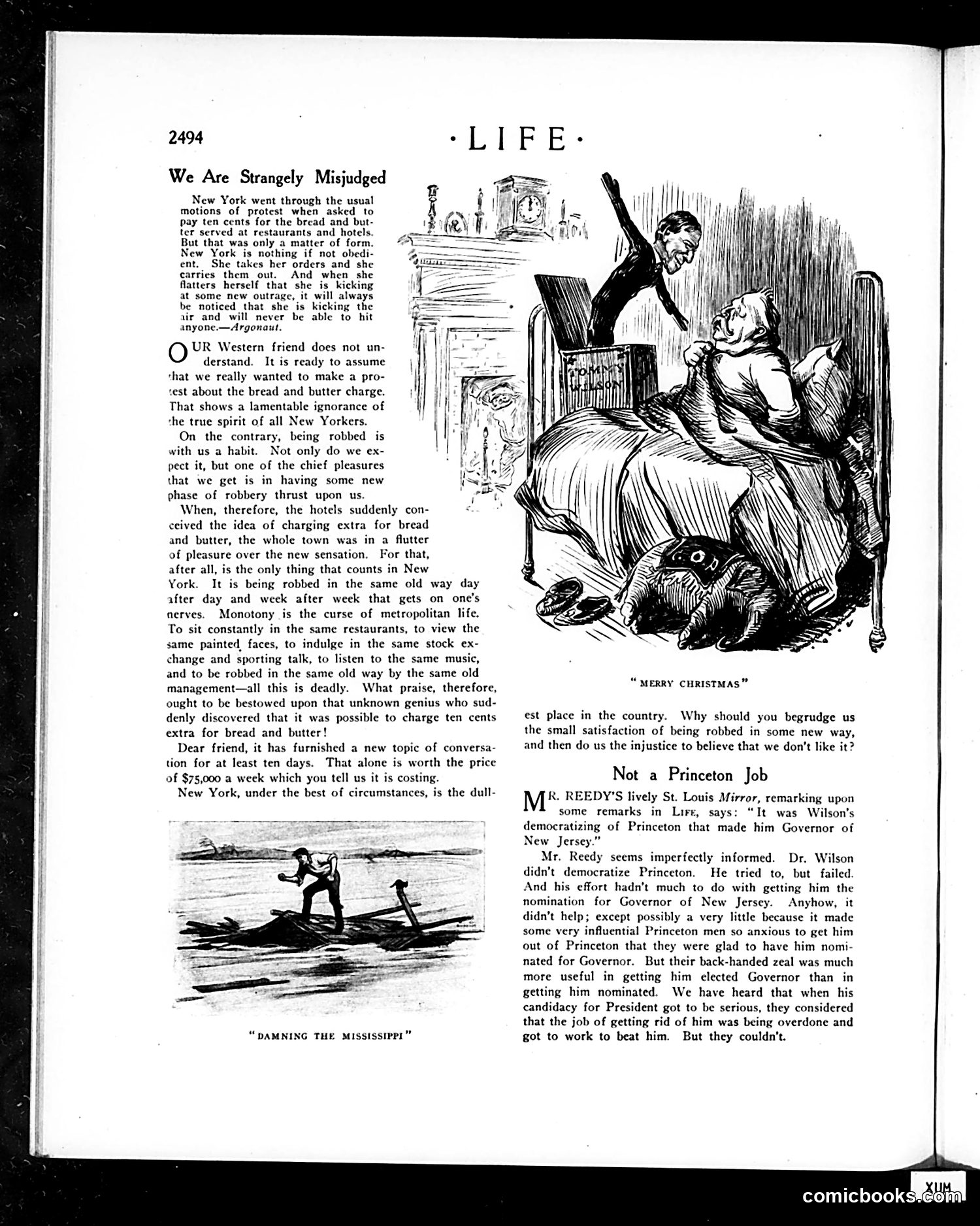
## "We Are Strangely Misjudged" This piece satirizes New Yorkers' acceptance of being exploited. Hotels began charging extra for bread and butter—a routine item previously included—and the city protested only perfunctorily. The satire's point: New Yorkers *enjoy* being robbed because it breaks the monotony of their dull metropolitan existence. Being fleeced in new, creative ways is entertainment. The author mocks this masochistic acceptance, suggesting New Yorkers will protest theatrically but obey anyway, too jaded to genuinely resist. ## The Cartoons **"Merry Christmas"** shows a man playfully whacking a sleeping woman with what appears to be a club or stick—domestic horseplay rendered as slapstick. **"Damning the Mississippi"** depicts a figure struggling against water or terrain, likely illustrating futility or fighting an impossible force. ## "Not a Princeton Job" This section corrects a St. Louis publication's claim that Woodrow Wilson's "democratization" of Princeton led to his New Jersey governorship. Life argues his reform efforts actually failed and played minimal role in his political rise.
📄 Transcribed text from this page (OCR, searchable)
Machine-transcribed from the original scan — historical spelling and the odd misread are preserved.
2494 We Are Strangely Misjudged New York went through the usual motions of protest when asked to pay ten cents for the bread and but- ter served at restaurants and hotels. But that was only a matter of form. New York is nothing if not obedi- ent. She takes her orders and she carries them out. And whi flatters herself tha is kicl at some new outra always, be noticed that she icking the 1ir and will never be able to hit anyone.—Argonaut. UR Western friend does not un- derstand. It is ready to assume that we really wanted to make a pro- test about the bread and butter charge. That shows a lamentable ignorance of the true spirit of all New Yorkers. On the contrary, being robbed is with us a habit. Not only do we ex- pect it, but one of the chief pleasures that we get is in having some new phase of robbery thrust upon us. When, therefore, the hotels suddenly con- ceived the idea of charging extra for bread and butter, the whole town was in a flutter of pleasure over the new sensation. For that, after all, is the only thing that counts in New York. It is being robbed in the same old way day after day and week after week that gets on one’s nerves. Monotony is the curse of metropolitan life. To sit constantly in the same restaurants, to view the same painted, faces, to indulge in the same stock ex- change and sporting talk, to listen to the same music, and to be robbed in the same old way by the same old management—all this is deadly. What praise, therefore, ought to be bestowed upon that unknown genius who sud- denly discovered that it was possible to charge ten cents extra for bread and butter! Dear friend, it has furnished a new topic of conversa- tion for at least ten days. That alone is worth the price of $75,000 a week which you tell us it is costing. New York, under the best of circumstances, is the dull- “DAMNING THE MISSISSIPPI” “MERRY CHRISTMAS” est place in the country. Why should you begrudge us the small satisfaction of being robbed in some new way, and then do us the injustice to believe that we don’t like it? Not a Princeton Job M* REEDY'S lively St. Louis Mirror, remarking upon some remarks in Lire, says: “It was Wilson’s democratizing of Princeton that made him Governor of New Jerse: Mr. Reedy seems imperfectly informed. Dr. Wilson didn’t democratize Princeton. He tried to, but failed And his effort hadn't much to do with getting him the nomination for Governor of New Jersey. Anyhow, it didn’t help; except possibly a very little because it made some very influential Princeton men so anxious to get him out of Princeton that they were glad to have him nomi- nated for Governor. But their back-handed zeal was much more useful in getting him elected Governor than in getting him nominated. We have heard that when his candidacy for President got to be serious, they considered that the job of getting rid of him was being overdone and got to work to beat him. But they couldn't.