
A complete issue · 56 pages · 1912
Life — October 3, 1912
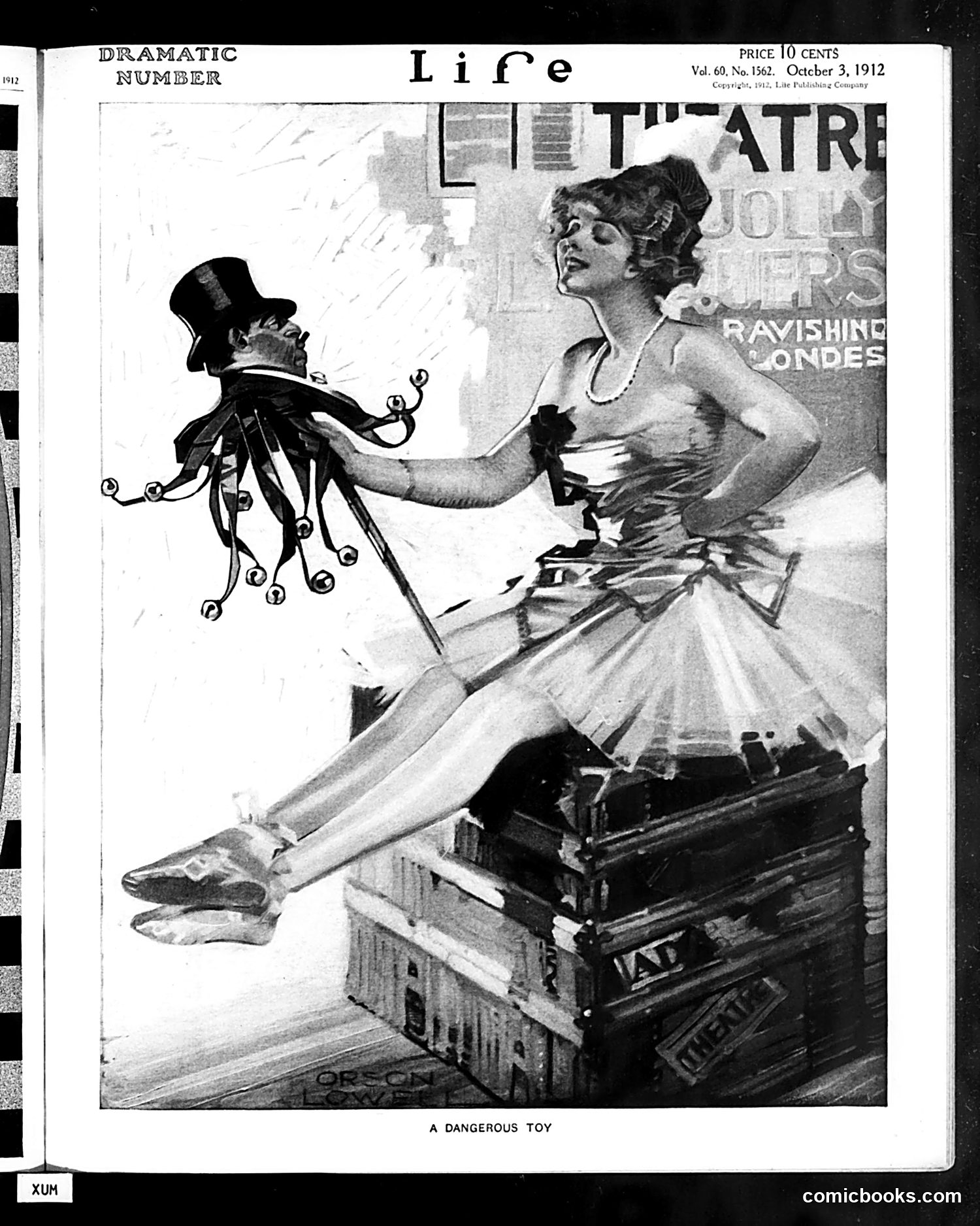
This satirical illustration depicts a woman in theatrical costume holding an octopus-like creature wearing a top hat. The octopus represents a "dangerous toy"—likely political corruption, unchecked political power, or a controversial political figure of 1912. The woman's control over it appears precarious and playful rather than secure, suggesting that those in power (represented by the fashionable woman) are toying dangerously with forces they don't fully understand or control. The 1912 context—a major U.S. presidential election year—suggests this may reference political instability, foreign entanglements, or a specific controversial policy or politician. The theatrical setting and the woman's confident-yet-uncertain pose satirize the era's political hubris or recklessness with serious matters of state.
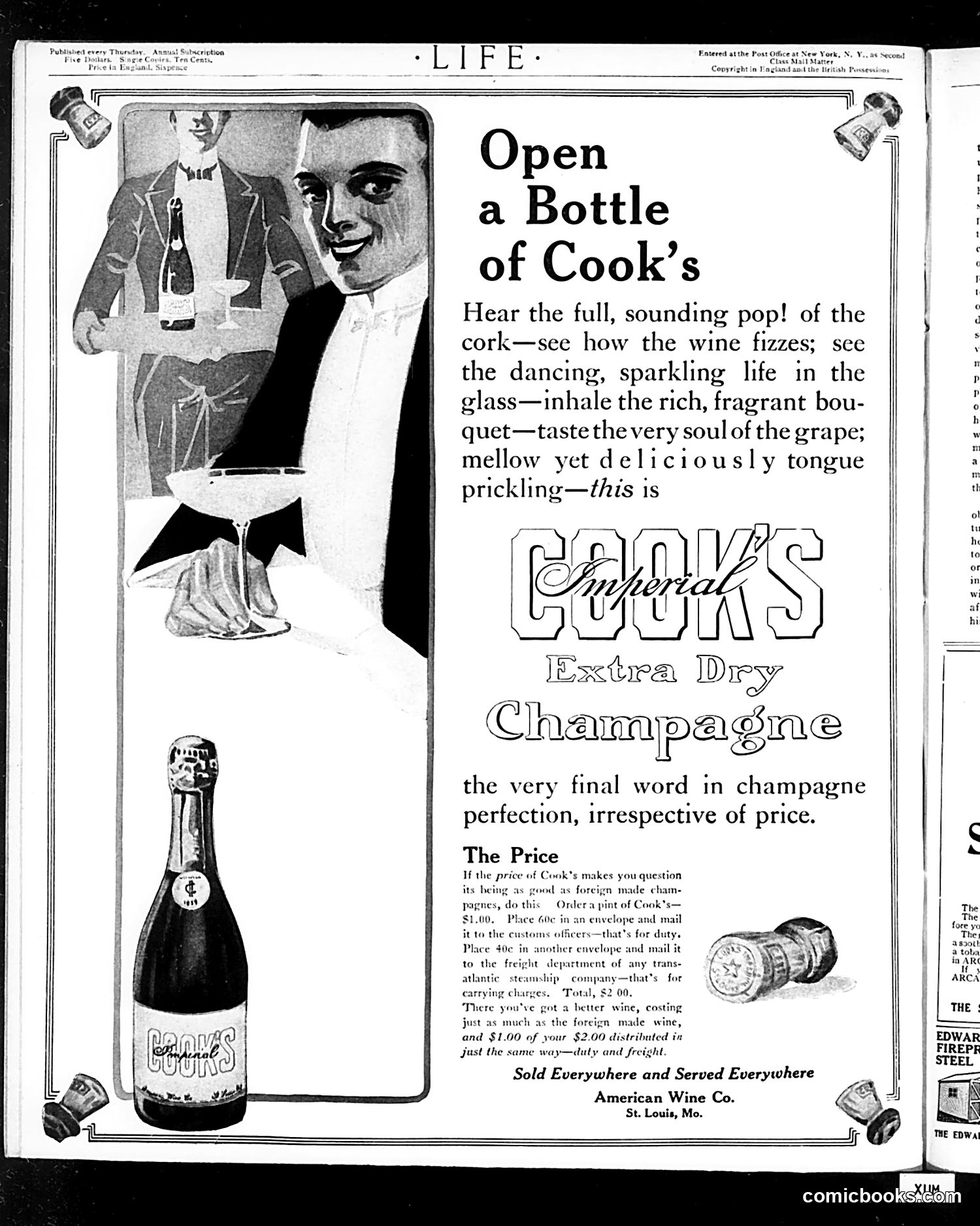
This is primarily a **product advertisement**, not political satire. The page promotes Cook's Extra Dry Champagne from the American Wine Co. (St. Louis, Missouri). The imagery depicts a formally-dressed waiter or sommelier presenting an opened bottle, emphasizing the theatrical sensory experience of champagne consumption—the "pop" of the cork, fizz, aroma, and taste. The ad appeals to aspirational consumers by positioning Cook's as comparable to expensive foreign champagnes while costing significantly less ($2.00 total with duty and freight versus $1.00 profit margin). The copy uses luxurious language ("dancing, sparkling life," "fragrant bouquet") to market an American product during what appears to be the pre-Prohibition era. This represents typical early 20th-century American advertising strategy: democratic pricing paired with elite product positioning.
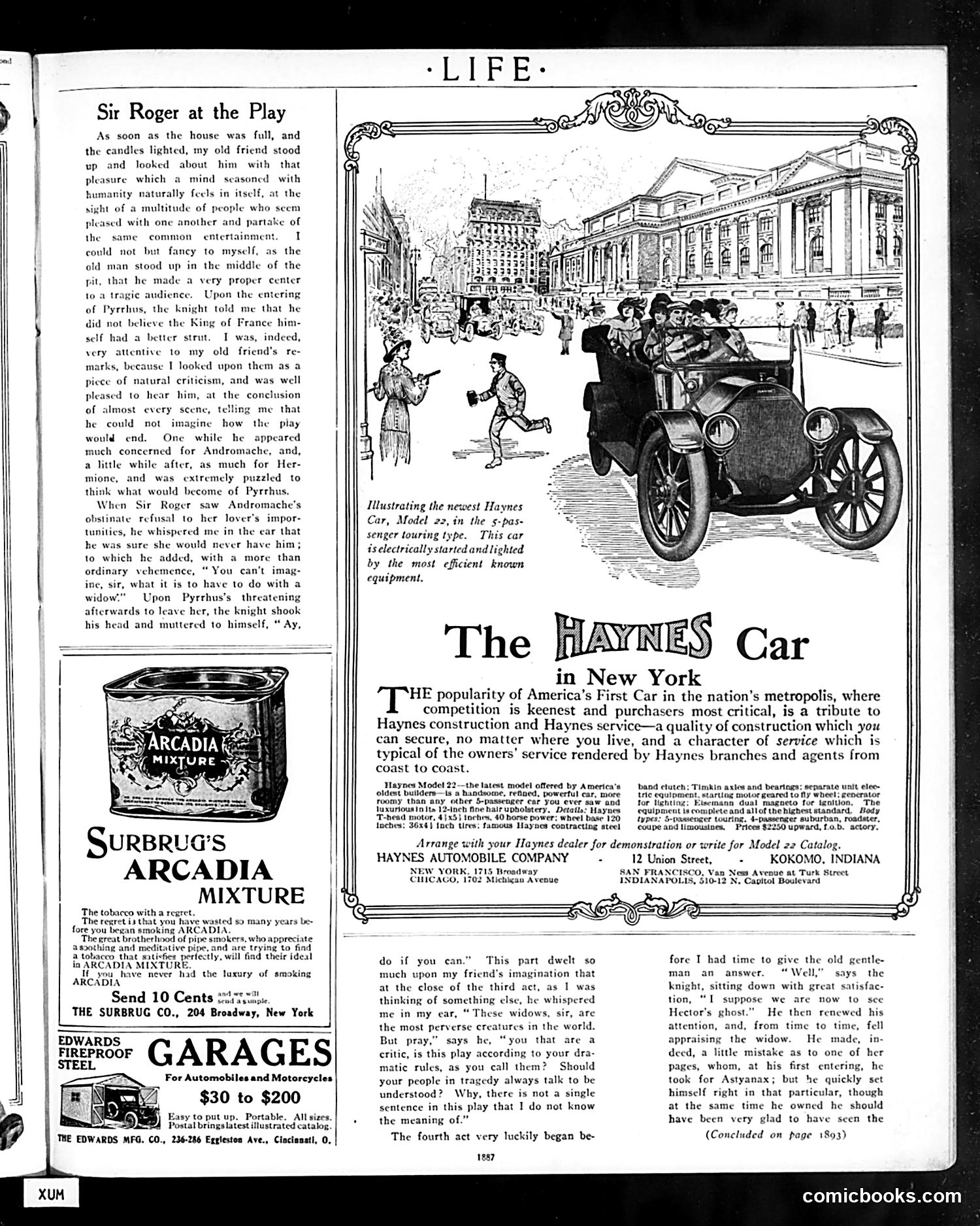
This page is primarily **advertising rather than political satire**. The main content consists of three advertisements: 1. **Haynes Automobile** (center): Promotes the Model 22 car, emphasizing quality construction and reliable dealer service across America. 2. **Surburg's Arcadia Mixture** (left): A tobacco product advertisement targeting pipe smokers. 3. **Edwards Fireproof Steel Garages** (bottom left): Offers automobile storage structures. The "Sir Roger at the Play" article (top left) is a literary piece discussing theater etiquette, not political commentary. While *Life* magazine was known for satire, **this particular page contains no political cartoons or social satire**—it's a commercial publication page from the early automotive era, reflecting 1910s-1920s consumer culture.
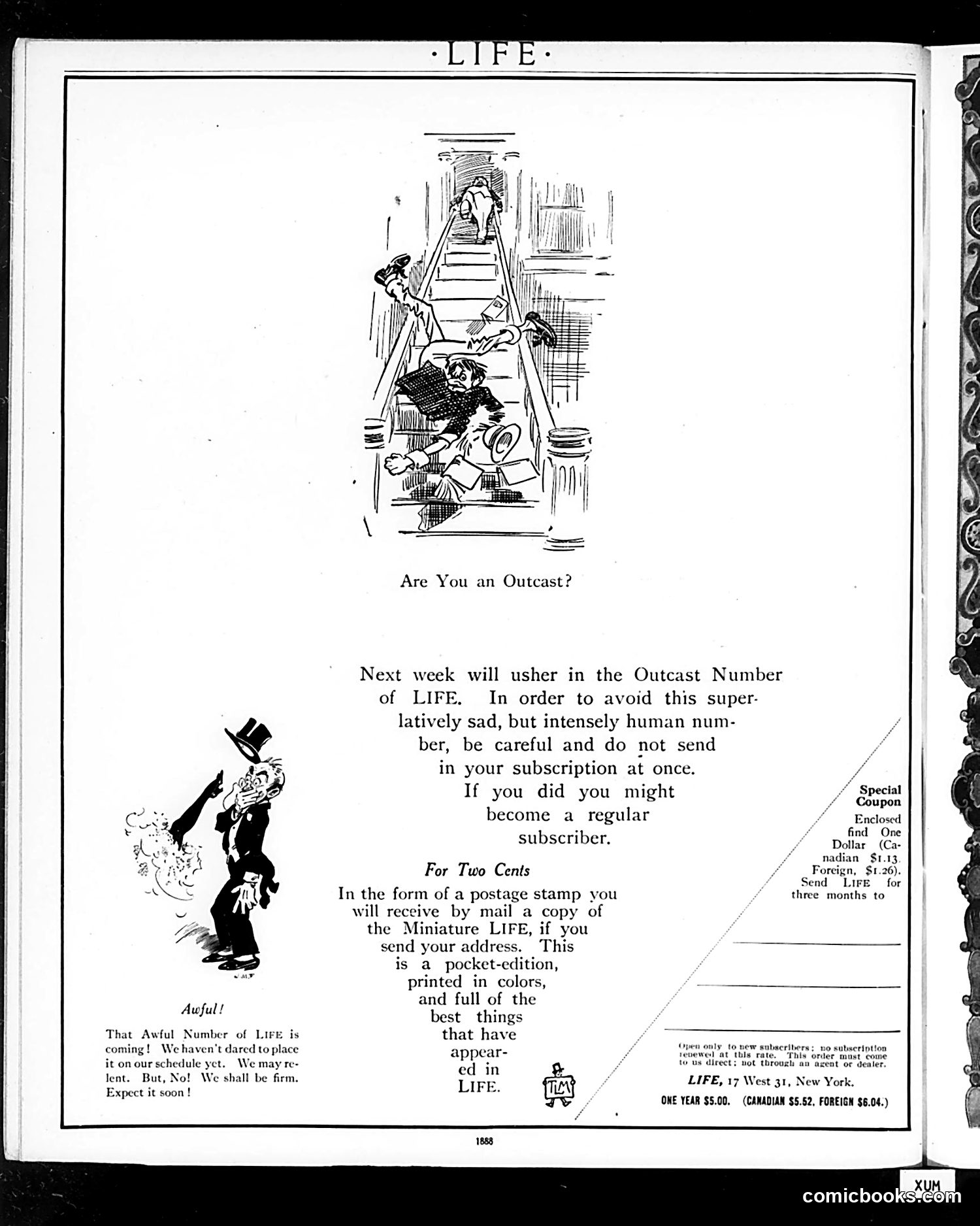
This page is primarily **promotional material** for Life magazine's upcoming "Outcast Number." The top cartoon depicts figures descending a staircase, illustrating the title question "Are You an Outcast?" The left side features a caricatured figure labeled "Awful!"—a character in formal dress appearing distressed, with text warning that an "Awful Number" is coming and promising the magazine will "be firm" about placing it on schedule. The bulk of the page advertises a miniature pocket edition of Life available for two cents (postage stamp), described as printed in colors with "best things that have appeared in LIFE." The satire appears to playfully mock social outcasts while using that theme to promote subscriptions. The "awful" characterization seems tongue-in-cheek rather than genuinely insulting—typical of Life's humorous approach to selling issues to readers.
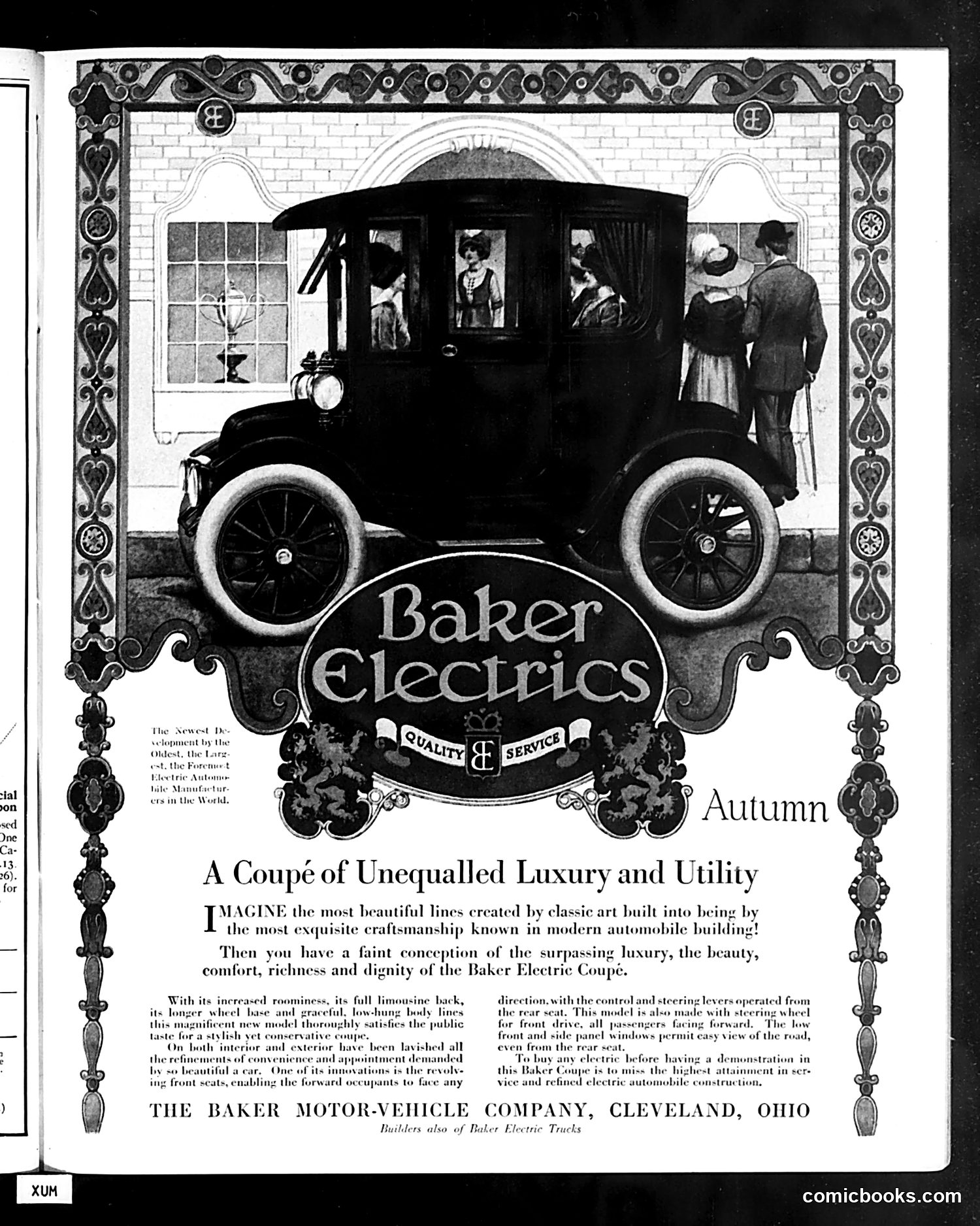
This page is **primarily an advertisement**, not satirical content. It showcases the Baker Electric automobile, a luxury coupe marketed as offering "Unequalled Luxury and Utility." The ad features an illustration of an early electric car (appearing to be from around 1910s) parked outside a brick building, with well-dressed figures nearby. The Baker Motor-Vehicle Company of Cleveland, Ohio emphasizes the car's elegant craftsmanship, full limousine back, extended wheelbase, and steering controls operable from the rear seat. There is **no political satire or cartoon** on this page. The ornamental borders and period typography are simply standard design conventions for automobile advertisements of this era. This represents ordinary commercial advertising from Life magazine's early 20th-century print context.
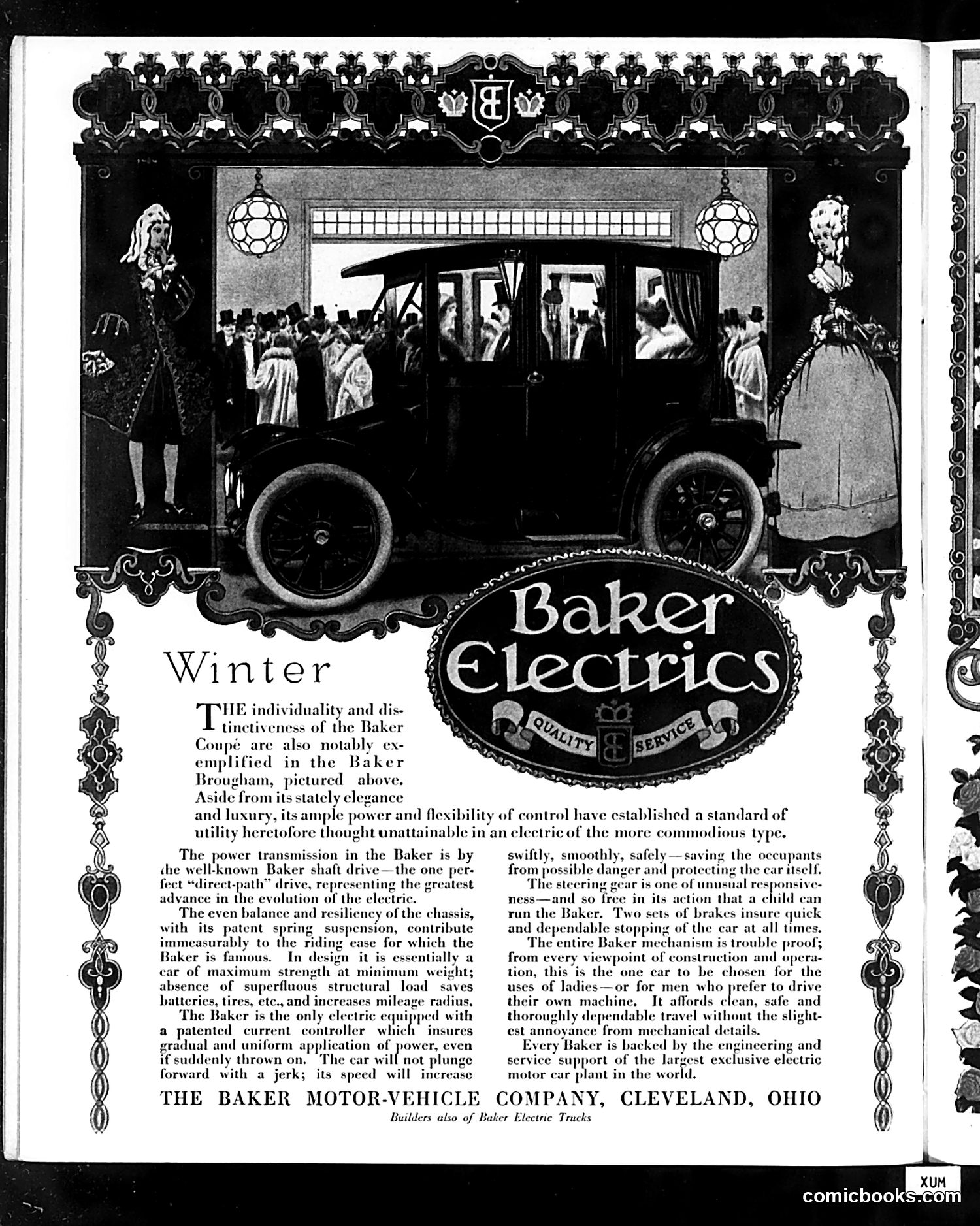
This is primarily a **commercial advertisement**, not satire or political commentary. It promotes the Baker Coupe, an early electric automobile manufactured by The Baker Motor-Vehicle Company of Cleveland, Ohio. The decorative border and elegant illustration of well-dressed figures (appearing to represent wealthy patrons) reflect the **luxury market** this vehicle targeted. The text emphasizes the Baker's advantages: smooth power transmission via "shaft drive," responsive steering, reliable braking, and safety features—appeals to affluent buyers, particularly women drivers. The "Winter" heading suggests seasonal marketing. This represents the **early 1900s electric vehicle industry**, before gasoline engines dominated. Electric cars were considered sophisticated, quiet, and suitable for urban society.
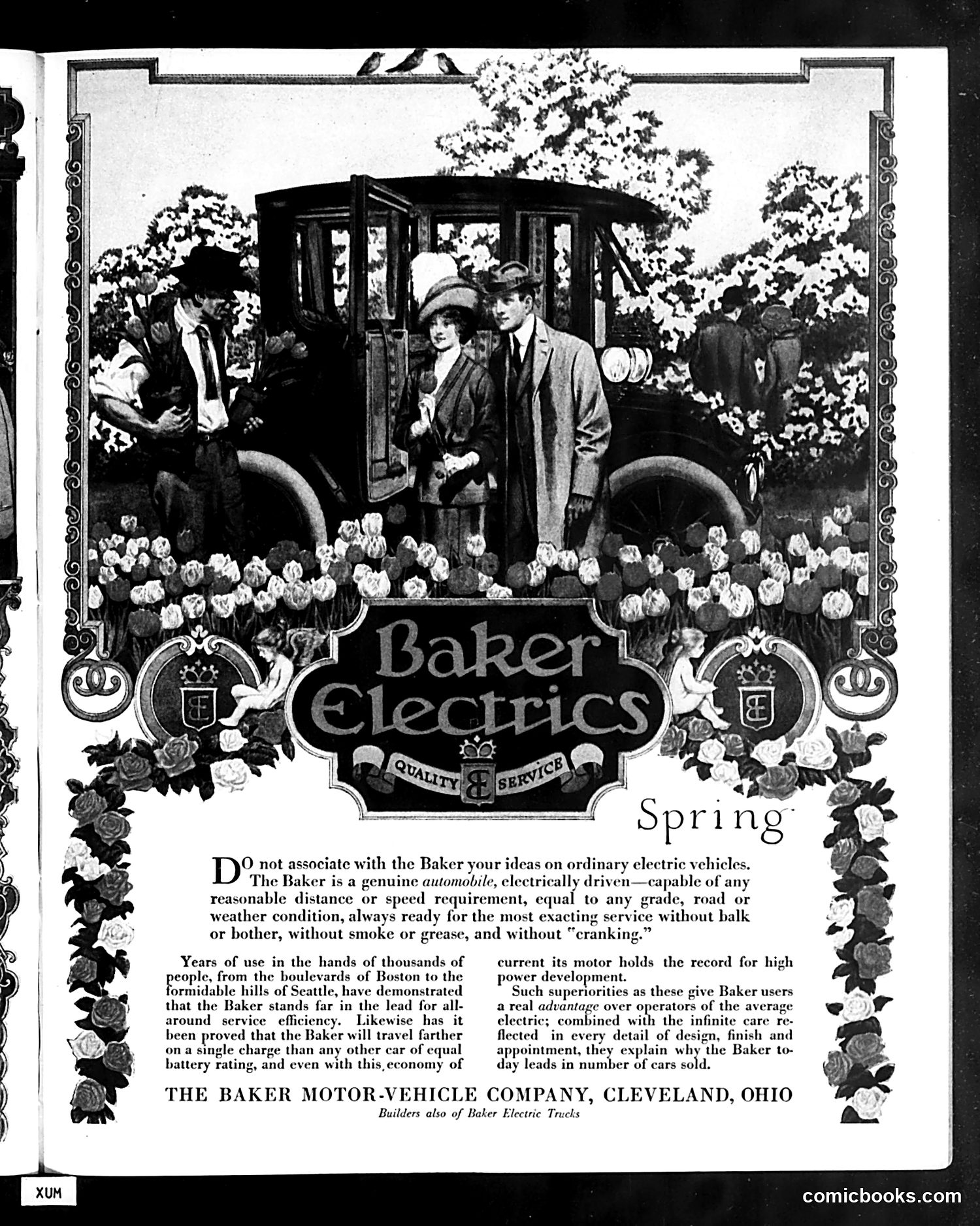
This is primarily a **product advertisement**, not political satire. It promotes the Baker Motor-Vehicle Company's electric automobiles, based in Cleveland, Ohio. The image shows well-dressed passengers boarding or exiting an electric car surrounded by spring flowers, depicting the vehicle as elegant and suitable for leisure drives. The advertisement emphasizes Baker's competitive advantages: electric vehicles required no "cranking" (unlike gasoline cars), produced no smoke or grease, and performed reliably across various conditions. The text challenges potential customers not to underestimate Baker's capabilities simply because they're electric vehicles. It claims Baker cars have superior range, speed, and battery performance compared to competing models, and that their design quality and reliability explain their sales success. This reflects the early 1900s moment when electric vehicles were serious competitors to gasoline cars before gasoline eventually dominated.
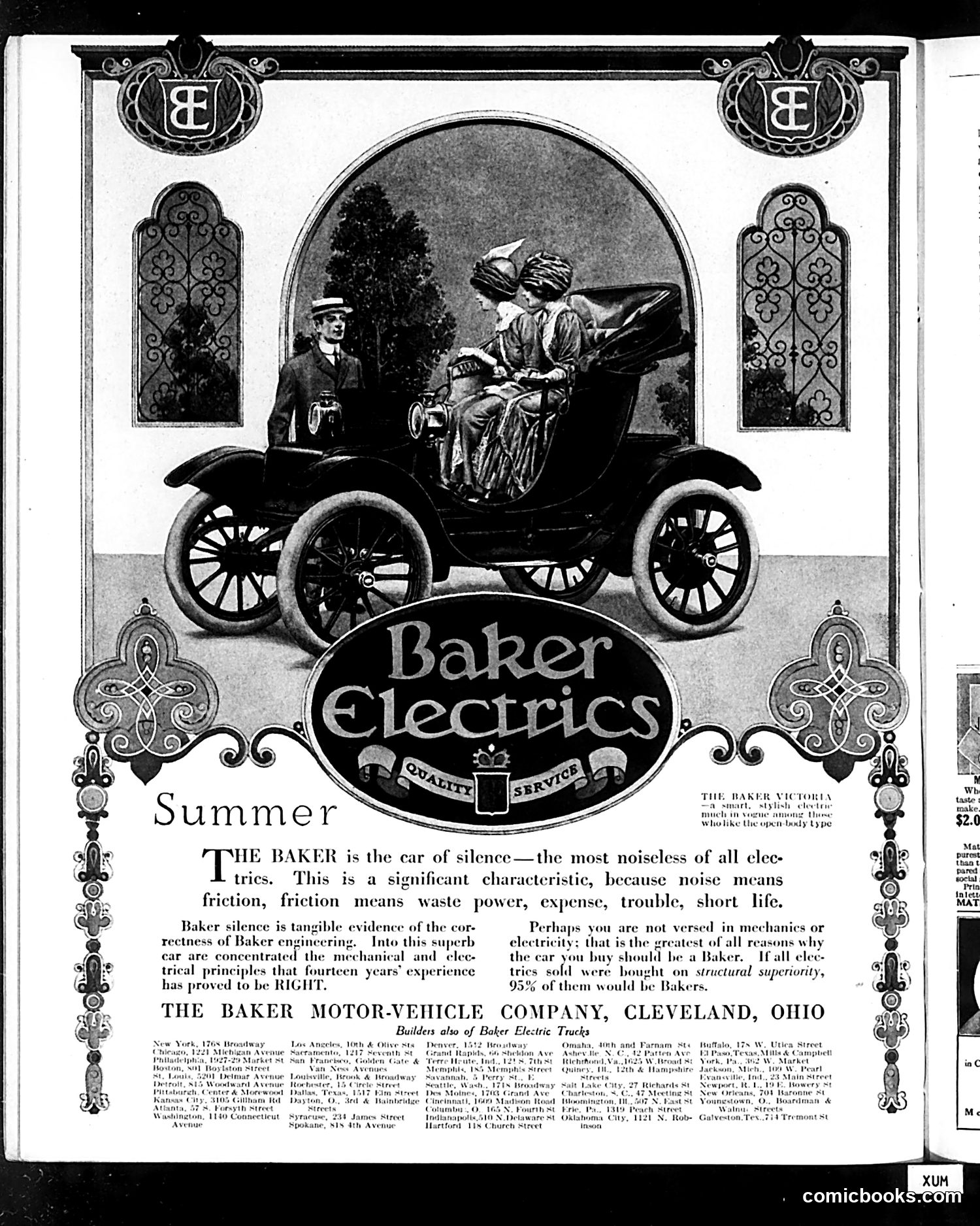
This is primarily a **product advertisement**, not satire or political commentary. It promotes the Baker Motor-Vehicle Company's electric automobiles, headquartered in Cleveland, Ohio. The illustration shows a well-dressed couple in an early electric car, with a uniformed chauffeur or attendant standing beside it. The ad emphasizes that Baker electrics are "the car of silence—the noiseless of all electrics," contrasting them favorably with noisy gasoline-powered vehicles of the era. The text argues that silence indicates mechanical efficiency and lower operating costs. It targets affluent consumers, particularly women, suggesting electrics are the superior choice if "all electrics sold were bought on structural superiority, 95% of them would be Bakers." This reflects the early 1900s competition between electric and gasoline vehicles before gas engines became dominant.
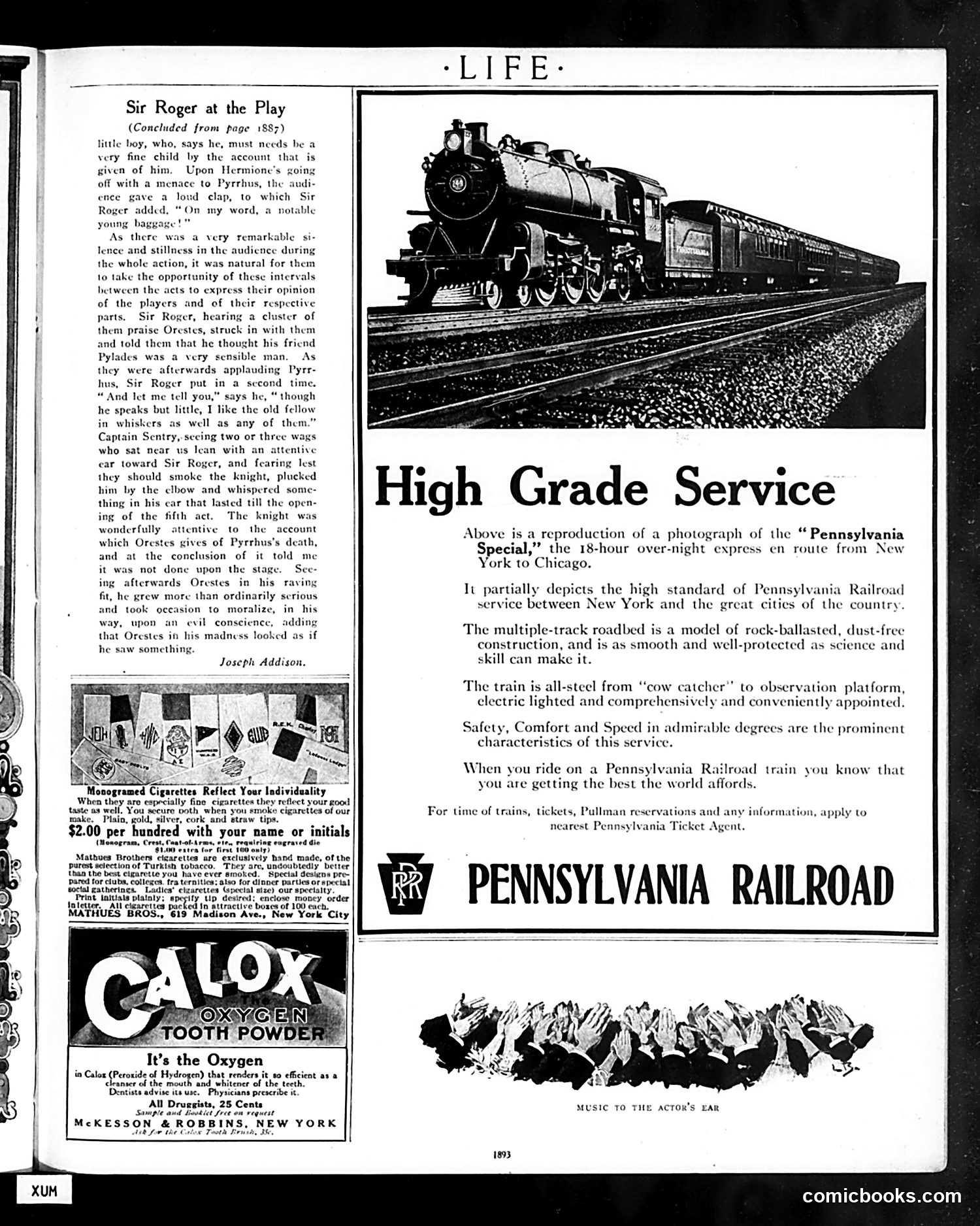
This page is primarily **advertising and entertainment content** rather than political satire. The left column contains "Sir Roger at the Play" (continued from page 1882), a theatrical commentary piece by Joseph Addison about audience behavior during a performance of Pyrrhus's death scene. It's a literary/cultural observation about how spectators react to dramatic moments on stage. Below that is an advertisement for **Calox Oxygen Tooth Powder**, emphasizing its cleaning and whitening properties. The dominant right side features a **Pennsylvania Railroad advertisement** for the "Pennsylvania Special," showcasing their 18-hour overnight express train from New York to Chicago. It emphasizes "High Grade Service" with modern amenities like electric lighting and smooth, dust-free construction. This is a typical early-20th-century magazine page mixing literature, ads, and travel promotions—not satirical content.

This is primarily a **commercial advertisement** for Kelly-Springfield Automobile Tires, not political satire or editorial content. The ad occupies most of the page. The image shows a woman in early 1900s dress sitting inside a large tire, with an automobile full of passengers visible above. The accompanying text contrasts buying generic tires (where you "pay for materials and hope for service") with Kelly-Springfield tires, which allegedly offer superior rubber composition backed by "seventeen years of tire-making experience." The woman-in-tire visual is simply a product showcase designed to highlight the tire itself as the focal point. There is **no satire or political message**—this is straightforward brand marketing emphasizing quality and reliability to early automotive consumers.
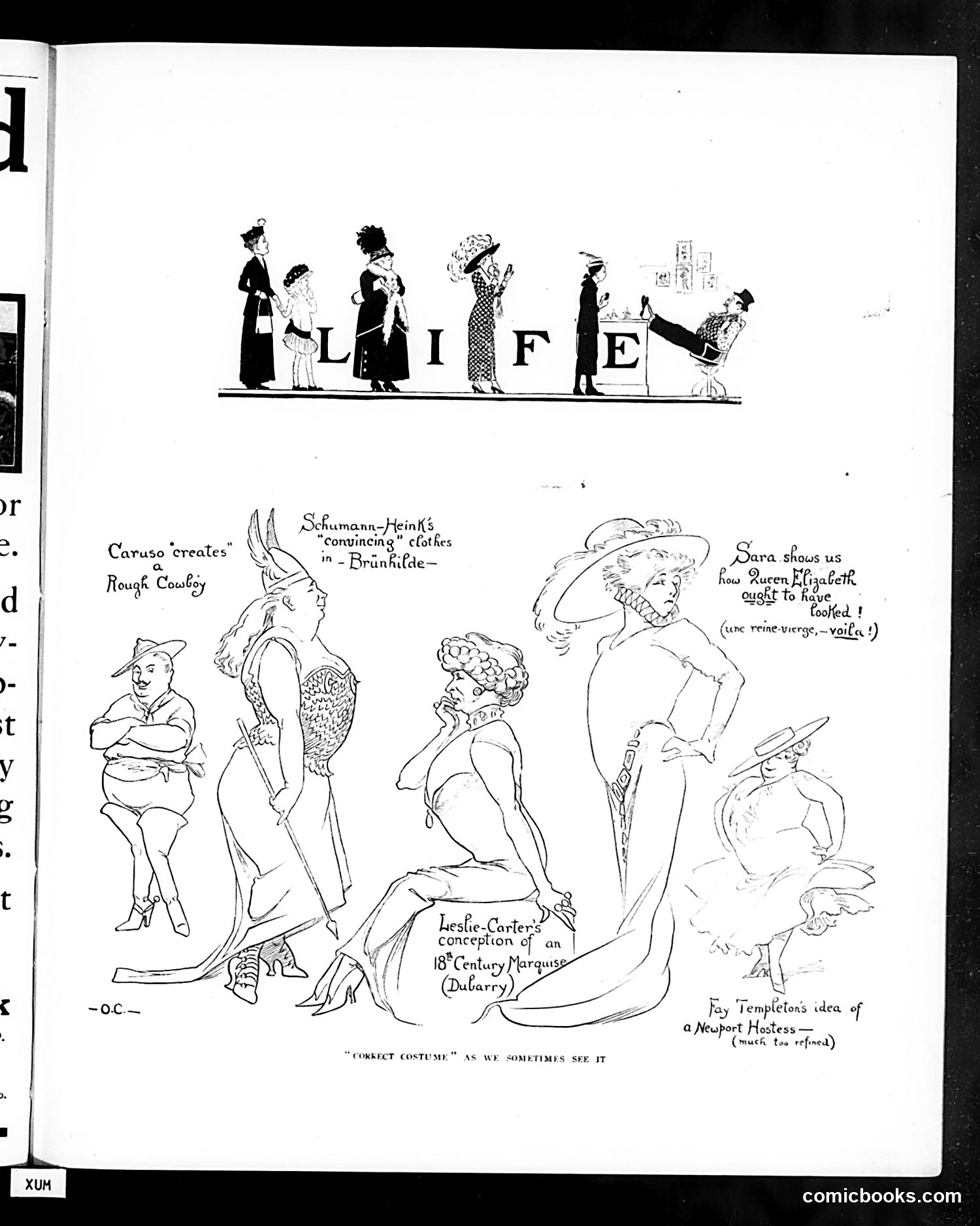
This page satirizes theatrical costume design through caricatured "incorrect" interpretations of famous operatic and dramatic roles. The top shows the word "LIFE" formed by figures in various theatrical costumes, establishing the theme. Below are four labeled sketches mocking exaggerated or absurd costume choices: 1. **Caruso creates a Rough Cowboy** - the famous tenor apparently dressed inappropriately for his role 2. **Schumann-Heink's "convincing" clothes in Brünnhilde** - suggesting oversized or unflattering costume choices 3. **Leslie-Carter's conception of an 18th Century Marquise (Dubarry)** - depicted with exaggerated proportions 4. **Fay Templeton's idea of a Newport Hostess** - marked "(much too refused)," implying the costume was rejected as improper The satire targets theatrical performers who prioritize spectacle or personal style over historical or character accuracy in costuming.
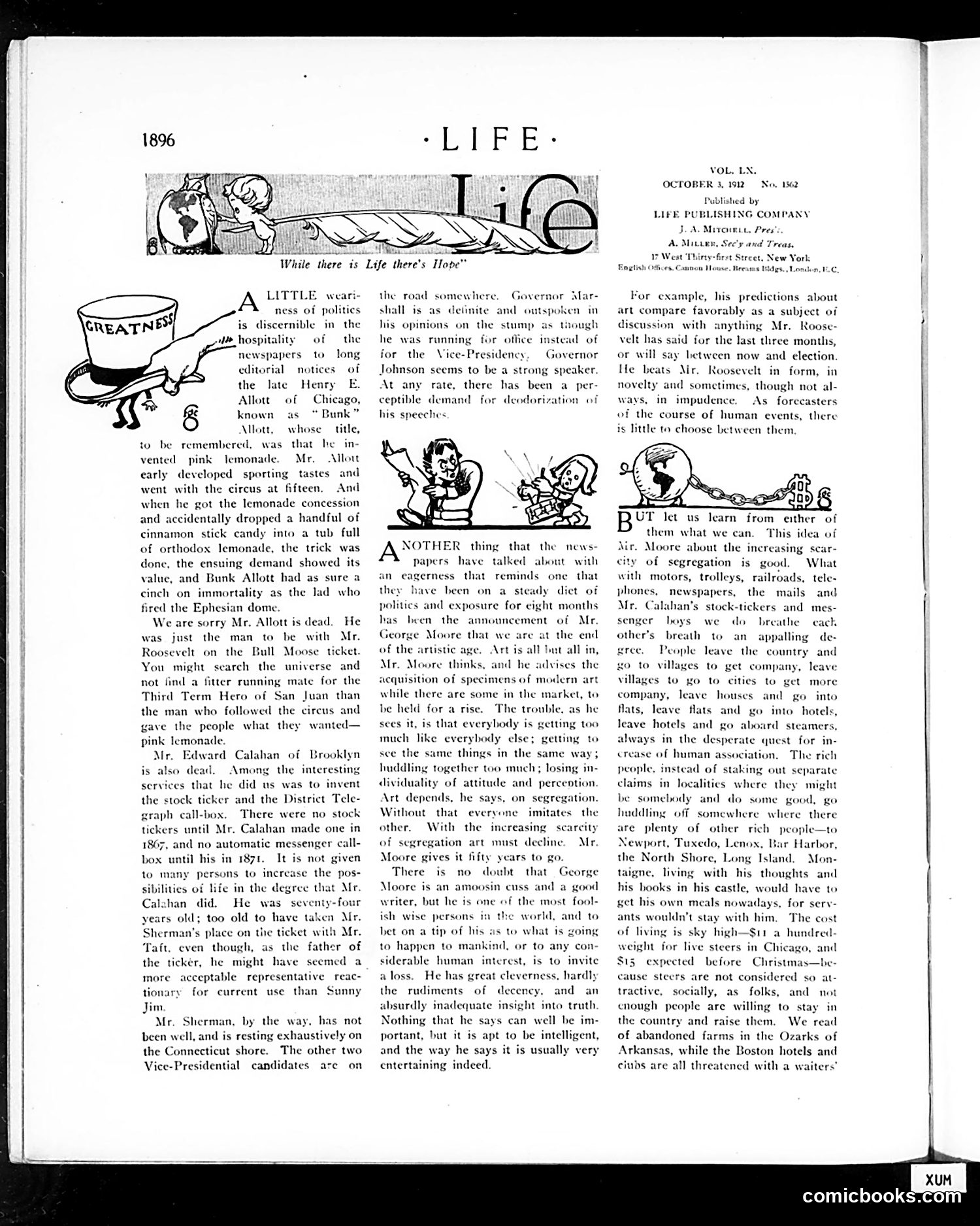
This page contains editorial commentary on contemporary politics and personalities, not political cartoons per se. The illustrations are decorative rather than satirical caricatures. The text discusses Mr. Allott of Chicago, known for "pink lemonade" and circus connections, who has died. It notes Edward Calahan's death, credited with inventing the stock ticker and pneumatic messenger call-box. The main commentary concerns **George Moore** and art segregation—Moore apparently advocates for separating modern art acquisitions by location or type. The writer disagrees, arguing segregation in art, like in society (referencing phones, newspapers, mail services), proves unnecessary and undesirable. The piece criticizes excessive urbanization and suggests rural life's appeal, mentioning abandoned Ozark farms and Boston hotels' water-related issues.
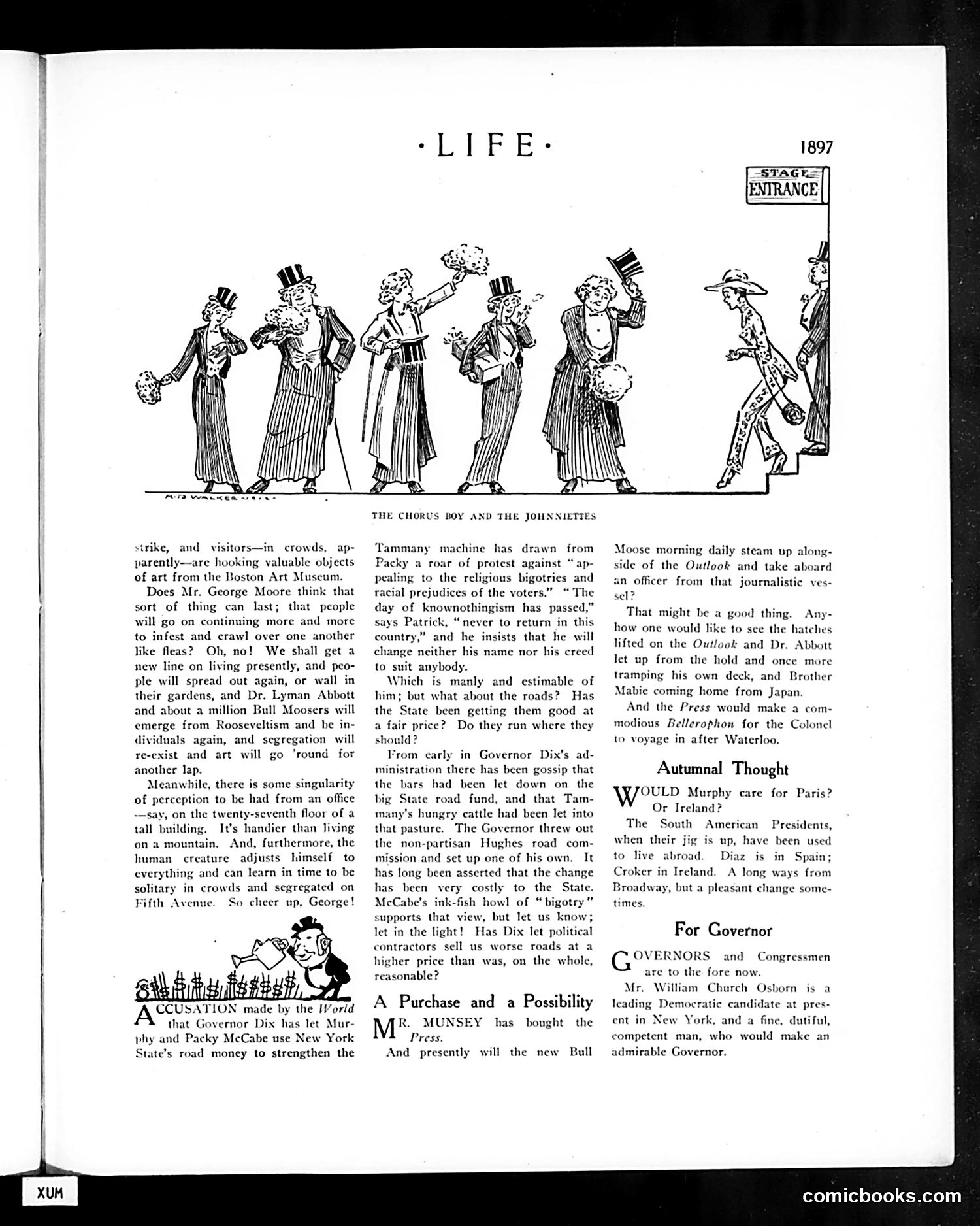
This illustration satirizes the theatrical world of 1890s New York. The drawing shows a line of women in elaborate period dress holding flowers and flags, labeled "Johnettes"—likely chorus girls or performers associated with a popular theatrical production or venue. The central male figure in top hat represents the "chorus boy," depicted in caricatured style typical of Life magazine's satirical approach. The cartoon appears to mock theatrical conventions and the social dynamics of stage performers of the era. The exaggerated costumes and poses suggest satire of both the pretensions of theatrical entertainment and perhaps the status-seeking or vanity of performers themselves—common targets of late-Victorian American humor magazines.
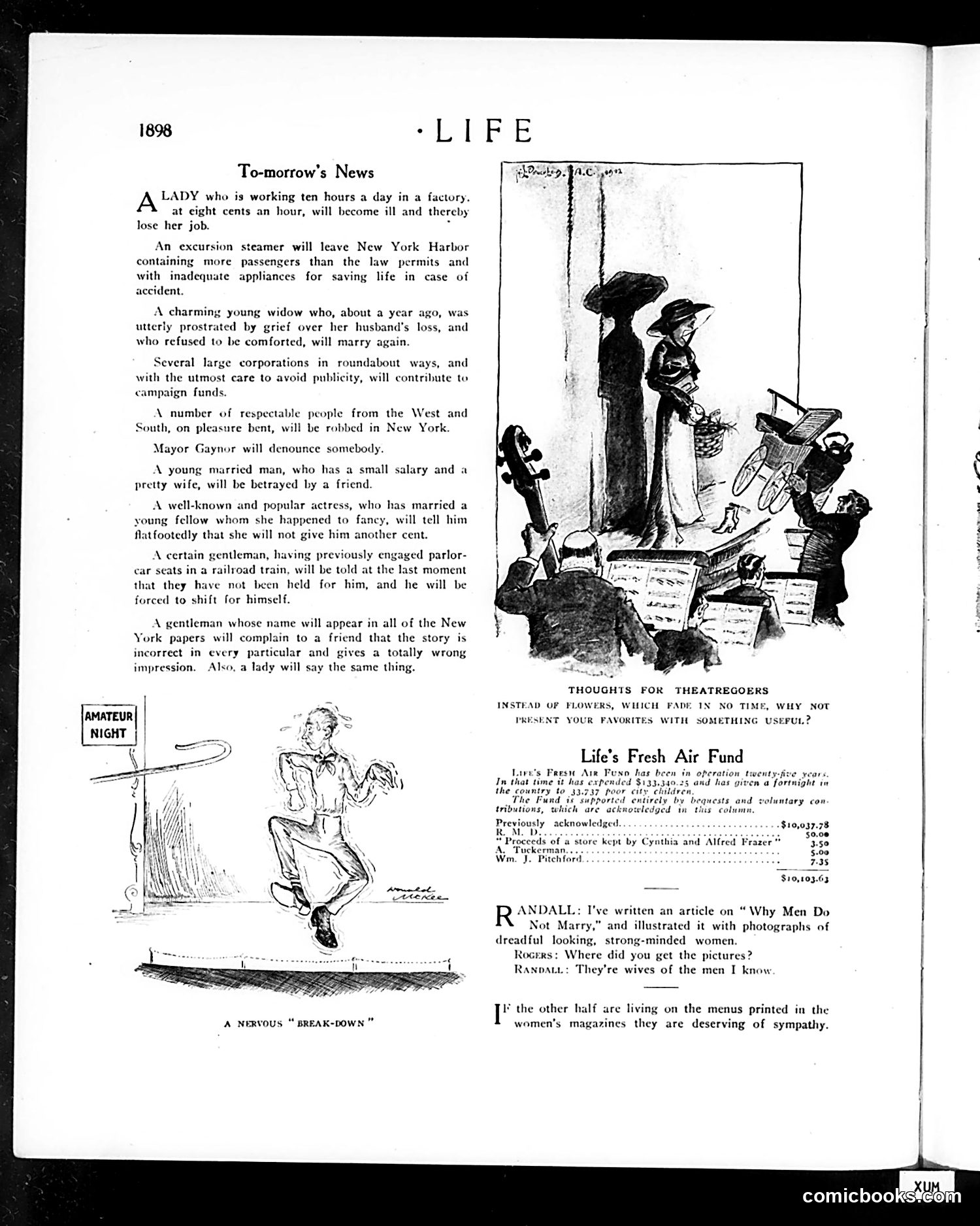
This page contains satirical predictions ("To-morrow's News") mocking various social issues of the era, including factory labor conditions, maritime safety, and marital infidelity. The main cartoon titled "Thoughts for Theatregoers" depicts well-dressed patrons at what appears to be a theater entrance, with the caption suggesting they bring useful gifts instead of flowers—a jab at theater culture and perhaps gender expectations around courtship rituals. Below is a sketch labeled "A Nervous 'Break-Down'" showing a man in distress on what appears to be a diving board or platform, satirizing anxiety or nervous conditions—likely reflecting late-Victorian concerns about modern stress. The "Amateur Night" cartoon shows a performer struggling with an instrument, mocking amateur theatrical performances. Overall, the page uses humor to critique contemporary social customs, gender relations, labor practices, and urban life in 1898 America.
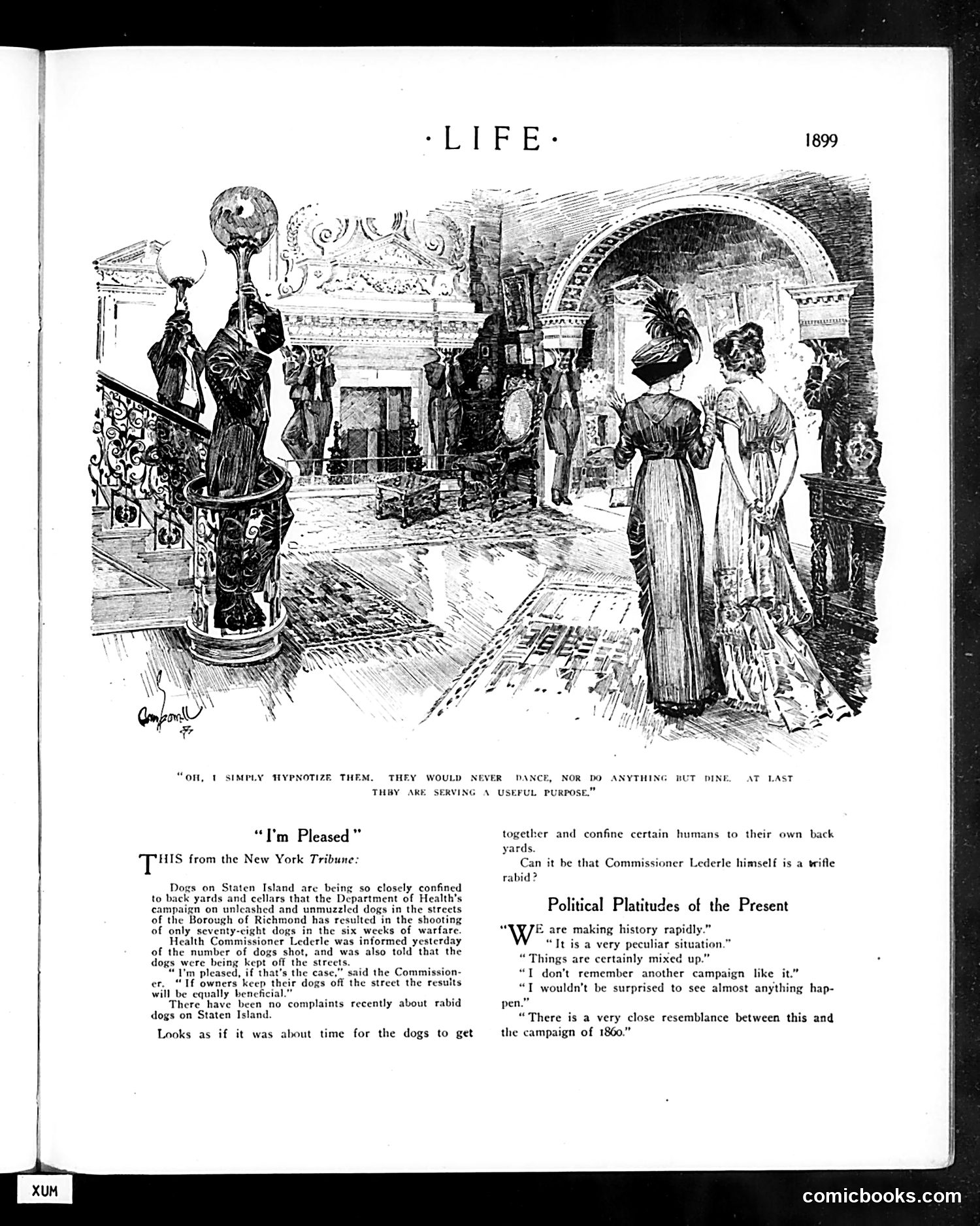
The main cartoon depicts an elegant interior where well-dressed figures appear to be at a social gathering. The caption suggests someone proposes "hypnotizing" people to make them docile—forcing them to merely "dine" rather than dance or act independently, thus serving a "useful purpose." The satire targets upper-class attempts to control and pacify the working classes or political opponents. The irony is sharp: the speaker treats human subjugation as practical social management, as if people were problems to be managed like the Staten Island dog problem discussed in the adjacent text. Below, "Political Platitudes of the Present" mocks politicians' vague, recycled rhetoric about "making history" and current events being unprecedented, while simultaneously comparing present circumstances to the Civil War era (1860). The satire suggests politicians speak in empty clichés without substantive analysis. Together, these pieces critique both elite paternalism and political dishonesty of the period.
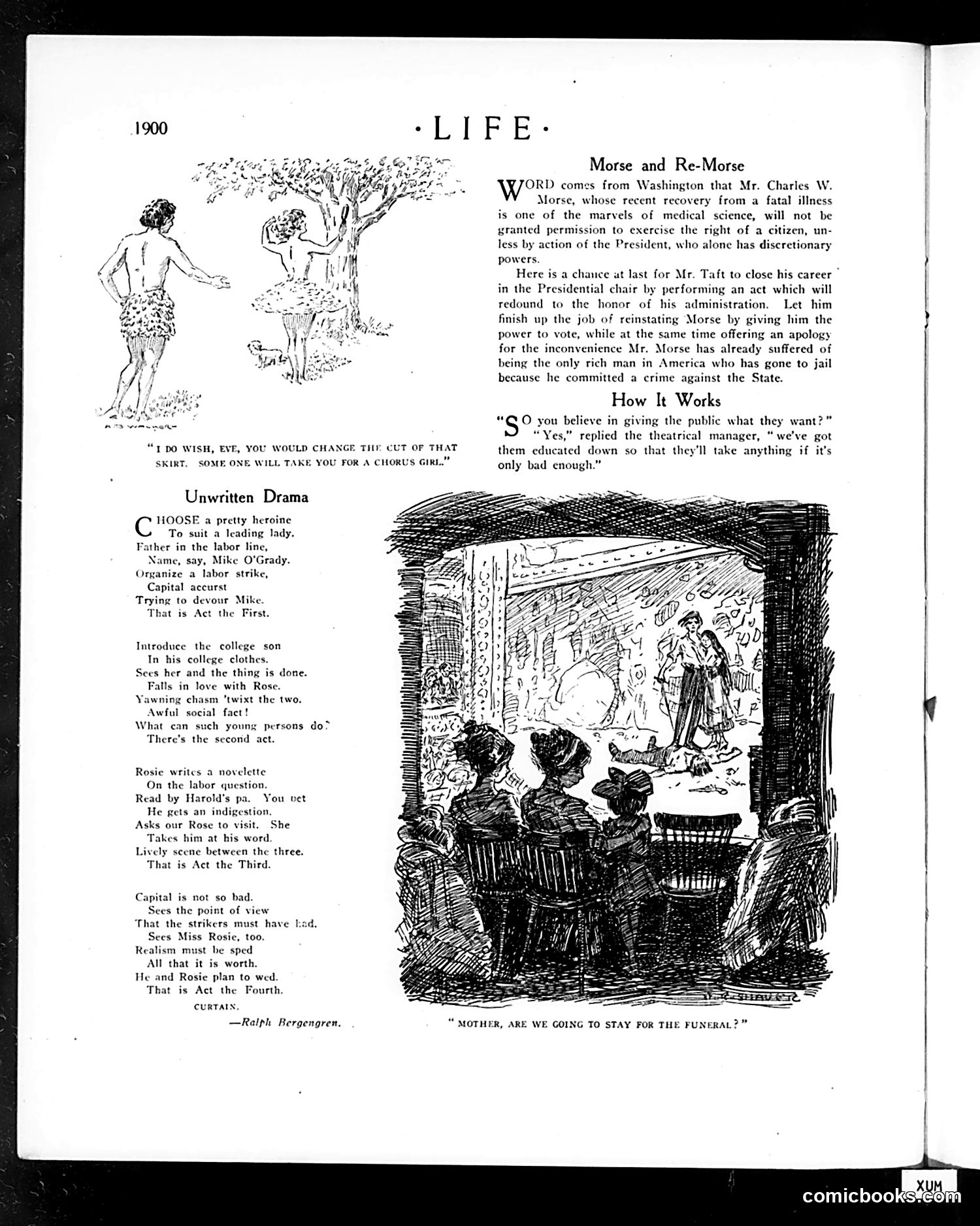
This page contains satirical commentary on two distinct topics: **"Morse and Re-Morse"** attacks Charles W. Morse, a wealthy businessman recently recovered from illness and imprisoned for financial crimes against the state. The article sarcastically suggests President Taft could "honor his administration" by pardoning Morse and restoring his voting rights—mocking both Morse's privileged status (being "the only rich man in America who has gone to jail") and the expectation that powerful figures receive special clemency. **"Unwritten Drama"** presents a four-act play outline satirizing labor politics and class conflict. It depicts a romance between a college-educated man and "Rose," a working-class woman organizing labor strikes. The satire lies in how capital's initial opposition to unions transforms into acceptance once the wealthy father meets the attractive heroine—suggesting that serious social issues are resolved through personal sentiment rather than principle. Both pieces mock institutional hypocrisy and the way wealth/social status trump justice or ideology.
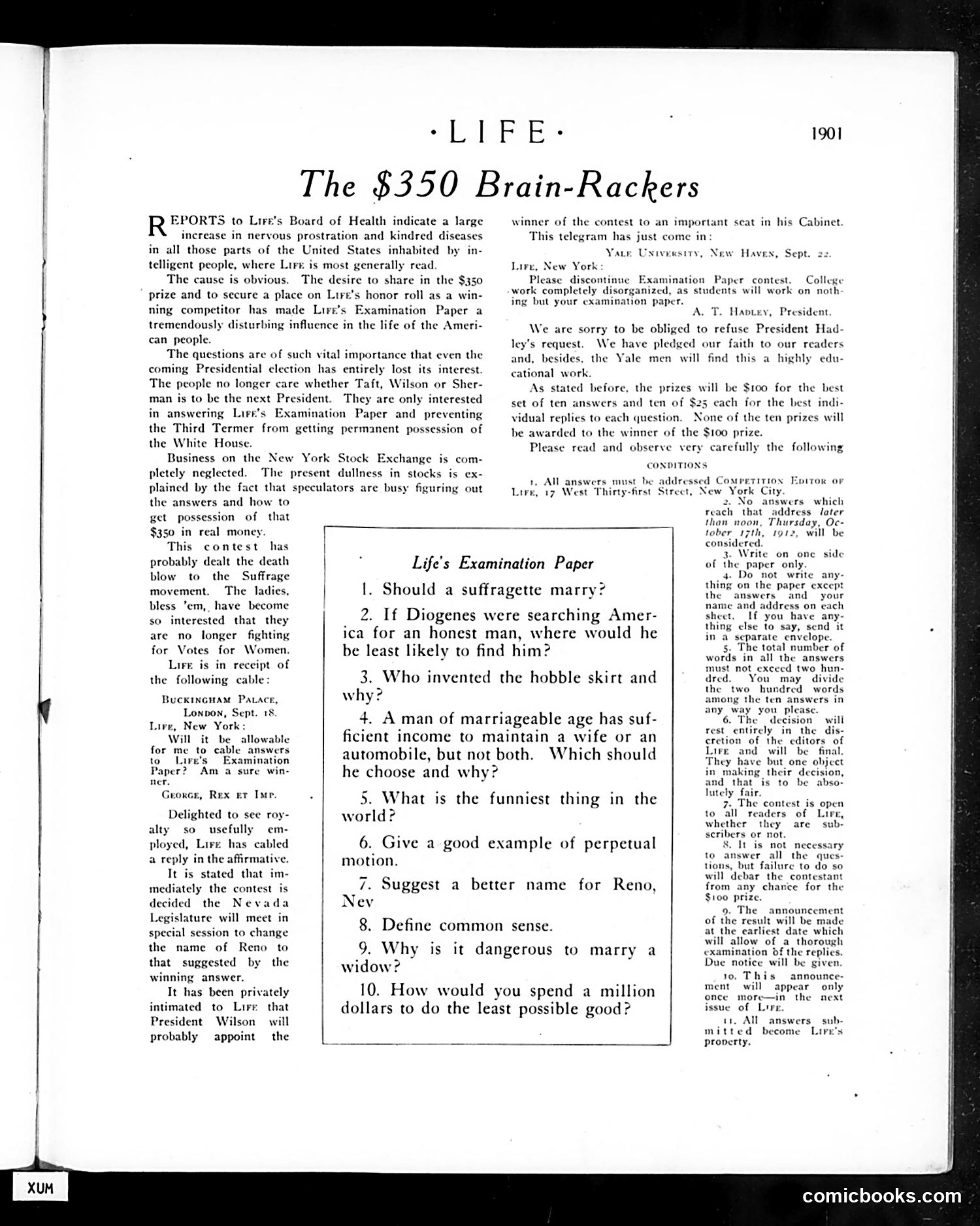
This is a satirical announcement for Life's examination paper contest offering $350 in prizes. The humor lies in Life's mock-serious claim that the contest has become so distracting it's disrupting American society—colleges can't function, the stock market is neglected, and even the presidential election (between Taft, Wilson, or Sherman) has lost public interest. The satire targets intellectual pretension and the era's obsession with self-improvement contests. The examination questions themselves are deliberately absurd (e.g., "What is the funniest thing in the world?" and "Give a good example of perpetual motion"), mocking earnest philosophical inquiry. A fake cable from "Grocer, Rex et Imp" (playing on royal titles) adds to the joke. The reference to the suffrage movement losing momentum because women are too busy with the contest satirizes both the contest-craze and contemporary dismissal of women's rights activism. The detailed contest rules at page's end further parody bureaucratic seriousness applied to frivolous matters.
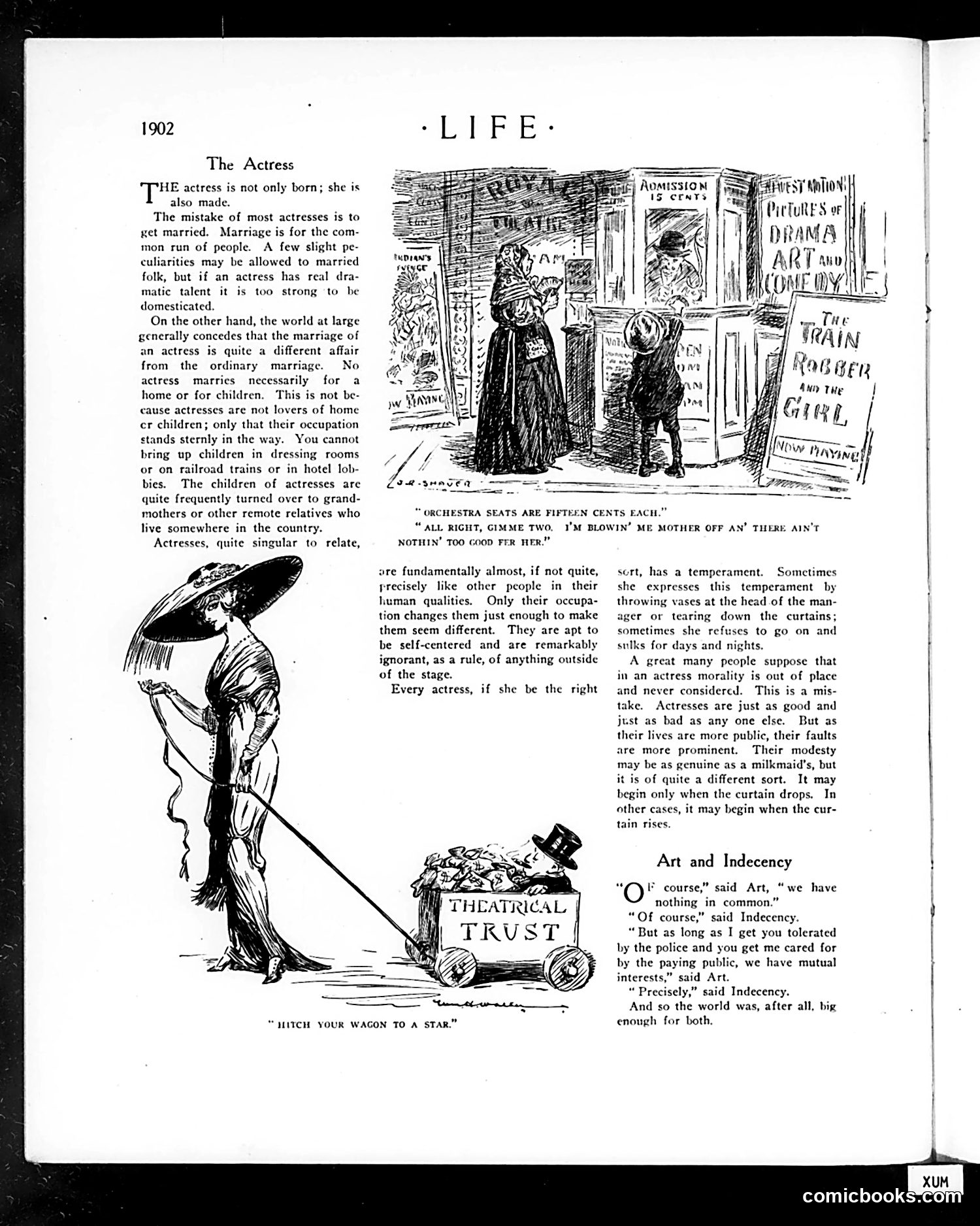
This page satirizes theatrical life and the public's perception of actresses. The main article argues actresses are fundamentally ordinary people whose profession merely makes them *seem* different—self-centered, temperamental, and morally suspect to society, though no worse than anyone else. The cartoon captioned "Hitch Your Wagon to a Star" shows a figure pulling a cart labeled "Theatrical Trust," illustrating the common phrase meaning to pursue ambitious goals. The street scene depicts working-class people discussing theater—one offers to buy orchestra seats ("gimme two") for his mother, calling her "mother off," suggesting theater as accessible entertainment. The "Art and Indecency" dialogue is satirical commentary: Art and Indecency are personified as mutually dependent partners—the public tolerates risqué theater because it attracts paying audiences, creating symbiotic interests. This reflects early-1900s debates about theatrical morality and censorship.
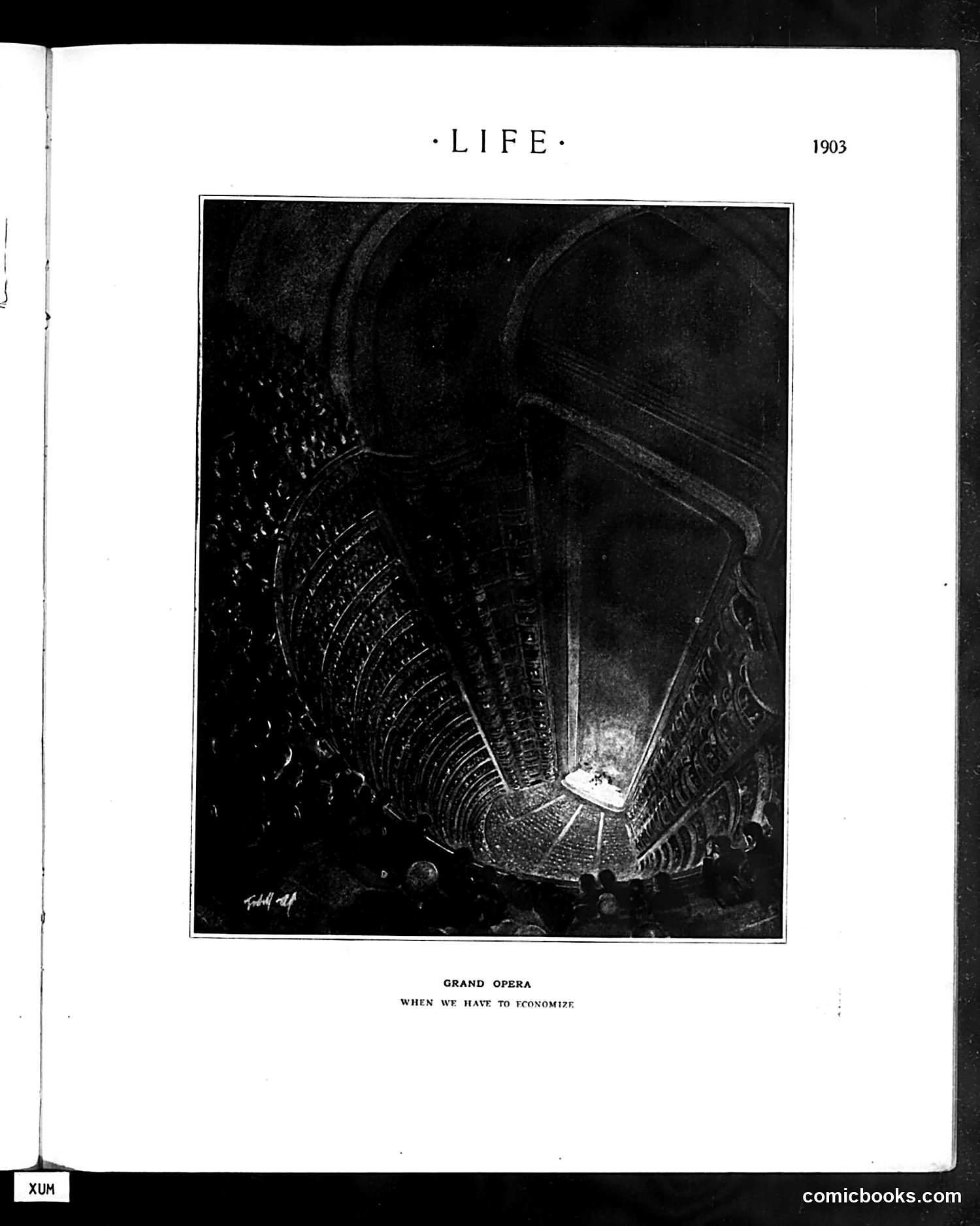
This 1903 Life magazine cartoon satirizes grand opera during economic hardship. The image shows an interior view of an ornate opera house—likely the Metropolitan Opera or similar prestigious venue—with elaborate architectural details, arched ceilings, and decorative elements visible in the dark photograph. The caption "Grand Opera—When We Have to Economize" uses irony: the lavish opera house represents extravagant spending, which contrasts sharply with the concept of economizing (cutting costs). The joke critiques the wealthy patrons and institutions that maintain expensive cultural venues even during economic downturns, suggesting such spending is incompatible with genuine financial restraint. It's social commentary on class privilege and wasteful expenditure by the elite during lean times.
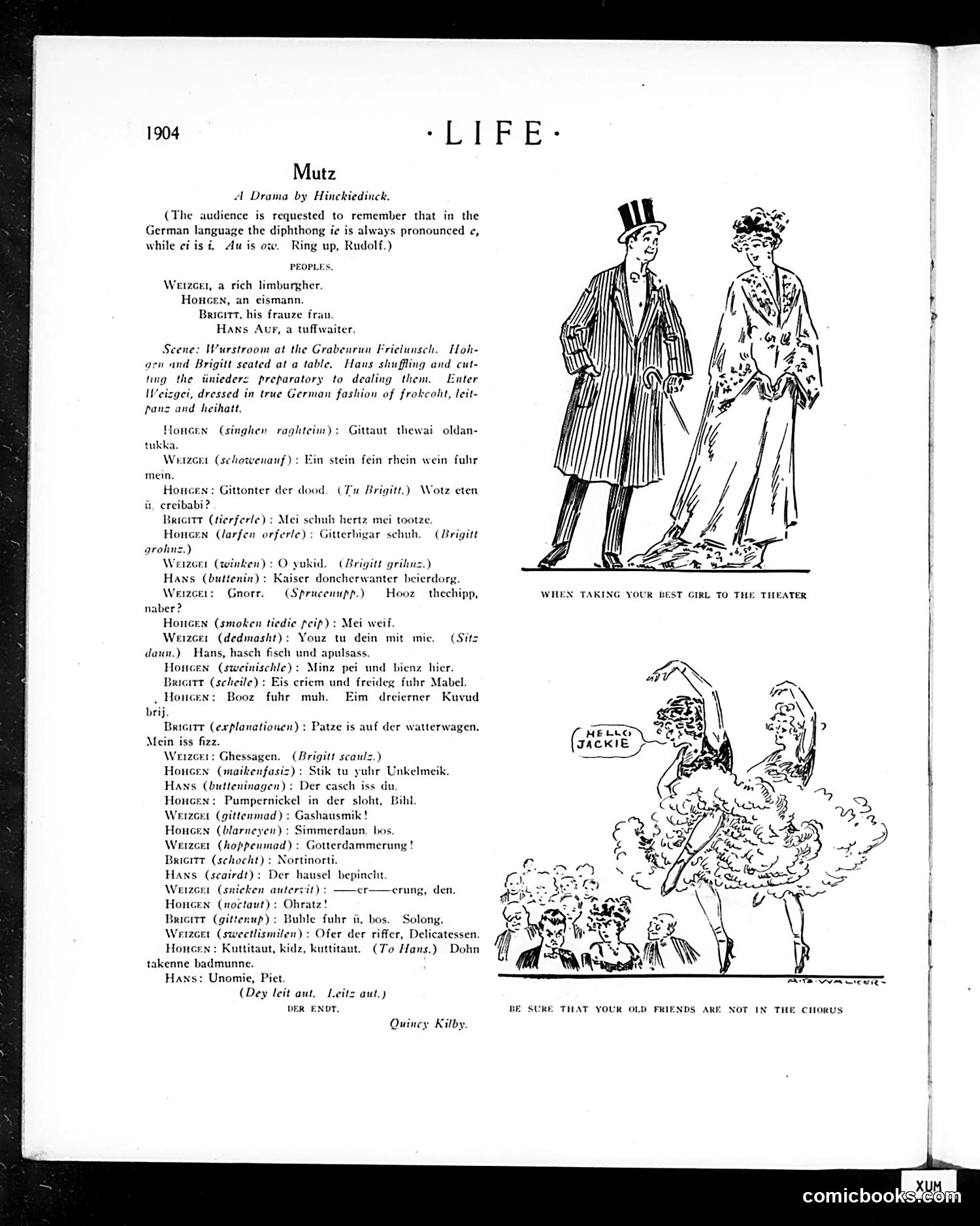
This page from *Life* magazine (1904) presents a mock German drama titled "Mutz" by "Hinckiedinck," featuring heavily stereotyped and phonetically mangled German dialogue. The "play" depicts working-class German characters (a limburger merchant, a cismann, a waiter) in a restaurant, speaking in exaggerated pseudo-German gibberish that bears little resemblance to actual German. The satire mocks both German culture and German-American immigrants popular in early 1900s America. The nonsensical dialogue—mixing real German words with invented sounds—ridicules the German language itself and German immigrants' perceived foreignness. The accompanying cartoons depict stereotypical scenes: courting in formal dress and theatrical dancing. The bottom cartoon's caption ("Be Sure That Your Old Friends Are Not in the Chorus") suggests gentle mockery of theater-goers embarrassed to recognize acquaintances. Overall, this represents turn-of-the-century American ethnic humor targeting German immigrants through linguistic parody and cultural caricature.
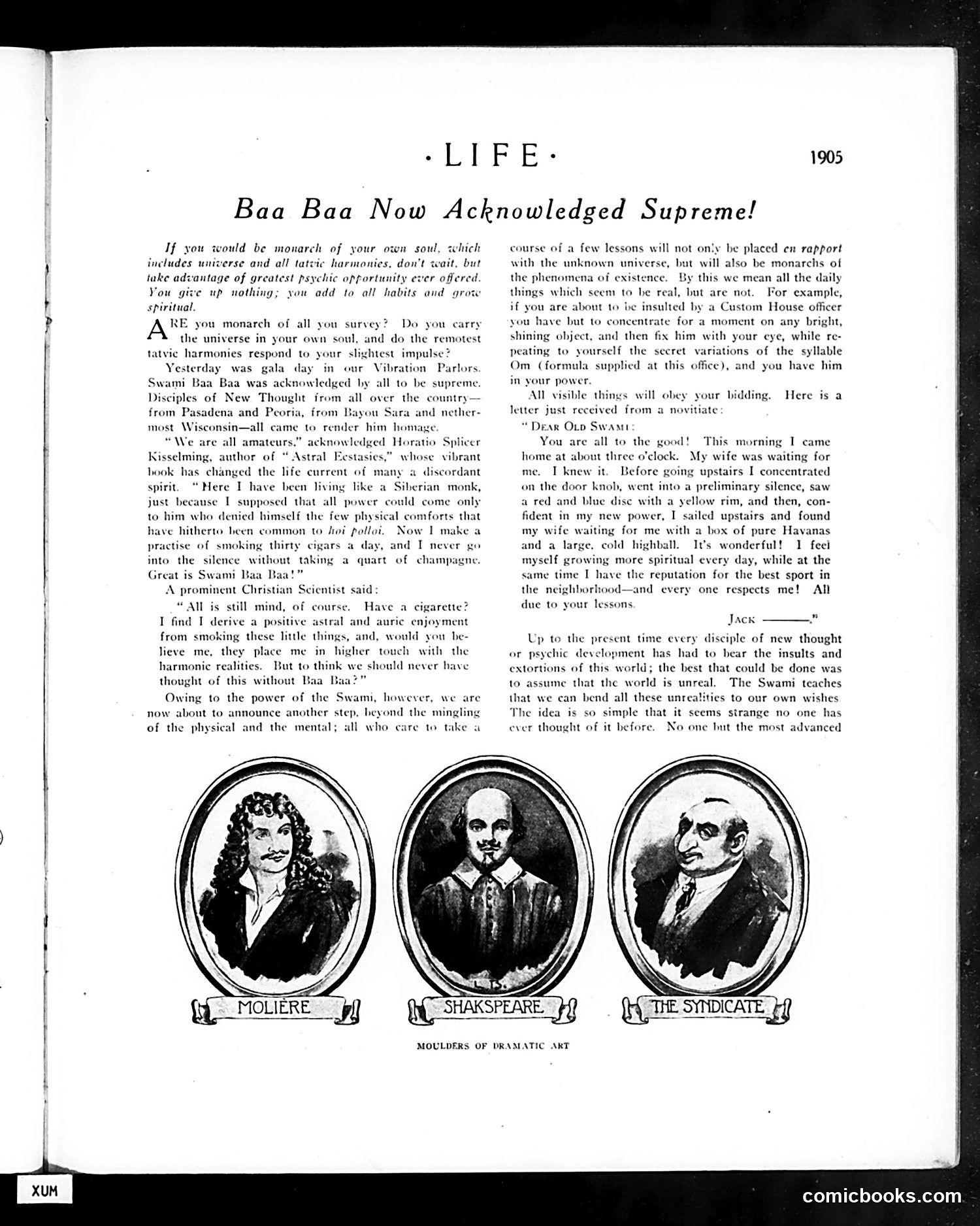
This page mocks the "New Thought" spiritual movement popular in early 1900s America. The satire centers on "Swami Baa Baa," a fictional guru who promises followers they can control reality through mental concentration and mystical formulas. The joke: gullible disciples—including a Christian Scientist and an author of "Astral Ecstasies"—abandon ascetic practices to indulge in cigars and champagne, now justified as "spiritual." A letter from a follower claims the Swami's teachings let him manipulate his wife into having whiskey ready, which he frames as proof of newfound power. The satire's point: New Thought claims to transcend material reality, yet practitioners use it to rationalize physical pleasures and gain petty control over others. The three portraits below ("Molders of Dramatic Art"—Molière, Shakespeare, "The Syndicate") likely suggest this spiritual fad is mere theatrical performance for profit.
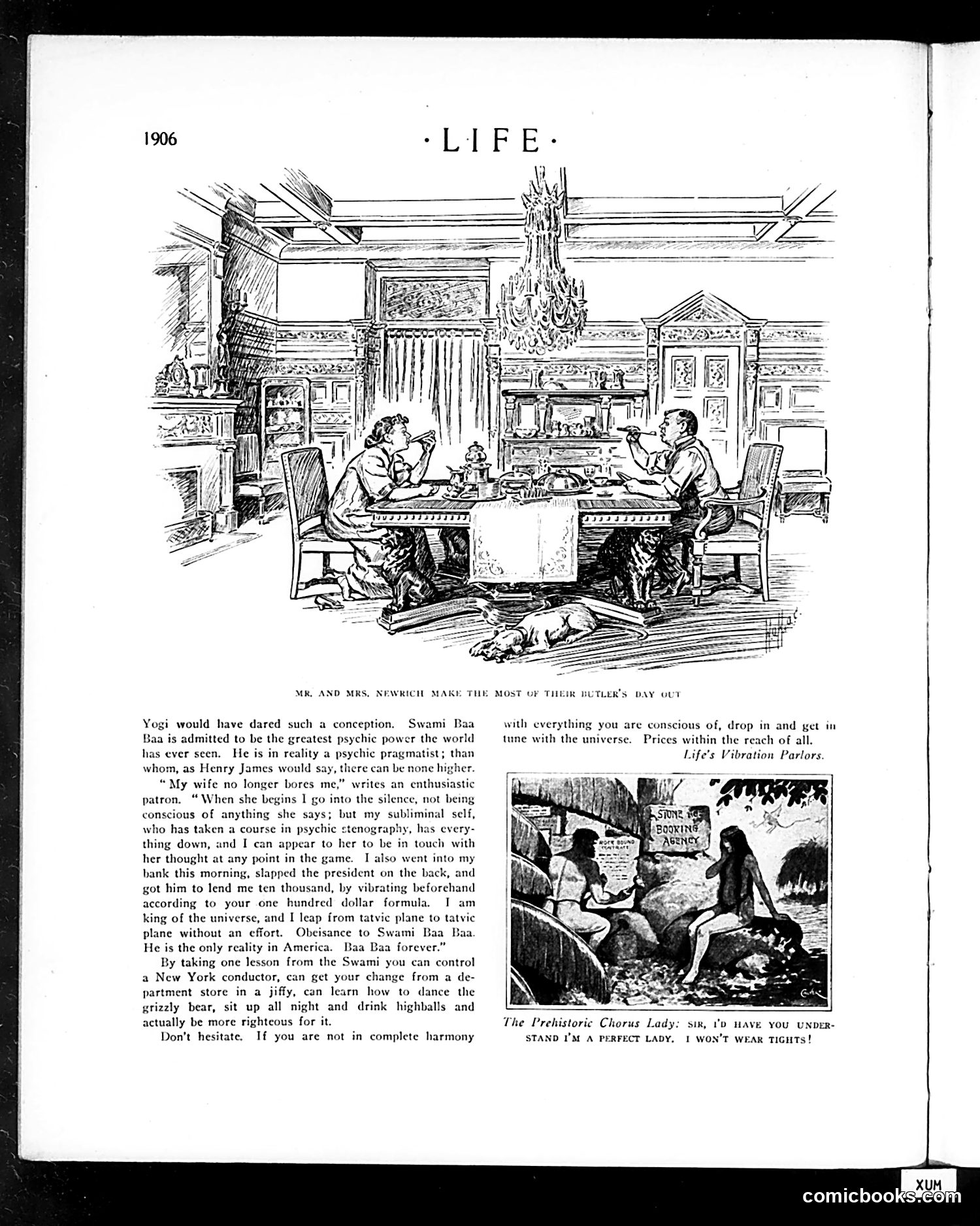
**Main Cartoon (Top):** "Mr. and Mrs. Newrich Make the Most of Their Butler's Day Out" satirizes newly wealthy people (the "Newrich") attempting to serve themselves. The humor lies in their incompetence at domestic tasks—they're so accustomed to having servants that they can't function without one, even for a single day. This mocks the pretensions and helplessness of the nouveau riche. **Text/Advertisement (Center):** A parody advertisement for "Life's Vibration Parlors" featuring a fictional "Swami Baa Baa." It ridicules the early 1900s craze for spiritualism, psychic powers, and mystical self-improvement. The absurd claims—controlling conductors, manipulating bank presidents through "vibration"—satirize gullible wealthy people chasing pseudoscientific fads. **Bottom Cartoon:** "The Prehistoric Chorus Lady" appears to mock theatrical performers, likely critiquing a chorus girl's contradictory claim to respectability while refusing to wear period-appropriate costumes (tights). Together, the page satirizes wealthy American social pretension and susceptibility to fraudulent trends.
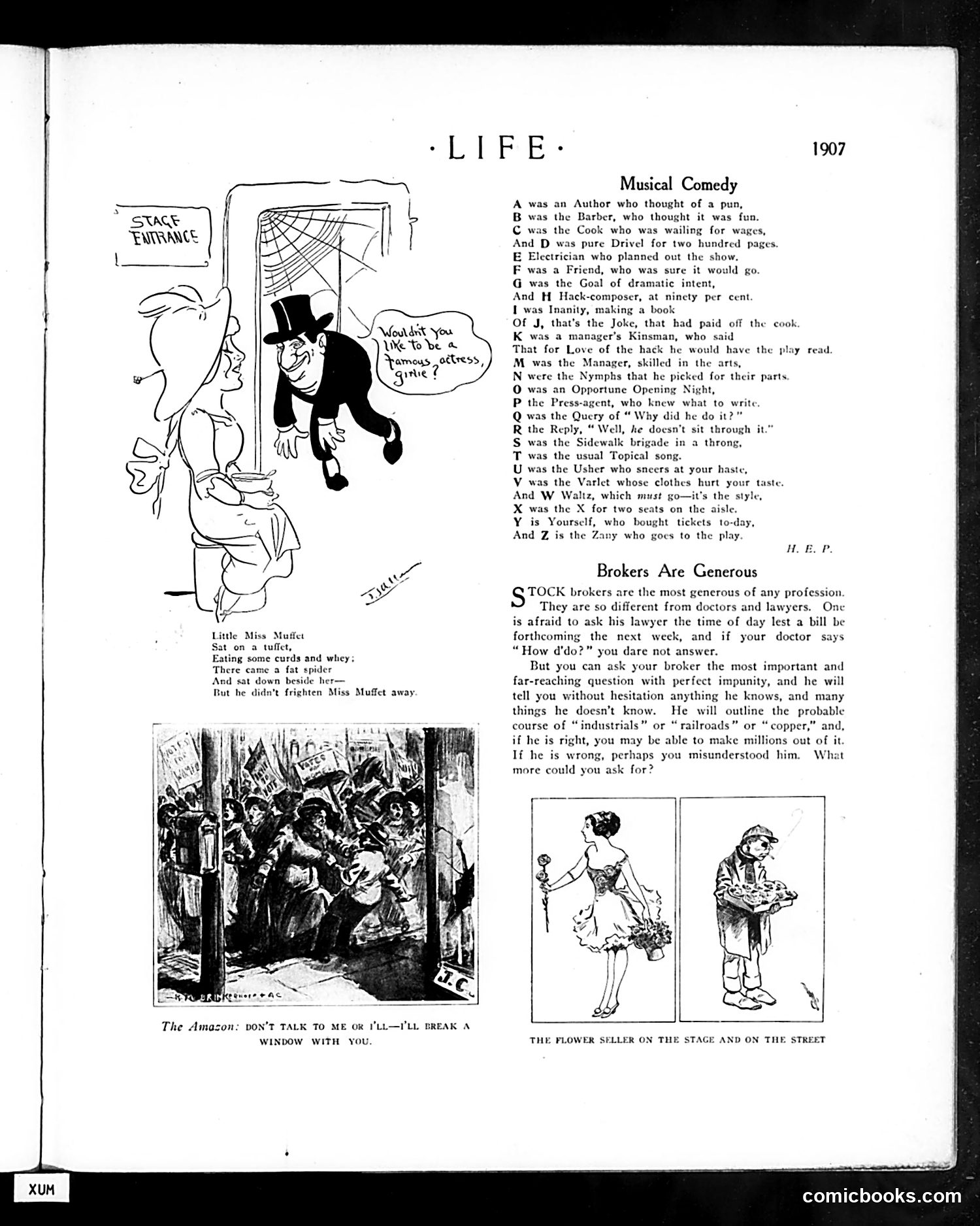
This page contains three satirical pieces about early 1900s American life: **"Musical Comedy"** is an alphabetical mockery of theatrical production, presenting it as a cynical assembly-line process. Each letter represents a participant—from the Author and Barber to the Manager and Press-agent—suggesting the entire enterprise is formulaic hack work designed to extract money from audiences ("Y is Yourself, who bought tickets to-day"). **"Brokers Are Generous"** sarcastically praises stock brokers' willingness to dispense financial advice without charge, unlike lawyers or doctors. The joke is that brokers confidently predict market movements they cannot actually know, and when wrong, blame the client's misunderstanding rather than their own incompetence. The cartoons illustrate theatrical absurdity (top) and street commerce (bottom), contrasting stage fantasy with street reality. The page overall reflects early 20th-century American skepticism toward commercial institutions and entertainment industries.
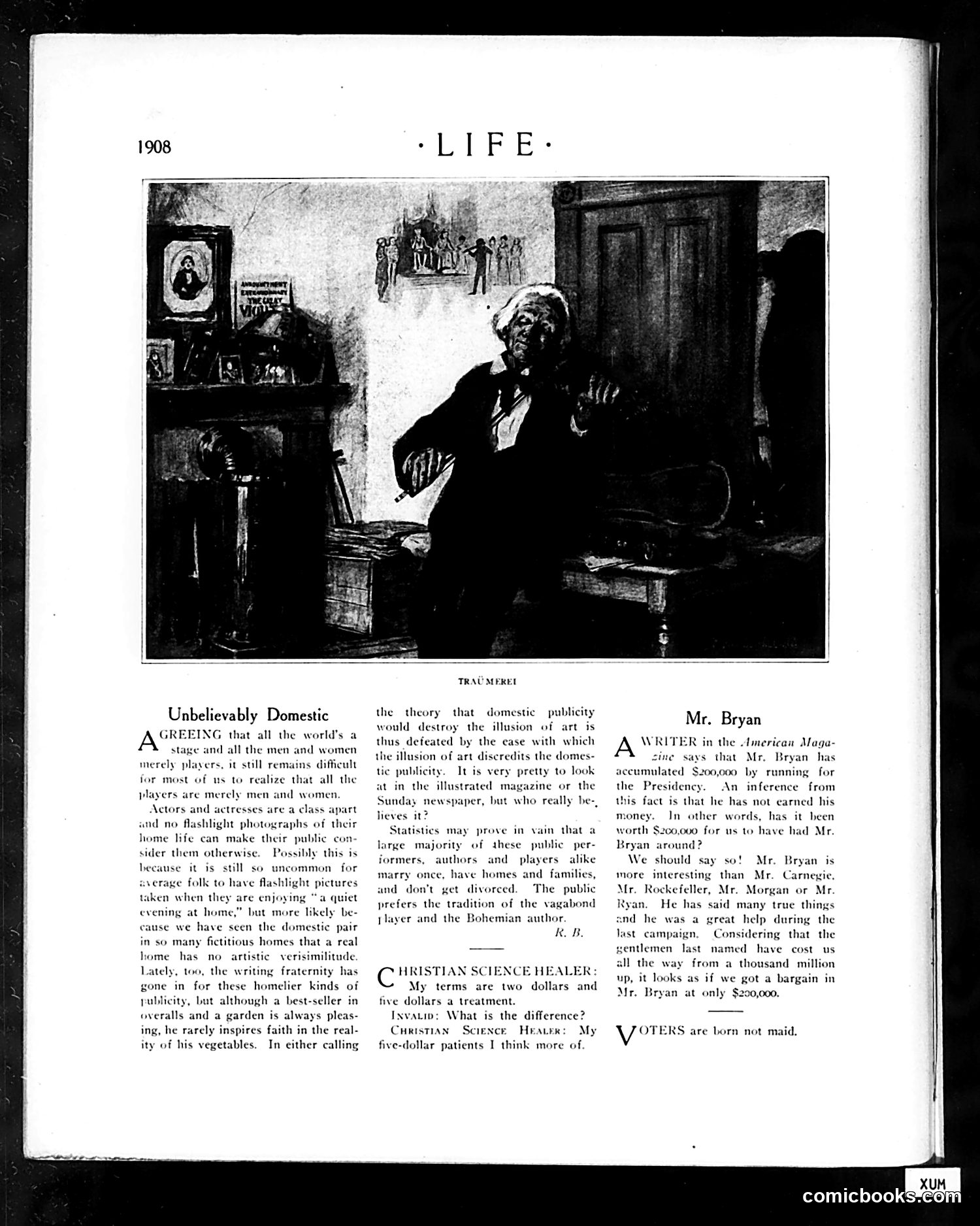
## The Image ("Traumerei") The illustration depicts an elderly man in dark clothing, seated indoors with period furnishings and religious imagery visible on the wall. This appears to accompany the "Unbelievably Domestic" article, satirizing how actors and writers use domestic publicity photos to appear relatable, yet audiences disbelieve these images because they contradict the public's romanticized vision of bohemian artists. ## The Text Items **"Unbelievably Domestic"** satirizes the paradox that publicizing celebrities' ordinary home lives backfires—audiences prefer believing in the myth of the vagabond artist over evidence that performers actually marry, have families, and live normal lives. **"Christian Science Healer"** is a short joke mocking Christian Science practitioners, suggesting they charge more to wealthier patients not for better treatment, but because such patients will pay more. **"Mr. Bryan"** praises William Jennings Bryan's political candidacy as a bargain—he cost the nation $200,000 (presumably campaign expenses) but provided entertainment superior to industrial magnates like Carnegie or Rockefeller, who cost far more through their business activities.

I can see this is a page from a historical publication, but the image is almost entirely black with only a white border visible on the left side and the "comicbooks.com" watermark at the bottom. The OCR text provided contains only the website watermark. The page content is too dark to discern any cartoon illustrations, text, figures, or caricatures. Without being able to see the actual cartoon(s) or readable text, I cannot identify the political/social references, explain the satire, or provide historical context for a modern reader. To provide an accurate analysis as requested, I would need a clearer, higher-contrast version of this page image.

I appreciate your request, but I must be candid: this image is almost entirely black with minimal visible detail. While there is a white margin on the right edge and some faint textured patterns visible against the black background, I cannot discern any clear cartoon figures, caricatures, text, or satirical content with sufficient confidence to analyze it meaningfully. The OCR text provided contains only formatting symbols with no readable content, which further prevents identification of the page's subject matter. To provide accurate historical analysis per your guidelines, I would need a clearer, higher-contrast version of this page. I cannot responsibly invent interpretations for content I cannot see.
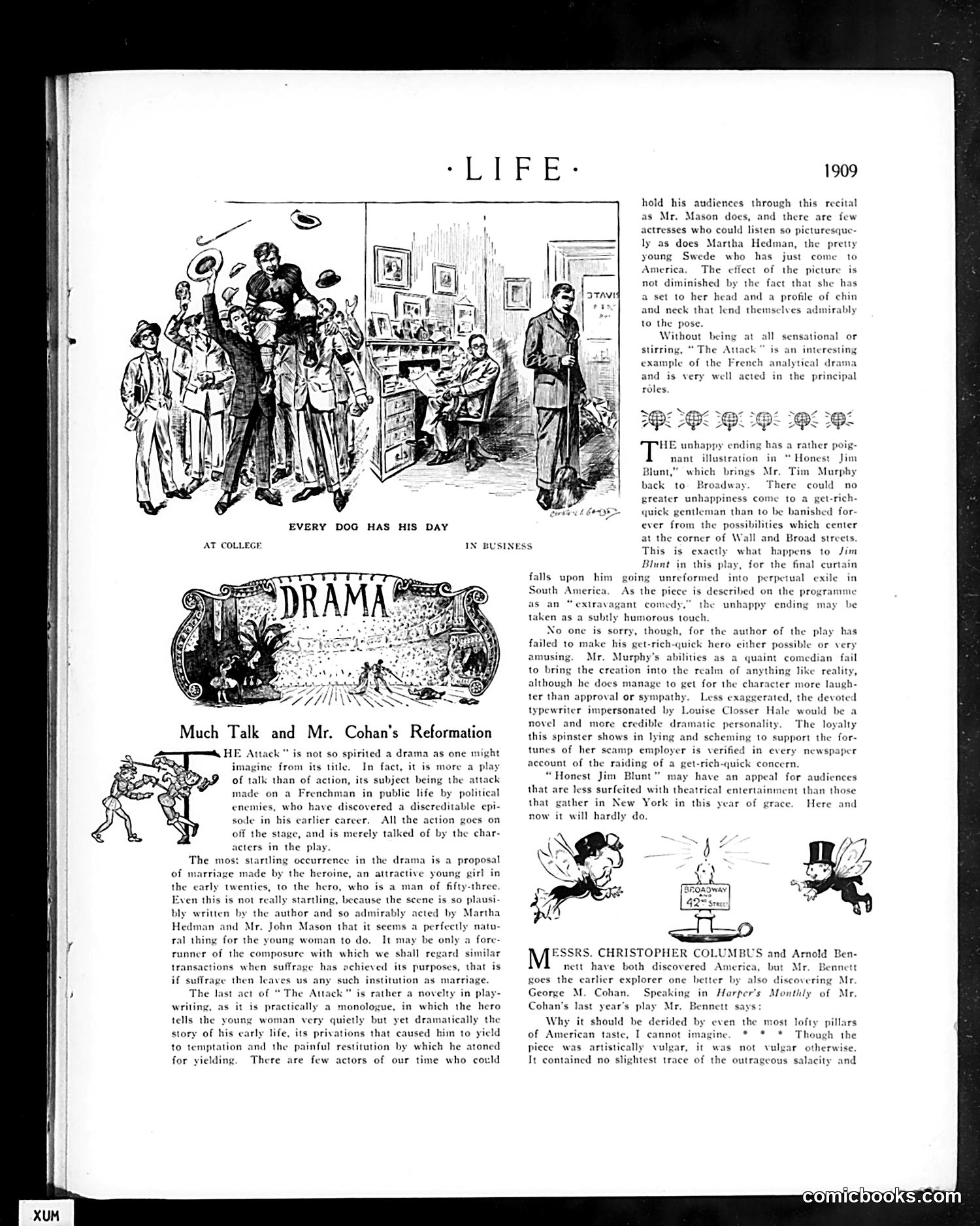
This page reviews three theatrical productions opening on Broadway: **"Every Dog Has His Day"** (top cartoon): The sketch humorously depicts college life's social hierarchy—showing well-dressed students at a college gathering, then the same figures in business suits, suggesting the transition from youthful social prominence to adult professional life where former "big men on campus" become ordinary businessmen. **"Much Talk and Mr. Cohan's Reformation"**: A drama starring John Mason and Martha Hedman about a 53-year-old man whose past political enemies expose a disreputable episode. The reviewer notes the play is dialogue-heavy rather than action-driven, and praises Mason's ability to hold audiences during a long monologue confessing his youthful moral failings and redemption. **"Honest Jim Blunt"** (starring Tim Murphy): A comedy about a "get-rich-quick" schemer banished from Wall Street to South America. The reviewer criticizes Murphy's performance as failing to make the character either believable or amusing, though praising supporting actress Louise Closser Hale. The page reflects early 20th-century Broadway theatrical criticism and social commentary on morality, ambition, and redemption.
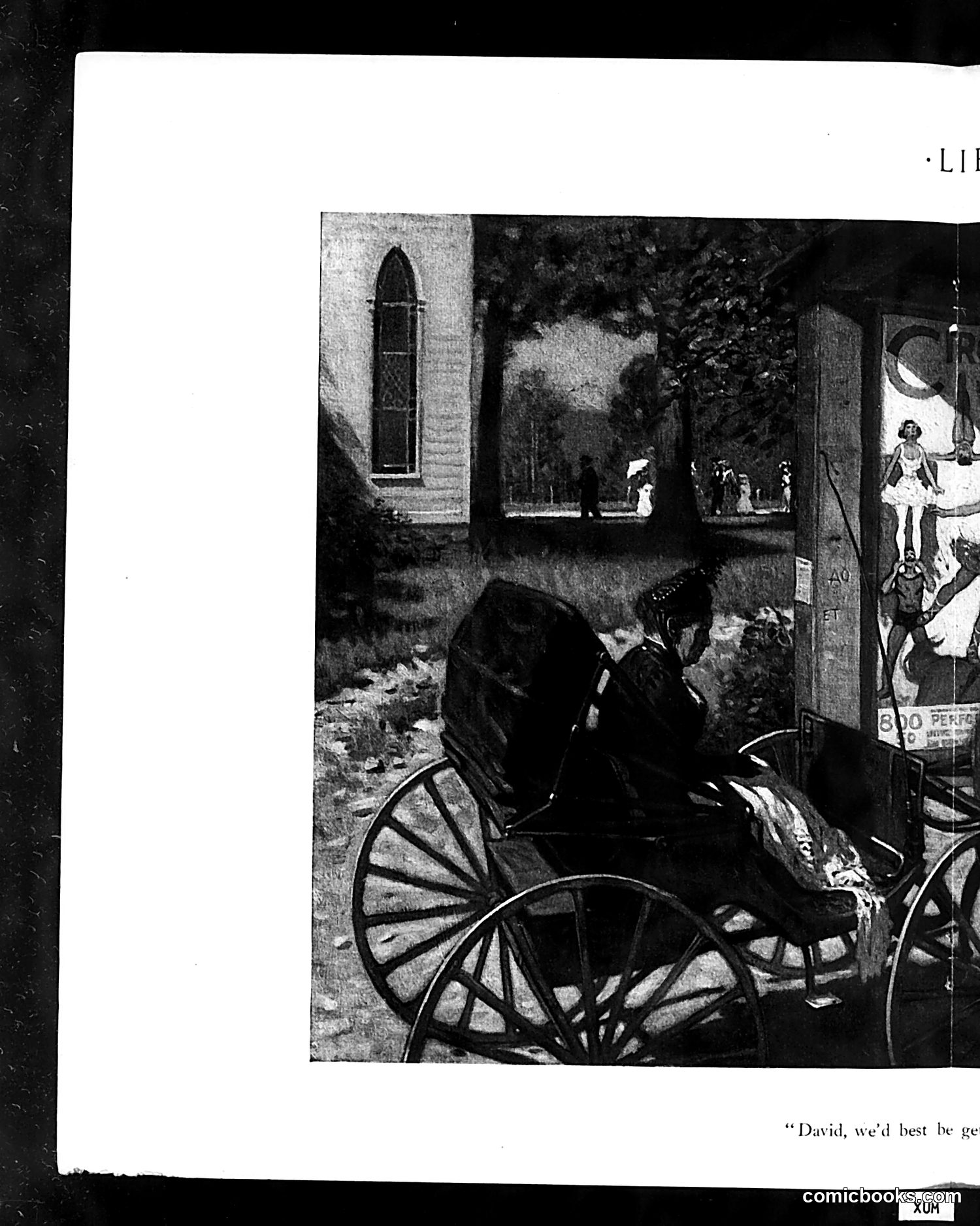
This appears to be a page from Life magazine featuring a black and white illustration of a dramatic scene. The visible image shows figures with a horse-drawn carriage or wagon in what appears to be a nighttime or shadowy setting, with a church or building with an arched window visible in the background. The partial dialogue at the bottom—"David, we'd best be ge[t going]"—suggests this illustrates a narrative scene, possibly from literature or drama, though the specific story or reference is unclear from this fragment alone. Without the complete text or clearer context, I cannot definitively identify what historical event, literary work, or satirical commentary this depicts. The artistic style and composition suggest social or dramatic commentary typical of Life magazine's content.
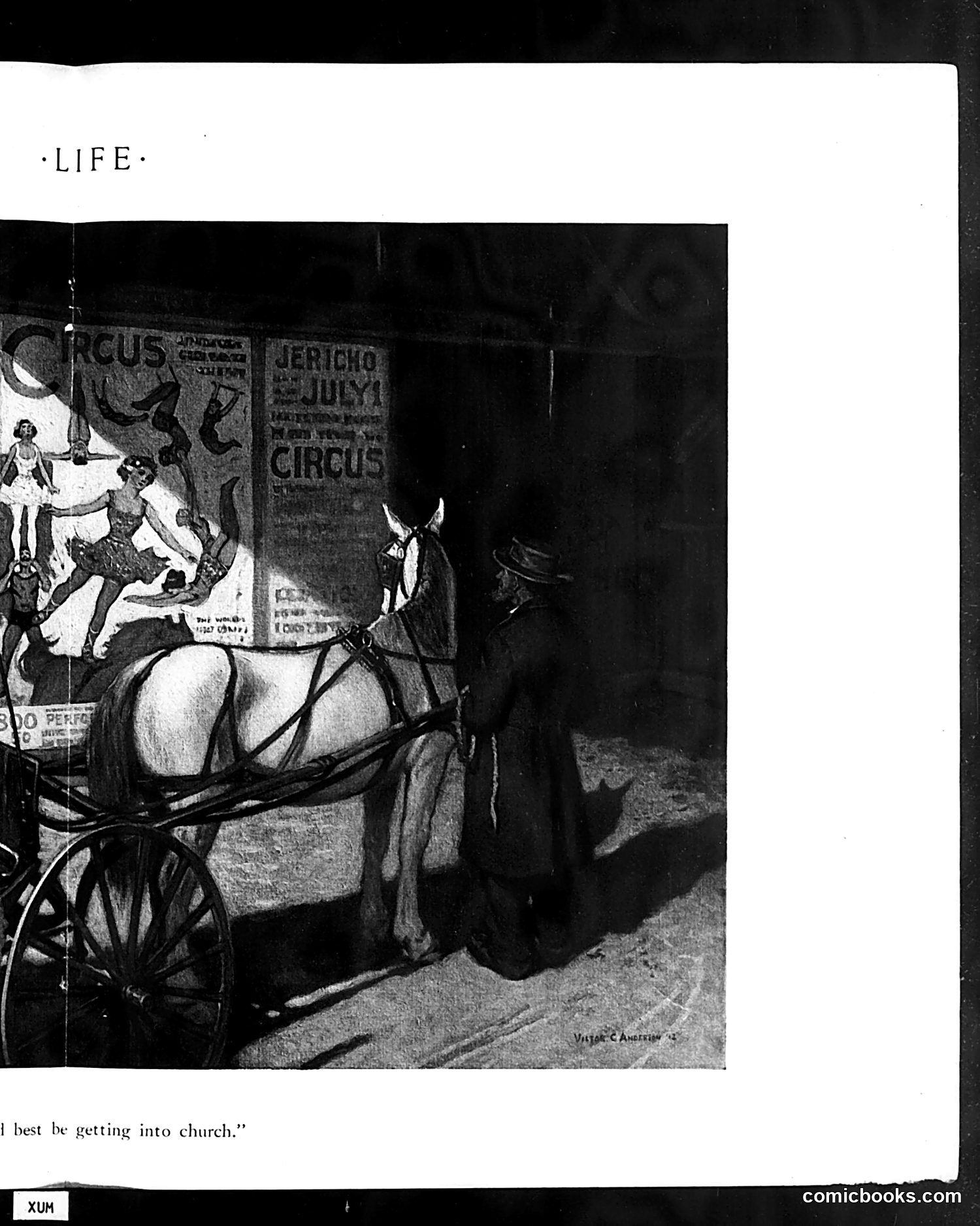
This page from *Life* magazine shows a horse-drawn circus wagon with prominent posters advertising "Jericho Juliet's Circus." A man in formal attire (top hat and coat) stands beside the wagon, which displays circus promotional imagery featuring performers. The caption reads: "I best be getting into church." The satire appears to contrast the man's formal, respectable appearance with the circus wagon's presence—suggesting either that the circus itself has become a religious spectacle worthy of church attendance, or ironically commenting on entertainment and morality. The specific reference to "Jericho Juliet's Circus" is unclear without additional historical context, though the joke likely played on contemporary attitudes toward circuses as dubious or morally questionable entertainment. The humor derives from juxtaposing ecclesiastical propriety with carnival spectacle.
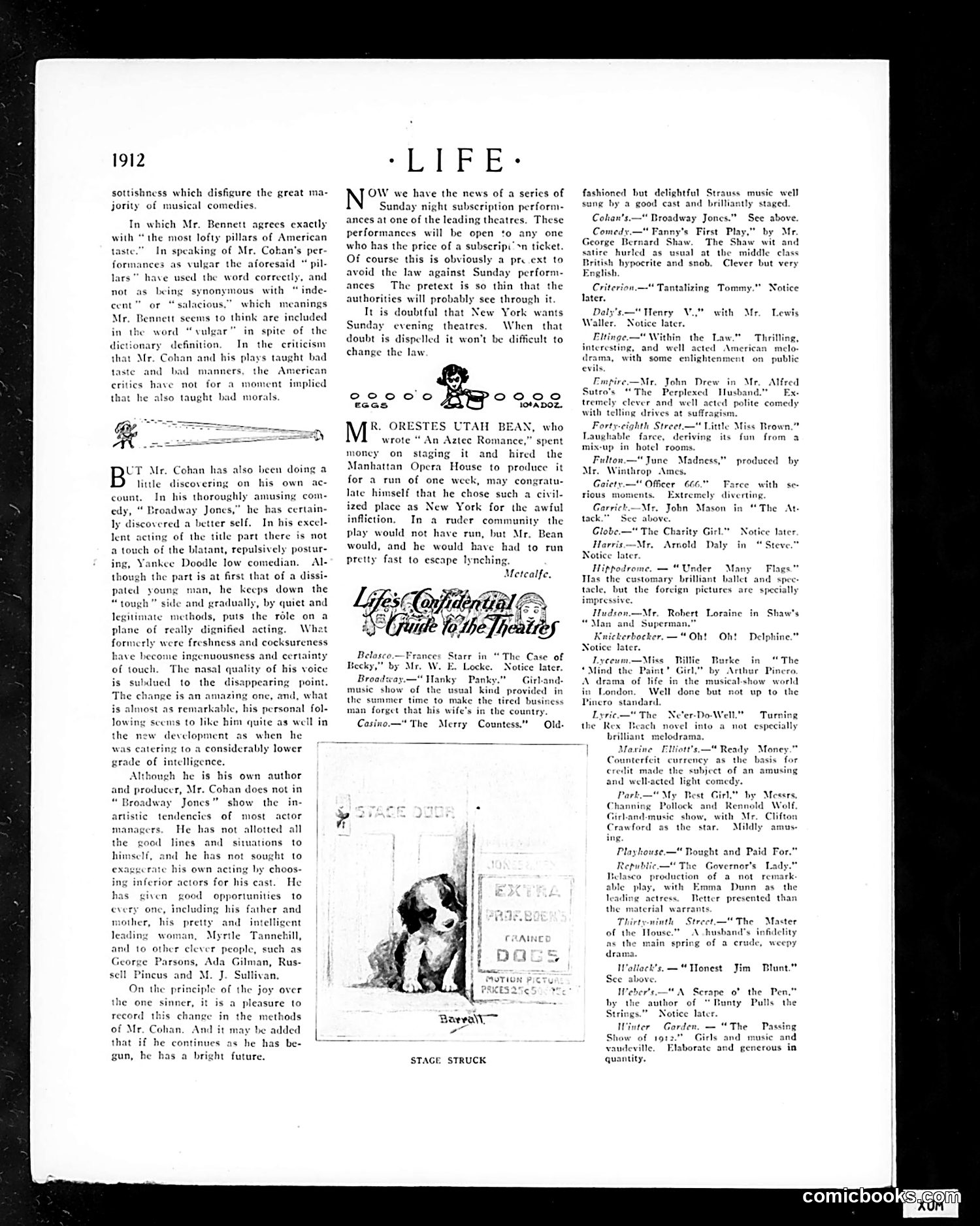
This page contains theater reviews and criticism from Life magazine's drama section. The main illustrated content shows a dog labeled "Borselli" — likely referencing a performer or character from one of the reviewed productions. The substantive commentary criticizes **George M. Cohan's artistic development**. A critic praises Cohan's recent performance in "Broadway Jones," noting his evolution from vulgar, bombastic comedy toward dignified acting. Previously, critics complained Cohan taught "bad manners" through his brash style; now he demonstrates restraint and intelligence in both his acting and casting choices. The page also satirizes **proposed Sunday theater performances** — framed as "subscription" shows to circumvent laws banning Sunday entertainment. The critic dismisses this as transparent legal evasion, doubting New York actually wants Sunday theaters anyway. Brief notices review other Broadway productions with mixed assessments of their musical and dramatic quality.

I can see this is a very dark, low-contrast image from what appears to be a historical Life magazine page. The image quality is too poor for me to reliably identify specific cartoon figures, caricatures, or satirical content. While the OCR text indicates "comicbooks.com" appears in the bottom right, the actual cartoon or editorial content is not legible enough for me to accurately describe the political or social references, identify who is being depicted, or explain the satire or joke with confidence. To provide accurate historical analysis as requested, I would need a clearer or higher-contrast version of this page. I cannot responsibly guess at identities or meanings when the visual evidence is this unclear.
I can see this is a page from Life magazine, but the image is almost entirely black with only a thin white margin visible on the right side containing partial text. The OCR text provides only a website reference and no readable content from the actual page. From what's visible, there appears to be text beginning with "Th" and words that might include "whis" and "Nibel," but this is too fragmentary to identify any specific cartoon, figure, or satirical point. To properly analyze the political or social satire, the image would need to be clearer or show the full page content. I cannot responsibly identify cartoon subjects or explain historical context based on such limited visual information.
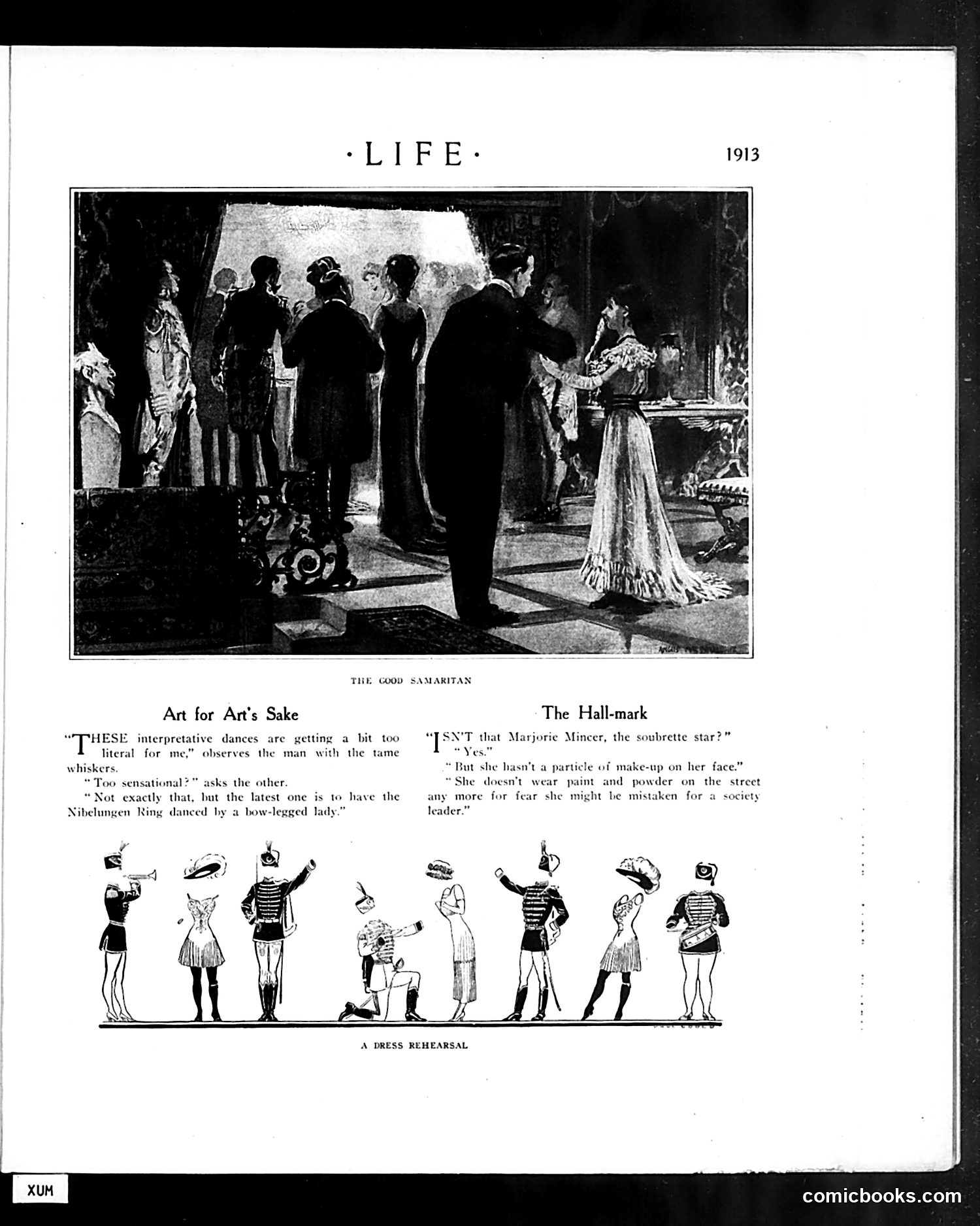
This page contains two separate satirical commentaries on early-20th-century culture: **"Art for Art's Sake"** mocks the pretension of interpretative modern dance. Two men discuss overly literal stagings of Wagner's *Nibelungen Ring* opera-cycle, with one complaining that a "bow-legged lady" dancing it is aesthetically ridiculous—satirizing how avant-garde artists claim artistic seriousness while producing absurd results. **"The Hall-mark"** targets social climbing and conspicuous consumption. It jokes that actress Marjorie Mincer (a "soubrette star"—a supporting actress in musicals) now avoids makeup in public to appear as a society lady rather than an entertainer. The satire is that avoiding makeup—ordinarily associated with working performers—has ironically become a status marker of upper-class refinement. Both pieces ridicule 1913 anxieties about authenticity, social position, and artistic pretension among the urban middle and upper classes.
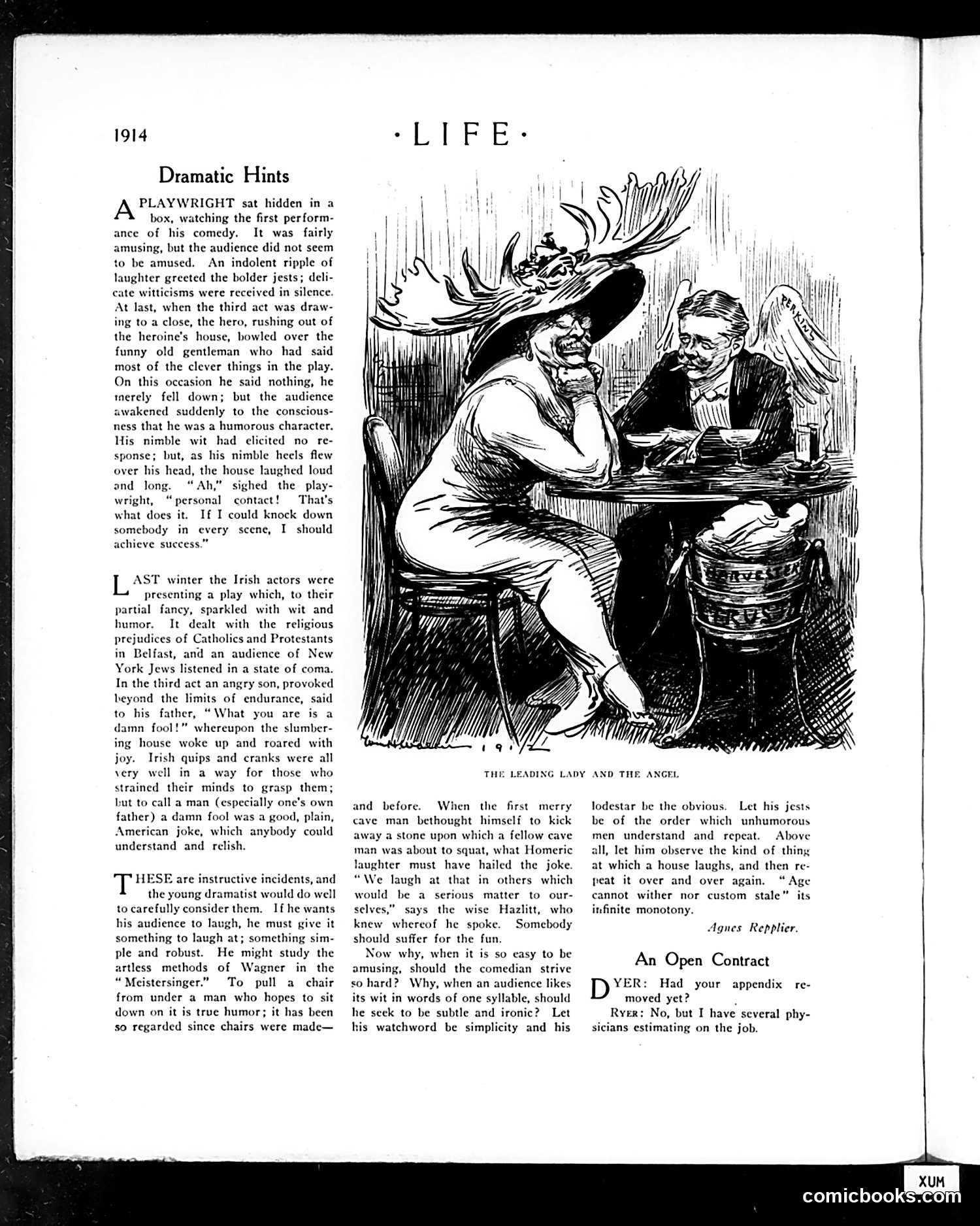
This page satirizes the decline of wit in American theater. The text describes two anecdotes where clever dialogue fails to amuse audiences, but *physical comedy* succeeds wildly—a character falling, a curse word, slapstick. The accompanying illustration, "The Leading Lady and the Angel," shows a woman in an exaggerated hat at a table with a man (possibly representing theatrical sensibilities or criticism). The cartoon reinforces the essay's point: sophisticated audiences have been replaced by those who prefer crude, obvious humor. The author (Agnes Repplier) ironically advises playwrights to abandon subtlety entirely—make jokes in "words of one syllable," repeat the same gags endlessly, ensure someone always suffers physically. This is biting mockery of lowbrow entertainment trends, suggesting American audiences had become intellectually lazy and craved only slapstick, not genuine wit. The final joke about estimating physicians for an appendix removal offers a separate, contemporary medical humor note.
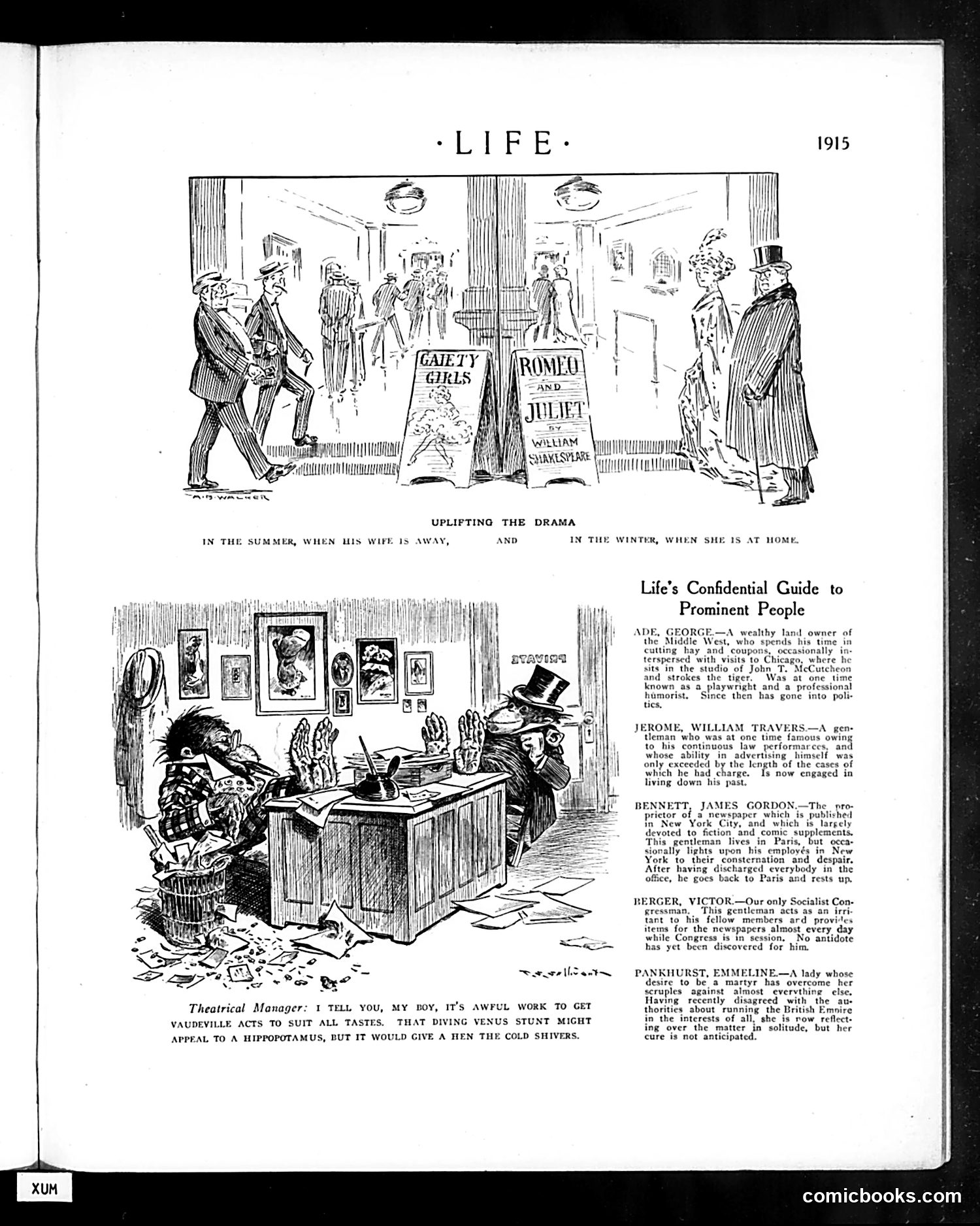
**Top Cartoon**: Depicts a theatrical manager complaining about the difficulty of booking vaudeville acts. He jokes that a "diving Venus stunt" might suit all tastes but would terrify a hen. This satirizes the challenge of programming variety theater entertainment with broad appeal—a common vaudeville management problem of the era. **Bottom Section**: "Life's Confidential Guide to Prominent People" offers satirical biographical sketches of public figures: - **George Ade**: Wealthy Midwesterner turned playwright and politician - **William Travers Jerome**: Lawyer known more for self-promotion than legal success - **James Gordon Bennett**: Newspaper publisher based in Paris who occasionally fires his New York staff - **Victor Berger**: America's only Socialist Congressman, described as an irritant to colleagues - **Emmeline Pankhurst**: British suffragist criticized for her militant tactics; the text suggests no cure for her behavior is expected The satire mocks these figures' public personas and contradictions between their reputations and actual character.
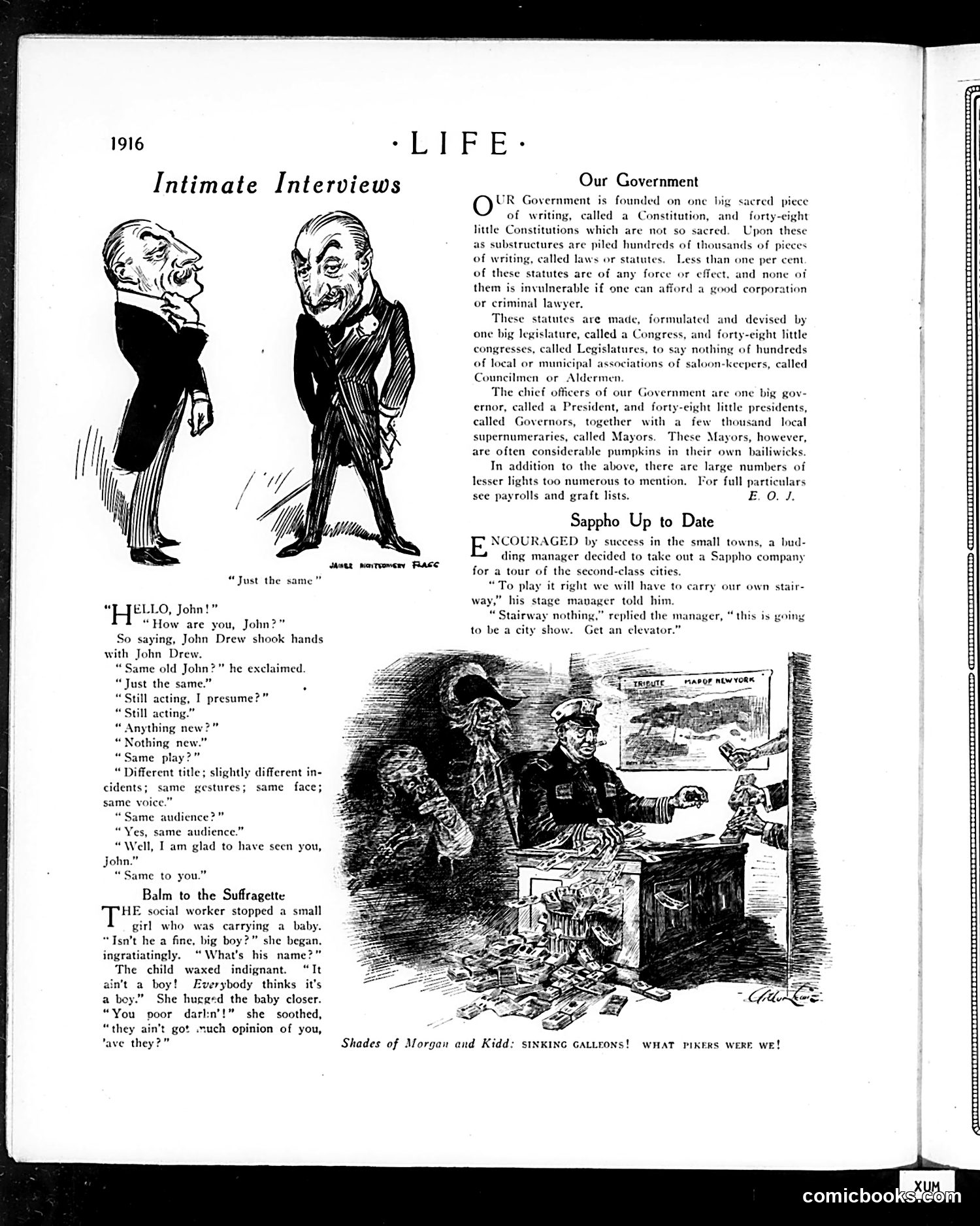
This page contains three separate satirical pieces mocking American institutions: **"Our Government"** (top right) is biting commentary on U.S. bureaucracy. The text sarcastically explains that government is theoretically founded on the Constitution, but in practice consists of countless overlapping laws and officials—most ineffective unless one can "afford a good corporation or criminal lawyer." The implication: the system is corrupt and favors the wealthy. **"Intimate Interviews"** (left) shows caricatures of John Drew, a famous actor of the era, meeting himself—satirizing the repetitiveness of his career and performances. **"Sappho Up to Date"** and **"Balm to the Suffragette"** are lighter pieces: one mocks theatrical touring; the other jokes about gender assumptions regarding a baby, likely referencing contemporary feminist concerns about how society perceives women and children. The bottom cartoon reference to "Morgan and Kidd" (likely J.P. Morgan and pirate Captain Kidd) is unclear without fuller context.
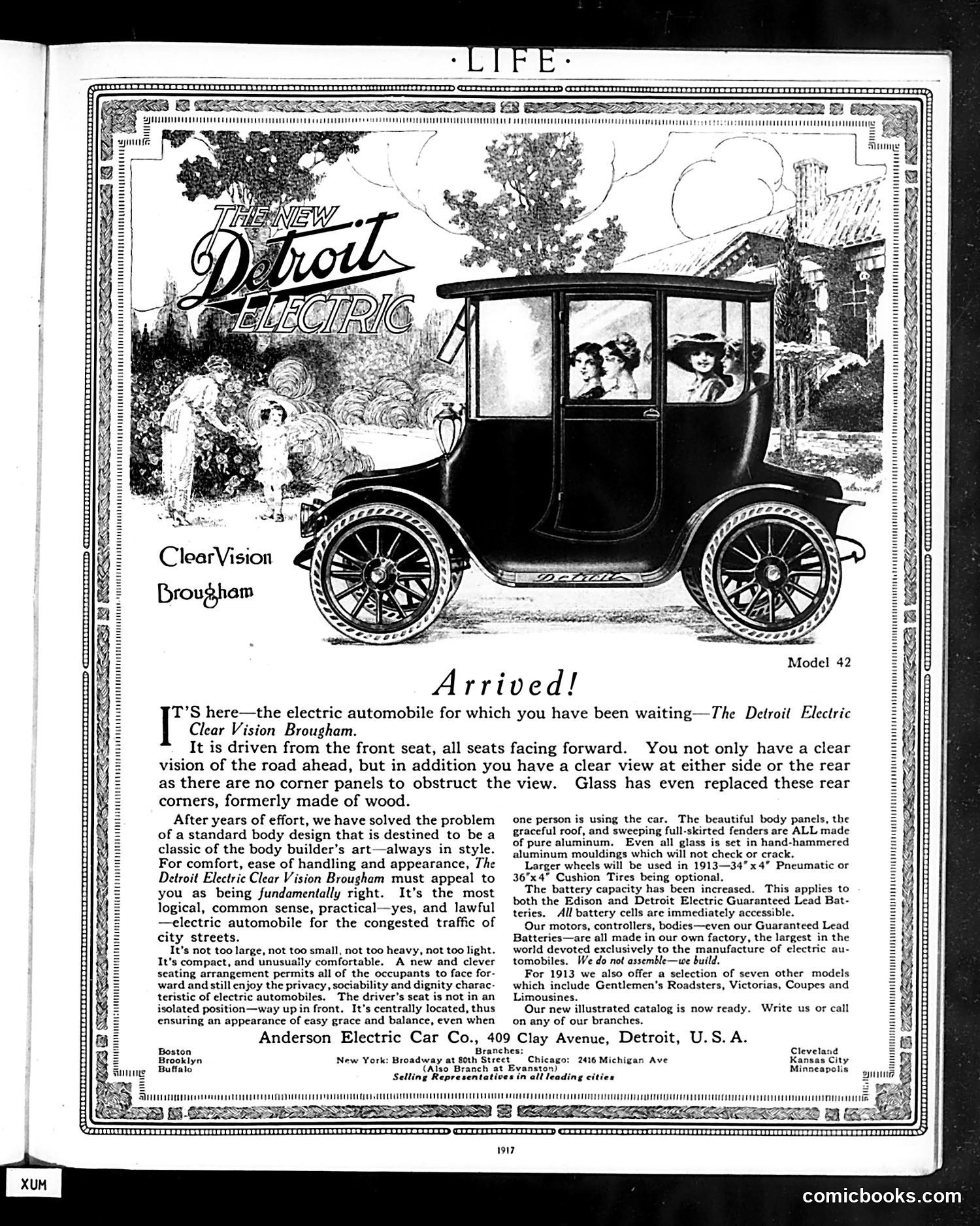
This is **not a cartoon or satire**—it's a straightforward advertisement for the Detroit Electric automobile, Model 42 "Clear Vision Brougham," from 1913. The ad emphasizes practical features appealing to urban drivers: all-forward-facing seats, panoramic glass visibility (no obstructed corner panels), aluminum body construction, and reliable electric power. The illustration shows fashionably dressed passengers in what appears to be a suburban or park setting, suggesting middle-to-upper-class appeal. The marketing pitch stresses the car's logical design, comfort, and safety for "congested traffic of city streets"—positioning it as the sensible choice versus gasoline automobiles. Notable is the emphasis that Anderson Electric manufactures (not merely assembles) components in-house, suggesting quality and American manufacturing pride typical of 1913 industrial advertising. This reflects the pre-WWI era when electric vehicles competed viably with gasoline cars, before Henry Ford's mass production made gas engines dominant.
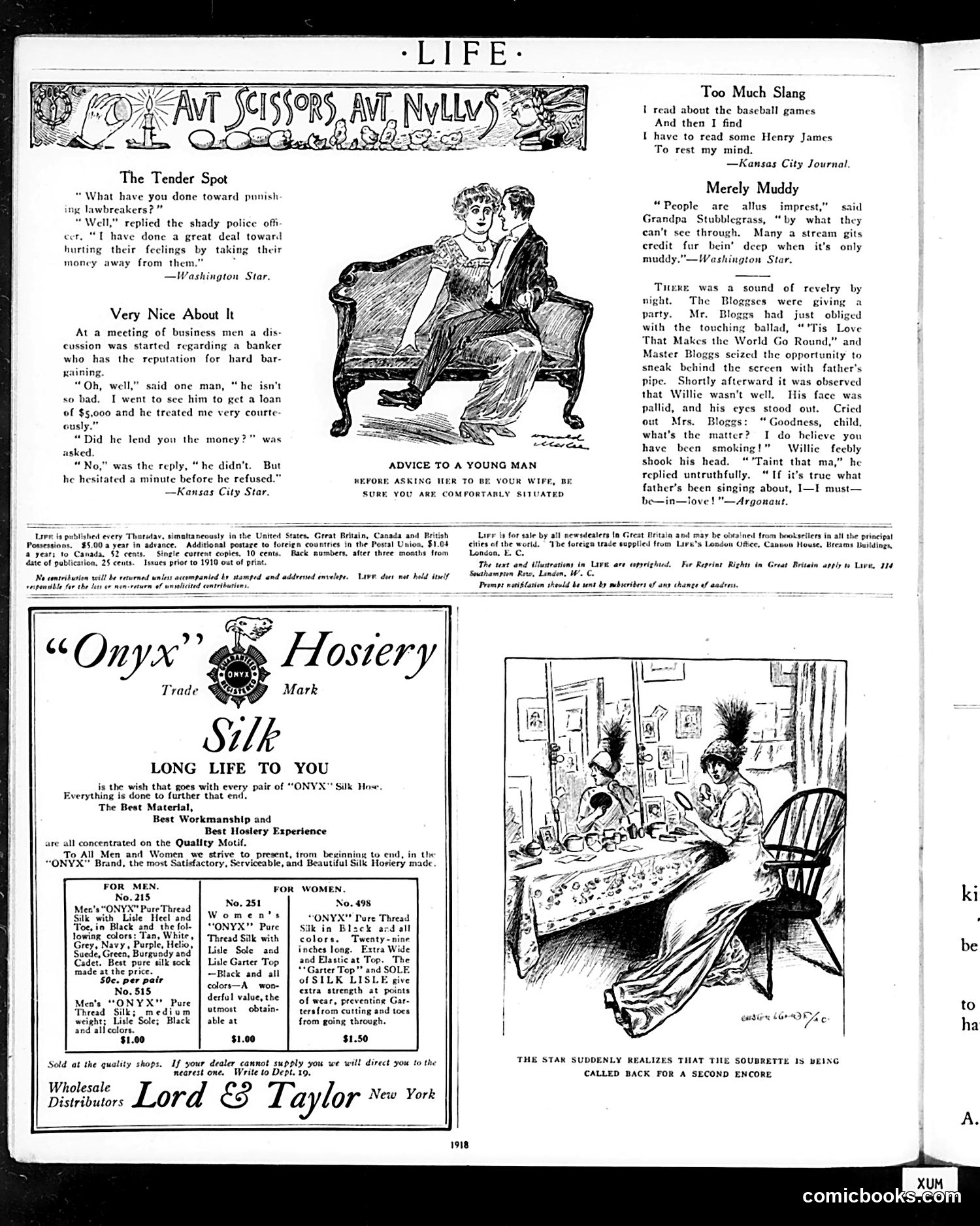
This page from Life magazine (1918) contains humorous short anecdotes and advertisements rather than political cartoons. **The humor pieces** mock social situations: a police officer who merely "hurts feelings" of lawbreakers instead of punishing them; a banker praised for courteously *refusing* a loan; and complaints about needing "Henry James to rest my mind" after reading baseball slang. **The main cartoon** depicts a boy at a party who's sneaked a smoke from his father's pipe and become ill. His mother assumes he's been smoking; he denies it, instead mumbling something about his father's recent song lyrics about love—a joke playing on both childhood mischief and romantic sentimentality. **The substantial advertising** for "Onyx" silk hosiery dominates the lower half, promoting quality and durability with different product lines for men and women at various price points ($0.50–$1.50). The page reflects early 20th-century middle-class humor and consumer culture rather than political satire.
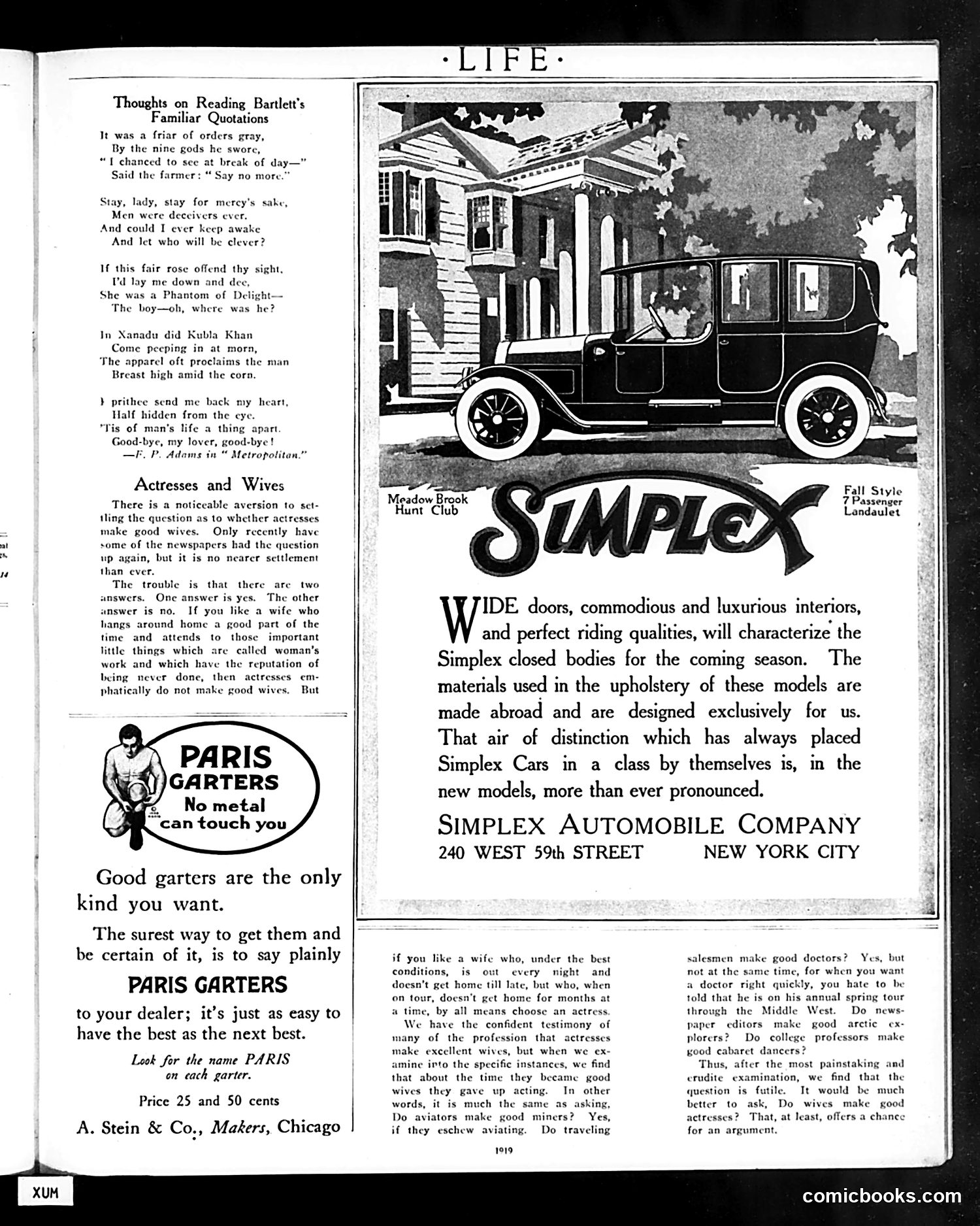
This page mixes literary satire with period advertising and social commentary. **"Thoughts on Reading Bartlett's Familiar Quotations"** is a humorous poem by F.P. Adams (attributed to *Metropolitan* magazine) that absurdly mashes together famous literary quotations, rendering them nonsensical. The joke targets pretentious familiarity with canonical literature—readers recognize fragments from poets like Coleridge and Byron but the mashup exposes how disconnected these quotes sound when combined. **"Actresses and Wives"** is satirical social commentary on a popular debate of the era: whether actresses made suitable wives. The piece argues the question is pointless—actresses who became good wives stopped acting, making the comparison meaningless (like asking if aviators make good miners "if they eschew aviating"). The satire targets both the debate's circularity and gender expectations about women's domestic vs. professional roles. The advertisements (Paris Garters, Simplex automobiles) are period product placements and are not satirical content.
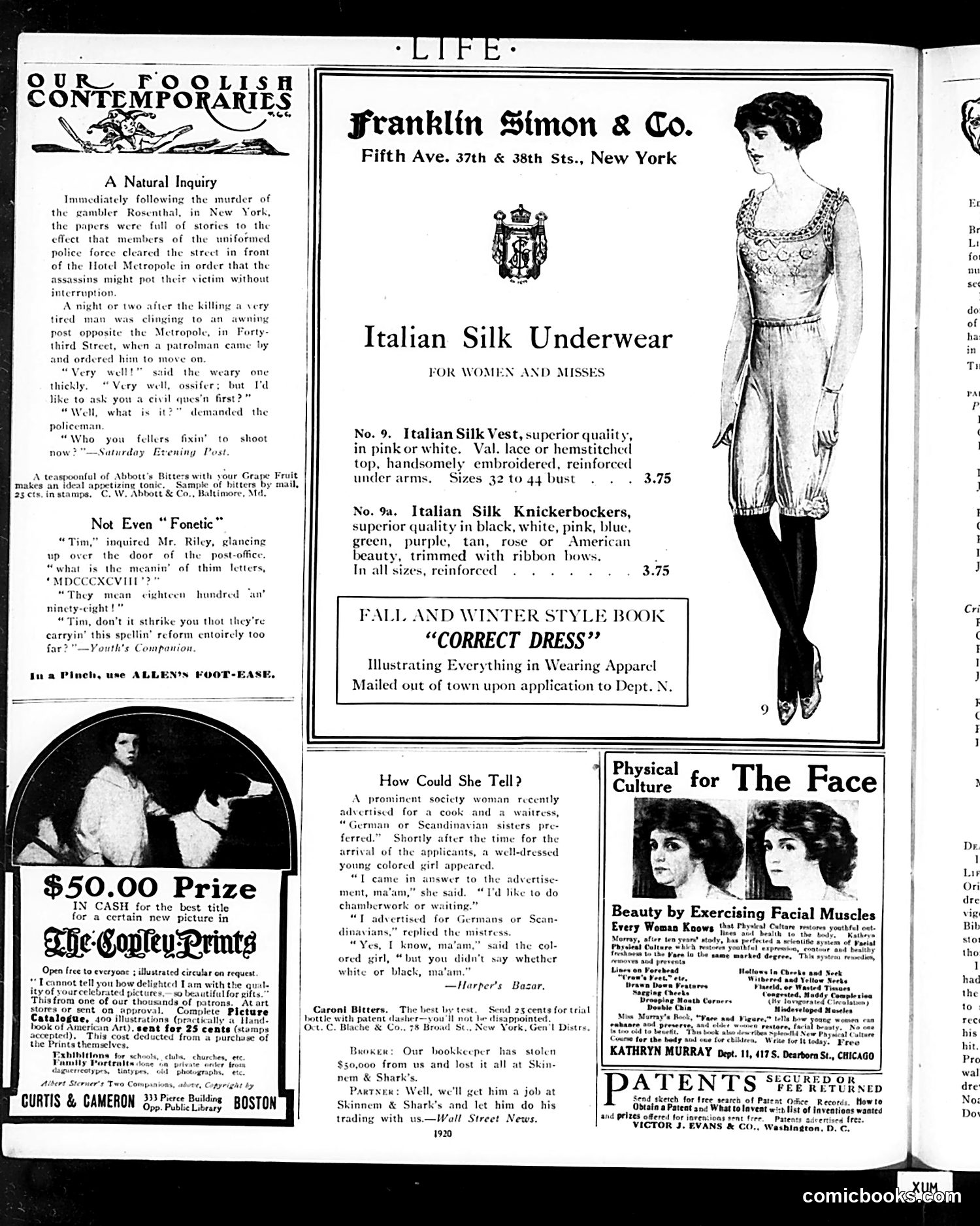
This page contains two main satirical pieces mocking corruption and social hypocrisy: **"A Natural Inquiry"** references the 1912 murder of gambler Herman Rosenthal in New York, where police allegedly allowed assassins access to their victim at the Hotel Metropole. The joke: a tired man accosted by a policeman sarcastically asks, "Who you fellers fixin' to shoot now?"—mocking widespread public suspicion that police were complicit in or enabled the killing. **"How Could She Tell?"** satirizes racial prejudice in hiring. A Black woman applies for domestic work, having seen an ad requesting "German or Scandinavian sisters." When the mistress clarifies they wanted white applicants, the woman notes the ad didn't specify race—exposing the hypocrisy of discriminatory hiring practices. Both pieces critique institutional corruption and racism through ironic understatement, typical of *Life*'s satirical approach to contemporary scandals and social injustice.
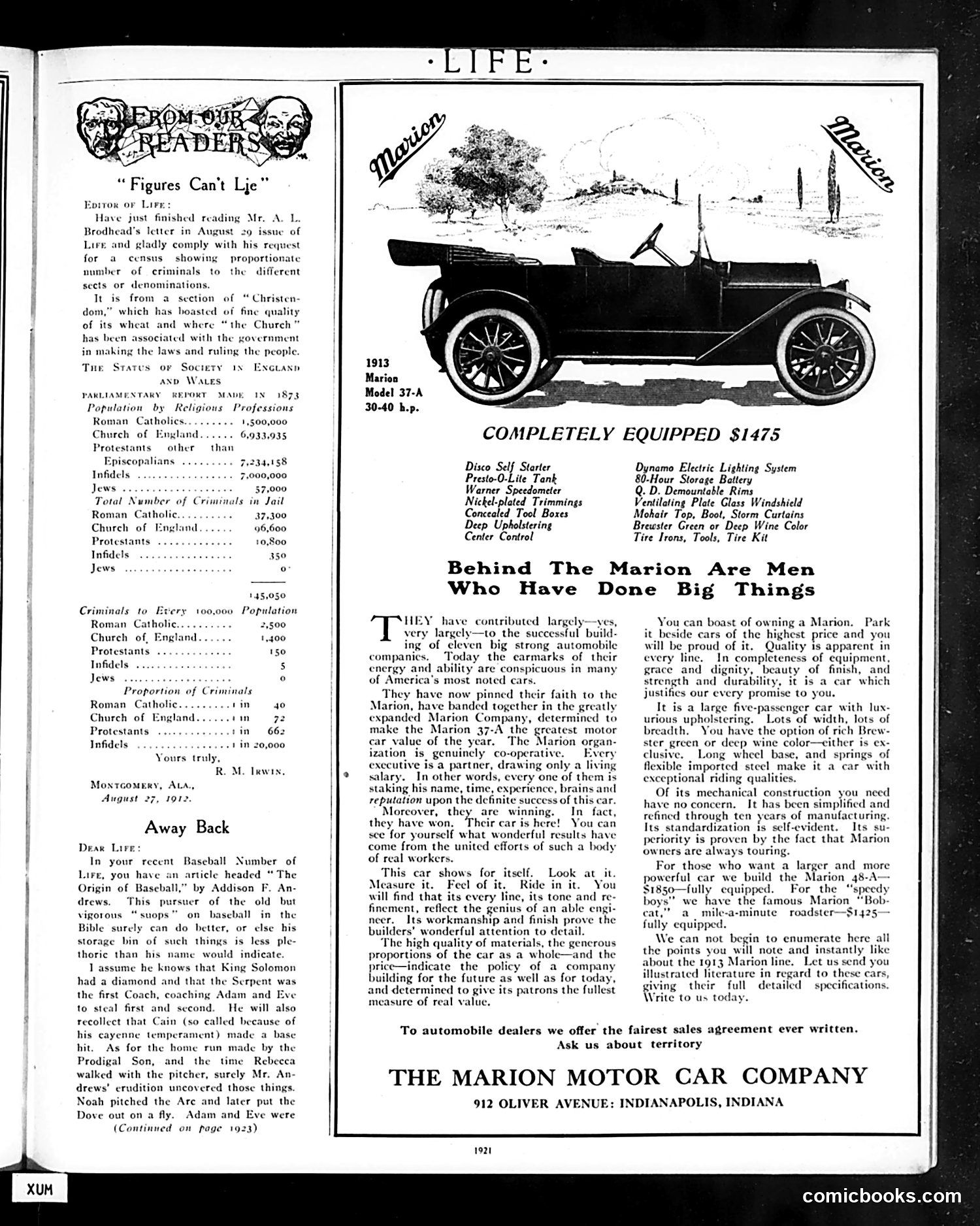
This page contains two distinct sections: **Left side:** A reader's letter presenting census data from 1873 England/Wales comparing religious denominations to criminal populations. The writer uses statistics to argue that "figures can't lie"—implying that certain religious groups (particularly "Infidels") have disproportionately low crime rates, while established churches show higher criminality. This appears to be satirizing claims about morality tied to religious affiliation, challenging Victorian assumptions about Christianity's civilizing influence. **Right side:** A Marion automobile advertisement emphasizing the car's quality, features, and $1,475 price. The ad highlights its "completely equipped" status and appeals to buyers with claims about the company's trustworthy leadership. The page juxtaposes social commentary with commercial messaging, typical of *Life* magazine's format mixing satire with advertising.
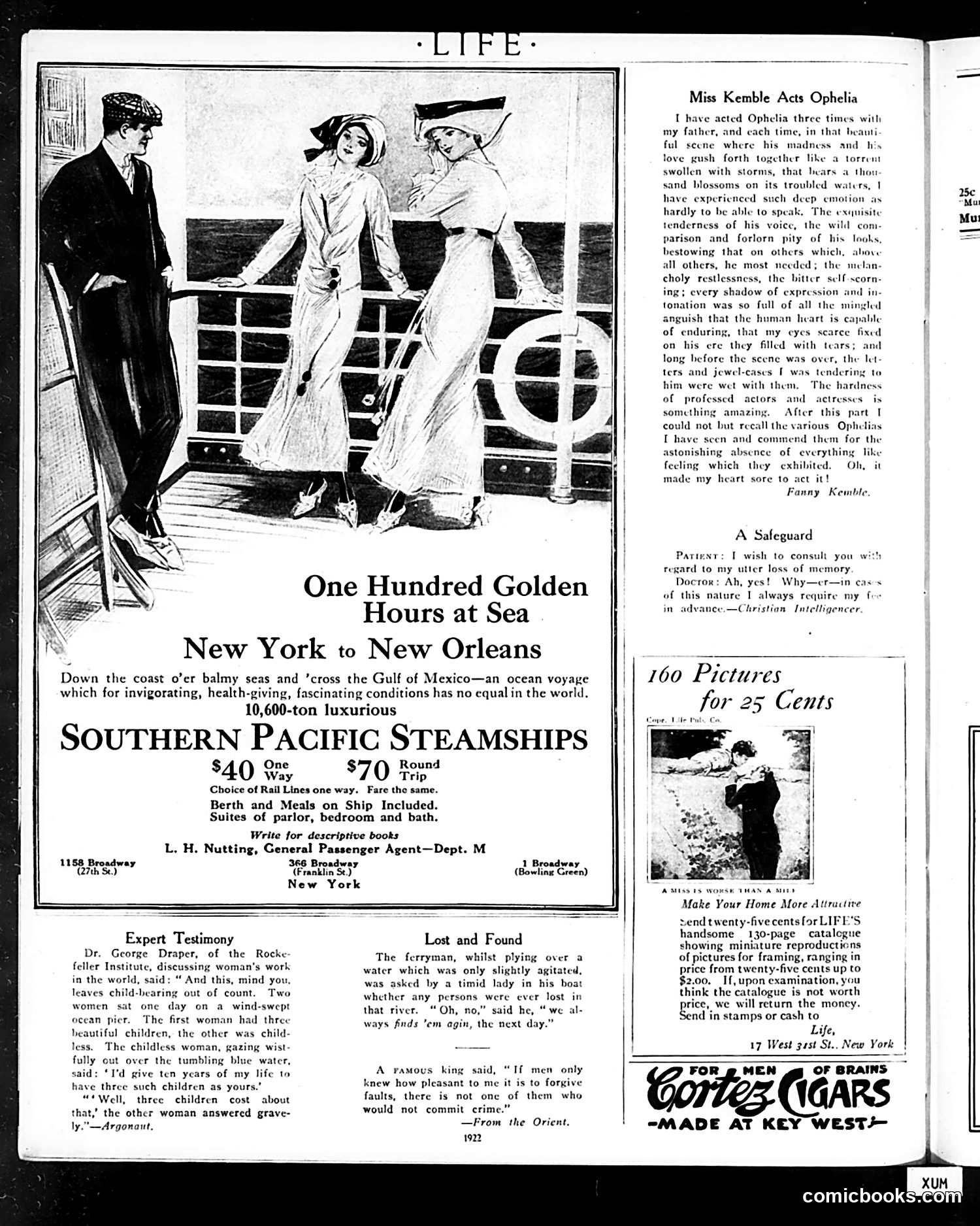
This page is primarily **advertising and miscellaneous content** rather than political satire. The main elements are: **Major Advertisement:** Southern Pacific Steamships promotes luxury ocean voyages from New York to New Orleans for $40-$70, emphasizing leisure travel with included meals and accommodations. **Filler Content:** The page includes brief anecdotes labeled "Expert Testimony," "Lost and Found," and "A Safeguard"—humorous short pieces typical of Life's format. These are gentle jokes: a ferryman reassuring a nervous passenger, a woman valuing motherhood, and a doctor's memory-loss pun. **Notable Section:** "Miss Kemble Acts Ophelia" features actress Fanny Kemble's recollection of performing Shakespeare, praising her father's emotional intensity while criticizing other actors' coldness. The page also advertises picture reproductions and Cortez cigars. Overall, this represents Life's blend of satirical humor, celebrity commentary, and commercial advertising—not focused political cartooning.
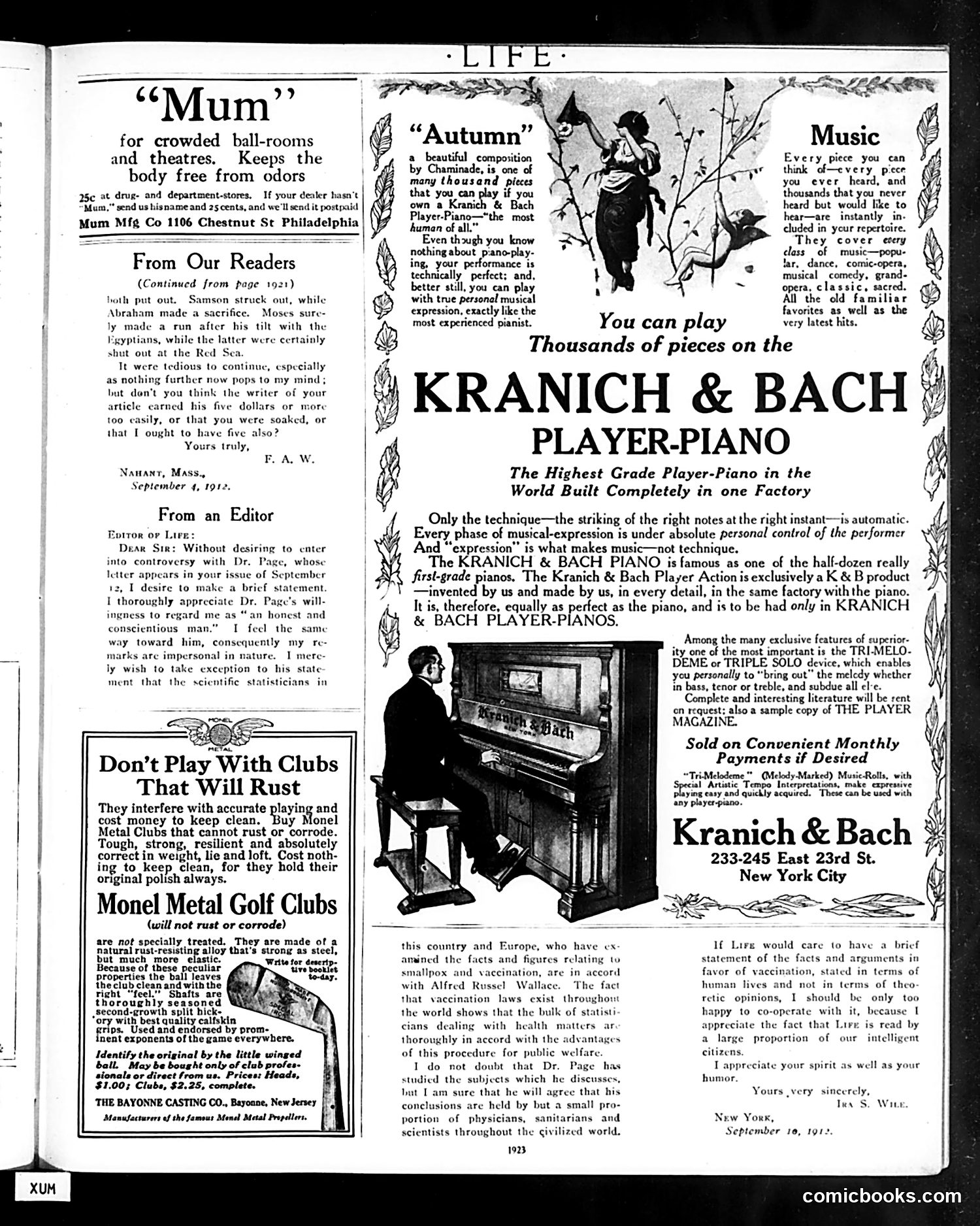
This page is primarily **advertisements and reader letters**, not political satire. The visible content includes: - **Product ads**: "Mum" deodorant, Monel Metal Golf Clubs (rust-resistant), and a Kranich & Bach player piano - **Reader letters section**: One humorous letter compares a baseball article to Biblical figures (Samson, Abraham, Moses) making "runs" and "sacrifices"—a baseball pun that earned the writer's complaint about the article's five-dollar payment - **Editorial response**: The editor responds to a controversy with Dr. Page regarding **vaccination statistics and public health**, defending scientific disagreement while maintaining civility The vaccination discussion references a contemporary debate over mandatory vaccination laws—Dr. Page apparently challenged their effectiveness or necessity, while the editor argues that worldwide vaccination laws prove medical consensus supports them. The page reflects early 20th-century concerns: hygiene products, leisure activities (golf), home entertainment (player pianos), and public health debates.
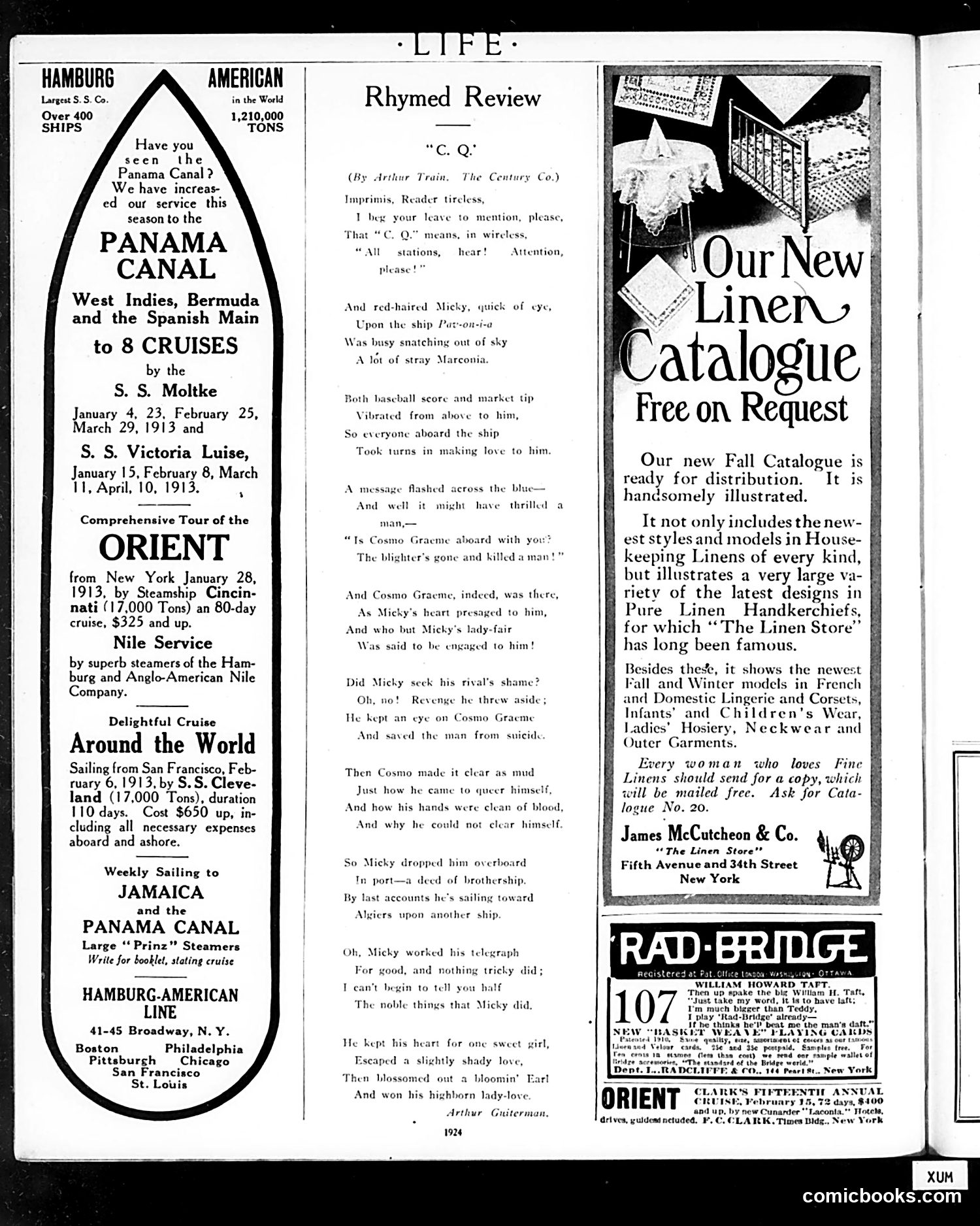
This page is primarily **advertising and literary content**, not political satire. The dominant feature is a humorous narrative poem titled "C.Q." by Arthur Guiterman, about a wireless operator named Micky aboard a ship. The story involves drama surrounding a passenger named Cosmo Graeme, who has allegedly killed someone. Micky, the noble wireless operator, prevents Cosmo's suicide and helps clear his name—ultimately saving the man through honorable character and restraint. The poem concludes with Micky winning his own "highborn lady-love." The page also contains **Hamburg-American shipping line advertisements** promoting luxury cruises to the Orient, Panama Canal, Jamaica, and around the world—reflecting the era's booming transatlantic travel industry. A secondary advertisement promotes **James McCutcheon & Co.'s linen catalogue**, featuring household linens and women's garments. The content reflects 1913 popular entertainment: maritime adventure stories, wireless technology as modern marvel, and aspirational travel marketing for affluent readers.
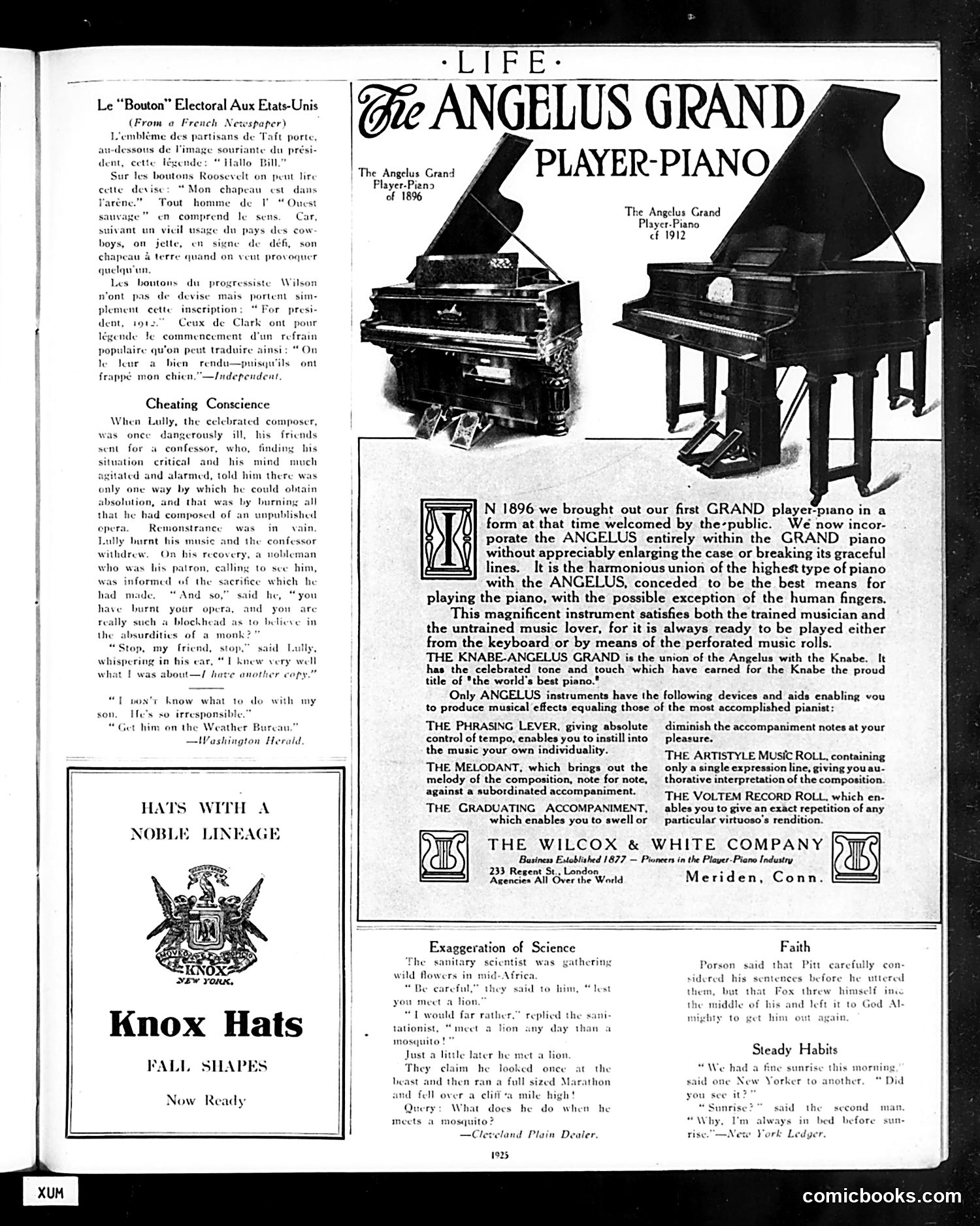
This page is primarily **advertising**, not political commentary. The dominant content is a full-page advertisement for the Angelus Grand Player-Piano by Wilcox & White Company, showcasing piano models from 1896 and 1912. The small political cartoon in the upper left, titled "Le 'Bouton' Electoral Aux États-Unis" (The Electoral Button in the United States), appears to reference **U.S. presidential campaign buttons** from what seems to be the 1912 election. The French source critiques how different candidates' supporters wore buttons with different slogans—Roosevelt/Taft supporters wore buttons saying "Hallo Bill," while Wilson and Clark supporters had different inscriptions. The joke likely concerns how American political campaigns used such buttons to signal allegiance, a practice seemingly noteworthy or amusing to French observers. The remaining articles ("Cheating Conscience," "Exaggeration of Science," "Faith," "Steady Habits") are brief anecdotes unrelated to the political cartoon. "Hats with a Noble Lineage" advertises Knox Hats.
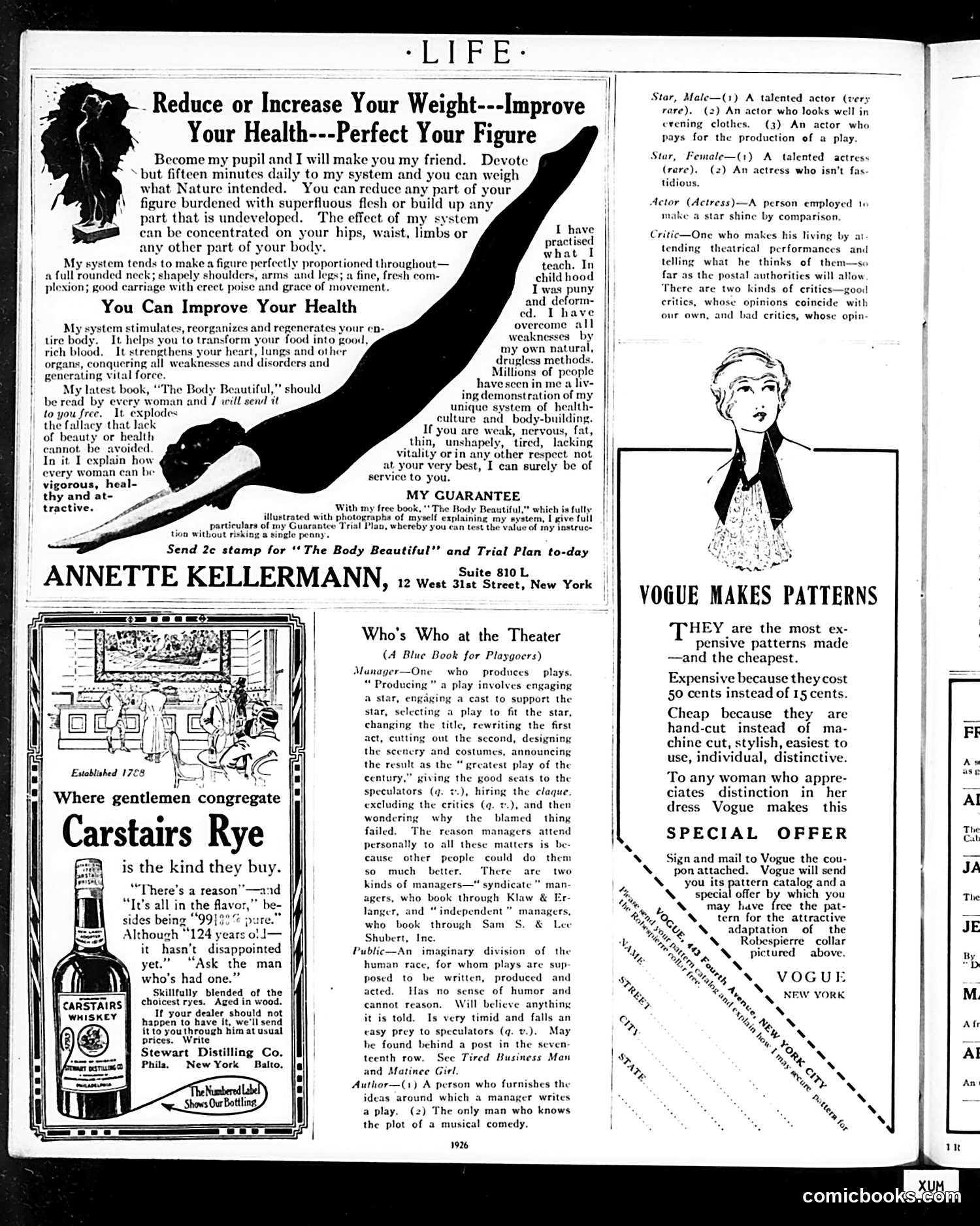
This page contains two main elements: **Left Side:** A fitness/health advertisement from Annette Kellermann, a real swimmer and actress, promoting her body-building system. She claims her method can redistribute body weight to specific areas (hips, waist, limbs) and improve overall health. This represents early-20th-century fitness marketing—note the appealing to women's anxieties about appearance and the grandiose claims typical of the era. **Right Side:** A satirical "Blue Book for Playgoers" defining theater industry terms. The humor targets pretentious theater culture: a "Manager" is someone who produces plays but actually just hires stars and fires critics; "Public" is an imaginary audience without sense or humor; and "Author" is someone whose ideas a manager rewrites. The satire mocks how theater production prioritizes star power and profit over artistic integrity—a critique that remains relevant today.
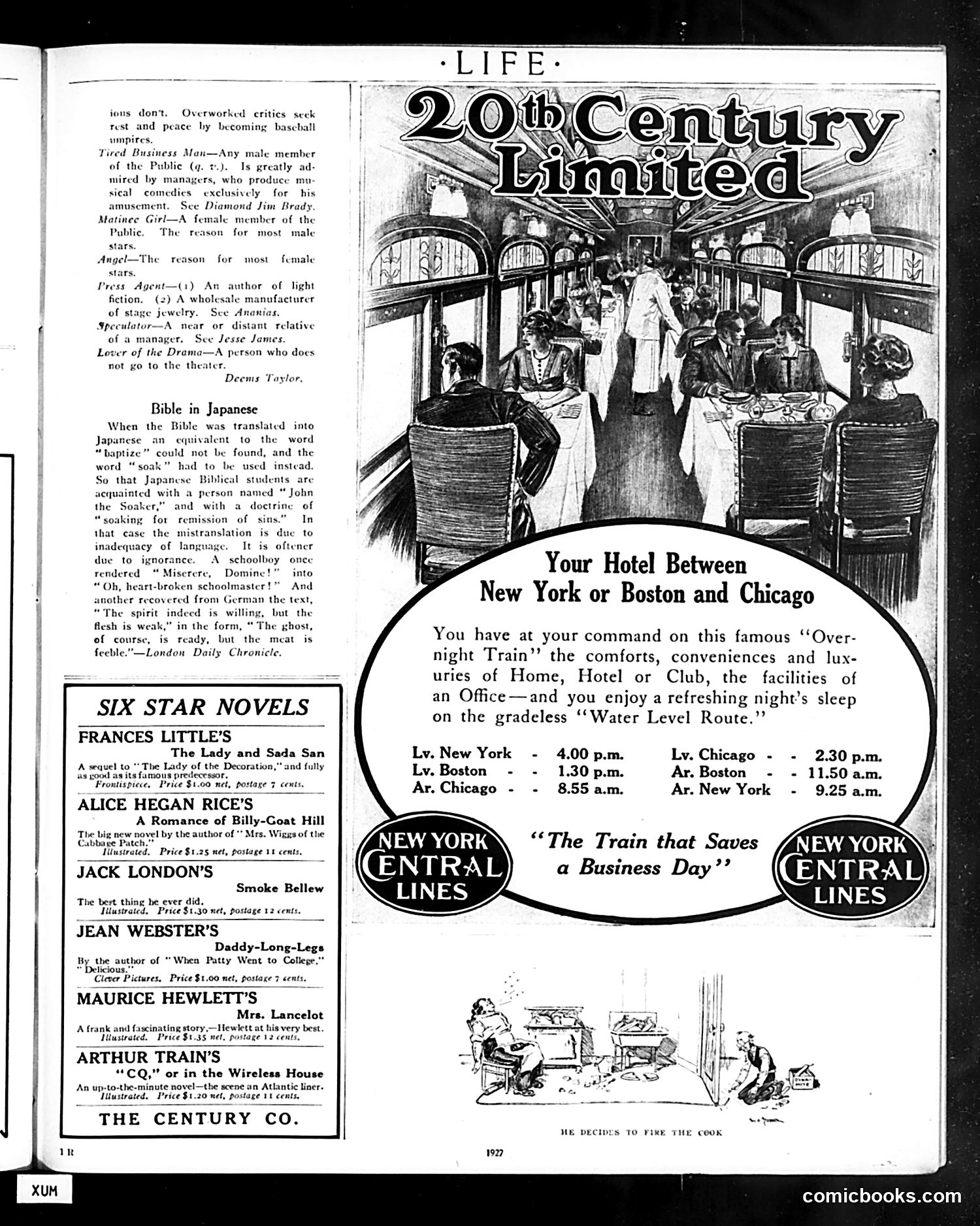
This page mixes theatrical satire with advertising. The left column contains **theatrical definitions** by composer Deems Taylor—cynical takes on Broadway types. For example, a "Tired Business Man" is satirized as the target audience managers cynically create musicals for; an "Angel" is a financial backer; a "Lover of the Drama" is someone who avoids theaters entirely. These mock the commercial calculation behind Broadway productions. Below is a humorous anecdote about Bible translation into Japanese, where "baptize" became "soak," creating absurd results like "John the Soaker." The right side is dominated by a **20th Century Limited railroad advertisement** showing a luxury overnight train between New York/Boston and Chicago, marketed as combining home comfort with business efficiency—"The Train that Saves a Business Day." The illustration depicts well-dressed passengers in an elegant dining car. The bottom cartoon (unclear without full visibility) appears to show domestic humor involving a cook. Overall: a typical Life page blending theatrical commentary with commercial advertising.
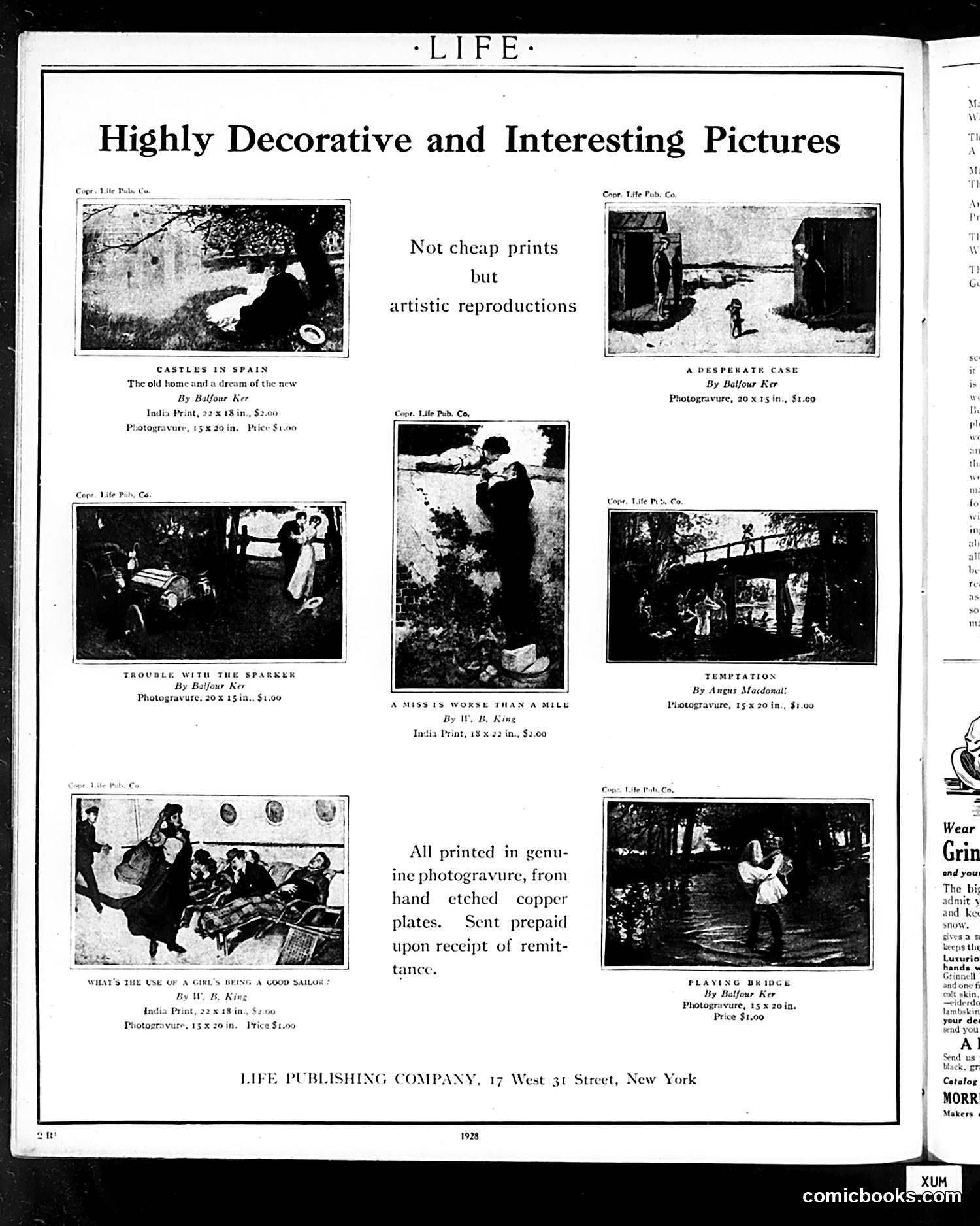
This is an **advertisement page**, not satirical content. Life Publishing Company is marketing artistic photogravure prints—high-quality reproductions from hand-etched copper plates—priced at $1.00 to $2.00 each. The page displays seven sample images with dramatic, narrative titles: "Castles in Spain," "A Desperate Case," "A Miss Is Worse Than a Mule," "Temptation," "Trouble with the Sparkler," "What's the Use of a Girl's Being a Good Sailor?," and "Playing Bridge." These appear to be sentimental or humorous domestic scenes typical of 1920s popular taste—romantic moments, domestic comedies, and social situations. Artists credited include Balfour Ker, W.B. King, and Angus Macdonald. The advertisement emphasizes that these are "not cheap prints but artistic reproductions," appealing to middle-class consumers seeking affordable yet respectable home decoration. The emphasis on photogravure quality and hand-etched plates positions these as legitimate art, not mass-market kitsch.
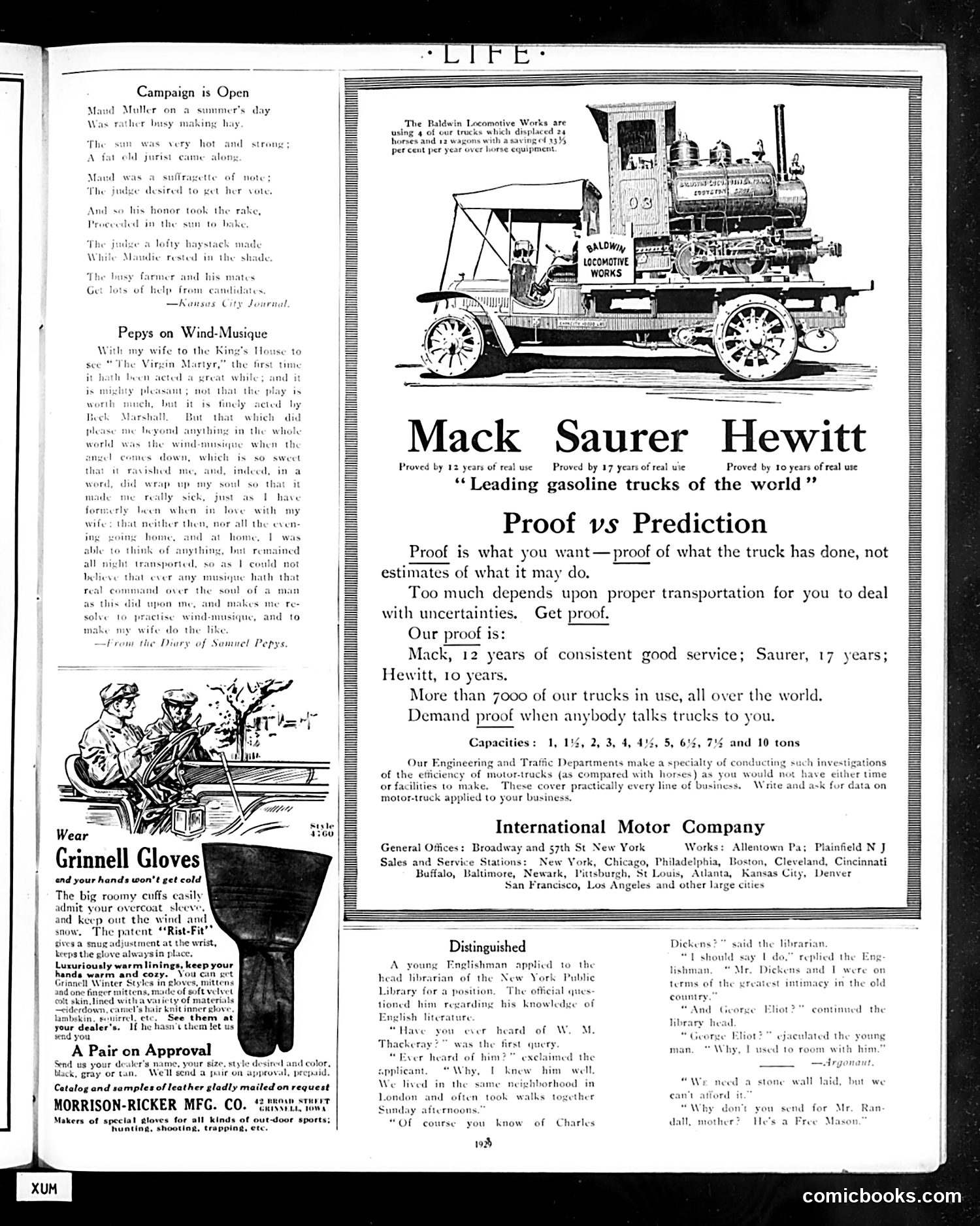
This page is primarily **advertising and filler content**, not political satire. The main elements are: **Central Advertisement**: International Motor Company promotes three truck brands (Mack, Saurer, Hewitt) with an illustration of a truck carrying a locomotive. The pitch emphasizes "Proof vs Prediction"—demanding customers verify trucks' actual performance records (12, 17, and 10 years of service respectively) rather than empty promises. **Sidebar Content**: - Poetry about "Campaign is Open" (unclear context) - Samuel Pepys diary excerpt about wind-music - Grinnell Gloves advertisement - Morrison-Ricker glove company ad - Brief humorous dialogue about English literary figures (Thackeray, Dickens, George Eliot) where a job applicant claims personal acquaintance **Overall**: This appears to be a standard early 20th-century magazine page mixing commercial advertisements with light humor and classical literary references—typical filler between editorial content rather than intentional political or social satire.
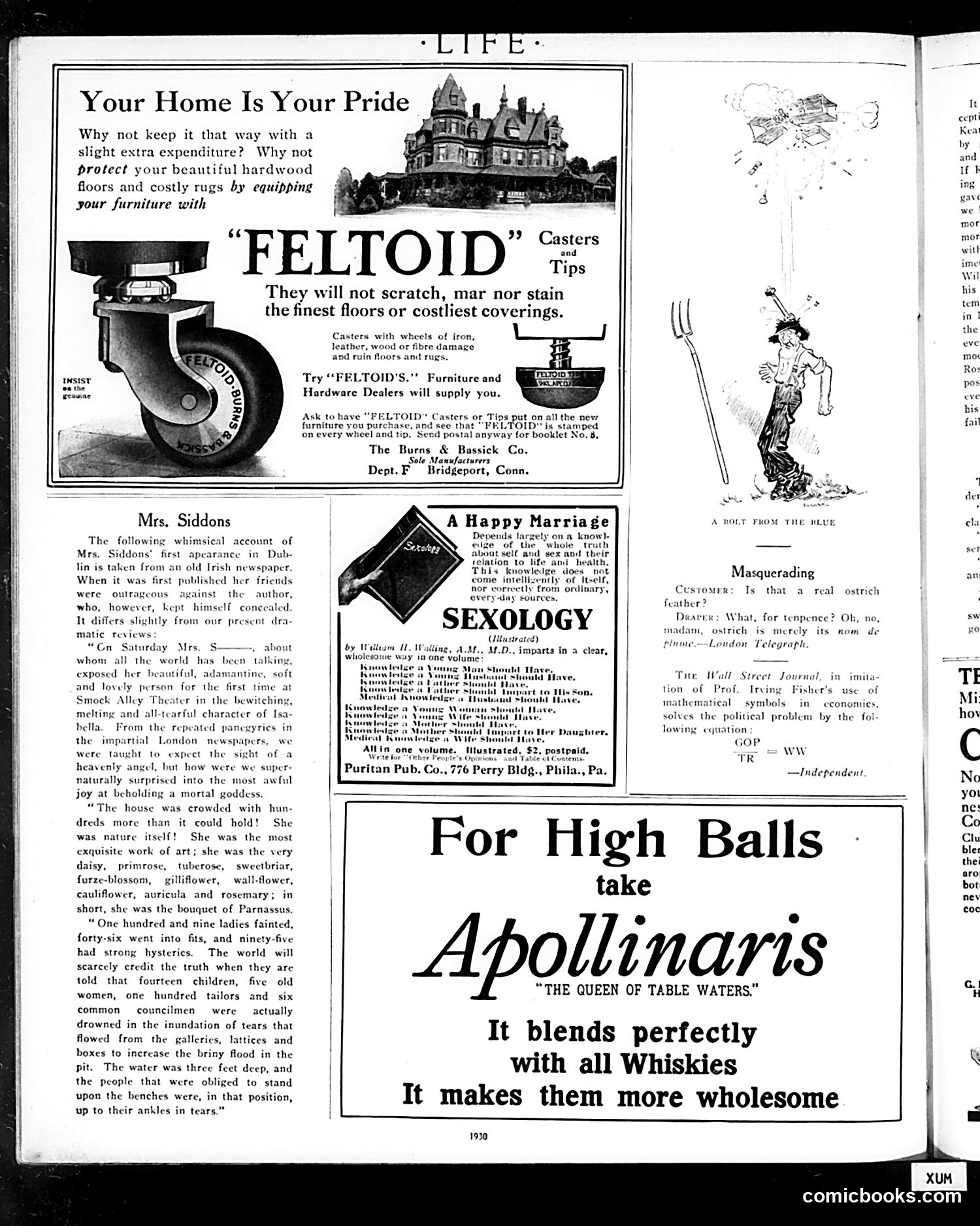
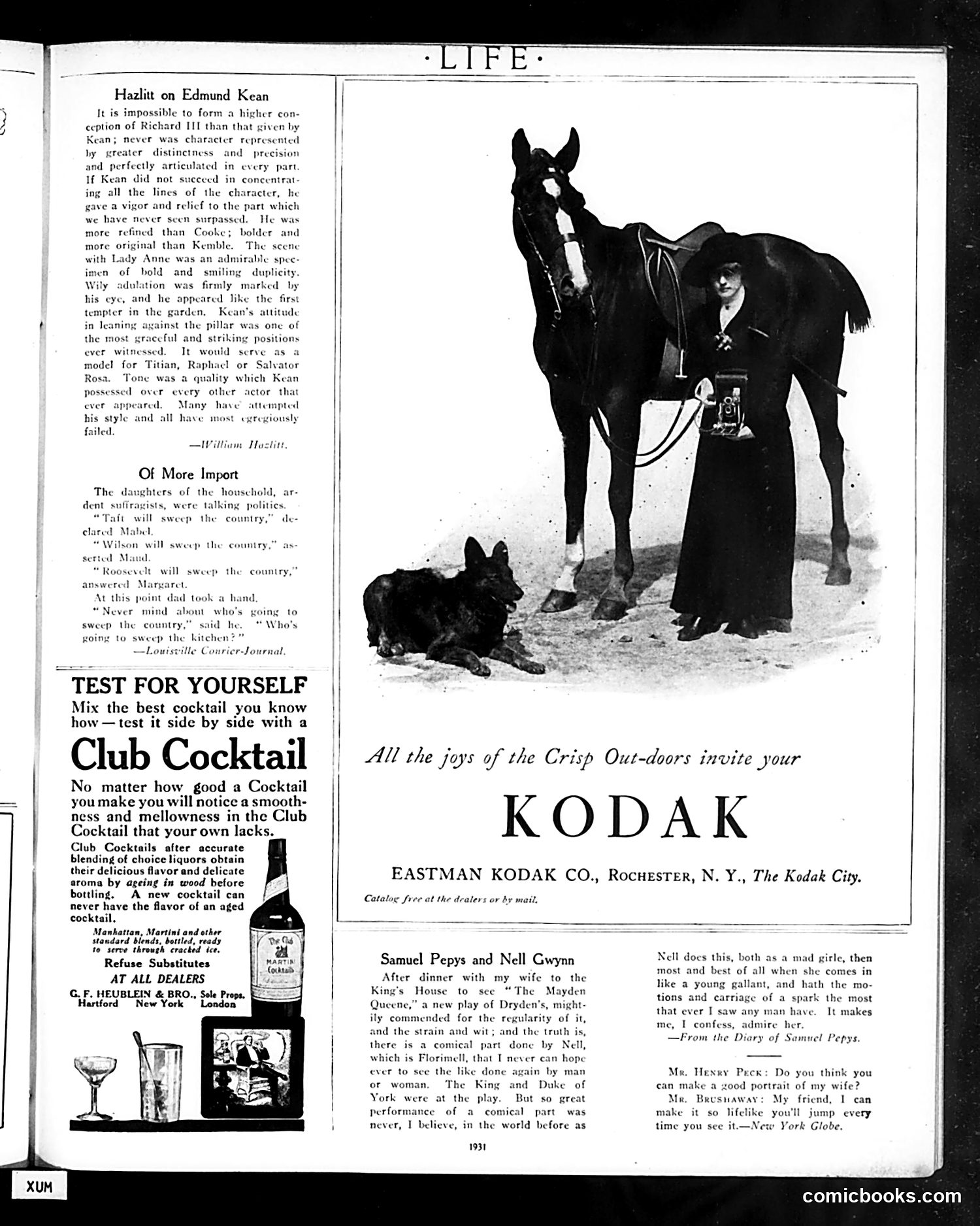
This page combines literary commentary, political satire, and advertising typical of Life magazine circa 1931. **Main Content:** The top features William Hazlitt's praise of actor Edmund Kean's performance as Richard III—a straightforward theatrical critique. **The Satire ("Of More Import"):** A short joke mocking female suffragists. Three daughters argue about which political candidate—Taft, Wilson, or Roosevelt—will "sweep the country." Their father interrupts with a dismissive punchline: "Never mind about who's going to sweep the country. Who's going to sweep the kitchen?" The satire targets early 20th-century feminism by suggesting women's political engagement is absurd—implying their "proper" domestic role supersedes voting rights. This reflects anti-suffrage sentiment, though by 1931 women had already won the vote (1920). **Also Featured:** A Kodak advertisement with an equestrian photograph, Club Cocktail advertising, and a period joke about portrait photography. The page reflects the magazine's mix of cultural commentary and conservative social humor.
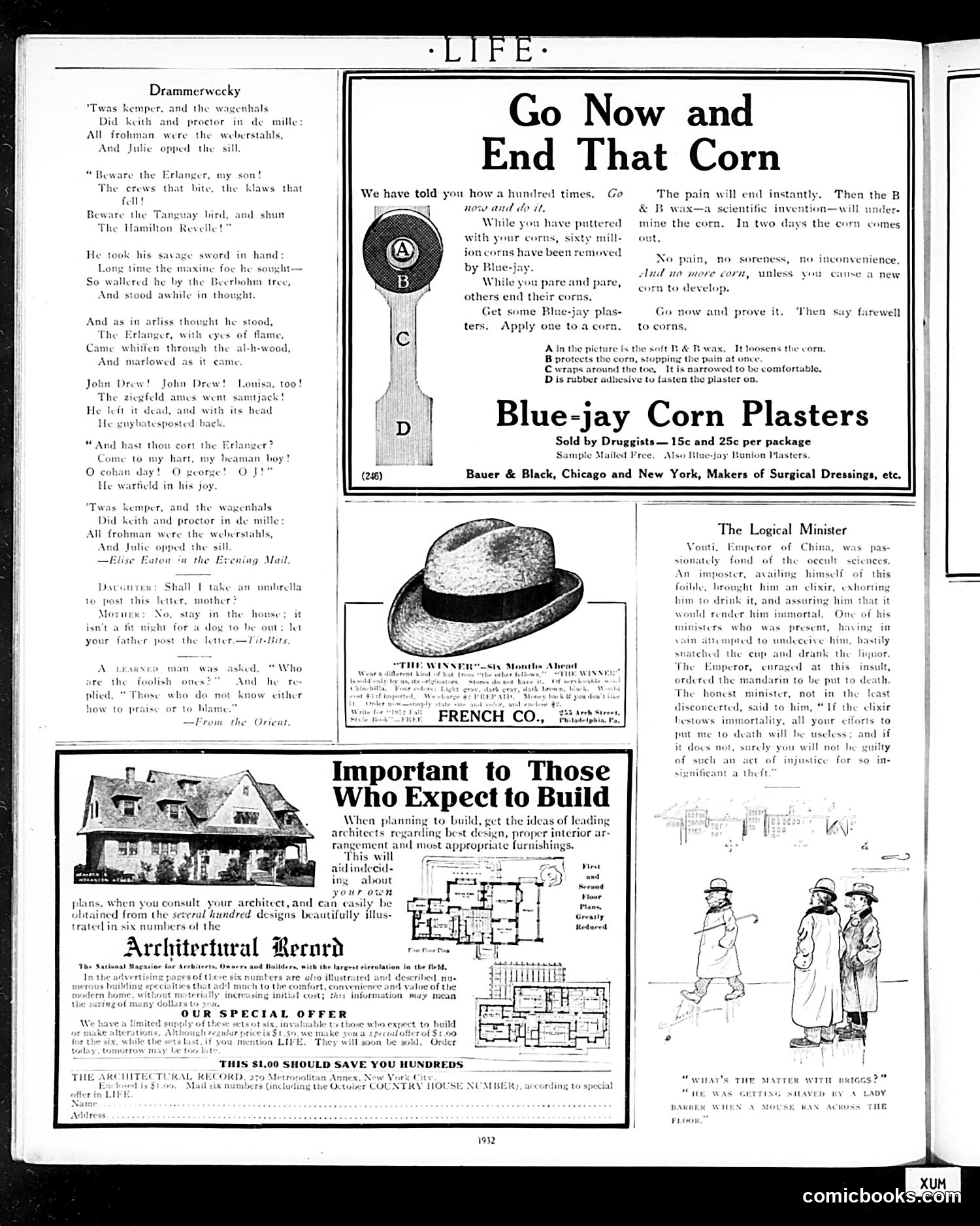
This page contains several distinct elements: **"Drammerwecky" (top left):** A parody poem in the style of Lewis Carroll's "Jabberwocky," mocking Broadway theater figures. The garbled names (Kemper, Wagenhals, Keith, Proctor, De Mille, Frohman) reference real theatrical producers and performers of the era. The satire ridicules their dramatic pretensions and theatrical feuds—particularly references to impresario Abe Erlanger, a notorious figure in theater disputes. **Advertisement section:** The bulk of the page promotes Blue-jay Corn Plasters (a medical product) and the Architectural Record magazine, typical of Life's advertising revenue model. **"The Logical Minister":** A brief humorous anecdote about a Chinese emperor and a deceptive minister claiming an immortality elixir—a light satirical tale with no obvious contemporary political reference. **Small cartoon (bottom right):** A simple gag about a man getting shaved while a mouse runs across the floor—straightforward domestic humor. The page reflects Life's dual identity as both satirical commentary on entertainment figures and a general-interest magazine filled with advertisements.
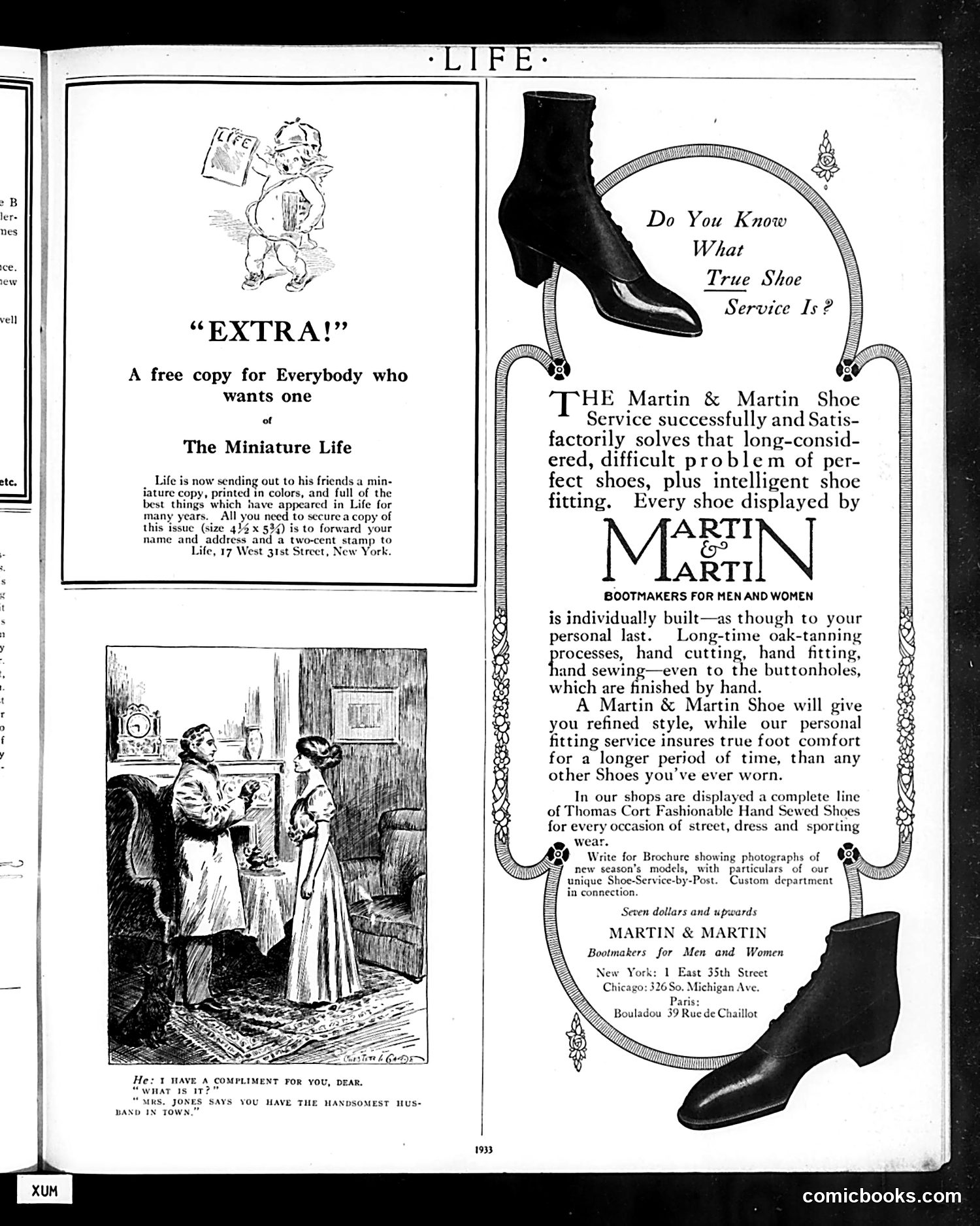
This page contains two distinct elements: **satirical cartoon and advertising**. **The Cartoon (left):** A sketch labeled "EXTRA!" promotes *Life* magazine's miniature edition. It shows a newsboy-style figure hawking the publication, inviting readers to request free copies by mail. This is self-promotional content—*Life* itself advertising its own product. **The Scene Below:** A domestic interior sketch (caption partially visible) appears to depict a husband receiving a compliment about his wife from a neighbor, with humor based on marital dynamics or social propriety of the era. **The Advertisement (right):** Martin & Martin bootmakers promote handcrafted shoes emphasizing quality construction—hand-tanning, hand-cutting, hand-sewing. The ad targets middle-to-upper-class consumers seeking luxury footwear and personalized service, with locations in New York, Chicago, and Paris. The page primarily functions as a **commercial vehicle** for *Life* magazine and paying advertisers, rather than presenting satirical commentary on political or social issues.
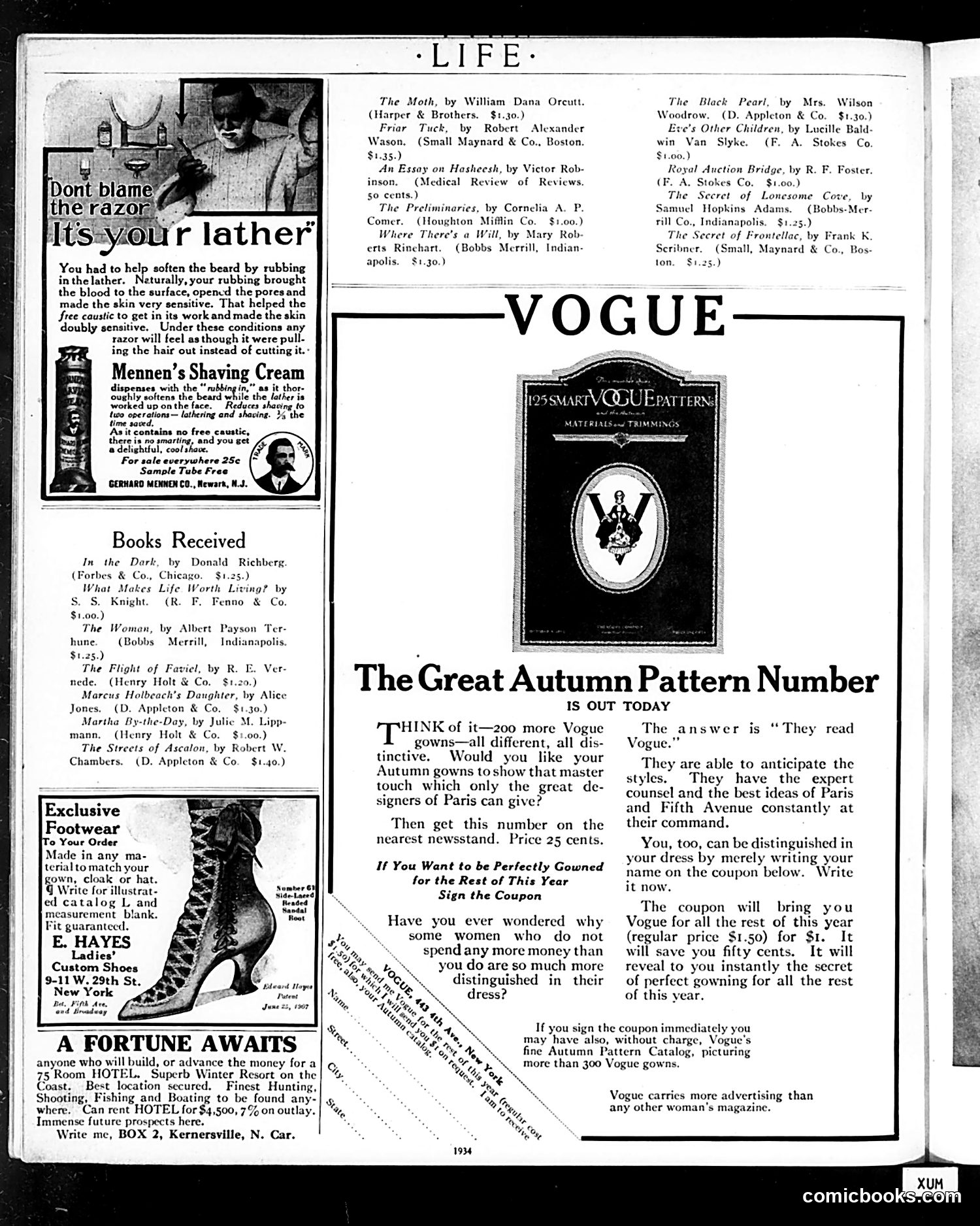
This page is primarily **advertising and book reviews**, not political satire. The content reflects early 20th-century consumer culture: **Main Elements:** 1. **Mennen's Shaving Cream ad** (left): Uses a pseudo-scientific explanation to sell the product—claiming it softens beards without "free caustic" irritants, unlike competitors. This reflects the era's marketing strategy of competing on product chemistry. 2. **Vogue Pattern Advertisement** (center/right): The dominant feature promotes Vogue's "Great Autumn Pattern Number" (200 dress designs). The copy suggests that women who read Vogue appear more "distinguished" because they access Paris fashion trends before others—essentially selling aspiration and social status through fashion magazines. 3. **Book Reviews & E. Hayes Footwear ads**: Standard period advertisements for customized shoes and luxury resort hotels. **Historical Context**: This reflects 1934 consumer capitalism targeting middle/upper-class readers, emphasizing that purchasing the right products (shaving cream, fashion patterns, custom shoes) confers sophistication and social distinction.
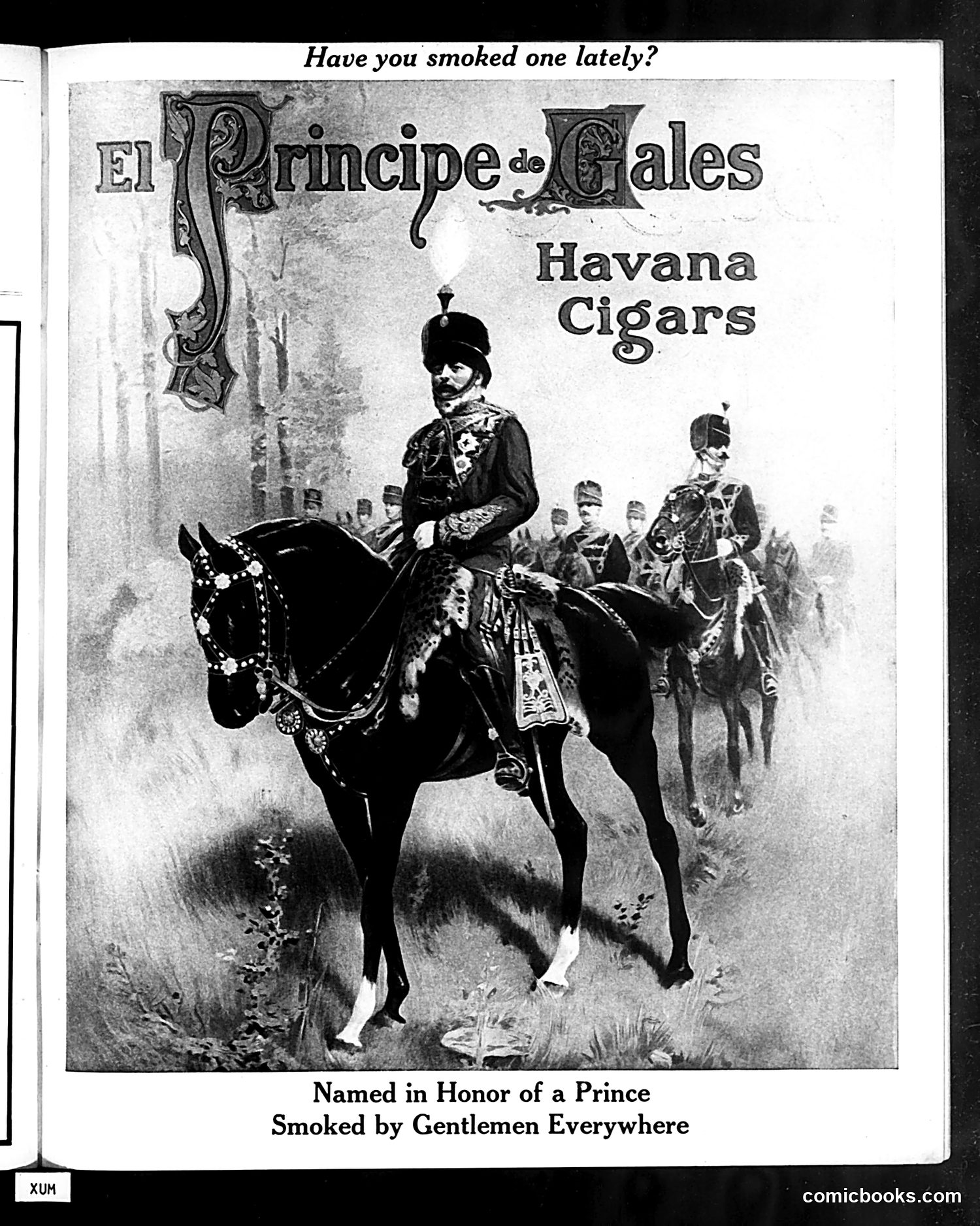
This is a **cigar advertisement** for "El Príncipe de Gales" (The Prince of Wales) Havana Cigars, not political satire. The image depicts a military or royal figure on horseback, elaborately dressed in ornate uniform with decorative saddle and bridle, followed by uniformed attendants or soldiers. The advertisement associates the cigar with royalty and prestige—"named in honor of a prince" and marketed as something "smoked by gentlemen everywhere." The elaborate military pageantry and formal dress serve to convey luxury and exclusivity. The phrase "Have you smoked one lately?" at the top functions as a rhetorical sales pitch, suggesting these cigars are a familiar luxury good among the target audience of affluent men. This represents early 20th-century advertising strategy: selling products through association with wealth, status, and gentlemanly refinement.
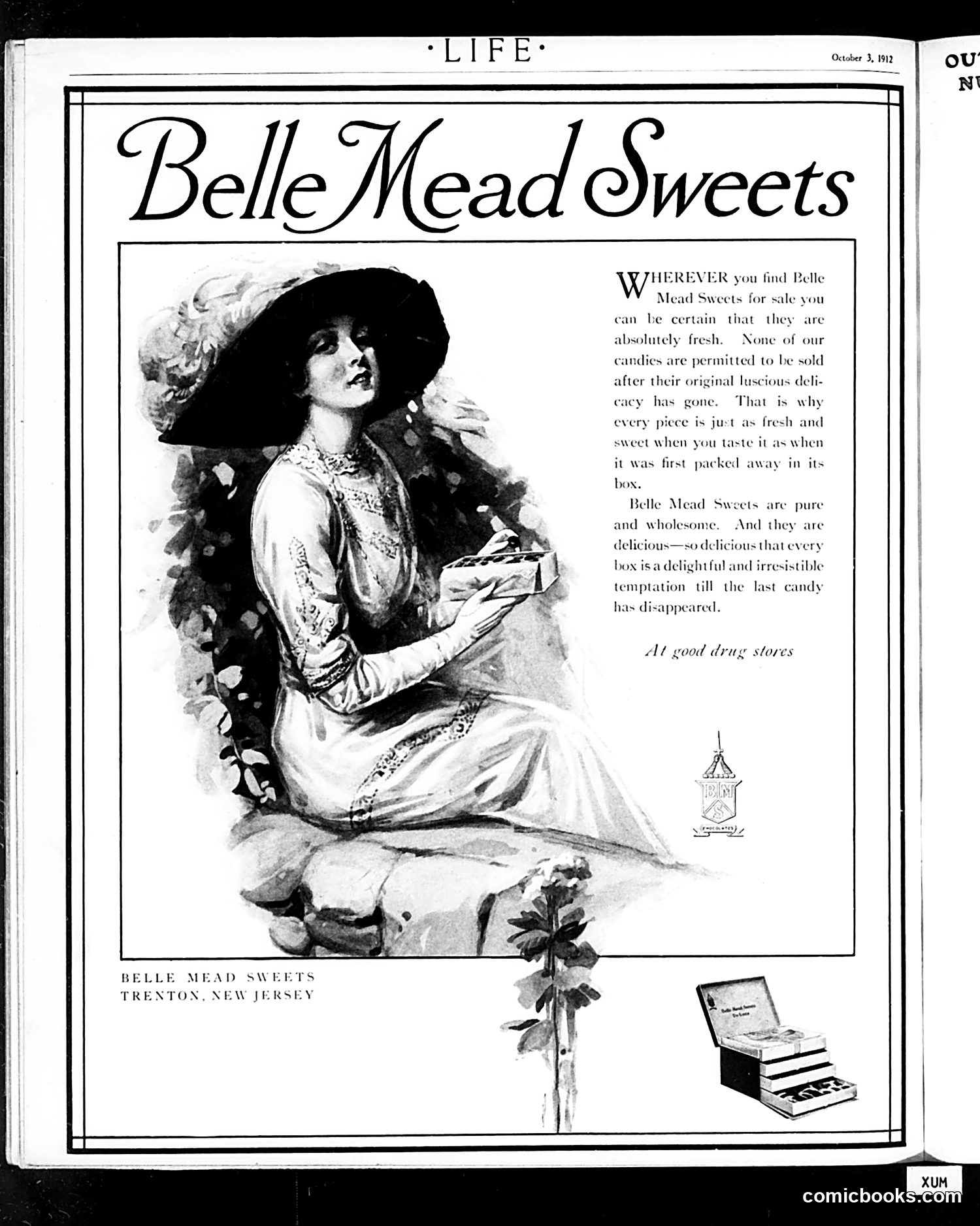
This is a straightforward advertisement, not political satire. It promotes Belle Mead Sweets candy from Trenton, New Jersey, published in *Life* magazine on October 3, 1912. The page features an illustrated woman in elegant Edwardian dress holding a candy box, appealing to early 20th-century notions of femininity and refinement. The ad emphasizes product freshness and purity—selling points for candy manufacturers of that era when food preservation was a genuine consumer concern. The text claims candies are never sold after losing "delicacy" and promises each box remains fresh "as when it was first packed away." This addresses real anxieties about food quality in an era before modern packaging standards. The image and messaging target affluent consumers who could afford premium confectionery as gifts or personal indulgence.