
Life, 1912-10-03 · page 18 of 56
Life — October 3, 1912 — page 18: what you’re looking at
What you’re looking at
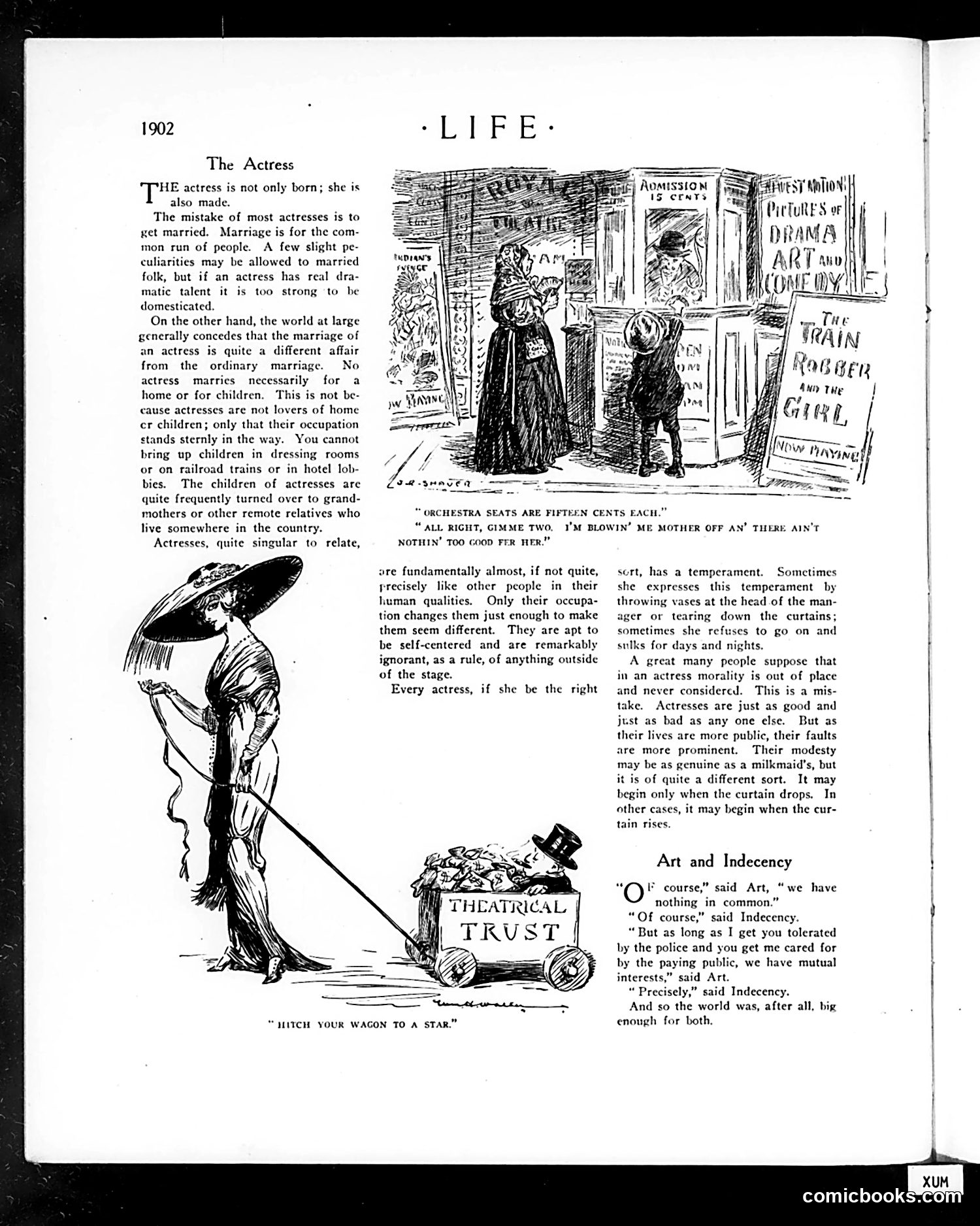
This page satirizes theatrical life and the public's perception of actresses. The main article argues actresses are fundamentally ordinary people whose profession merely makes them *seem* different—self-centered, temperamental, and morally suspect to society, though no worse than anyone else. The cartoon captioned "Hitch Your Wagon to a Star" shows a figure pulling a cart labeled "Theatrical Trust," illustrating the common phrase meaning to pursue ambitious goals. The street scene depicts working-class people discussing theater—one offers to buy orchestra seats ("gimme two") for his mother, calling her "mother off," suggesting theater as accessible entertainment. The "Art and Indecency" dialogue is satirical commentary: Art and Indecency are personified as mutually dependent partners—the public tolerates risqué theater because it attracts paying audiences, creating symbiotic interests. This reflects early-1900s debates about theatrical morality and censorship.
📄 Transcribed text from this page (OCR, searchable)
Machine-transcribed from the original scan — historical spelling and the odd misread are preserved.
1902 The Actress HE actress is not only born; she is also made. The mistake of most actresses is to get married. Marriage is for the com- mon run of people. A few slight pe- culiarities may be allowed to married folk, but if an actress has real dra- matic talent it is too strong to be domesticated. On the other hand, the world at large generally concedes that the marriage of an actress is quite a different affair from the ordinary marriage. No actress. marries necessarily for a home or for children. This is not be- cause actresses are not lovers of home cr children; only that their occupation stands sternly in the way. You cannot bring up children in dressing rooms or on railroad trains or in hotel lob- bies. The children of actresses are quite frequently turned over to grand- mothers or other remote relatives who live somewhere in the country. Actresses, quite singular to relate, Avatssion 1S CENTS “ORCHESTRA SEATS ARE FIFTEEN CENTS EACH.” “ ALL RIGHT, GIMME TWO, NOTHIN’ TOO GOOD FER HER.” ure fundamentally almost, if not quite, precisely like other people in their human qualities. Only their occupa- tion changes them just enough to make them seem different. They are apt to be self-centered and are remarkably ignorant, as a rule, of anything outside of the stage. Every actress, if she be the right “MITCH YOUR WAGON TO A STAR.” I'M BLOWIN’ ME MOTHER OFF AN’ THERE AIN'T sort, has a temperament. Sometimes she expresses this temperament by throwing vases at the head of the man- ager or tearing down the curtains; sometimes she refuses to go on and sulks for days and nights. A great many people suppose that in an actress morality is out of place and never considered. This is a mis- take. Actresses are just as good and just as bad as any one els But as their lives are more public, their faults are more prominent. Their modesty may be as genuine as a milkmaid’s, but it is of quite a different sort. It may begin only when the curtain drops. In other cases, it may begin when the cur- tain rises. Art and Indecency ‘“O course,” said Art, “ nothing in common.” Of course,” said Indecency. “But as long as I get you tolerated by the police and you get me cared for by the paying public, we have mutual interests,” said Art. “ Precisely,” said Indecency. And so the world was, after all, big enough for both, we have