
Life, 1912-10-03 · page 27 of 56
Life — October 3, 1912 — page 27: what you’re looking at
What you’re looking at
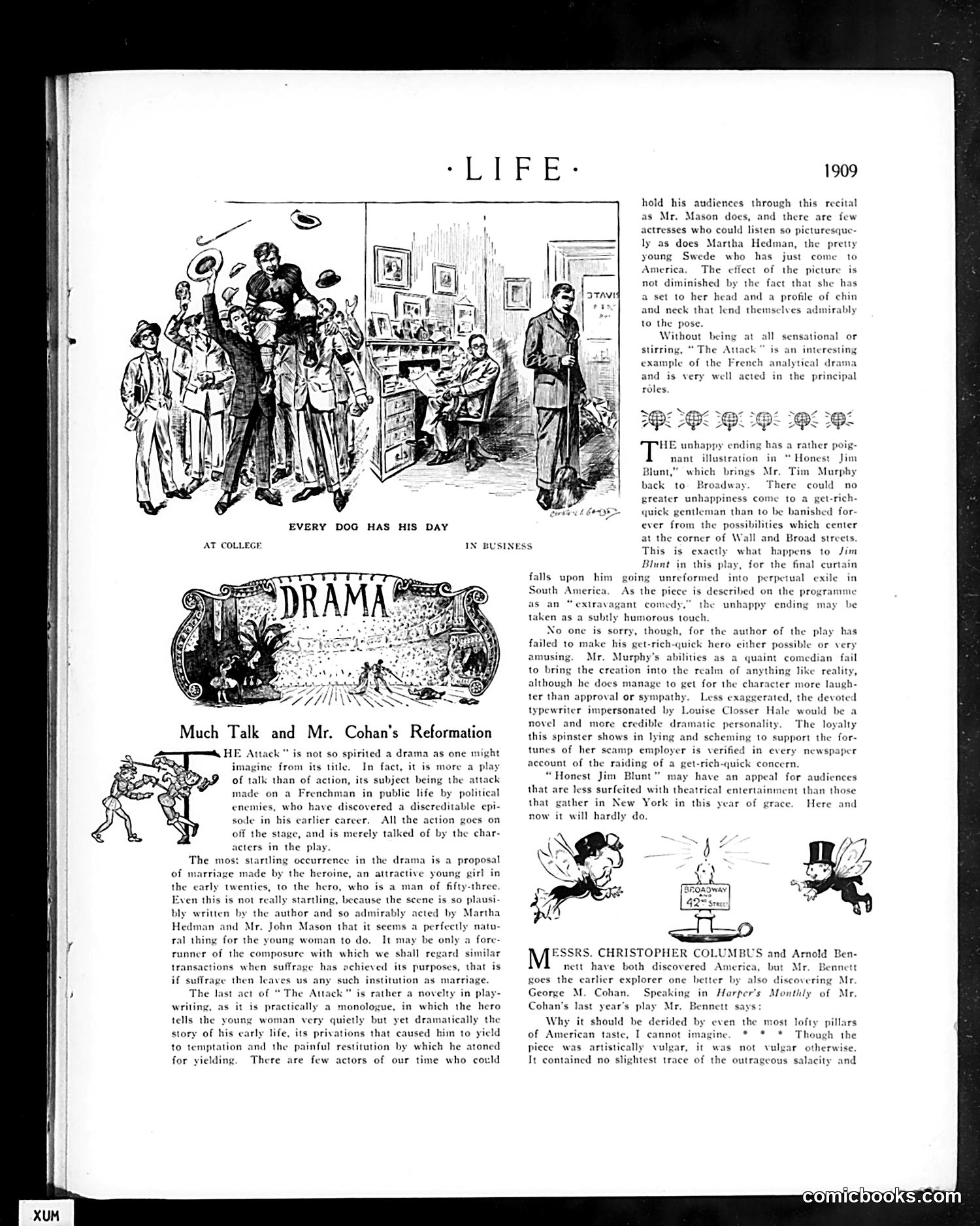
This page reviews three theatrical productions opening on Broadway: **"Every Dog Has His Day"** (top cartoon): The sketch humorously depicts college life's social hierarchy—showing well-dressed students at a college gathering, then the same figures in business suits, suggesting the transition from youthful social prominence to adult professional life where former "big men on campus" become ordinary businessmen. **"Much Talk and Mr. Cohan's Reformation"**: A drama starring John Mason and Martha Hedman about a 53-year-old man whose past political enemies expose a disreputable episode. The reviewer notes the play is dialogue-heavy rather than action-driven, and praises Mason's ability to hold audiences during a long monologue confessing his youthful moral failings and redemption. **"Honest Jim Blunt"** (starring Tim Murphy): A comedy about a "get-rich-quick" schemer banished from Wall Street to South America. The reviewer criticizes Murphy's performance as failing to make the character either believable or amusing, though praising supporting actress Louise Closser Hale. The page reflects early 20th-century Broadway theatrical criticism and social commentary on morality, ambition, and redemption.
📄 Transcribed text from this page (OCR, searchable)
Machine-transcribed from the original scan — historical spelling and the odd misread are preserved.
1909 EVERY DOG HAS HIS DAY AT COLLEGE. Much Talk and Mr. Cohan’s Reformation kis not so spirited a drama as one might azine from its title. In fact, it is more a play of talk than of action, its subject being the attack lic life by political enemies, who have discovered a discreditable epi- sode in his earlier carcer. All the action goes on off the stage, and is merely talked of by the char- acters in the play. ‘The mos: startling occurrence in the drama is a proposal of marriage made by the heroine, an attractive young girl in the carly twenties, to the hero, who is a man of fifty-three Even this is not really startling, because the scene is so plausi bly written by the author and so admirably acted by Martha Hedman and Mr. John Mason that it seems a perfectly natu- ral thing for the young woman to do. It may be only a fore- runner of the composure with which we shall regard similar made on a Frenchman in transactions when suffrage has achieved its purposes, that is if suffrage then leaves us any such institution as marr’ The last act of “1 * js rather a novelty in pl writin; it is practi onologue, in which the hero tells the young woman very quietly but yet dramatically the story of his carly life, its privations that caused him to yield to temptation and the painful restitution by which he atoned for yielding. There are few actors of our time who could IN BUSINESS hold his audiences through this recital as Mr. Mason docs, actresses who could listen so picturesque- ly as does Martha Hedman, the pretty young Swede who has just come to d there are few America, The effect of the picture is not diminished by the fact that she has a set to her head and a profile of chin and neck that lend themselves admirably to the pose. Without being at all sensational or stirring, “ The Attack example of the French analyti and is very well acted in the principal is an interesting drama roles TE: VB Ne “Ep? 7¢R7 Ape ABS Be = TBS BS T" unhappy ending has a rather poig- n nt illustration in “Honest Jim Blunt,” which brings Mr. Tim Murphy back to Broadway. There could no greater unhappiness come to a get-rich- quick gentleman than to be banished for- ever from the possibilities which center at the corner of Wall and Broad streets This is exactly what happens to Jim Blunt in this pl going unreformed into perpetual exile in As the piece is described on the programme for the final curtain falls upon hi South America as an “extravagant comedy,” the unhappy ending may be taken as a subtly humorous touch No one is sorry, though, for the author of the play has failed to make his get-rich-quick hero ei musing. Mr. Murphy's er possible or very bilities as a quaint comedian fail to bring the creation into the realm of anything like reality, r more laugh- Less exaggerated, the devoted typewriter impersonated by Louise Closser Ha novel and more credible dramatic personality this spinster shows in lying and schemin although he does manage to get for the chara ter than approval or sympathy. would be a The loyalty to support the for- tunes of her scamp employer is verified in every newspaper account of the raiding of a get-rich-quick concern. “Honest Jim Blunt" may have an appeal for audiences that are less surfeited with theatrical entertainment than those that gather in New York in this year of grace now it will hardly do. Here and =SSRS. CHRISTOPHER COLUMBUS and Arnold Ben- nett have both discovered America, but Mr. Bennett goes the carlier explorer one better by also discovering Mr. George M. Cohan. Spea in Harper's Monthly of Mr. Cohan’s last year’s play Mr. Bennett sa Why it should be derided by most lofty pillars of American taste, I cannot imagi Though the piece was artistically vulgar, it was not vulgar otherwise. It contained no slightest trace of the outrageous salacity and