
Life, 1912-10-03 · page 12 of 56
Life — October 3, 1912 — page 12: what you’re looking at
What you’re looking at
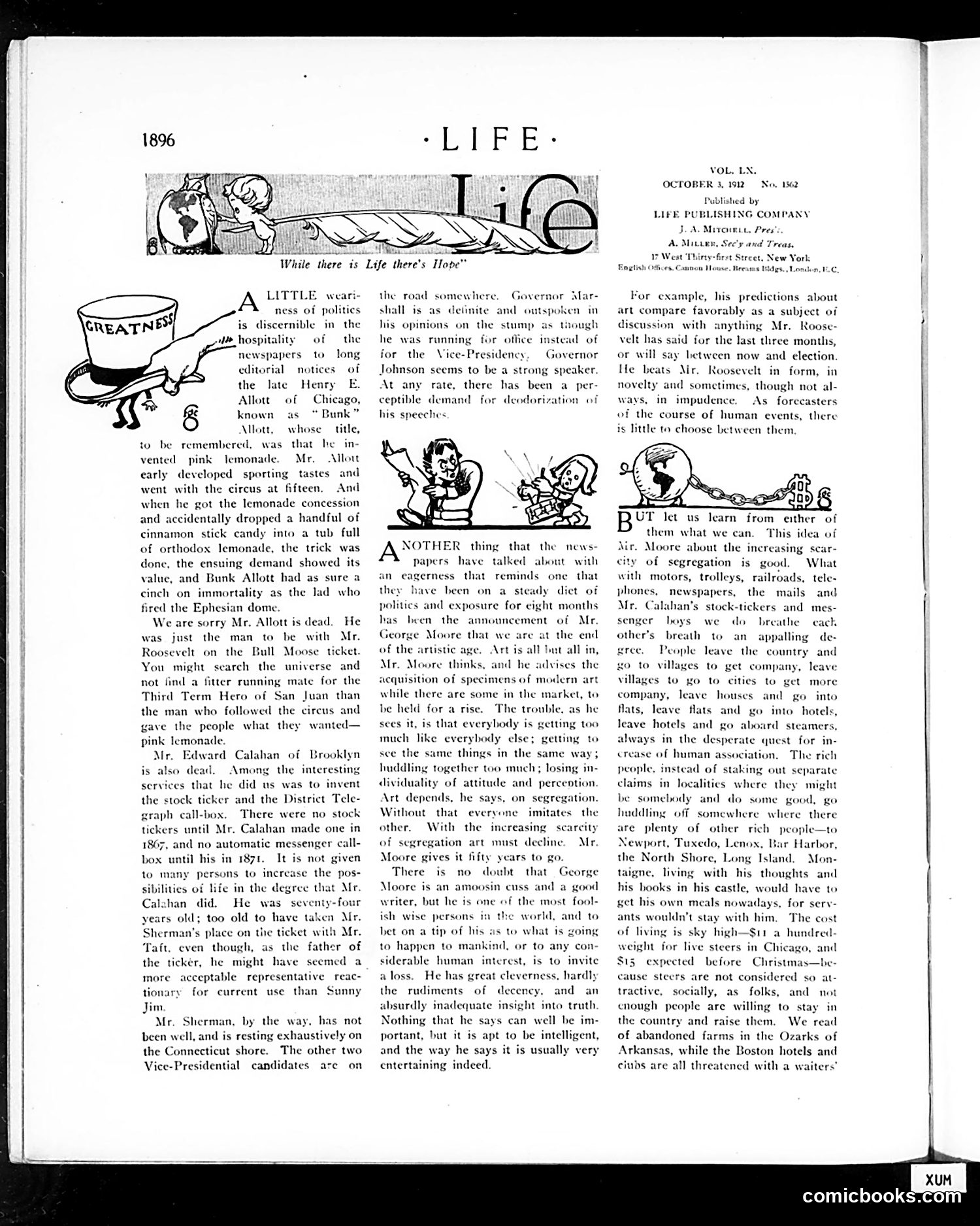
This page contains editorial commentary on contemporary politics and personalities, not political cartoons per se. The illustrations are decorative rather than satirical caricatures. The text discusses Mr. Allott of Chicago, known for "pink lemonade" and circus connections, who has died. It notes Edward Calahan's death, credited with inventing the stock ticker and pneumatic messenger call-box. The main commentary concerns **George Moore** and art segregation—Moore apparently advocates for separating modern art acquisitions by location or type. The writer disagrees, arguing segregation in art, like in society (referencing phones, newspapers, mail services), proves unnecessary and undesirable. The piece criticizes excessive urbanization and suggests rural life's appeal, mentioning abandoned Ozark farms and Boston hotels' water-related issues.
📄 Transcribed text from this page (OCR, searchable)
Machine-transcribed from the original scan — historical spelling and the odd misread are preserved.
8 - While there LITTI ness of politics is discernible in the hospitality of — the newspapers to. long editorial notices of Henry E. Chicago, “Bunk” whose title, weari- the late Allott of known as Allott, to be remembered, was that he in- vented pink lemonade. Mr. Allow early developed sporting tastes and went with the circus at fifteen, And when he got the lemonade concession and accidentally dropped a handful of cinnamon stick candy into a tub full of orthodox lemonade, the trick was done, the ensuing demand showed its value, and Bunk Allott had as cinch on immortality as the lad who fired the Ephesian dome. We are sorry Mr. Allott is dead. He was just the man to be with Mr. Roosevelt. on the Bull Moose ticket. You might search the unives and not find a fitter running mate for the Third Term Hero of San Juan than the man who followed the circus and gave the people what they wanted— pink lemonade. Mr. Edward Calahan of Brooklyn is also dead. Among the interesting services that he did us was to invent the stock ticker and the District Tele- graph call-box. There were no stock tickers until Mr. Calahan made one in 1867, and no automatic messenger call- box until his in 1871. It is not given to many persons to increase the pos- ree that Mr. sure a sibilitics of life in the di Calahan did. He was seventy-four years old; too old to have taken Mr. herman’s place on the ticket with Mr. Taft. even though, as the father of the tickér, he might have seemed a more acceptable representative reac- tionary for current use than Sunny Jim Mr. Sherman, by the way, has not been well, and is resting exhaustively on the Connecticut shore. The other two Vice-Presidential candidates are on Lispe as Life there's Hobe” the road somewhere. Governor Mar- shall is as delinite and outspoken. in his opinions on the stump as though he was running for office instead of for the Vice-Presidency, Governor Johnson seems to be a strong speaker. At any rate, there has been a per- ceptible demand for dendorization of his speeches NOTHER thing that the news- papers have talked about with an eagerness that reminds one that they have been on a steady dict of politics and exposure for cight months has been the announcement of Mr. George Moore that we the end of the artistic age. Art is all but all in, Mr. Moore thinks, and he advises the xcquisition of specimens of modern art while there are some in the market, to be held for a rise. The trouble, as he sees it, is that everybody is getting too much like everybody else; getting to see the same things in the same w huddling t divid her too much; losing in- ality of attitude and perception. Art depends, he says, on segregation. Without that everyone imitates the With the increasing scarcity of segregation art must decline. Mr, Moore gives it fifty years to go. There is no doubt that George Moore is an ame writer, but he is one of the me other, sin cuss and a good t fool- ish wise persons in the world, and to bet on a tip of his as to what is going, to happen to mankind, or to any con- siderable human interest, is to invite loss. He has great cleverness, hardly the rudiments of decen and an absurdly inadequate insight into truth. Nothing that he says can well be im- portant, but it is apt to be intelligent, and the way he says it is usually very entertaining indeed. VoL. OCTOBER 8, 1912 Published by LIFE PUBLISHING COMPANY n. 1S62 JA. Mirourin, Pres A. Mituen, Sec'y and Treas. 17 West ‘Thirty-firet Street, New York: House. Heeams Hides, 1c For example, his predictions about art compare favorably as a subject of discussion with anything Mr. Roose- velt has said for the last three months, or will say between now and election. He beats Mr. Roosevelt in form, in novelty and sometimes, though not ways, in impudence. As forcea sters of the course of human events, there is little to choose between them. Bt let _us learn from either of them what we can. This id f Mir. Moore about the increasing scar- ty of segregation is good. What with motors, trolleys, railroads, tele- phones, newspapers, the mails and Mr. Calahan’s stock-tickers and mes- senger boys we do breathe cack other's breath to an appalling de- gree. People leave the antry and x0 to villages to get company, leave villages t0 yo to cities to get more company, leave houses and go into flats, leave flats and go into hotels, leave hotels and go aboard steamers, ways in the desper © quest for in- jon, The rich people, instead of staking out separate claims in localities where they might be somebody and do some good, go crease of human asso haddling off somewhere where there are plenty of other rich people—to Newport, Tuxedo, Lenox, Bar Harbor, the North Shore, Long Island. Mon- taigne, living with his thoughts and his books in his castle, would have to get his own meals nowadays, for serv- ants wouldn't stay with him The cost of living is sky high—$11 a hundred weight for live steers in Chicago, and S15 expected before Christmas—be- cause steers are not considered so at- tractive, socially, as foll cnough ps Ss, and not ple are willing to stay in the country and raise them. We read of abandoned farms in the Ozarks of Arkansas, while the Boston hotels and ciubs are all threatened with a waiters’ comicbook $.co