
Life, 1912-10-03 · page 34 of 56
Life — October 3, 1912 — page 34: what you’re looking at
What you’re looking at
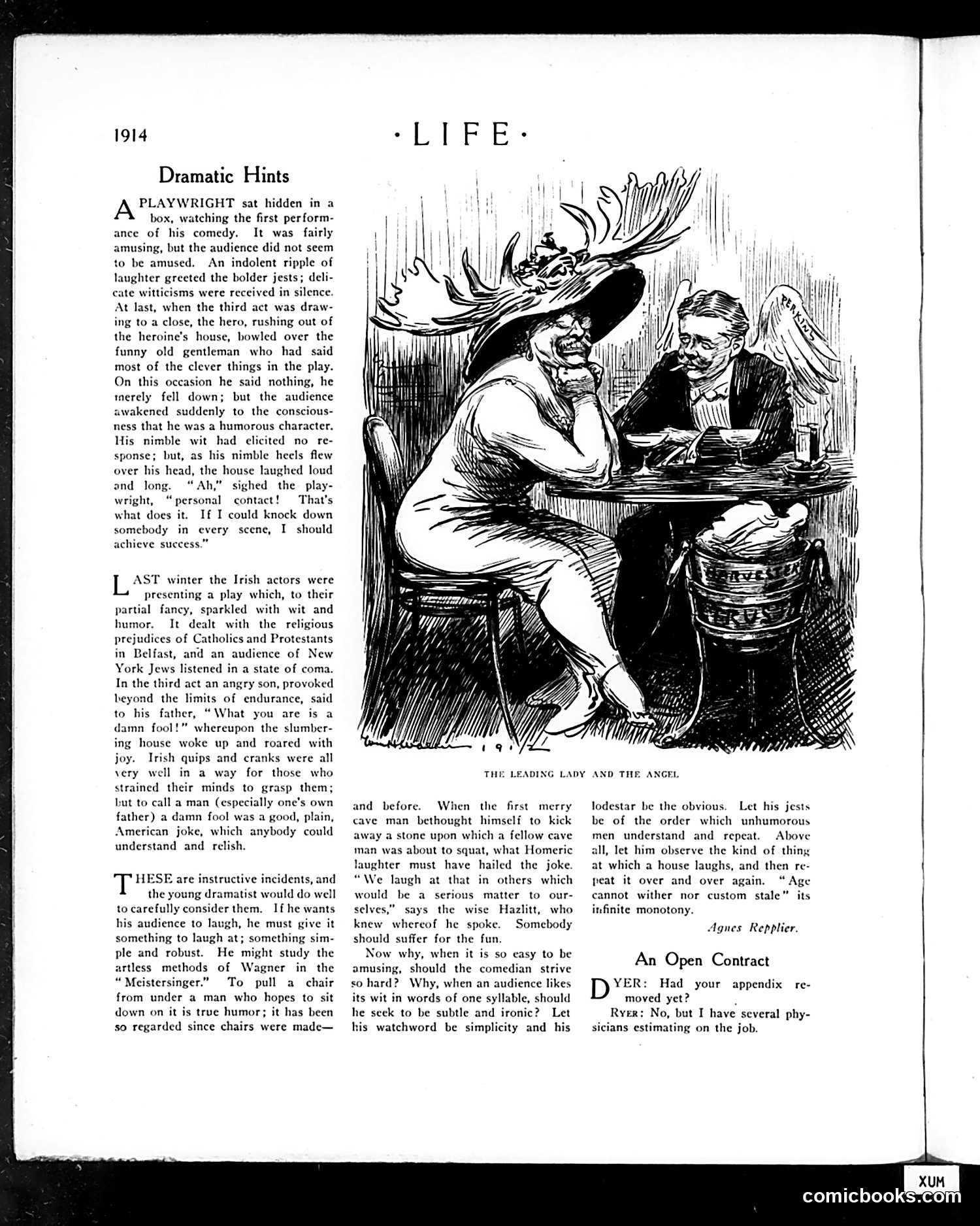
This page satirizes the decline of wit in American theater. The text describes two anecdotes where clever dialogue fails to amuse audiences, but *physical comedy* succeeds wildly—a character falling, a curse word, slapstick. The accompanying illustration, "The Leading Lady and the Angel," shows a woman in an exaggerated hat at a table with a man (possibly representing theatrical sensibilities or criticism). The cartoon reinforces the essay's point: sophisticated audiences have been replaced by those who prefer crude, obvious humor. The author (Agnes Repplier) ironically advises playwrights to abandon subtlety entirely—make jokes in "words of one syllable," repeat the same gags endlessly, ensure someone always suffers physically. This is biting mockery of lowbrow entertainment trends, suggesting American audiences had become intellectually lazy and craved only slapstick, not genuine wit. The final joke about estimating physicians for an appendix removal offers a separate, contemporary medical humor note.
📄 Transcribed text from this page (OCR, searchable)
Machine-transcribed from the original scan — historical spelling and the odd misread are preserved.
1914 Dramatic Hints PLAYWRIGHT sat hidden in a box, watching the first perform- ance of his comedy. It was fairly amusing, but the audience did not seem to be amused. An indolent ripple of laughter greeted the bolder jests; deli- cate witticisms were received in silence. At last, when the third act was draw- ing to a close, the hero, rushing out of the heroine's house, bowled over the funny old gentleman who had said most of the clever things in the play. On this occasion he said nothing, he merely fell down; but the audience awakened suddenly to the conscious- ness that he was a humorous character. His nimble wit had elicited no re- sponse; but, as his nimble heels flew over his head, the house laughed loud and long. “Ah,” sighed the play- wright, “personal contact! That's what does it. If I could knock down somebody in every scene, I should achieve success.” ST winter the Irish actors were presenting a play which, to their partial fancy, sparkled with wit and humor. It dealt with the reli prejudices of Catholics and Protestants in Belfast, and an audience of New York Jews listened in a state of coma. In the third act an angry son, provoked beyond the limits of endurance, said to his father, “What you are is a damn_ foo whereupon the slumber- ing house woke up and roared with joy. Irish quips and cranks were all very well in a way for those who strained their minds to grasp them; but to call a man (especially one’s own father) a damn fool was a good, plain, American joke, which anybody could understand and relish. HESE are instructive incidents, and the young dramatist would do well to carefully consider them. If he wants his audience to laugh, he must give i something to laugh at; something sim- ple and robust. He might study the artless methods of Wagner in the “Meistersinger.” To pull a chair from under a man who hopes to sit down on it is true humor; it has been so regarded since chairs were made— THE LEADING LADY and before. When the first’ merry cave man bethought himself to ki away a stone upon which a fellow c man was about to squat, what Homeric laughter must have hailed the joke. “We laugh at that in others which would be a serious matter to our- selves,” says the wise Hazlitt, who knew whereof he spoke. Somebody should suffer for the fun. Now why, when it is so easy to be amusing, should the comedian strive so hard? Why, when an audience likes its wit in words of one syllable, should he seek to be subtle and ironic? Let his watchword be simplicity and his AND THE lodestar be the obvious. Let his jests be of the order which unhumorous men understand and repeat. Above all, let him observe the kind of thing at which a house laughs, and then re- peat it over and over again. “A; cannot wither nor custom stale” its infinite monotony. Agnes Repplier. An Open Contract YER: Had moved yet? j Rye: No, but I have several phy- sicians estimating on the job. your appendix re- comicbooeom (0)