
A complete issue · 40 pages · 1912
Life — August 1, 1912
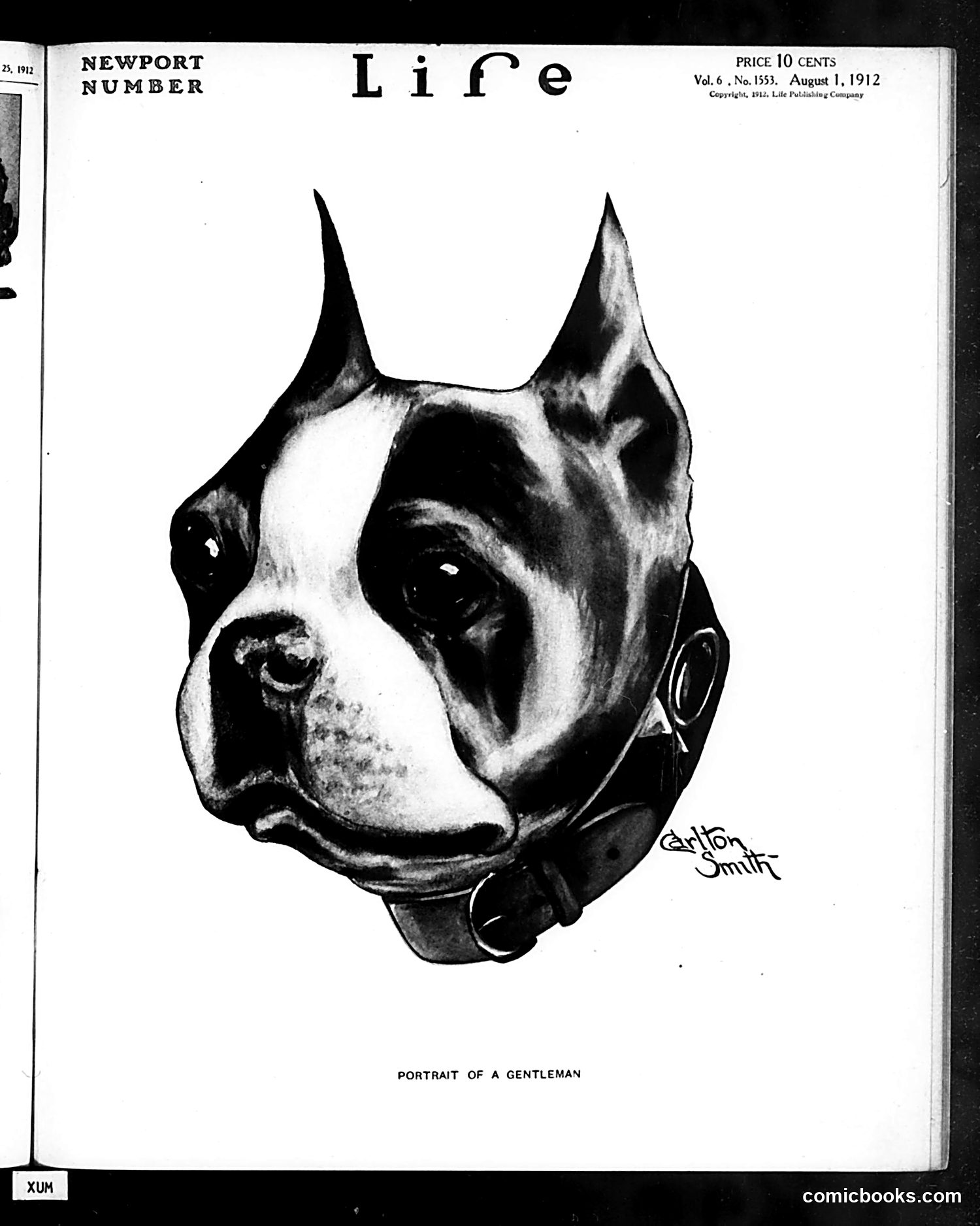
This is a humorous illustration by Carlton Smith showing a Boston Terrier or similar dog breed wearing a collar, captioned "Portrait of a Gentleman." The satire works through visual pun: the dog's dignified pose and formal attire (the collar) are presented as if it were a serious portrait of a distinguished person. Given the 1912 date and Life magazine's satirical tradition, this likely comments on contemporary society—perhaps mocking human pretension by suggesting that some "gentlemen" are no more refined than dogs, or using the dog as an ironic stand-in for someone specific. Without additional context, the exact target remains unclear, though the joke relies on the contrast between the animal subject and the formal presentation.
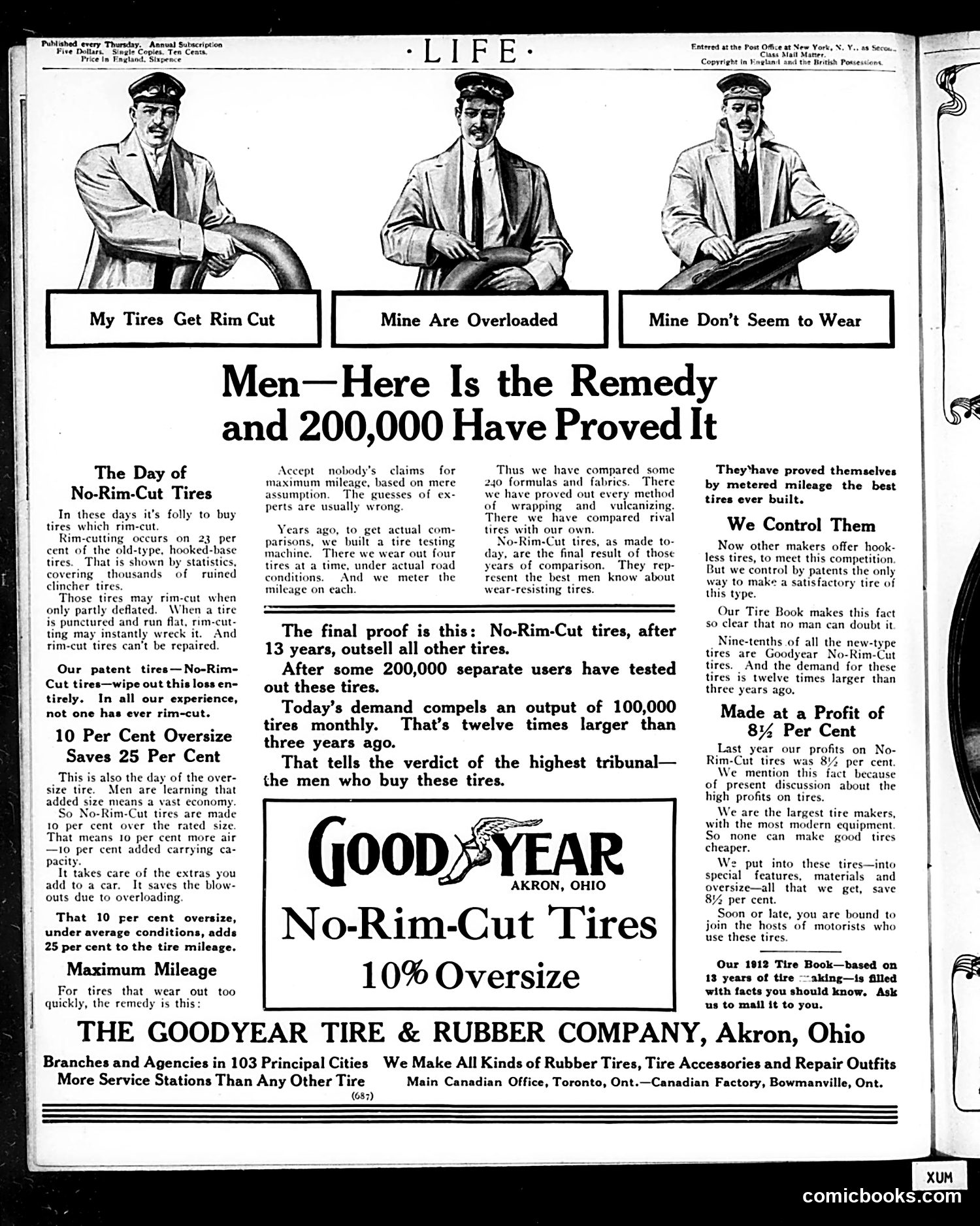
This is primarily a **Goodyear Tire Company advertisement**, not satire. The page shows three illustrated men representing common tire complaints: rim-cut tires, overloaded tires, and worn tires. The ad claims Goodyear's "No-Rim-Cut" tires solve these problems through superior engineering. Key marketing claims include: 200,000 users have tested them; they outsell competitors after 13 years; production is 100,000 monthly (twelve times larger than three years prior); and they generate 8½% profit margins. The advertisement emphasizes technological superiority and market dominance as proof of quality. This represents early automotive industry competition, where tire durability was a significant consumer concern and a legitimate selling point for vehicle maintenance.
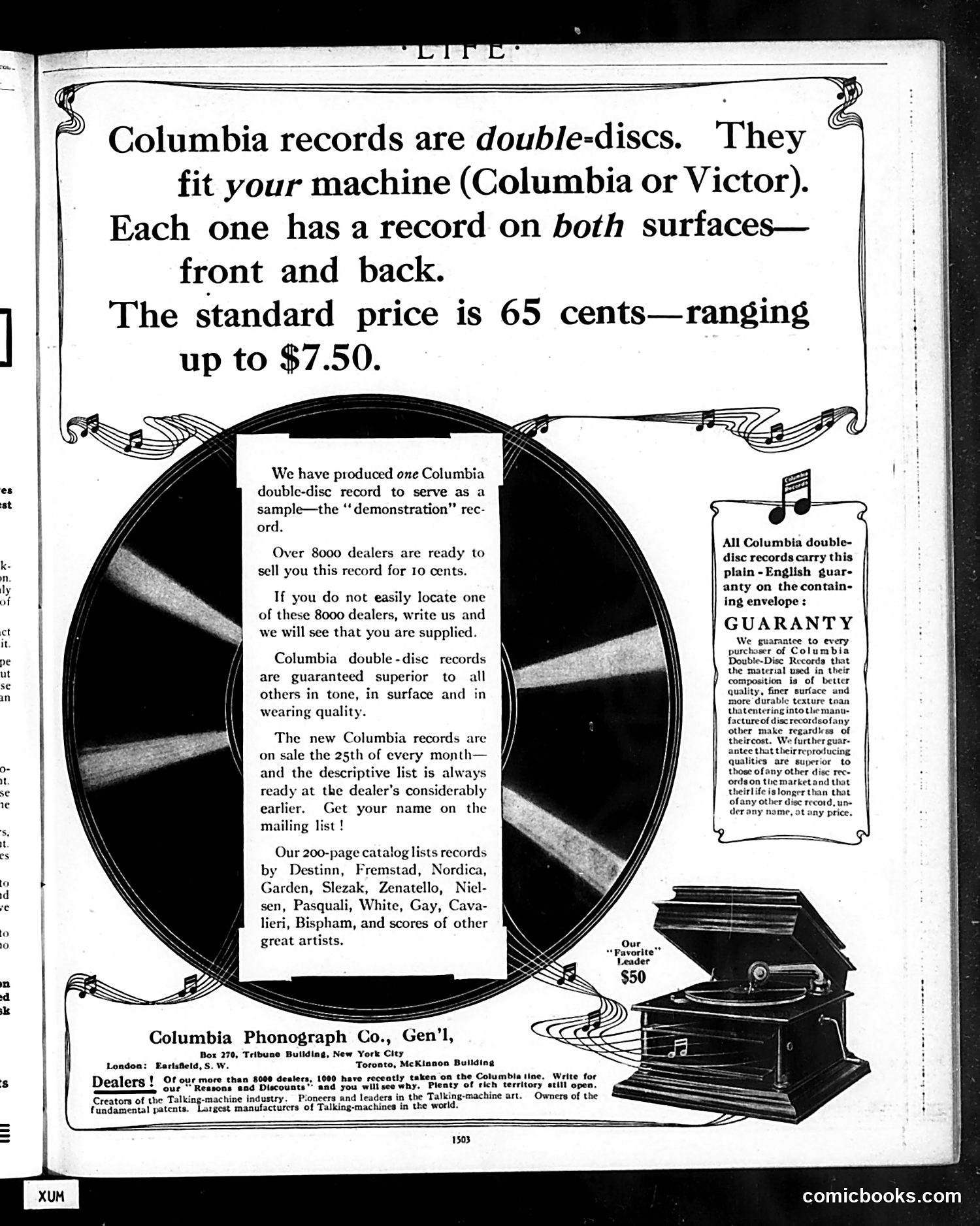
This page is primarily **advertising, not satire or editorial content**. It's a full-page advertisement for Columbia double-disc phonograph records from the Columbia Phonograph Company. The ad emphasizes that Columbia records are superior products: they feature music on both sides ("double-discs"), cost 65 cents standard (up to $7.50), fit both Columbia and Victor machines, and carry a guarantee of quality. The company lists famous artists like Caruso, Fremstad, and Nordica to establish prestige. A phonograph machine is illustrated at bottom right. The circular record image dominates the center. This appears to be a trade publication ad targeting dealers and consumers interested in early recorded music technology—a major consumer product of the era before radio became widespread.
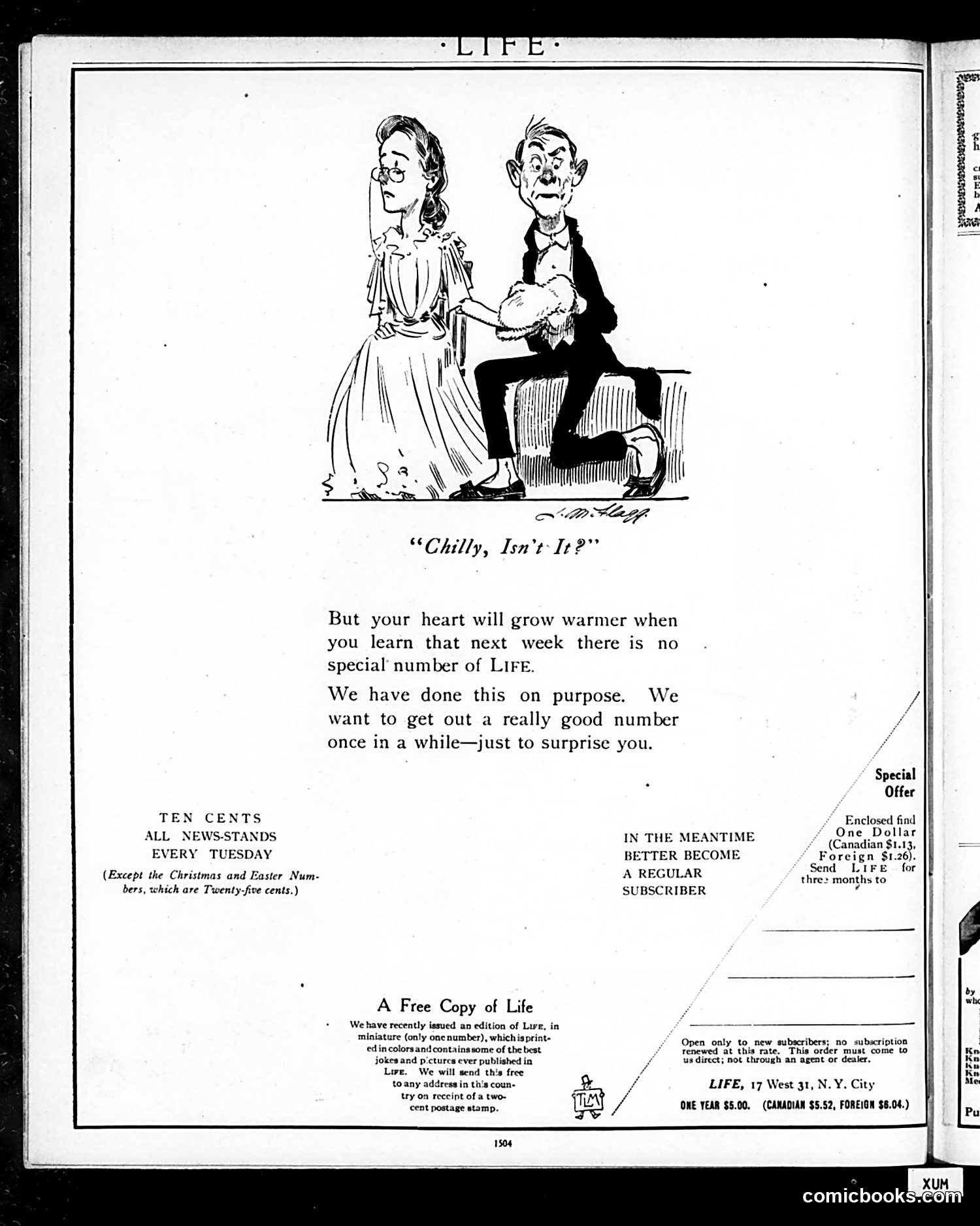
This page is primarily **advertising and subscription promotion** rather than political satire. The cartoon at top, titled "Chilly, Isn't It?" depicts a couple in formal dress—the man seated, the woman standing beside him. The exaggerated caricature style suggests social commentary about their interaction, though the specific figures are unclear without additional context. The text below announces that **next week's issue will have no special number**, explaining this is deliberate to eventually surprise readers with "a really good number once in a while." The remainder of the page promotes Life magazine subscriptions (ten cents at newsstands every Tuesday, except Christmas and Easter issues at twenty-five cents) and offers a free miniature edition to new subscribers for one dollar annually.
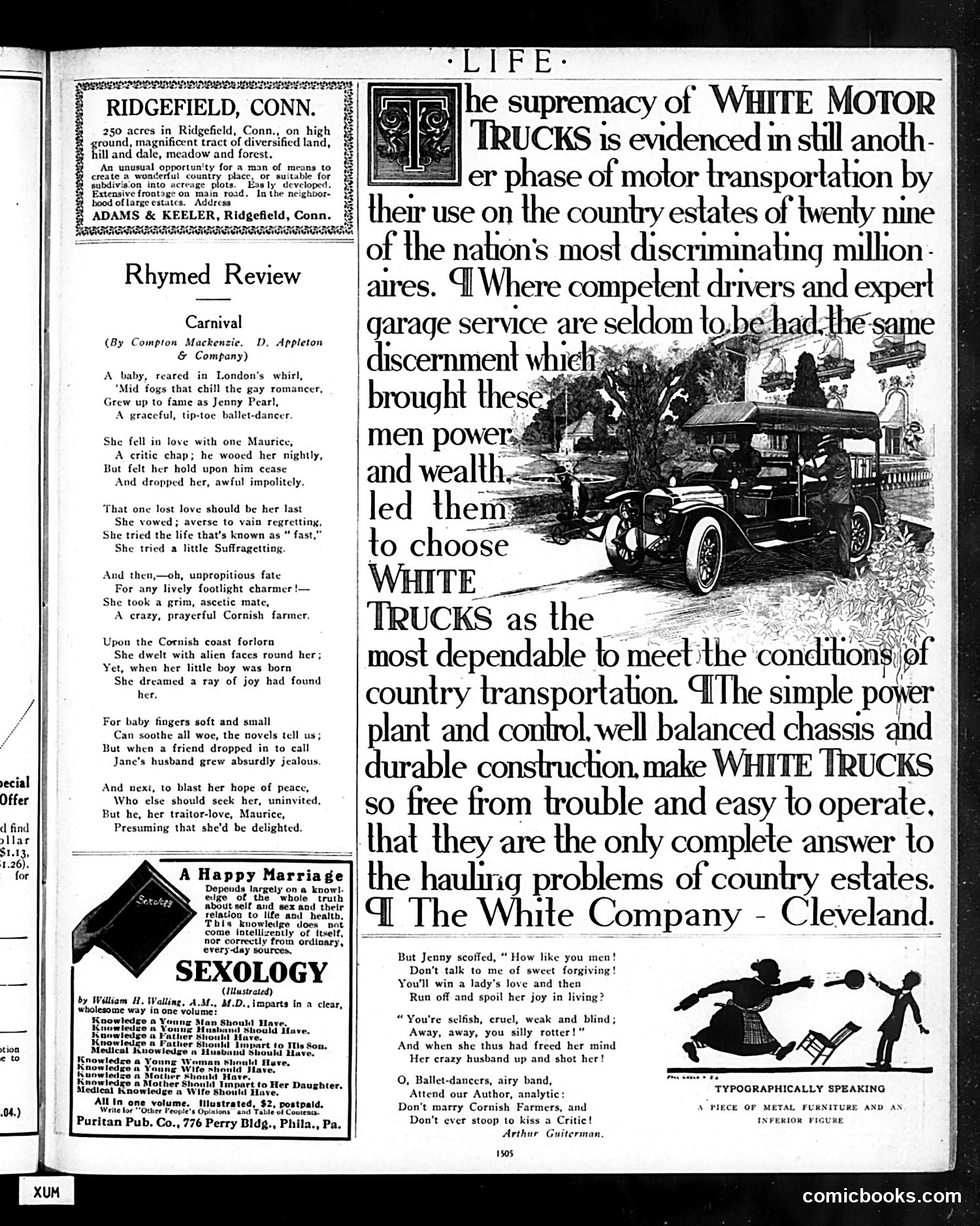
This page is **primarily advertising** for White Motor Trucks, with minimal satirical content. The large advertisement features a photograph of a truck on a country estate, promoting White Trucks to wealthy landowners. The text emphasizes their reliability and ease of operation for rural transportation needs. The only satirical poem on the page is "Carnival" by Compton Mackenzie—a romantic narrative about a young woman ("baby") who falls for a critic named Maurice, then a Cornish farmer. It satirizes melodramatic love stories and female vulnerability, mocking both the heroine's naive romanticism and fortune-seeking behavior. The final verse by Arthur Guiterman mocks art critics and suggests marrying practical farmers instead. The "Sexology" book advertisement at bottom left is standard educational marketing for the era. The page reflects 1920s class anxieties and gender attitudes rather than political satire.
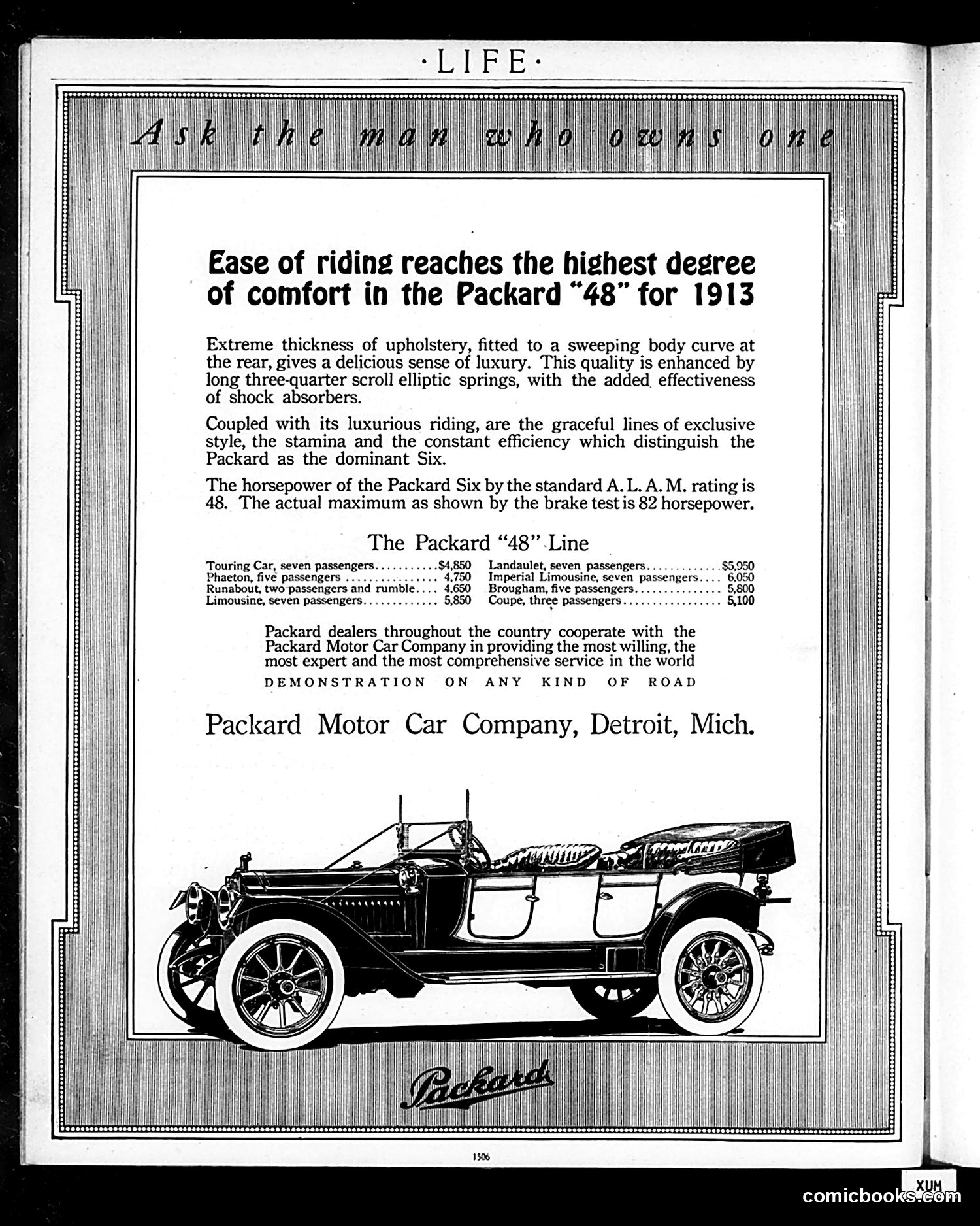
This page is **not a cartoon or satire**—it's a straightforward automobile advertisement, not political commentary. The header "Ask the man who owns one" was Packard's actual advertising slogan of the era. The content advertises the 1913 Packard "48" luxury automobile, highlighting its comfort features: thick upholstery, elliptic springs, and shock absorbers. It lists various models and prices (ranging from $4,650 to $6,100), emphasizes the car's 48 horsepower (actually 82 at maximum), and promotes dealer support. The illustration shows a touring car—a common open-air automobile design of the period. This is commercial advertising typical of *Life* magazine, which carried ads alongside its satirical content.
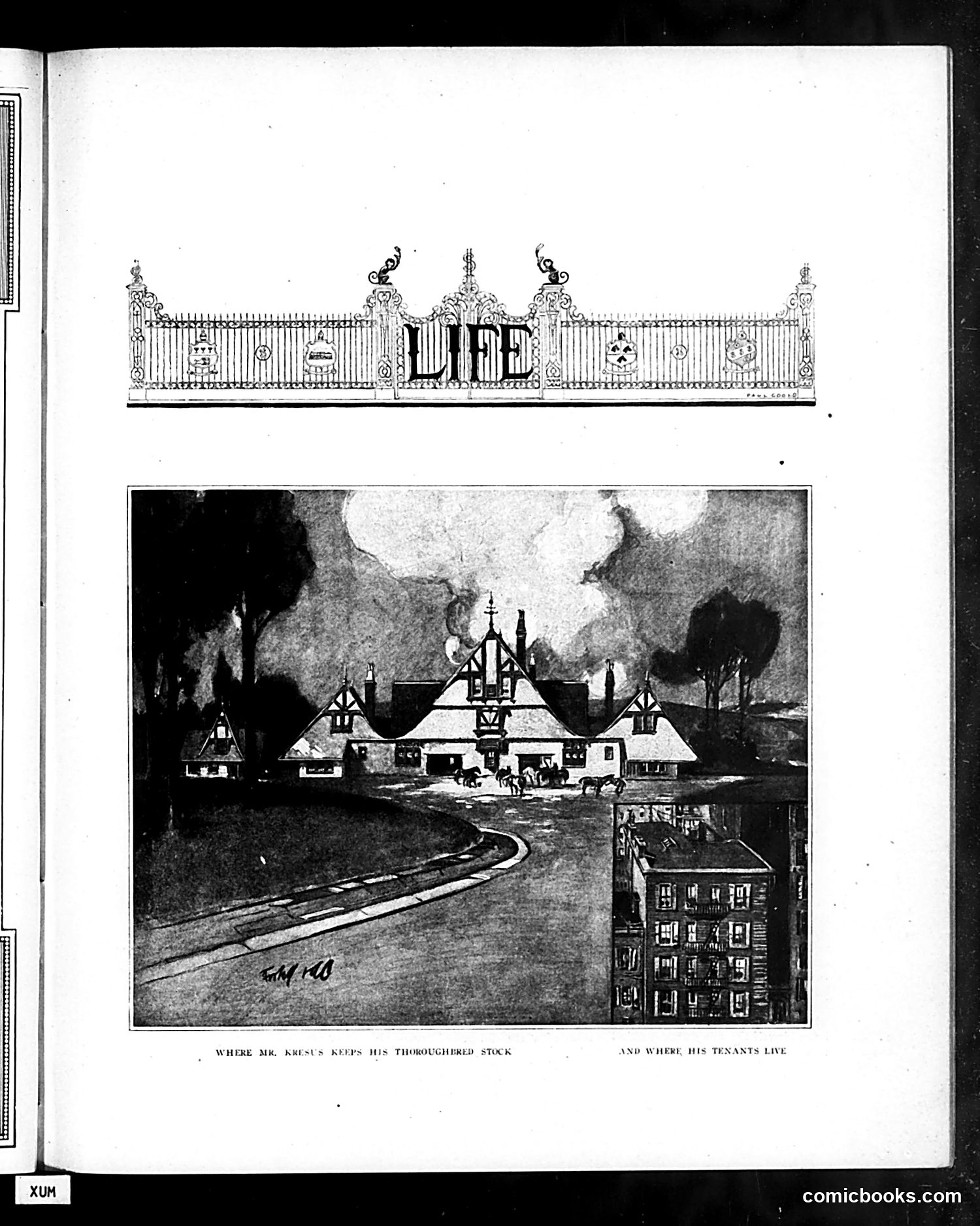
This page shows architectural designs for a wealthy estate. The top illustration depicts an ornate wrought-iron fence with decorative panels and finials. Below is a rendered perspective showing the main residence—a Tudor-style manor house with distinctive half-timbering, steep gables, and multiple chimneys, surrounded by manicured grounds and trees. The caption reads: "WHERE MR. KNEU'S KEEPS HIS THOROUGHBRED STOCK AND WHERE HIS TENANTS LIVE." The satire contrasts the elaborate, expensive main house with a modest multi-story building visible in the right foreground—implying the estate owner houses his valuable horses more lavishly than his working tenants. This critiques wealth inequality and the priorities of the wealthy, suggesting they invest more in animals than in their employees' living conditions, a common Progressive-era complaint about industrial-age class disparities.
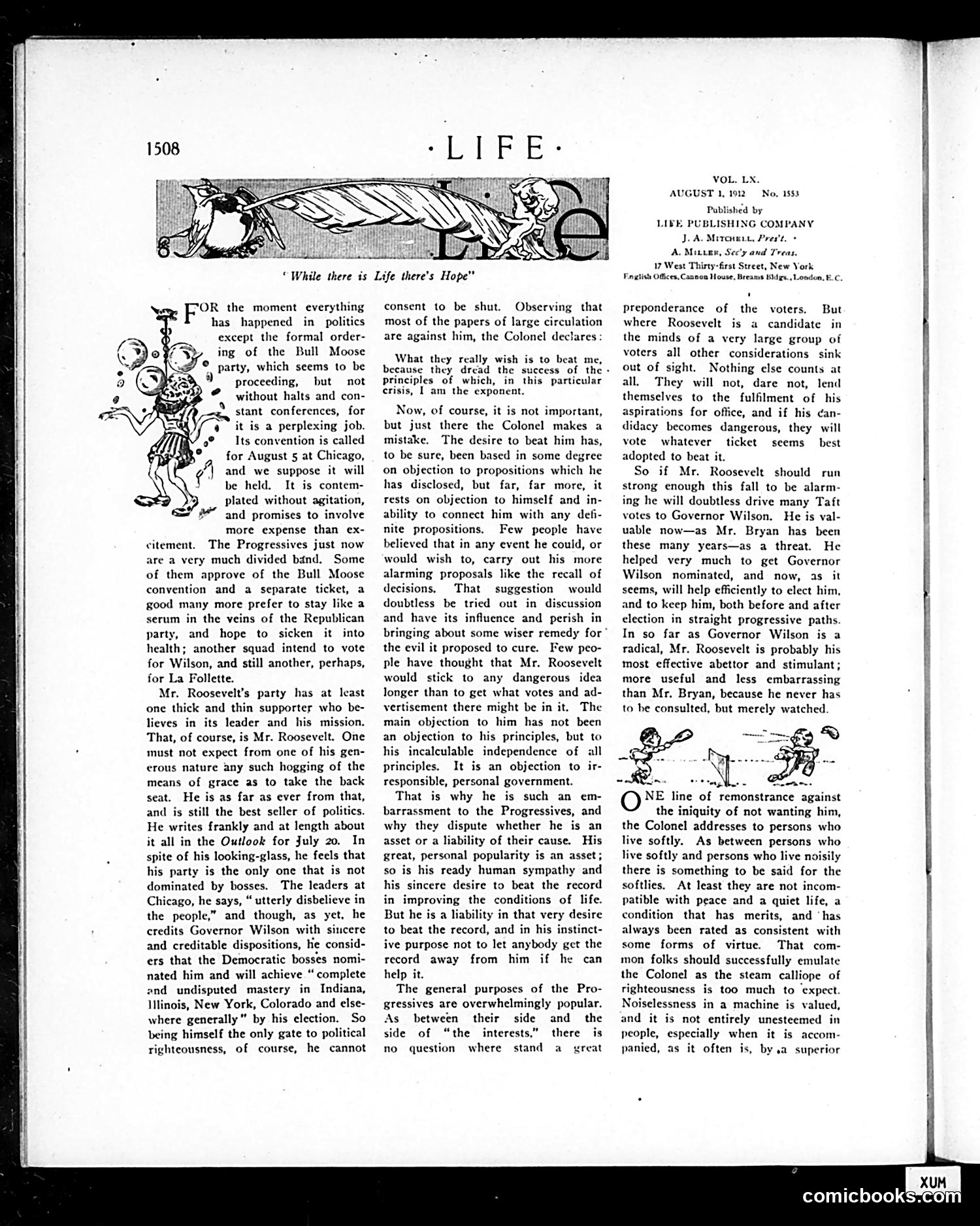
This page discusses the 1912 presidential election, specifically Colonel Roosevelt's candidacy. The text criticizes Roosevelt for his independent stance and suggests he's pursuing personal ambition rather than party loyalty. The small cartoon (bottom right) shows a figure being knocked down or falling—likely depicting Roosevelt's political fortunes or the consequences of his insurgent "Bull Moose" campaign splitting the Republican Party. The article argues that Roosevelt's refusal to align with either major party demonstrates dangerous independence, though it grudgingly admits his popularity and sincere desire to improve conditions. The satire mocks Roosevelt's self-righteousness while acknowledging he remains a formidable political force—the key tension of the 1912 three-way race between Roosevelt, Taft, and Wilson.
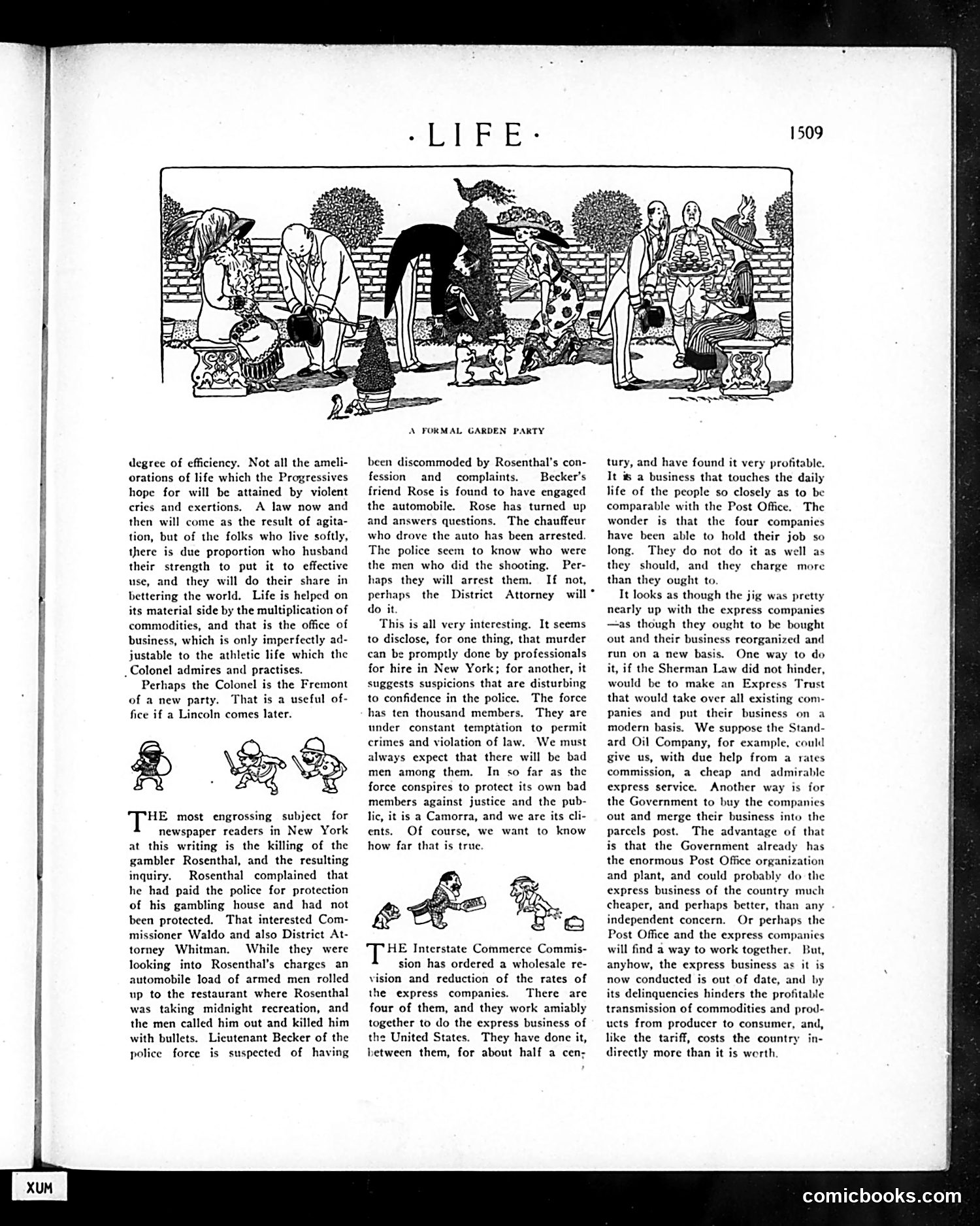
The top illustration depicts a garden party scene with well-dressed figures in early 20th-century attire. The cartoon appears satirical in nature, though the specific joke is unclear from the image alone. The accompanying text discusses a shooting incident involving gambler Rosenthal and police corruption in New York City. It references Commissioner Waldo, District Attorney Whitman, and Lieutenant Becker of the police force—all apparently implicated in the case. The article suggests systemic police corruption, with officers protecting criminals and permitting "crimes and violation of law." The text also discusses express company rate-fixing and potential government regulation, suggesting broader themes of institutional malfeasance and reform that Life was satirizing during this Progressive Era period.
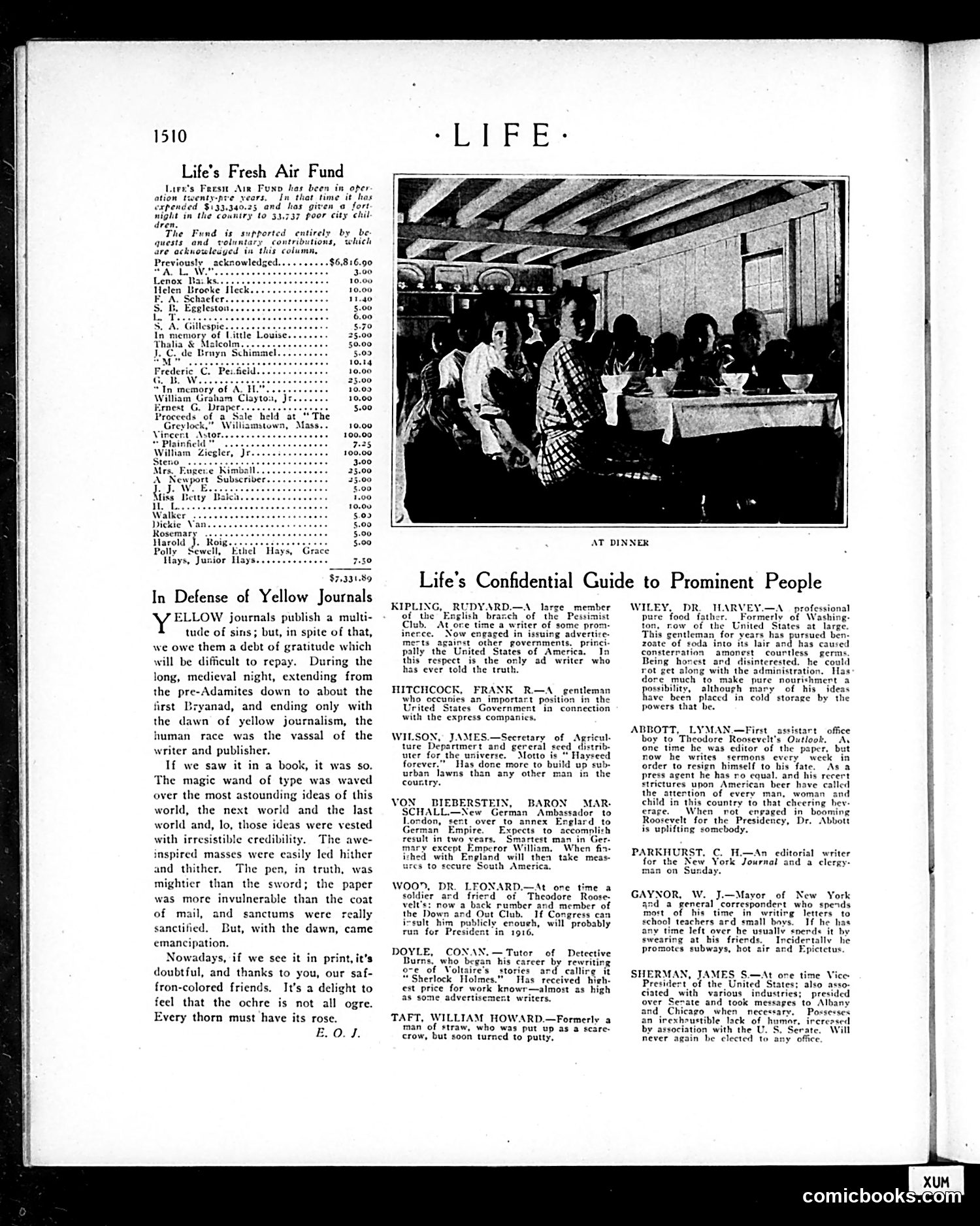
This page contains a **photograph labeled "At Dinner"** showing a group of people dining together, and below it **"Life's Confidential Guide to Prominent People"** — brief biographical sketches of notable figures from the early 1900s. The accompanying article **"In Defense of Yellow Journals"** defends sensationalist newspapers, arguing they've been unfairly criticized. The author claims yellow journalism has done more good than harm, built up suburbs, and made the "vassal of the writer and publisher" into something admirable — suggesting satirically that while these papers are criticized, they're actually powerful and influential. The "Confidential Guide" sketches appear satirical, offering tongue-in-cheek descriptions of public figures' accomplishments and quirks, typical of Life's style of gentle mockery of prominent society members.
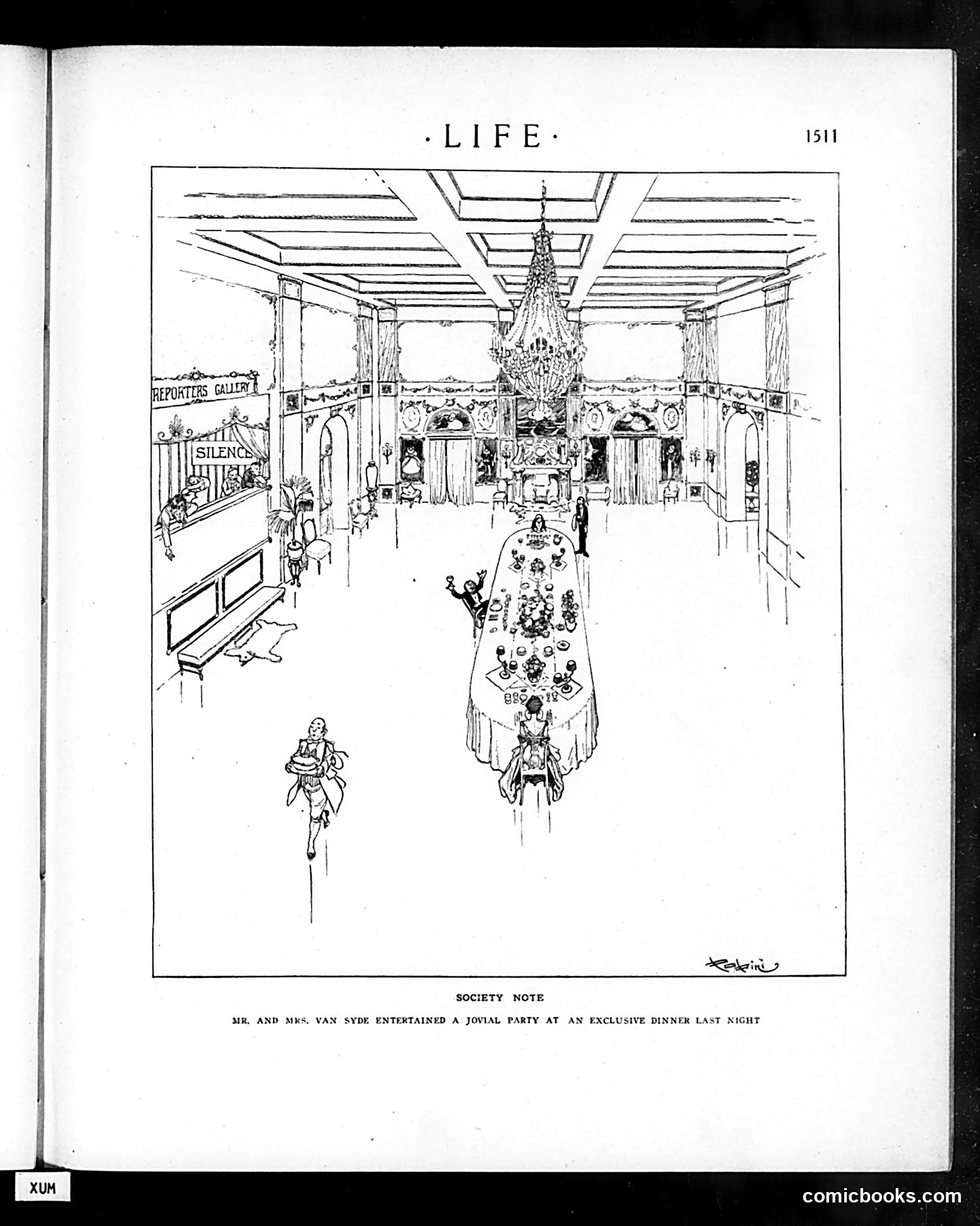
This page from Life magazine (dated 1511, likely early 20th century) contains a single illustration labeled "Society Note." The sketch depicts an elegant formal dinner party in what appears to be an exclusive, high-ceilinged venue with a chandelier, columns, and decorative garlands. The caption states: "MR. AND MRS. VAN SYDE ENTERTAINED A JOYFUL PARTY AT AN EXCLUSIVE DINNER LAST NIGHT." The cartoon satirizes wealthy society's pretensions through architectural grandeur and formal dining. The "Van Syde" name suggests Dutch-American old money. The detailed interior rendering emphasizes the exclusivity being mocked. This appears typical of Life's social satire targeting the upper class and their elaborate entertainments, though the specific individuals being referenced are unclear to modern readers.
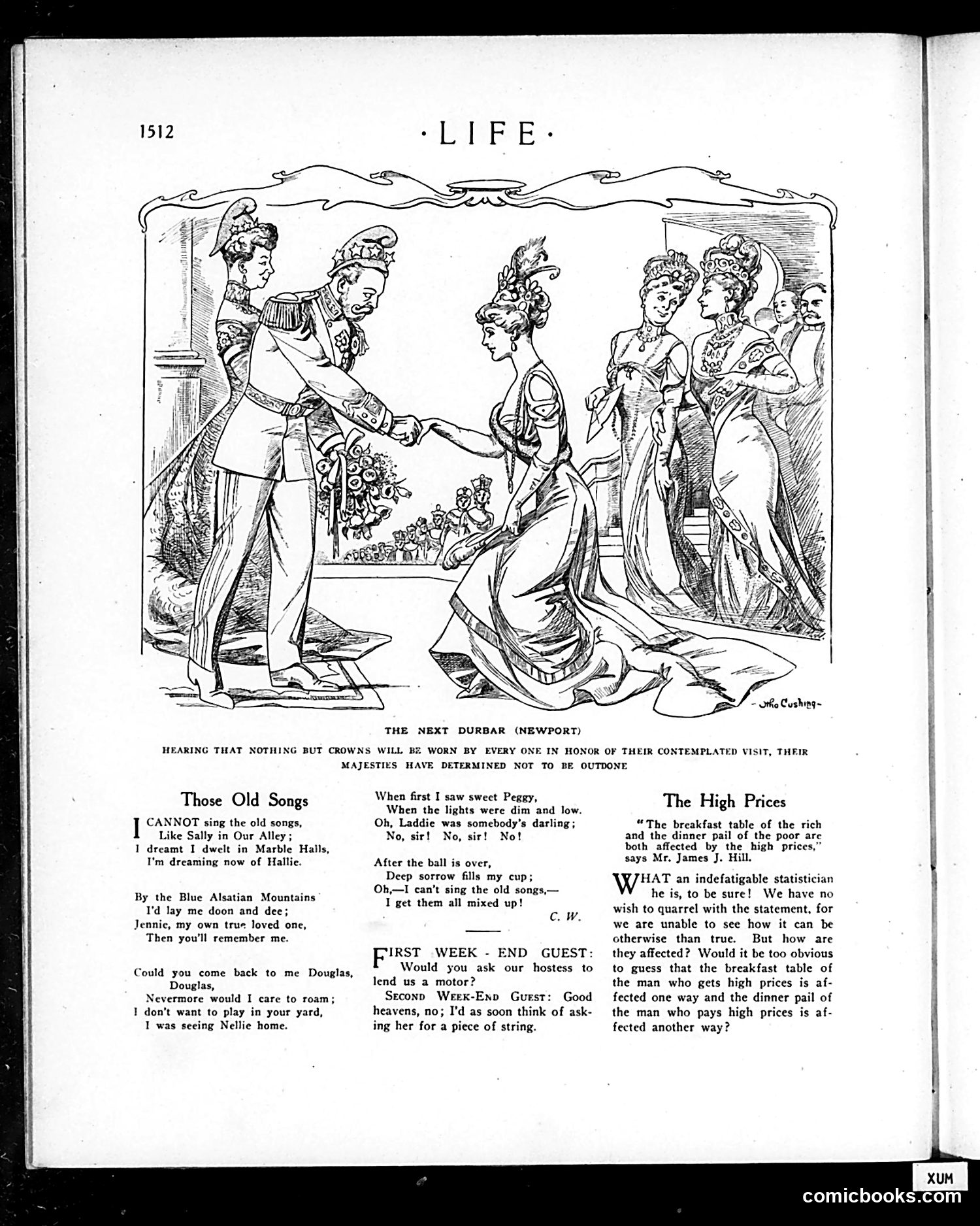
The main cartoon depicts a royal court scene titled "The Next Durbar (Newport)," satirizing high society's pretensions. A uniformed military figure (likely a visiting dignitary) shakes hands with a woman in elaborate dress, while observers note that "nothing but crowns will be worn by every one in honor of their contemplated visit." The satire mocks Newport's social elite for their obsessive, crown-wearing formality in honor of royal visitors—suggesting they treat themselves as pseudo-royalty. The page also contains three separate pieces: "Those Old Songs" (nostalgic verse), "When First I Saw Sweet Peggy" (romantic poem), and "The High Prices" (commentary on inflation affecting both wealthy and poor households). These address early 20th-century social concerns about rising costs and nostalgia.
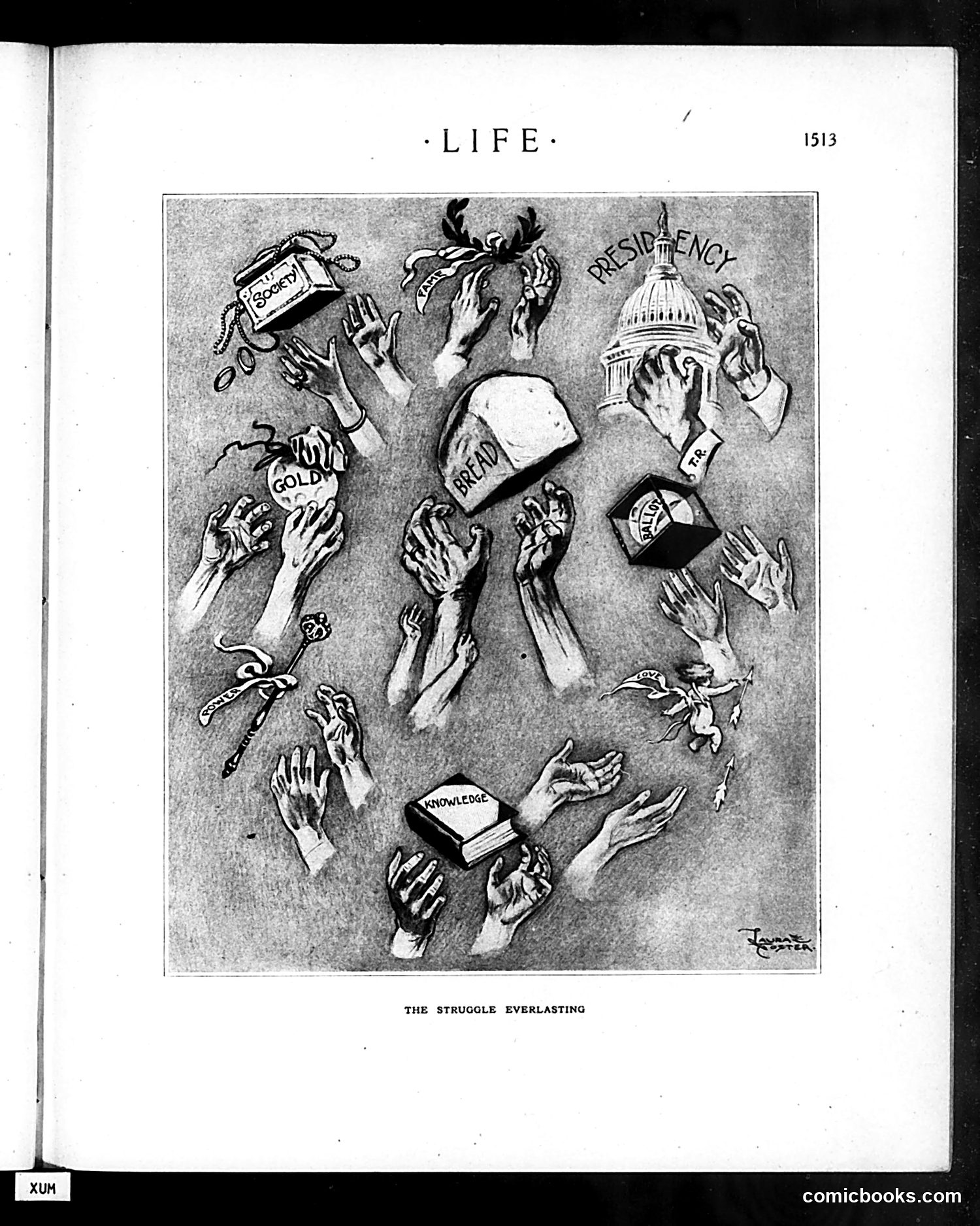
This political cartoon depicts competing forces grasping for central control of a large head labeled "BREAD." The surrounding hands reach for various symbols of power and resources: a "GOLD" container (wealth), a "PRESIDENCY" capitol dome, a book labeled "KNOWLEDGE," and what appears to be a "SOUP" container. The cartoon satirizes the perpetual struggle among different interest groups—wealthy industrialists, politicians, intellectuals, and those seeking basic sustenance—all competing for dominance and resources. The central focus on "bread" suggests anxiety about food security and economic survival, likely reflecting early 20th-century concerns about labor disputes, inequality, and political competition. The title emphasizes this conflict as ongoing and unresolvable.
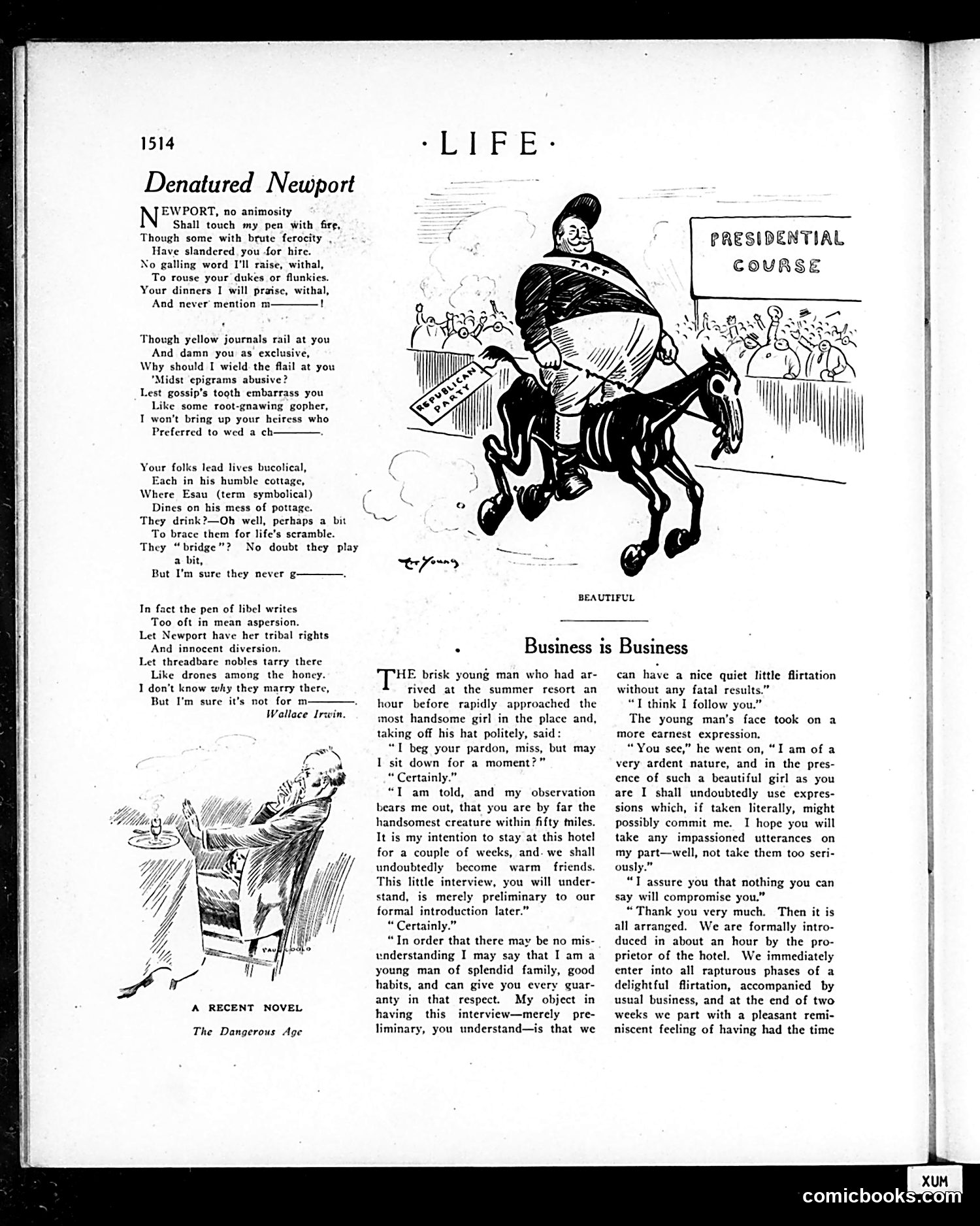
The main cartoon shows a figure on horseback labeled "PRESIDENTIAL COURSE" jumping over an obstacle marked "IMPOSSIBLE," with spectators cheering in the background. This satirizes the challenges facing a presidential candidate—the cartoon suggests that winning the presidency requires navigating seemingly insurmountable obstacles. The page also contains a poem titled "Denatured Newport" criticizing high society in Newport, Rhode Island, mocking the wealthy for their pretentious behavior and suggesting their lives lack authentic meaning. Below is a short story titled "Business is Business" about a young man's romantic encounter at a summer resort, illustrating period attitudes toward courtship and social propriety among the well-to-do. The overall page reflects Life's satirical commentary on American politics, wealth, and social conventions of its era.
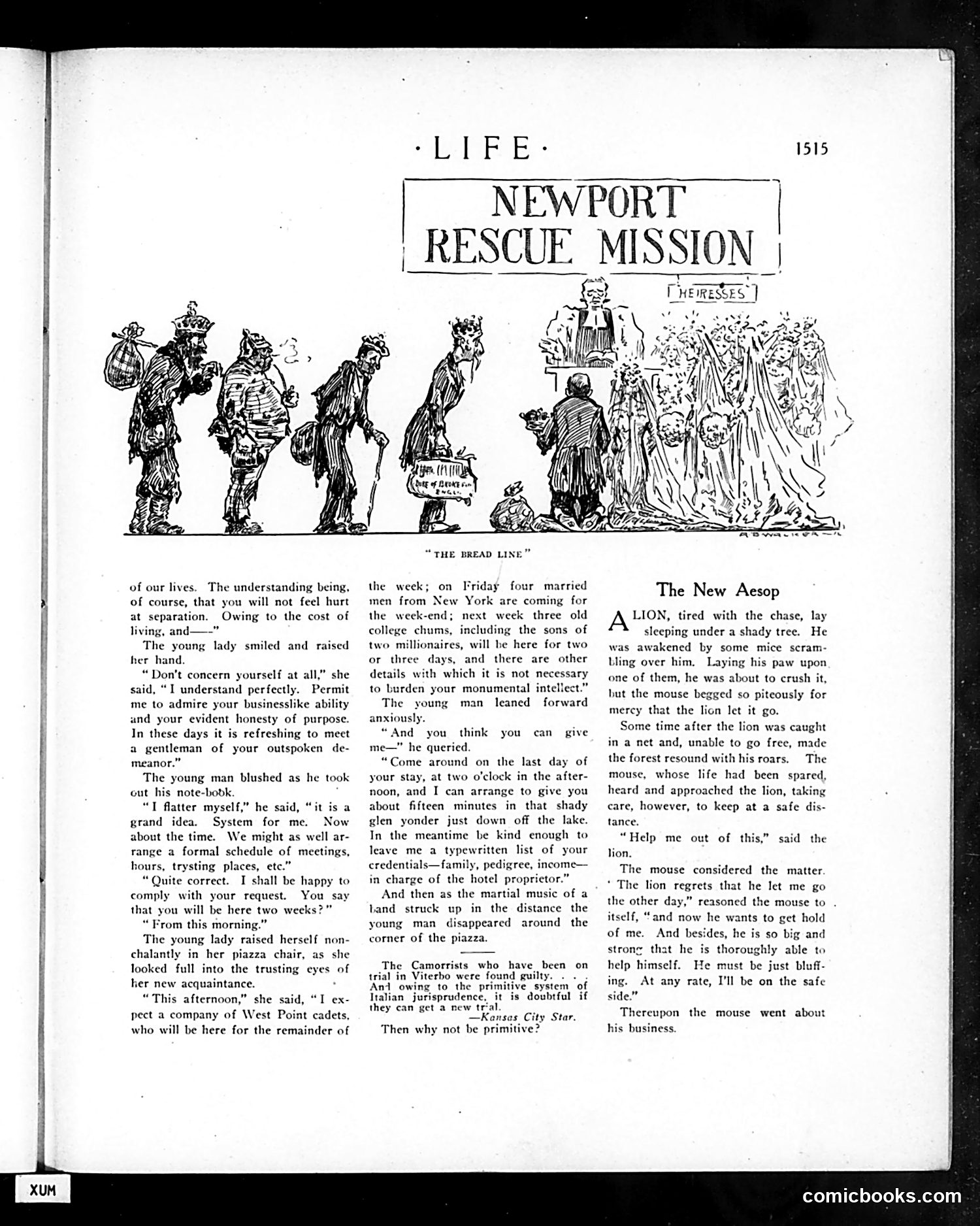
This page satirizes the marriage market among wealthy American elites, particularly at Newport (Rhode Island's fashionable resort). The main cartoon depicts a young man attempting to court a society woman through systematic "scheduling." She responds by revealing her crowded social calendar: West Point cadets this week, married New York men next, wealthy college alumni following. She offers him a mere 15 minutes, typed appointment-style, contingent on his submitting credentials (family pedigree, income). The satire targets the transactional, business-like nature of elite courtship and marriage prospects. The woman's clinical efficiency—treating romantic attention as a commodity to be rationed among wealthy suitors—mocks both the young man's naive "system" and the mercenary calculations underlying high-society romance. Below is "The New Aesop," an unrelated moral fable about ingratitude: a lion spares a mouse's life, but when later trapped, the mouse refuses to help, suspecting the lion's motives.
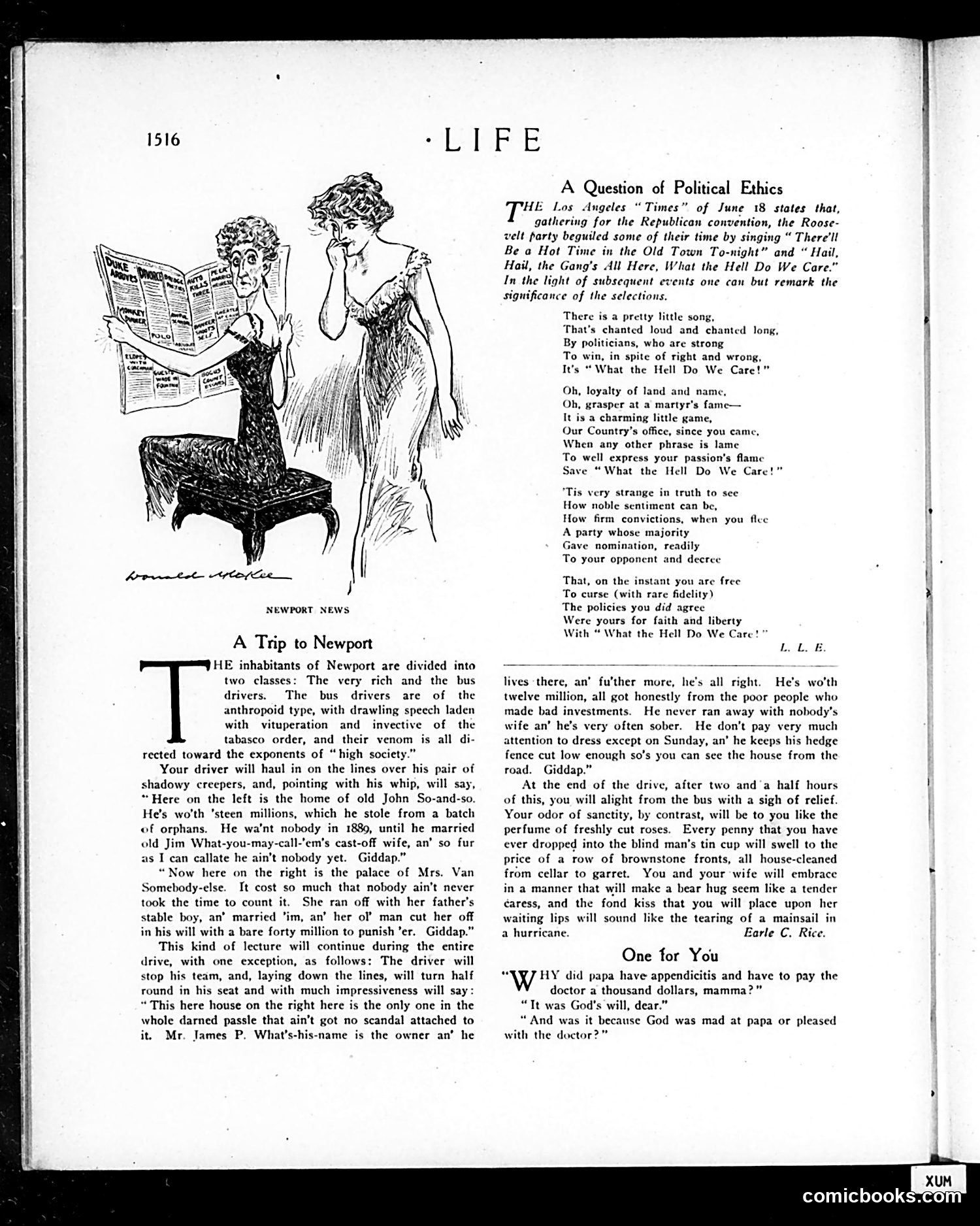
**The Cartoon/Illustration:** The sketch shows a well-dressed couple—she in an elegant gown, he reading a newspaper—representing Newport's wealthy elite. The artist is Arnold Artzybasheff (signed lower left). **"A Trip to Newport" (Main Article):** This satirizes the sharp class divide in Newport, Rhode Island, a wealthy resort town. A bus driver—depicted as crude, resentful, and verbally crude—guides tourists past mansions while making bitter commentary. He mocks the wealthy for their scandalous origins (stolen money, affairs, divorces) while praising one "honest" millionaire who merely exploited poor investors and drinks less. The satire targets both class hypocrisy and the driver's caustic envy. **"A Question of Political Ethics" (Poem):** This critiques Republican politicians (likely referencing the 1912 convention and Roosevelt's split from Taft). The poem attacks those who, when defeated or switching parties, cynically abandon previous principles with the refrain "What the Hell Do We Care!"—exposing political opportunism masked as noble conviction. **Overall Point:** Both pieces mock moral compromises: the wealthy concealing corruption, and politicians abandoning ethics for power.
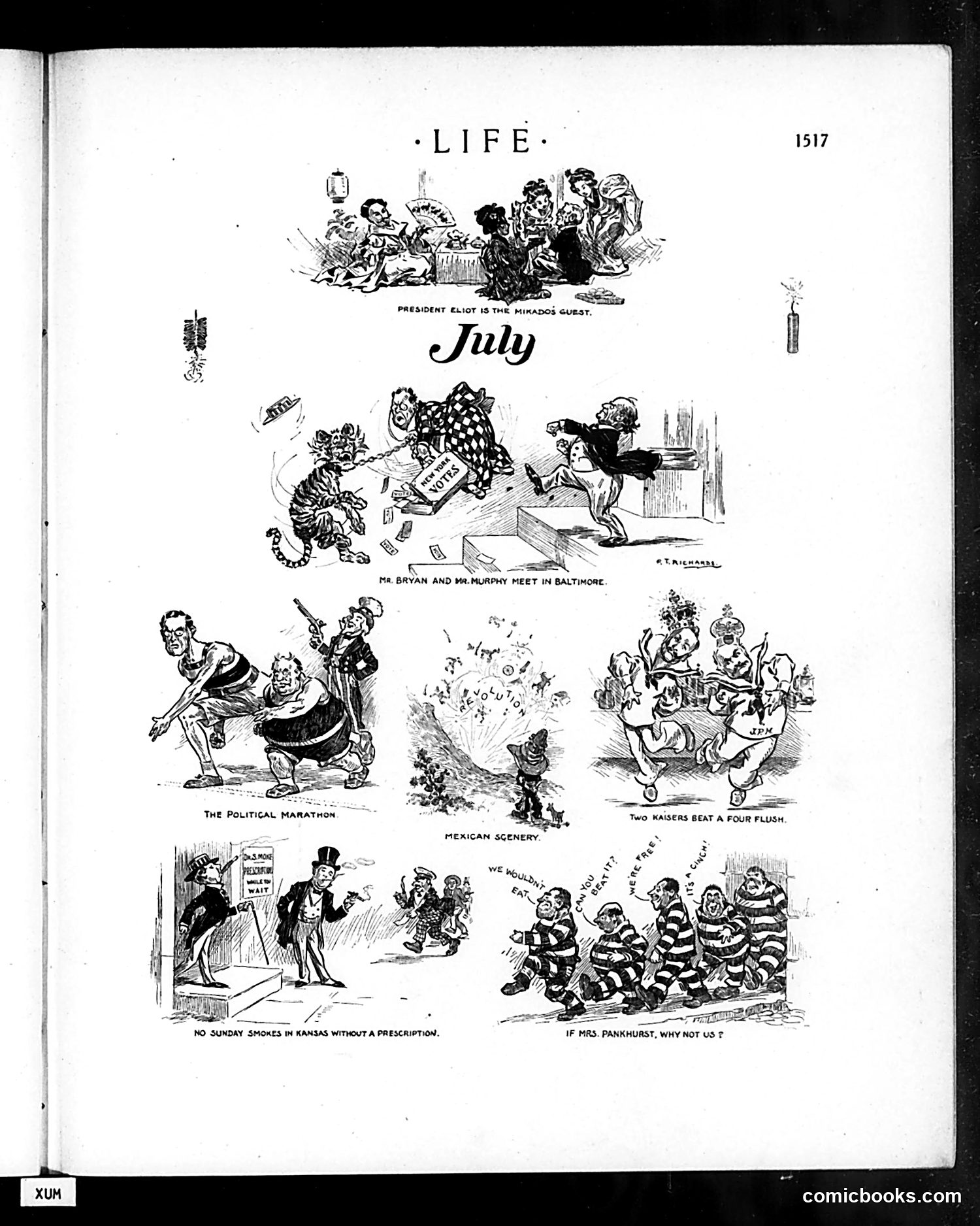
This page collects satirical cartoons mocking contemporary political and social issues: **Top cartoon** references President Eliot as the Mikado's guest—likely commentary on diplomatic relations. **"The Political Marathon"** depicts politicians exhausted by campaigning, satirizing the grueling 1912 election cycle. **"Mr. Bryan and Mr. Murphy Meet in Baltimore"** references the Democratic Convention, likely mocking negotiations between William Jennings Bryan and political boss Charles Murphy. **"No Sunday Smokes in Kansas"** satirizes Kansas's restrictive smoking laws requiring prescriptions. **"If Mrs. Pankhurst, Why Not Us?"** references British suffragist Emmeline Pankhurst, sarcastically suggesting if women deserve voting rights, imprisoned figures deserve them too—unclear which prisoners are referenced. The cartoons employ exaggerated caricature typical of early 20th-century satirical illustration, targeting electoral politics, state legislation, and women's rights debates.
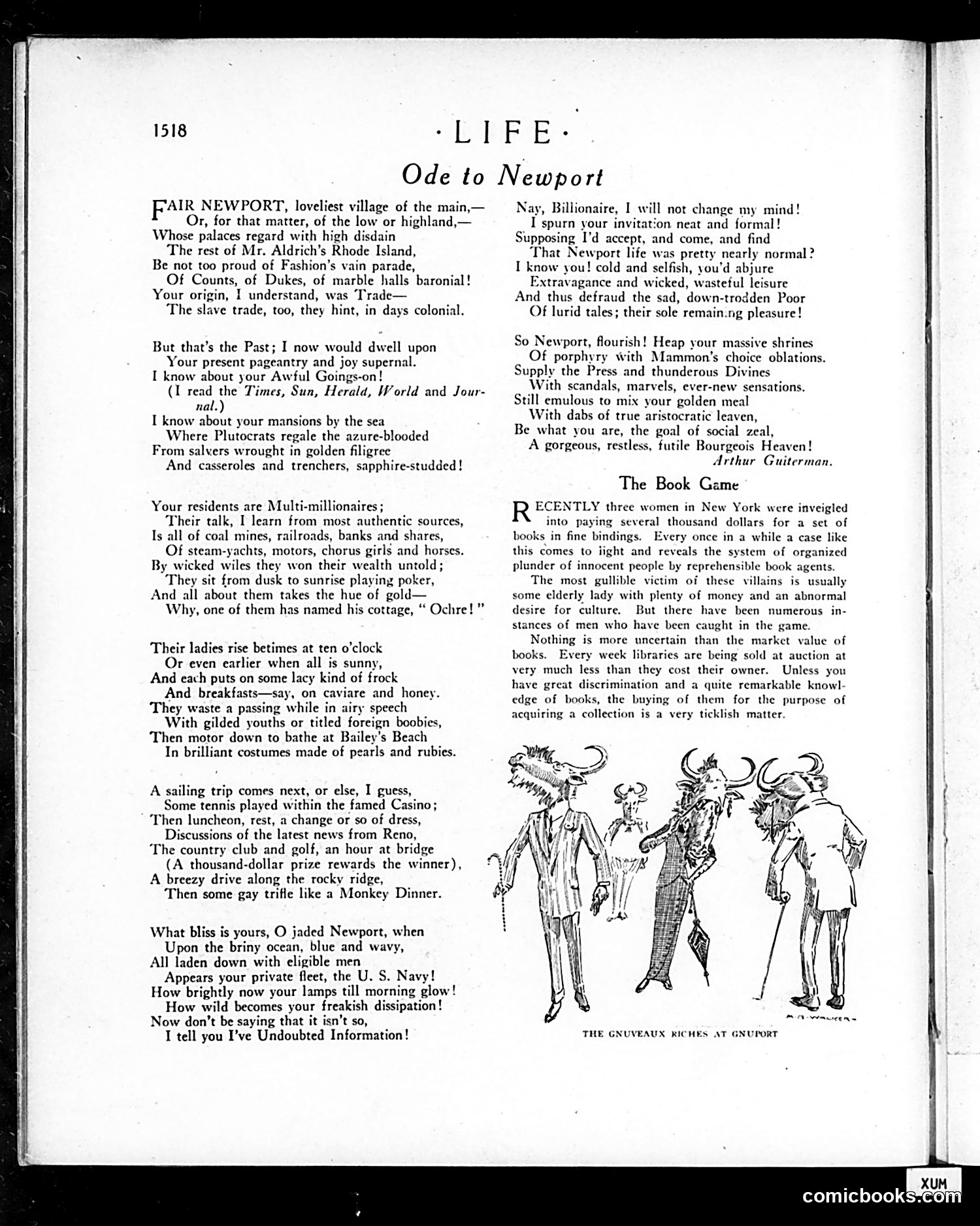
This page contains two satirical pieces from *Life* magazine (dated 1518, likely an error for 1918). **"Ode to Newport"** by Arthur Guiterman mocks Newport, Rhode Island's wealthy elite. The poem sarcastically celebrates their ostentatious lifestyle—mansions, yachts, polo, and extravagant parties—while exposing the hypocrisy beneath. It hints that their fortunes derive from colonial slave trading, then catalogs their current vices: gambling, materialism, and shallow pursuits. The final stanza requests Newport remain scandalous to entertain the poor with "lurid tales," suggesting the wealthy serve primarily as objects of voyeuristic fascination for the masses. **"The Book Game"** exposes a con where unscrupulous book agents sell expensive leather-bound sets to gullible wealthy buyers, particularly elderly women seeking "culture." The text notes that fine books' market value is unpredictable and often far less than purchase price. This piece targets both predatory salesmen and the pretentious aspirations of the wealthy. Both selections critique American wealth, materialism, and social aspiration during the early 20th century.
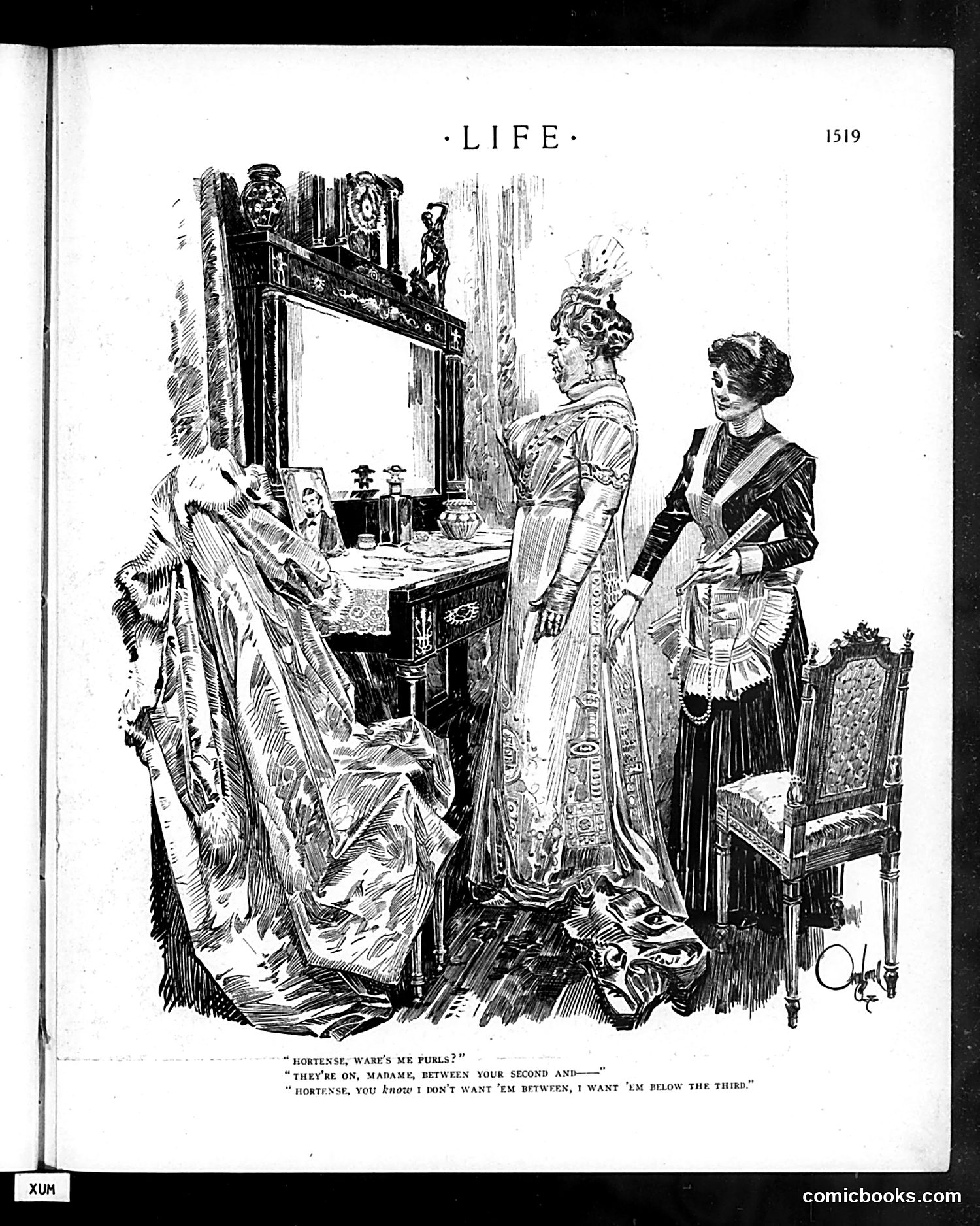
This illustration depicts a wealthy woman at her vanity mirror, attended by servants. The caption reads: "HORTENSE, WHERE'S ME PURLS?" with dialogue about positioning pearls between the second and third (or below the third). The satire targets **upper-class vanity and pretension**. The character appears to be a society woman obsessing over pearl placement—a trivial concern treated with exaggerated importance. The misspelling "WHERE'S ME" (instead of "WHERE ARE MY") suggests either affected speech patterns or mockery of someone adopting false aristocratic airs. The joke likely ridicules **Gilded Age excess**: wealthy women's preoccupation with jewelry, status symbols, and minute details of fashion that signaled social rank. The elaborate mirror, servants, and luxurious fabrics emphasize conspicuous consumption. Without a visible date attribution, the specific target remains unclear, though this reflects Life's typical early-20th-century mockery of nouveau riche pretension and society obsessions.
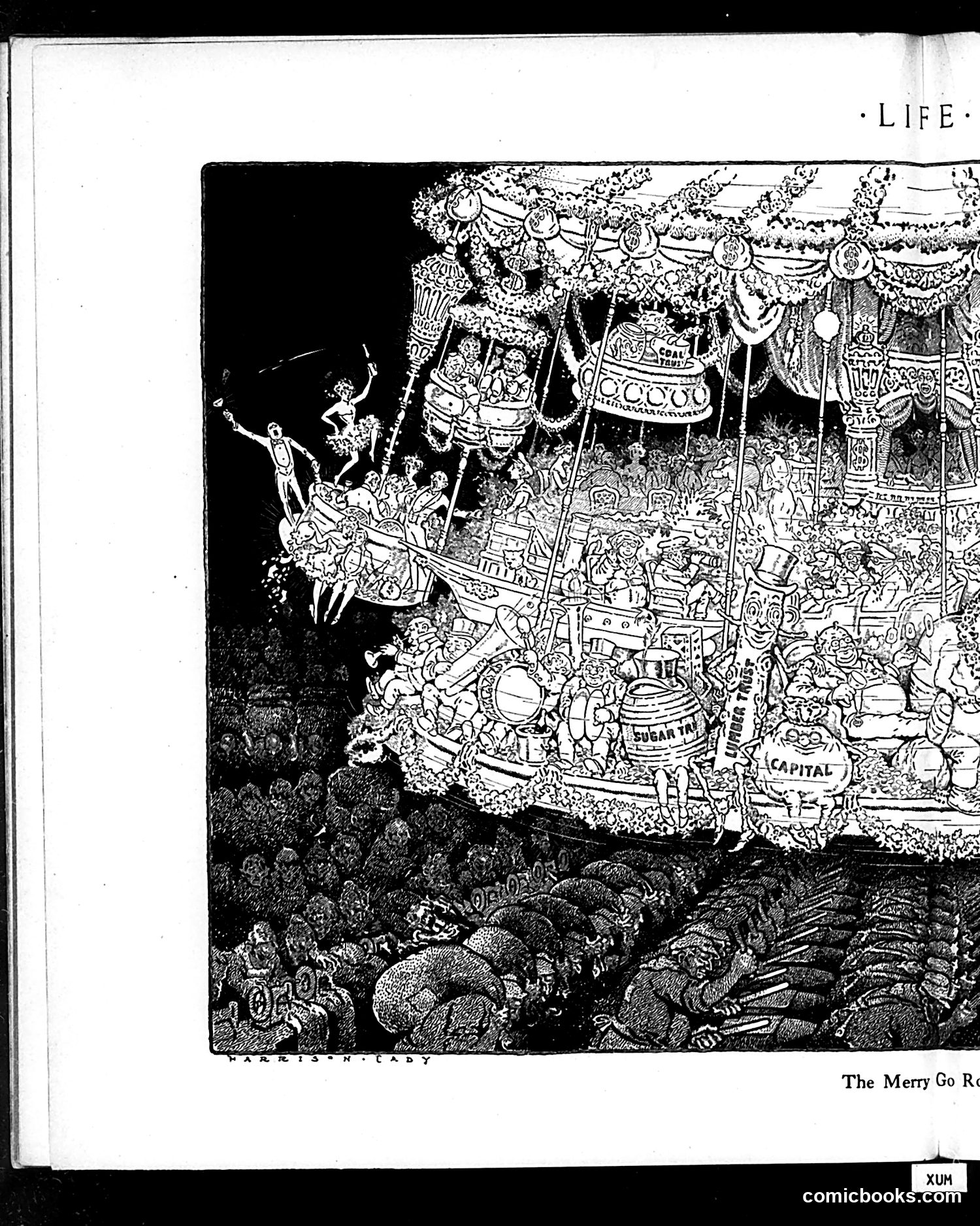
This densely detailed satirical illustration depicts a chaotic carnival or circus scene. The upper portion shows an ornate, festive pavilion with decorative garlands and flags, filled with elaborately dressed figures in what appears to be a formal or governmental setting. The lower portion transforms into a darker, more sinister image: a massive crowd of grotesque, demon-like or monstrous faces and figures swarms below, suggesting the hidden chaos or moral corruption beneath the surface spectacle above. The title "The Merry Go Round" implies cyclical futility or that society's elaborate public displays mask underlying disorder. Without a visible date or artist attribution, the specific political targets remain unclear, though this appears to critique governmental pageantry or social hypocrisy—a common Life magazine theme.
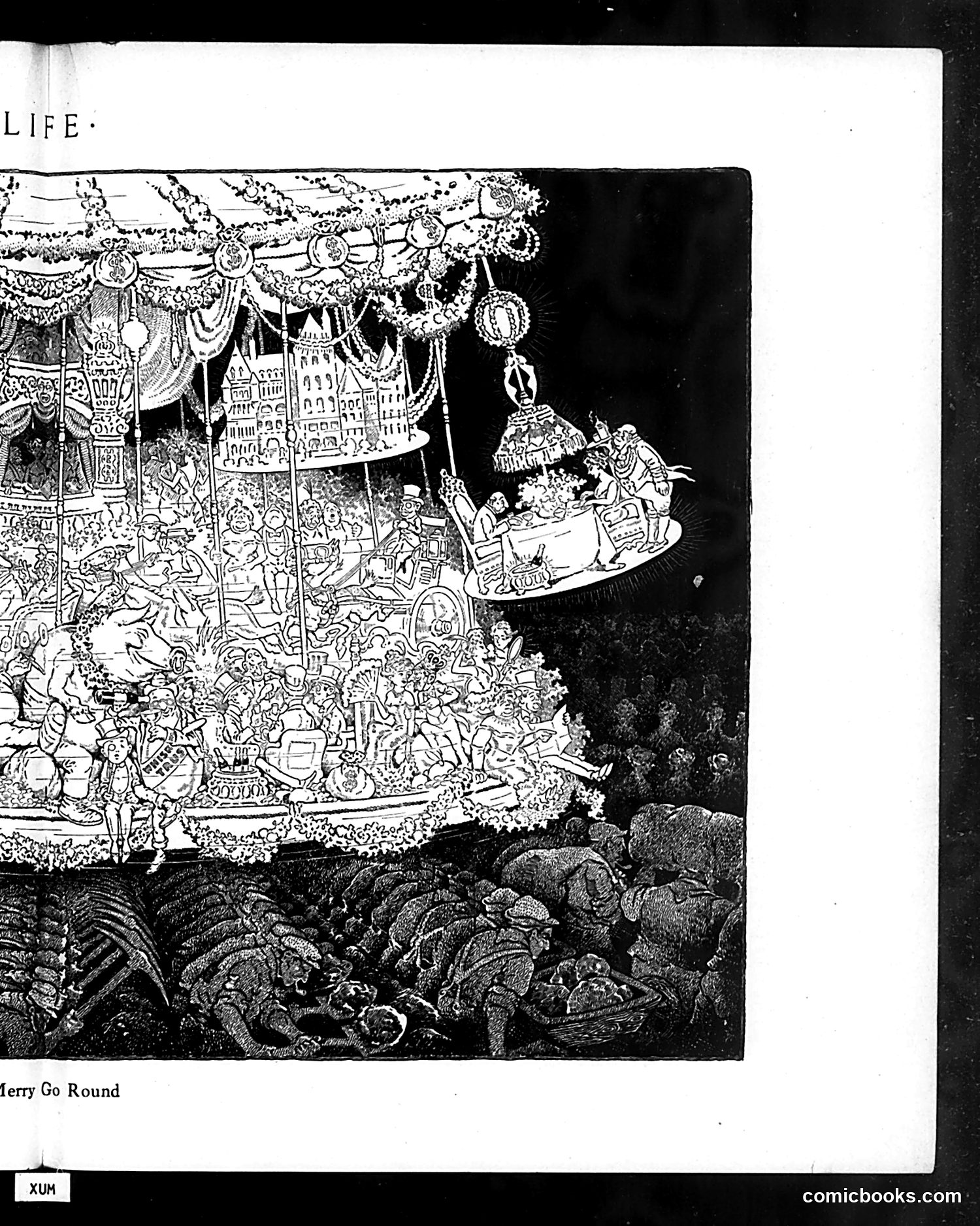
This intricate satirical illustration depicts a carnival or amusement park scene with a massive merry-go-round as its centerpiece. The upper portion shows an elaborately decorated carousel with ornate architecture, hanging lanterns, and well-dressed riders enjoying themselves. The lower half reveals a stark contrast: crowds of what appear to be working-class or poor people densely packed below, watching the spectacle from outside. The cartoon likely satirizes **class inequality and economic disparity**—the pleasure and abundance enjoyed by the privileged few at the top, contrasted against the masses excluded from prosperity below. The "merry-go-round" metaphor suggests circularity and futility, implying that the system perpetuates inequality endlessly. This was typical of *Life* magazine's social commentary on wealth gaps and class divisions in early 20th-century America.
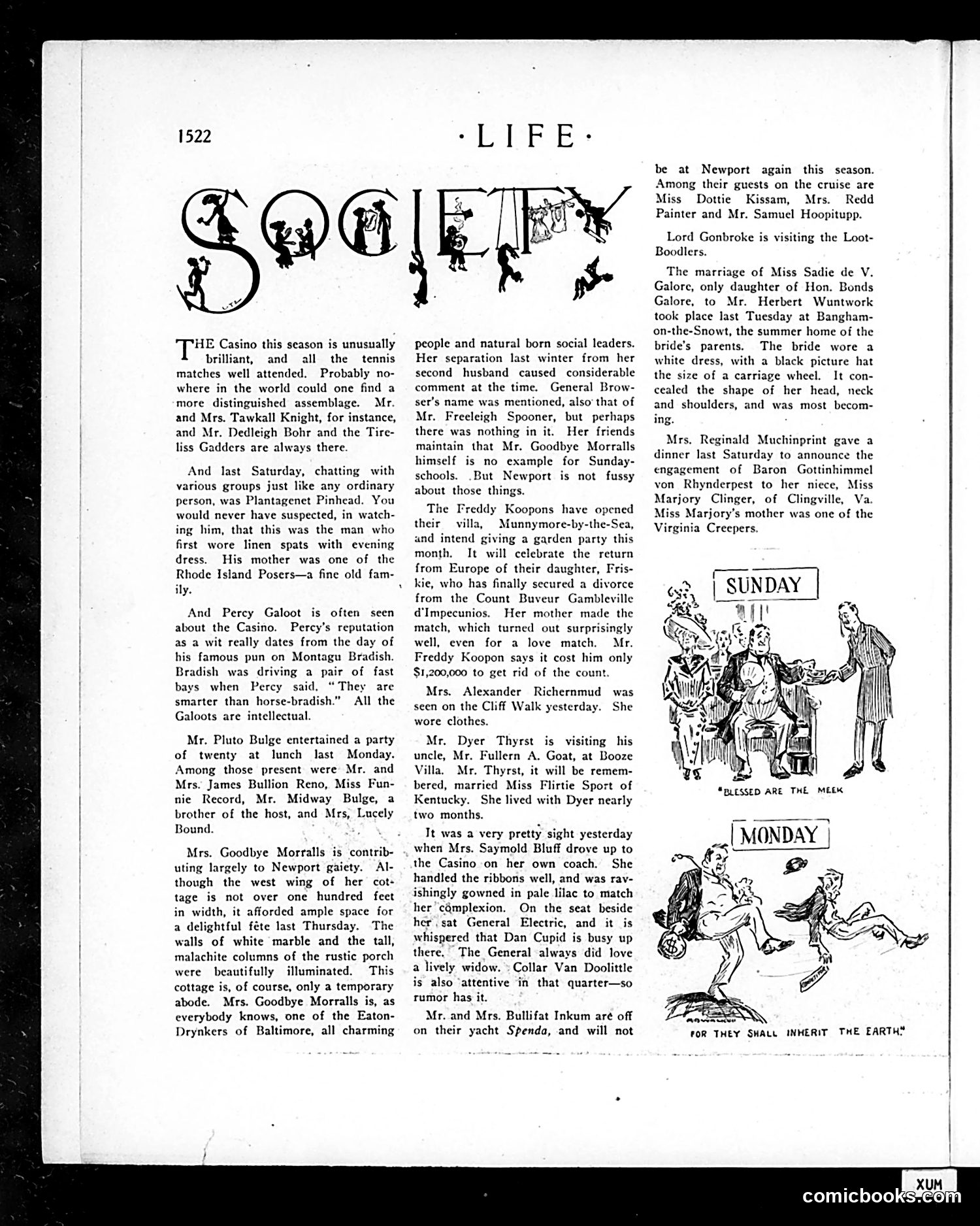
This is a satirical society column mocking Newport's elite. The text uses absurdly invented names—Plantagenet Pinhead, Percy Galoot, Pluto Bulge, Mrs. Goodbye Morralls—to ridicule wealthy socialites and their pretensions. The humor targets their obsessions: name-dropping lineage ("Rhode Island Posers"), conspicuous consumption (Mrs. Morralls's marble cottage), and hollow social rituals. References like a man costing $1.2 million to "get rid of" his wife's count suggest satirizing the era's transactional marriages among the wealthy. The accompanying cartoons ("Blessed are the Meek," "For They Shall Inherit the Earth") reinforce the critique through ironic juxtaposition—contrasting Christian virtue with the selfish materialism depicted in the column. Life magazine regularly used such "Society" parodies to mock upper-class vanity and superficiality during this period.
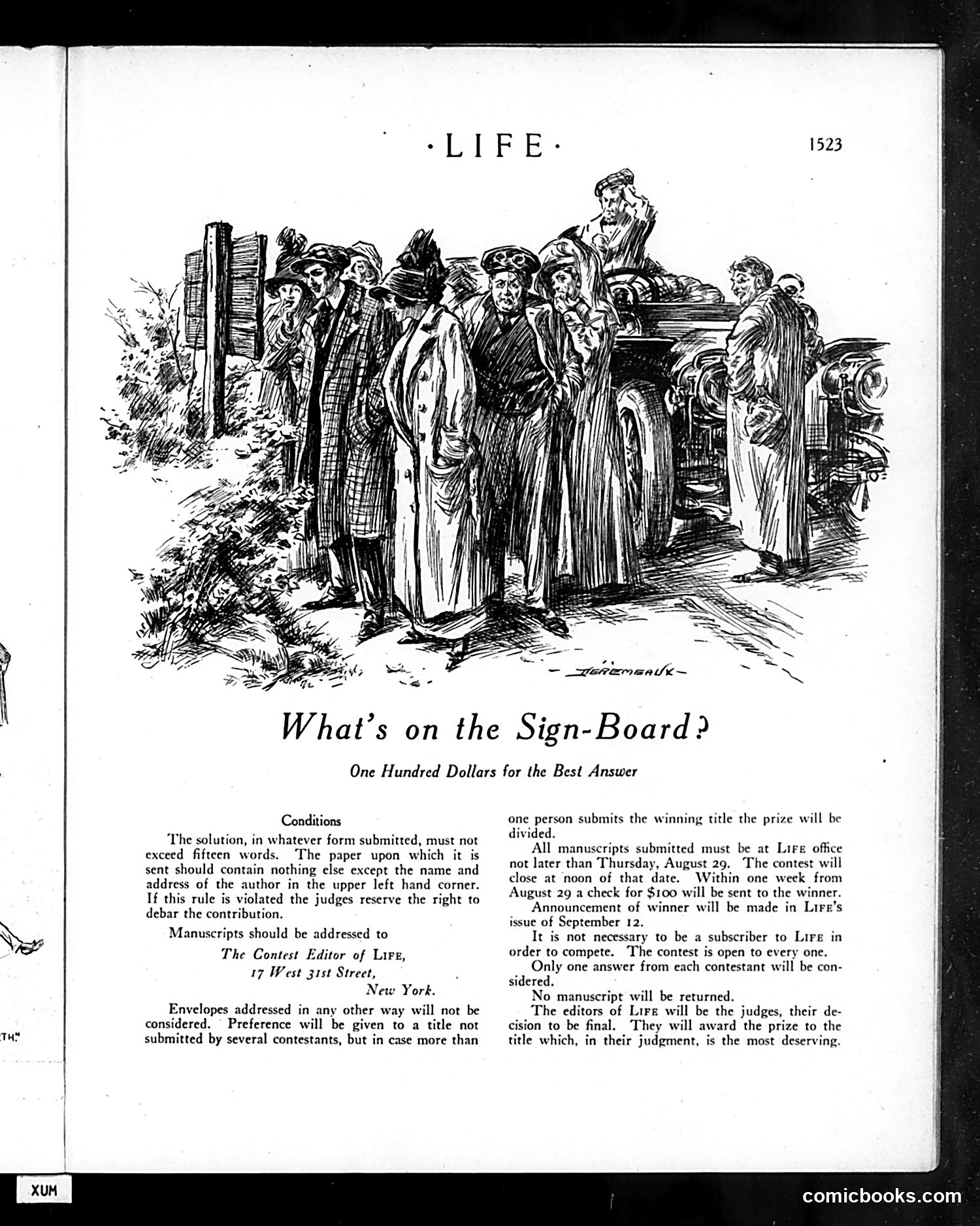
This page announces a reader contest: Life magazine is offering $100 (substantial money in 1923) for the best caption to the illustration above. The cartoon shows a group of people—appearing to be working-class or rural figures in period clothing—gathered around an automobile, staring at an illegible sign-board. The joke's premise is that readers must guess what the sign says. The contest rules are strict: answers must not exceed fifteen words, submitted on plain paper with only the contestant's name and address, and received by August 29. Life's editors will judge submissions based on wit and originality. This was a common early-twentieth-century magazine engagement tactic—a contest inviting reader participation and creativity while generating content and subscriptions. The cartoon itself relies on the humor of confusion or misreading, inviting readers to complete an ambiguous visual joke.
This is a **book review column** from Life magazine, not primarily a political cartoon. The page features J.B. Kerfoot reviewing new publications, with a humorous introductory anecdote. The "Hard Luck Stories" section opens with a **satirical comparison**: a nineteenth-century Pullman car anecdote about an annoying woman complaining "I am so dry" to the exhaustion of fellow passengers. Kerfoot then compares this to **Karin Michaelis Stangeland's recent novel "Elsie Lindner,"** suggesting her book similarly aired repetitive feminine complaints across Sweden and Germany. The implication is that both the woman and the author were tiresome—dwelling on grievances that annoyed their respective audiences. The joke relies on readers recognizing Stangeland's work as emotionally overwrought. Kerfoot mocks "restless forties" female anxiety as tedious, reflecting early 20th-century attitudes dismissing women's discontent as whining rather than legitimate concern. The remainder of the page contains standard literary reviews of various books on nature, prison life, and rural England.
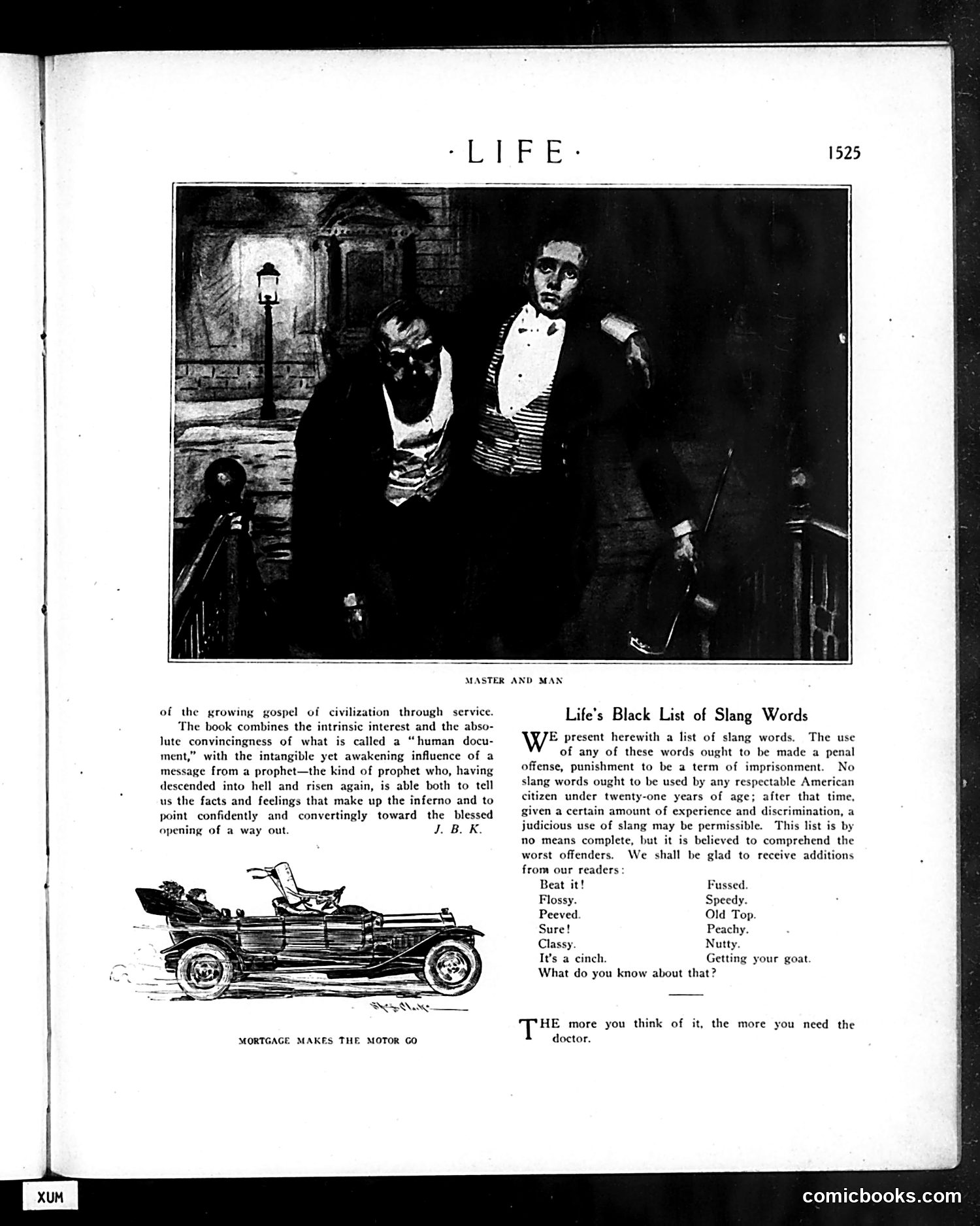
**The Image ("Master and Man"):** A dramatic scene showing two men in formal evening wear in what appears to be a dark, shadowy interior. The caption references a book promoting "civilization through service" and uses religious metaphor—a "prophet" who descended into "hell and risen again." This likely promotes a moral or self-help book popular in the era. **"Mortgage Makes the Motor Go":** A cartoon car labeled with the mortgage concept, satirizing how debt drives consumerism and the automobile industry's growth in the 1920s. **"Life's Black List of Slang Words":** A humorous editorial attacking contemporary slang terms (Beat it! Flossy! Peeved! Classy!) as corrupting language. The piece proposes criminalization for under-21s, reflecting generational anxiety about youth culture and linguistic "degradation"—a recurring early-20th-century complaint about modern speech. The final quip ("The more you think of it, the more you need the doctor") suggests these linguistic trends are mentally taxing.
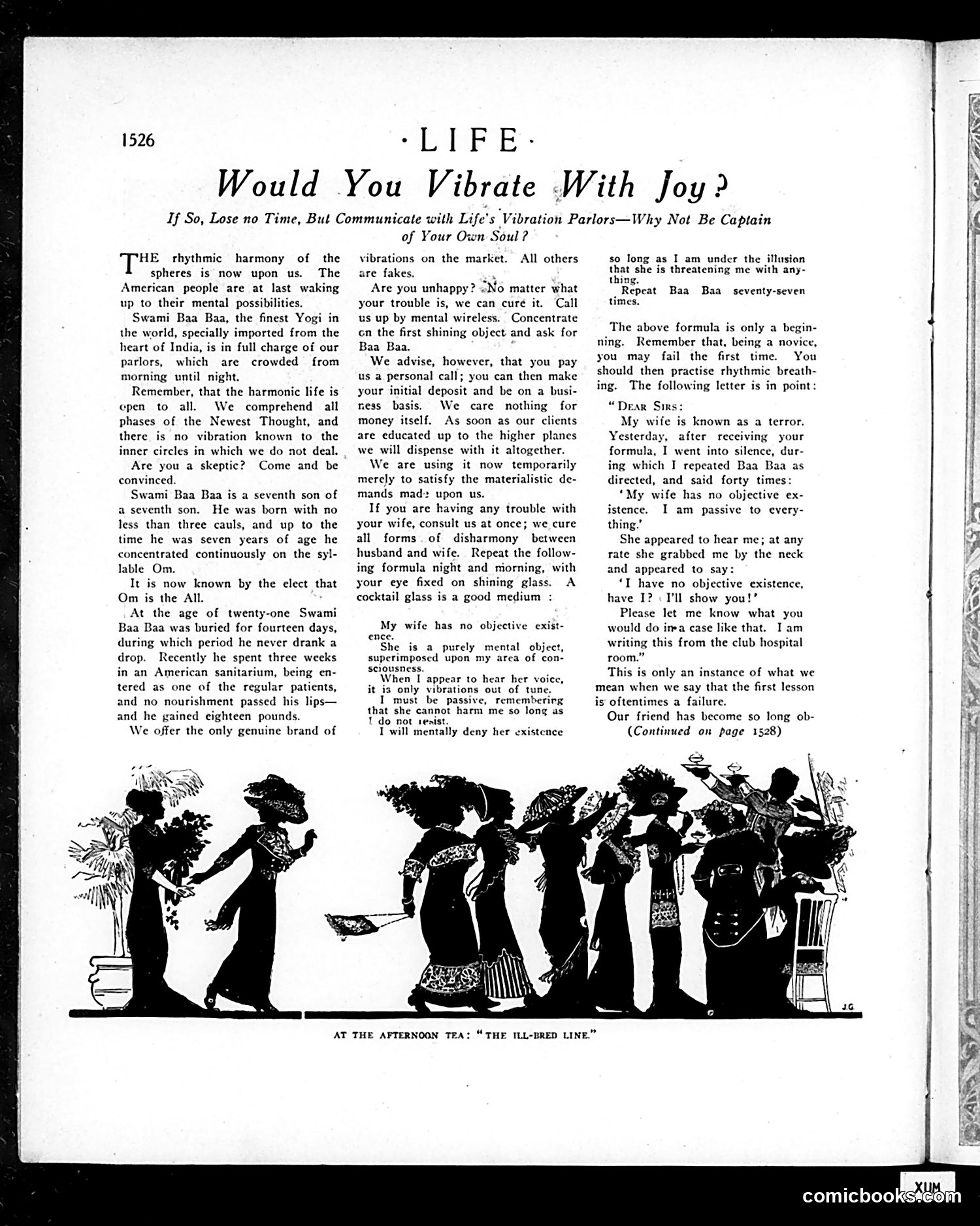
This page satirizes the early 20th-century American craze for New Thought spiritualism and pseudo-Eastern mysticism. The satirical advertisement promotes "Swami Baa Baa's Vibration Parlors"—a fake wellness business claiming to cure unhappiness through mental "vibrations" and Hindu-inspired practices. The joke targets multiple absurdities: an obviously fabricated Indian guru ("Baa Baa"), miraculous feats (surviving buried for weeks), and pseudoscientific jargon ("mental wireless," "objective existence"). The included letter from a client perfectly demonstrates the satire's point: a man tries the formula to deny his wife's existence, but she responds by physically attacking him—revealing the method's uselessness. The silhouette cartoon "At the Afternoon Tea" appears to show social commentary on manners. Life magazine here mocks wealthy Americans' gullibility toward trendy spiritualism and wellness scams dressed in exotic Eastern philosophy.
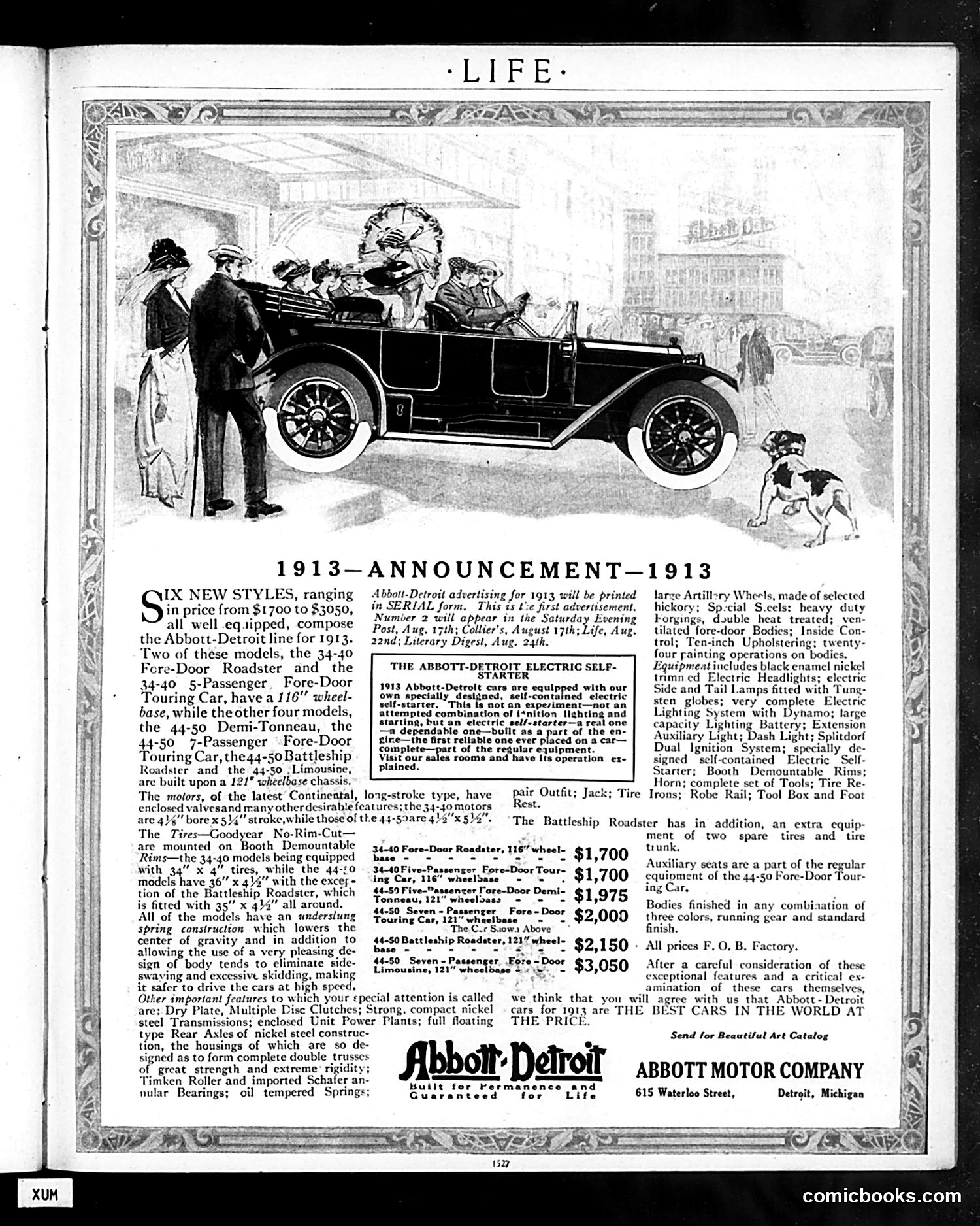
This page is primarily a **automobile advertisement**, not political satire. It announces six new Abbott-Detroit car models for 1913, priced $1,700–$3,050. The illustration shows a stylish open-air automobile with well-dressed passengers and onlookers in an urban setting, typical marketing imagery of the era. The ad emphasizes modern features: an "electric self-starter" (then a significant innovation), electric lighting, demountable rims, and quality construction details. The text emphasizes this is the "first advertisement" in a serialized campaign appearing across major publications (Saturday Evening Post, Collier's, Life, Literary Digest). The company promotes these as "THE BEST CARS IN THE WORLD AT THE PRICE." There is **no satirical content or political commentary** on this page—it's straightforward early automotive advertising targeting affluent consumers interested in the latest mechanical innovations.
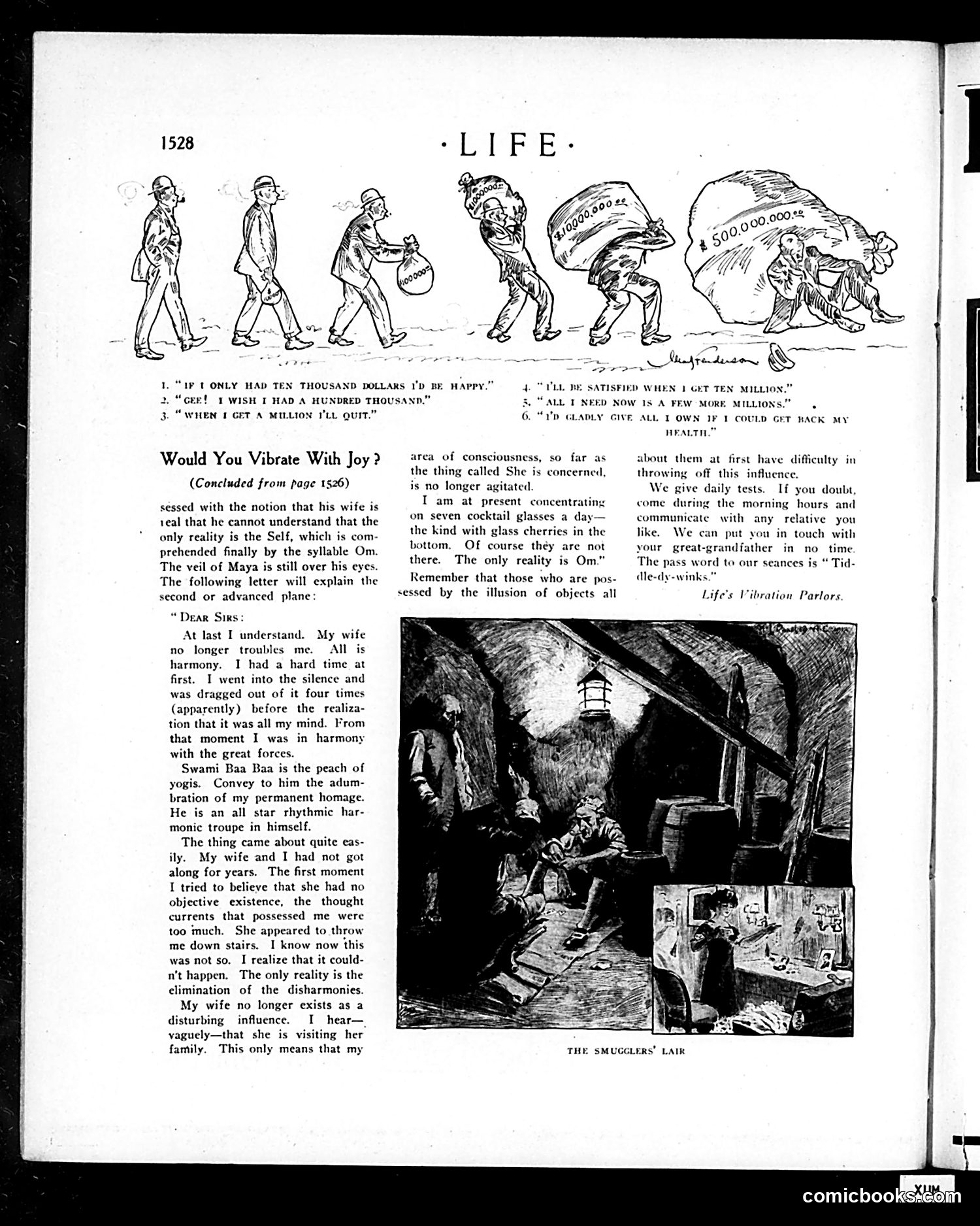
The top cartoon satirizes endless materialism and greed. Six figures progress left-to-right, each carrying increasingly larger money bags labeled with escalating amounts ($1,000 to $500,000,000). Their captions show perpetual dissatisfaction: each claims they'd be happy with their stated amount, yet the final figure, crushed under the largest sack, realizes wealth means nothing—he'd "gladly give all I own if I could get back my health." The satire targets the American obsession with wealth accumulation. No matter how much money one acquires, happiness remains elusive. The final figure's revelation—that health and wellbeing matter more than riches—serves as the moral critique. Below, "Life's Vibration Parlors" mocks trendy New Thought/spiritualism movements popular in the 1920s. A man uses mysticism and meditation to convince himself his wife doesn't actually exist (she's merely "illusion"). The satire exposes how people weaponize pseudo-spiritual philosophy to rationalize selfish or delusional behavior, rather than addressing real problems.
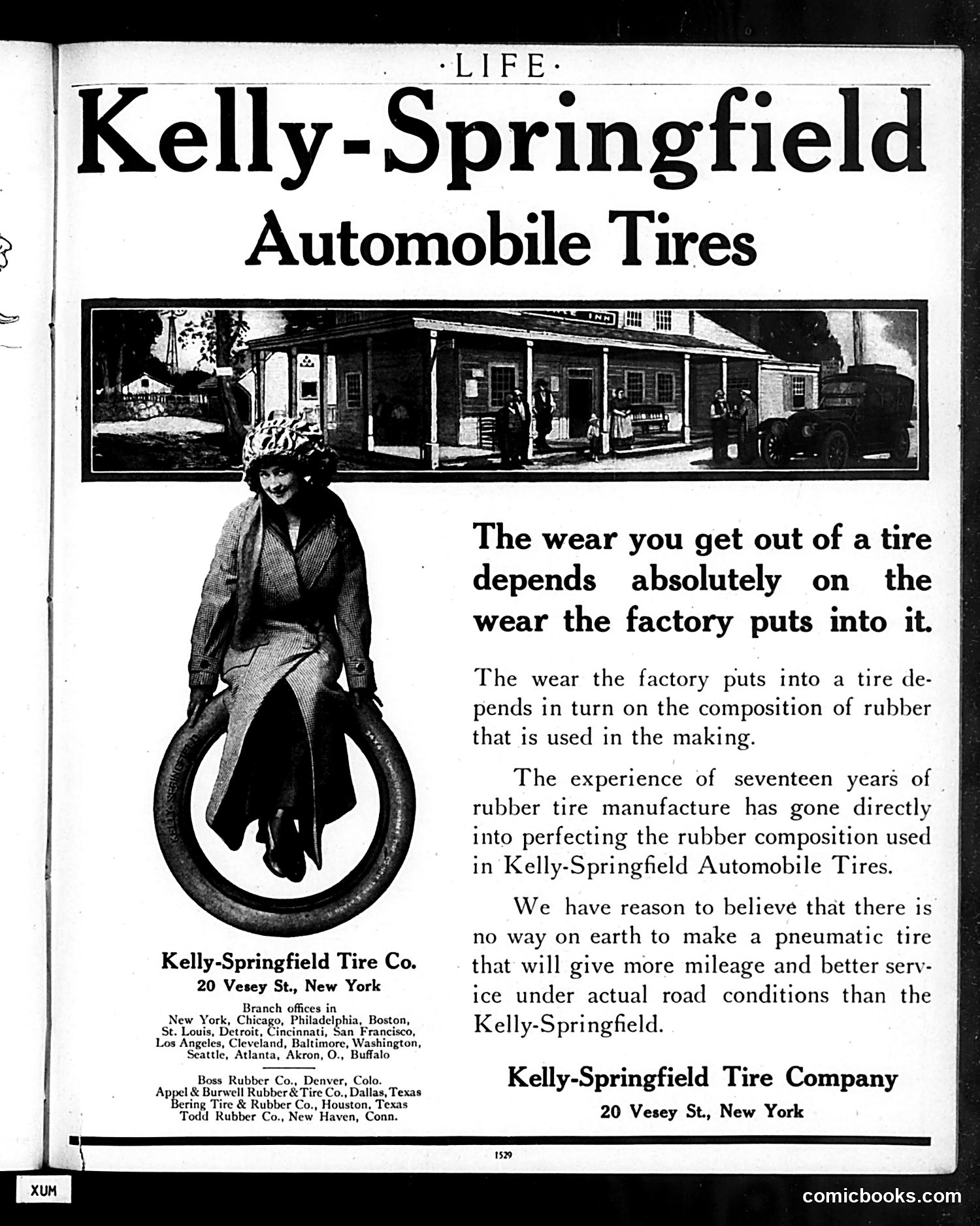
This is a **straightforward advertisement**, not satire. The page promotes Kelly-Springfield automobile tires through *Life* magazine (which ran both humor and ads). The visual shows a woman in early 20th-century dress sitting inside a large tire, likely meant to convey the tire's durability and quality. The accompanying text emphasizes the company's manufacturing expertise—seventeen years of experience in rubber composition—as the key to tire longevity. The marketing claim ("no way on earth to make a pneumatic tire that will give more mileage and better service") reflects early automotive-era competition when tire quality was a genuine consumer concern and competitive differentiator. The multiple branch offices and affiliated rubber companies listed suggest Kelly-Springfield's national reach during this period of American industrial expansion.
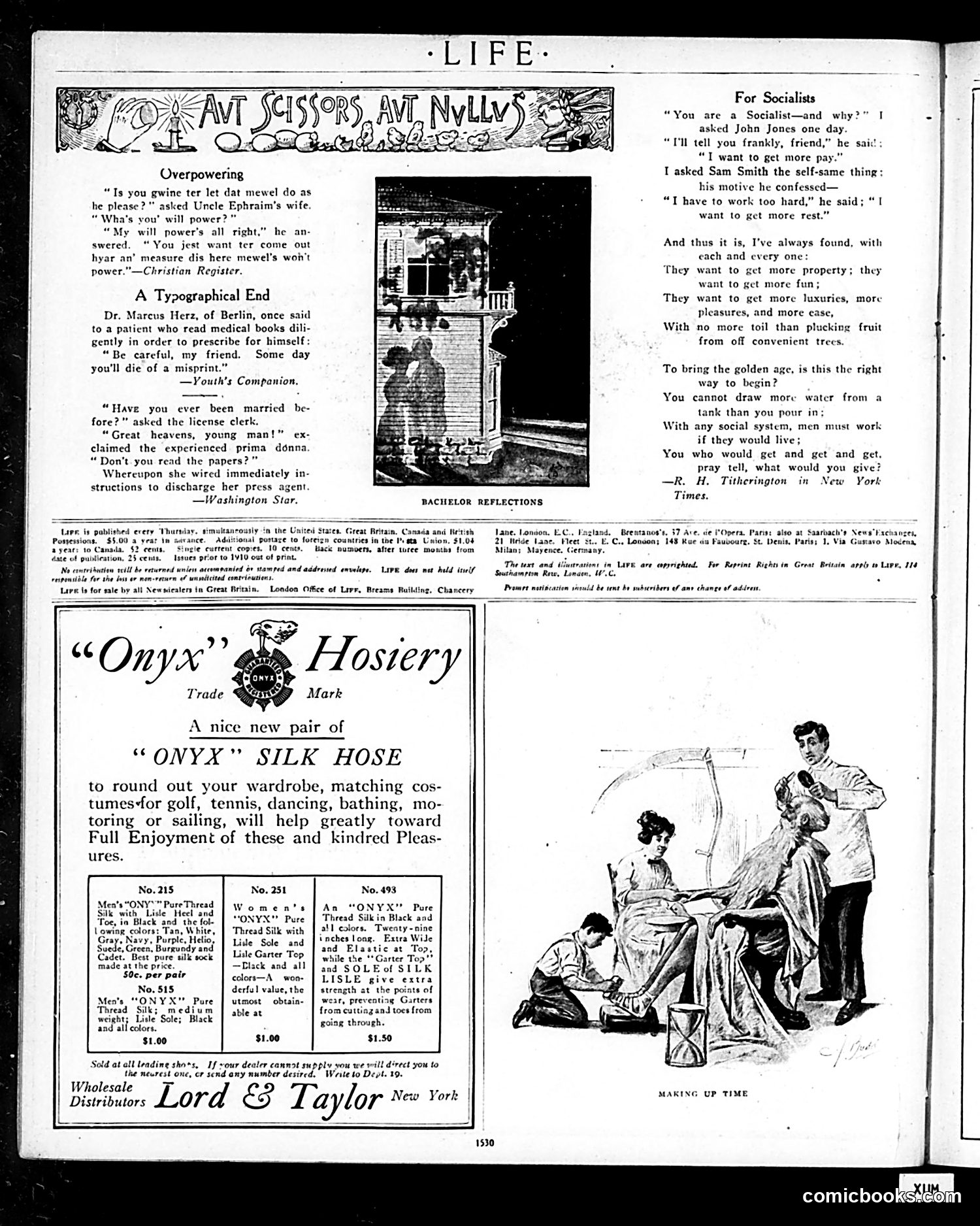
This page contains **three unrelated satirical pieces and an advertisement**, typical of Life's format. The main **"For Socialists"** poem mocks socialist ideology by suggesting that working-class people who claim socialist motivations are actually driven by selfish desires—wanting more money, less work, more property and luxuries. The satirist (R. H. Titherington) argues this exposes socialism's fundamental contradiction: you cannot redistribute wealth or reduce labor if everyone simply wants more for themselves. It's a critique suggesting socialism ignores human nature's inherent selfishness. The three brief **humor items** are standard joke fare: "Overpowering" plays on dialect humor; "A Typographical End" is a pun about a doctor's misprint causing death; the marriage license clerk joke is about a woman's press agent managing her public image. The **"Bachelor Reflections"** illustration (center) depicts domestic scenes with no clear satirical message visible. Below is a straightforward **"Onyx" hosiery advertisement** offering silk stockings for various activities. The page is primarily **advertising and light humor**, not serious political commentary.
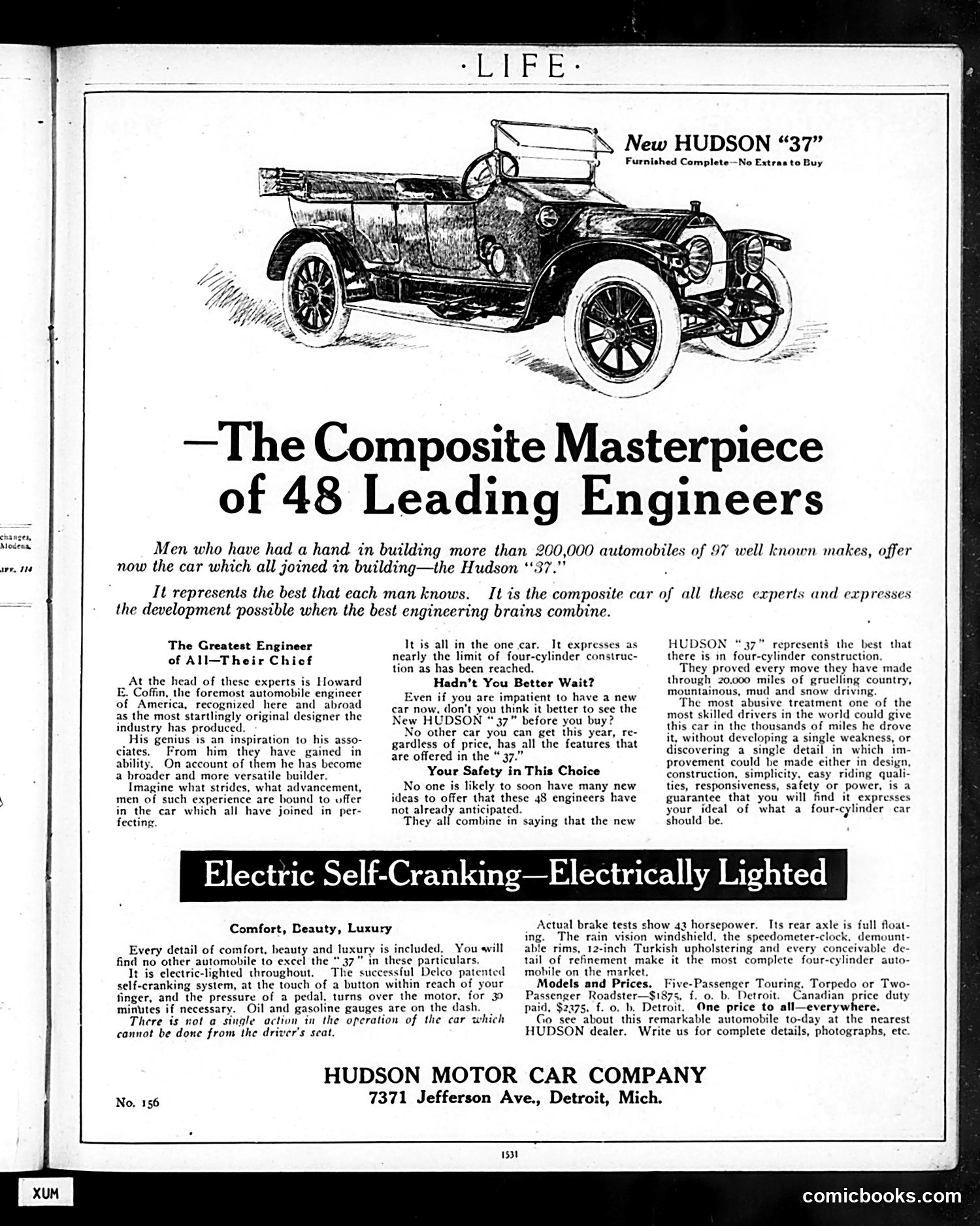
This is **not a cartoon or satire**—it's a straightforward automobile advertisement from Life magazine (1911, based on the page number). The Hudson Motor Car Company advertises their 1937 model by claiming it represents "the composite masterpiece of 48 leading engineers." The ad's central appeal is that the car was designed by Howard E. Coffin and 47 other engineers who collectively had experience building over 200,000 automobiles from 97 different manufacturers. The ad uses this engineering pedigree as its main selling point: the "37" supposedly embodies the best knowledge of multiple experts combined. It emphasizes practical features (electric self-cranking, lighting, comfort) and durability tested over 20,000 miles. This reflects early automotive marketing strategy—appealing to buyers' desire for technological legitimacy and reliability by name-checking prominent engineers and emphasizing safety testing.
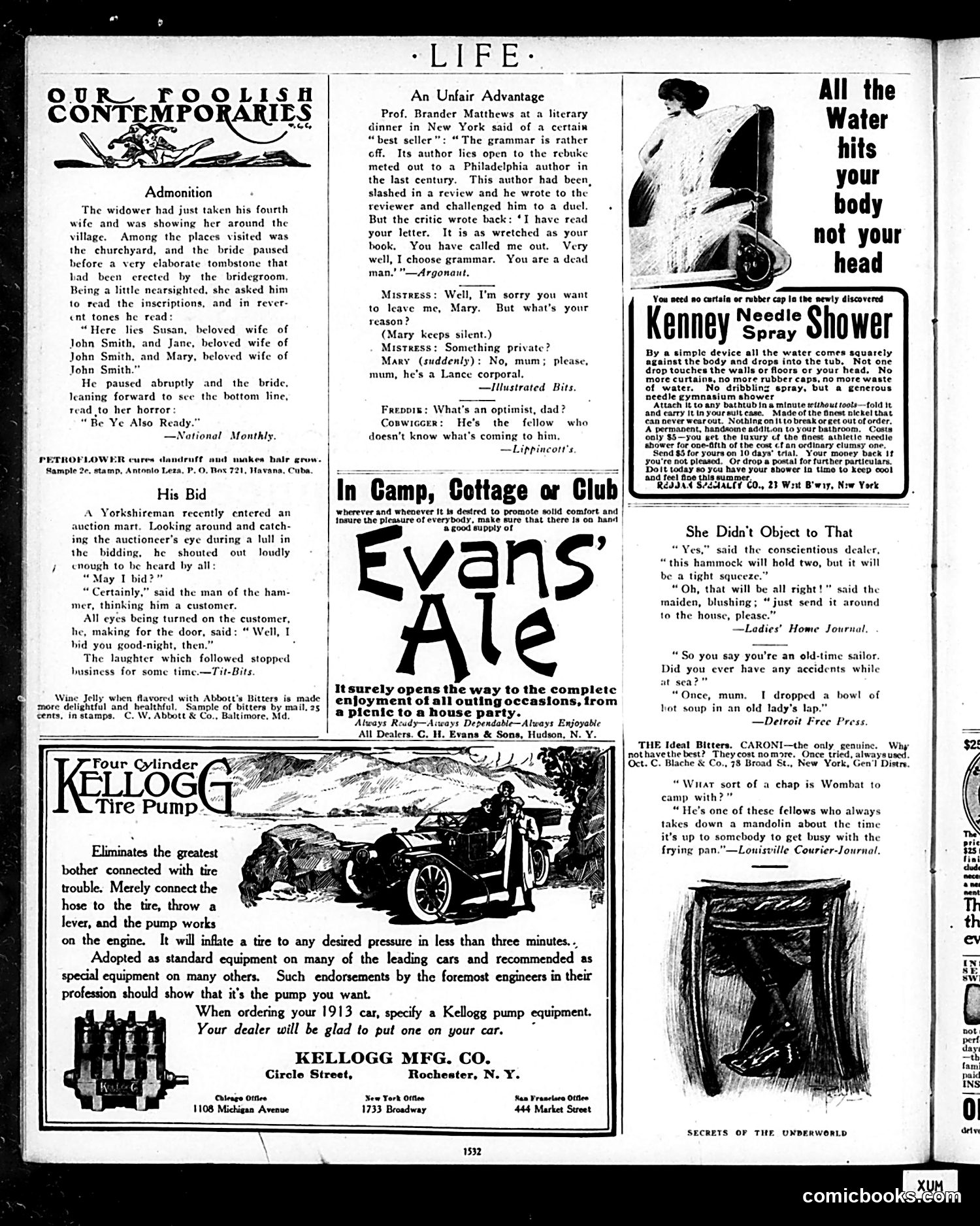
This page from *Life* magazine (dated 1532, likely 1913 based on context) contains mostly **humorous anecdotes and advertisements** rather than political cartoons. ## Key Content: **"Admonition"** joke: A widower remarries for the fourth time and shows his new bride tombstones of his previous three wives, all named, ending with "Be Ye Also Ready"—a dark humor punchline suggesting the bride should prepare to become wife number five. **"His Bid"** anecdote: A Yorkshire farmer enters an auction, loudly announces "May I bid?" then immediately says "Good-night" and leaves—humor based on the double meaning of "bid" (to make an offer vs. to bid farewell). **"An Unfair Advantage"** piece: Recounts a story where a literary critic chose "grammar" over pistols in a duel challenge, implying the author's poor writing was a fatal flaw. The page is primarily **advertisements** (Kellogg tire pumps, Evans Ale, Kenney shower spray) interspersed with short comic vignettes—typical *Life* magazine content that relied on wordplay and social observation rather than visual satire.
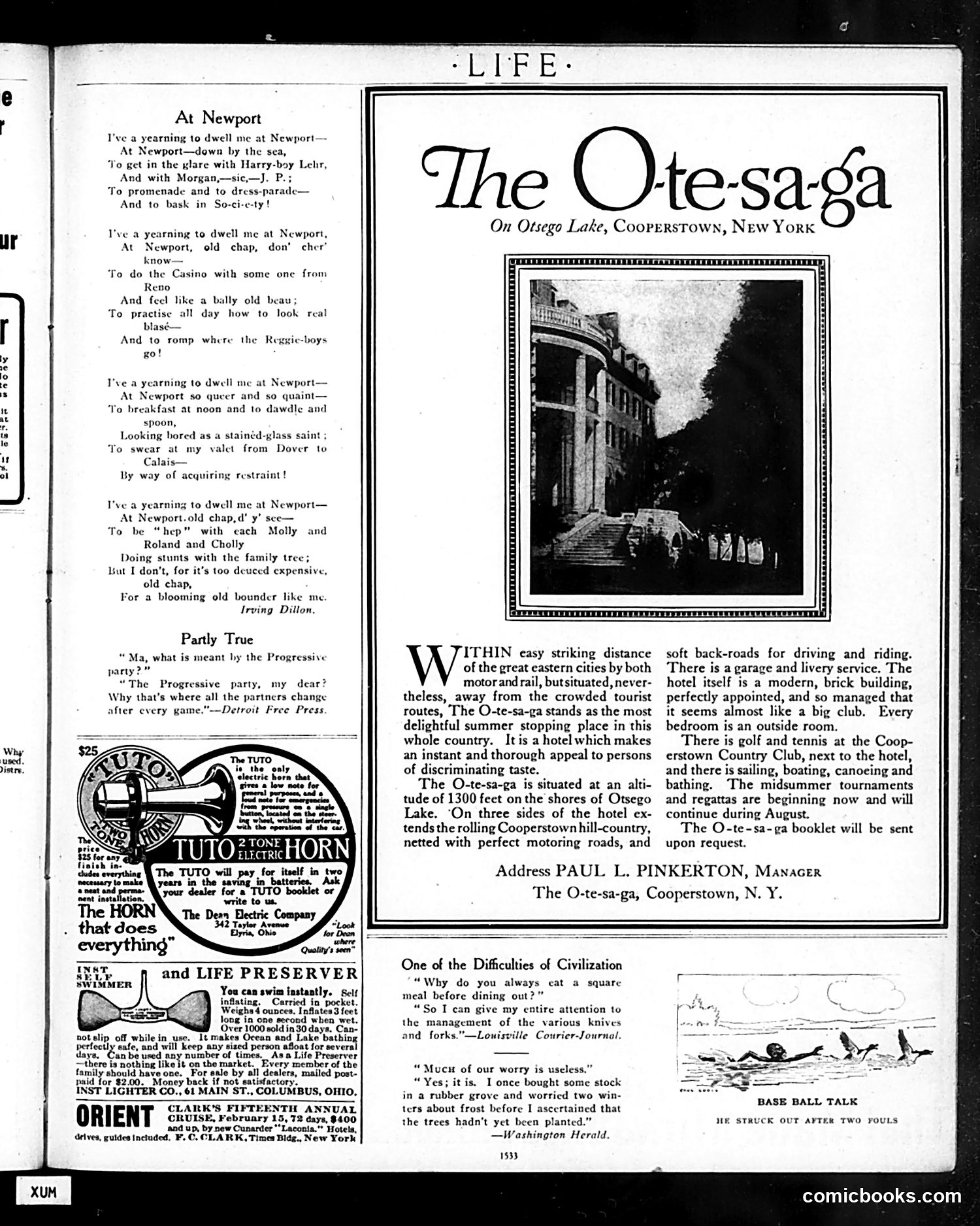
This page is primarily **advertising and social commentary** rather than political satire. The main poem, "At Newport," mocks wealthy aspirants to high society. It catalogs the affectations of Newport's elite—name-dropping J.P. Morgan and "Harry-boy Lehr" (a real Newport social figure), referencing the Casino, affected speech patterns ("So-ci-e-ty"), and pretentious behaviors. The joke's punchline: the narrator can't afford this lifestyle because it's "too deuced expensive." A brief joke about the Progressive Party plays on the phrase "changing partners"—political criticism wrapped in wordplay. The remaining content is **hotel and product advertising**: The O-te-sa-ga resort in Cooperstown, NY; a self-inflating life preserver; cruise bookings; and a car horn. Two short humor pieces—one about eating before formal dining to manage silverware, another about useless worry—fill remaining space. **Context**: This reflects early 1900s Life magazine's format: satirizing American upper-class pretension while monetizing reader interest in leisure and consumption.
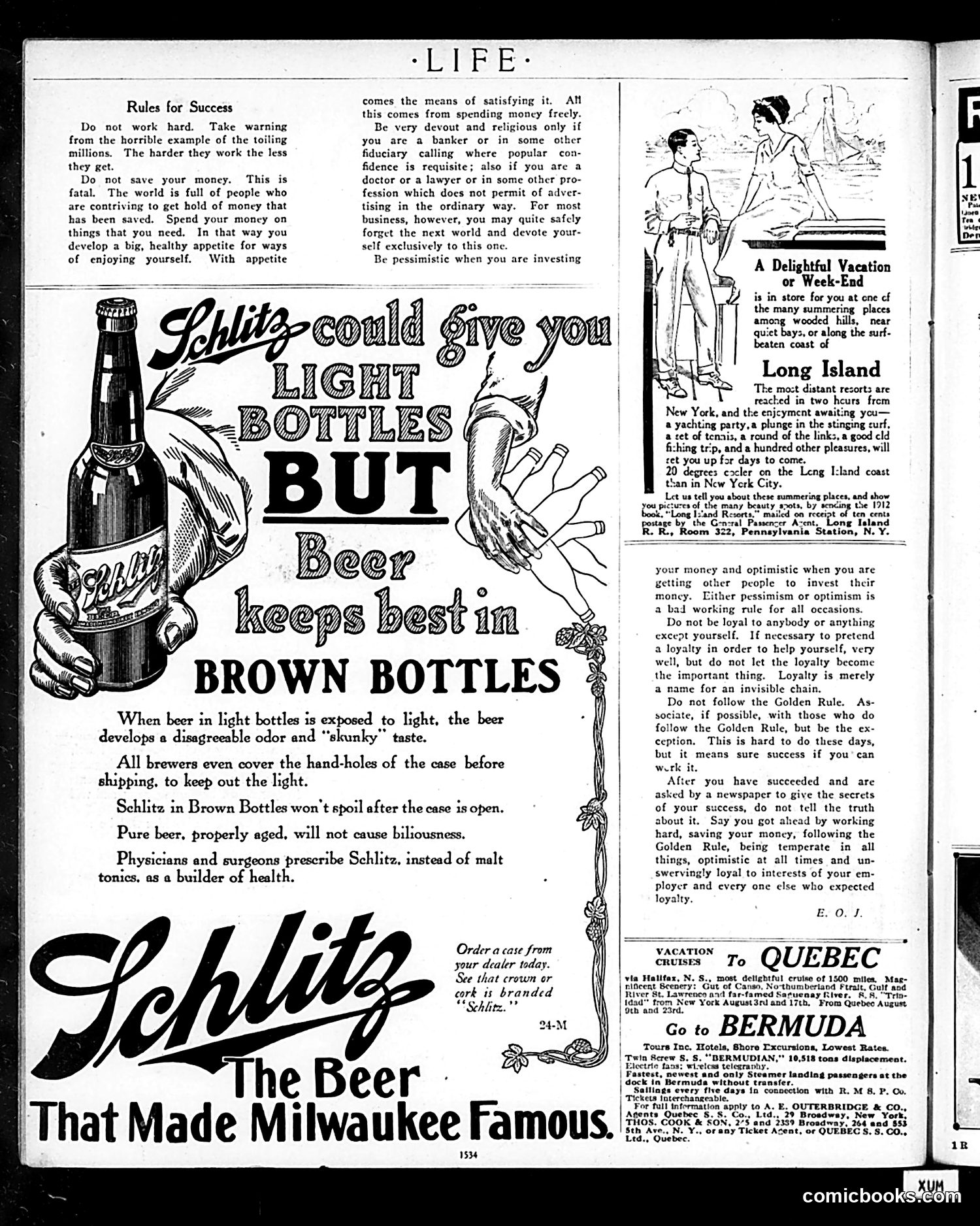
This page contains satirical advice on success alongside period advertisements. The "Rules for Success" section is ironic social commentary—Life magazine presents deliberately cynical, amoral guidance that contradicts conventional wisdom. The satire advises readers to: avoid hard work (mocking the "Protestant work ethic"), spend rather than save money, abandon religious principles unless professionally necessary, and reject loyalty except to oneself. The final rule is key: after achieving success through these selfish means, *lie about it*—claim you succeeded through hard work, thrift, and the Golden Rule you actually ignored. This critiques Gilded Age hypocrisy: wealthy industrialists publicly preached moral virtue while practicing ruthless self-interest. The joke is that the advice is probably *accurate* about how success actually worked, even though it violates stated American values. The advertisements (Schlitz beer, Long Island vacations, ocean cruises) represent the consumer goods and leisure activities this cynical success supposedly purchases.
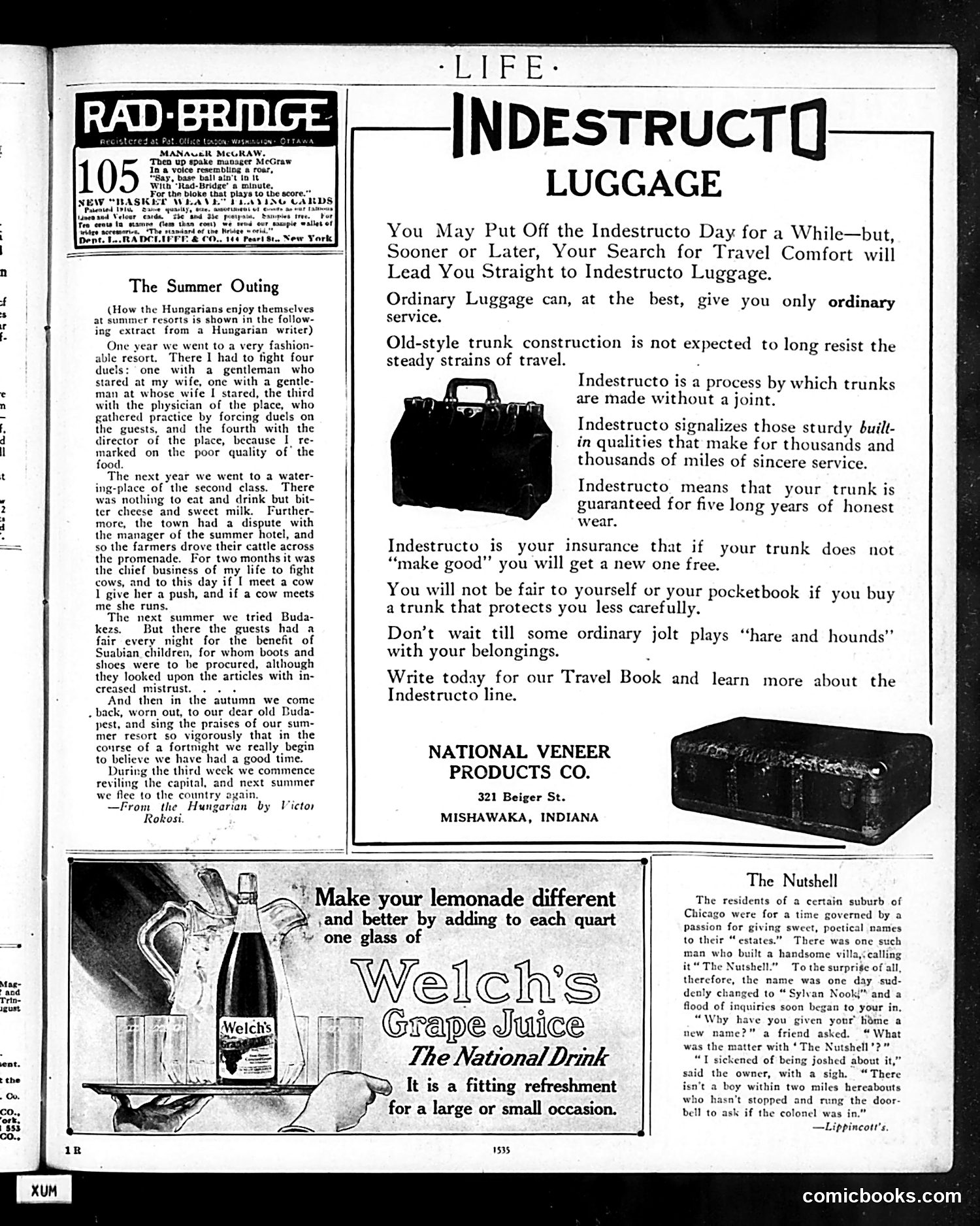
This page (from 1935) contains three distinct pieces: **Top Left - "Manager McGraw" Verse**: A brief poem about baseball manager John McGraw, praising "Rad-Bridge" (likely a card game) as superior to baseball. This is light sports satire. **Center - "The Summer Outing"**: A humorous translated excerpt from Hungarian writer Victor Rokosi describing the absurd experience of Hungarian resort vacations—fighting duels with strangers, encountering aggressive cows, and enduring poor accommodations—yet returning annually to repeat the cycle. It satirizes how people romanticize terrible vacation experiences. **Right Side - Advertisements**: Two ads (Indestructo Luggage and Welch's Grape Juice) and a short humorous item called "The Nutshell" about a suburban Chicago homeowner who renamed his villa from "The Nutshell" to "Sylvan Nook" because neighborhood boys kept ringing the doorbell asking if "the colonel" was home—a joke playing on the double meaning of "nutshell." The page is primarily advertising-focused with light satirical content supporting product promotion.
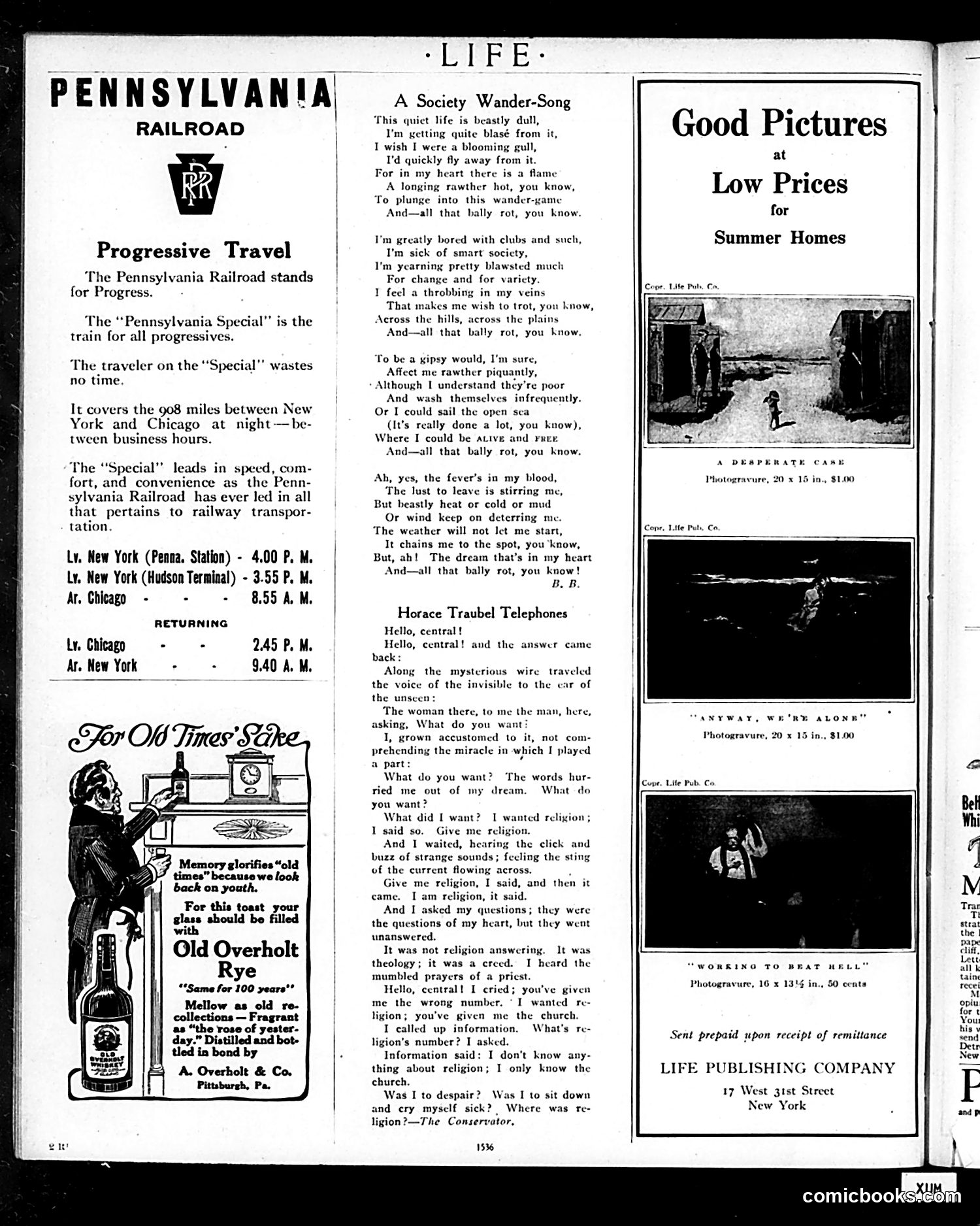
This page combines advertisements with satirical content typical of early 20th-century Life magazine. **The "Society Wander-Song"** mocks wealthy, bored socialites who romanticize exotic travel and unconventional life (gypsies, sailing) while remaining too comfortable and weather-dependent to actually pursue such adventures. The repeated phrase "all that bally rot, you know" satirizes pretentious British affectations and empty wanderlust among the idle rich. **"Horace Traubel Telephones"** appears to be philosophical satire contrasting institutional religion (theology, creeds, priests) with genuine spiritual seeking. The telephone operator cannot distinguish between "religion" and "church," suggesting organized religion has replaced authentic faith—a critique common in early Progressive Era writing. The advertisements—Pennsylvania Railroad (emphasizing modern "progress"), Old Overholt whiskey, and Life Publishing's art prints—represent commercial appeals to this same leisure class. Overall, the page satirizes upper-class ennui and spiritual emptiness while marketing products and services to that same audience.
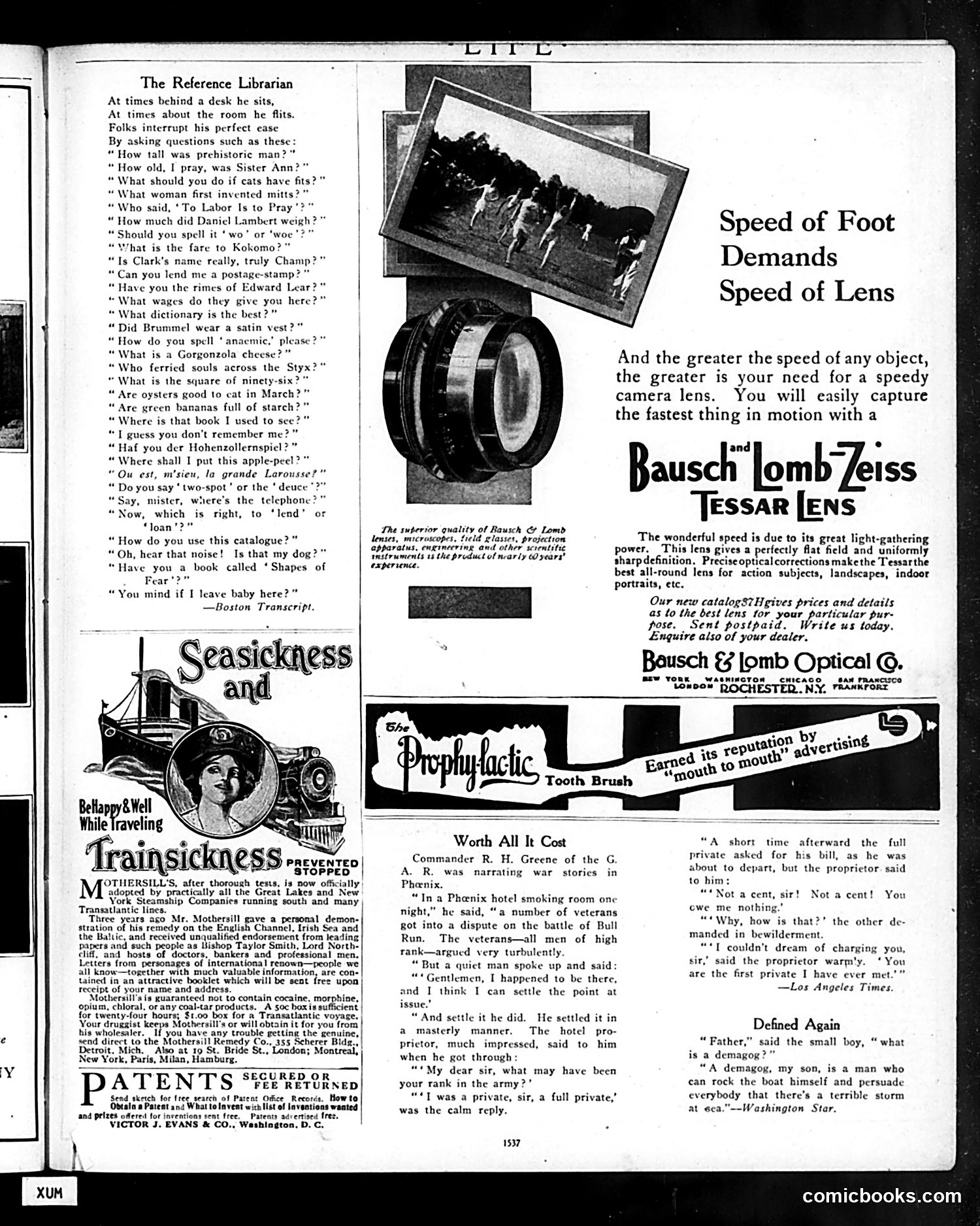
This page features a humorous poem about a library reference desk worker besieged by an endless stream of absurd, trivial, and tangential questions from patrons. The joke satirizes both the public's unrealistic expectations of librarians' omniscience and the sheer randomness of patron inquiries—ranging from historical facts ("How tall was prehistoric man?") to spelling questions to personal requests ("You mind if I leave baby here?"). The satire mocks how librarians must maintain patience while interrupted constantly with questions spanning every conceivable topic, often unrelated to legitimate research needs. It's a gentle critique of public library culture and user behavior, suggesting librarians face an impossible, exhausting job trying to serve an unpredictable clientele with wildly varying needs and manners. The remainder of the page consists of period advertisements for camera lenses, seasickness remedies, and patent services—typical early 20th-century magazine filler.
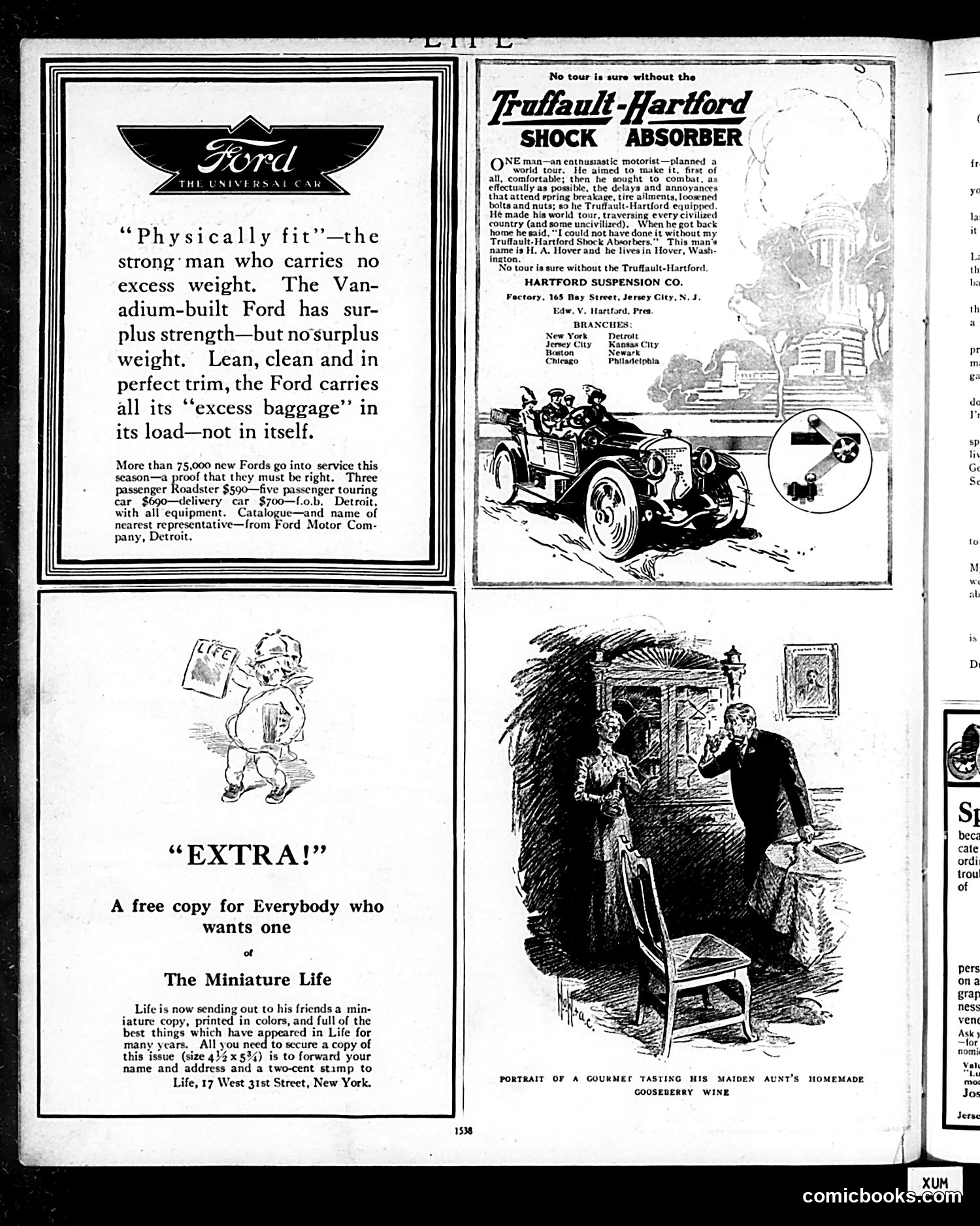
This page is primarily **advertising with one satirical cartoon**. The top advertisement promotes Ford's "Vanadium-built" car using the metaphor of physical fitness—like a strong man carrying no excess weight, the Ford has structural strength without unnecessary bulk. The bottom cartoon satirizes **social pretense around homemade wine**. The illustration shows a well-dressed man (a "gourmet") tasting his maiden aunt's homemade gooseberry wine. His exaggerated facial expression—appearing pained or grimacing—reveals the joke: he's performing polite appreciation of what is likely terrible wine. The satire targets the social performance required when tasting amateur creations from relatives, where one must appear delighted regardless of actual quality. The middle section advertises *The Miniature Life* magazine in reduced format. This reflects early 20th-century concerns: automobile reliability marketing and Victorian-era social etiquette around gift-giving and family politeness.
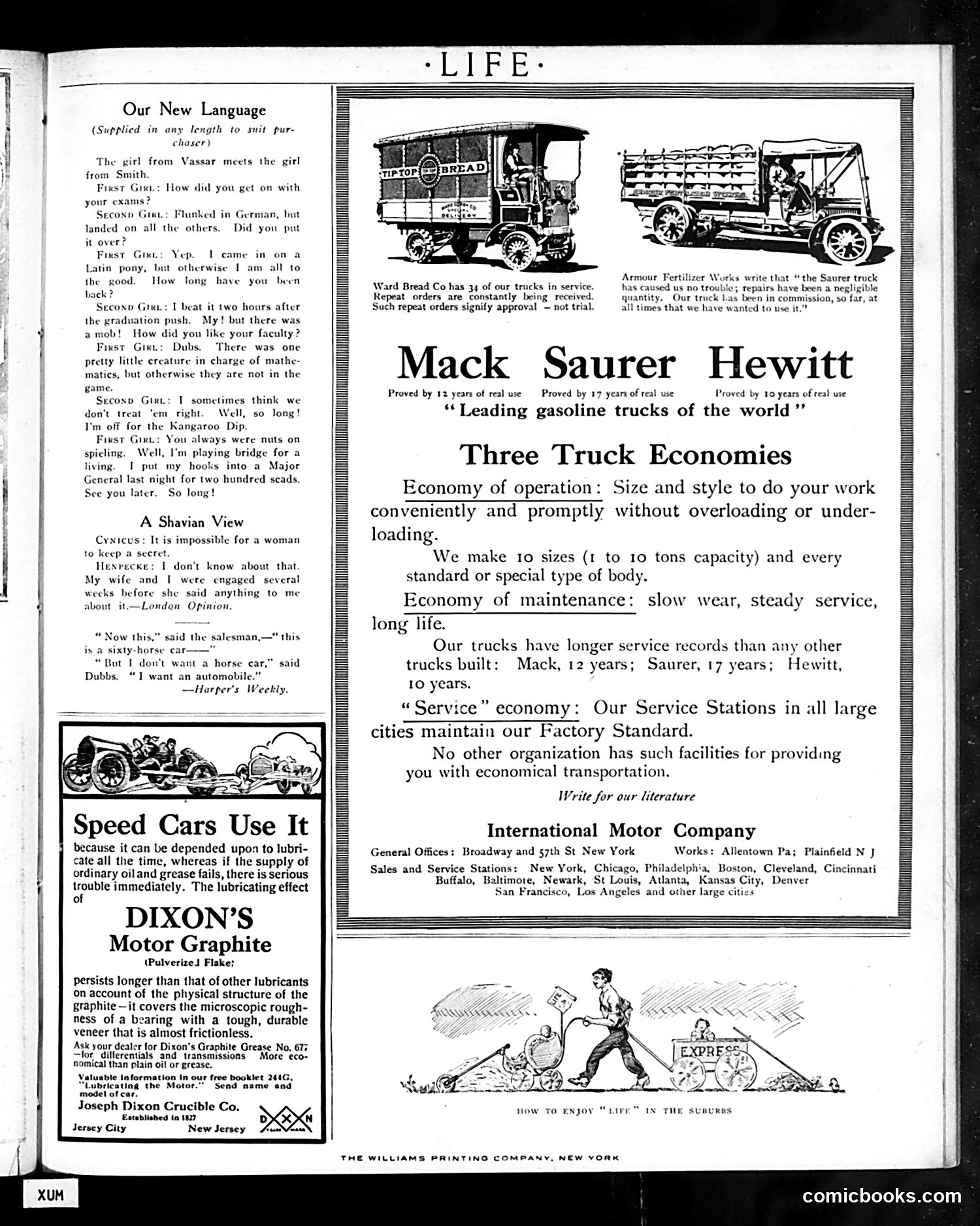
This Life magazine page contains satirical humor about early 1900s college culture and advertising. **"Our New Language"**: A dialogue between two female college graduates (from Vassar and Smith, elite women's colleges) using slang and jargon ("landed on all the others," "put it over," "dubs," "scads"). The satire mocks how college students adopt affected speech patterns—using Latin "ponies" (study guides), playing bridge for money, and dismissing their professors as irrelevant ("not in the game"). It's commentary on artificiality and pretension. **"A Shavian View"**: Brief witty exchanges—one plays on the impossibility of women keeping secrets (a common stereotype), another jokes about preferring automobiles to horses. The page is otherwise dominated by **advertisements** for truck manufacturers (Mack, Saurer, Hewitt) and lubricants (Dixon's Motor Graphite)—not satirical content. These emphasize reliability and service economy for commercial transport. The bottom cartoon shows suburban leisure activity, contrasting with the urban/commercial focus above.
This appears to be a **title page or advertisement** from *Life* magazine (August 1, 1912) for **Pall Mall cigarettes**. The page features the product prominently—a cigarette package shown in perspective—centered within a decorative black and white diamond/harlequin pattern. Above the package is a royal coat of arms, likely emphasizing the brand's British prestige and quality. There is **no political cartoon or satire visible** on this page. Rather, it is a commercial advertisement designed to promote Pall Mall as a "famous" luxury cigarette brand through elegant visual design and royal iconography. The fancy typography and heraldic symbols suggest marketing to an upscale audience in the early 20th century.