
Life, 1912-08-01 · page 8 of 40
Life — August 1, 1912 — page 8: what you’re looking at
What you’re looking at
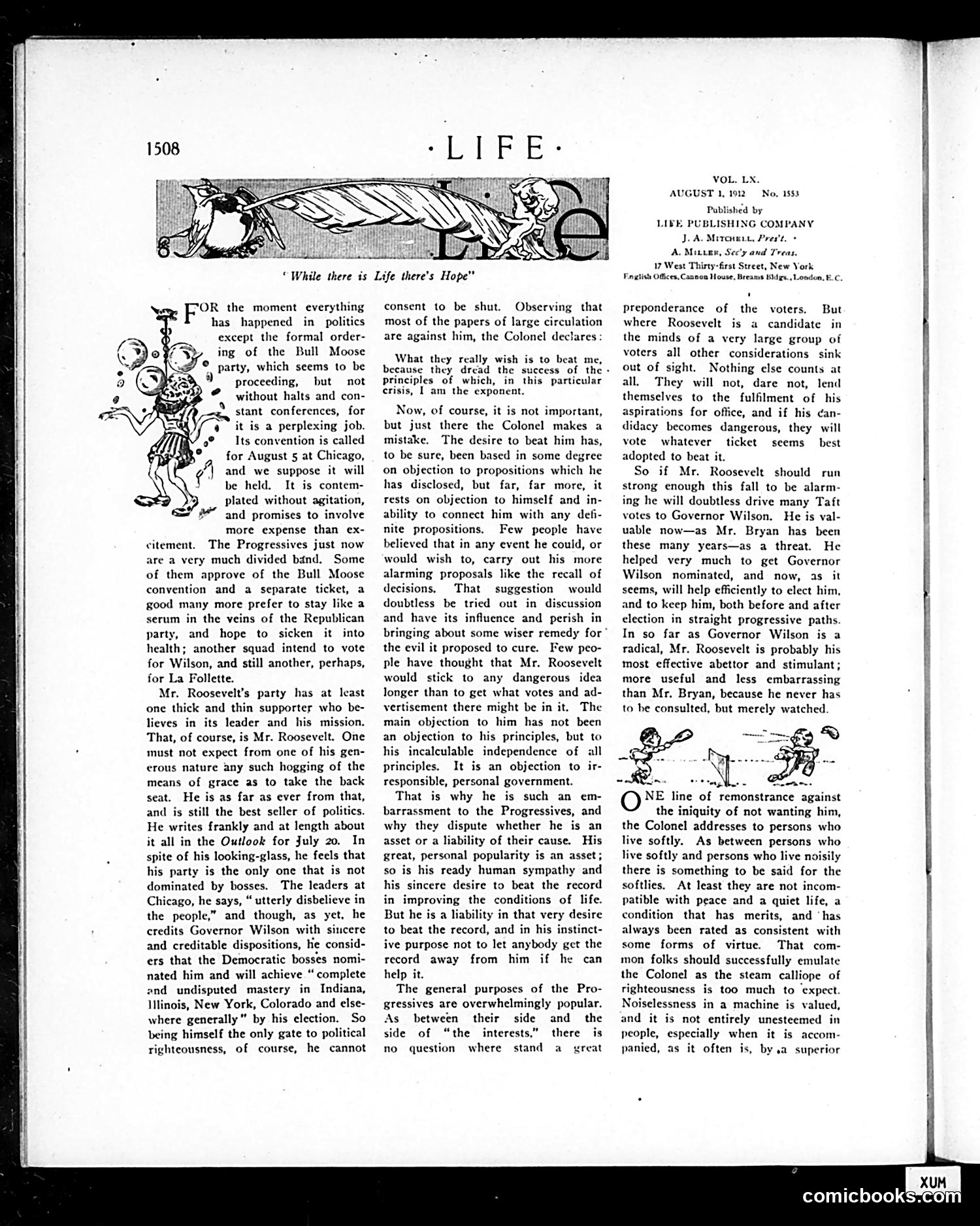
This page discusses the 1912 presidential election, specifically Colonel Roosevelt's candidacy. The text criticizes Roosevelt for his independent stance and suggests he's pursuing personal ambition rather than party loyalty. The small cartoon (bottom right) shows a figure being knocked down or falling—likely depicting Roosevelt's political fortunes or the consequences of his insurgent "Bull Moose" campaign splitting the Republican Party. The article argues that Roosevelt's refusal to align with either major party demonstrates dangerous independence, though it grudgingly admits his popularity and sincere desire to improve conditions. The satire mocks Roosevelt's self-righteousness while acknowledging he remains a formidable political force—the key tension of the 1912 three-way race between Roosevelt, Taft, and Wilson.
📄 Transcribed text from this page (OCR, searchable)
Machine-transcribed from the original scan — historical spelling and the odd misread are preserved.
“While there is Life there's Hope” ‘OR the moment everything has happened in politics except the formal order- ing of the Bull Moose party, which seems to be proceeding, but not without halts and con- stant conferences, for it is a perplexing job. Its convention is called for August 5 at Chicago, and we suppose it will be held. It is contem- plated without agitation, and promises to involve more expense than ex- citement. The Progressives just now are a very much divided bind. Some of them approve of the Bull Moose convention and a separate ticket, a good many more prefer to stay like a serum in the veins of the Republican party, and hope to sicken it into health; another squad intend to vote for Wilson, and still another, perhaps, for La Follette. Mr. Roosevelt’s party has at least one thick and thin supporter who be- lieves in its leader and his mission. That, of course, is Mr. Roosevelt. One must not expect from one of his gen- erous nature any such hogging of the means of grace as to take the back seat. He is as far as ever from that, and is still the best seller of politics. He writes frankly and at length about it all in the Outlook for July 20. In spite of his looking-glass, he feels that his party is the only one that is not dominated by bosses. The leaders at Chicago, he says, “ utterly disbelieve in the people,” and though, as yet, he credits Governor Wilson with sincere and creditable dispositions, he consid- ers that the Democratic bosses nomi- nated him and will achieve “ complete and undisputed mastery in Indiana, Illinois, New York, Colorado and else- where generally” by his election. So being himself the only gate to political righteousness, of course, he cannot oe consent to be shut. Observing that most of the papers of large circulation are against him, the Colonel declares: What they really wish is to beat me, because they dread the success of the - principles of which, in this particular crisis, | am the exponent. Now, of course, it is not important, but just there the Colonel makes a mistake. The desire to beat him has, to be sure, been based in some degree on objection to propositions which he has disclosed, but far, far more, it rests on objection to himself and in- ability to connect him with any defi- nite propositions. Few people have believed that in any event he could, or would wish to, carry out his more alarming proposals like the recall of decisions, That suggestion would doubtless be tried out in discussion and have its influence and perish in bringing about some wiser remedy for the evil it proposed to cure. Few peo- ple have thought that Mr. Roosevelt would stick to any dangerous idea longer than to get what votes and ad- vertisement there might be in it. The main objection to him has not been an objection to his principles, but to his incalculable independence of all principles. It is an objection to ir- responsible, personal government. That is why he is such an em- barrassment to the Progressives, and why they dispute whether he is an asset or a liability of their cause. His great, personal popularity is an asset; so is his ready human sympathy and his sincere desire to beat the record in improving the conditions of life. But he is a liability in that very desire to beat the record, and in his instinct- ive purpose not to let anybody get the record away from him if he can help it. The general purposes of the Pro- gressives are overwhelmingly popular. As between their side and the side of “the interests,” there is no question where stand a great VoL. AUGUST 1, 192 Published by LIFE PUBLISHING COMPANY J. A. Miron, Pres't + A. Minure, Sec’y and Treas, 17 West Thirty-first Street, New York Fngtish Offices, Cannon House, Breams Bdge, London, E.C. No. 1853 Preponderance of the voters. But where Roosevelt is a candidate in the minds of a very large group of voters all other considerations sink out of sight. Nothing else counts at all. They will not, dare not, lend themselves to the fulfilment of his aspirations for office, and if his ¢an- didacy becomes dangerous, they will vote whatever ticket seems best adopted to beat it. So if Mr. Roosevelt should run strong enough this fall to be alarm- ing he will doubtless drive many Taft votes to Governor Wilson. He is val- uable now—as Mr. Bryan has been these many years—as a threat. He helped very much to get Governor Wilson nominated, and now, as it seems, will help efficiently to elect him, and to keep him, both before and after election in straight progressive paths. In so far as Governor Wilson is a radical, Mr. Roosevelt is probably his most effective abettor and stimulant; more useful and less embarrassing than Mr, Bryan, because he never has to he consulted, but merely watched. NE line of remonstrance against the iniquity of not wanting him, the Colonel addresses to persons who live softly. As between persons who live softly and persons who live noisily there is something to be said for the softlies. At least they are not incom- patible with peace and a quiet life, a condition that has merits, and ‘has always been rated as consistent with some forms of virtue. That com- mon folks should successfully emulate the Colonel as the steam calliope of righteousness is too much to ‘expect. Noiselessness in a machine is valued, and it is not entirely unesteemed in people, especially when it is accom- panied, as it often is, by.a superior