
Life, 1912-08-01 · page 24 of 40
Life — August 1, 1912 — page 24: what you’re looking at
What you’re looking at
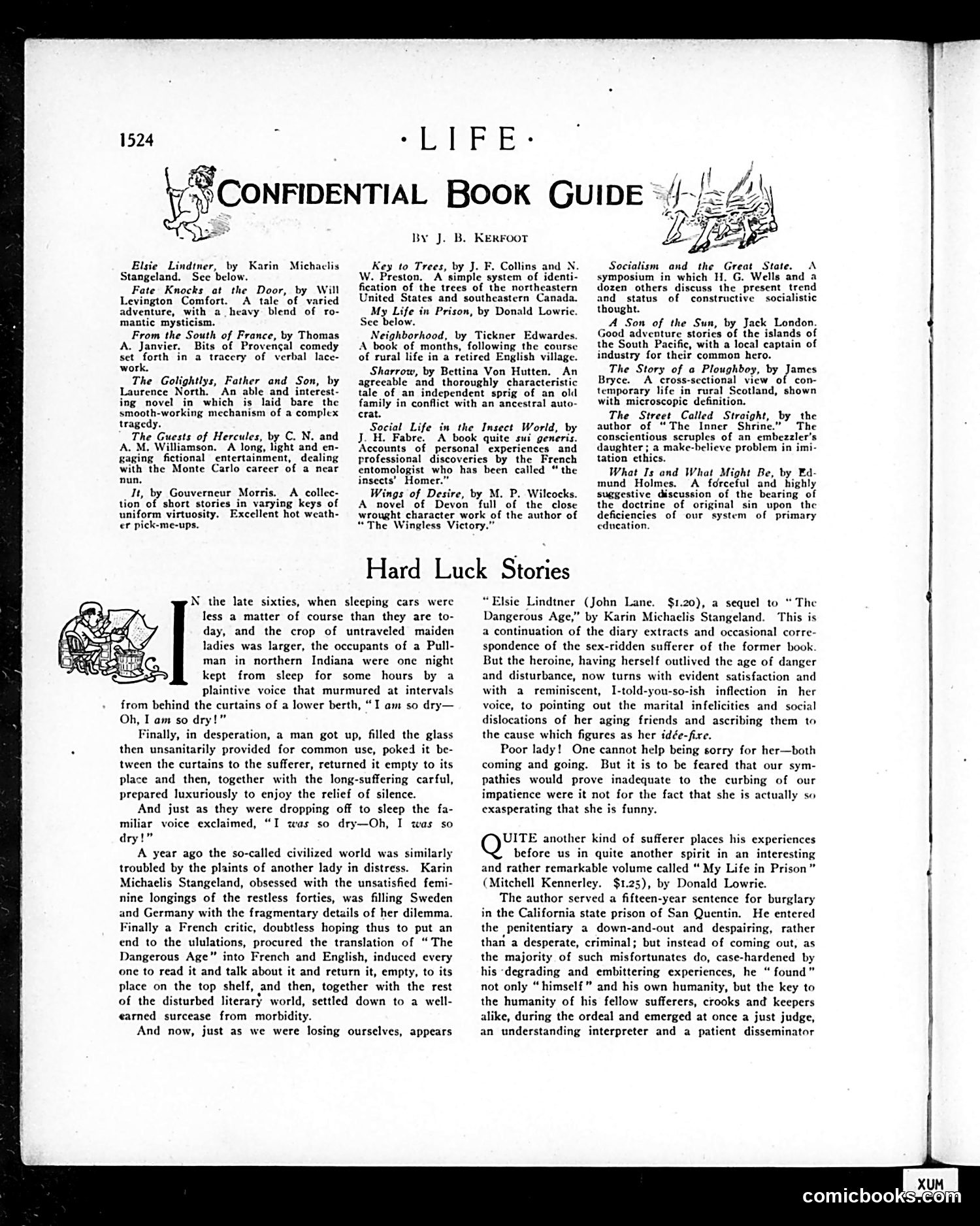
This is a **book review column** from Life magazine, not primarily a political cartoon. The page features J.B. Kerfoot reviewing new publications, with a humorous introductory anecdote. The "Hard Luck Stories" section opens with a **satirical comparison**: a nineteenth-century Pullman car anecdote about an annoying woman complaining "I am so dry" to the exhaustion of fellow passengers. Kerfoot then compares this to **Karin Michaelis Stangeland's recent novel "Elsie Lindner,"** suggesting her book similarly aired repetitive feminine complaints across Sweden and Germany. The implication is that both the woman and the author were tiresome—dwelling on grievances that annoyed their respective audiences. The joke relies on readers recognizing Stangeland's work as emotionally overwrought. Kerfoot mocks "restless forties" female anxiety as tedious, reflecting early 20th-century attitudes dismissing women's discontent as whining rather than legitimate concern. The remainder of the page contains standard literary reviews of various books on nature, prison life, and rural England.
📄 Transcribed text from this page (OCR, searchable)
Machine-transcribed from the original scan — historical spelling and the odd misread are preserved.
Elsie Lindtner, by Karin Michaclis Stangeland. See below. Fate Knocks at the Door, by Will Levington Comfort. A tale ‘of varied adventure, with a heavy blend of ro- mantic mysticism. From the South of France, by Thomas A. Janvier. Bits of Provencal comedy set forth in a tracery of verbal lace- work. The Golightlys, Father and Son, by Laurence North. An able and interest- ing novel in which is laid bare the smooth-working mechanism of a complex tragedy. The Guests of Hercules, by C. N. and A. M, Williamson. A long, light and en- gaging fictional entertainment, dealing with the Monte Carlo career of a near nun, It, by Gouverneur Morris. A collec- tion of short stories in varying keys of uniform virtuosity. Excellent hot weath- er pick-me-ups. By J. B. KEeRFoor Key to Trees, by J. F. Collins and N. W. Preston. A’ simple system of identi- fication of the trees of the northeastern United States and southeastern Canada. My Life in Prison, by Donald Lowrie. See below. Neighborhood, by Tickner Edwardes. A book of months, following the course of rural life in a retired English village. Sharrow, by Bettina Von Hutten. An agreeable and thoroughly characteristic tale of an independent sprig of an oli family in conflict with an ancestral auto- crat. Social Life in the Insect World, by J. H. Fabre, A book quite sui generis. Accounts of personal experiences and professional discoveries by the French entomologist who has been called “ the insects’ Homer.” Wings of Desire, by M. P. Wilcocks. A novel of Devon full of the close wrought character work of the author of “The Wingless Victory.” Hard Luck Sores Socialism and the Great State. A symposium in which H, G. Wells and a dozen others discuss the present trend and status of constructive socialistic thought. A Son of the Sun, by Jack London. Good adventure stories of the islands of the South Pacific, with a local captain of industry for their common hero. The Story of a Ploughboy, by James Bryce. A cross-sectional view of con- temporary life in rural Scotland, shown with microscopic definition. The Street Called Straight, by the author of “The Inner Shrine.” The conscientious scruples of an embezzler’s daughter; a make-believe problem in imi- tation ethics. What Is and What Might Be, by Ed- mund Holmes. A fdrceful and highly suggestive discussion of the bearing of the doctrine of original sin upon the deficiencies of our system of primary education. N the late sixties, when sleeping cars were less a matter of course than they are to- day, and the crop of untraveled maiden ladies was larger, the occupants of a Pull- man in northern Indiana were one night kept from sleep for some hours by a plaintive voice that murmured at intervals from behind the curtains of a lower berth, “I am so dry— Oh, I am so dry!” Finally, in desperation, a man got up, filled the glass then unsanitarily provided for common use, poked it be- tween the curtains to the sufferer, returned it empty to its place and then, together with the long-suffering carful, prepared luxuriously to enjoy the relief of silence. And just as they were dropping off to sleep the fa- miliar voice exclaimed, “I was so dry—Oh, I was so dry!” A year ago the so-called civilized world was similarly troubled by the plaints of another lady in distress. Karin Michaelis Stangeland, obsessed with the unsatisfied femi- nine longings of the restless forties, was filling Sweden and Germany with the fragmentary details of her dilemma. Finally a French critic, doubtless hoping thus to put an end to the ululations, procured the translation of “The Dangerous Age” into French and English, induced every one to read it and talk about it and return it, empty, to its place on the top shelf, and then, together with the rest of the disturbed literary world, settled down to a well- earned surcease from morbidity. And now, just as we were losing ourselves, appears “Elsie Lindtner (John Lane. $1.20), a sequel to “ The Dangerous Age,” by Karin Michaelis Stangeland. This is a continuation of the diary extracts and occasional corre- spondence of the sex-ridden sufferer of the former book But the heroine, having herself outlived the age of danger and disturbance, now turns with evident satisfaction and with a reminiscent, I-told-you-so-ish inflection in her voice, to pointing out the marital infelicities and social dislocations of her aging friends and ascribing them to the cause which figures as her idée-fire. Poor lady! One cannot help being sorry for her—both coming and going. But it is to be feared that our sym- pathies would prove inadequate to the curbing of our impatience were it not for the fact that she is actually so exasperating that she is funny. UITE another kind of sufferer places his experiences before us in quite another spirit in an interesting and rather remarkable volume called “ My Life in Prison” (Mitchell Kennerley. $1.25), by Donald Lowrie. The author served a fifteen-year sentence for burglary in the California state prison of San Quentin. He entered the penitentiary a down-and-out and desp; ig, rather than a desperate, criminal; but instead of coming out, as the majority of such misfortunates do, case-hardened by his ‘degrading and embittering experiences, he “ found” not only “himself” and his own humanity, but the key to the humanity of his fellow sufferers, crooks and keepers alike, during the ordeal and emerged at once a just judge, an understanding interpreter and a patient disseminator comicbooeanh