
Life, 1912-08-01 · page 16 of 40
Life — August 1, 1912 — page 16: what you’re looking at
What you’re looking at
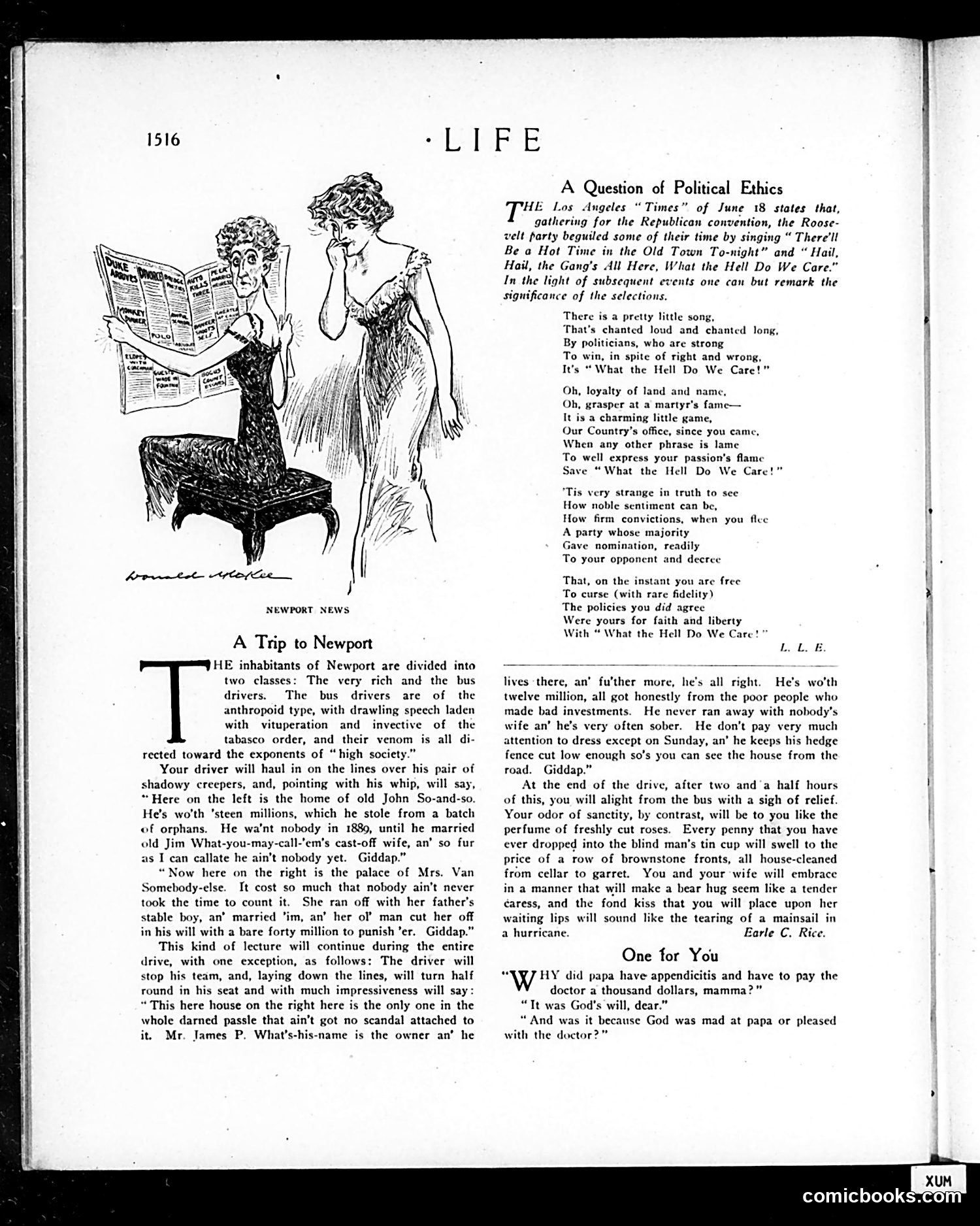
**The Cartoon/Illustration:** The sketch shows a well-dressed couple—she in an elegant gown, he reading a newspaper—representing Newport's wealthy elite. The artist is Arnold Artzybasheff (signed lower left). **"A Trip to Newport" (Main Article):** This satirizes the sharp class divide in Newport, Rhode Island, a wealthy resort town. A bus driver—depicted as crude, resentful, and verbally crude—guides tourists past mansions while making bitter commentary. He mocks the wealthy for their scandalous origins (stolen money, affairs, divorces) while praising one "honest" millionaire who merely exploited poor investors and drinks less. The satire targets both class hypocrisy and the driver's caustic envy. **"A Question of Political Ethics" (Poem):** This critiques Republican politicians (likely referencing the 1912 convention and Roosevelt's split from Taft). The poem attacks those who, when defeated or switching parties, cynically abandon previous principles with the refrain "What the Hell Do We Care!"—exposing political opportunism masked as noble conviction. **Overall Point:** Both pieces mock moral compromises: the wealthy concealing corruption, and politicians abandoning ethics for power.
📄 Transcribed text from this page (OCR, searchable)
Machine-transcribed from the original scan — historical spelling and the odd misread are preserved.
NEWPORT NEWS A Trip to Newport HE inhabitants of Newport are divided into two classes: The very rich and the bus drivers. The bus drivers are of the anthropoid type, with drawling speech laden with vituperation and invective of the tabasco order, and their venom is all di- rected toward the exponents of “high society.” Your driver will haul in on the lines over his pair of shadowy creepers, and, pointing with his w will say, “Here on the left is the home of old John So-and-so. He’s wo'th ‘steen millions, which he stole from a batch of orphans. He wa’nt nobody in 1889, until he married old Jim What-you-may-call-’em’s cast-off wife, an’ so fur as I can callate he ain’t nobody yet. Giddap.” “Now here on the right is the palace of Mrs. Van Somebody-else. It cost so much that nobody ain't never took the time to count it. She ran off with her father’s stable boy, an’ married ‘im, an’ her ol’ man cut her off in his will with a bare forty million to punish er. Giddap.” This kind of lecture will continue during the entire drive, with one exception, as follows: The driver will stop his team, and, laying down the lines, will turn half round in his seat and with much impressiveness will say : “This here house on the right here is the only one in the whole darned passle that ain't got no scandal attached to it. Mr. James P. What’s-his-name is the owner an’ he “IGE: A Question of Political Ethics "HE Los Angeles “Times” of June 18 states that, gathering for the Republican convention, the Roose- velt party beguiled some of their time by singing “ There'll Be a Hot Time in the Old Town To-night” and “ Hail, Hail, the Gang’s All Here, What the Hell Do We Car In the light of subsequent events one can but remark the Significance of the selections. There is a pretty little song, That's chanted loud and chanted long, By politicians, who are strong To win, in spite of right and wrong, It's “ What the Hell Do We Care!” Oh, loyalty of land and name, Oh, grasper at a martyr's fame— It is a charming little game, Our Country’s office, since you came, When any other phrase is lame To well express your passion’s flame ¢ “What the Hell Do We Care!" ‘Tis very strange in truth to see How noble sentiment can be, How firm convictions, when you flee A party whose majority Gave nomination, readily To your opponent and decree That, on the instant you are free To curse (with rare fidelity) The policies you did agree Were yours for faith and liberty With “ What the Hell Do We Care!” lives there, an’ fu’ther more, he’s all right. He's wo'th twelve million, all got honestly from the poor people who made bad investments. He never ran away with nobody's wife an’ he’s very often sober. He don’t pay very much attention to dress except on Sunday, an’ he keeps his hedge fence cut low enough so’s you can see the house from the road. Giddap.” At the end of the drive, after two anda half hours of this, you will alight from the bus with a sigh of relief. Your odor of sanctity, by contrast, will be to you like the perfume of freshly cut roses. Every penny that you have ever dropped into the blind man’s tin cup will swell to the price of a row of brownstone fronts, all house-cleaned from cellar to garret. You and your wife will embrace in a manner that will make a bear hug seem like a tender ¢aress, and the fond kiss that you will place upon her waiting lips will sound like the tearing of a mainsail in a hurricane. Earle C. Rice. One for You “YYZ HY did papa have appendicitis and have to pay the doctor a thousand dollars, mamma?" “Tt was God's will, dear.” “And was it because God was mad at papa or pleased with the doctor?” comicbook asa SES s.com