
Life, 1912-08-01 · page 9 of 40
Life — August 1, 1912 — page 9: what you’re looking at
What you’re looking at
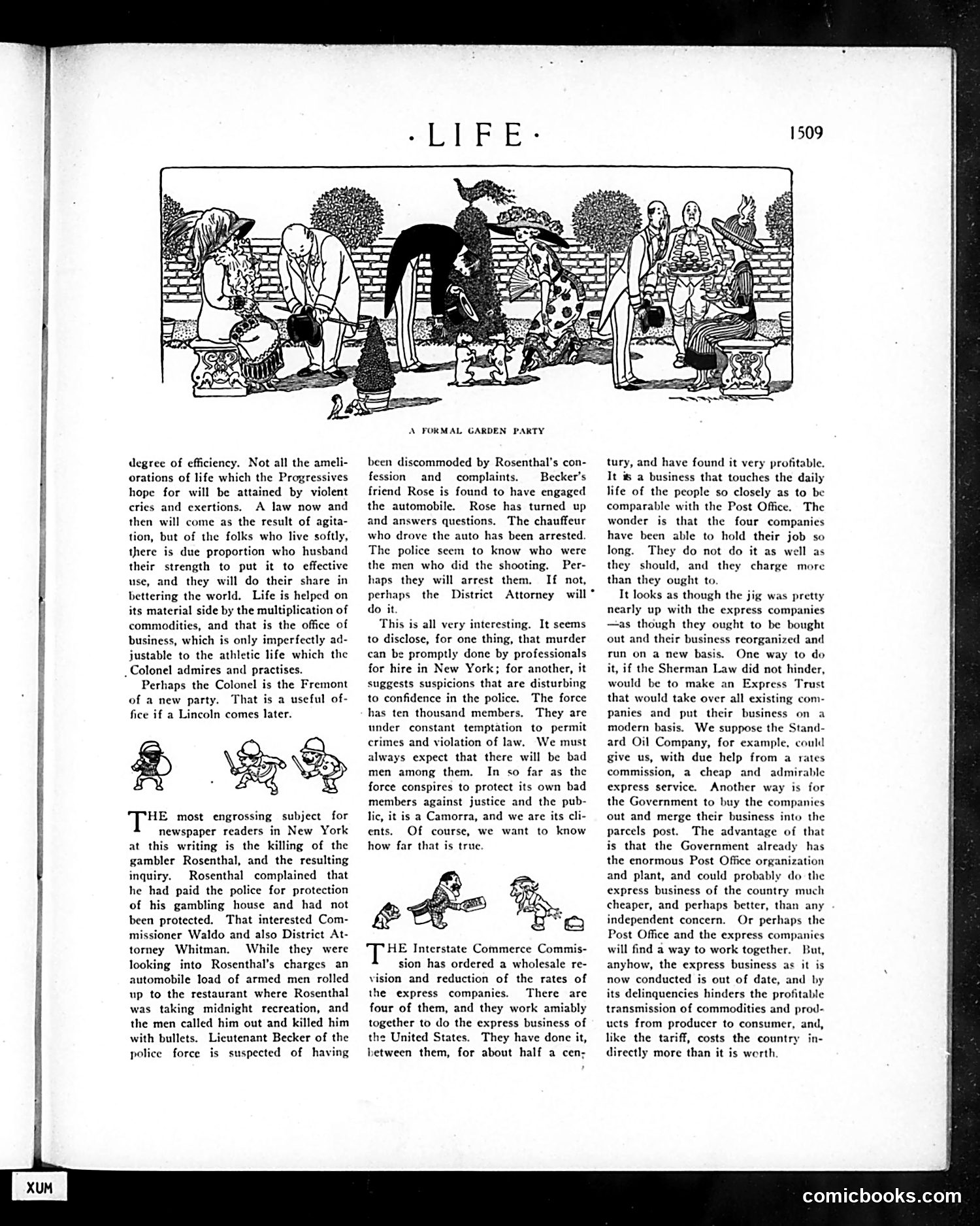
The top illustration depicts a garden party scene with well-dressed figures in early 20th-century attire. The cartoon appears satirical in nature, though the specific joke is unclear from the image alone. The accompanying text discusses a shooting incident involving gambler Rosenthal and police corruption in New York City. It references Commissioner Waldo, District Attorney Whitman, and Lieutenant Becker of the police force—all apparently implicated in the case. The article suggests systemic police corruption, with officers protecting criminals and permitting "crimes and violation of law." The text also discusses express company rate-fixing and potential government regulation, suggesting broader themes of institutional malfeasance and reform that Life was satirizing during this Progressive Era period.
📄 Transcribed text from this page (OCR, searchable)
Machine-transcribed from the original scan — historical spelling and the odd misread are preserved.
degree of efficiency. Not all the ameli- orations of life which the Progressives hope for will be attained by violent cries and exertions. A law now and then will come as the result of agita- tion, but of the folks who live softly, there is due proportion who husband their strength to put it to effective use, and they will do their share in bettering the world. Life is helped on its material side by the multiplication of commodities, and that is the office of business, which is only imperfectly ad- justable to the athletic life which the _Colonel admires and practises. Perhaps the Colonel is the Fremont of a new party. That is a useful of- fice if a Lincoln comes later. TR most engrossing subject for newspaper readers in New York at this writing is the killing of the gambler Rosenthal, and the resulting inquiry. Rosenthal complained that he had paid the police for protection of his gambling house and had not been protected. That interested Com- missioner Waldo and also District At- torney Whitman. While they were looking into Rosenthal’s charges an automobile load of armed men rolled up to the restaurant where Rosenthal was taking midnight recreation, and the men called him out and killed him with bullets. Licutenant Becker of the police force is suspected of having \ FORMAL GARDEN PARTY been discommoded by Rosenthal’s con- fession and complaints. Becker's friend Rose is found to have engaged the automobile. Rose has turned up and answers questions. The chauffeur who drove the auto has been arrested. The police seem to know who were the men who did the shooting. Per- haps they will arrest them. If not, perhaps the District do it This is all very interesting. It seems to disclose, for one thing, that murder can be promptly done by professionals for hire in New York; for another, it suggests suspicions that are disturbing to confidence in the police. The force has ten thousand members. They are under constant temptation to permit crimes and violation of law. We must always expect that there will be bad men among them. In so far as the force conspires to protect its own bad members against justice and the pub- lic, it is a Camorra, and we are its cli- ents. Of course, we want to know how far that is true. eda %., HE Interstate Commerce Commis- sion has ordered a wholesale re- vision and reduction of the rates of the express companies. There are four of them, and they work amiably together to do the express business of the United States. They have done it, between them, for about half a cen; Attorney will * tury, and have found it very profitable. It is a business that touches the daily life of the people so closely as to be comparable with the Post Office. The wonder is that the four companies have been able to hold their job so long. They do not do it as well as they should, and they charge more than they ought to. It looks as though the jig was pretty nearly up with the express companies —as though they ought to be bought out and their business reorganized and run on a new basis. One way to do it, if the Sherman Law did not hinder, would be to make an Express Trust that would take over all existing com- panies and put their business on a modern basis. We suppose the Stand- ard Oil Company, for example, could give us, with due help from a rates commission, a cheap and admirable express service. Another way is for the Government to buy the companies out and merge their business into the parcels post. The advantage of that is that the Government already has the enormous Post Office organization and plant, and could probably do the express business of the country much cheaper, and perhaps better, than any independent concern. Or perhaps the Post Office and the express companies will find a way to work together. But, anyhow, the express business as it is now conducted is out of date, and by its delinquencies hinders the profitable transmission of commodities and prod- ucts from producer to consumer, and, like the tariff, costs the country in- directly more than it is worth. comicbooks.com