
A complete issue · 44 pages · 1912
Life — April 25, 1912
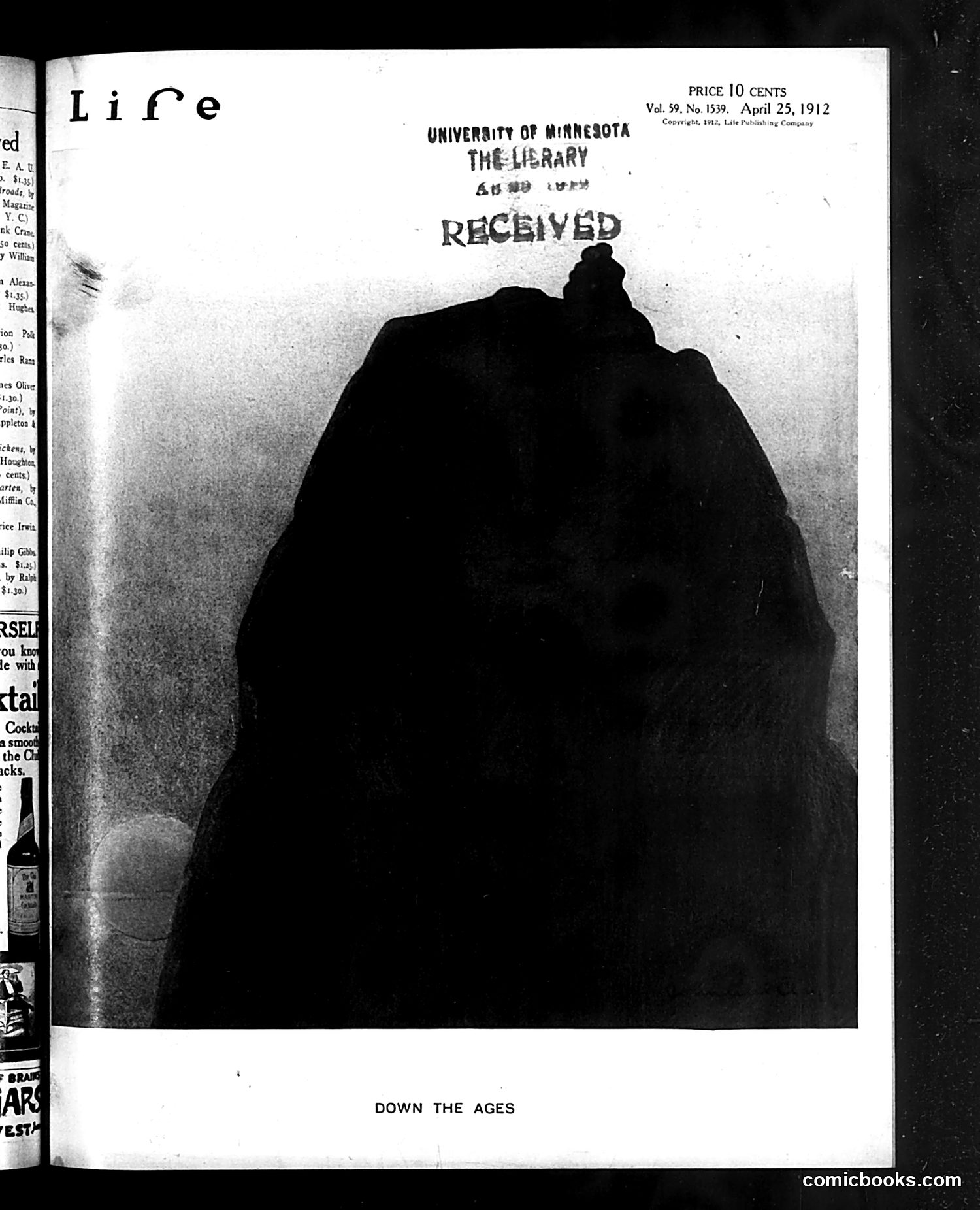
This page appears to be a photographic image rather than a traditional political cartoon. It shows a large, dark silhouette of what looks like a rocky formation or mountain against a lighter background. The caption reads "DOWN THE AGES," suggesting the image represents something enduring through time. Given the publication date of April 1912, this likely references a significant contemporary event, though the specific reference is unclear from the image alone. The photograph's dramatic silhouette and monumental quality suggest it may be commenting on permanence, stability, or historical legacy—possibly related to a current political or social debate of that era. Without additional context from the magazine's surrounding content, the precise satirical target remains uncertain.

This page is **not a cartoon or satirical content**—it's a straightforward product advertisement from *Life* magazine for Sanitol Tooth Powder or Paste, manufactured by Sanitol Chemical Laboratory Co. (St. Louis). The ad features an illustration of a well-dressed woman at her vanity mirror, representing "The Complete Toilet." The copy emphasizes dental hygiene benefits: antiseptic properties, teeth whitening, and mouth freshness. The advertisement appeals to early 20th-century consumer desires for cleanliness and respectability, framing proper dental care as essential to appearing "immaculate." The "trial size package" offer and dentist endorsement reflect typical vintage advertising strategies for patent medicines and toiletries.
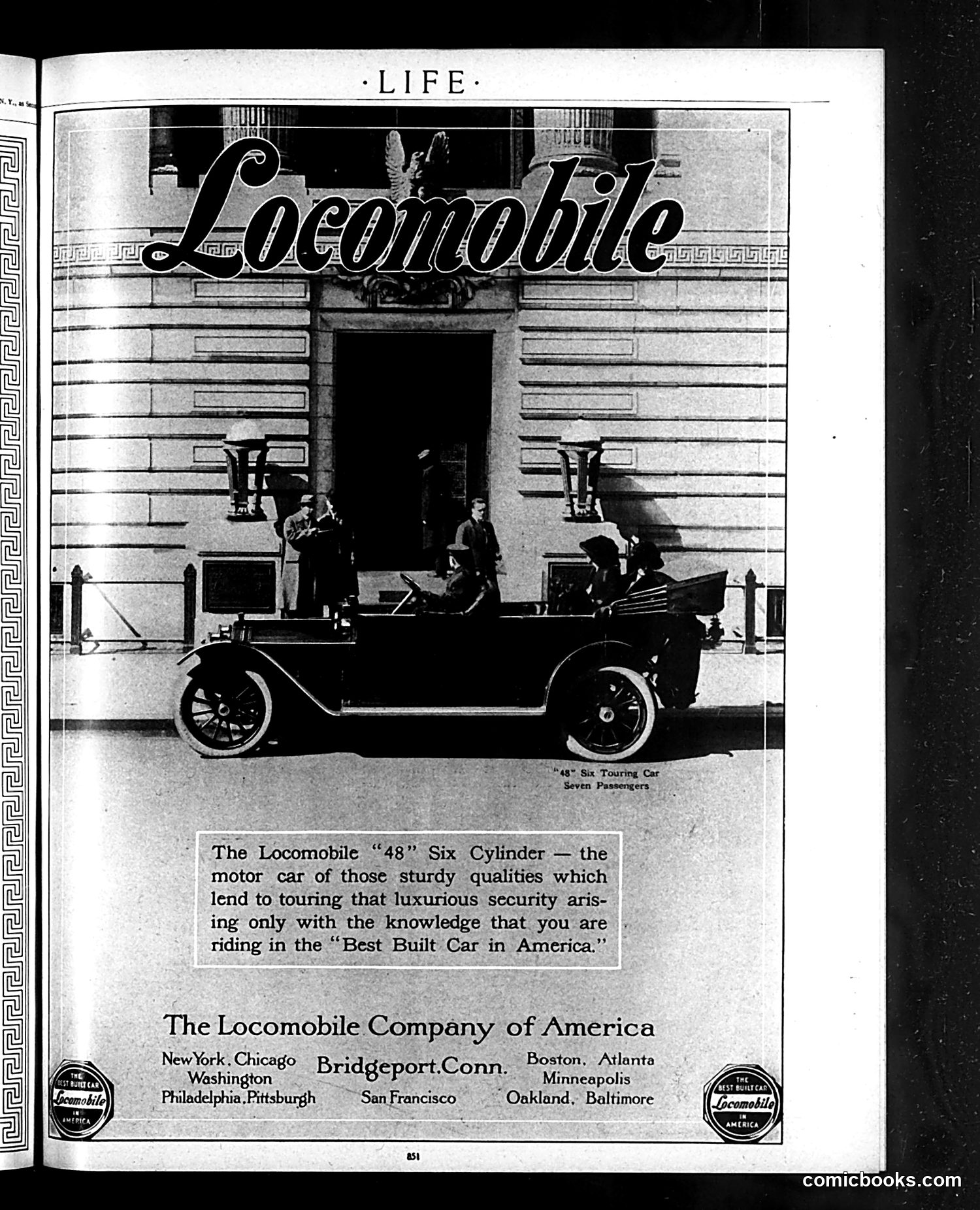
This is **not a cartoon or satire page**—it is a **straightforward advertisement** for the Locomobile automobile, published in *Life* magazine. The image shows a "48" Six Touring Car with seven passengers parked in front of an elegant neoclassical building. The advertisement emphasizes the vehicle's reliability and luxury, describing it as possessing "sturdy qualities" that provide "touring that luxurious security" and positioning it as "the Best Built Car in America." The Locomobile Company lists multiple offices across major American cities (New York, Chicago, Boston, etc.), indicating this was a serious, well-established manufacturer of high-end automobiles in the early 20th century. There is no political commentary or satire present—merely period automotive marketing targeting wealthy consumers.
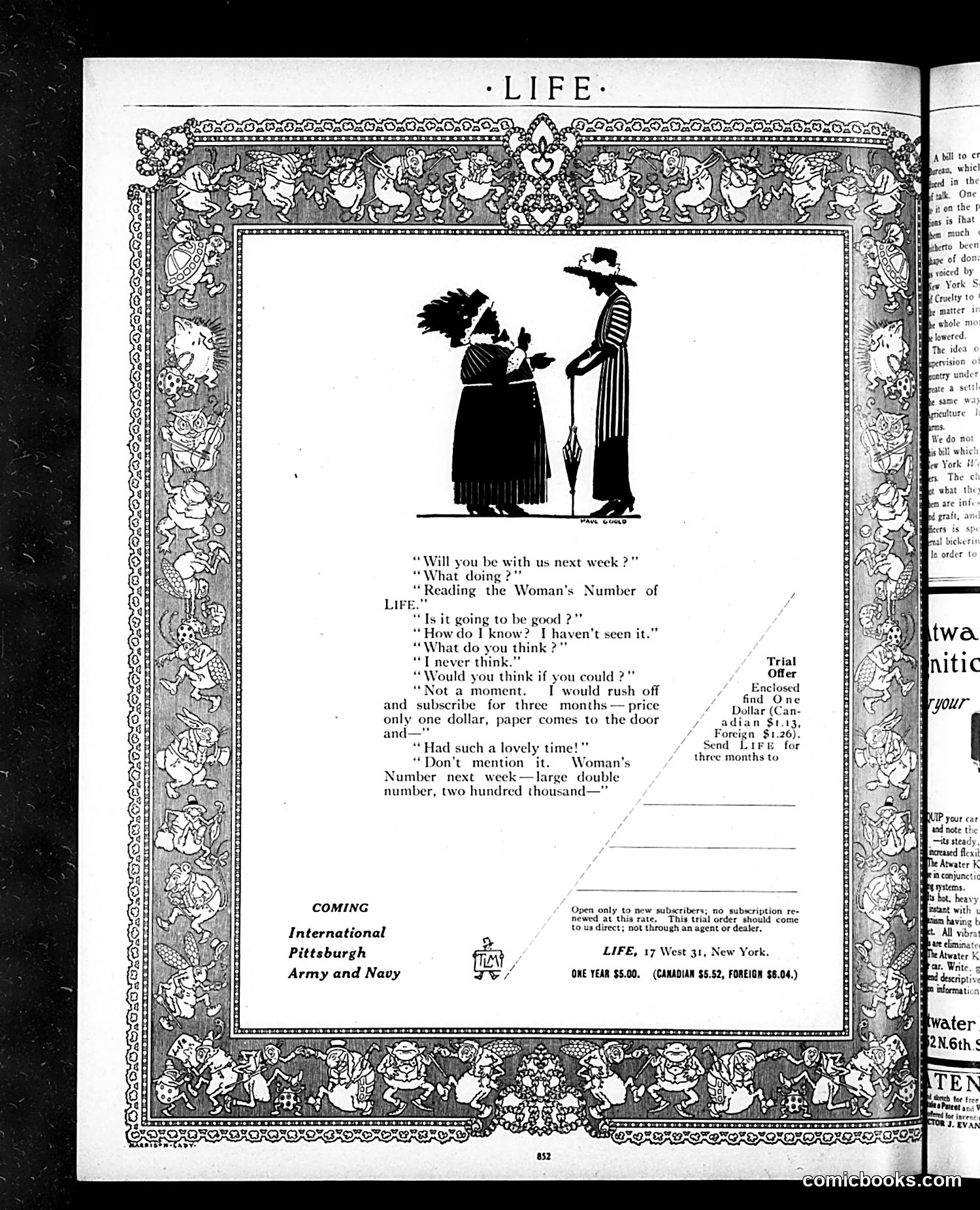
This page is primarily a **subscription advertisement for Life magazine**, not editorial content. The silhouette cartoon depicts a conversation between two figures—a woman in an elaborate hat and a tall, thin man in formal attire. The dialogue satirizes women's magazine reading habits, with the woman discussing "the Woman's Number of LIFE" and the man questioning whether she'll subscribe. The humor likely targets **early 20th-century gender dynamics**: the stereotype of women as frivolous magazine readers, combined with gentle mockery of subscription sales tactics. The elaborate hat exaggerates feminine fashion excess of the era. The "Trial Offer" box below promotes a three-month subscription for one dollar, targeting new readers. This appears designed to appeal to women readers specifically, using humor about their own reading preferences as a marketing tool.
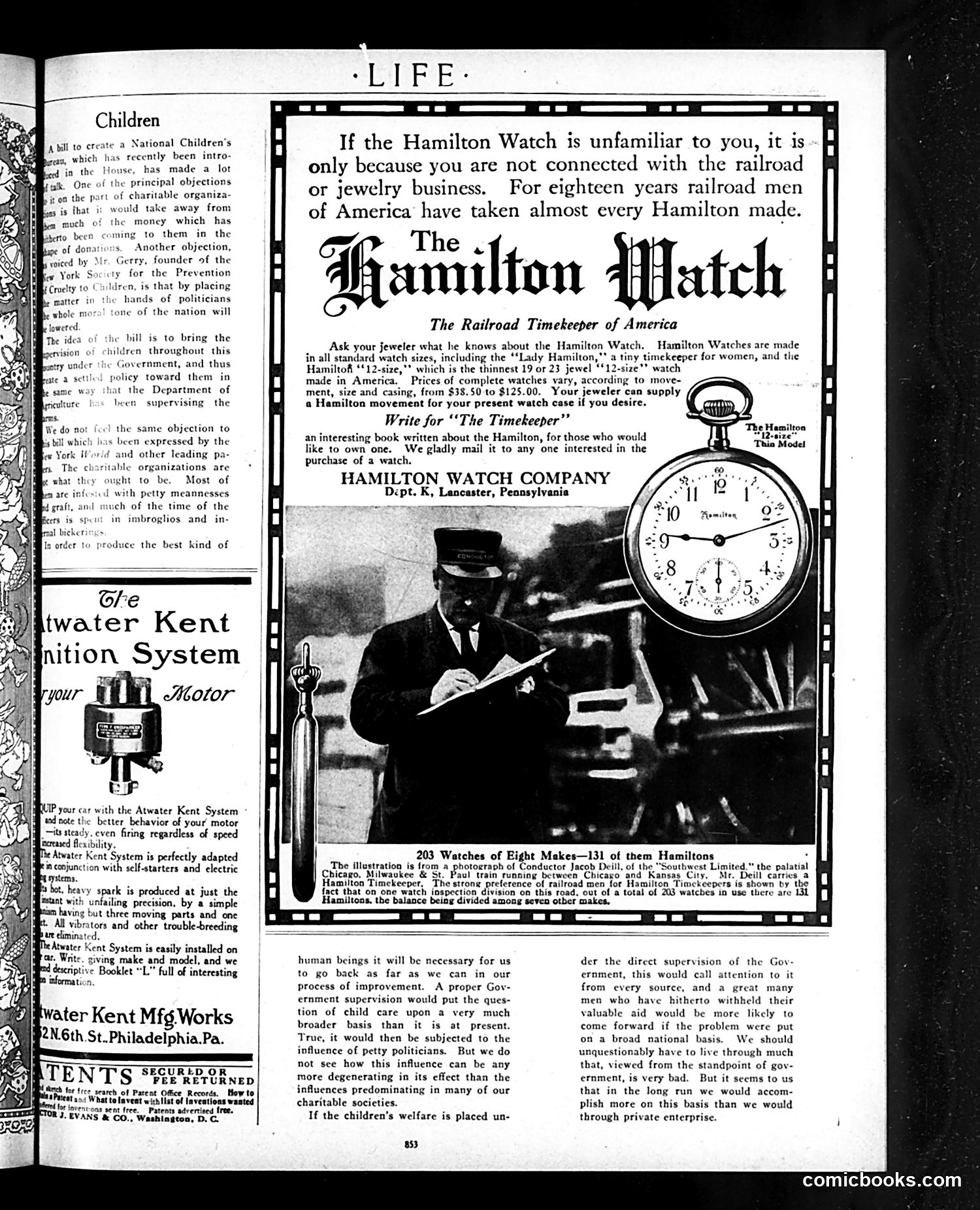
This page is primarily **advertising, not satire or political commentary**. The dominant content is a Hamilton Watch Company advertisement touting their timepieces as "The Railroad Timekeeper of America." The ad emphasizes that railroad men have "taken almost every Hamilton made" and notes the watches are made in various sizes, from $18.50 to $125.00. The accompanying image shows a railroad conductor checking a Hamilton watch against a train, reinforcing the brand's association with railroad precision and reliability. The left column contains unrelated ads for a water cooling system and tents. The "Children" text column discusses child welfare policy but is separate editorial content. This represents typical *Life* magazine layout: mixing satirical editorial content with full-page advertisements targeting affluent readers.
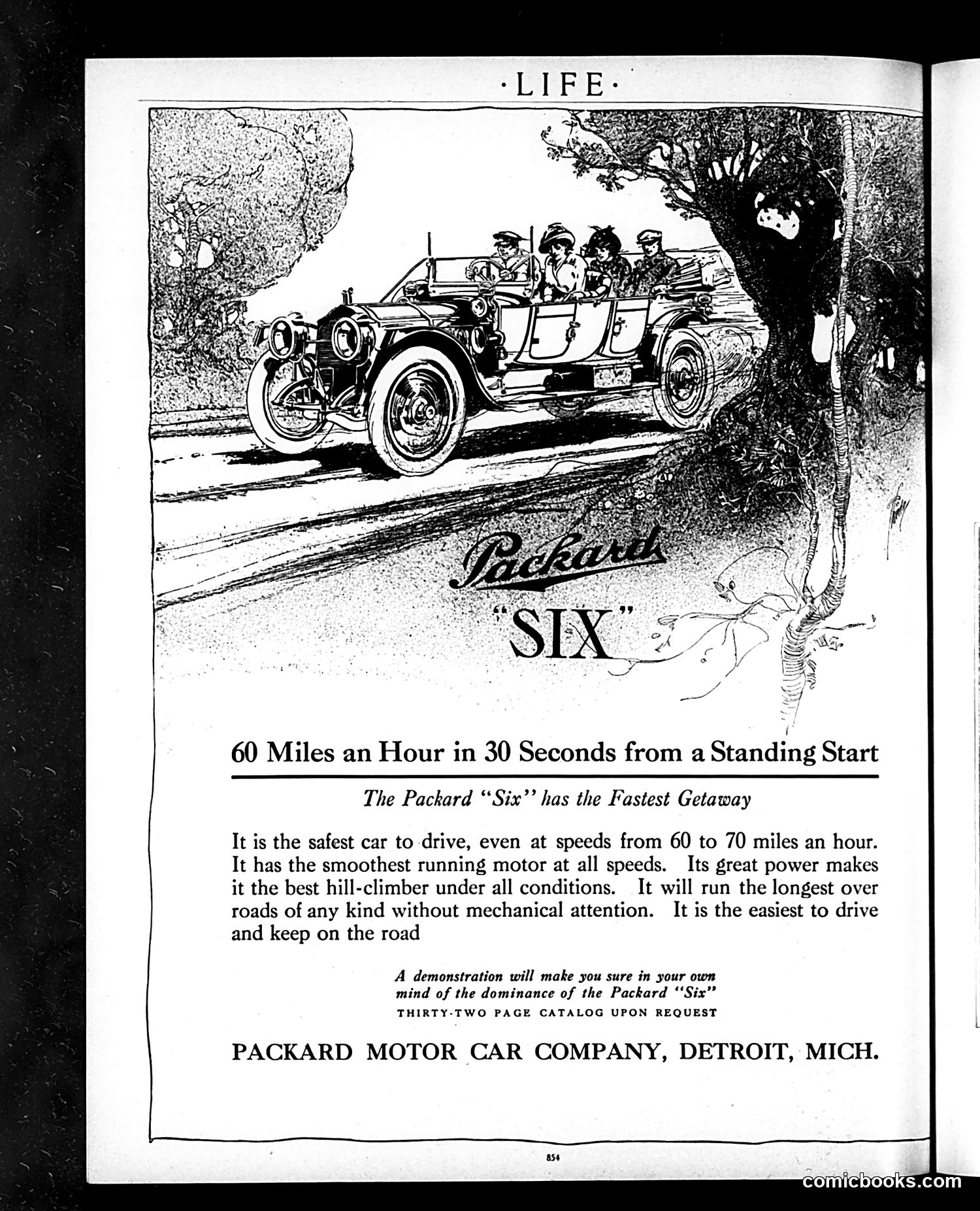
This is **not a cartoon or satire** — it's a straightforward advertisement for the Packard "Six" automobile, published in Life magazine. The ad features an illustration of an early 1910s luxury car filled with well-dressed passengers driving past a tree-lined road. The text makes performance claims: the vehicle can reach 60 mph in 30 seconds from a standing start and is marketed as "the safest car to drive" at high speeds, with a smooth-running motor suitable for all road conditions. The ad emphasizes reliability and ease of operation ("easiest to drive"), targeting affluent buyers. The Packard Motor Car Company, based in Detroit, was a prestigious American automaker competing in the luxury vehicle market of the era.
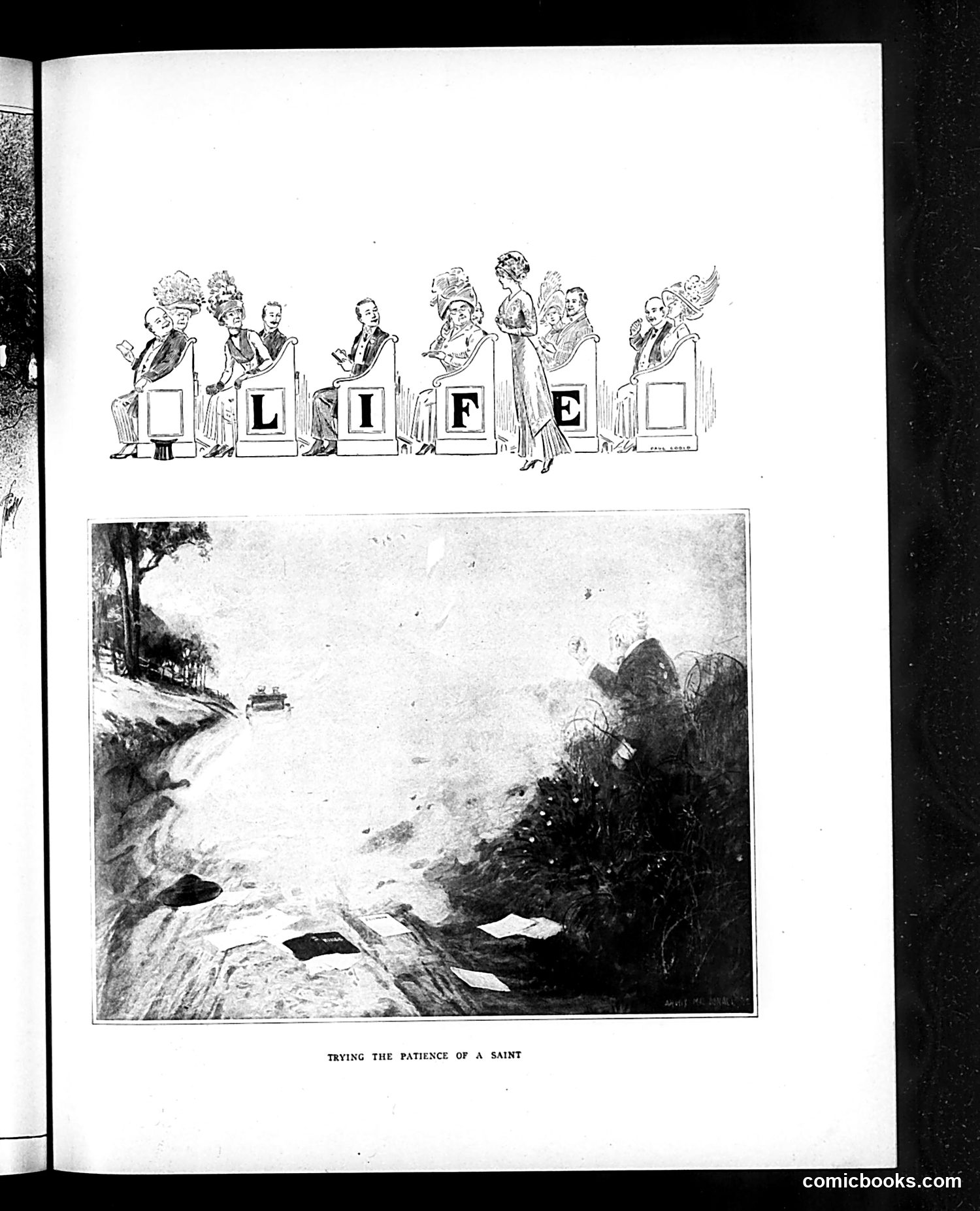
The top illustration shows a line of well-dressed figures sitting on blocks spelling "LIFE," representing different stages or types of people experiencing life's journey. The bottom photograph, captioned "TRYING THE PATIENCE OF A SAINT," depicts a scenic riverside or waterside location with what appears to be a vehicle or boat. The caption suggests this image illustrates something that would test even a saint's patience—likely depicting a frustrating or exasperating situation, though the specific context isn't entirely clear from the image alone. Without additional page context or publication date information, the precise satirical target remains unclear, but both elements appear to be commentary on human experience and social situations contemporary to the magazine's publication.
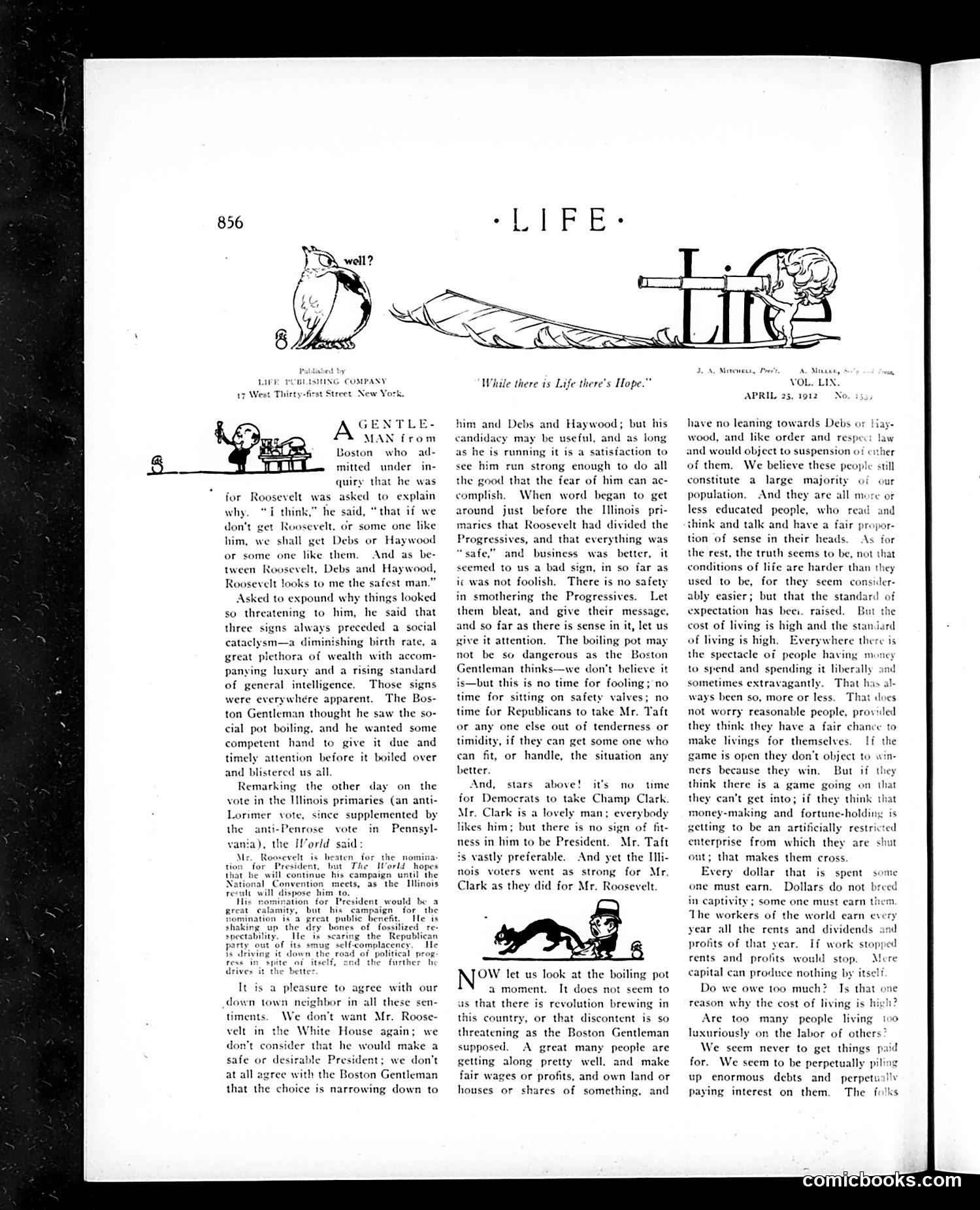
This page discusses the 1912 U.S. presidential election, specifically the split between Theodore Roosevelt and William Howard Taft within the Republican Party. The text references Roosevelt, Taft, Champ Clark (the Democratic candidate), and the "Progressives"—the splinter party Roosevelt formed. The cartoon at top shows a figure (likely Roosevelt) using a telescope, suggesting foresight or scrutiny of political developments. The main article criticizes both the Republican divide and discusses broader concerns about wealth inequality and labor conditions during this turbulent election year. The satire targets political infighting while the broader commentary addresses working-class economic struggles—rents, profits, and the cost of living—issues central to Progressive Era politics. The magazine appears skeptical of all candidates' abilities to address these concerns.
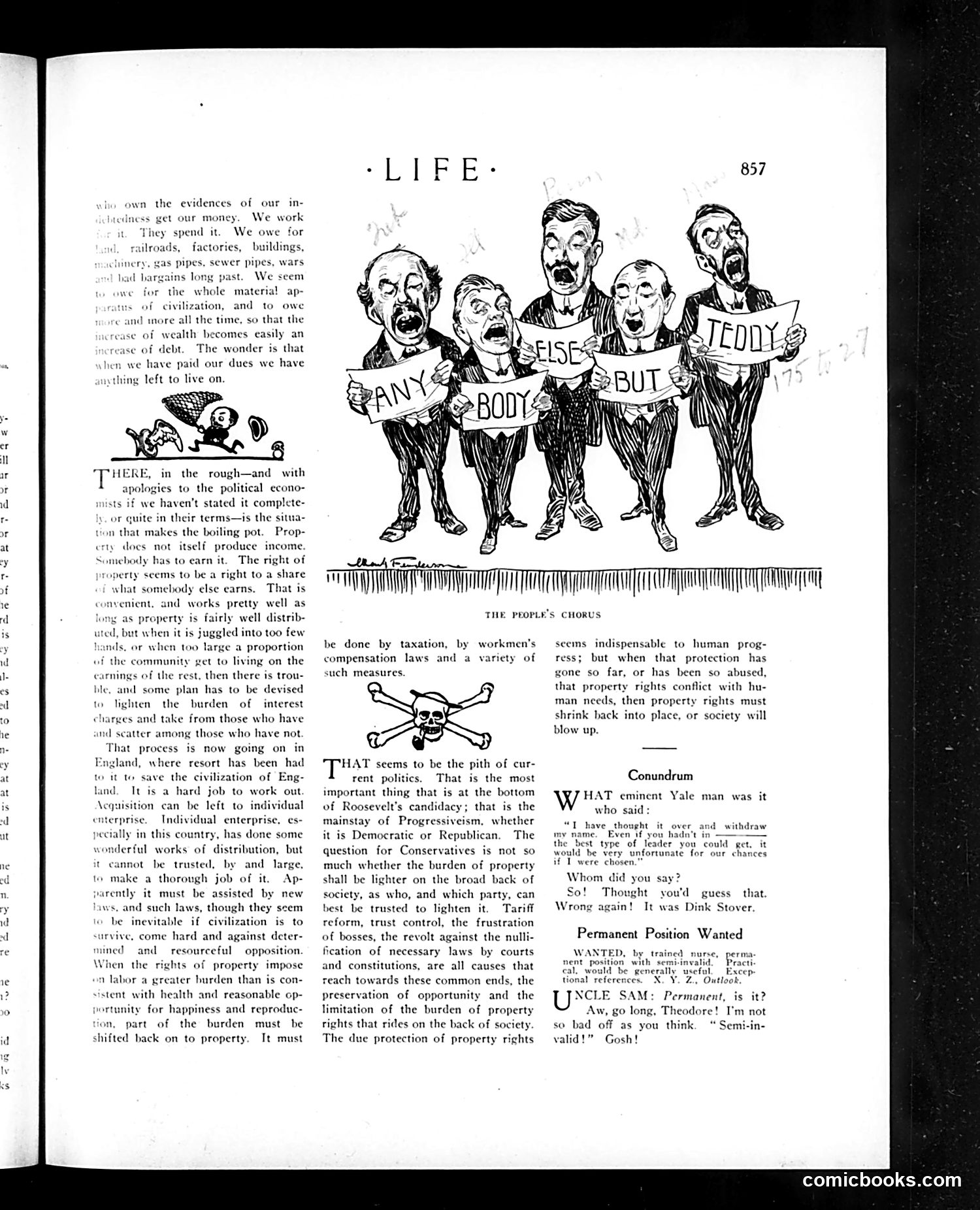
This cartoon satirizes political debates over property rights and wealth distribution, likely from the Progressive Era. Five caricatured men hold banners reading "PANY," "FISE," "BUT," "BODY," and "TEDDY"—apparently spelling out a fragmented political message, possibly referencing Theodore Roosevelt's Progressive policies. The accompanying text discusses property rights distribution and taxation, debating whether wealth concentration creates social problems. The skull-and-crossbones imagery suggests the cartoonist views certain economic positions as dangerous. The article criticizes both Progressive and Conservative approaches to regulating property, arguing that excessive burden on wealthy individuals conflicts with broader social stability. The satire mocks the competing political factions as incoherent "choruses" rather than offering substantive solutions.
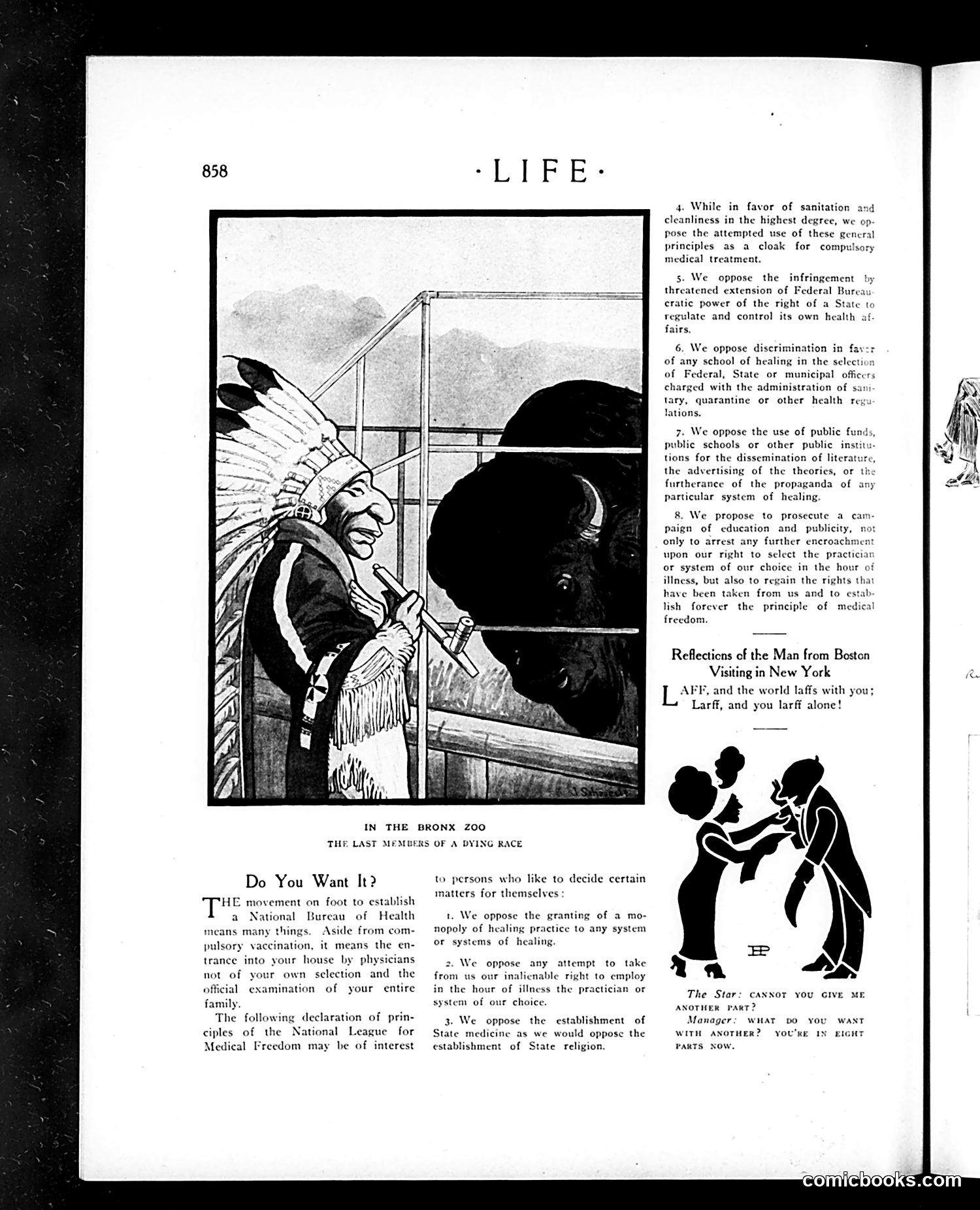
The main illustration shows a Native American figure (depicted in period-stereotypical style) observing a Black man in formal dress through a window or barrier at the Bronx Zoo, captioned "IN THE BRONX ZOO / THE LAST MEMBERS OF A DYING RACE." This is bitterly satirical commentary on racial exploitation: the cartoon inverts the typical power dynamic, suggesting that both Indigenous peoples and Black Americans were treated as "specimens" for public display and scientific racism. By placing them in reversed positions, the artist critiques the dehumanization embedded in zoos, anthropology, and American society. The accompanying text promotes the "National League for Medical Freedom," opposing government health regulation—a contemporaneous anti-establishment position. The humor piece below about a theatrical star adds lighter satirical commentary on celebrity vanity.
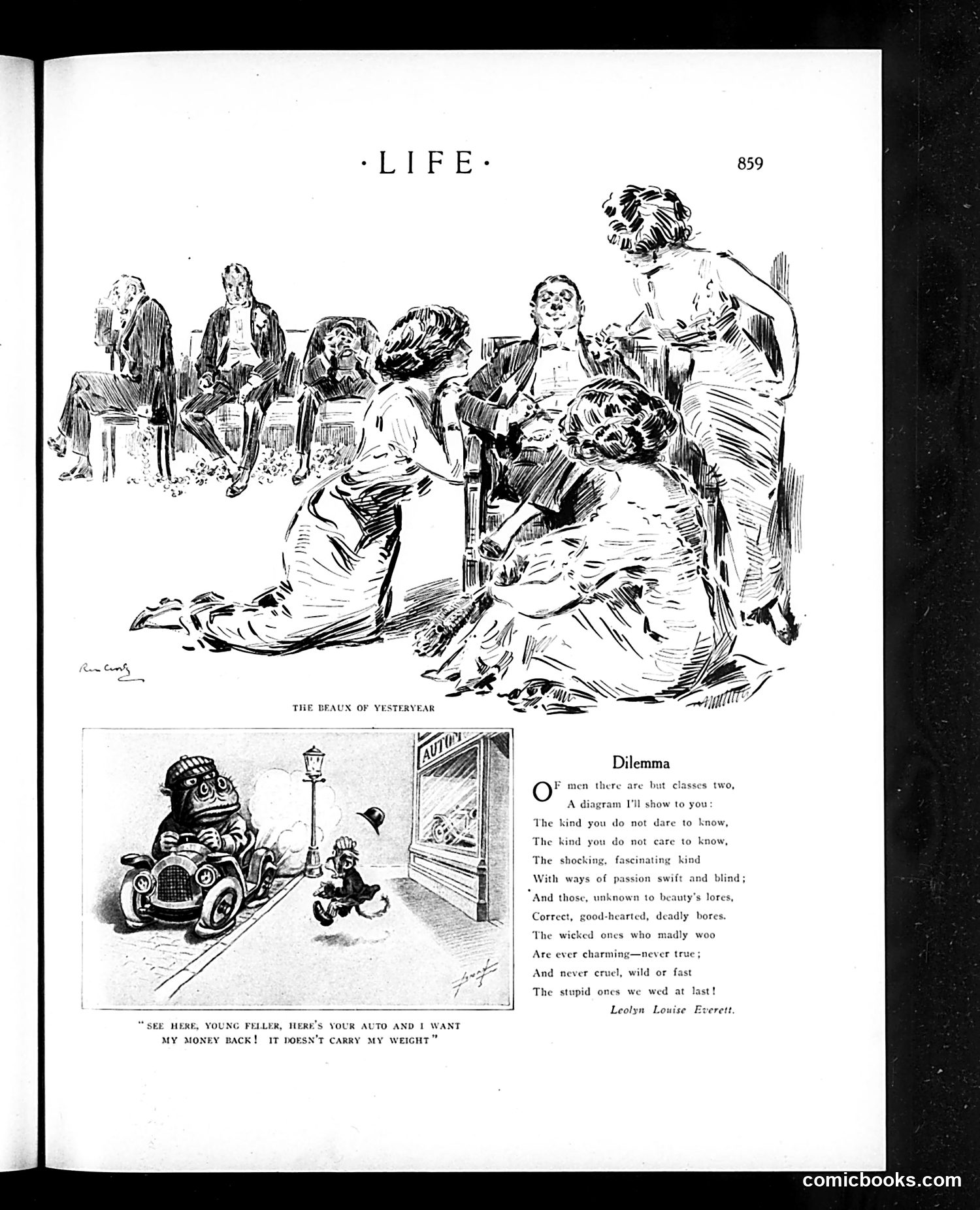
**Top Cartoon: "The Beaux of Yesteryear"** This depicts a social scene where women are kneeling or sitting before seated men in what appears to be a parlor setting. The satire likely mocks outdated courtship rituals and the subservient posturing expected of women in previous generations. **Bottom Cartoon: "See Here, Young Feller..."** Shows a rotund man in an automobile confronting a smaller figure, with text about the car not carrying his weight. This satirizes either automotive reliability or—more likely—the man's obesity, using the car's mechanical failure as humorous commentary on his size. **Poem: "Dilemma"** The accompanying verse by Joslyn Louise Everett categorizes men into two types: the dangerously passionate and the boringly stupid, presenting a cynical view of male character options available to women.
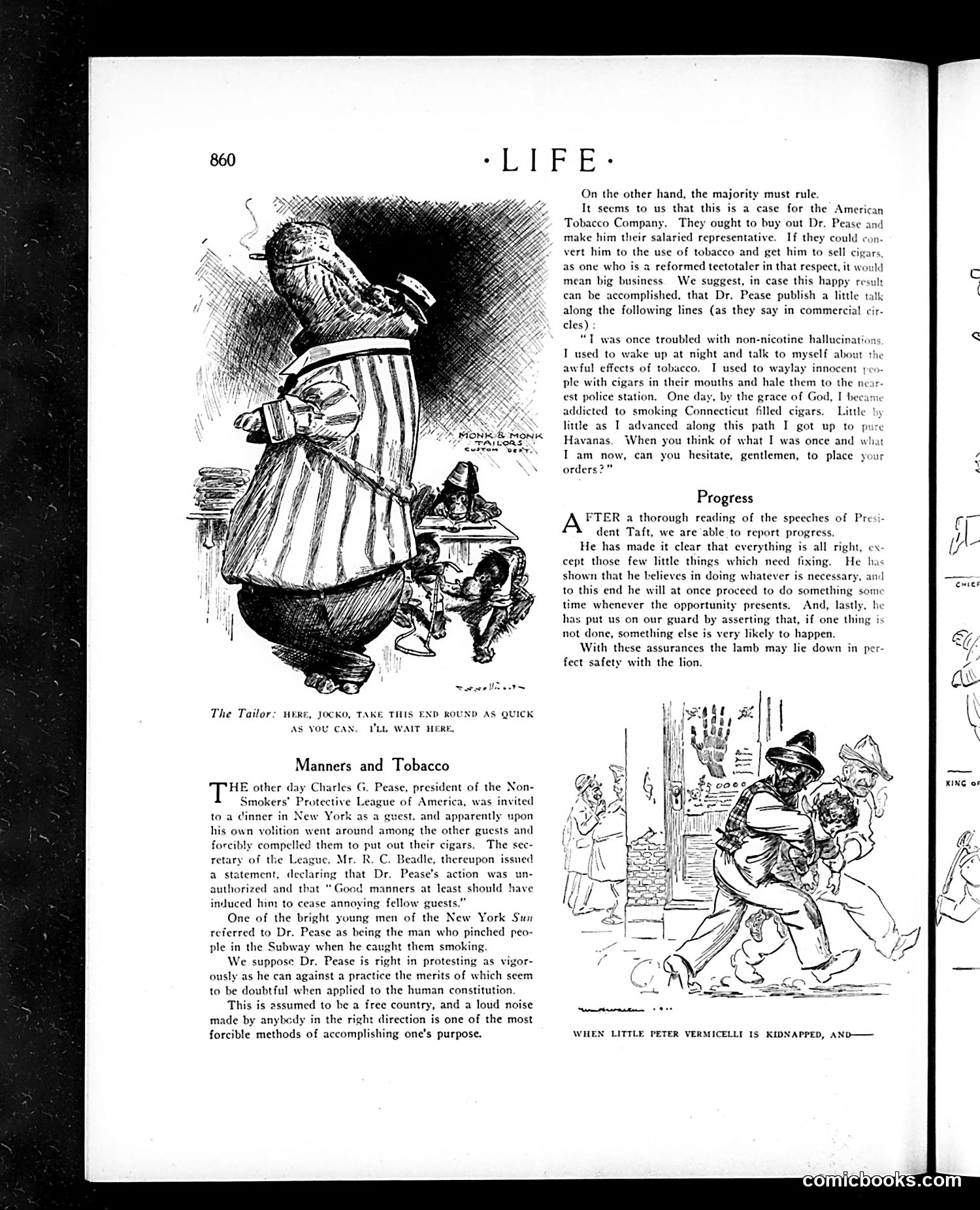
This page satirizes anti-smoking activism through two elements: **Main Cartoon ("The Tailor"):** A portly figure (likely Santa Claus, based on the robe and jolly appearance) is depicted as a tailor being instructed to bind something "quick as you can." The visual pun conflates Santa with a tailor, possibly mocking the conflation of different authorities. **"Manners and Tobacco" Article:** The text criticizes Charles G. Pease, president of the Non-Smokers' Protective League, who allegedly forced dinner guests to stop smoking. The satire defends smoking as a right in a "free country," mocking Pease's activism as heavy-handed and authoritarian. The magazine argues that loud objection is an ineffective social tactic. The page ridicules anti-smoking advocates as overbearing busybodies infringing on personal liberty—a libertarian defense of smoking common in early 20th-century American magazines.
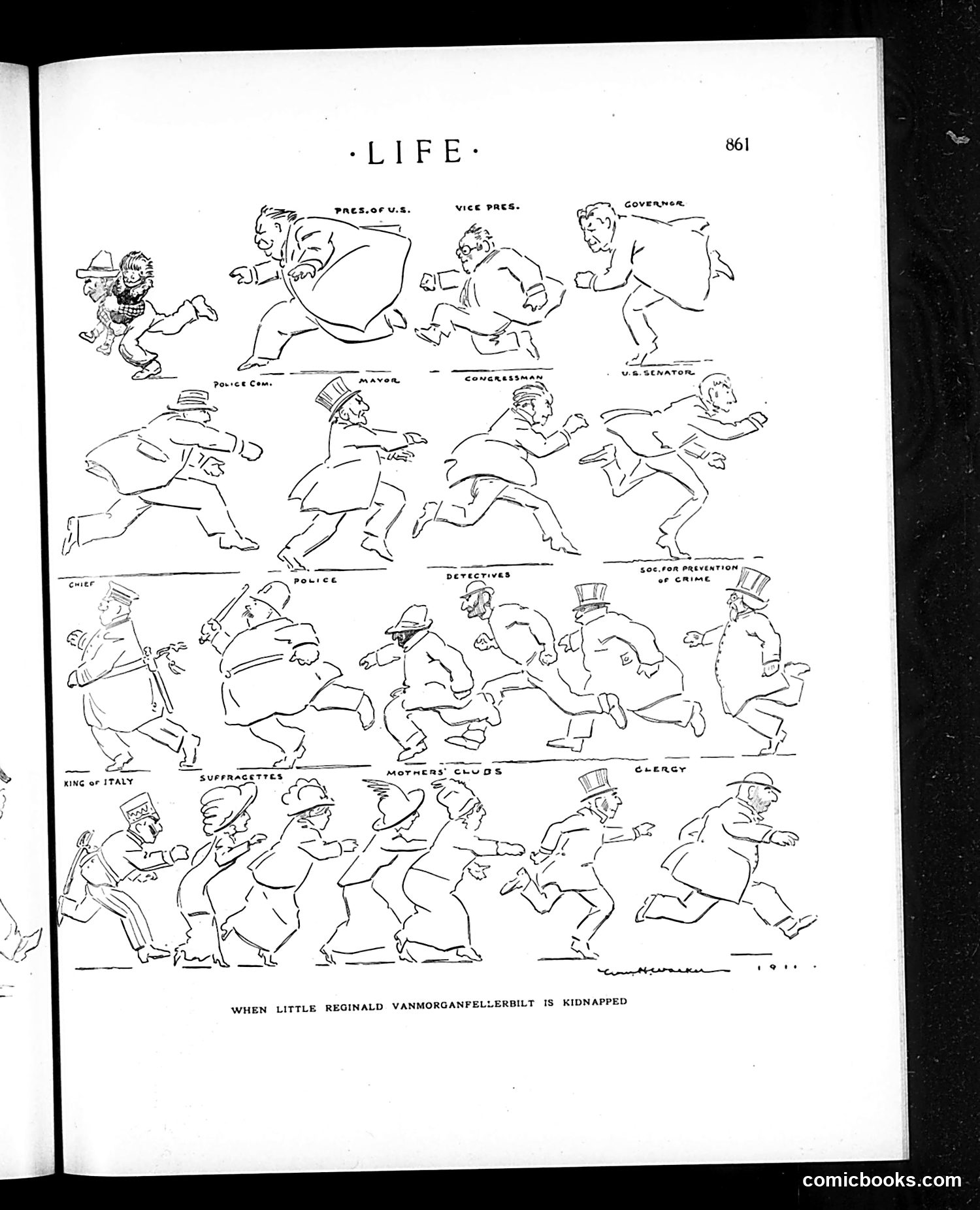
This satirical cartoon depicts various U.S. political and social figures reacting with exaggerated panic to a kidnapping. The page shows labeled characters including the President, Vice President, Governor, Mayor, Congressman, U.S. Senator, Police Chief, Detective, and others—plus the "King of Italy," "Suffragettes," "Mothers' Clubs," and "Clergy." The joke targets wealthy industrialist Reginald Vanderbilt's prominence: the cartoon suggests that his child's kidnapping would mobilize virtually every level of government and society into frantic action. It's satire about class privilege and how the ultra-wealthy command disproportionate public attention and resources compared to ordinary citizens' crises. The absurdist gathering of diverse groups emphasizes how such a high-profile case would dominate society.
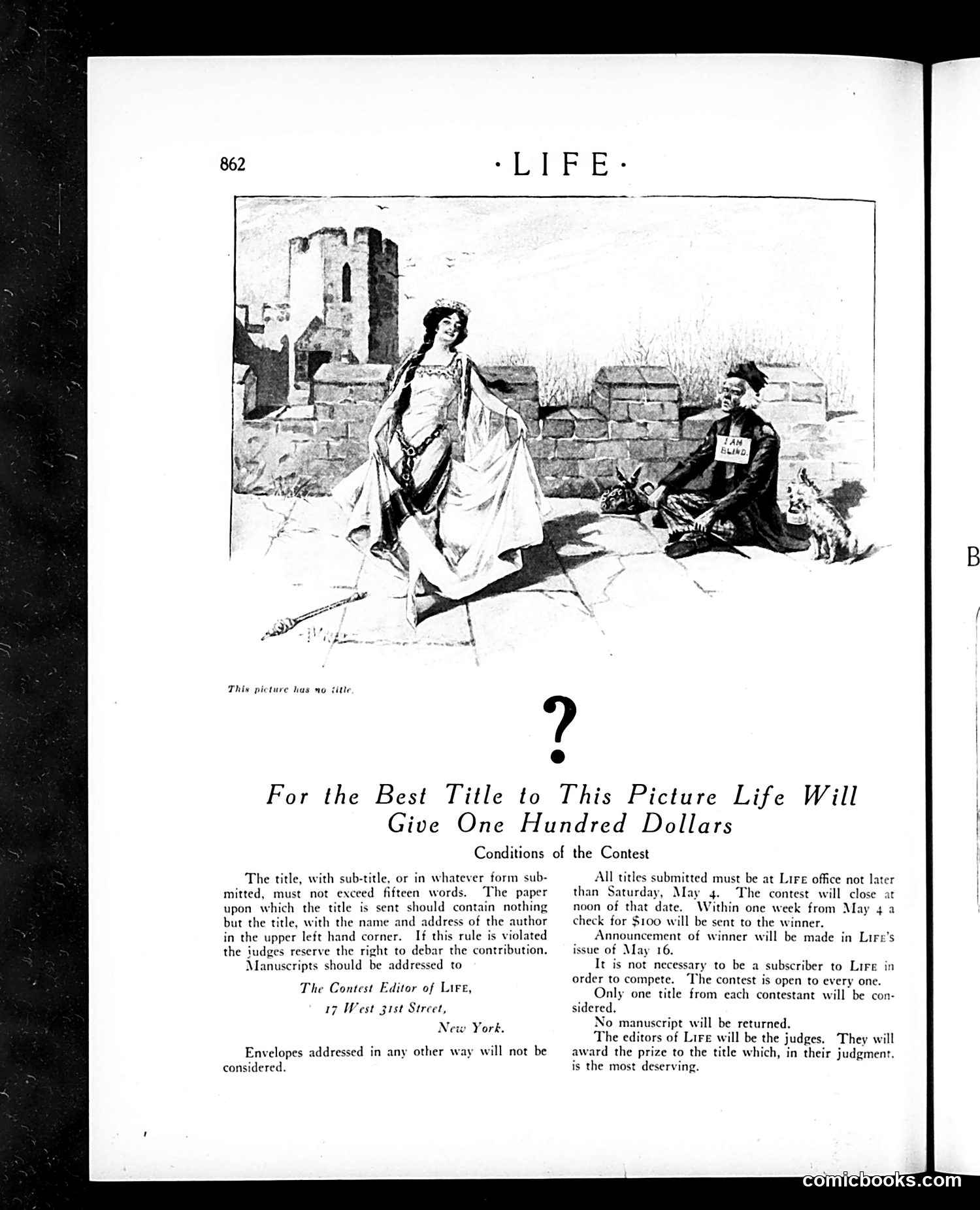
This page is primarily a **contest announcement** rather than political satire. Life magazine is running a $100 contest asking readers to submit titles for an untitled illustration. The illustration itself shows a scene at what appears to be castle or fortress ruins. A woman in classical or theatrical dress stands prominently in the center, while a seated figure (possibly wearing period costume) watches. The setting and clothing suggest historical or literary drama. The contest rules are clearly detailed: titles must be brief, submitted to the Life office by May 4, with announcement of the winner in the May 16 issue. Notably, **readers need not be subscribers** to enter. The editors will judge which title is "most deserving." Without knowing the specific historical moment this was published, the image's exact meaning remains unclear—it could reference classical literature, contemporary theater, or contemporary events depicted through historical costume.
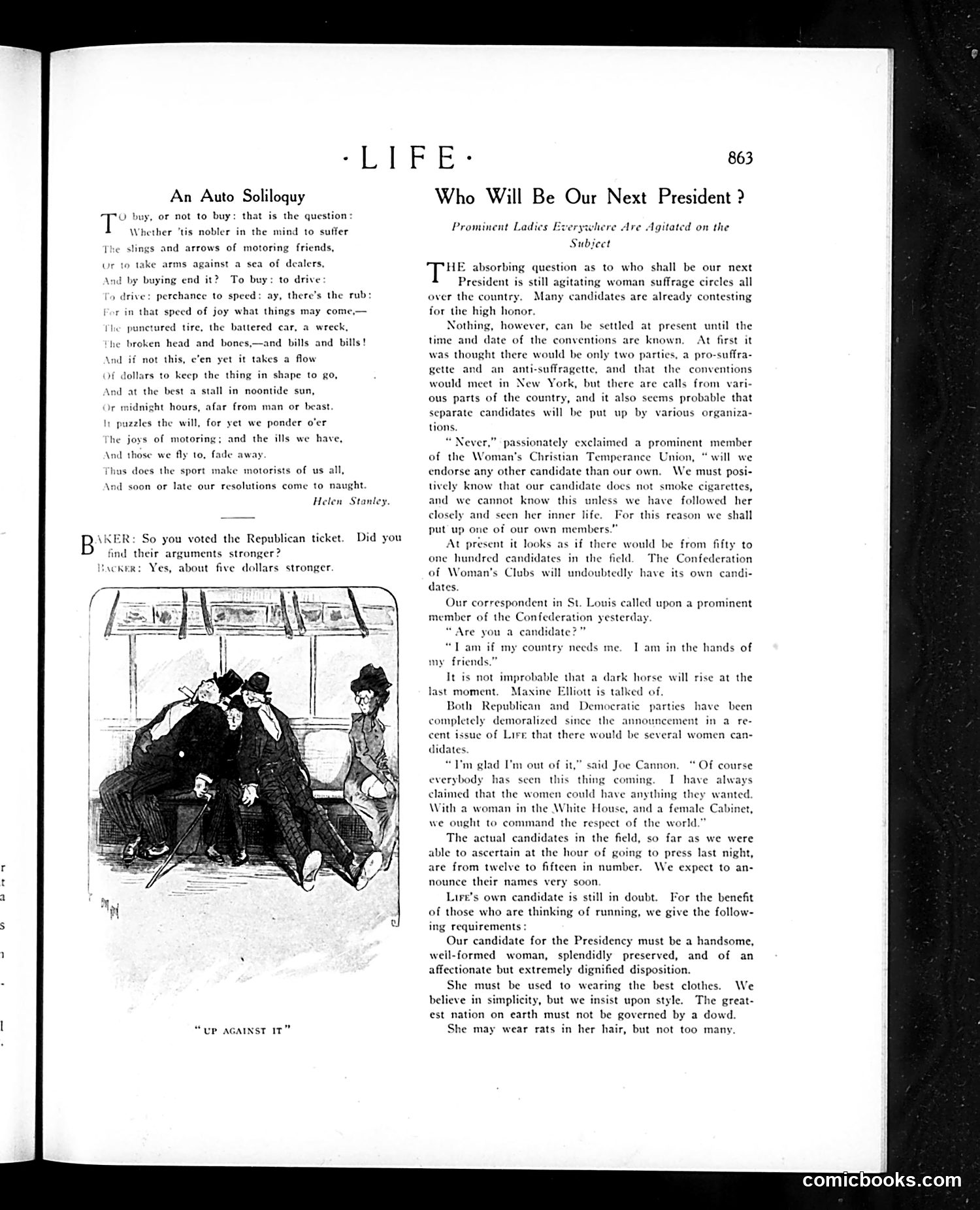
This Life magazine page (page 863) contains two satirical pieces mocking early 20th-century concerns: **"An Auto Soliloquy"** (top left): A Shakespearean parody about whether to buy an automobile. It humorously weighs the "joys of motoring" against practical dangers—punctured tires, wrecks, broken bones, and endless repair bills—reflecting contemporary anxiety about this new, expensive, dangerous technology. **"Who Will Be Our Next President?"** (right): Satire on women's suffrage activism. The piece jokes that women's groups are fielding numerous presidential candidates based on narrow ideological tests (the WCTU demanding a non-smoking candidate, various women's clubs proposing their own choices). It mocks both the fractious nature of women's political organizing and male politicians' dismissive responses. The cartoon caption "UP AGAINST IT" likely depicts suffragists confronting these political obstacles. This reflects pre-1920 debates over women's voting rights.
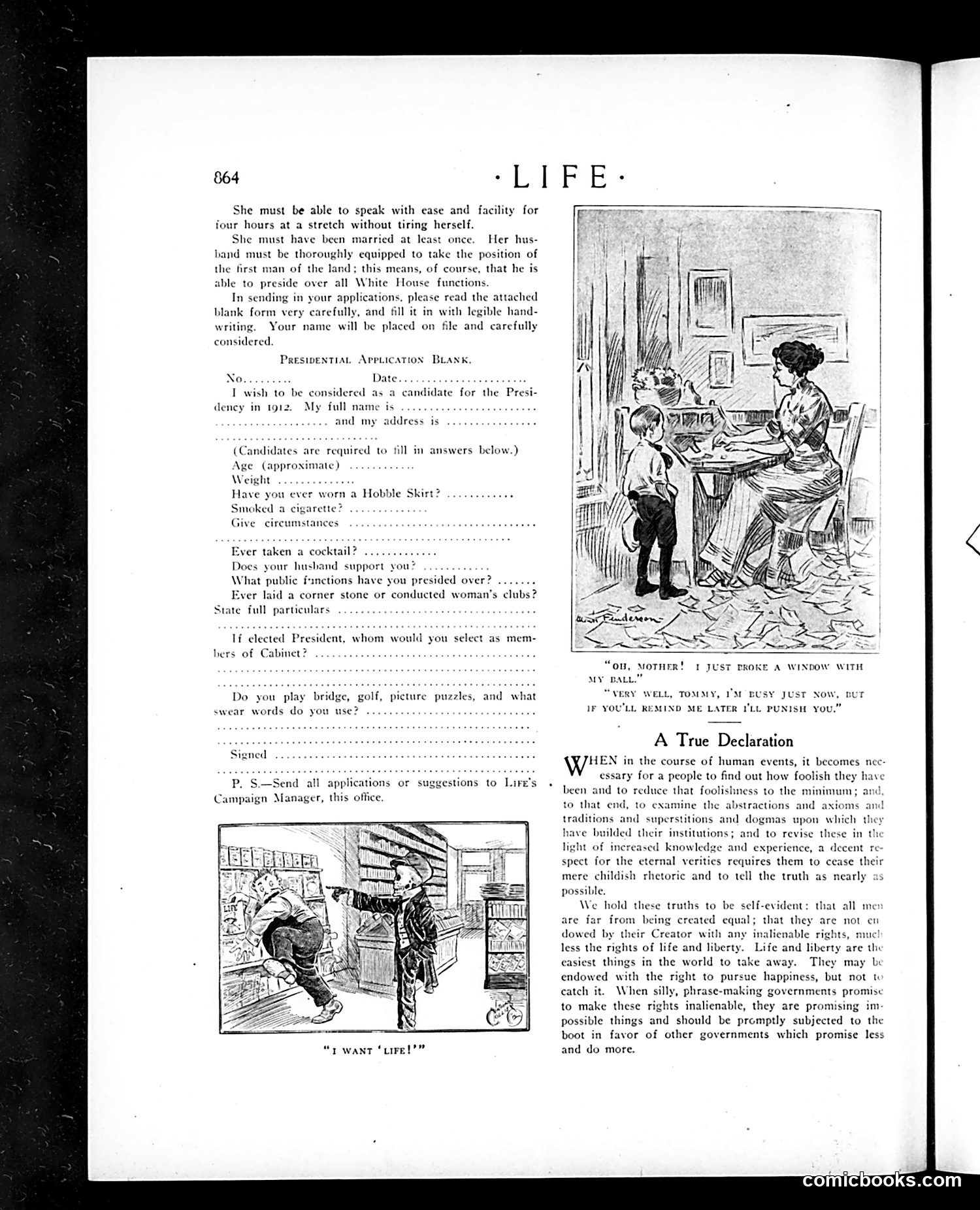
This page satirizes early feminist demands for women's political participation, specifically the push for female presidential candidates around 1912. **The Main Satire:** The "Presidential Application Blank" mocks women's qualifications for the presidency by listing absurd requirements: ability to speak for four hours without tiring, prior marriage, a husband capable of presiding over White House functions, and questions about hobble skirts and cocktails. The joke targets the contradiction—women are being considered "candidates" while simultaneously being required to have husbands who do the actual leading. **The Cartoons:** The top illustration shows a child disrupting a woman's work, captioned with her postponing punishment. The bottom cartoon ("I Want 'Life'!") appears to show someone desperately seeking the magazine itself. **"A True Declaration":** This mock-Declaration of Independence sarcastically rewrites American ideals, asserting that people are *not* created equal and that rights like liberty are "easiest things in the world to take away"—critiquing governments that make hollow promises. The overall message: Life magazine ridicules both women's suffrage advocates and government rhetoric as equally foolish.
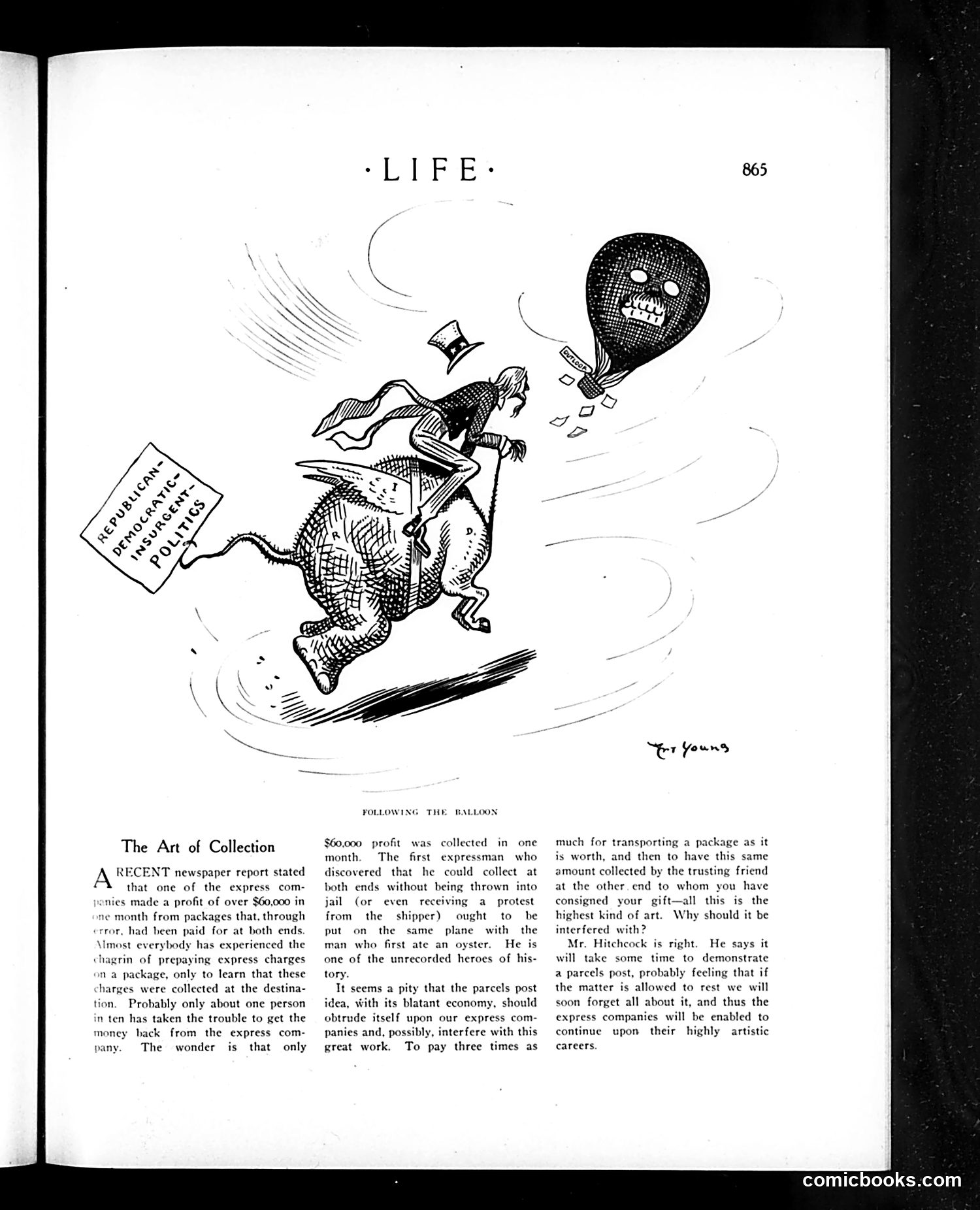
This cartoon satirizes express companies' practice of collecting shipping fees at both delivery AND origin—a lucrative double-billing scheme. The illustration shows a figure chasing a balloon labeled with a grinning face, representing the express companies' pursuit of profit through this questionable practice. The accompanying article, titled "The Art of Collection," mocks the express industry's resistance to the new Parcels Post (a cheaper government shipping service). The writer sarcastically praises express companies' "artistic" billing method and criticizes Postmaster General Hitchcock's defense of allowing time before implementing reforms, suggesting he's giving the companies opportunity to continue exploiting customers. The satire targets corporate greed and regulatory capture—the express companies' ability to profit from customers' inattention while resisting reform that would lower shipping costs.
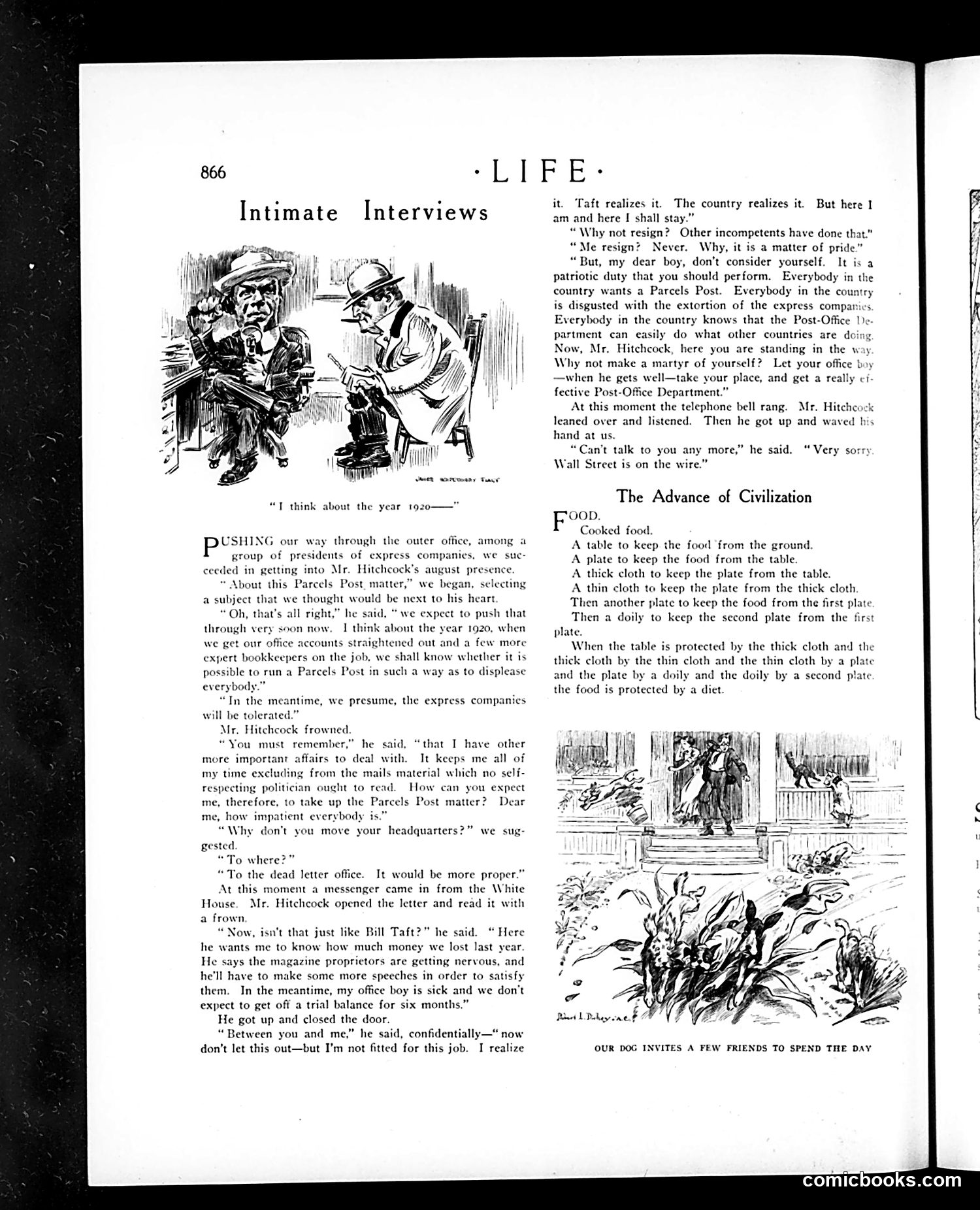
## The Hitchcock Interview The main cartoon satirizes **Frank H. Hitchcock**, Postmaster General under President William Howard Taft. The dialogue mocks Hitchcock's bureaucratic incompetence regarding the proposed Parcels Post (a mail service for parcels). The satire's points: - Hitchcock admits he's "not fitted for this job" but refuses to resign on principle - He's overwhelmed by trivial duties (censoring mail) while ignoring major policy demands - He deflects responsibility to Taft and complains about workload - The "Wall Street is on the wire" gag suggests corporate pressure supersedes public service The interviewer argues Hitchcock should resign as a patriotic duty since everyone—country, public, Congress—wants the Parcels Post and despises express company monopolies. ## "The Advance of Civilization" This brief satirical piece mocks pretentious dining etiquette. It traces how civilization "progresses" by adding increasingly unnecessary layers (cloth, plates, doilies) to protect food from table to plate—only to conclude the food ends up protected by "a diet" (implying people can't actually eat it).
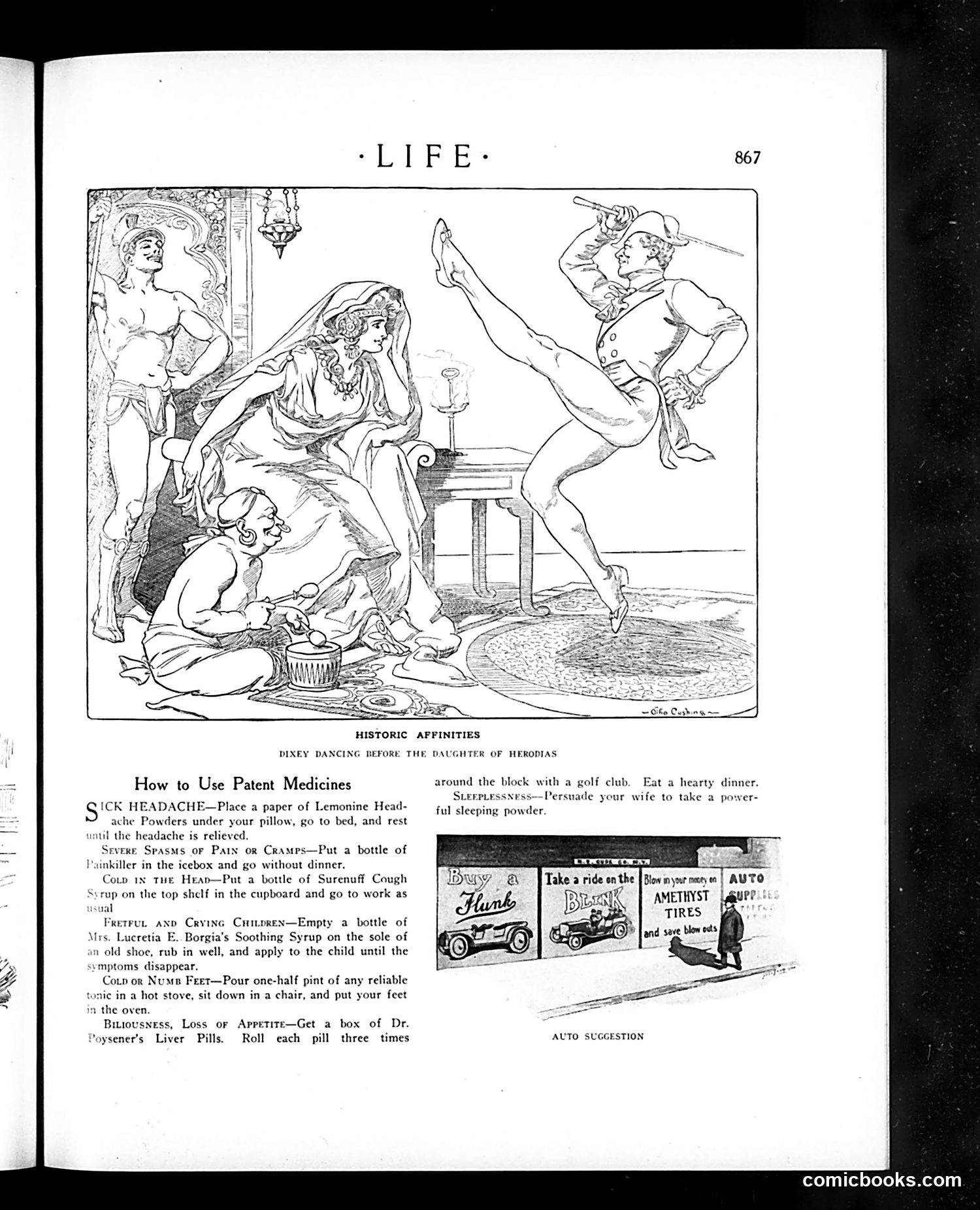
The main cartoon satirizes patent medicine quackery. Titled "Historic Affinities," it compares "Dixey Dancing Before the Daughter of Herodias" (a biblical reference to Salome's seductive dance) to modern medicine promoters. The figure on the right, dressed as a harlequin or entertainer, performs for a seated woman while cherubs and onlookers surround them—suggesting patent medicine salesmen use seduction and spectacle to sell dubious cures. Below, the text mock-advertises absurd "remedies": placing powders under pillows, storing medicines in iceboxes, applying syrups to shoe soles. The satire ridicules both the ineffective treatments and the public's gullible acceptance of them. This reflects Progressive-era concerns about unregulated patent medicines, many containing narcotics or alcohol, sold with false health claims before FDA regulation.
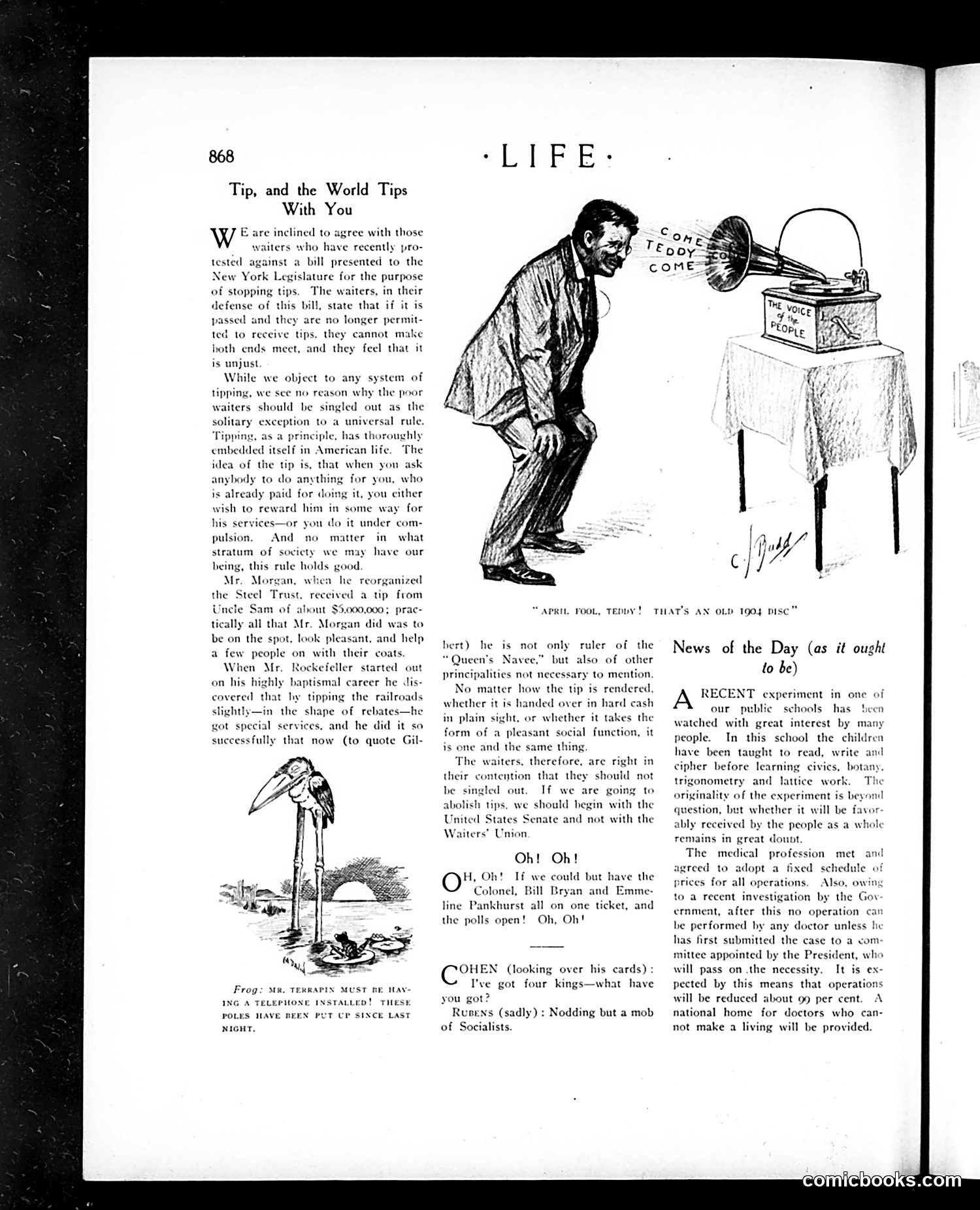
This Life magazine page satirizes tipping culture and wealthy industrialists' hypocrisy. The main article argues that if society opposes tipping for poor waiters, it should equally oppose the "tips" given to the rich—specifically mentioning **J.P. Morgan** receiving a $5 million governmental advantage during steel trust reorganization, and **John D. Rockefeller** receiving railroad rebates. The satire suggests both are forms of tip-taking, yet only poor service workers face criticism. The accompanying cartoon shows a waiter bowing before a gramophone, captioned "That's an old 1924 disc"—mocking outdated entertainment, likely alluding to how society treats traditional tipping as outmoded. The "News of the Day" section contains absurdist satire: children learning cipher before civics, and doctors needing government approval for operations—commentary on bureaucratic inefficiency and misplaced priorities. The frog cartoon references telephone poles, appearing unrelated to the main content.
This page reviews British theatrical productions, particularly focusing on the play "Dear Old Charlie" and actor Charles Hawtrey's performance at New York's Maxine Elliott Theatre. **The Satire:** The opening section satirizes British theatrical censorship through a fictional debate between playwright Charles H. Brookfield and himself as the Lord Chamberlain's censor. The joke is that Brookfield must argue with himself about whether his own play is morally acceptable—a critique of Britain's absurd censorship system. The reference to Gilbert's "Pooh-Bah" (from *The Mikado*) reinforces this mockery of bureaucratic pomposity. **The Criticism:** The review complains that while Hawtrey maintains his polished comedic style, the British cast obscures much of the dialogue through unclear diction and rapid delivery. The play itself is deemed old-fashioned, relying on tired slapstick (characters burning themselves with flatirons) that amuses conservative British audiences but lacks intellectual substance. **The Broader Point:** The piece contrasts British theatrical tradition with American expectations, implying British theater is stodgy and resistant to progress.
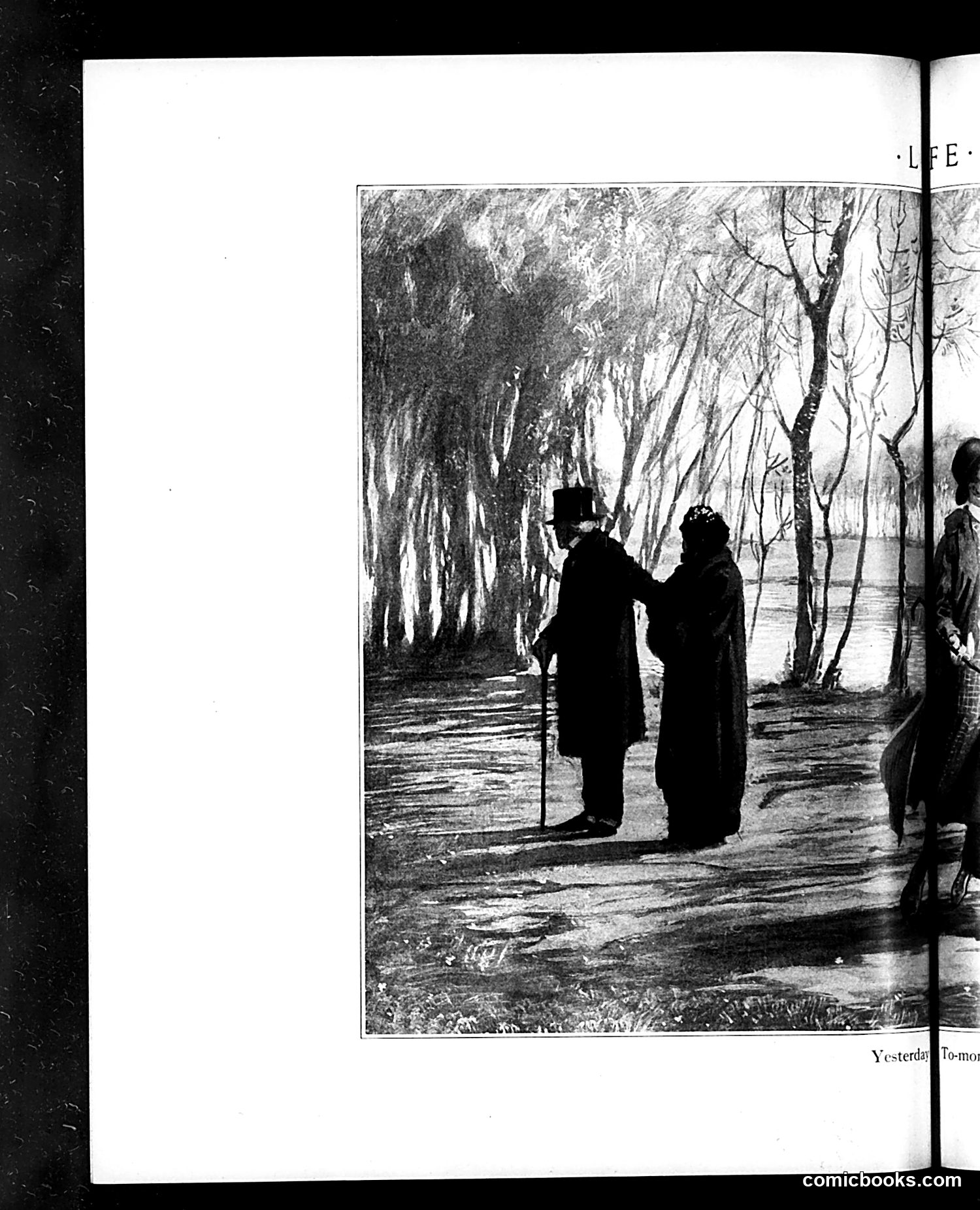
This page from *Life* magazine shows a black and white photograph rather than a cartoon. The image depicts silhouetted figures in formal attire (including at least one wearing a top hat) standing along a tree-lined path near water. The composition and poses suggest a serious or melancholic mood. The caption fragments—"Yesterday" and "To-mor[row]" (likely "Tomorrow")—suggest the image is making a temporal or nostalgic point, possibly contrasting past and future. However, without the complete caption text or additional context about the specific issue date, I cannot definitively identify the figures or determine what historical/political event this references. The formal dress and formal setting suggest this may relate to a significant public or ceremonial occasion.
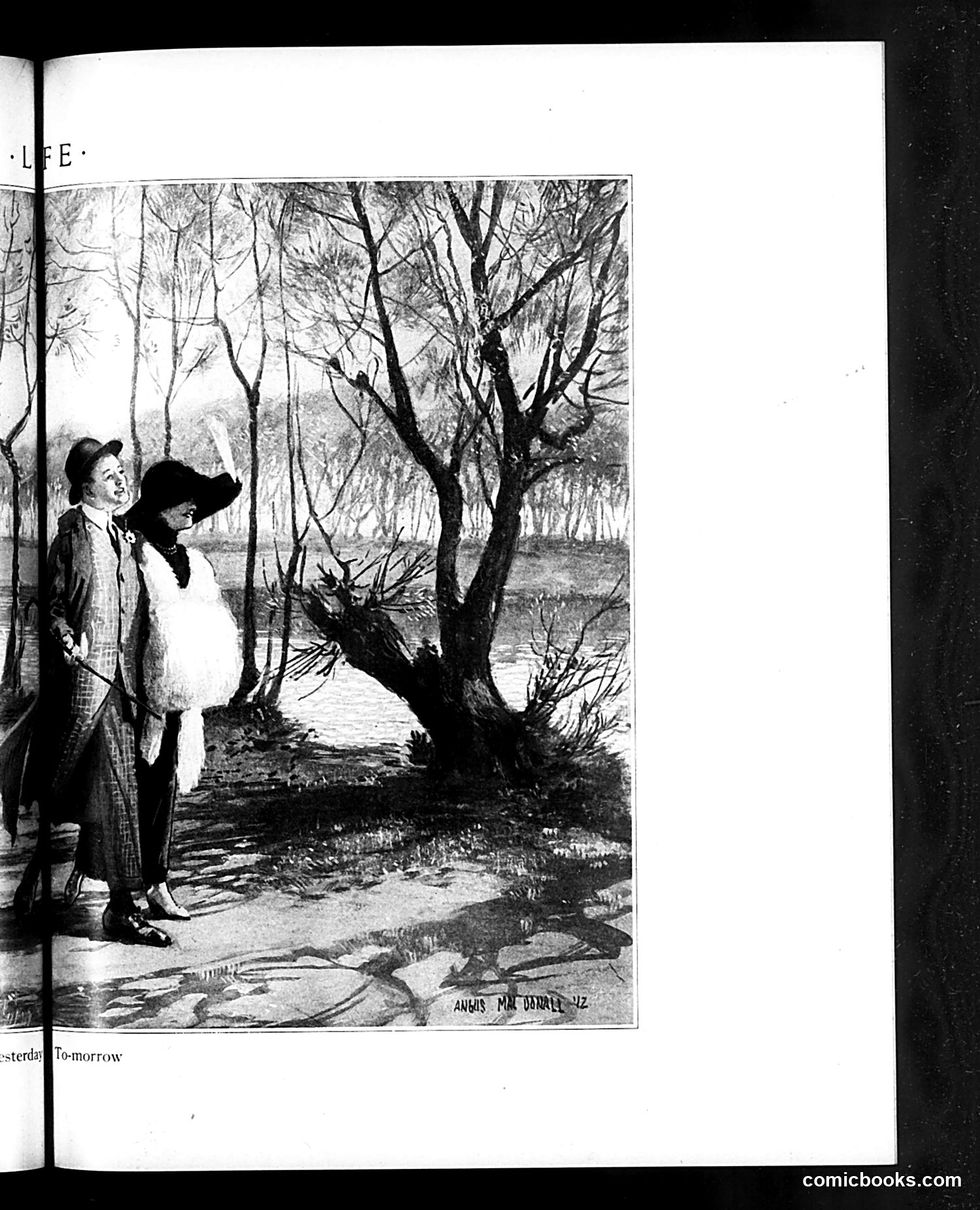
This appears to be a satirical cartoon titled "Yesterday/To-morrow," contrasting past and future. The image shows two figures in a wooded riverside setting—a man in a suit and hat alongside a woman in a dress and hat. The visual suggests a commentary on courtship or romantic relations, likely critiquing social conventions of the era. Without clearer identification of specific historical figures or dated context, the exact political or social reference remains unclear. The cartoon's point seems to contrast idealized versus realistic portrayals of romance or relationships, though the specific satirical target—whether aimed at particular public figures, social customs, or gender relations—cannot be definitively determined from the visible image alone.
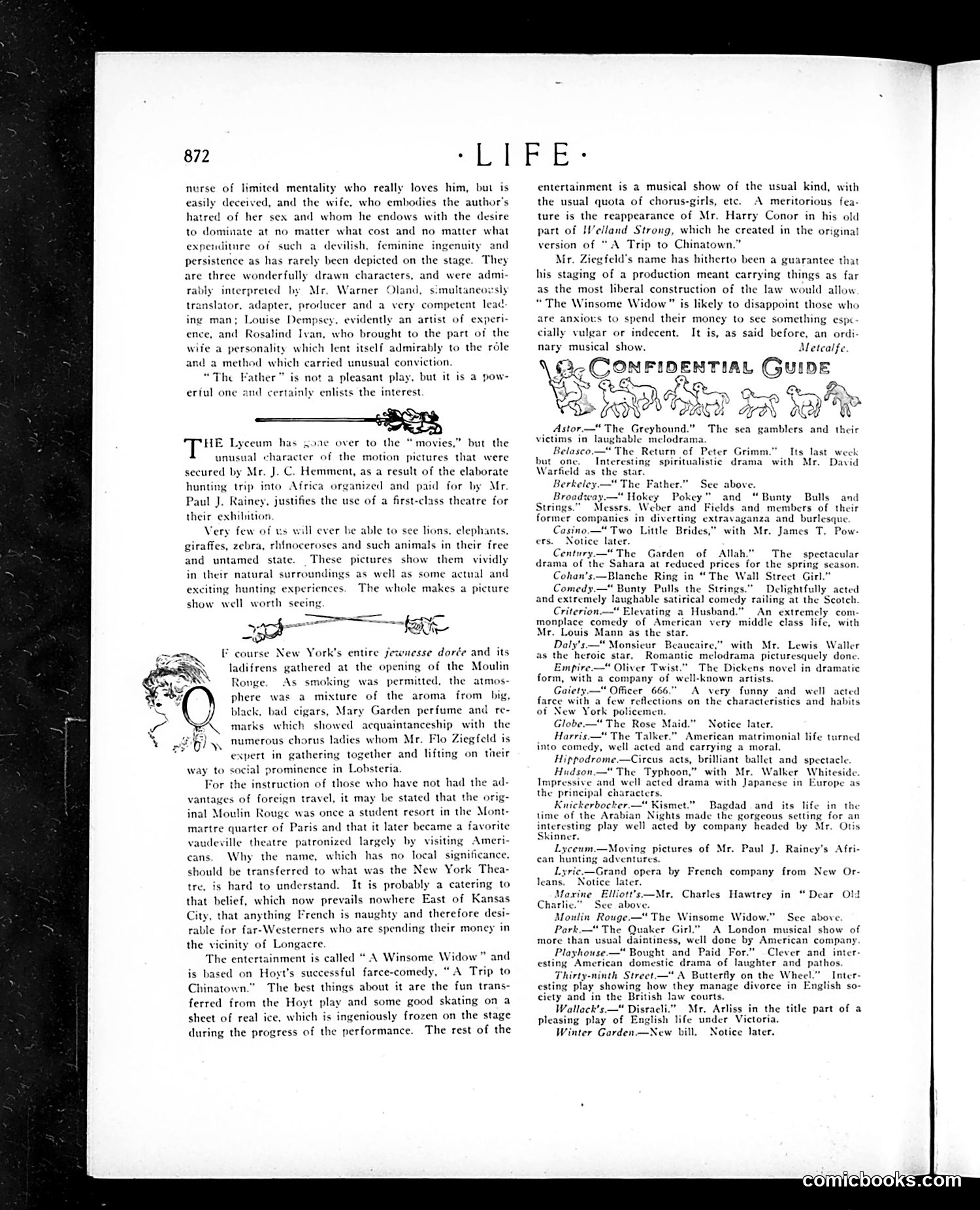
This page from *Life* magazine reviews theatrical productions and the Moulin Rouge nightclub opening in New York. The text critiques "A Winsome Widow," a musical comedy produced by Flo Ziegfeld, sarcastically noting that despite Ziegfeld's reputation for pushing boundaries, this show is disappointingly ordinary and inoffensive. The satire targets the pretension of American audiences: the writer mocks New Yorkers for adopting the name "Moulin Rouge" (a famous Parisian venue) for a theater, suggesting that easterners believe "anything French is naughty and therefore desirable for far-Westerners." This reveals early 1900s attitudes about regional sophistication and manufactured exoticism. The page also reviews a dramatic play, "The Father," and celebrates a wildlife film shot in Africa—reflecting *Life*'s role as a general-interest cultural commentary magazine blending theater criticism with humor and social observation.
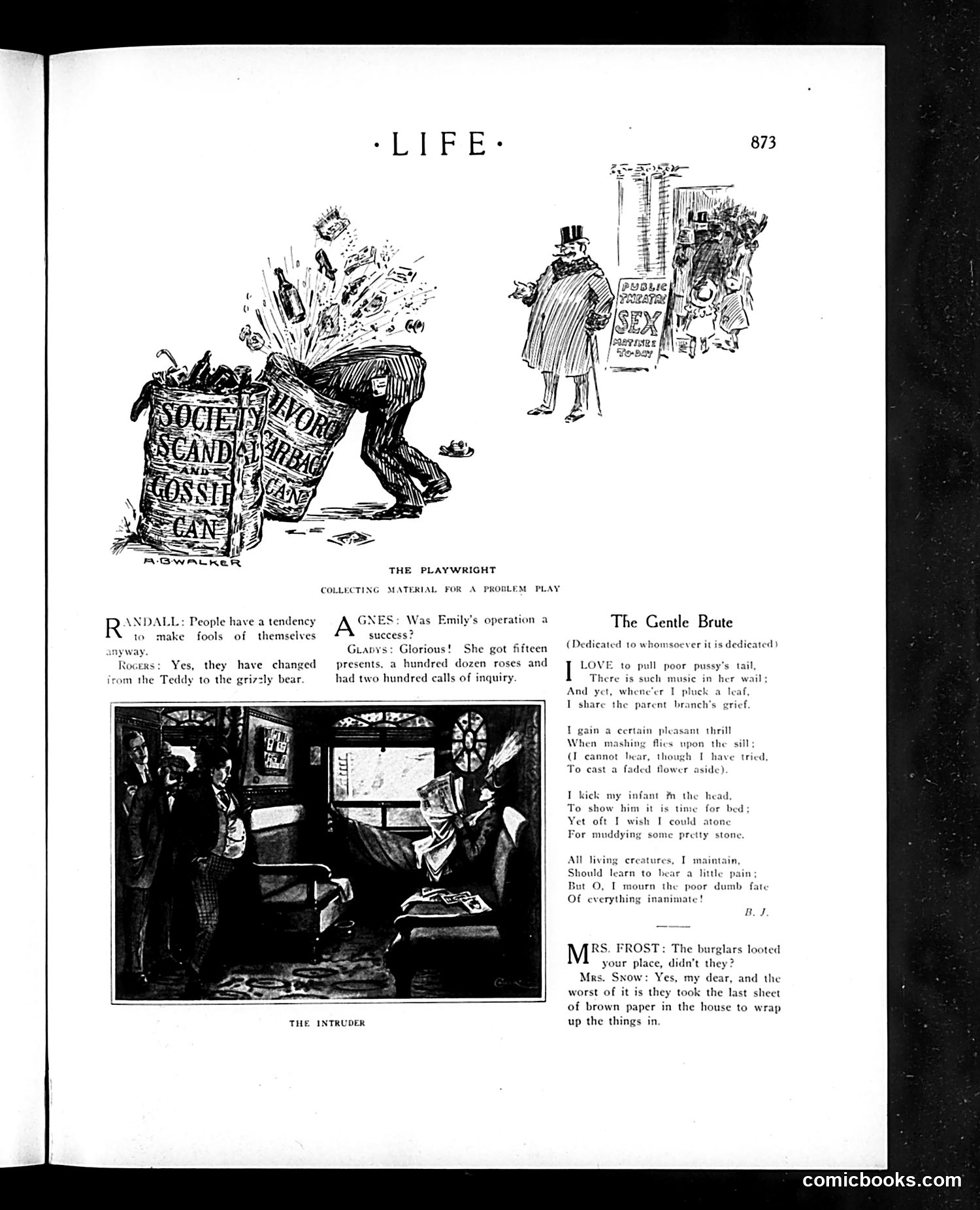
This page contains early 20th-century satirical humor addressing social attitudes and behavior: **Top cartoons:** "The Playwright Collecting Material for a Problem Play" depicts a figure literally mining trash bins labeled "Society Scandal," "Divorce," and "Gossip" — satirizing playwrights who exploit sensational social problems as theatrical material rather than offering genuine commentary. **Dialogue exchanges:** Two brief comedic exchanges mock societal absurdities. One jokes about how social fashions change (from "Teddy" bear affection to "grizzly bear" behavior). Another mocks wealthy hypochondriacs: Emily's operation draws gifts, flowers, and sympathy calls — suggesting people perform illness for attention. **"The Gentle Brute" poem:** This satirizes moral hypocrisy — a speaker who torments animals and children yet sentimentally mourns damaging inanimate objects, revealing twisted priorities and selective compassion. **"The Intruder" scene:** A domestic comedy where a burglar's theft of brown wrapping paper distresses Mrs. Snow more than losing valuables — poking fun at petty middle-class concerns. Overall, the page ridicules social pretense, theatrical exploitation, and misplaced values.
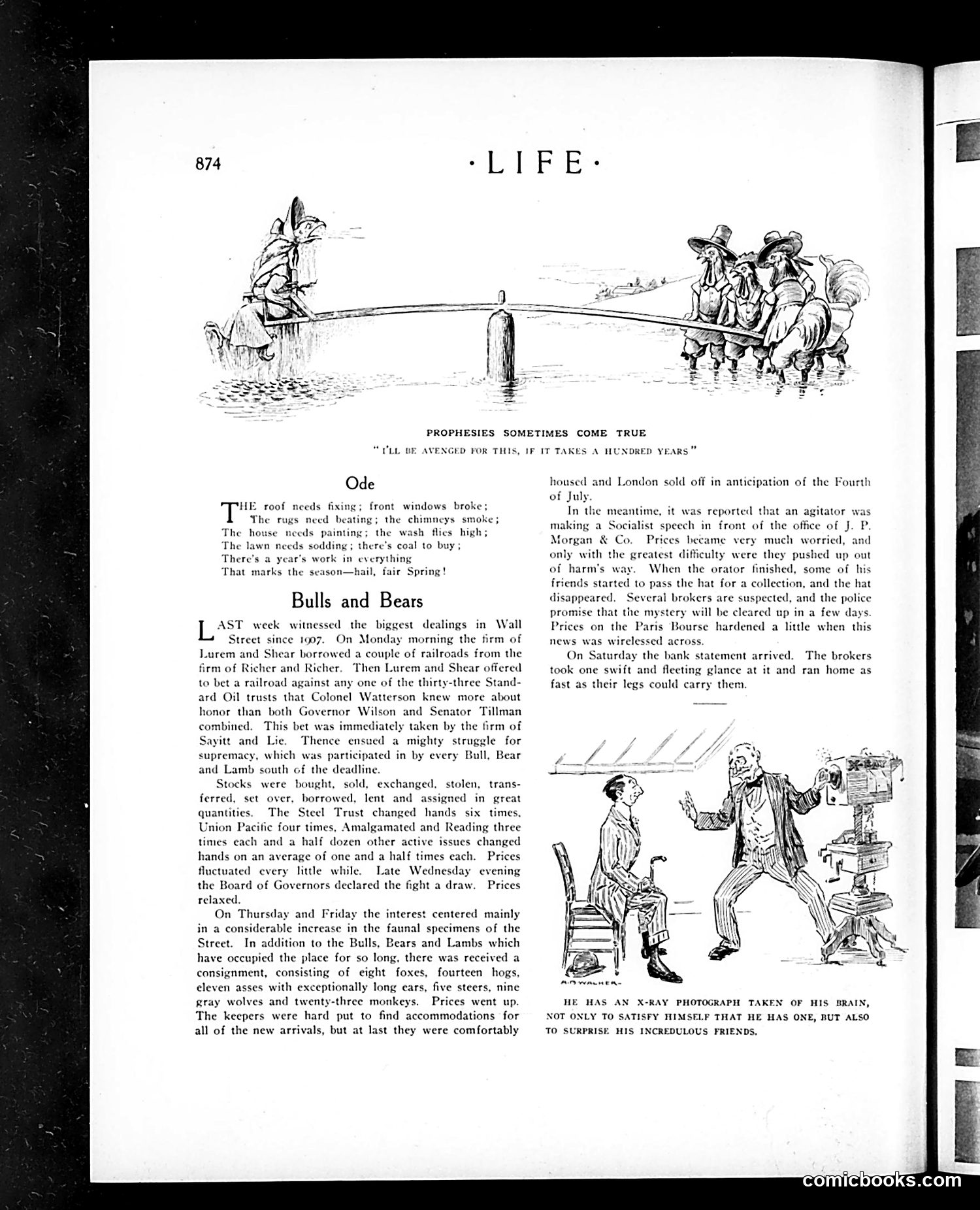
This page satirizes Wall Street financial chaos and speculation circa 1907-1912. The "Bulls and Bears" section mocks the frenzied trading by describing stock exchanges using absurd animal metaphors—literally adding foxes, hogs, asses, and monkeys to Wall Street, treating financial instruments like livestock commodities. The joke targets the reckless, almost gambling-like nature of stock trading: railroads and trusts are "borrowed" and bet like poker chips, prices fluctuate wildly over nothing, and a Socialist speech causes panicked selling. The cartoon shows a man getting an X-ray of his brain (bottom right), captioned as proof he actually has one—mocking Wall Street traders' supposed lack of intelligence. References include J.P. Morgan & Co. (real banking giant) and likely Governors Wilson and Senator Tillman (political figures of that era), suggesting broader critique of both financial and political incompetence during this volatile economic period.
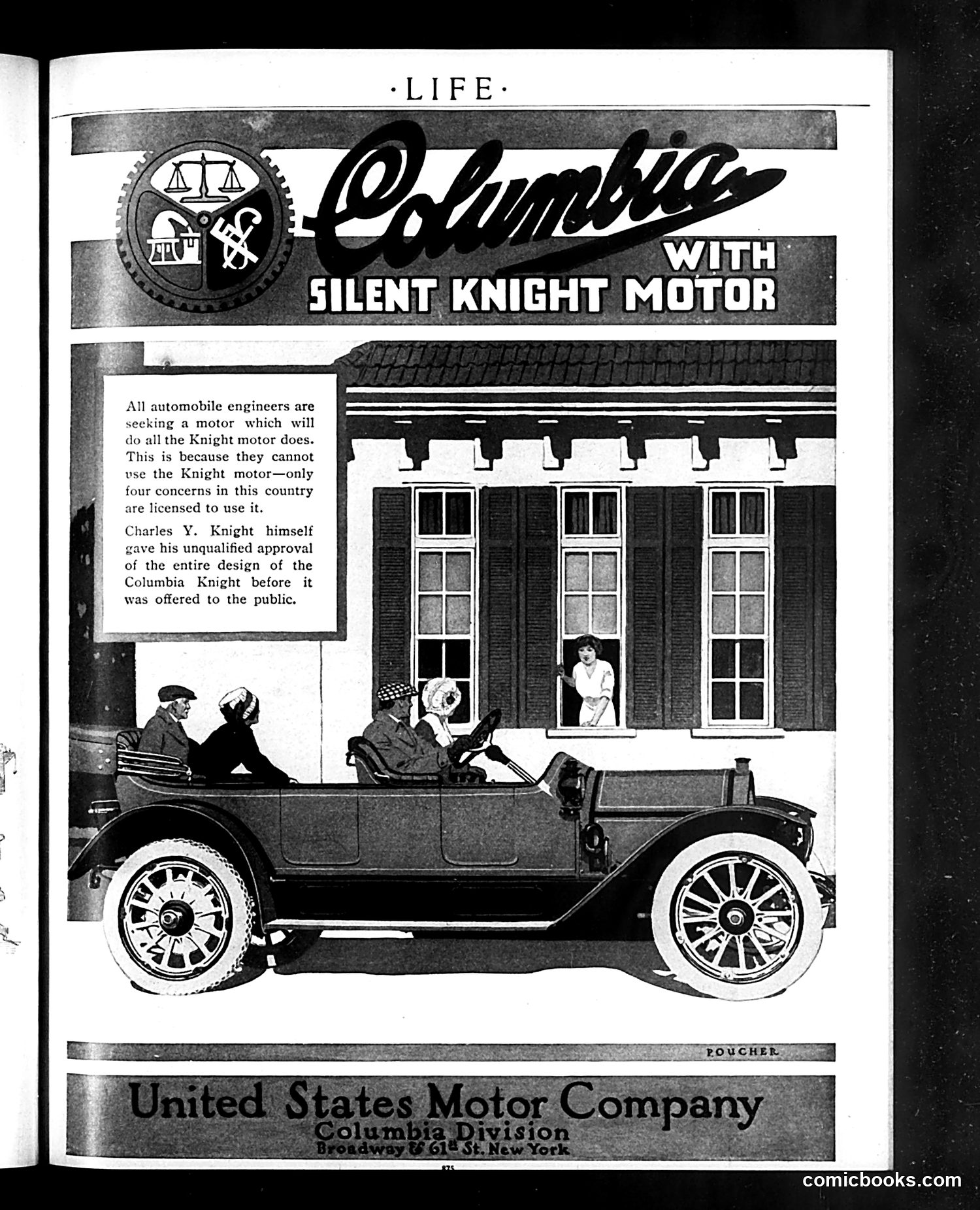
This is a **product advertisement**, not satire. It promotes the Columbia automobile, which featured the patented "Silent Knight Motor" — a real engine technology licensed exclusively to only four manufacturers in the U.S. The ad's humor is subtle: it claims all engineers want the Knight motor *because* they can't use it (only four companies have licenses). This creates artificial desirability through scarcity. Charles Y. Knight's personal endorsement of the Columbia design is emphasized to boost credibility. The illustration shows a well-dressed couple in the car outside a nice home, suggesting affluence and respectability — typical early automotive advertising targeting middle-to-upper-class buyers. The "Silent Knight" name emphasizes the engine's supposedly quiet operation, a valued feature in early automobiles.
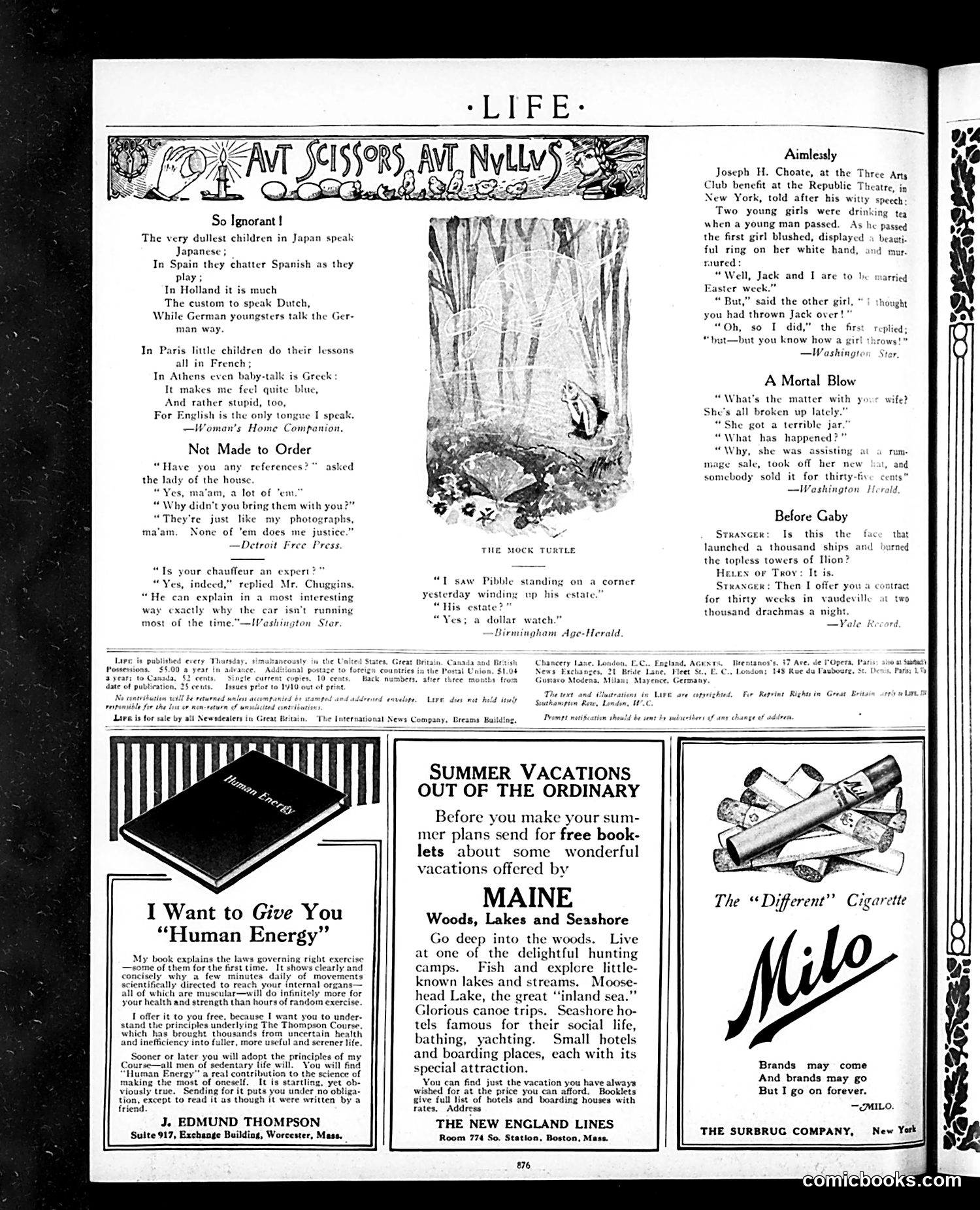
This page contains several short humorous anecdotes rather than political cartoons. The jokes satirize: **"So Ignorant!"** - Mocks English monolingualism. The joke: while children everywhere naturally learn their native languages, English speakers appear uniquely unable to learn others, making them seem comparatively foolish. **"Not Made to Order"** - A servant jokes that her references "don't do her justice" like photographs don't—implying poor references reflect badly on her, just as unflattering photos do. **"The Mock Turtle"** - A man describes someone "winding up his estate"—a pun suggesting he's reducing his wealth to almost nothing (a dollar watch). **"A Mortal Blow"** and **"Before Gaby"** continue in this vein with romantic and social humor. The remainder is advertising: vacation promotions for Maine, an "energy/exercise" self-help book, and cigarette ads. This was typical Life magazine content—light satire mixed with period advertisements.
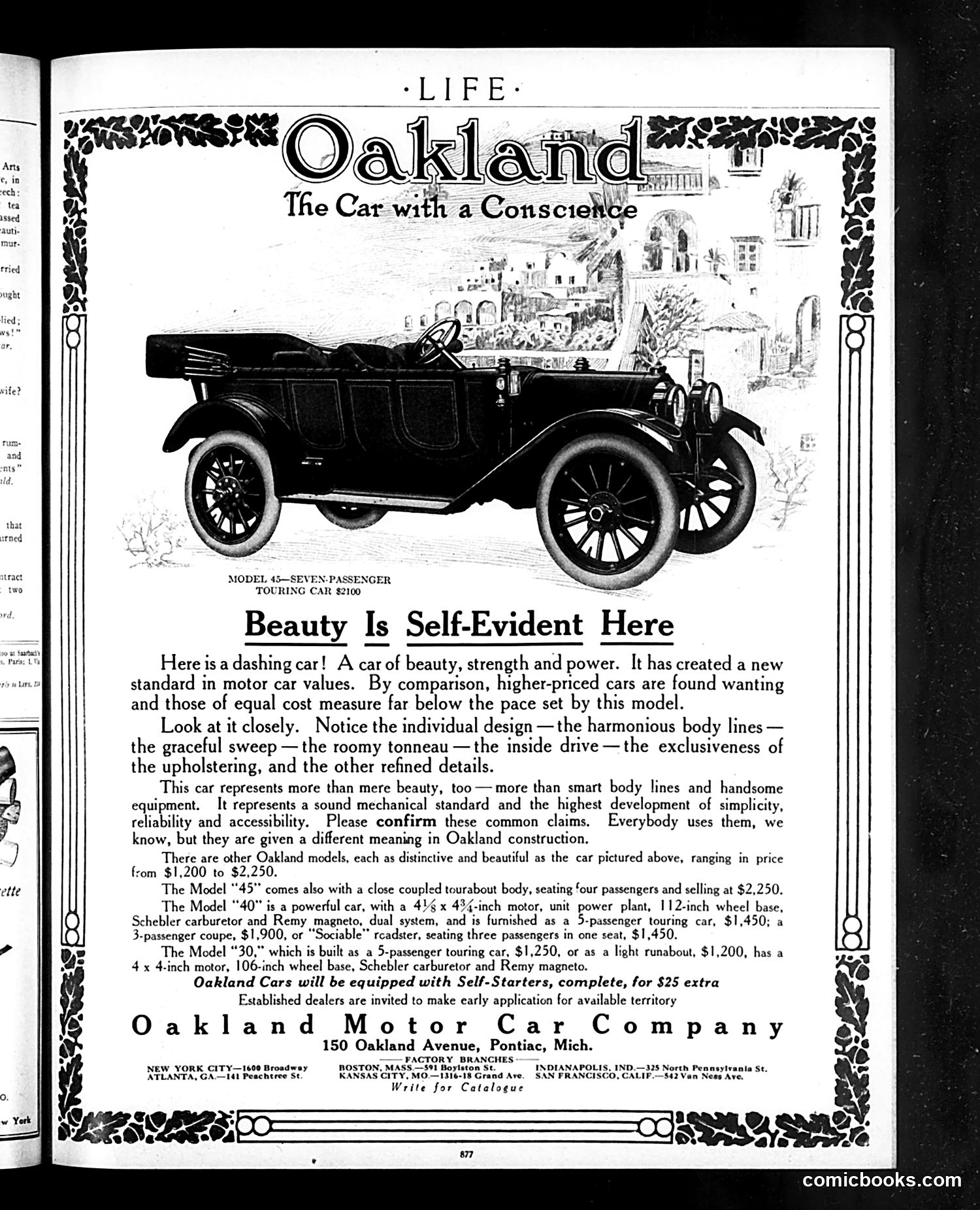
This is primarily a **automobile advertisement**, not political satire or a cartoon. It promotes Oakland's Model 45 touring car ($2,100) as a luxury vehicle offering exceptional value. The ad employs persuasive rhetoric typical of early 1910s marketing: it claims the car achieves "a new standard in motor car values," outperforming higher-priced competitors. The copywriting emphasizes both aesthetics ("graceful sweep," "harmonious body lines") and mechanical superiority ("simplicity, reliability and accessibility"). The illustration shows a sleek touring car with a cityscape backdrop, conveying sophistication and urban appeal. The ad lists multiple Oakland models ($1,200–$2,250) and features self-starters available for $25 extra—a notable luxury feature for the era. There is **no political cartoon or satire** on this page—it's straightforward commercial advertising from Life magazine's advertising section.
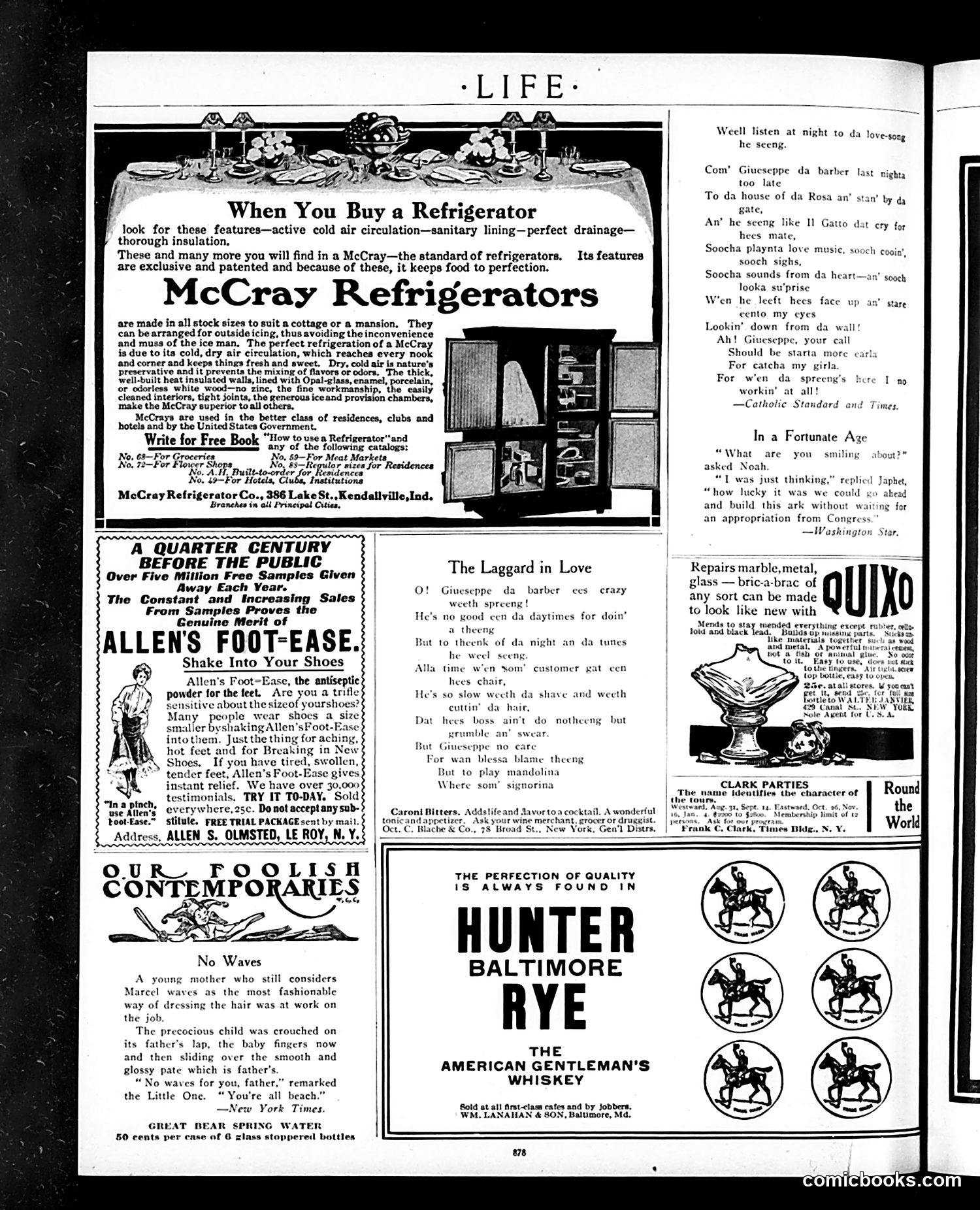
This is primarily an **advertising page** from an early 20th-century issue of Life magazine, with minimal satirical content. The main features are product advertisements: McCray Refrigerators (prominent top section), Allen's Foot-Ease powder, Hunter Baltimore Rye whiskey, and Quixo cleaning product. The only satirical content is **"The Laggard in Love,"** a dialect poem about Giuseppe, an Italian barber distracted by romance. He performs poorly at work because he's preoccupied with serenading a girl at night with his mandolin. The humor relies on **Italian-immigrant stereotypes** (phonetic dialect, mandolin-playing, emotional nature) common in early 20th-century American publications. A small item, **"In a Fortunate Age,"** presents Noah joking that he's fortunate to have built the ark without needing government appropriation—likely a dig at growing government spending or bureaucracy. The page reflects the era's casual ethnic caricaturing and advertising-driven editorial content.
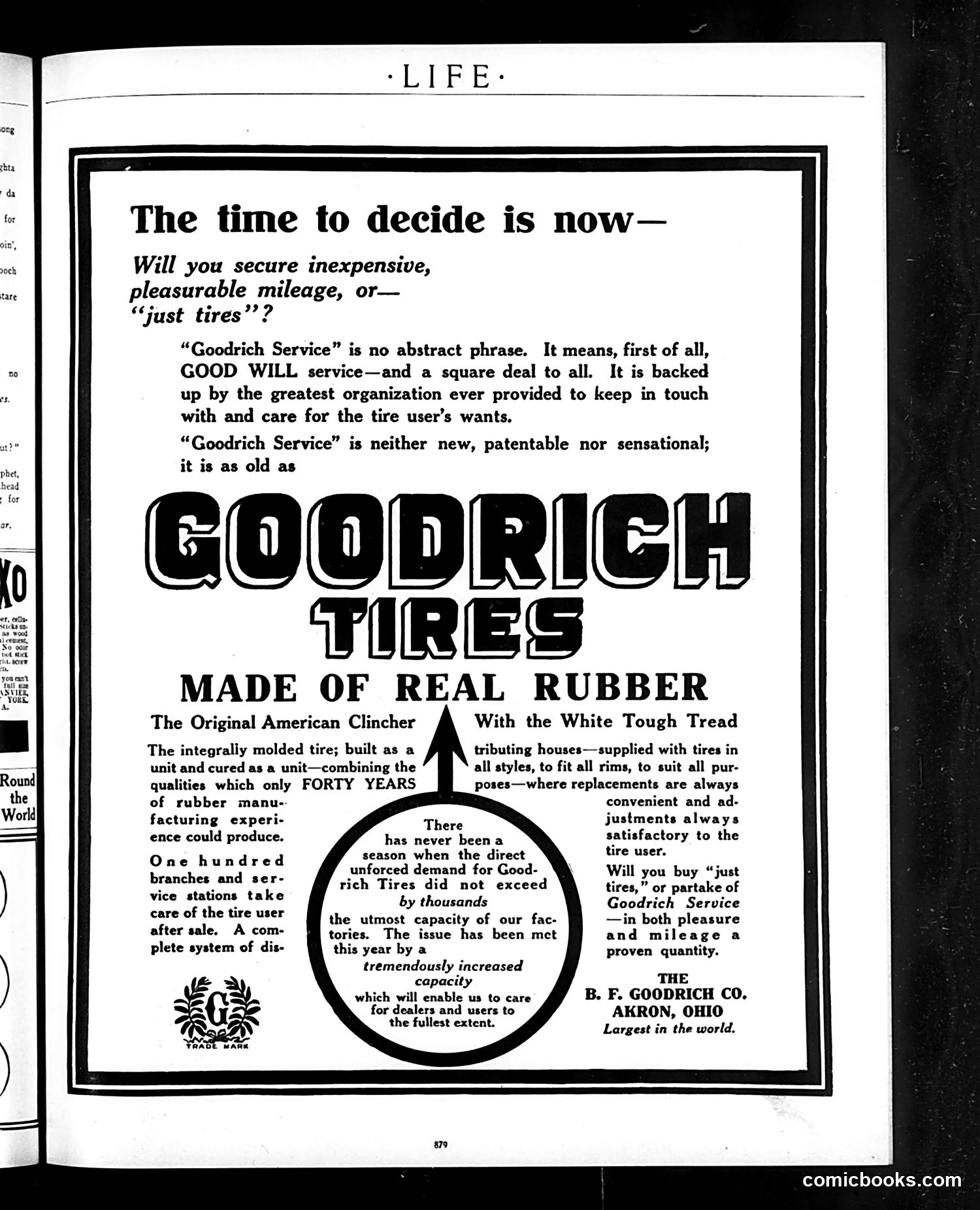
This is a **full-page advertisement**, not satire or political content. The B.F. Goodrich Company promotes its tire service and products in Life magazine. The ad addresses a consumer choice: buy generic "just tires" or invest in Goodrich's comprehensive service network. Key selling points include: - **40 years of manufacturing experience** backing product quality - **"Goodrich Service"**: a nationwide dealer/service station system providing post-sale support, repairs, and replacements - Availability in multiple styles and sizes across all outlets - A reassurance about meeting high demand ("tremendously increased capacity") The central circular emblem emphasizes the company's proven track record and organizational infrastructure. This appeals to buyers concerned about tire reliability and convenient maintenance—significant considerations when automobiles were newer and tire failures more common. The ad positions quality service as differentiating Goodrich from cheaper competitors, making this early automotive marketing focused on **customer loyalty through after-sale support** rather than price competition alone.
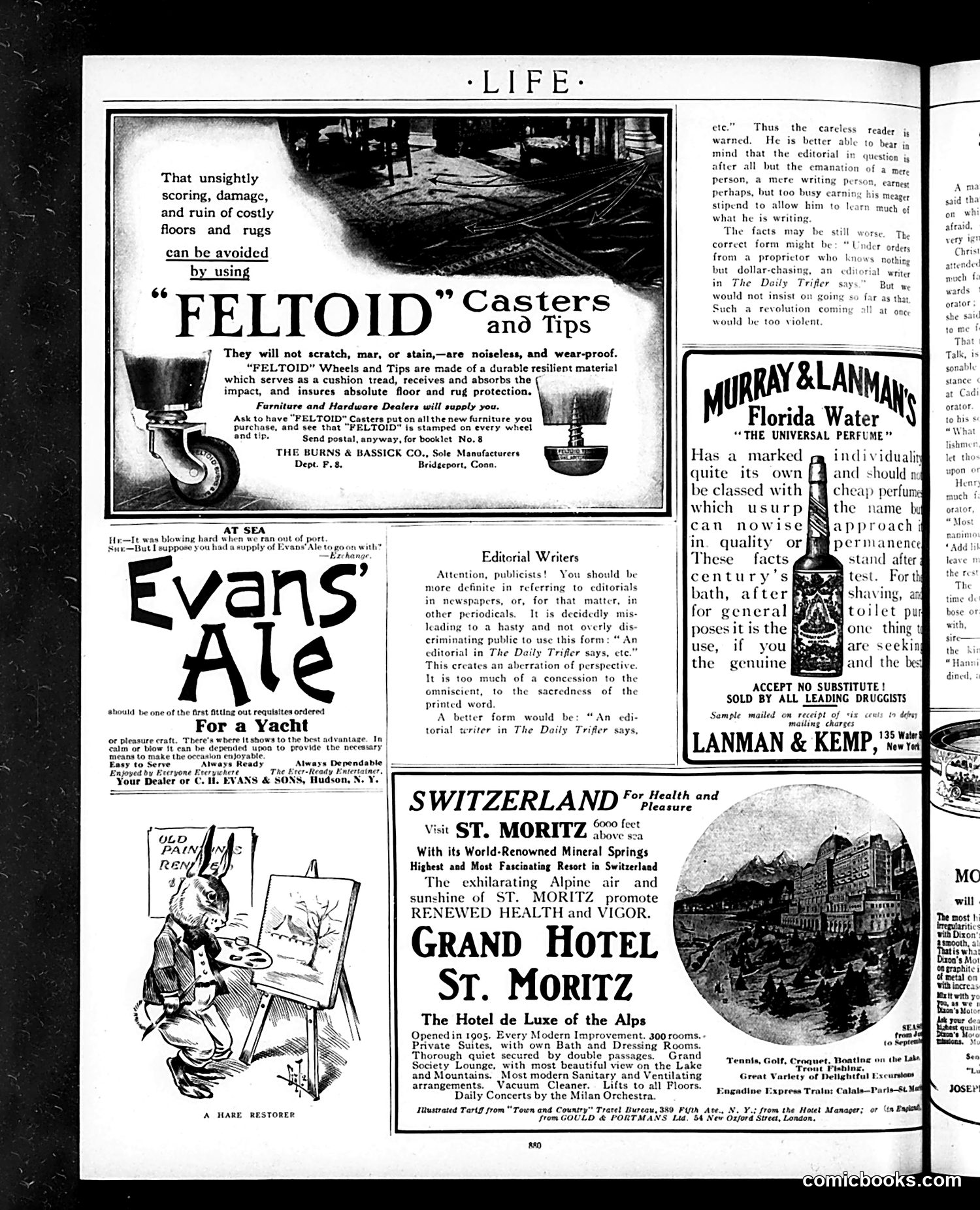
This page is primarily **advertising**, with one editorial section. The main satirical content addresses **editorial attribution practices** in newspapers. ## Editorial Section ("Editorial Writers") The piece criticizes journalists and editors who casually attribute statements to newspapers using vague phrasing like "An editorial in The Daily Trifler says, etc." The satire suggests this is intellectually lazy—it creates "an aberration of perspective" by implying newspapers speak with unified authority when editorials are actually individual writers' opinions. The author advocates for more precise attribution: "An editorial writer in The Daily Trifler says," distinguishing the person from the institution. This reflects early 20th-century concerns about **journalistic credibility and clarity**—warning readers not to confuse institutional positions with individual writer opinions. ## Advertisements The remainder features product ads (Feltoid casters, Evans ale, Murray & Lanman perfume, and Grand Hotel St. Moritz), typical of Life's commercial content.
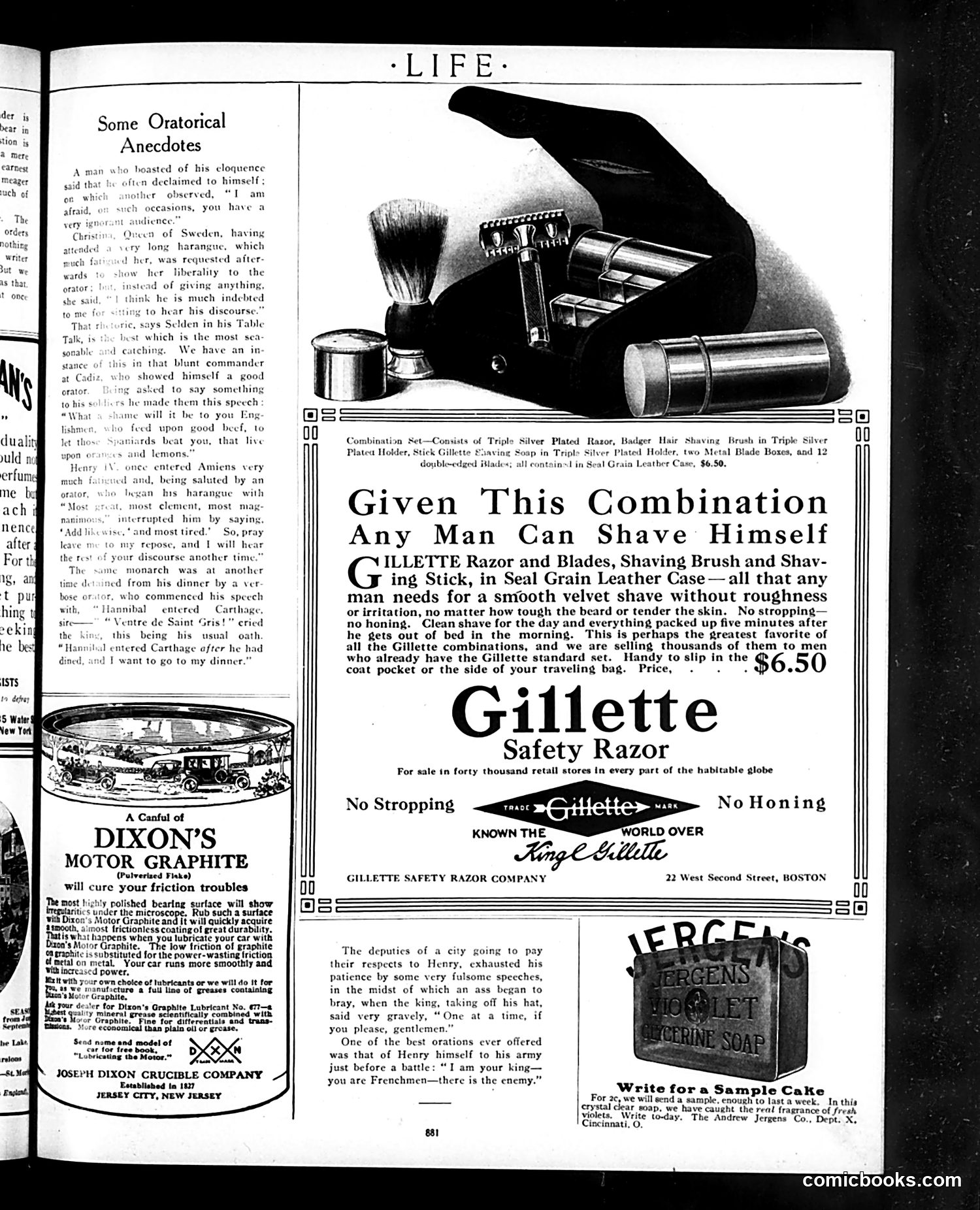
This page is primarily **advertising**, not political satire. It contains three product advertisements interspersed with a "Some Oratorical Anecdotes" section featuring historical anecdotes about famous speakers and rulers (Queen of Sweden, Henry, Hannibal). The anecdotes themselves are **not satirical cartoons** but rather humorous stories illustrating verbose oratory being interrupted or deflated—such as a king interrupting tedious deputies by removing his hat and saying "One at a time, if you please, gentlemen" when a donkey brays. The three main advertisements are: 1. **Dixon's Motor Graphite** lubricant 2. **Gillette Safety Razor** combination set ($6.50) 3. **Jergens Glycerine Soap** (bottom right) There are no political cartoons, caricatures, or satirical commentary visible on this page. It represents typical early 20th-century *Life* magazine content: light humor mixed with commercial advertising.
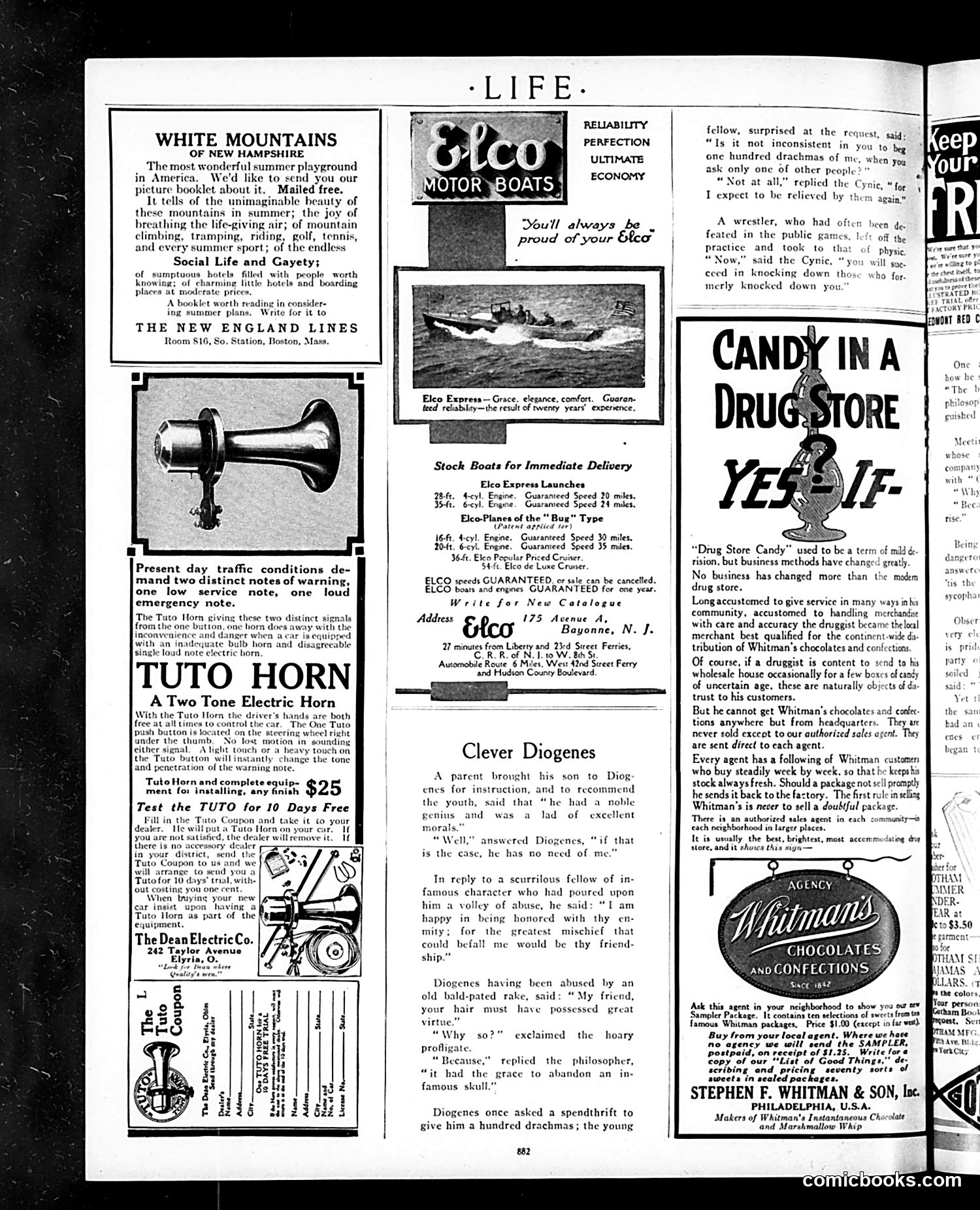
This page is primarily **advertisements and filler content** rather than political satire. It contains: **Advertisements:** - White Mountains tourism promotion - Tuto Horn (two-tone car horn, $25) - Elco motor boats and launches - Whitman's Chocolates **Editorial Content:** The "Clever Diogenes" section presents classical anecdotes about the ancient Greek philosopher Diogenes, known for his ascetic lifestyle and sharp wit. These stories illustrate his rejection of materialism and witty comebacks to critics. The final anecdote contrasts his skepticism of wealth with his willingness to ask for money—a paradox resolved by his philosophical indifference. **"Candy in a Drug Store"** briefly discusses how the term "drug store candy" evolved from mild mockery to legitimacy as distribution methods improved. This appears to be a typical early-20th-century *Life* page mixing advertising revenue with light educational/philosophical content rather than satirical commentary.
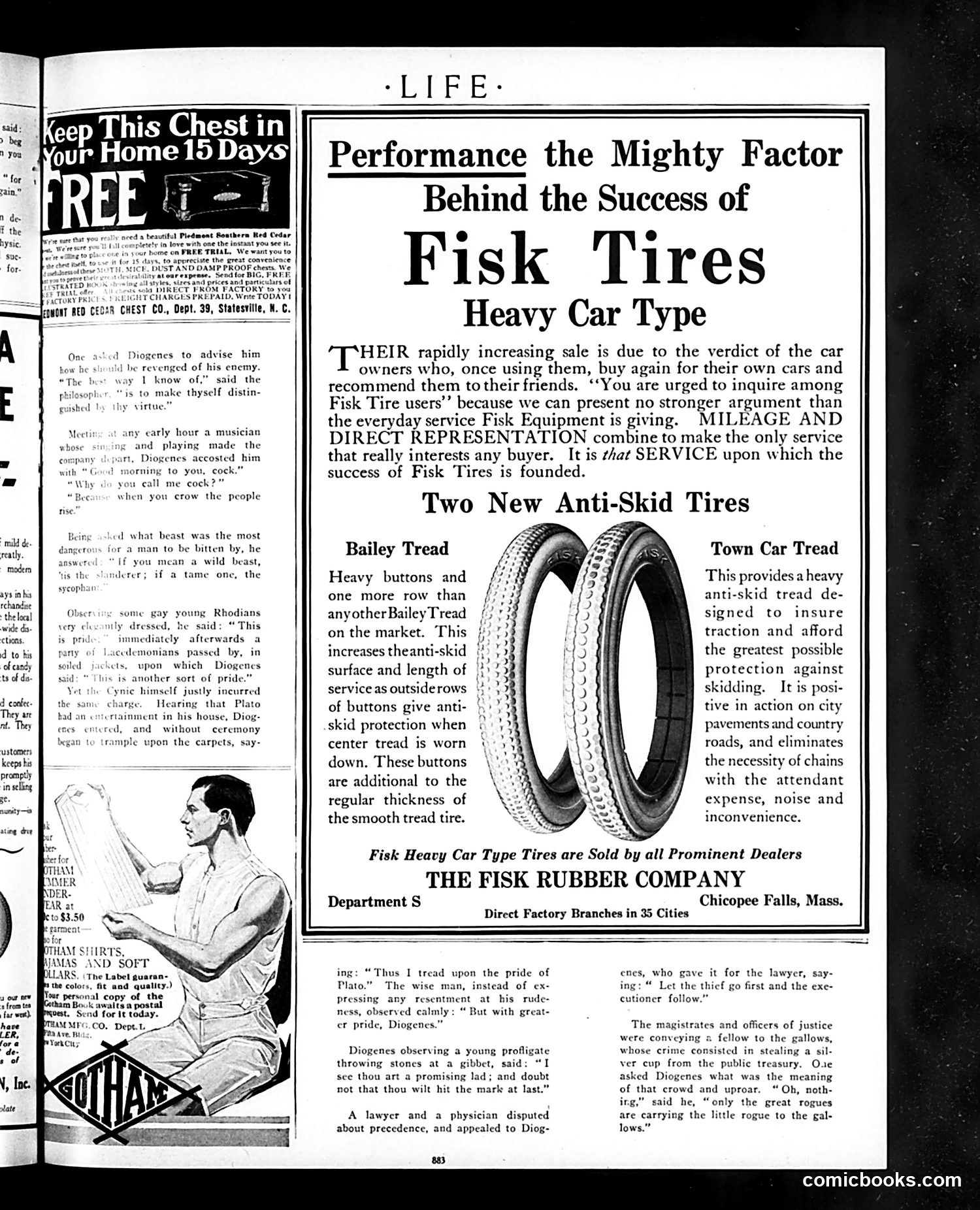
This page combines **advertising with philosophical anecdotes**. The main content is a **Fisk Tires advertisement** emphasizing service and performance for heavy automobiles, featuring two tire tread designs (Bailey and Town Car). On the left is unrelated **satirical content featuring Diogenes**, the ancient Greek Cynic philosopher. The anecdotes illustrate his famous practice of mocking social pretension through sharp retorts. Examples include: insulting a musician, trampling Plato's carpets to demonstrate pride, and declaring that thieves being executed to the gallows are merely "little rogues" carried by "great rogues" (corrupt officials). The **satire targets hypocrisy and social hierarchy**—Diogenes exposes how supposedly virtuous people (philosophers, lawyers, magistrates) are no better than common criminals. This classical reference would appeal to *Life* readers' education and sense of wit. The juxtaposition with tire advertising is typical magazine layout, with no connection between content.
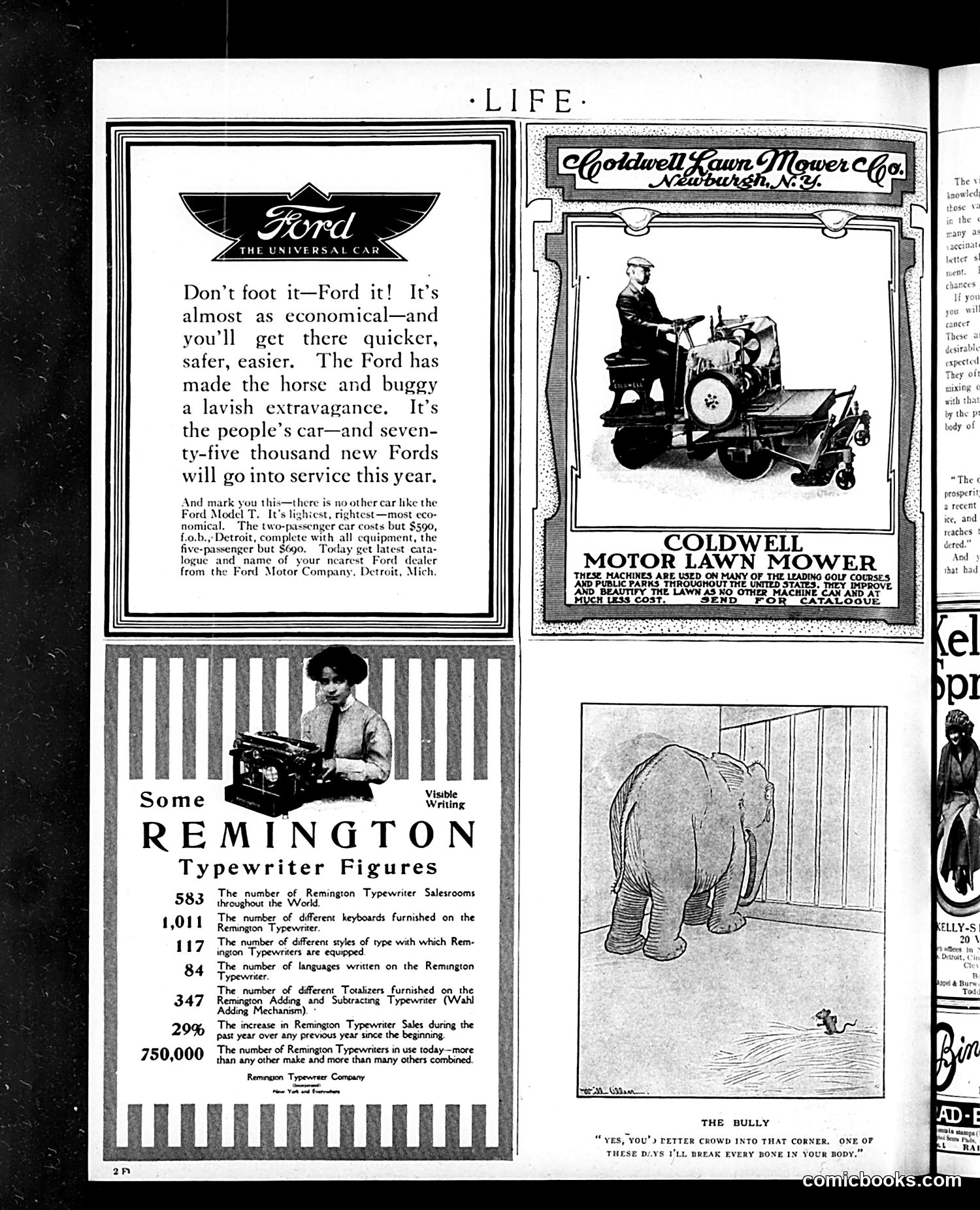
This page consists primarily of **advertisements** rather than editorial content or satire. It includes: 1. **Ford Model T ad**: Promotes the automobile as economical and superior to horse-drawn buggies ("the people's car"), emphasizing mass production (75,000 new Fords annually). 2. **Coldwell Motor Lawn Mower ad**: Markets a motorized lawn mower for public parks and estates. 3. **Remington Typewriter ad**: Uses statistics to demonstrate market dominance—583 salesrooms worldwide, 750,000 machines in use, emphasizing technological superiority through multiple keyboard styles and languages supported. 4. **"The Bully" cartoon**: A small sketch showing what appears to be a threatening confrontation, with text suggesting coercion ("I'll break every bone in your body"). The exact context is unclear without more page context. The page reflects early-20th-century consumer culture, showcasing industrial progress through automobiles, mechanized lawn care, and office technology marketed to middle-class readers.
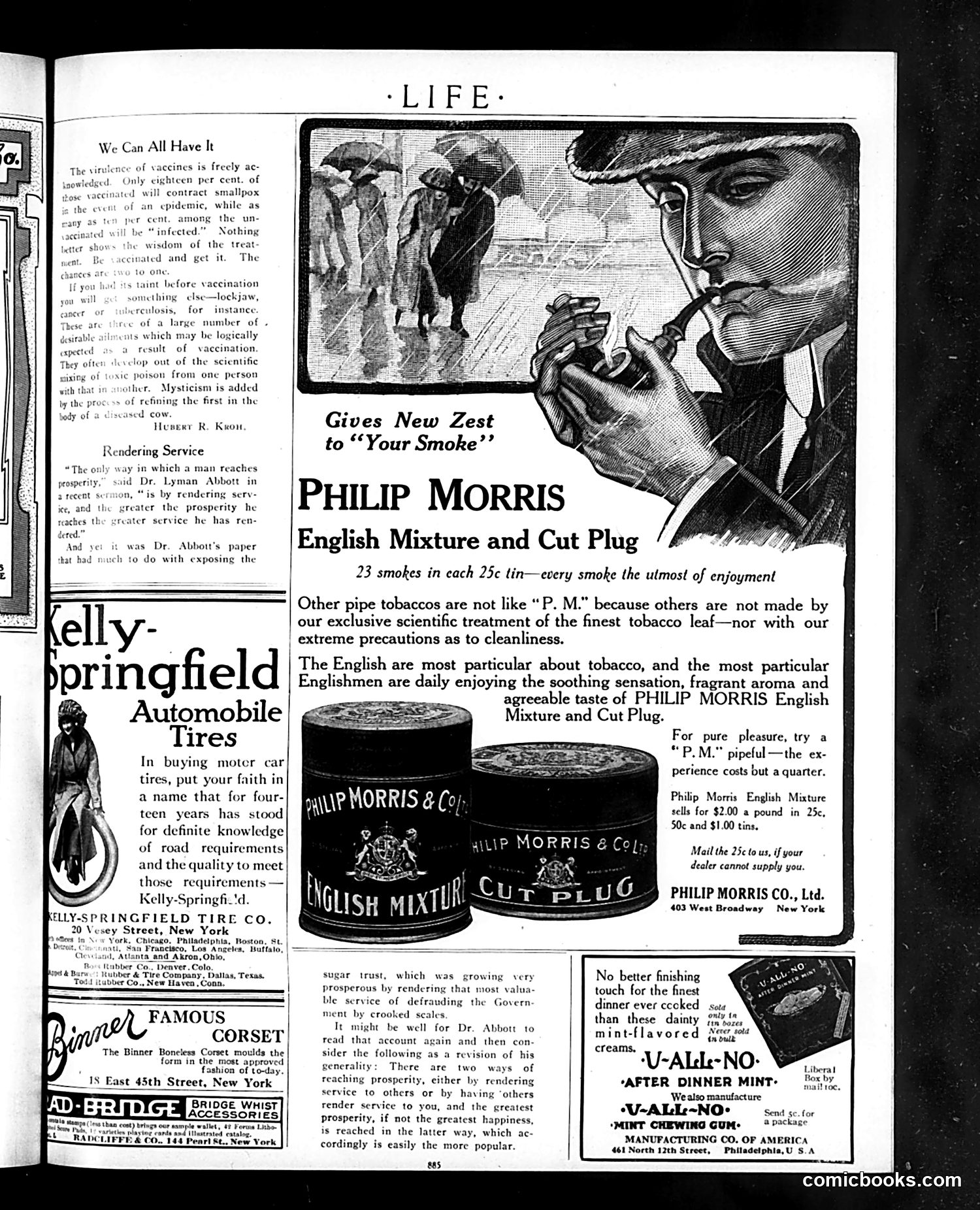
This page is primarily **advertising**, not satire or political cartoon. However, the left column contains two opinion pieces relevant to historical context: **"We Can All Have It"** addresses **vaccine skepticism**—a real debate of the era. The anonymous author argues vaccines are effective (82% protection rate cited) but acknowledges contemporary concerns about side effects like lockjaw or tuberculosis. This reflects genuine early-20th-century medical hesitation about vaccination safety, before modern regulatory standards. **"Rendering Service"** references **Dr. Lyman Abbott's** philosophy that prosperity comes through service. The piece sarcastically counters with a historical example of a "sugar trust" defrauding the government—likely alluding to real monopolistic practices of the Gilded Age/Progressive Era, suggesting prosperity can also derive from exploiting others. The rest is standard period advertising for automobiles, corsets, tobacco, and candy—no political content visible.
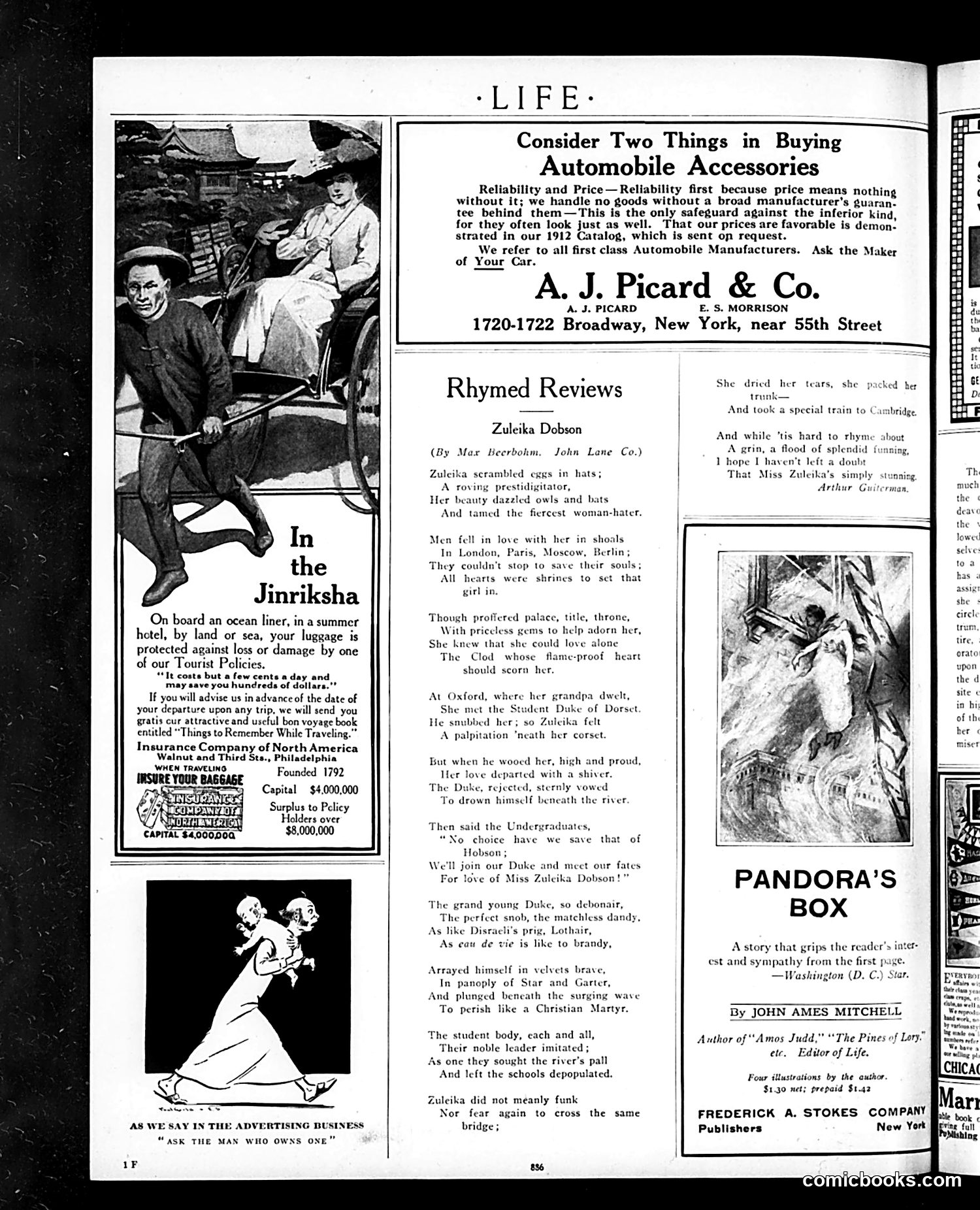
This page mixes advertising and literary reviews. The key visual content is the upper-left cartoon showing what appears to be a **jinriksha** (a hand-pulled Asian cart), illustrating a travel insurance advertisement. The cartoon humorously suggests that luggage aboard ocean liners needs protection—the image likely exaggerates the precarious conditions of travel to justify buying insurance. The **"Rhymed Reviews"** section satirizes Max Beerbohm's *Zuleika Dobson*, a novel about an irresistible woman whose love rejection causes a college student and then entire student body to commit suicide. The verse summary maintains tongue-in-cheek tone while recounting this absurdly dramatic plot, ending with Zuleika pragmatically catching a train to Cambridge—undercut the story's melodrama with comedic practicality. The page represents Life's dual purpose: selling advertising while offering literary mockery and social commentary to educated readers.
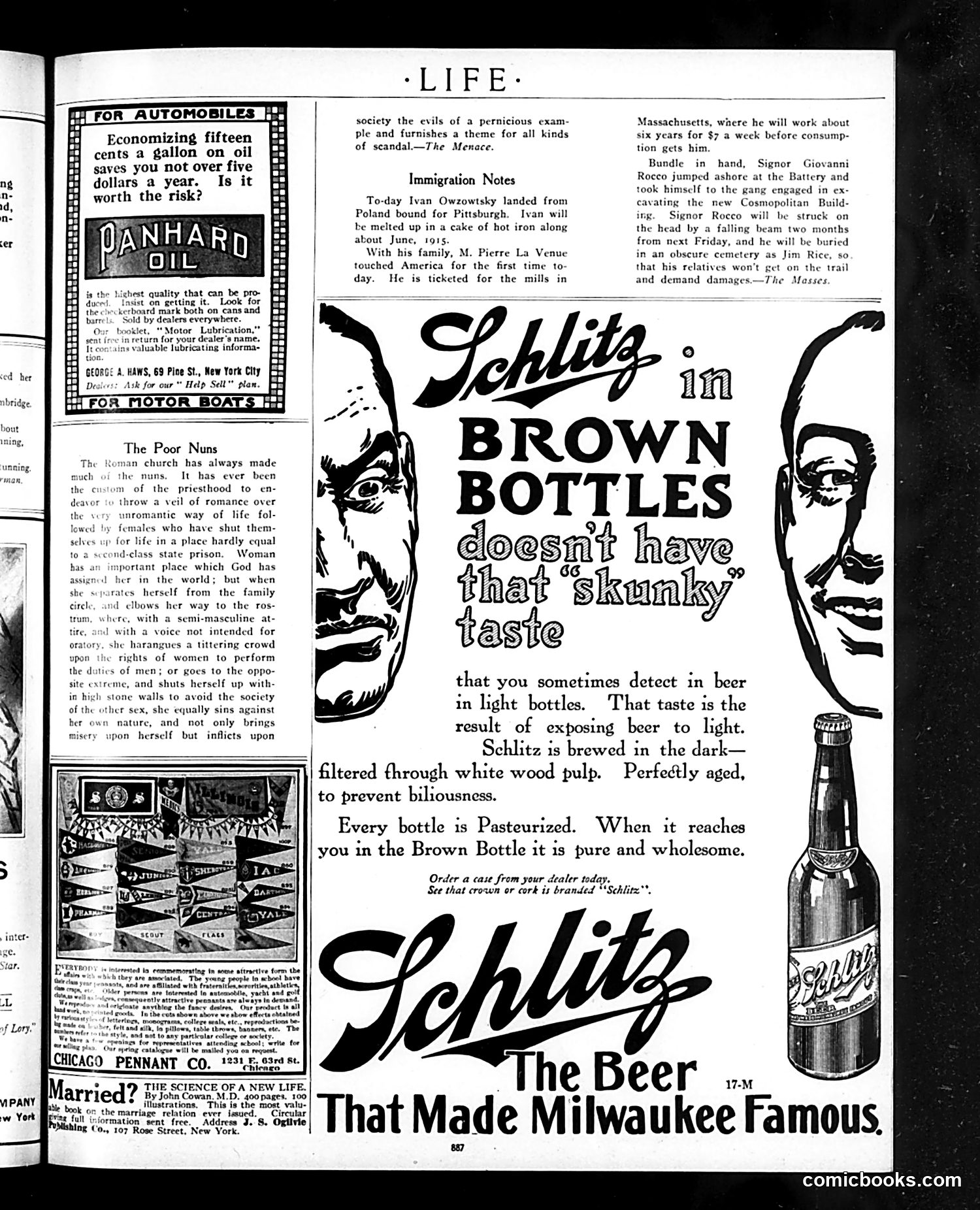
This page combines satirical editorial content with period advertising. **"The Poor Nuns"** column attacks Catholic convents as unnatural imprisonment of women. The author argues nuns abandon their proper role in society and family life, creating a "pernicious example" that corrupts public morality. This reflects early 20th-century anti-Catholic sentiment common in Protestant American publications. **"Immigration Notes"** presents dark satire about European immigrant laborers. The brief entries catalog newly-arrived immigrants (Polish, French) with grim "predictions" of their fates—industrial accidents, disease, early death from grueling factory work. This satirizes both the exploitation of immigrants and the indifference of American society toward their suffering. **The Schlitz advertisement** promotes brown bottles to prevent light exposure that allegedly causes unpleasant taste in beer. Together, the content reflects Life magazine's role as a vehicle for social commentary alongside commercial messaging—mixing satirical criticism of institutions (Church, industrial capitalism) with advertisements for consumer goods.
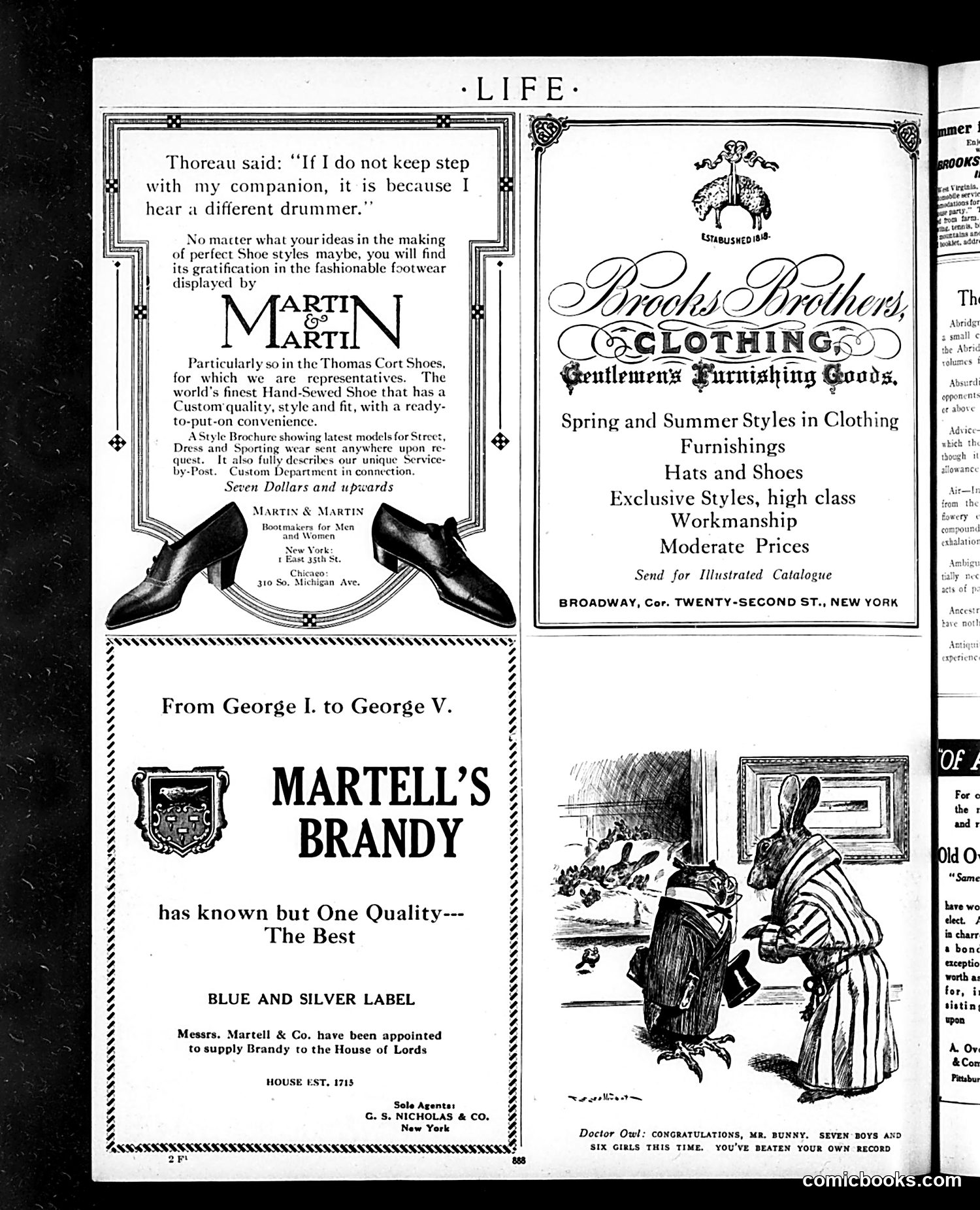
This page is primarily **advertisements** with one small cartoon at the bottom. **The Cartoon:** "Doctor Owl" congratulates "Mr. Bunny" on producing thirteen offspring, noting he's "beaten your own record." This is a **fertility joke** playing on the common saying that rabbits reproduce prolifically. The humor is gentle and visual rather than pointed satire—it's a pun on rabbits' well-known reproductive capacity, presented as if they were human patients visiting a doctor. **The Ads:** The page features luxury goods (Martin & Martin shoes, Brooks Brothers clothing, Martell's Brandy) targeting affluent readers. The Thoreau quote about "marching to a different drummer" is used ironically to suggest that choosing fashionable shoes is actually *individualistic*—a common advertising strategy of the era claiming conformity equals personal expression. The Martell's ad notably references supply to the "House of Lords," emphasizing aristocratic prestige and centuries-old tradition (est. 1715).
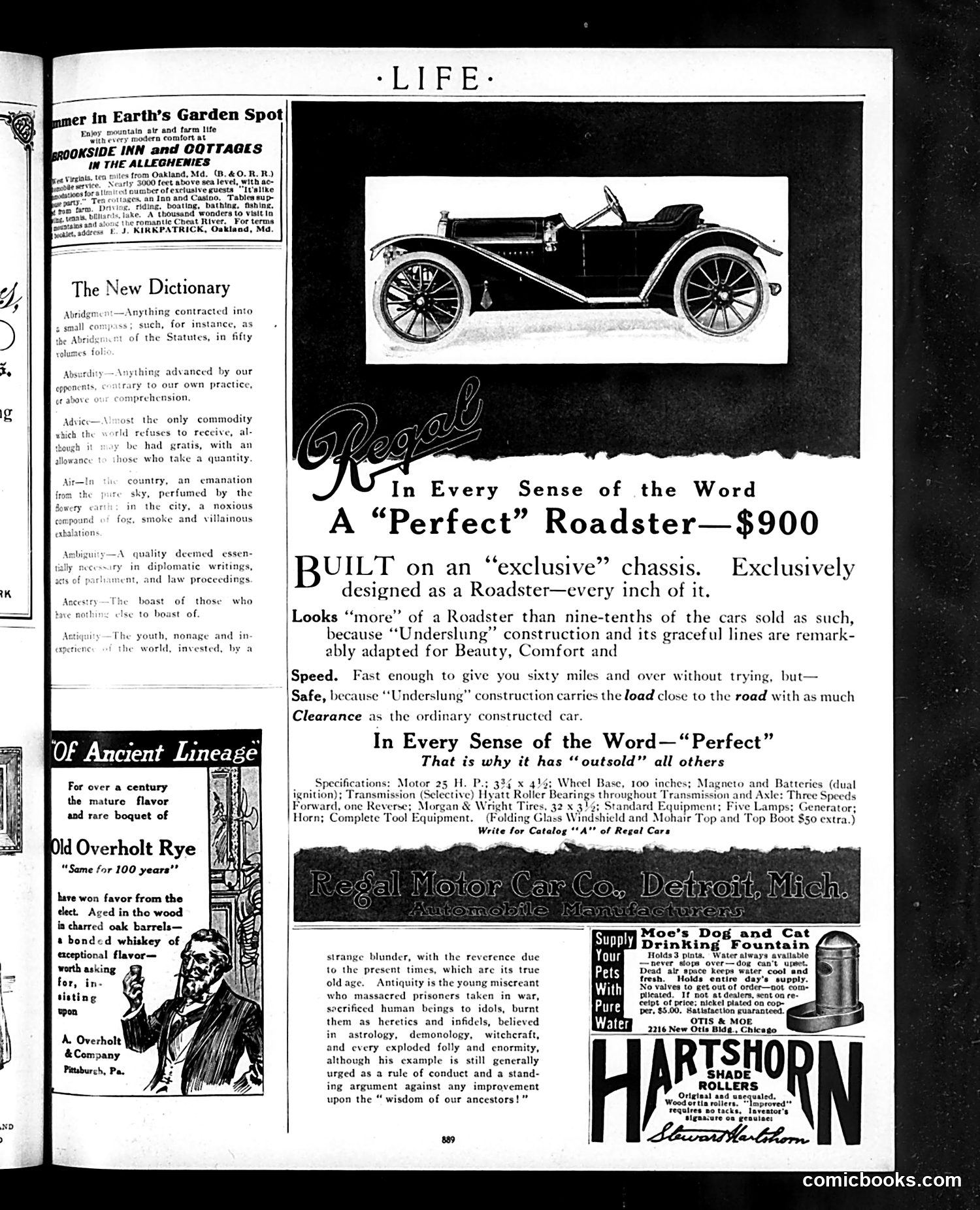
This page is primarily **advertising-driven**, not satirical content. The main feature is a Regal Motor Car advertisement promoting a $900 roadster as "perfect" in every sense—emphasizing its exclusive chassis design, speed (60+ mph), safety features, and underslung construction that keeps the load close to the road. The left column contains **"The New Dictionary,"** a satirical glossary defining words like "Abridgment," "Absurdity," and "Advice" with tongue-in-cheek commentary on human nature and society—typical of Life's literary humor. Other advertisements include Old Overholt Rye whiskey ("aged 100 years") and Hartshorn Shade Rollers. At the bottom, there's a brief essay on "Antiquity" **mocking reverence for the past**, suggesting modern society foolishly imitates ancestors who practiced human sacrifice, witchcraft, and superstition—a common early-20th-century progressive critique of blind traditionalism. The page reflects 1910s-era consumer culture and intellectual satire rather than political cartooning.
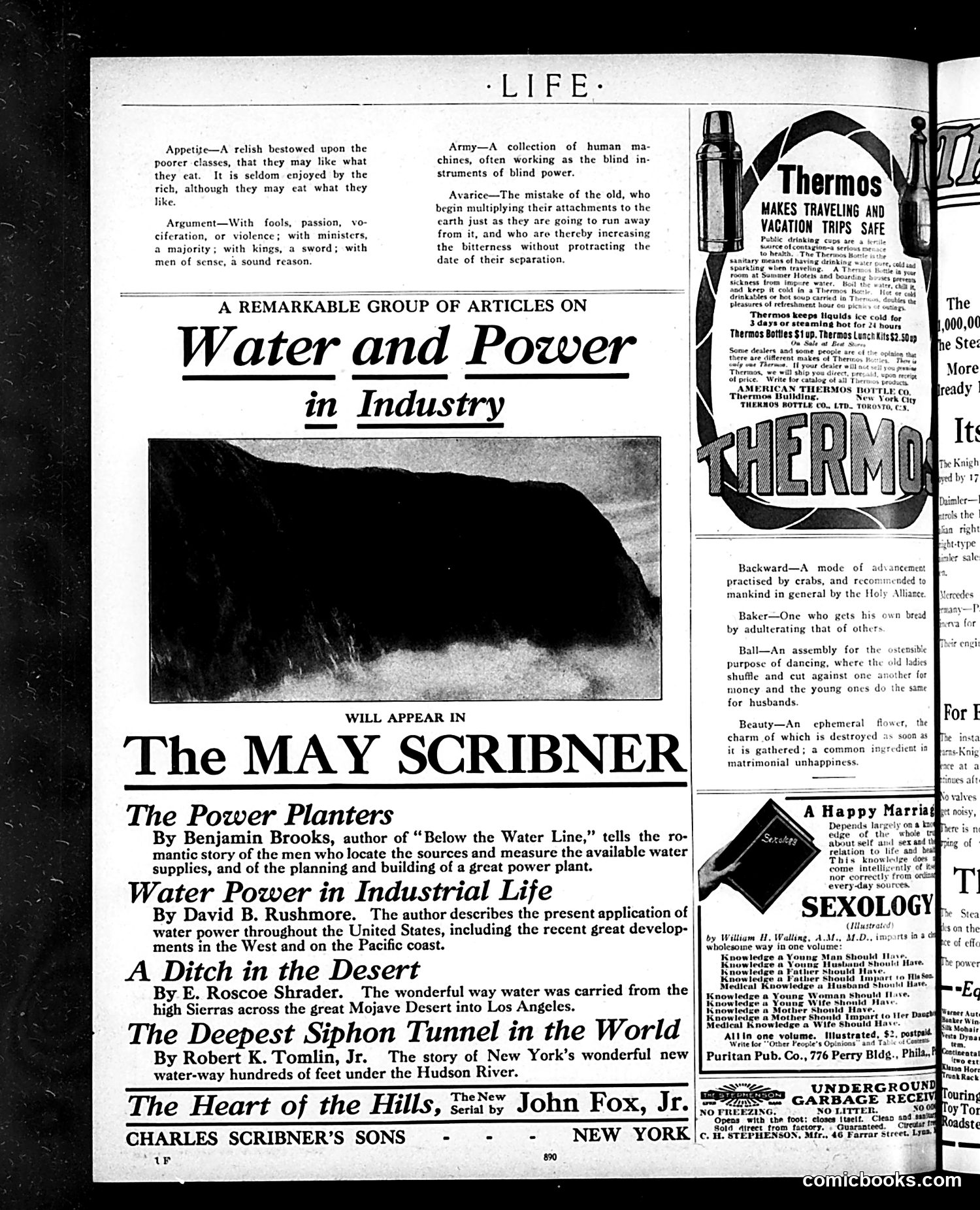
This page is primarily **promotional content for The May Scribner magazine**, not political satire. The dominant feature announces five upcoming articles about water and power in industry—topics of genuine contemporary interest during America's early industrial expansion. The only satirical content appears at page top: brief **dictionary-style definitions** mocking social classes and institutions. These include cynical observations like "Appetite" being a luxury of the poor, "Army" as blind machines serving blind power, and "Avarice" as an old person's folly. This reflects Life's characteristic turn-of-century satirical voice critiquing wealth inequality and militarism. The page is otherwise filled with **advertisements** (Thermos bottles, a "Sexology" book, garbage receivers) typical of the era's magazine format. The water-power articles reflect genuine Progressive Era interest in industrial development and natural resource management, particularly relevant given mentions of Pacific Coast and Los Angeles water projects—actual historical infrastructure developments of that period.
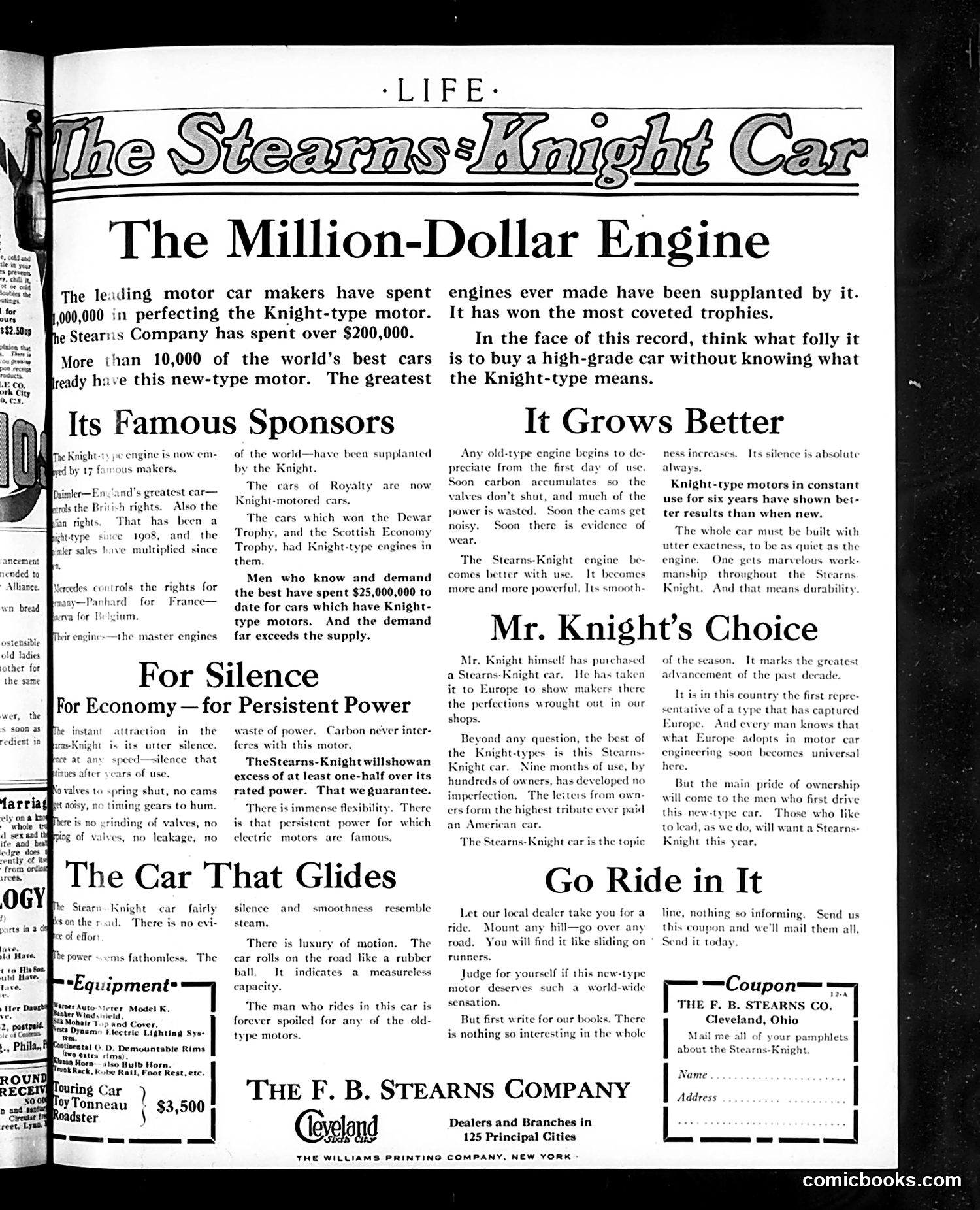
This is primarily a **automobile advertisement**, not satire or political commentary. The F.B. Stearns Company promotes their Knight-type motor engine to modern readers of *Life* magazine. The page emphasizes the engine's technical superiority: it's silent, fuel-efficient, and grows more powerful with use (unlike competitor engines that deteriorate). The company claims royalty and trophy-winning vehicles use it, and that wealthy buyers have spent $25 million on Knight-type cars. The "Famous Sponsors" section lists prestigious endorsements from European royalty and racing champions. "Mr. Knight's Choice" notes that the inventor himself owns a Stearns-Knight, lending credibility. The tone is aspirational marketing aimed at affluent readers seeking luxury and reliability. A coupon invites readers to request pamphlets. This reflects early 1900s automotive advertising when new engine technology was genuinely novel and competitive selling points.
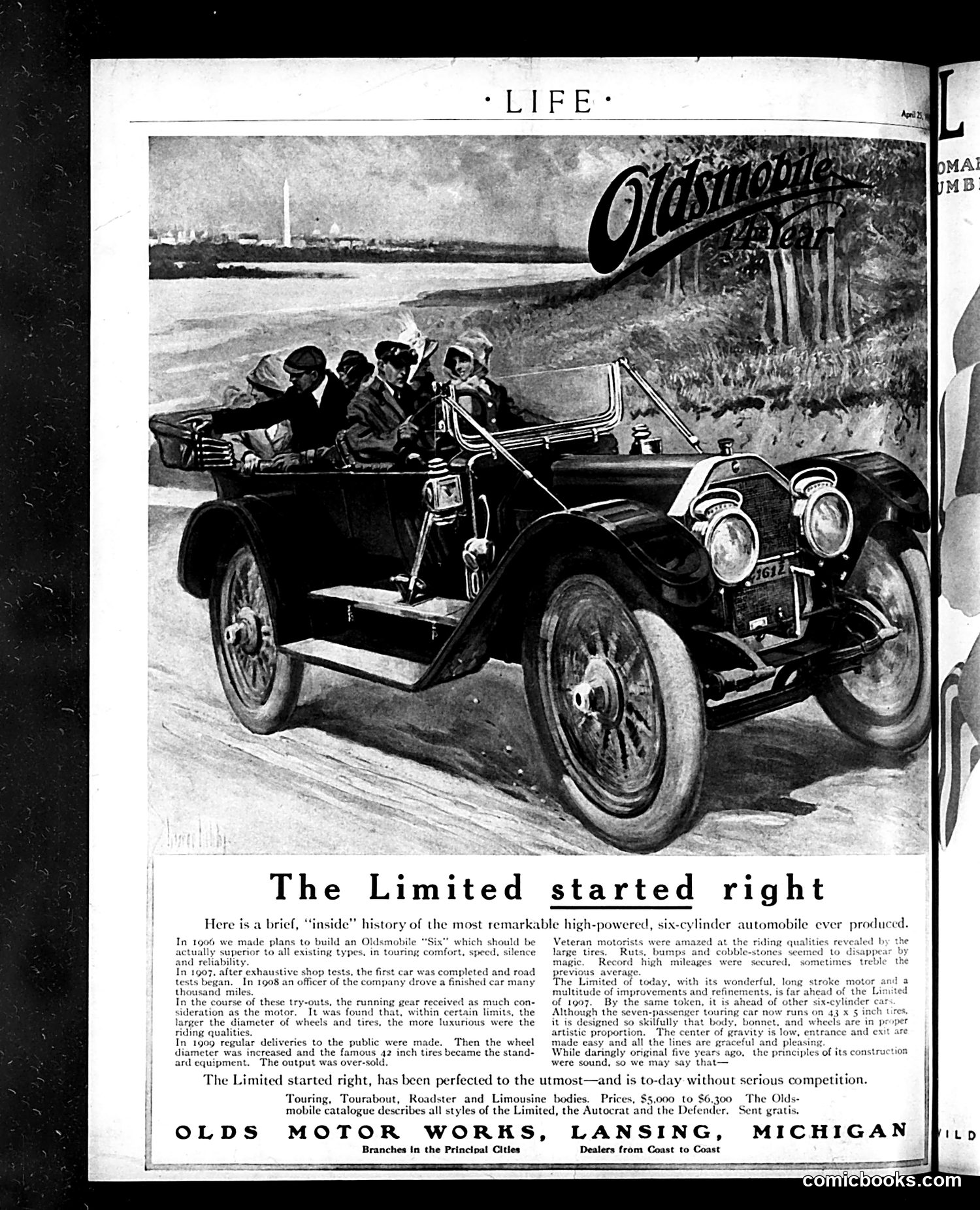
This is **not a cartoon or satire**—it's a straightforward automobile advertisement from *Life* magazine's advertising section. The page promotes the Oldsmobile "Limited," a high-end six-cylinder car. The image shows five well-dressed passengers in an open-air touring car driving along a scenic riverside road, with the Washington Monument visible in the distance. The text provides the car's development history: Oldsmobile designed it in 1906 to compete with luxury imports, completed prototypes by 1908, and began regular production in 1909. It highlights technical achievements like its large 42-inch tires and notes the car was "over-sold" (demand exceeded supply). The ad emphasizes luxury and performance: prices ranged from $5,000 to $6,300 (equivalent to roughly $160,000–$200,000 today). The copy stresses that the Limited had been "perfected to the utmost" and faced "no serious competition," a common advertising claim of the era. This reflects the early automotive market when cars were luxury goods for the wealthy.