
Life, 1912-04-25 · page 18 of 44
Life — April 25, 1912 — page 18: what you’re looking at
What you’re looking at
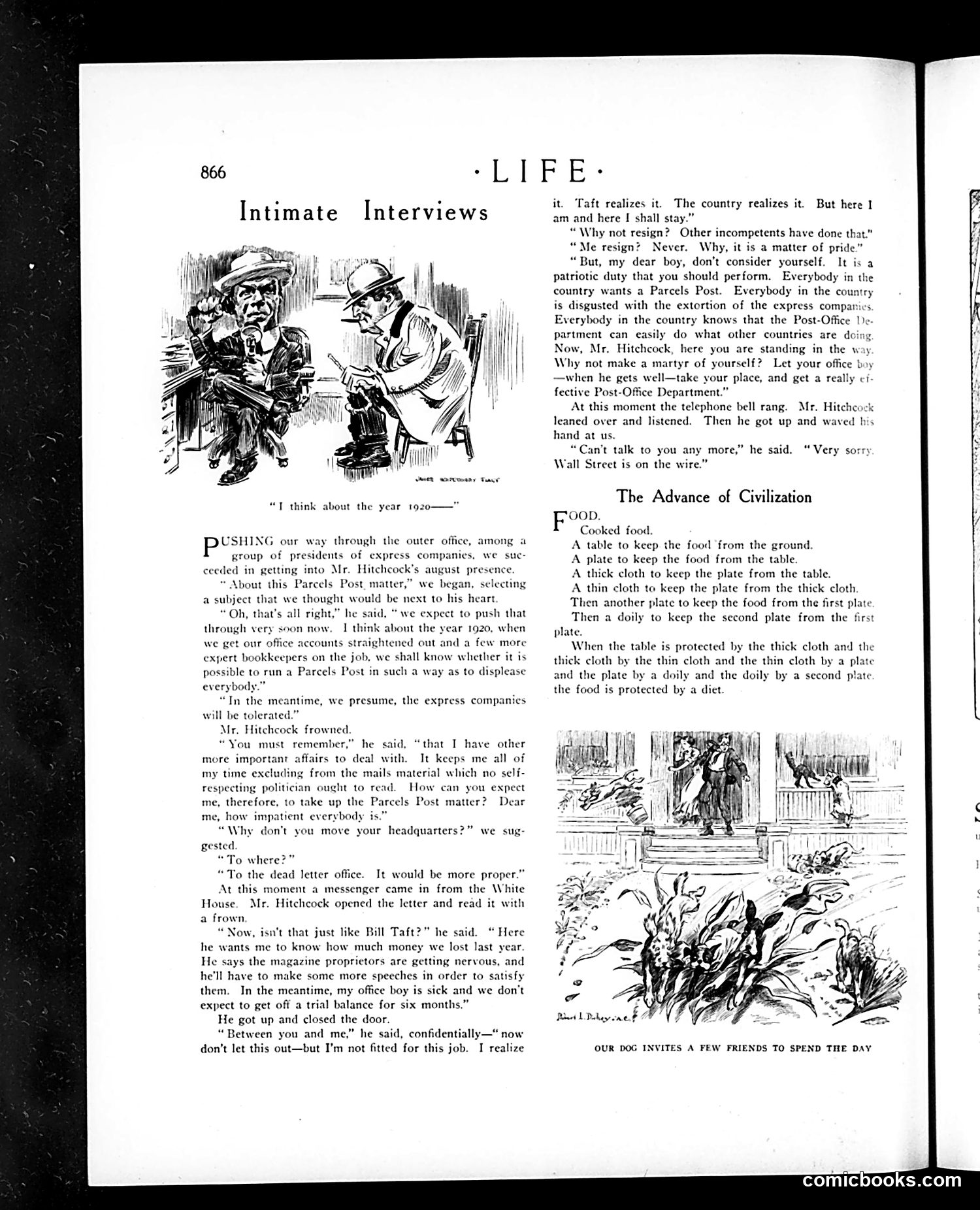
## The Hitchcock Interview The main cartoon satirizes **Frank H. Hitchcock**, Postmaster General under President William Howard Taft. The dialogue mocks Hitchcock's bureaucratic incompetence regarding the proposed Parcels Post (a mail service for parcels). The satire's points: - Hitchcock admits he's "not fitted for this job" but refuses to resign on principle - He's overwhelmed by trivial duties (censoring mail) while ignoring major policy demands - He deflects responsibility to Taft and complains about workload - The "Wall Street is on the wire" gag suggests corporate pressure supersedes public service The interviewer argues Hitchcock should resign as a patriotic duty since everyone—country, public, Congress—wants the Parcels Post and despises express company monopolies. ## "The Advance of Civilization" This brief satirical piece mocks pretentious dining etiquette. It traces how civilization "progresses" by adding increasingly unnecessary layers (cloth, plates, doilies) to protect food from table to plate—only to conclude the food ends up protected by "a diet" (implying people can't actually eat it).
📄 Transcribed text from this page (OCR, searchable)
Machine-transcribed from the original scan — historical spelling and the odd misread are preserved.
866 Interviews Intimate wee woreomeay Face “T think about the year 1920—" USHING our way through the outer office, among group of presidents of express companies, we suc- ceeded in getting into Mr. Hitchcock's august presence bout this Parcels Post, matter, we thought would be next to his heart "5 all right,” he said, “we expect to push that about the year 1920, when we began, selecting a subject th “Oh, tha through very soon now. 1 thi we get our office accounts straightened out and a few more ert bookkeepers on the job, we shall know whether it is possible to run a Parcels Post in such a way as to displease everybody.” “In the meantime, we presume, the express companies will be tolerated. Mr. Hitchcock frowned “You must remember,” he said, “that I have other more important al with, It keeps me all of my time excluding from the mails material which no seli- respecting politician ought to read. How can you expect me, therefore, to take up the Parcels Post matter?) Dear me, how impatient everybody is.” n't you move your headquarters?” we sug- At this moment a messenger came in from the White House. Mr. Hitchcock opened the letter and read it with a frown. Now, isn't that just like Bill Taft?” he said. “ Here he wants me to know how much money we lost last y He says the magazine proprietors are getting nervous, and he'll have to make some more speeches in order to satisfy them, In the meantime, my office boy is sick and we don’t expect to get off a trial balance for six months.” He got up and closed the door. “Between you and me,” he said, confidentially—" now don’t let this out—but I’m not fitted for this job. I realize 2 LIP Es it. Taft realizes it. The country realizes it. But here 1 am and here [ shall stay.” “Why not resign? Other incompetents have done that.” “Me resign? Never. Why, it is a matter of pride” “But, my dear boy, don’t consider yourself. It is a patriotic duty that you should perform. Everybody in the country wants a Parcels Post. Everybody in the country is disgusted with the extortion of the express companies. Everybody in the country knows that the Post-Office De. partment can easily do what other countries are doing Now, Mr. Hitchcock, here you are standing in the way Why not make a martyr of yourself? Let your office b —when he gets well—take your place, and get a really ci- fective Post-Office Department.” At this moment the telephone bell rang. Mr. Hitchcock leaned over and listened. Then he got up and waved his hand at us. “Can't talk to you any more,” he said. Wall Street is on the wir The Advance of Civilization “Very sor OOD. Cooked food, A table to keep the food ‘from the ground, A plate to keep the food from the table. A thick cloth to keep the plate from the table. A thin cloth to keep the plate from the thick cloth Then another plate to keep the food from the first plate. Then a doily to keep the second plate from the first plate. When the table is protected by the thick cloth and the thick cloth by the thin cloth and the thin cloth by a plate and the plate by a doily and the doily by a second plate the food is protected by a diet, OUR DOG INVITES A FEW FRIENDS TO SPEND THE DAY comicbooks.com