
Life, 1912-04-25 · page 9 of 44
Life — April 25, 1912 — page 9: what you’re looking at
What you’re looking at
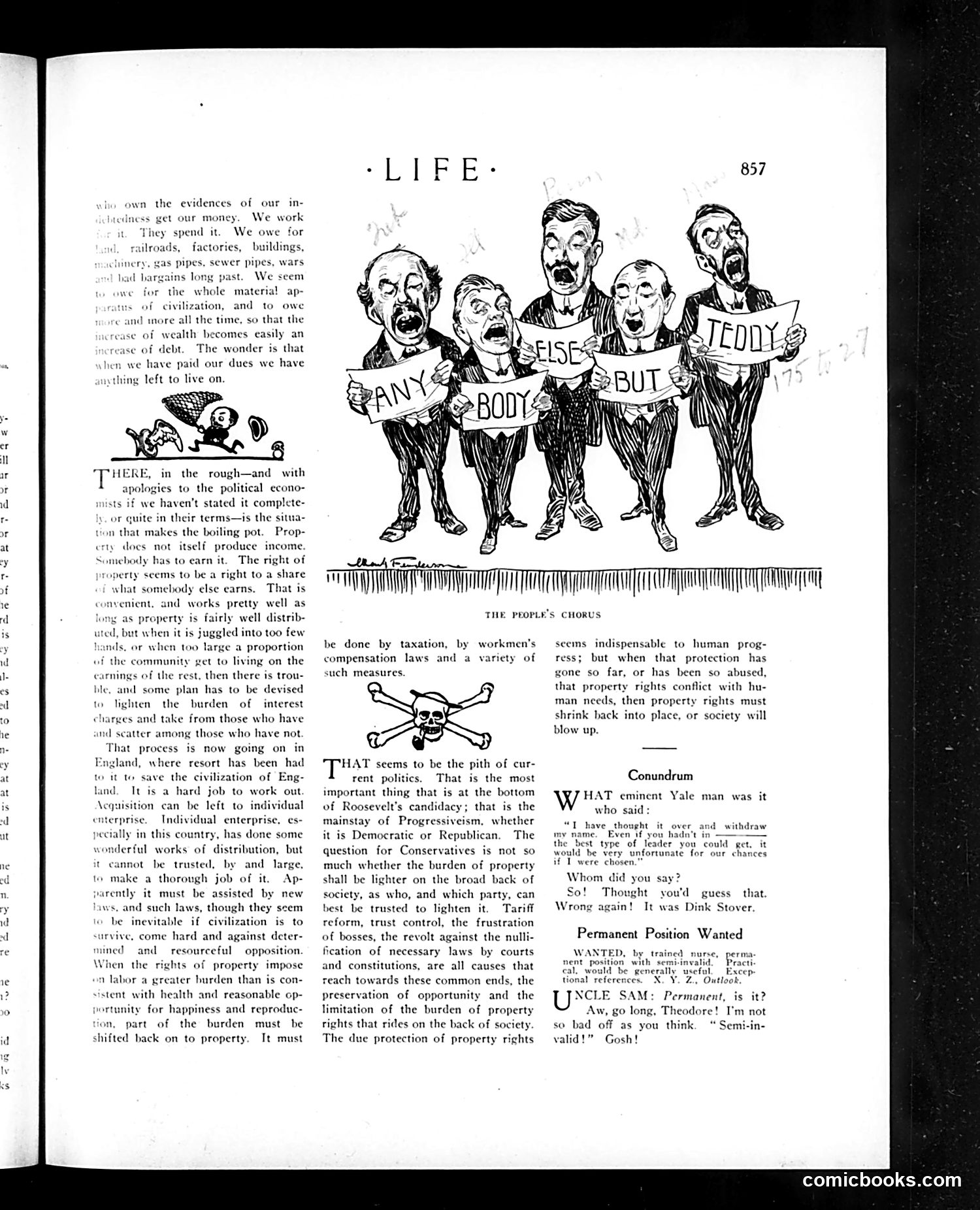
This cartoon satirizes political debates over property rights and wealth distribution, likely from the Progressive Era. Five caricatured men hold banners reading "PANY," "FISE," "BUT," "BODY," and "TEDDY"—apparently spelling out a fragmented political message, possibly referencing Theodore Roosevelt's Progressive policies. The accompanying text discusses property rights distribution and taxation, debating whether wealth concentration creates social problems. The skull-and-crossbones imagery suggests the cartoonist views certain economic positions as dangerous. The article criticizes both Progressive and Conservative approaches to regulating property, arguing that excessive burden on wealthy individuals conflicts with broader social stability. The satire mocks the competing political factions as incoherent "choruses" rather than offering substantive solutions.
📄 Transcribed text from this page (OCR, searchable)
Machine-transcribed from the original scan — historical spelling and the odd misread are preserved.
own the evidences of our in- ciiness get our money. We work We owe for buildings, They spend it railroads, factories, is pipes, sewer pipes, wars ins Tong past. We seem + the whole material ap- tus of civilization, and to owe «© and more all the time, so that the case of wealth becomes easily se of debt. The wonder is that ave paid our dues we have vthing left to live on. in the rough—and with apologies to the political econo- sts if we haven't stated it complete- or quite in their terms—is the sitta- mn that makes the boiling pot. Prop- erty docs not itself produce income. y has to carn it. The right of roperty seems to be a right to a share what somebody else earns. That is convenient, and works pretty well as as property is fairly well distrib- uted, but when it is juggled into too few hands, or when too large a proportion of the community get to living on the carnings of the rest, then there is trou- ble, and some plan has to be devised to lighten’ the burden of interest charges and take from those who have and scatter among those who have not That process is now going on in and, where resort has been had to it to save the civilization of Eng- land. It is a hard job to work out. \cquisition can be left to individual enterprise. Individual enterprise, es- pecially in this country, has done some wonderful works of distribution, but not be trusted, by and large, ts make a thorough job of it. Ap- parently it must be assisted by new laws. and such laws, though they seem be inevitable if civilization is to survive, come hard and against dete mined and resourceful opposition. When the rights of property impose on labor a greater burden than is con- sistent with health and reasonable op- wrtunity for happiness and reproduc- n, part of the burden must be shifted back on to property. It must THE PEOPLE'S CHORUS be done by taxation, by workmen's compensation laws and a variety of such measures. HAT seems to be the pith of cur- rent politics. That is the most important thing that is at the bottom of Roosevelt's candidacy; that is the mainstay of Progressiveism, whether it is Democratic or Republican, The question for Conservatives is not so much whether the burden of property shall be lighter on the broad back of society, as who, and which party, can best be trusted to lighten it. Tariff reform, trust control, the frustration of bosses, the revolt against the nulli- fication of necessary laws by courts and constitutions, are all causes that reach towards these common ends, the preservation of opportuni and the limitation of the burden of property rights that rides on the back of society. The due protection of property rights seems indispensable to human prog- ress; but when that protection has gone so far, or has been so abused, that property rights conflict with hu- man needs, then property rights must shrink back into place, or society will blow up. Conundrum HAT eminent Yale man was it who said: “T have thought it ove my name. Even if you hadn't # the dest type of leader you would be very unfortunate for ¢ £1 were chosen.” Whom did you say? S Thought you'd gu that. ain! It was Dink Stover. Permanent Position Wanted WANTED, nent position with semi-invalid, cal. would be generally useful. Excep- tional references. X.Y. Z., Outlook CLE SAM: Permanent, is it? Aw, go long, Theodore! I'm not so bad off as you think. “ Semi-in- valid!” Gosh! comicbooks.com