
Life, 1912-04-25 · page 8 of 44
Life — April 25, 1912 — page 8: what you’re looking at
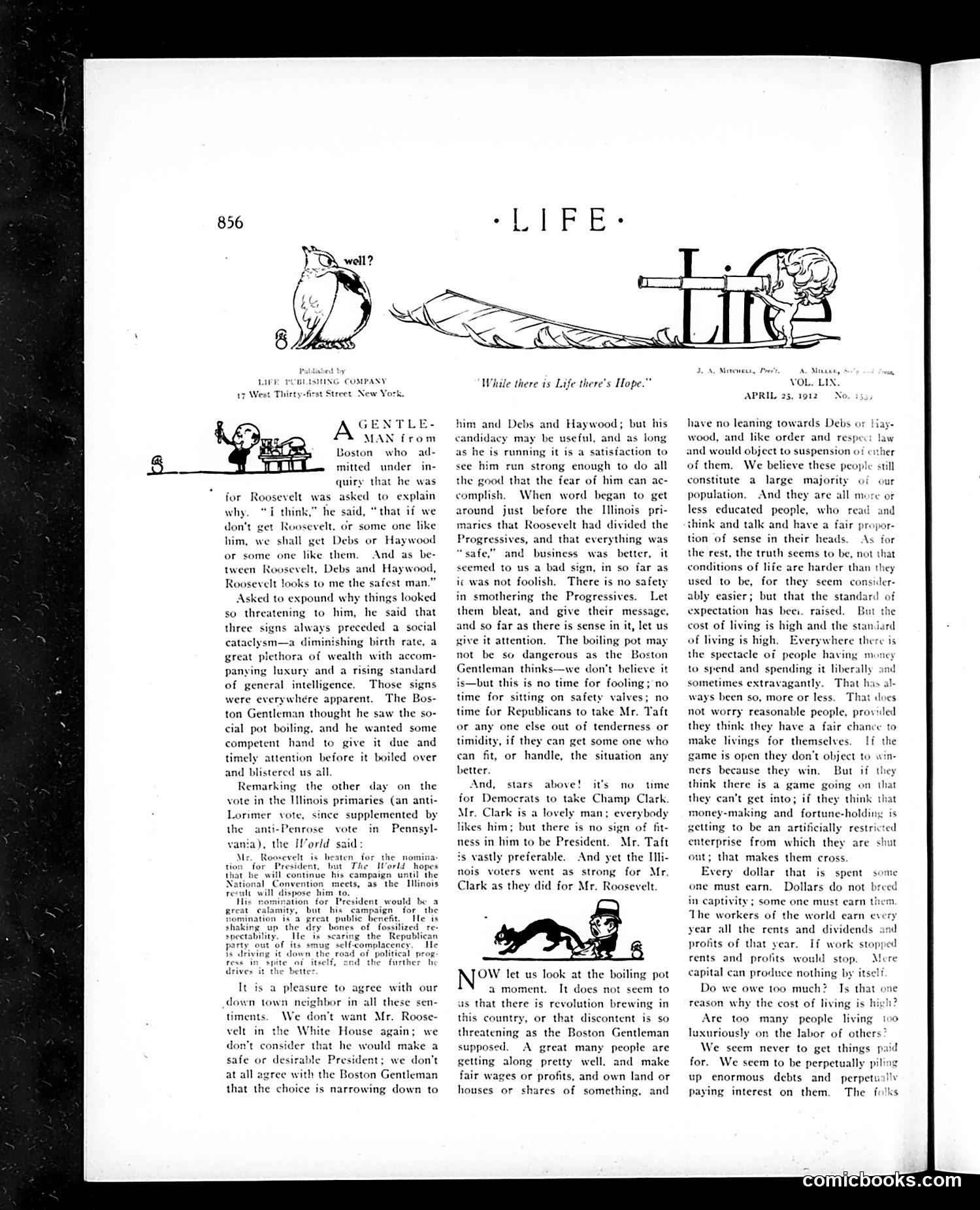
What you’re looking at
This page discusses the 1912 U.S. presidential election, specifically the split between Theodore Roosevelt and William Howard Taft within the Republican Party. The text references Roosevelt, Taft, Champ Clark (the Democratic candidate), and the "Progressives"—the splinter party Roosevelt formed. The cartoon at top shows a figure (likely Roosevelt) using a telescope, suggesting foresight or scrutiny of political developments. The main article criticizes both the Republican divide and discusses broader concerns about wealth inequality and labor conditions during this turbulent election year. The satire targets political infighting while the broader commentary addresses working-class economic struggles—rents, profits, and the cost of living—issues central to Progressive Era politics. The magazine appears skeptical of all candidates' abilities to address these concerns.
📄 Transcribed text from this page (OCR, searchable)
Machine-transcribed from the original scan — historical spelling and the odd misread are preserved.
LIFE POBLISHING COMPANY 17 West Thirty-first Street New York. GENTLE- MAN from Boston who ad- mitted under in- quiry that he was r Roosevelt asked to explain why, “FT think,” he said, “that if we ysevelt, Gr some one like I get Debs or Haywood or some one like them. And as be- tween Roosevelt, Debs and Haywood, Roosevelt looks to me the safest man.” Asked to expound why things looked so threatening to him, he said that three signs always preceded a. social cataclysm—a diminishing birth rate, a great plethora of wealth with accom- panying luxury and a rising standard of general intelligence. Those signs were everywhere apparent. The Bos- ton Gentleman thought he saw the so- cial pot boiling. and he wanted some competent hand to give it due and timely attention before it boiled over and Dlistered us all Remarking the other day on the vote in the Illinois primaries (an anti- Lorimer vote, since supplemented by the anti-Penrose Pennsyl- don't get B him, we s\ vote in vania), the [orld said Mr. R nomina, tion for President, World hopes that he will continue his campaign until the National Convention meets, nois result will dispose him to. ymination for President would be a lamity, but his campaign for the shaking Speetability. ating the Republican party. out of its smug self-complaceney. Ie Ie driving it down. th Feys in spite of itsel drives the better It is a pleasure to agree with our down town neighbor in all these sen- timents. We don’t want Mr. Roose- velt in the White House again; we don't consider that he would make a safe or desirable President; we don't at all agree with the Boston Gentleman that the choice is narrowing down to While there is Life there's Hope. him and Debs and Haywood; but his candidacy may be useful, as he is running it is a satisfaction to see him run strong enough to do all the good that the fear of him can ac- complish. When word began to get around just before the Illinois pri- marics that Roosevelt had divided the Progressives, and that everything was “safe,” and business better, it seemed to us a bad sign, in so far as ic was not foolish. There is no safety in smothering the Progressives. Let them bleat, and give their message, and so far as there is sense in it, let us give it attention. The boiling pot may not be so dangerous as the Boston Gentleman thinks—we don't believe is—but this is no time for fooling; no time for sitting on safety valves; no time for Republicans to take Mr. Taft or any one else out of tenderness or timidity, if they can get some one who can fit, or handle, the situation any better. And, above! it’s no time for Democrats to take Champ Clark. Mr. Clark is a lovely man; everybody likes him; but there is no sign of fit- ness in him to be President. Mr. Taft is vastly preferable. And yet the IIli- nois voters went as strong for Mr. Clark as they did for Mr. Roosevelt. nd as long was stars OW let us look at the boiling pot a moment. It does not seem to us that there is revolution brewing in this country, or that discontent is so threatening as the Boston Gentleman supposed. A great many people are getting along pretty well. and make fair wages or profits, and own land or houses or shares of something, and A. Merewent, Pre ‘ . VOL. LIX. APRIL 25, 1912 have no leaning towards De wood, and like order and respec and would object to suspension of ether of them. We believe these people still constitute a large majority of our population. And they are all more of less educated people, who read and think and talk and have a fair proj tion of sense in their heads. As for the rest, the truth seems to be, not that conditions of life are harder than they used to be, for they seem consider- ably easier; but that the standard of expectation has beei. raised. But the cost of living is high and the standard of living is high. Everywhere there is the spectacle of people having money to spend and spending it liberally and sometimes extravagantly. That has al- ways been so, more or less. Tha not worry reasonable people, provided they think they have a fair chance to make livings for themselves. [if the game is open they don’t object to win- ners because they win. But if. they think there is a game going on that they can’t get into; if they think t money-making and fortune-holdiny is getting to be an artificially restricted enterprise from which they are shut out; that makes them cross. Every dollar that is spent some one must earn, Dollars do not breed in captivity ; some one must earn them ‘The workers of the world earn every year all the rents and dividends and profits of that year. If work stopped rents and profits would stop. Mere capital can produce nothing by its Do we owe too much? Is that one reason why the cost of living is high? does Are too many people living 100 luxuriously on the labor of others? We seem never to get things paid for. We seem to be perpetually piling up enormous debts and perpetually paying interest on them. The folks Comicbooks.com