
Life, 1912-04-25 · page 21 of 44
Life — April 25, 1912 — page 21: what you’re looking at
What you’re looking at
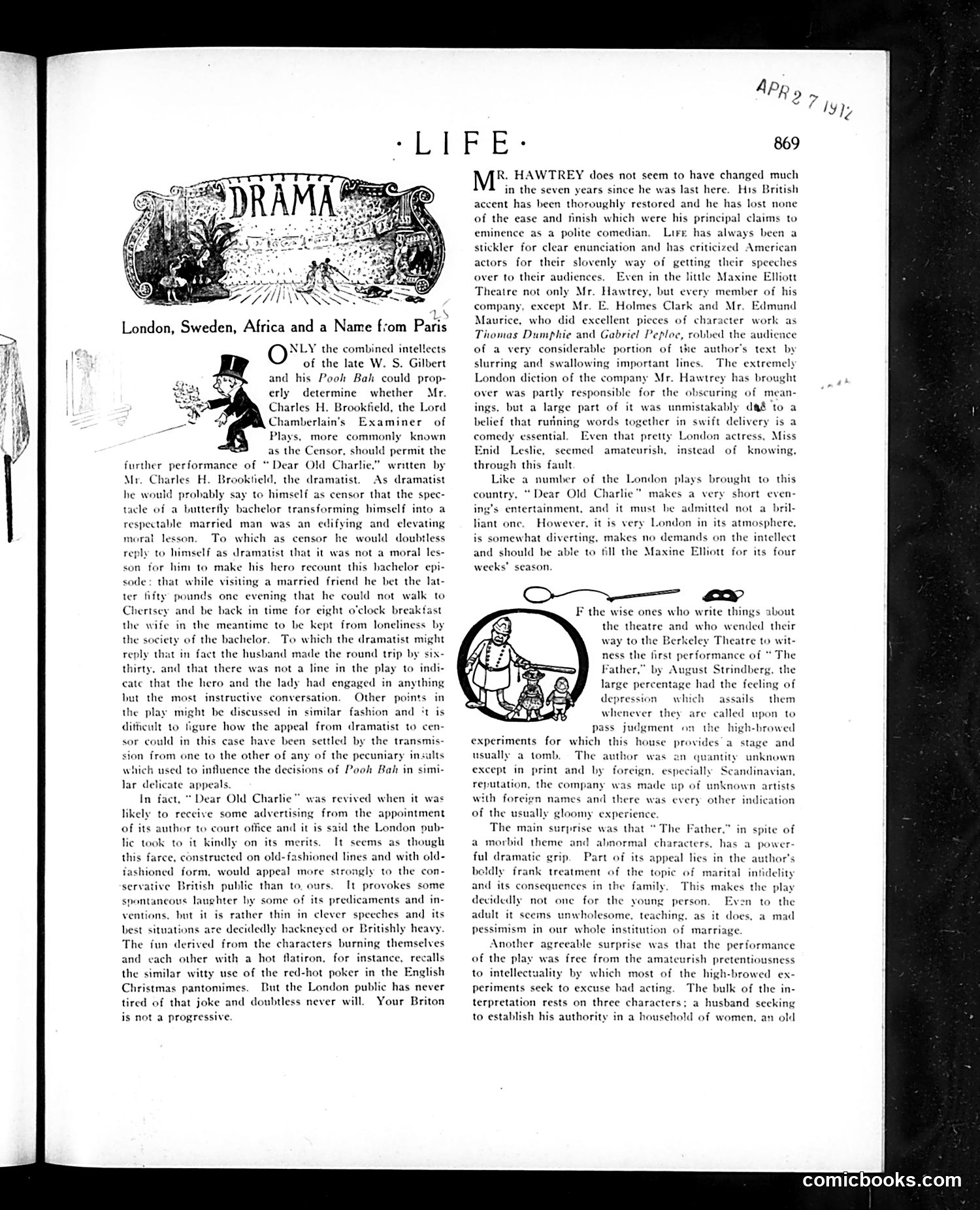
This page reviews British theatrical productions, particularly focusing on the play "Dear Old Charlie" and actor Charles Hawtrey's performance at New York's Maxine Elliott Theatre. **The Satire:** The opening section satirizes British theatrical censorship through a fictional debate between playwright Charles H. Brookfield and himself as the Lord Chamberlain's censor. The joke is that Brookfield must argue with himself about whether his own play is morally acceptable—a critique of Britain's absurd censorship system. The reference to Gilbert's "Pooh-Bah" (from *The Mikado*) reinforces this mockery of bureaucratic pomposity. **The Criticism:** The review complains that while Hawtrey maintains his polished comedic style, the British cast obscures much of the dialogue through unclear diction and rapid delivery. The play itself is deemed old-fashioned, relying on tired slapstick (characters burning themselves with flatirons) that amuses conservative British audiences but lacks intellectual substance. **The Broader Point:** The piece contrasts British theatrical tradition with American expectations, implying British theater is stodgy and resistant to progress.
📄 Transcribed text from this page (OCR, searchable)
Machine-transcribed from the original scan — historical spelling and the odd misread are preserved.
-LIFE- London, Sweden, Africa and a Name from Paris NLY the combined intellects of the late W. S. Gilbert and his Pooh Bah could prop- erly determine whether Mr. Charles H. Brookfield, the Lord Chamberlain's. Examiner of Plays, more commonly known as the Censor, should permit the written by As dramatist further performance of “Dear Old Charlie Mr. Charles H. Brooktield, the dramatist he would probably say to himself as censor that the spec- intterily bachelor transforming himself into a respectable married man was an edifying and elevating moral lesson. To which as censor he would doubtless reply to himself as dramatist that it was not a moral les- son for him to make his hero recount this bachelor epi- sode; that while visiting a married friend he bet the lat- ter fifty pounds one evening that he could not walk to Chertsey and be back in time for eight o'clock breakfast the wife in the meantime to be kept from loneliness by the society of the bachelor. To which the dramatist might reply that in fact the husband made the round trip by six- thirty, and that there was nota line in the play to indi- cate that the hero and the lady had engaged in anything but the most instructive Other points in the play might be discussed in similar fashion and ‘t is tacle of a conversation ditheult to figure how the appeal from dramatist to cen- sor could in this case have been settled by the transmis- sion from one to the other of any of the pecuniary insults which used to influence the decisions of Pooh Bah in simi- lar delicate appeals. In fact, * Dear Old Charlie” was revived when it was likely to receive some advertising from the appointment of its author to court office and it is said the London pub- lic took to it kindly on its merits. It seems as though this farce, constructed on old-fashioned lines and with old- iashioned form, would appeal more strongly to the con- servative British public than to, ours, [t provokes some spontaneous laughter by some of its predicaments and in- ventions, but it is rather thin in clever speeches and its Dest situations are decidedly hackneyed or Britishly heavy. The jun derived from the characters burning themselves and vach other with a hot flatiron, for instance, recalls the similar witty use of the red-hot poker in the English Christmas pantomimes. But the London public has never tired of that joke and doubtless never will. Your Briton is not a progressive. APR » 869 R. HAWTREY does not seem to have changed much in the seven years since he was last here. His British accent has been thoroughly restored and he has lost none of the ease and finish which were his principal claims to eminence as a polite comedian. Lire has always been a stickler for clear enunciation and has criticized American actors venly way of getting their speeches over to their audiences. Even in the little Maxine Elliott Theatre not only Mr. Hawtrey, but every member of his company, except Mr. E. Holmes Clark and Mr. Edmund Maurice, who did excellent pieces of character work as Thomas Dumphie and Gabriel Peploe, robbed the audience of a very considerable portion of the author's text. by slurring and swallowing important lines. The extremely London diction of the company Mr. Hawtrey has brought over was partly responsible for the obscuring of mean- ings, but a large part of it was unmistakably da8 ‘to a belief that running words together in swift delivery is a ven that pretty London actress, Miss instead of knowing for their sh comedy essential Enid Leslie, through this fault Like a number of the London plays brought to this country, “Dear Old Charlie” makes a very short even- seemed amateurish, ing’s entertainment, and it must he admitted not a. bril- liant one. However, it is very London in its atmosphere, is somewhat diverting, and should be able to fill the Maxine Elliott for its four makes no demands on the intellect weeks’ season. Oo- ~~ _— == F the wise ones who write things about the theatre and who wended their way to the Berkeley Theatre to wit- ness the first performance of * The Father,” by August Strindberg, the large percentage had the feeling of depression which —assails them whenever they are called upon to pass judgment on the high-browed experiments for which this house provides ge and usually a tomb, The author was an quantity unknown except in print and by. foreig Scandinavian, reputation ny was made up of unknown artists with foreign names and there was every other indication of the usually gloomy experience The main surprise was that “ The especially the com Father.” a morbid theme and abnormal characters, has a power- ful dramatic grip. Part of its appeal lies in the author's boldly frank treatment of the topic of marital infidelity and its consequences in the family makes the play decidedly not one for the young person, Even to. the in spite of adult it seems unwholesome, teaching, as it does, a mad pessimism in our whole institution of marriage Another agreeable surprise was that the performance of the play was free from the amatcurish pretentiousness to intellectuality by which most of the high-browed ex- periments seck to excuse bad acting. The bulk of the in- terpretation rests on three characters: a husband secking to establish his authority in a household of women, an old Ae é We comicbooks.com