
Life, 1912-04-25 · page 12 of 44
Life — April 25, 1912 — page 12: what you’re looking at
What you’re looking at
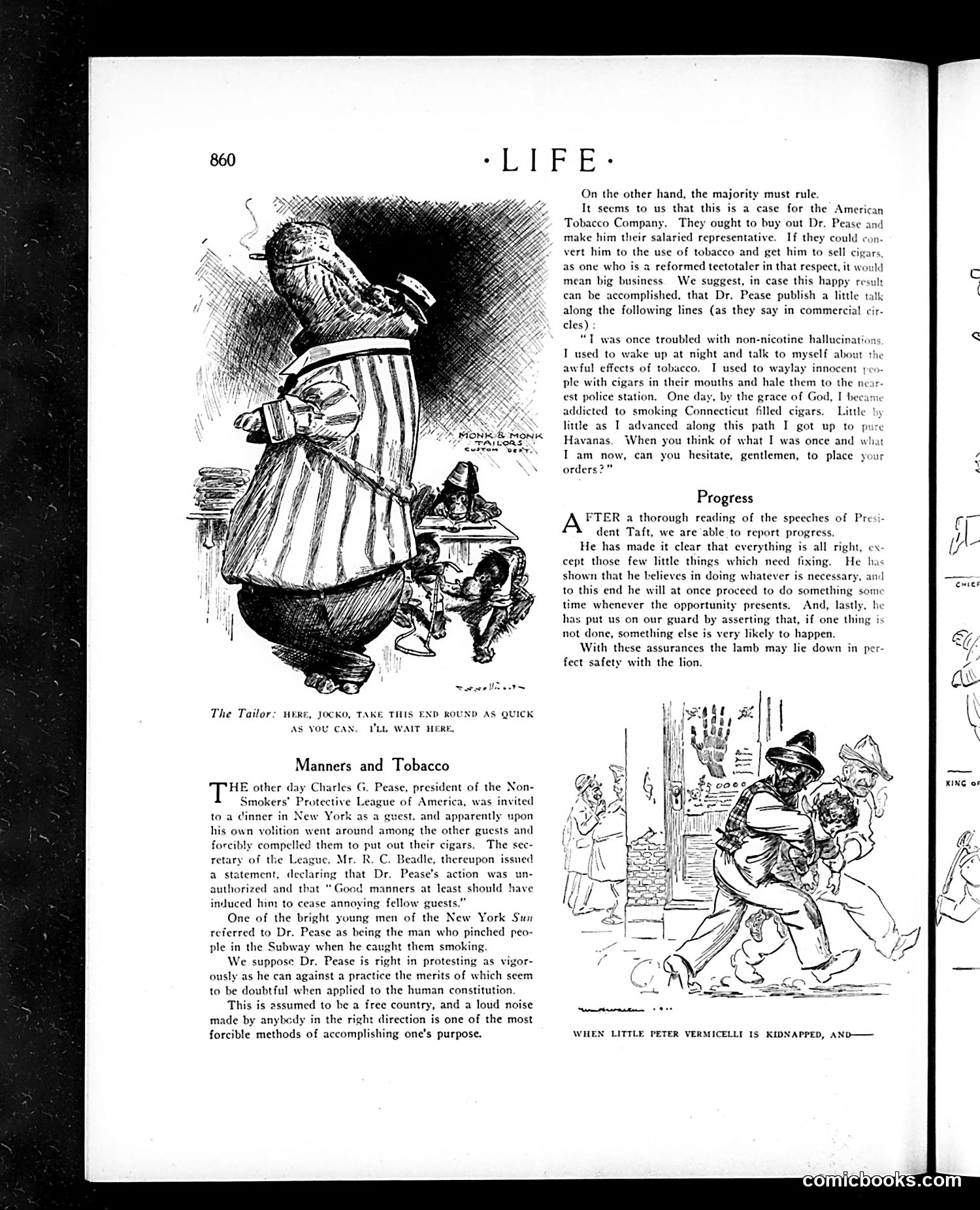
This page satirizes anti-smoking activism through two elements: **Main Cartoon ("The Tailor"):** A portly figure (likely Santa Claus, based on the robe and jolly appearance) is depicted as a tailor being instructed to bind something "quick as you can." The visual pun conflates Santa with a tailor, possibly mocking the conflation of different authorities. **"Manners and Tobacco" Article:** The text criticizes Charles G. Pease, president of the Non-Smokers' Protective League, who allegedly forced dinner guests to stop smoking. The satire defends smoking as a right in a "free country," mocking Pease's activism as heavy-handed and authoritarian. The magazine argues that loud objection is an ineffective social tactic. The page ridicules anti-smoking advocates as overbearing busybodies infringing on personal liberty—a libertarian defense of smoking common in early 20th-century American magazines.
📄 Transcribed text from this page (OCR, searchable)
Machine-transcribed from the original scan — historical spelling and the odd misread are preserved.
* LaF 'E « JX AONB MONK ° OAS 7 ‘ eutyow wer The Tailor: were, JocKO, TAKE THIS END ROUND AS QUICK AS YOU CAN. 1'LL WAIT HERE. Manners and Tobacco HE other day Charles G. Pease, president of the Non- Smokers’ Protective League of America, was invited toa dinner in New York as a guest, and apparently upon his own volition went around among the other guests and forcibly compelled them to put out their cigars. The sec- uc. Mr. R. C. Beadle, thereupon issued laring that Dr. Pease’s action was un- Good manners at least should have retary of the I a statement, d. authorized and that “ induced him to cease annoying fellow guests.” One of the bright young men of the New York Sun referred to Dr. Pease as being the man who pinched peo- ple in the Subway when he caught them smoking. We suppose Dr. Pease is right in protesting as vigor- ously as he can against a practice the merits of which seem to be doubtful when applied to the human constitution. This is assumed to be a free country, and a loud noise made by anybedy in the right direction is one of the most forcible methods of accomplishing one's purpose. On the other hand, the majority must rule. It seems to us that this is a case for the American Tobacco Company. They ought to buy out Dr. Pease a; make him their salaried representative. If they could con- vert him to the use of tobacco and get him to sell cigars, as one who is a reformed tectotaler in that respect, it would mean big business We suggest, in case this 1 can be accomplished, that Dr. Pease publish a along the following lines (as they say in commercial cir- cles) “T was once troubled with non-nicotine hallucina T used to wake up at night and talk to myself abo: awful effects of tobacco. I used to waylay innocent pc ple with cigars in their mouths and hale them to the ne est police station. One day, by the grace of God, I 1 addicted to smoking Connecticut filled cigars. Little little as I advanced along this path I got up to Havanas. When you think of what I was once and \ T am now, can you hesitate, gentlemen, to place you orders?” Progress FTER a thorough reading of the speeches of Pre dent Taft, we are able to report progress. He has made it clear that everything is all right, ex- cept those few little things which need fixing. He has shown that he believes in doing whatever is necessary, anil to this end he will at once proceed to do something some time whenever the opportunity presents. And, lastly, he has put us on our guard by asserting that, if one thing is not done, something else is very likely to happen. With these assurances the lamb may lie down in per- fect safety with the lion, WHEN LITTLE PETER VERMICELLI 1S KIDNAPPED, AND—