
A complete issue · 44 pages · 1911
Life — December 21, 1911
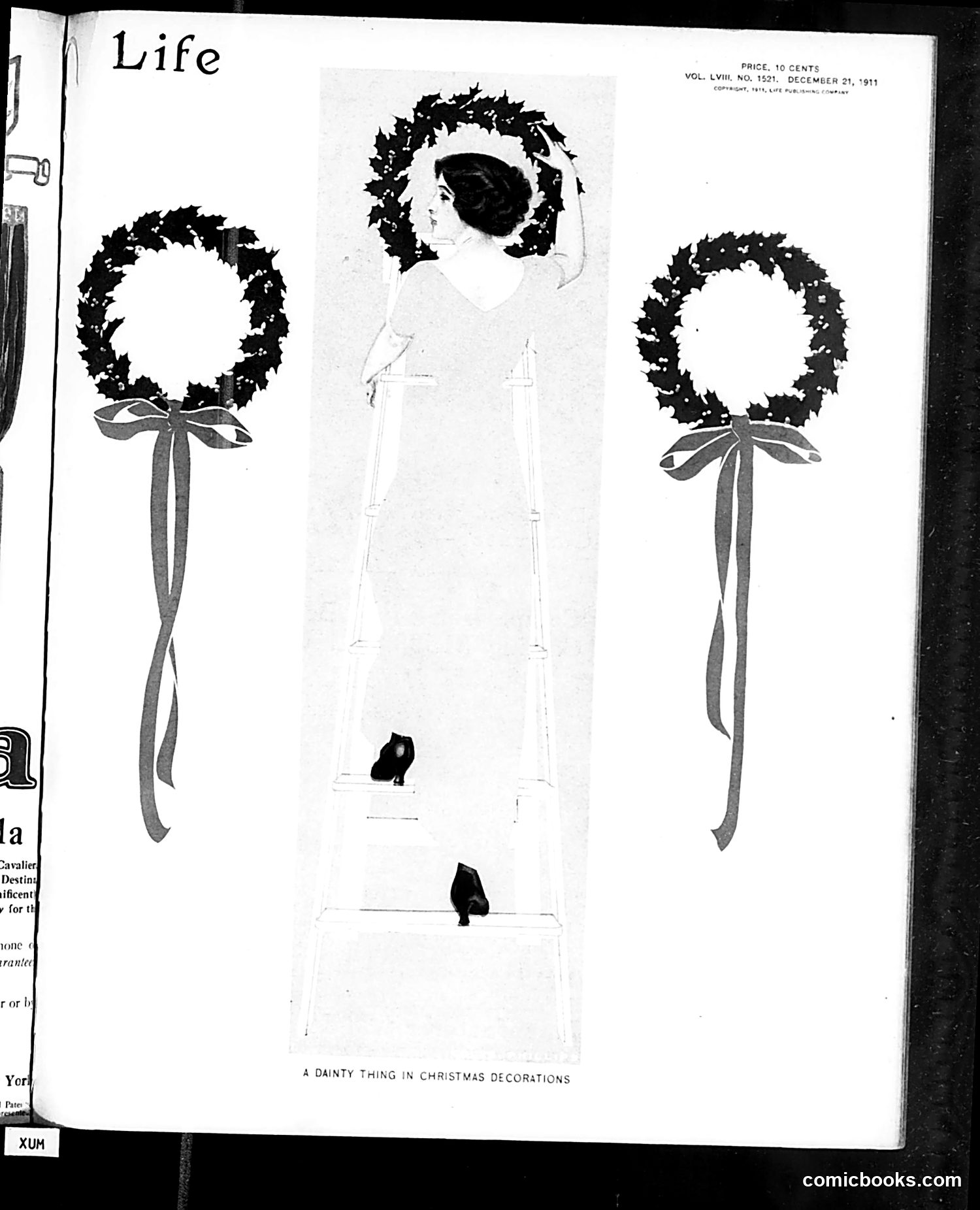
This December 1911 *Life* magazine page satirizes Christmas decoration trends. The central illustration shows a fashionable woman wearing an oversized wreath as a hat, flanked by two standalone wreaths on ribbon-tied stands. The caption's humor lies in the exaggeration: the woman sports a wreath so enormous it dominates her entire head, suggesting that contemporary Christmas decorations had become absurdly excessive and impractical—prioritizing fashionable appearance over functionality. The satire critiques both consumer culture and gender fashion conventions of the Edwardian era, mocking the tendency of wealthy women to adopt increasingly ridiculous accessories. By presenting the wreath as wearable fashion rather than household decoration, *Life* ridicules the era's conspicuous consumption and the lengths people went for seasonal display.
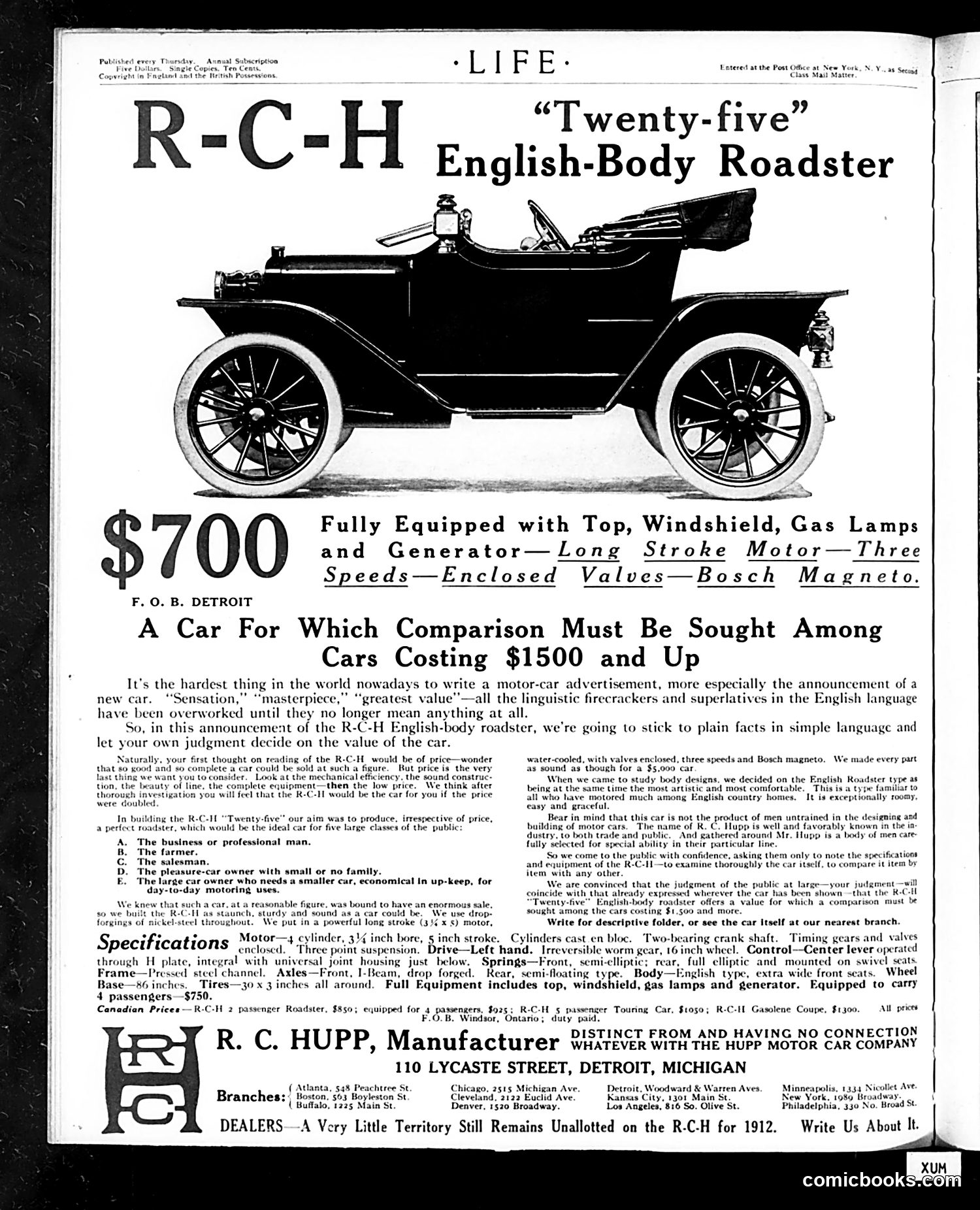
This is **not a cartoon or satire page** — it's a straightforward automobile advertisement from Life magazine. The page promotes the R-C-H "Twenty-five" English-Body Roadster, manufactured by R.C. Hupp in Detroit, Michigan. The ad emphasizes the car's value proposition: priced at $700, it claims to offer features and quality comparable to automobiles costing $1500 or more. It highlights practical features like the long-stroke motor, three speeds, enclosed valves, and Bosch magneto. The text explicitly states the advertiser is avoiding hyperbolic language ("sensation," "masterpiece") in favor of "plain facts in simple language." This is a genuine product advertisement with no political or satirical content — typical business messaging from the early automotive era.
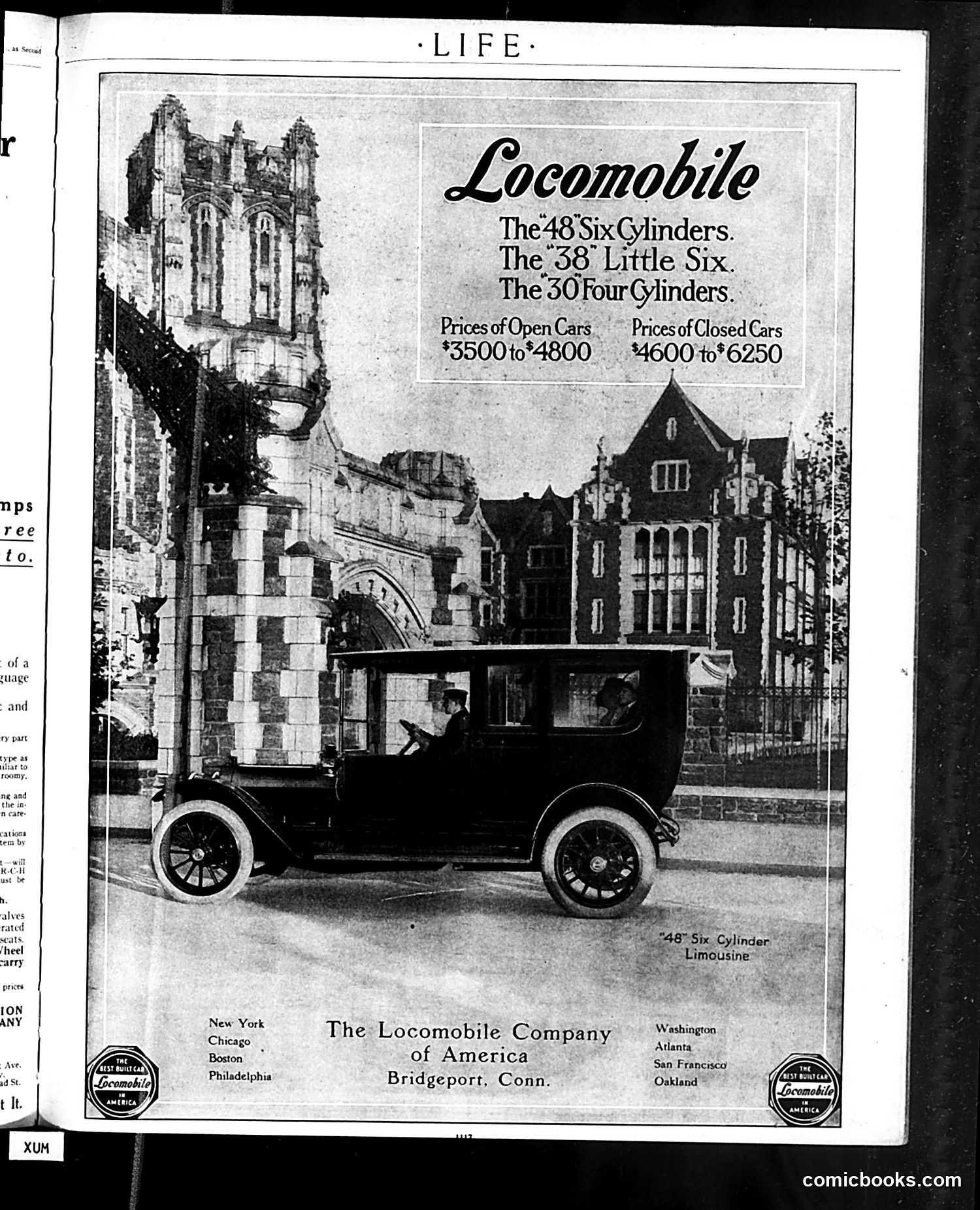
This page is **primarily an advertisement**, not editorial content or satire. It features a Locomobile automobile advertisement from the Locomobile Company of America (Bridgeport, Connecticut). The ad showcases a "48 Six Cylinder Limousine" parked before grand institutional buildings (likely a church and university or civic structure), emphasizing the vehicle's prestige and suitability for refined clientele. The company lists three models with pricing: - 48 Six Cylinders: $3,500–$4,800 (open cars) - 38 Little Six - 30 Four Cylinders - Closed cars: $4,600–$6,250 The architectural backdrop and formal presentation are designed to associate Locomobile with established institutions and upper-class status. This is a straightforward early-automotive marketing appeal to wealthy consumers, not political satire.
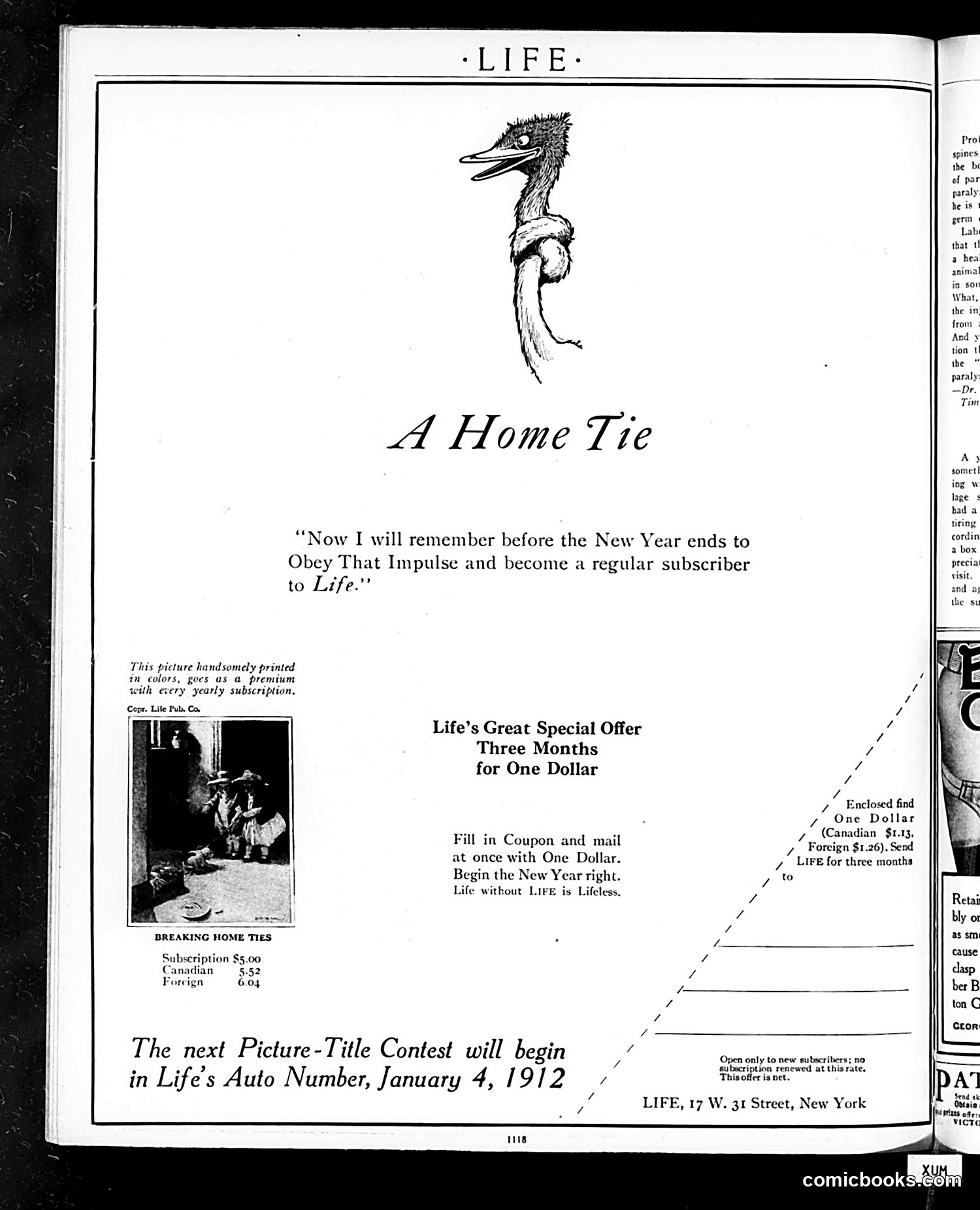
This page is primarily **advertising** for Life magazine subscriptions, not political satire. The main visual element is a drawing of an ostrich titled "A Home Tie"—likely a humorous reference to the common saying "home ties" (family obligations). The ostrich illustration appears decorative rather than politically pointed. The page promotes Life's subscription offer: three months for one dollar. There's a photograph labeled "Breaking Home Ties" showing what appears to be a domestic scene, possibly illustrating the theme of family connections or departures. Below, Life announces an upcoming "Picture-Title Contest" starting January 4, 1912, in their Auto Number. The content is **primarily commercial**, designed to encourage New Year subscriptions by playing on sentimentality about home and family bonds.
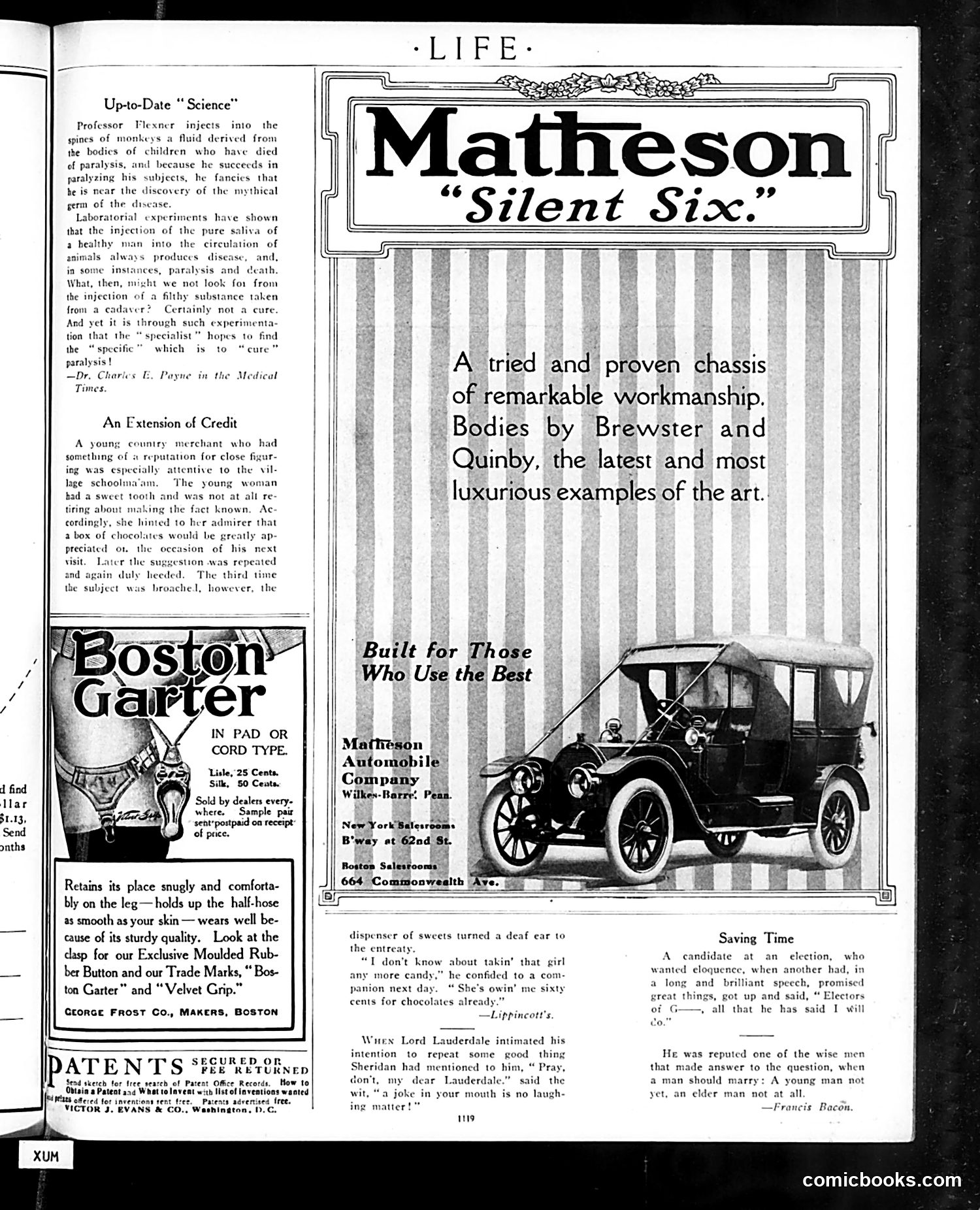
This page is primarily **advertising rather than political satire**. The dominant content is a full-page Matheson automobile advertisement featuring the "Silent Six" model, highlighting its chassis quality and luxury features. The ad emphasizes it's "Built for Those Who Use the Best." The left sidebar contains a Boston Garter advertisement (hosiery/socks) and a patent notice. The small text items scattered throughout ("An Extension of Credit," "Saving Time") appear to be brief humorous anecdotes or fillers typical of Life magazine's format, not political commentary. One involves a woman securing chocolates through flattery; another references Lord Lauderdale and a jest about keeping quiet. **No significant political or social satire is evident on this page.**
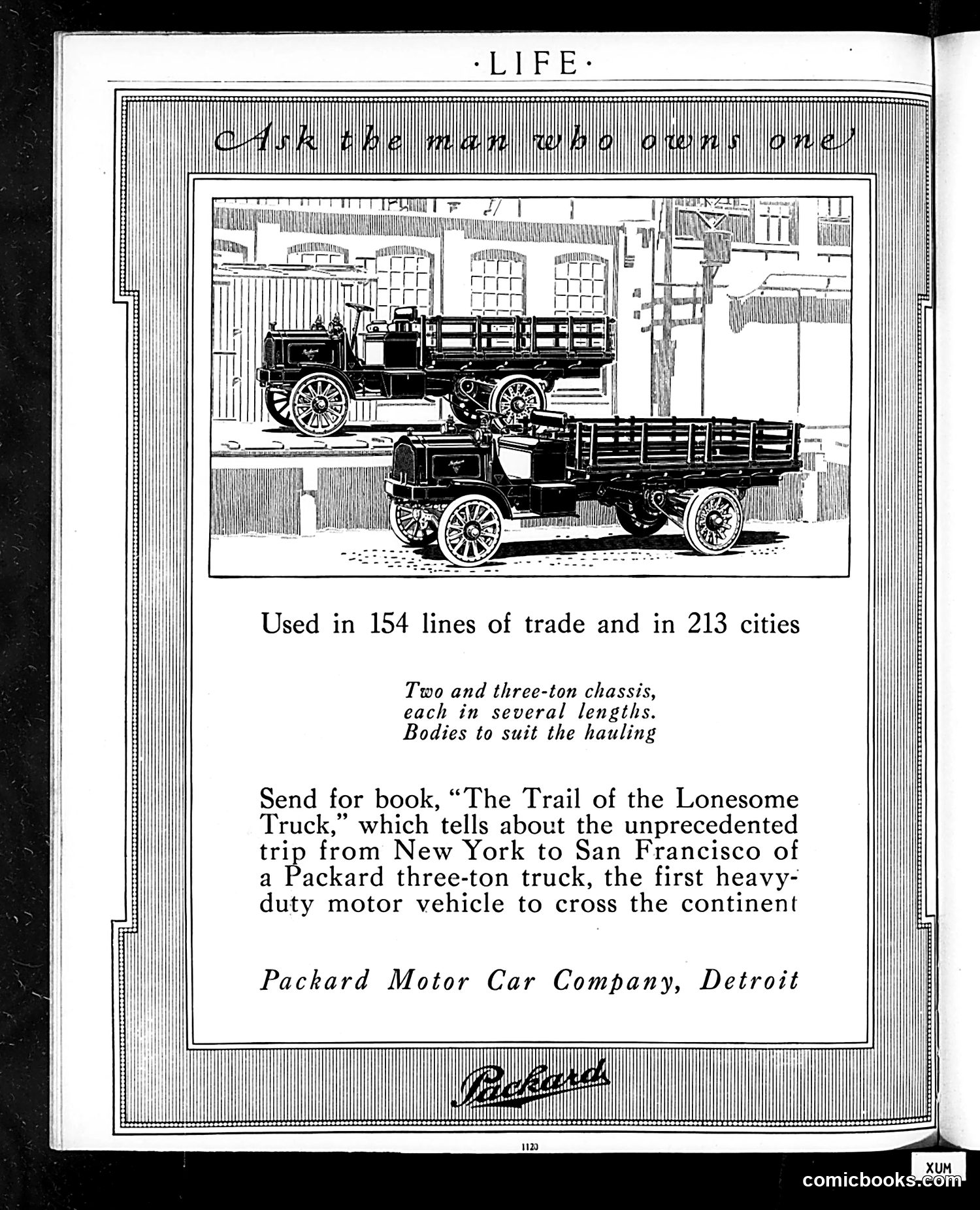
This is **not a political cartoon or satire**—it's a straightforward advertisement for Packard Motor Car Company's commercial trucks, published in *Life* magazine (which contained both satirical content and ads). The page shows two Packard truck models: a 2-ton and 3-ton chassis with interchangeable bodies. The ad emphasizes their widespread commercial use (154 trade lines, 213 cities) and promotes a promotional book called "The Trail of the Lonesome Truck," which documented a Packard three-ton truck's cross-country journey from New York to San Francisco—a feat presented as the first heavy-duty motor vehicle to accomplish this route. This represents early automotive marketing highlighting industrial capability and reliability.
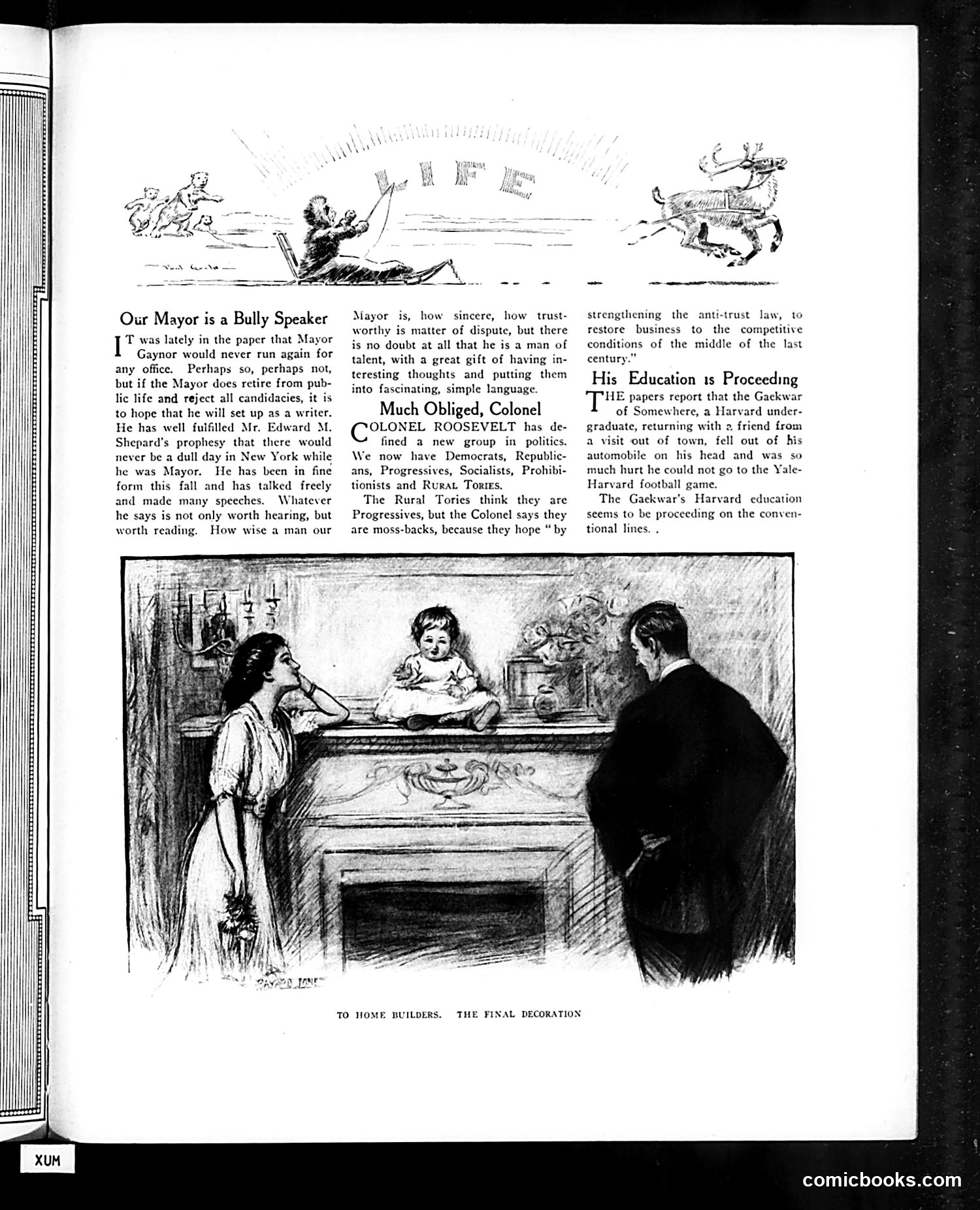
This page contains three distinct pieces: **"Our Mayor is a Bully Speaker"** praises an unnamed mayor for his oratorical skills and character, noting he would never run for higher office despite being qualified. **"Much Obliged, Colonel"** references Colonel Roosevelt's new political grouping. It jokes that various political factions (Democrats, Republicans, Progressives, Socialists, Prohibitionists, and Rural Tories) all claim Roosevelt agrees with them, though he considers Progressives and Rural Tories "moss-backs" who merely *hope* he agrees. **"His Education is Proceeding"** notes a Gackwar of Somewhere (likely fictional) returned from America with an automobile, impressing him more than a Yale football game would have. The bottom illustration, "To Home Builders: The Final Decoration," shows a couple and child at a fireplace mantel—likely satirizing interior decoration trends or domestic life.
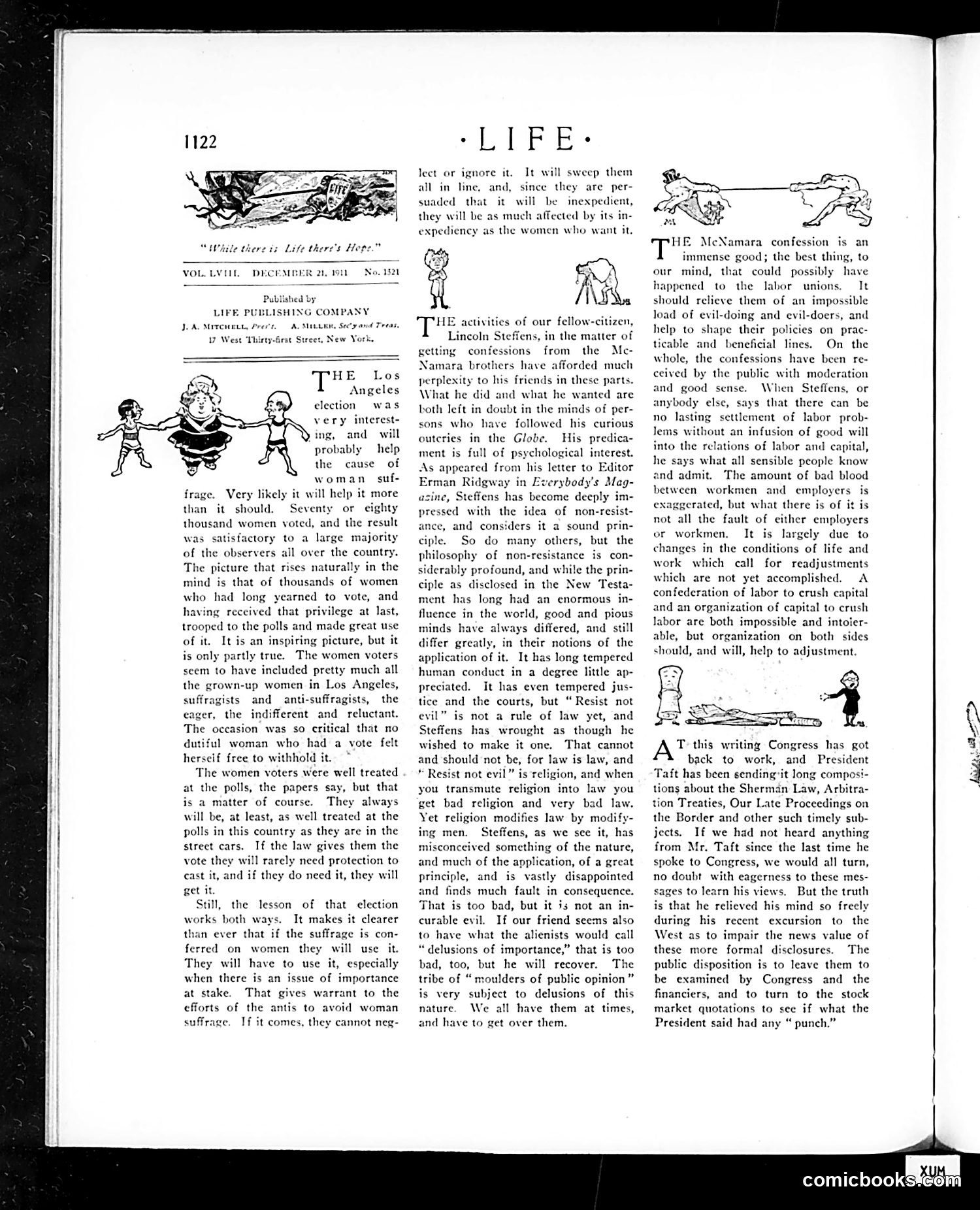
This page contains editorial commentary on two major contemporary issues. The left column discusses the Los Angeles election, praising women voters' participation while cautioning that suffrage alone won't solve labor problems. The accompanying cartoon (top left) appears to depict the tension between these groups—showing figures in what looks like a political struggle. The right column discusses Lincoln Steffens' McXamara confession piece, analyzing labor violence and non-resistance philosophy. The text debates whether Steffens' pacifist conclusions are practical, arguing that labor organization and capital negotiation are both necessary. The cartoons use caricature to satirize these debates about voting rights, labor unions, and political reform—core Progressive Era concerns.
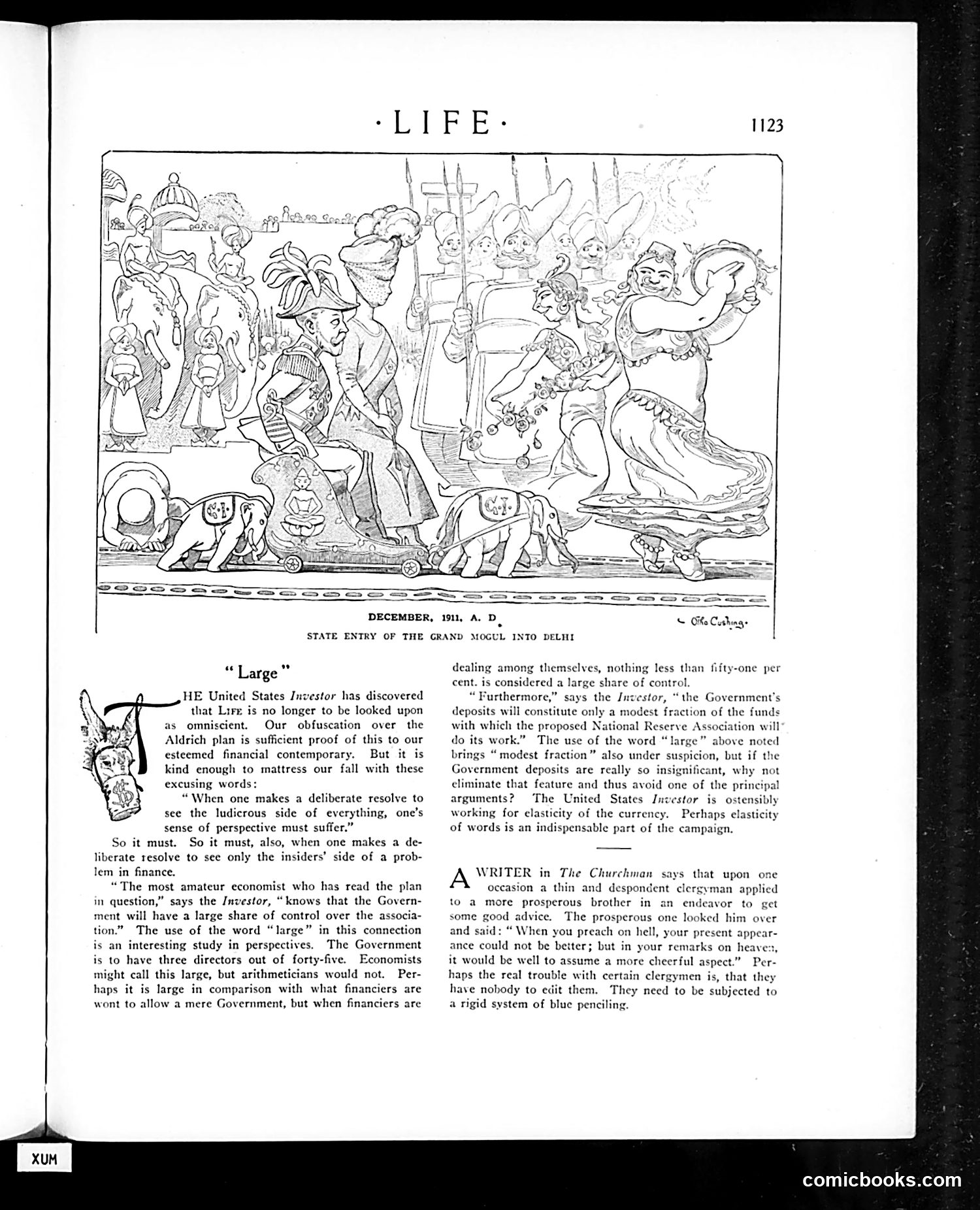
**The Cartoon:** Titled "State Entry of the Grand Mogul into Delhi," this satirical illustration depicts an elaborate procession with an Indian ruler (the "Grand Mogul") entering a city. The caricatures and exaggerated style mock the pageantry of British imperial rule in India during the Delhi Durbar period. **The Articles:** The page contains commentary on financial matters, discussing the U.S. Government's involvement in currency elasticity and a National Reserve Association. A separate piece references clergy needing editorial oversight regarding sermon content. **The Satire:** The cartoon likely critiques the pomp and ostentation of British imperial ceremonies in India, while the articles debate government economic intervention—typical 1911 Progressive Era concerns about monopolies, finance, and institutional authority.
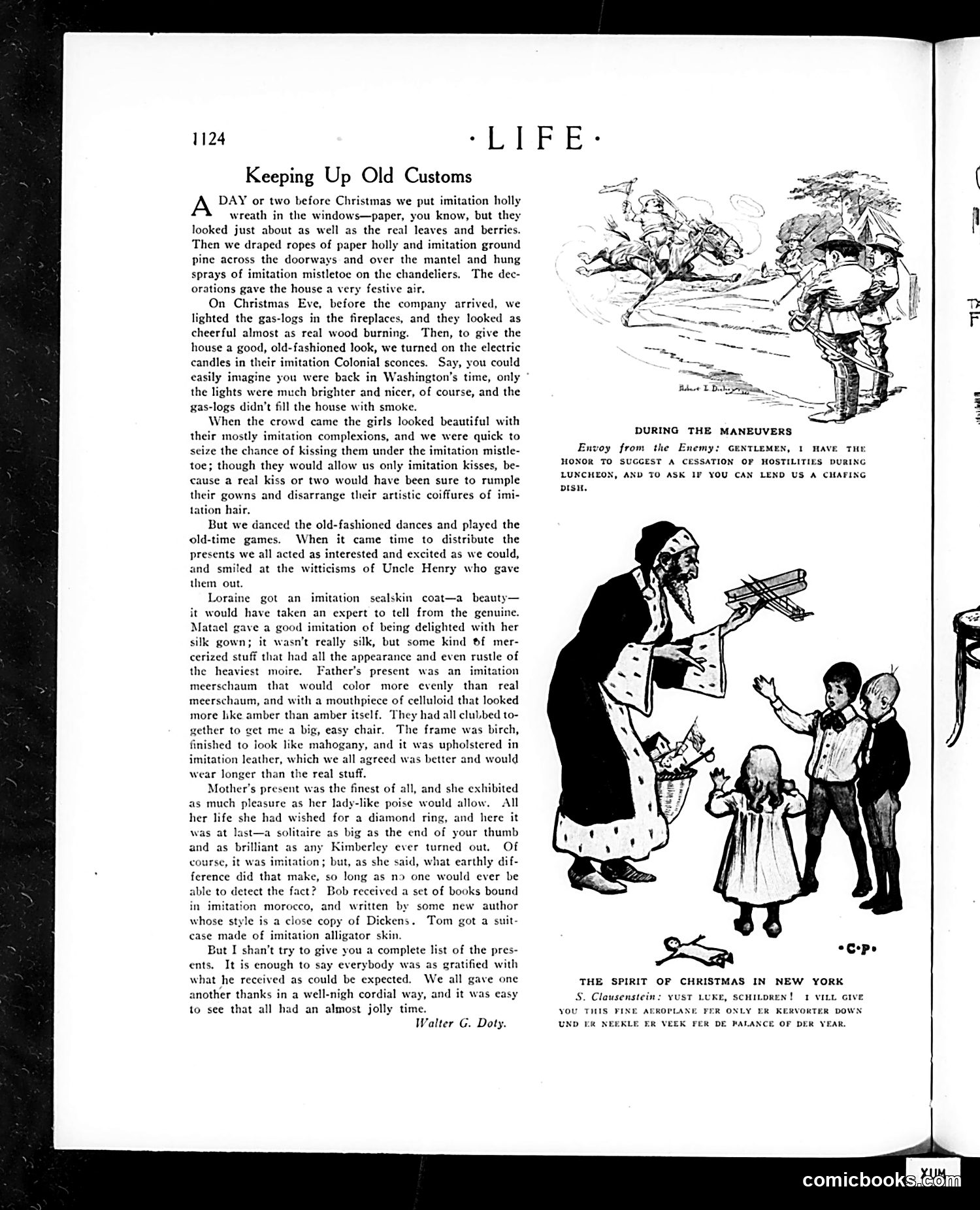
This page from *Life* magazine describes Christmas celebrations featuring imitation decorations and period costumes. The text by Walter G. Doty humorously chronicles how guests received "imitation" gifts—fake silk gowns, mock meerschaum pipes, and imitation leather items—presented as if they were genuine luxuries. The accompanying illustrations depict Christmas games and festivities. The lower cartoon, titled "The Spirit of Christmas in New York," shows what appears to be a street performer or caroler with children, satirizing urban holiday traditions. The German-language caption suggests mockery of European Christmas customs. The satire targets the American middle-class practice of maintaining "old customs" through cheap imitations rather than genuine articles, poking fun at pretension and the gap between aspiration and economic reality during the holiday season.
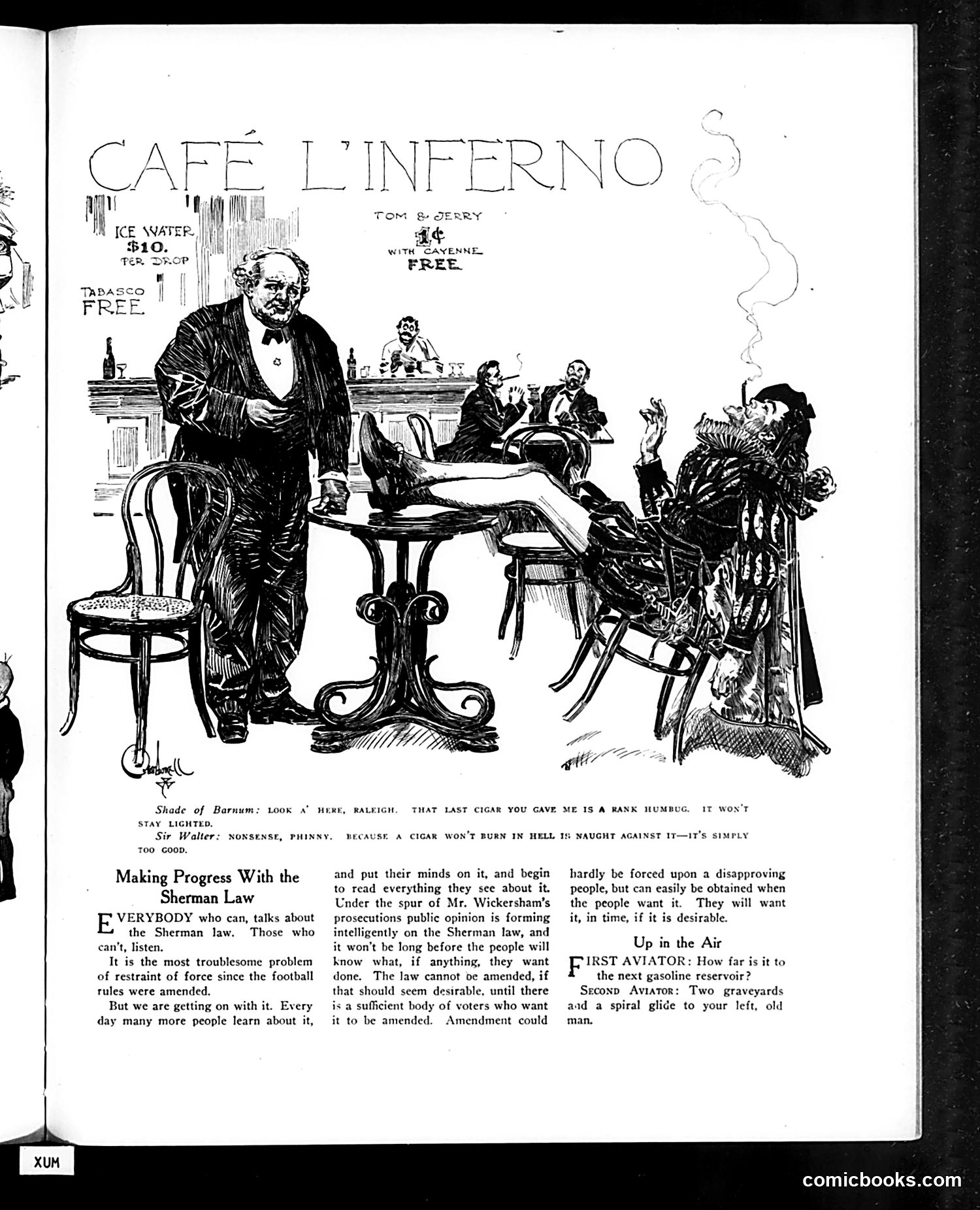
This satirical illustration depicts a café scene where a well-dressed man serves drinks to patrons while others socialize in the background. The caption references "Raleigh" receiving a cigar that "won't stay lighted" in hell—a moral judgment suggesting damnation. The accompanying text discusses the Sherman Law (antitrust legislation) and public opinion forming around its enforcement. The "Making Progress With the Sherman Law" section suggests citizens are gradually understanding and supporting antitrust reform, despite initial resistance. The cartoon appears to satirize business figures or politicians resisting regulation, suggesting their schemes are as futile as trying to light a cigar in hell. The specific identity of "Raleigh" remains unclear without additional historical context, though the reference implies a notable contemporary figure facing public disapproval.
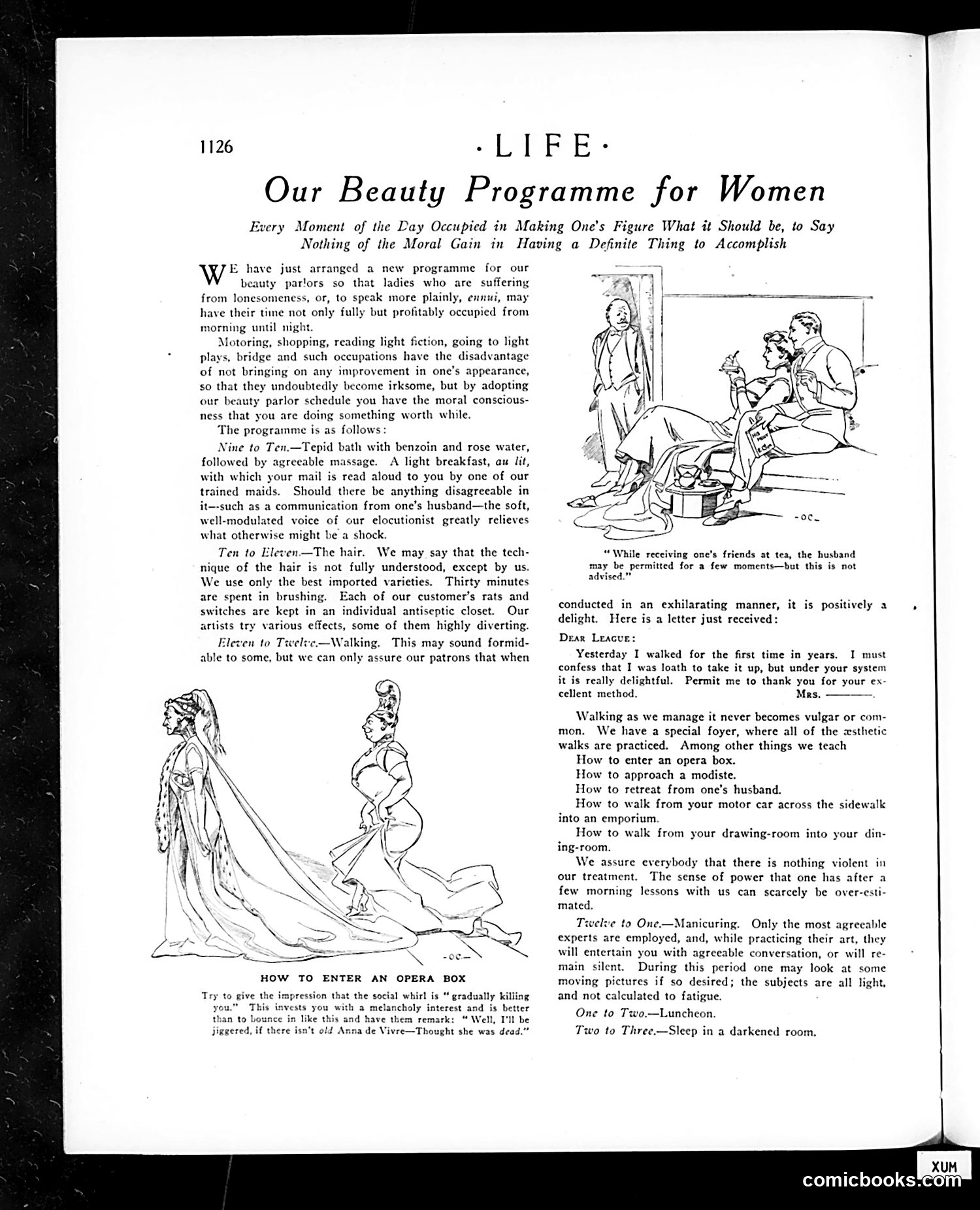
This satirical article mocks the commercialization of women's beauty routines and leisure time. The magazine presents a mock "beauty parlor schedule" from 9 AM to 3 PM, suggesting women fill their days with superficial activities: baths, hair treatments, walking lessons, and manicures. The satirical subtitle states this provides "moral consciousness" while doing "something worth while"—clearly ironic, as the activities listed are purely cosmetic and leisure-focused, not substantive. The accompanying sketches illustrate "How to Enter an Opera Box" and proper walking posture, mocking the artificiality and rigid etiquette demands placed on women of this era. The overall satire critiques how women's time and aspirations are reduced to appearance management and social performance rather than meaningful pursuits.
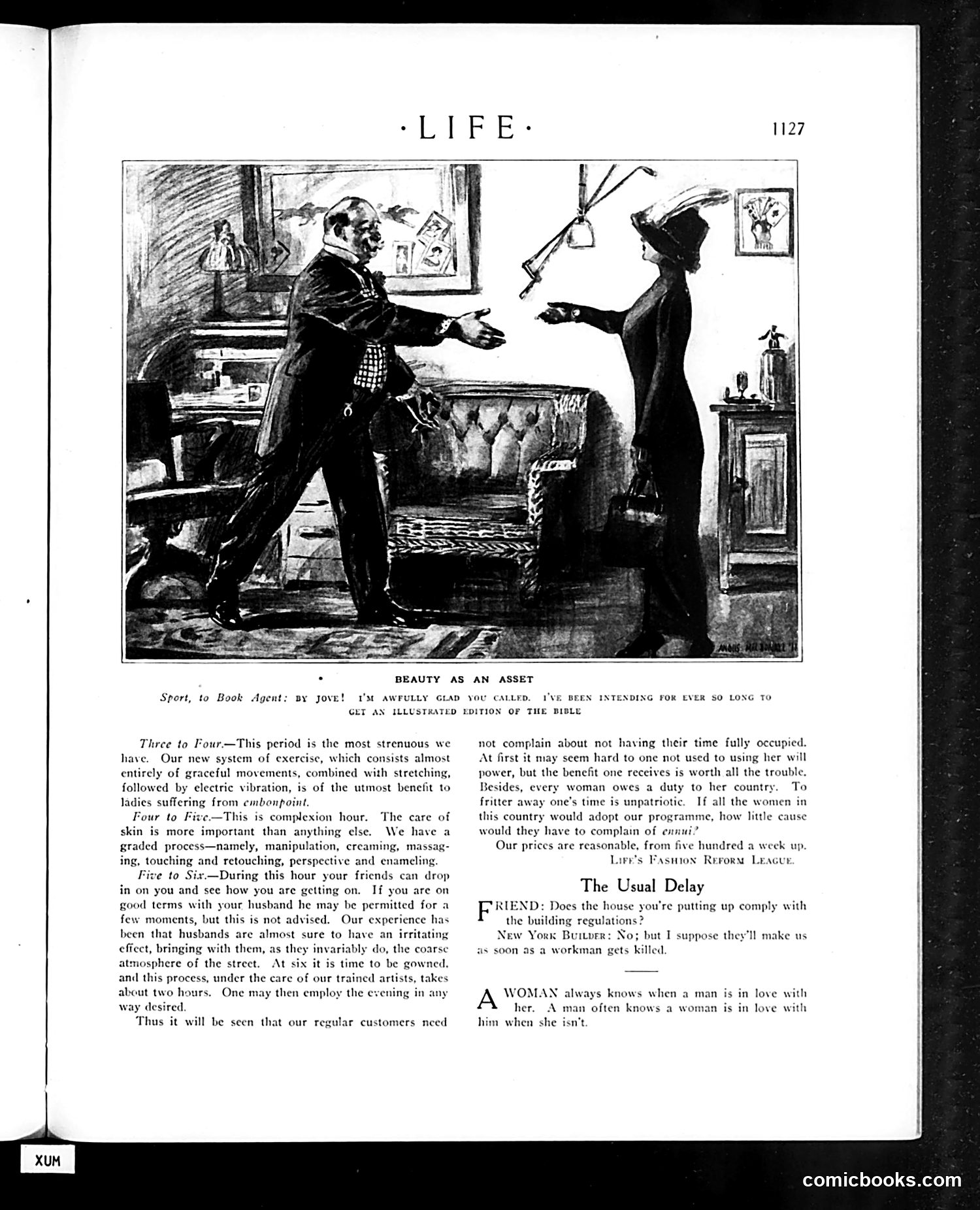
This cartoon satirizes the commercialization of women's beauty and leisure time. A well-dressed man (a "Sport" or wealthy gentleman) appears to be propositioning a woman about an "illustrated edition of the Bible" — a transparent euphemism for an improper proposition. The satire targets how beauty is marketed as a commercial "asset" that women should cultivate during prescribed leisure hours ("Three to Four," "Four to Five," etc.). The text below mocks the fashion/beauty industry's claims that women have patriotic duty to look attractive and that husbands tolerate their beauty routines. The cartoon critiques how women's appearance was being packaged and sold as both a moral obligation and a commodity in early 20th-century consumer culture.
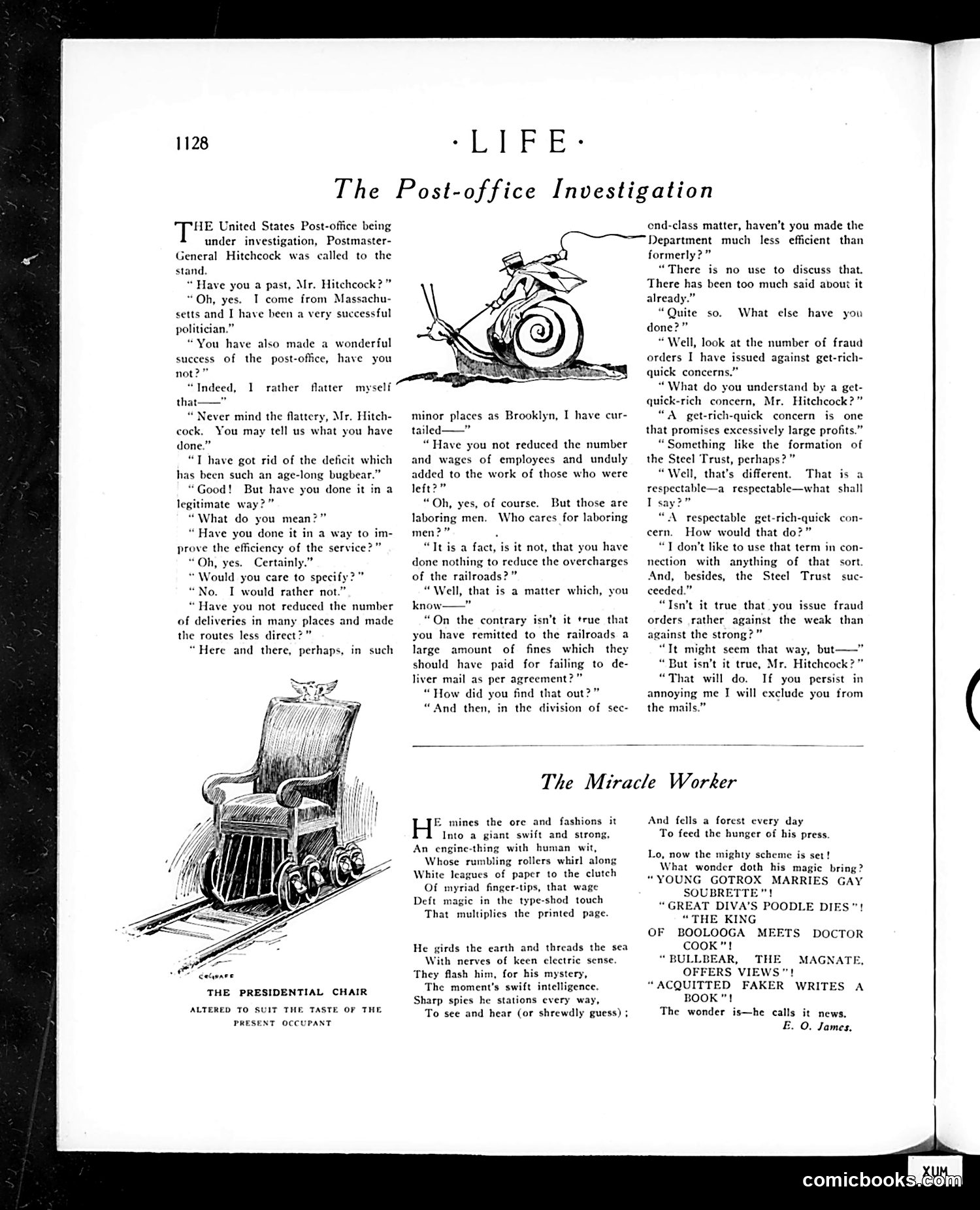
This page satirizes a contemporary investigation into the U.S. Post Office. Postmaster General Hitchcock is being questioned about postal inefficiency. The dialogue mocks his defensive responses—he claims success while admitting he's reduced neither deliveries nor employee wages, and he dismisses concerns about "get-rich-quick" mail fraud schemes (likely referring to fraudulent business promotions). The satire's point: Hitchcock deflects responsibility, distinguishing between "respectable" concerns (like Steel Trust regulation) and "disreputable" ones (like mail fraud), while the snail cartoon implies the postal service's glacial pace. The lower section, "The Miracle Worker," appears to be unrelated verse praising industrial/modern achievement.
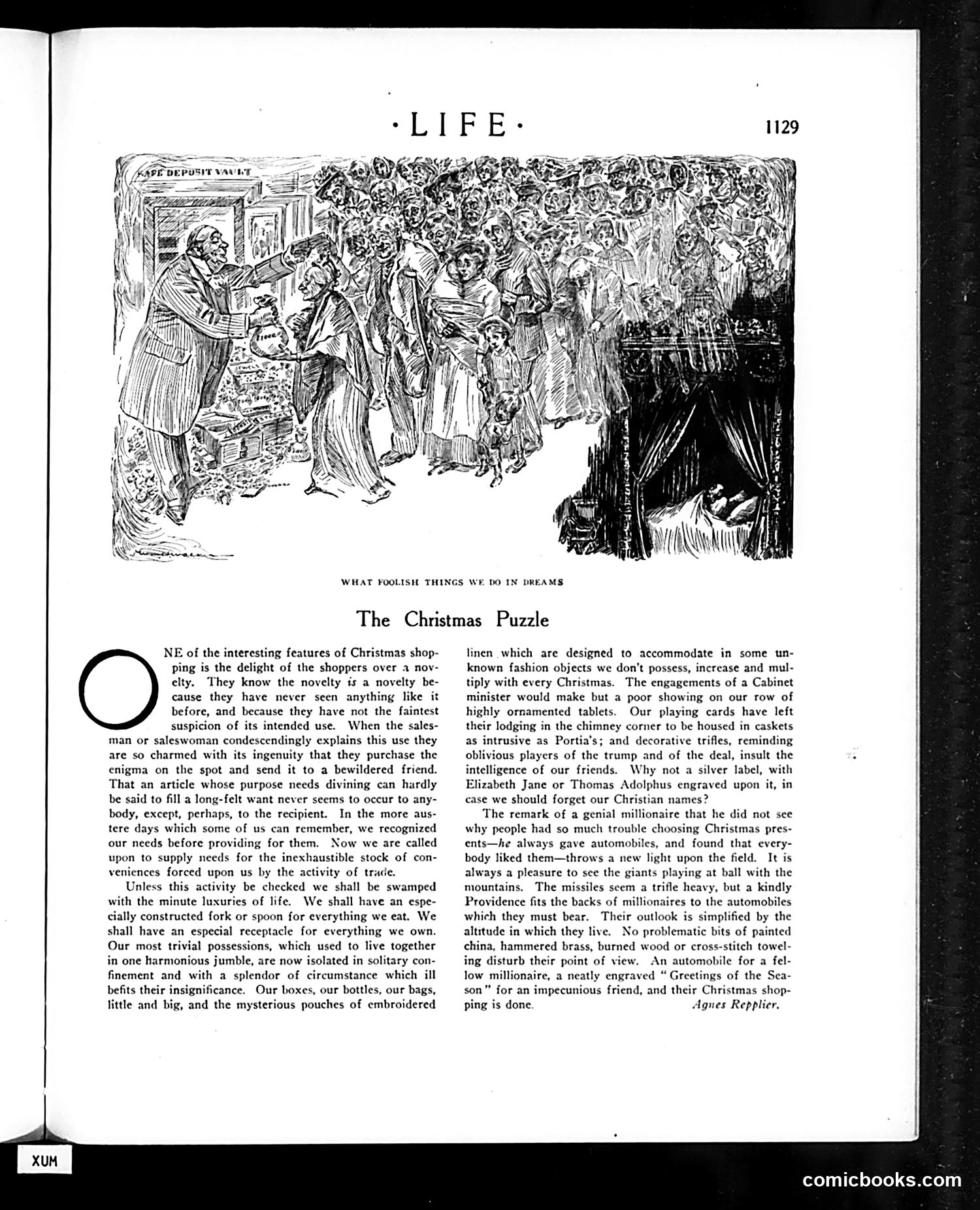
This is a satirical essay accompanying an illustration of a crowded Christmas shopping scene. Repplier mocks the modern consumer culture of her era (early 20th century), arguing that Christmas shopping has become absurd. The central complaint: retailers manufacture and sell "novelties"—useless gadgets whose purpose is unclear—and consumers eagerly buy these puzzling items as gifts, passing confusion to recipients. Repplier contrasts this with earlier times when people bought only genuine necessities. She satirizes how trivial possessions now get elaborate, specialized containers and decorative cases, and mocks the wealthy millionaire who simply gives automobiles as gifts, finding the problem trivial from his elevated perspective. The essay argues that modern commerce has created artificial "needs" and that Christmas gift-giving has devolved into exchanging incomprehensible objects. The cartoon depicts the chaotic shopping experience she describes.
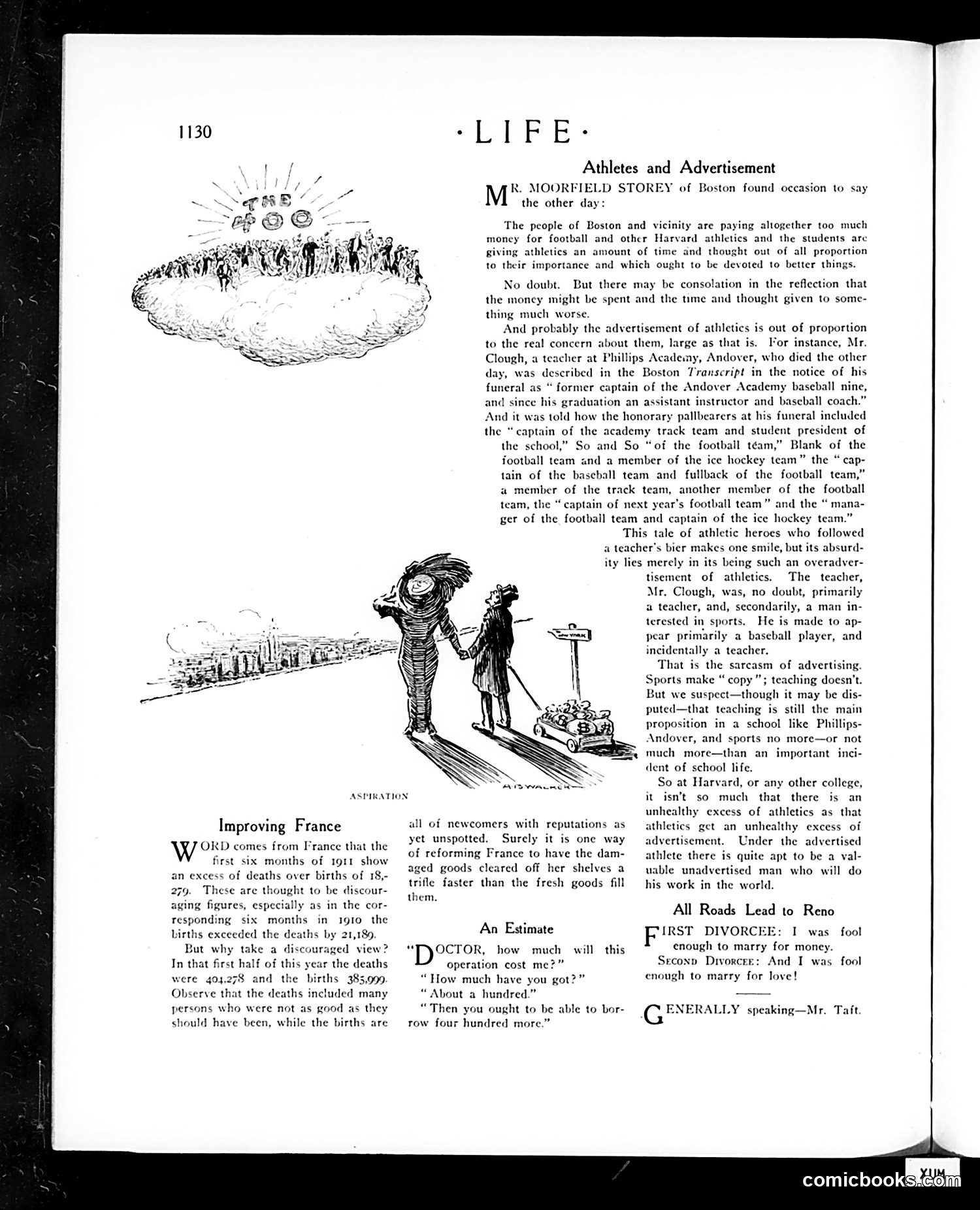
This page contains three satirical pieces critiquing early 20th-century American society: **"Athletes and Advertisement"** mocks the excessive publicity given to college athletes over academics. Moorfield Storey (a real Boston figure) complained that Harvard students overfocus on athletics. The satire centers on Mr. Clough, a Phillips Academy teacher whose funeral notice emphasized his sports roles (baseball captain, football coach) while barely mentioning teaching—illustrating how sports generate sensational "copy" while education doesn't. The cartoons labeled "Aspiration" and "Ambition" visualize this misplaced emphasis. **"Improving France"** sardonically frames France's 1911 death surplus (more deaths than births) as beneficial "reform," suggesting the deceased were society's undesirable elements being naturally culled. **"All Roads Lead to Reno"** jokes about Reno, Nevada's reputation as a divorce destination. Two divorcées compare mistakes: one married for money, the other for love—implying both motives lead equally to failure. The final quip attributes cynical commentary to President Taft, a common rhetorical device.
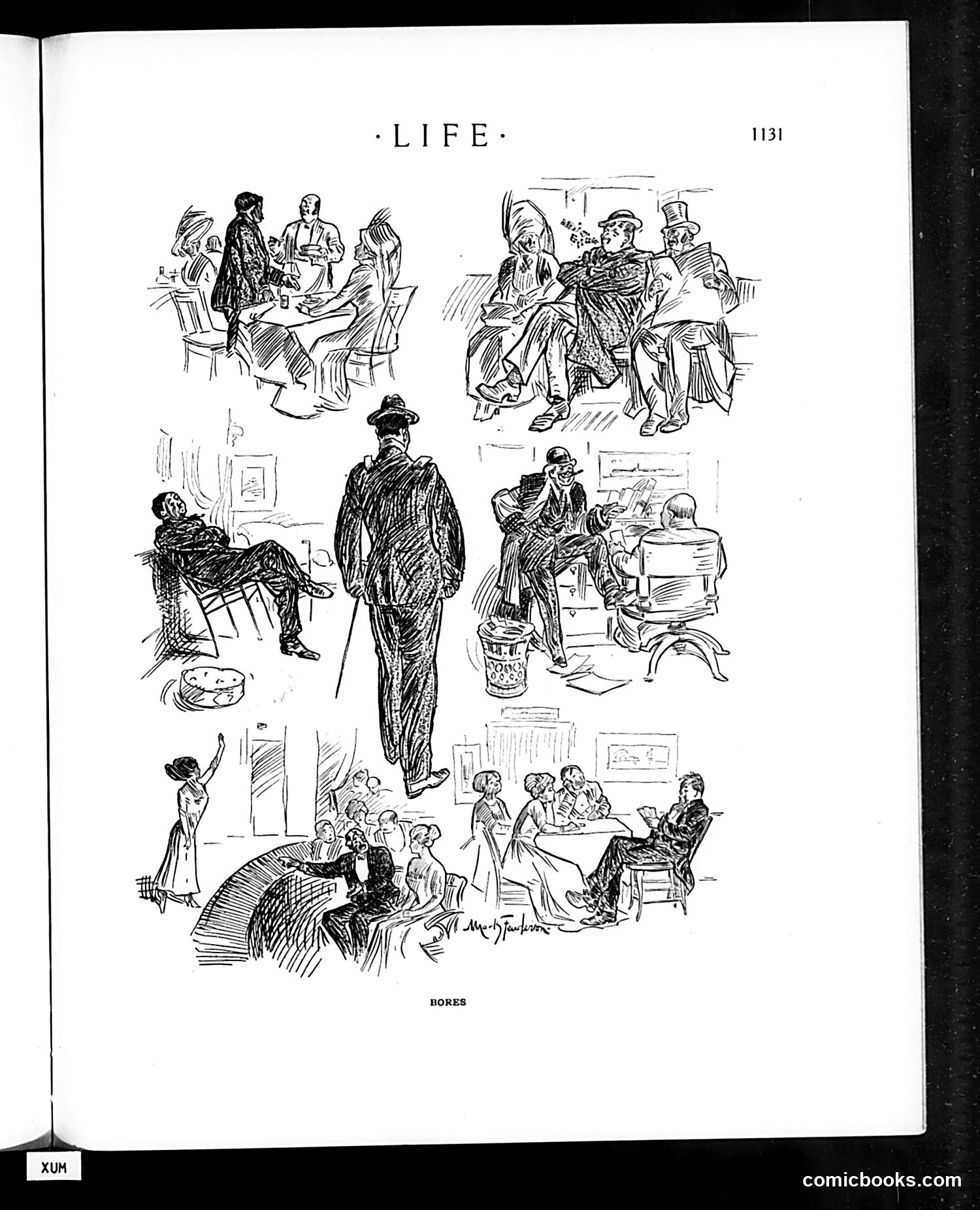
This page presents a satirical sketch series titled "Bores," depicting various tedious social situations and personality types that annoy others. The vignettes show: - Upper-class social gatherings where people appear to endure dull conversation - A well-dressed man (center) standing alone, possibly representing a boring conversationalist or social burden - Various domestic and social scenes where individuals seem trapped or disengaged - A woman gesturing dramatically, suggesting exasperation with boring company The satire targets the universal social experience of encountering tedious people and situations. The sketches mock both those who bore others through their conversation or behavior, and the social obligation to tolerate them politely. This reflects early 20th-century Life magazine's focus on satirizing middle and upper-class social conventions and human behavioral quirks.
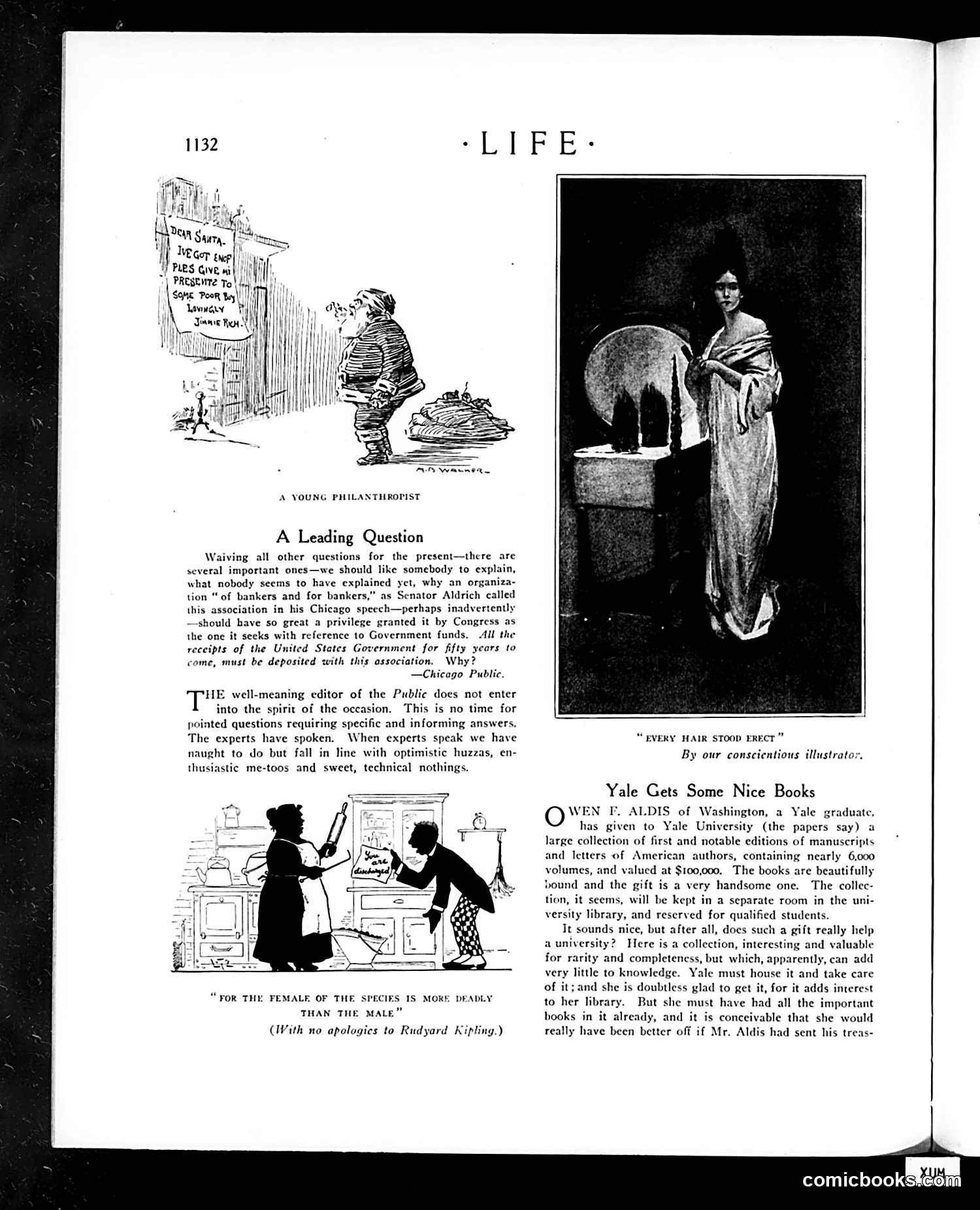
**Top Cartoon - "A Young Philanthropist":** A child deposits coins into a poor box labeled with charitable sentiments while ignoring a basket of actual poor people. This satirizes performative, self-congratulatory charity—the hypocrisy of publicizing small donations while ignoring systemic poverty. **"A Leading Question" Article:** Life critiques Senator Aldrich's banking organization (likely the Federal Reserve banking system under discussion), which would receive unprecedented government deposits. The piece mocks experts who demand blind trust rather than transparent explanation of why bankers receive such extraordinary privilege over public funds. **Bottom Section - "Yale Gets Some Nice Books":** Life sardonically questions whether a wealthy donor's $100,000 gift of rare manuscripts truly benefits Yale University. The critique: the university already owns important books; rare editions add prestige and interest but little educational knowledge. Life suggests the donor's generosity, while genuine, addresses vanity rather than actual institutional need. **Overall Theme:** Skepticism toward the wealthy's philanthropic gestures that prioritize appearance over substance or genuine social benefit.
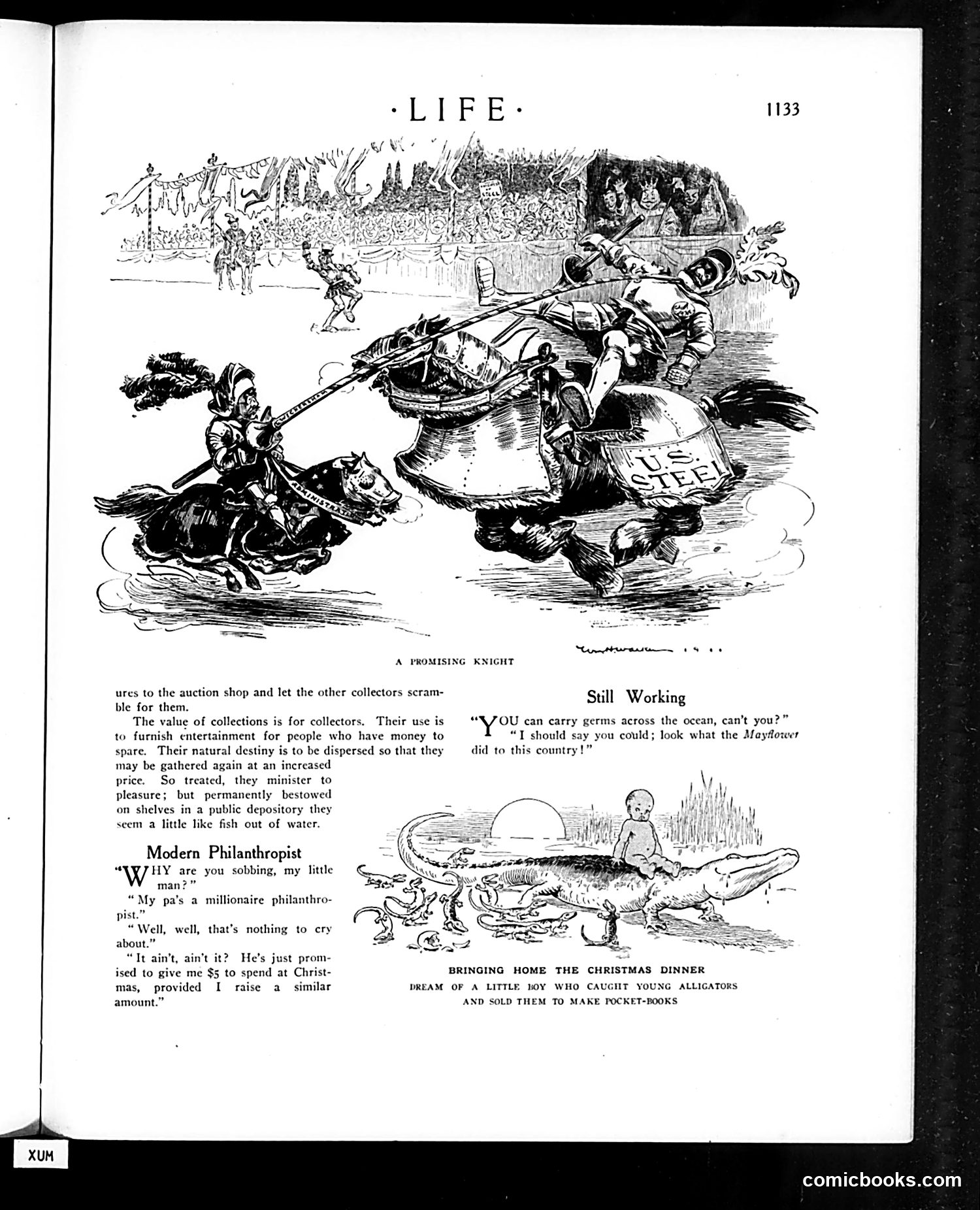
This page contains three distinct satirical pieces: **"A Promising Knight"** (top): A large illustration showing an armored knight jousting, likely satirizing wealthy collectors who treat art acquisition as a competitive sport—competing for prestige rather than genuine appreciation. **"Modern Philanthropist"** (left): A joke mocking wealthy philanthropists' stingy conditional charity. A millionaire promises his son only $5 for Christmas *if* the boy raises matching funds himself—exposing the hypocrisy of the ultra-rich who publicly pose as generous while being miserly in practice. **"Still Working"** (right): A brief dialogue satirizing disease transmission fears, likely referencing post-WWI anxieties about germs and the Mayflower's historical role in bringing disease to America—an ironic comment that Old World immigration itself was a "plague." **"Bringing Home the Christmas Dinner"** (bottom): A boy's fantasy of catching alligators and selling them as pocket-books—satirizing childhood entrepreneurial dreams and the commercialization of nature, possibly also mocking the alligator-skin luxury goods market. All pieces target wealth, greed, and social pretension.
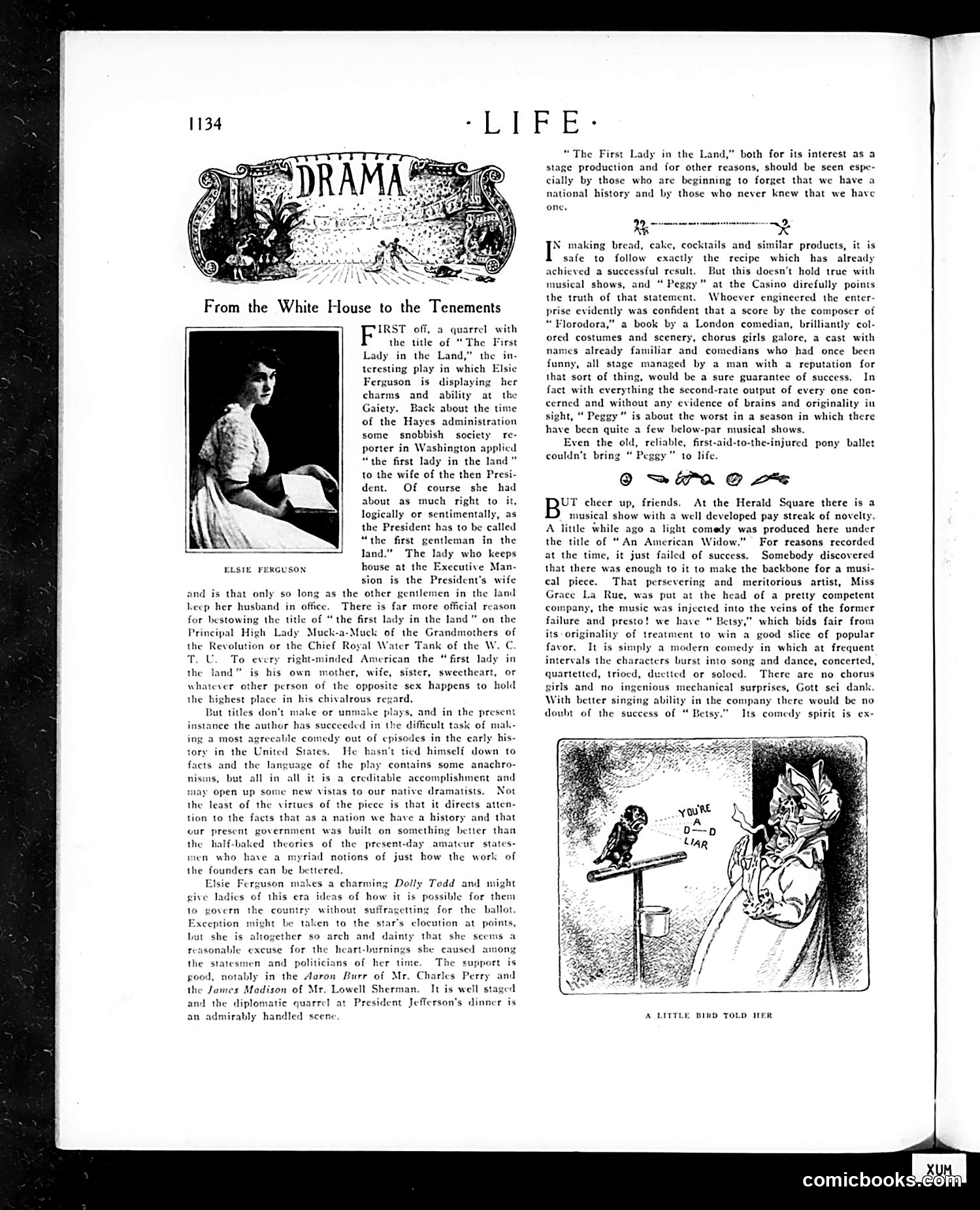
This page reviews two theatrical productions. The main article discusses "The First Lady in the Land," starring Elsie Ferguson, a play about early American history featuring Dolly Todd (James Madison's wife). The reviewer critiques the pretentious title "First Lady," arguing it's undeserved—the President's wife holds the title only while her husband serves. Ferguson plays the role charmingly, and the reviewer praises the production for reminding Americans of their national history, though it contains historical inaccuracies. The second review (partially visible) pans "Peggy" at the Casino theater, arguing that unlike recipes, musicals can't simply combine established ingredients—a famous composer, London book, costumes, and comedians—to guarantee success. The show apparently failed despite these elements, lacking originality and intelligence. The small cartoon titled "A Little Bird Told Her" (bottom right) is unclear without additional context.
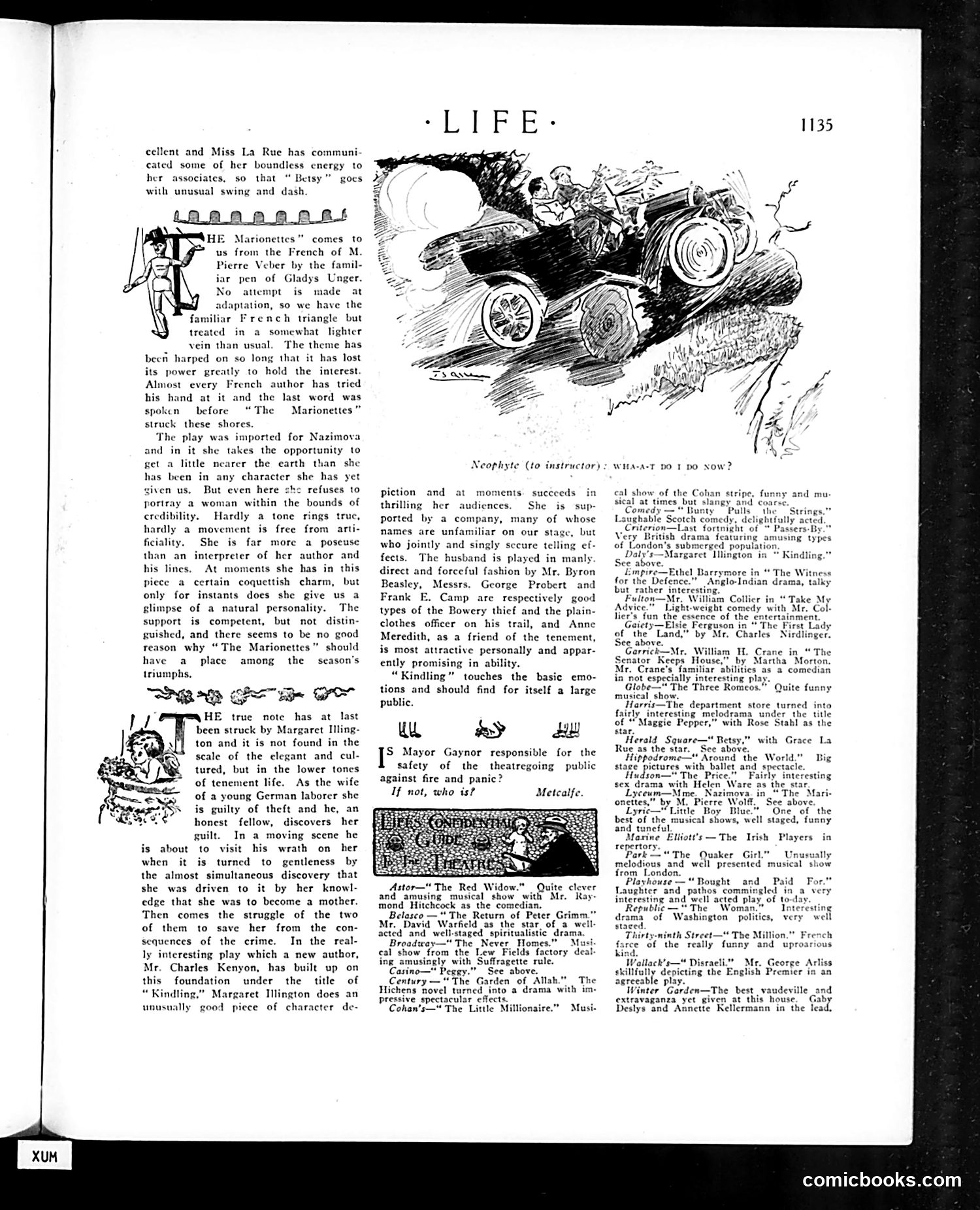
This page contains theatre reviews from an early 20th-century American satirical magazine. The main cartoons and commentary focus on Broadway productions and theatrical criticism rather than political satire. The prominent cartoon shows a car accident—likely satirizing early automobile dangers, a contemporary concern as cars were still novel and hazardous. The text reviews several plays, including critical commentary on actress Nazimova in "The Marionettes" (adapted from French), and praise for Margaret Illington in "Kindling," a new play about working-class tenement life by Charles Kenyon. A small political cartoon by "Metcalfe" asks whether Mayor Gaynor bears responsibility for theatre fire safety—referencing real fire-safety concerns at the time, particularly following major theatre disasters. The page also lists current Broadway shows with brief descriptions, demonstrating the magazine's focus on entertainment and urban culture rather than explicit political commentary.
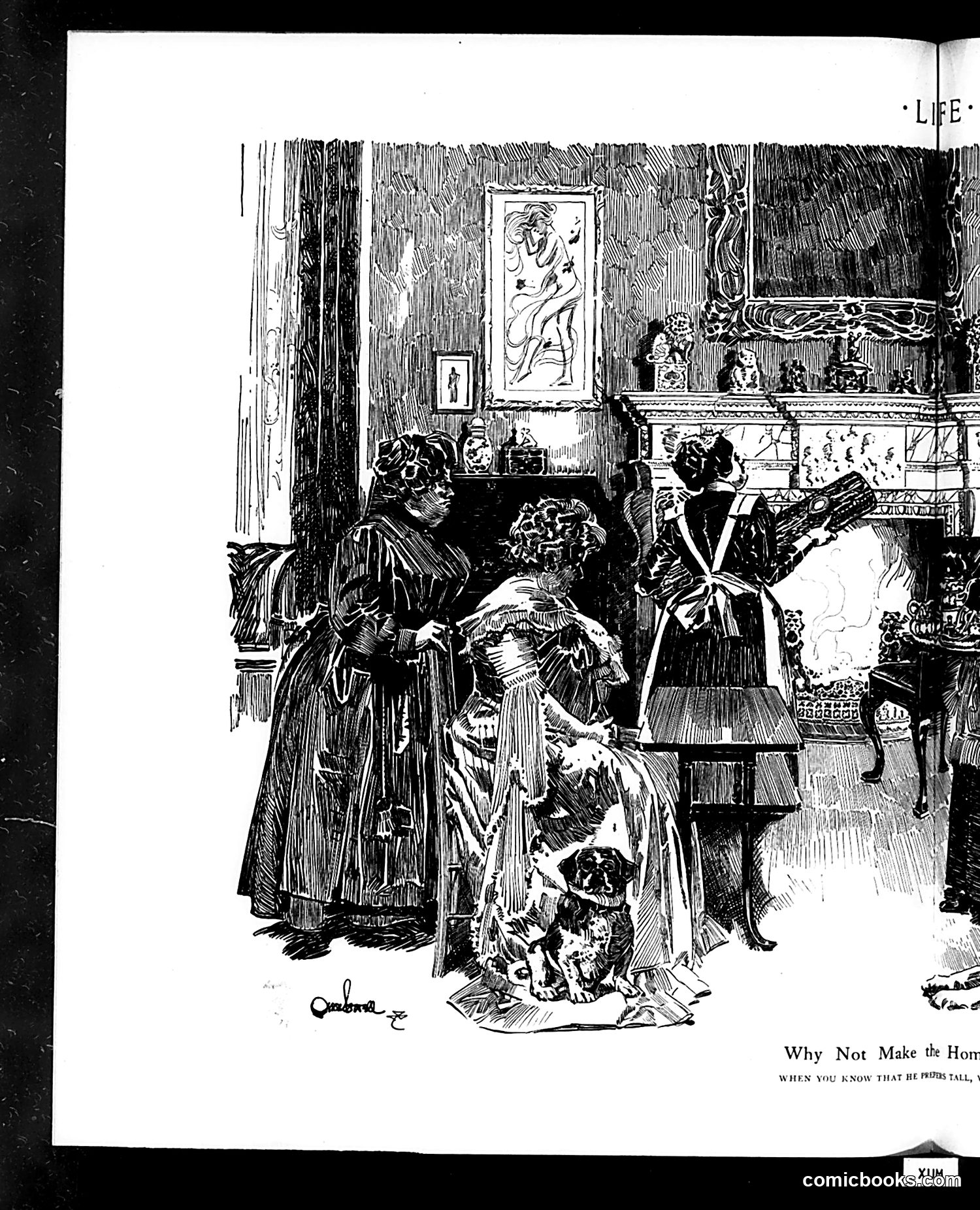
This appears to be a satirical cartoon from an early 20th-century issue of *Life* magazine. The illustration depicts an elegant interior scene with well-dressed figures, including what appears to be a woman seated centrally and several standing attendants or guests. The partial caption reads "Why Not Make the Hon[orable]..." with reference to someone who "presses tall." The satire likely mocks the pretensions of high society or political figures—possibly suggesting that someone of questionable character or abilities should be elevated to an honorable position based on superficial qualities like height or appearance. The ornate interior setting and formal dress emphasize the superficiality of social/political advancement being criticized. However, without the complete caption or publication date, the specific political reference remains unclear.
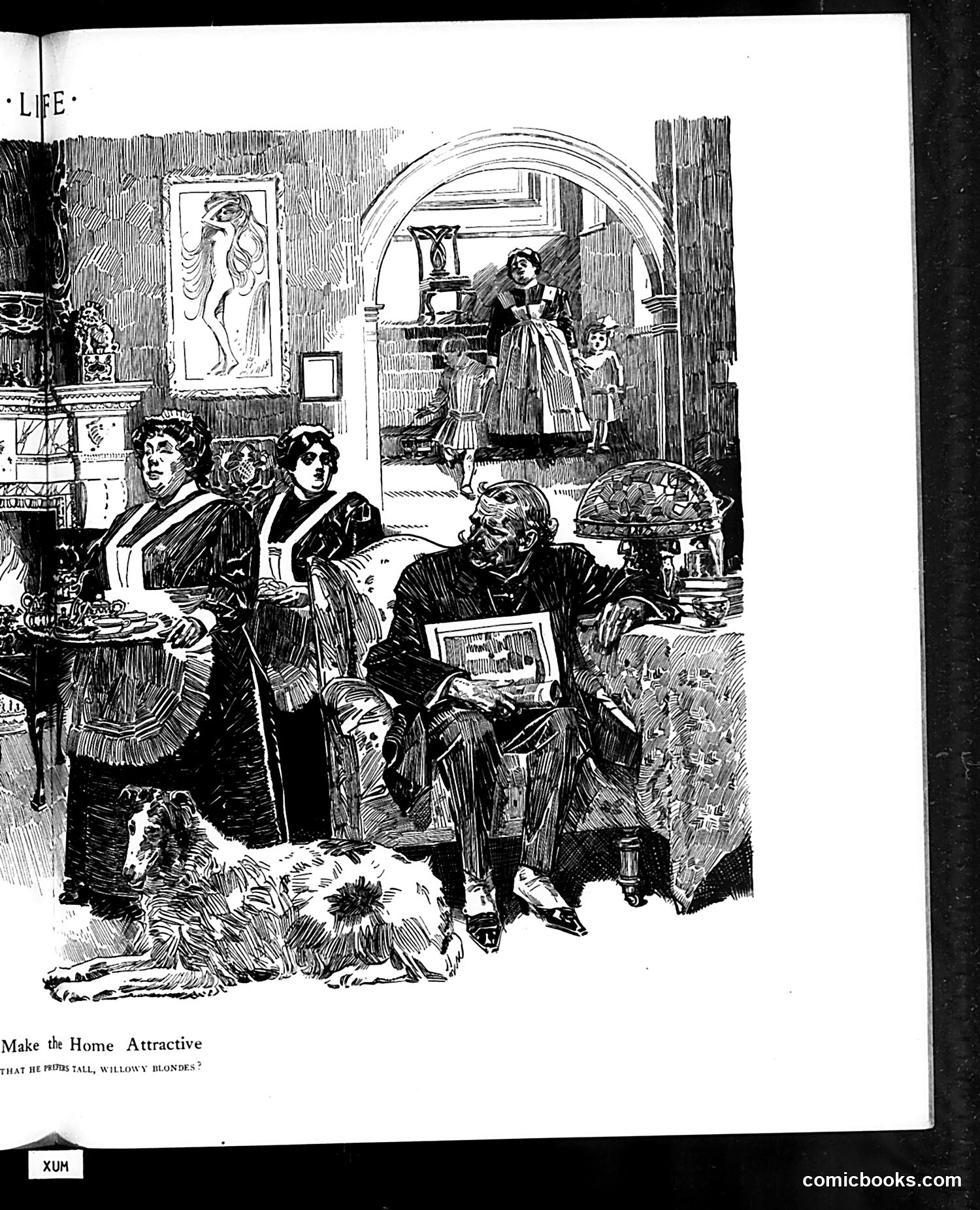
This satirical cartoon from *Life* magazine illustrates the saying "Make the Home Attractive" with a domestic scene. The caption, "That He Prefers Tall, Willowy Blondes?" appears sarcastic. The image shows a man reading a newspaper while seated at home, surrounded by women (his wife and visitors, apparently). A dog lies at his feet. The composition suggests domestic social life—the very opposite of "tall, willowy blondes." The satire targets the disconnect between men's stated preferences and domestic reality. While the gentleman might claim to prefer idealized beauties, he's actually surrounded by everyday household company: his wife, family, and social callers. The joke mocks the gap between male fantasy and the actual married life men experience, suggesting that "making the home attractive" means accepting real domestic circumstances rather than chasing unattainable ideals.
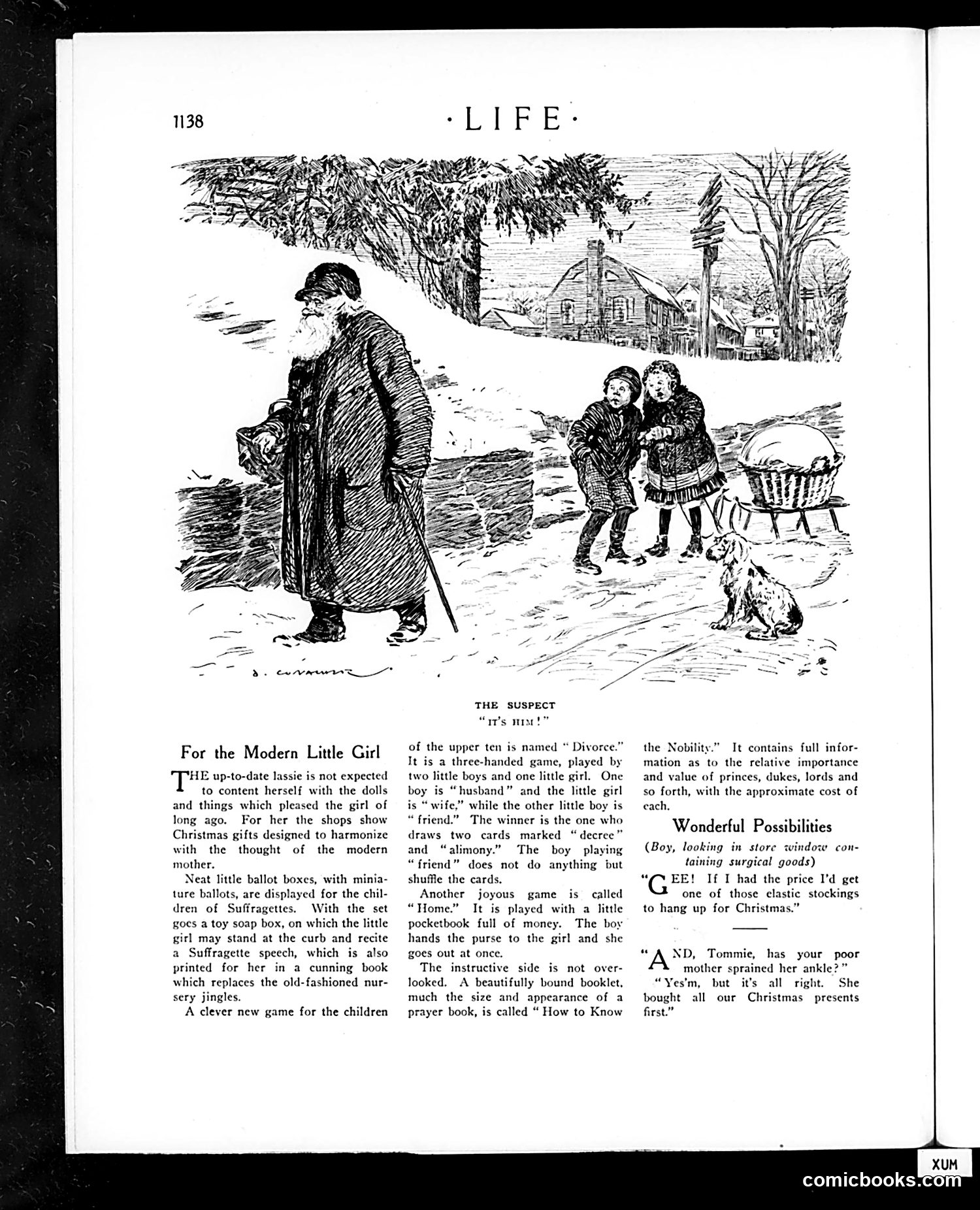
This page satirizes early 20th-century social anxieties about women's changing roles. The main article mocks "modern" Christmas gifts for girls, including toy ballot boxes and suffragette speech kits—ridiculing the women's suffrage movement by suggesting it corrupts childhood innocence. The "Divorce" card game parodies wealthy society's perceived moral decline, depicting infidelity and marital dissolution as entertainment for children. The "Home" game sardonically shows a girl immediately spending money, reinforcing stereotypes about female frivolousness. The cartoon "The Suspect" (top) appears to show an elderly man regarded with suspicion by children and a dog—likely commenting on generational conflict or moral disapproval, though the specific reference is unclear. The final anecdote about the boy wanting elastic stockings for Christmas as a gift reflects Depression-era poverty, contrasting sharply with the article's focus on wealthy frivolity.
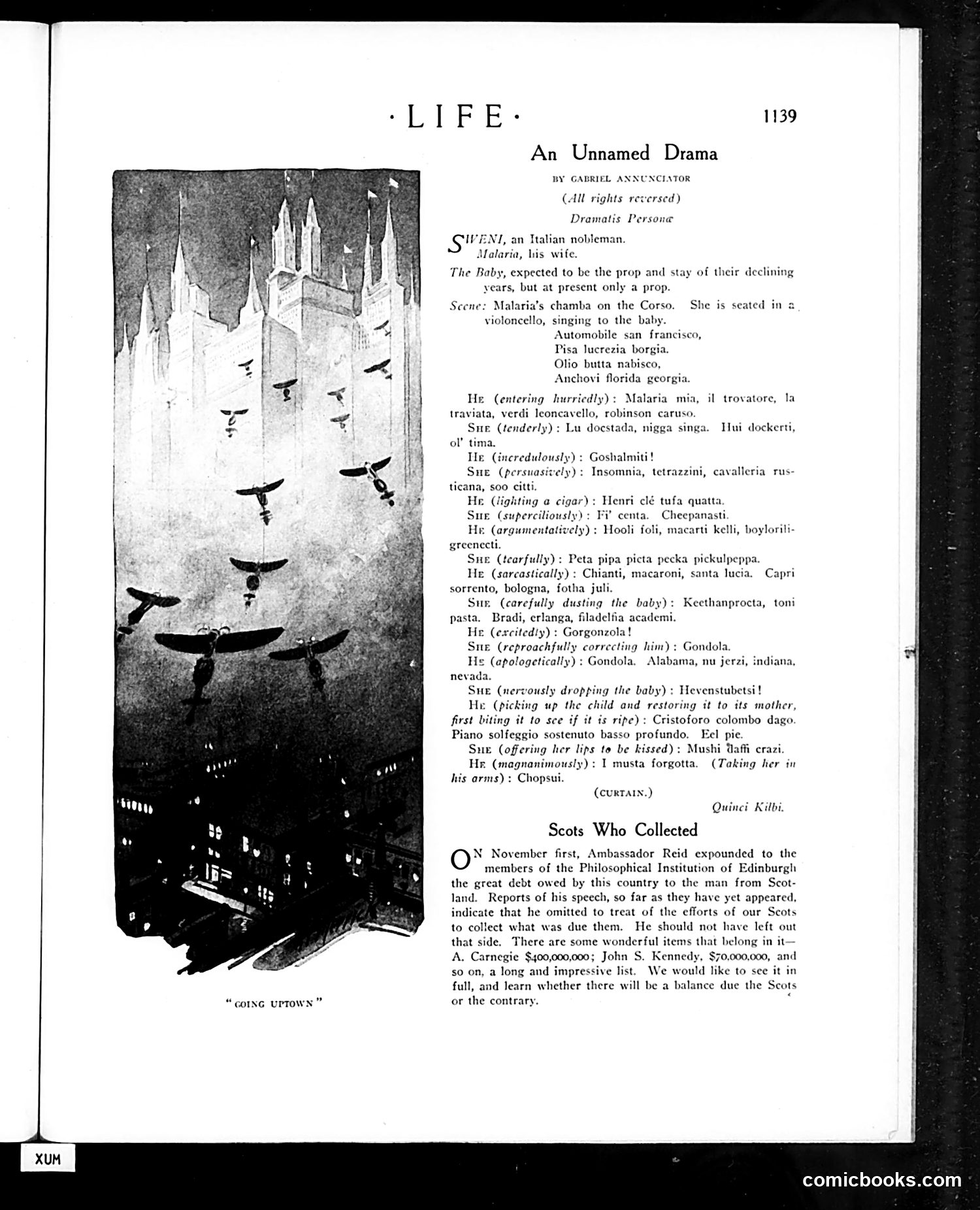
This is a satirical one-act play mocking Italian opera culture and Italian-American stereotypes. The "drama" features Siveni (an Italian nobleman) and Malaria (his wife) who communicate entirely in a nonsensical mishmash of Italian opera titles, food names, and gibberish—"Automobile san francisco," "Pisa lucrezia borgia," "Gorgonzola," "Gondola," etc. The humor targets two audiences: wealthy Americans who pretended to appreciate opera as high culture, and Italian immigrants. The baby, a "prop" rather than a real character, gets dropped and bitten in slapstick fashion. The accompanying article, "Scots Who Collected," sarcastically addresses Scottish philanthropists (Carnegie, Kennedy) who donated large sums to America while Scotland itself remained unpaid by those same benefactors—a jab at nationalist hypocrisy disguised as generosity.
This page consists primarily of the magazine's letters section, featuring reader correspondence on various topics—not illustrated cartoons. The main content addresses three political/social issues of the era: 1. **Teachers' Salaries and Democratic Process**: Readers debate whether organized public employees (teachers, police, firefighters) should lobby legislators for raises. The editorial stance defends majority-rule democracy over special-interest pressure, citing concerns about "organized bodies of paid workers" having advantages over individual taxpayers. 2. **A Humorous Pseudo-Intellectual Letter**: One correspondent mockingly responds to an article by "E.O.J." with deliberately absurd definitions distinguishing "materia medica" from "pharmacopaia," satirizing obfuscatory academic writing. 3. **Historical Correction**: A reader corrects an error about Emperor Conrad III besieging Munich, clarifying it was actually Weinsberg—a pedantic but legitimate historical note. The page reflects Progressive Era debates about labor organization, government spending, and democratic representation circa 1911.
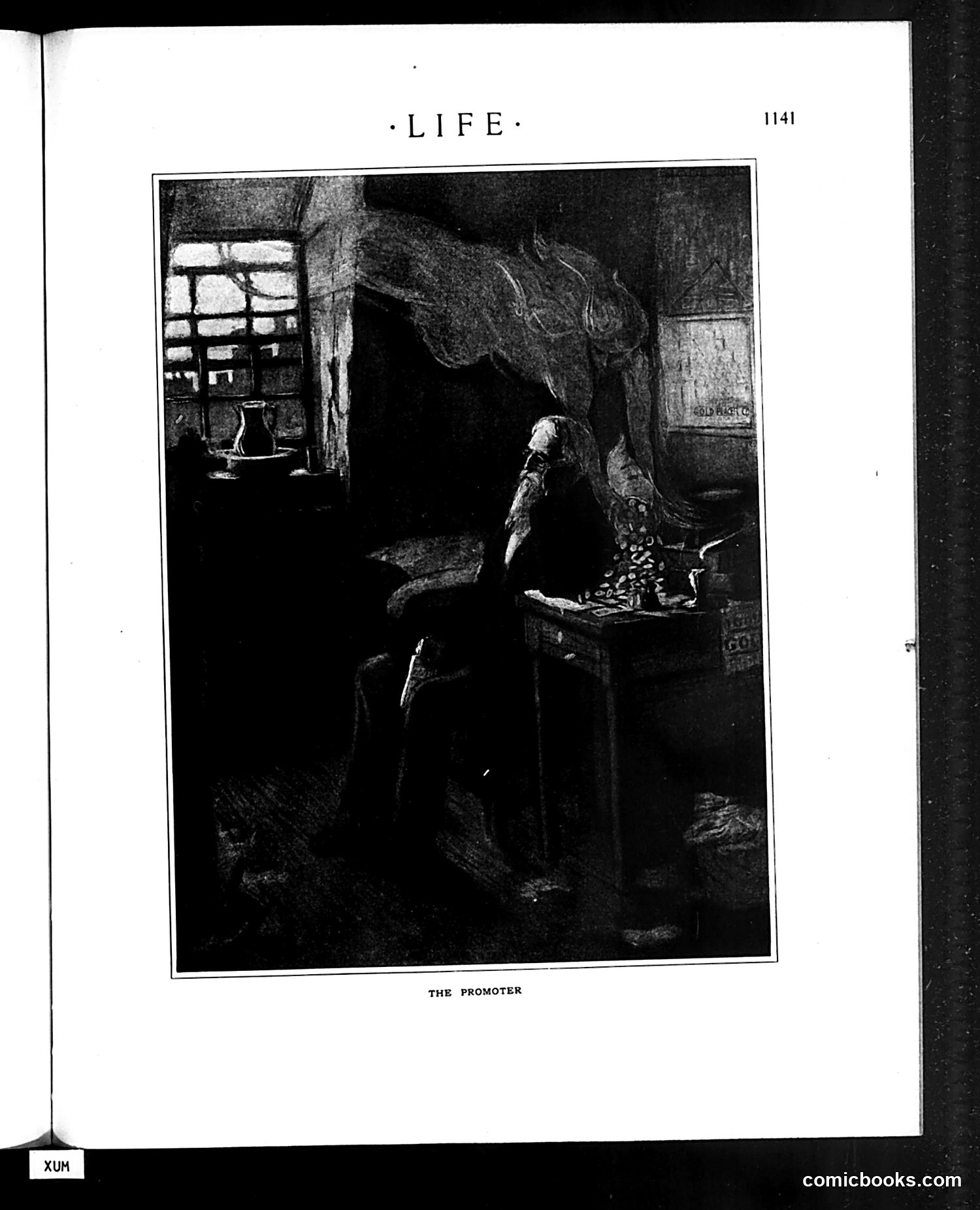
This illustration depicts a scene titled "The Promoter" showing what appears to be a scheming figure in dark clothing positioned in a dimly-lit interior space. The figure's body language and positioning suggest deception or manipulation—a classic depiction of someone engaged in dubious dealings. The artwork employs heavy shadows and dramatic lighting typical of early 20th-century satirical illustration, emphasizing the sinister nature of the "promoter" character. The setting appears to be a modest or shabby room, reinforcing the satirical critique. Without additional context from surrounding text or caption, the specific target of this satire remains unclear—though "promoter" typically referenced fraudsters, financial schemers, or unscrupulous businessmen of the era, common subjects for Life's social commentary.
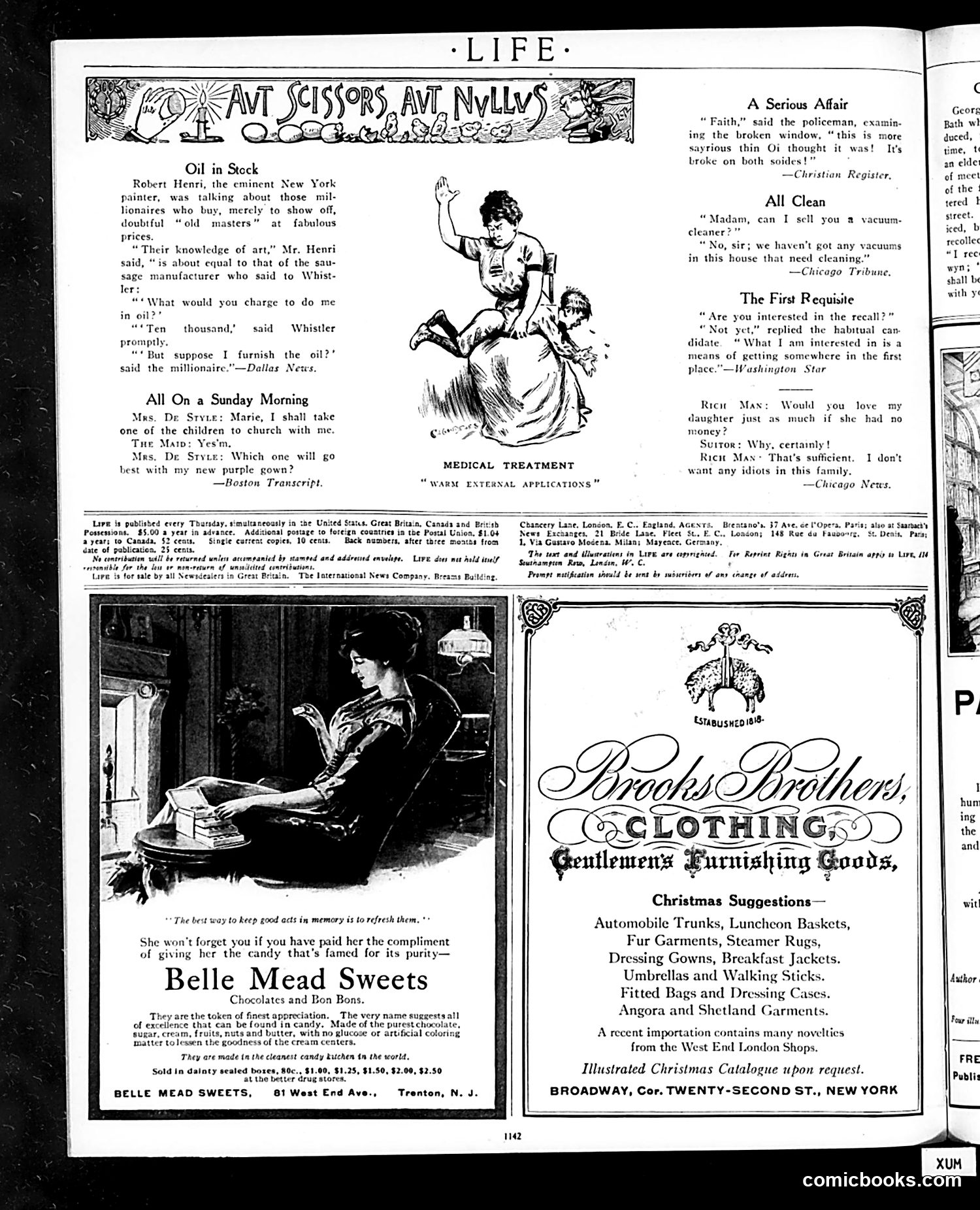
This page from *Life* magazine presents several short humor pieces satirizing early 20th-century American society: **"Oil in Stock"** mocks wealthy art collectors' ignorance. Painter Robert Henri recounts an anecdote where a millionaire asks Whistler (the famous artist) to paint him in oil, offering to supply the materials himself—implying money can substitute for taste or artistic merit. **"All On a Sunday Morning"** satirizes status-obsessed wealthy women. Mrs. De Style chooses which child to bring to church based on which will best complement her new purple gown, treating her children as fashion accessories. **"A Serious Affair"** and other brief jokes mock various modern anxieties: vacuum cleaner salesmen, political recall elections, and gold-diggers. The central illustration depicts a woman with children, likely illustrating domestic life themes. The page mostly contains advertisements (Belle Mead Sweets candy, Brooks Brothers clothing), reflecting *Life*'s reliance on advertising revenue. Overall, the satire targets wealthy pretension, consumerism, and shallow values among the American upper classes.
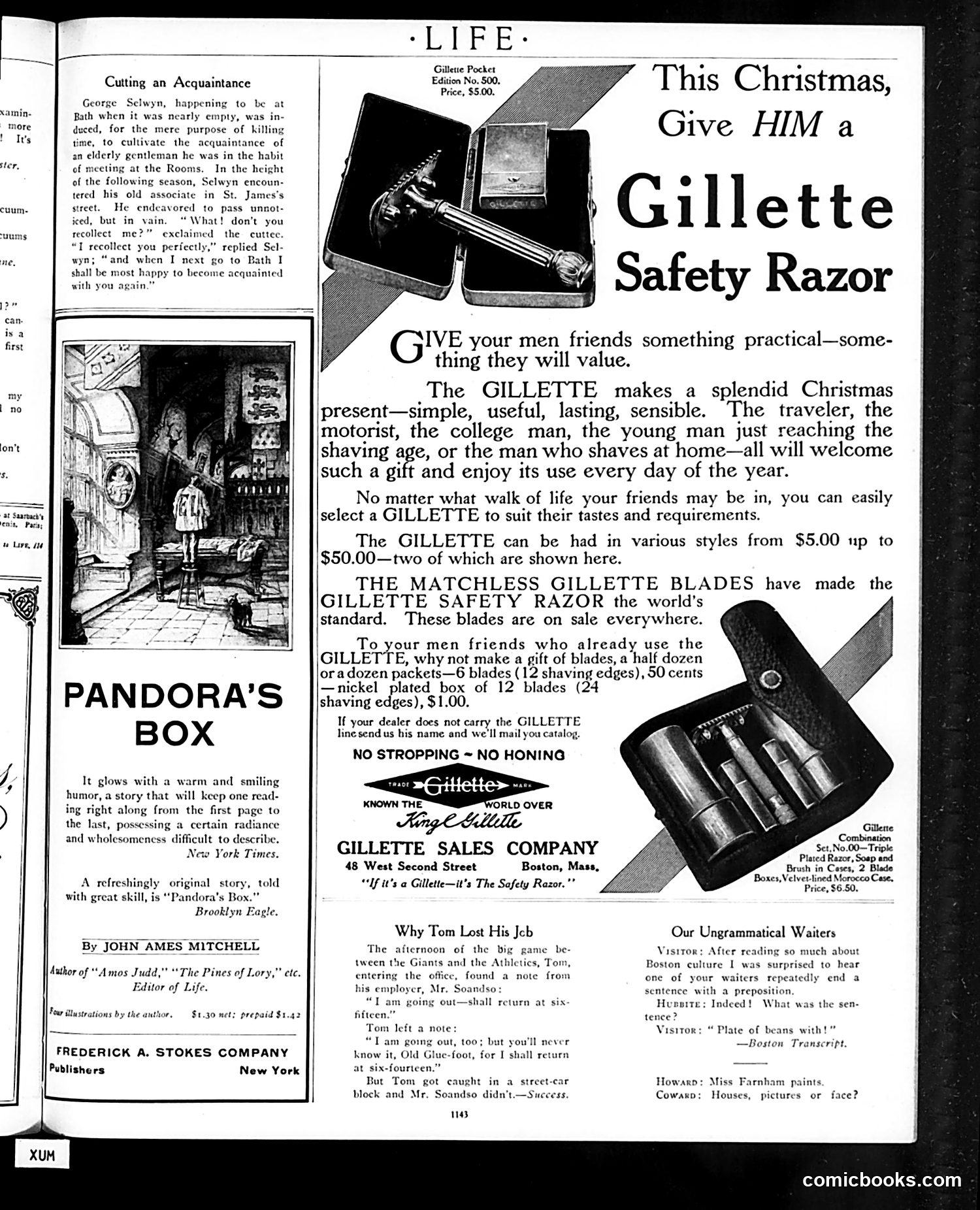
This page is primarily **advertising**, dominated by a large Gillette Safety Razor Christmas gift advertisement. The razor is pitched as practical for "the traveler, the motorist, the college man" — targeting male gift-givers seeking useful presents. Models range from $5 to $50. The page also includes three brief anecdotes: "Cutting an Acquaintance" (a Georgian-era story about social snubbing), "Why Tom Lost His Job" (workplace humor about a tardy employee using an alibi), and "Our Ungrammatical Waiters" (a joke about Boston dialect, mocking a waiter ending a sentence with a preposition). A book advertisement for *Pandora's Box* by John Ames Mitchell appears on the left. **Context for modern readers:** The Gillette ad reflects early 20th-century marketing targeting men, emphasizing practicality. The brief jokes rely on period-specific social hierarchies and linguistic humor now largely obscured.
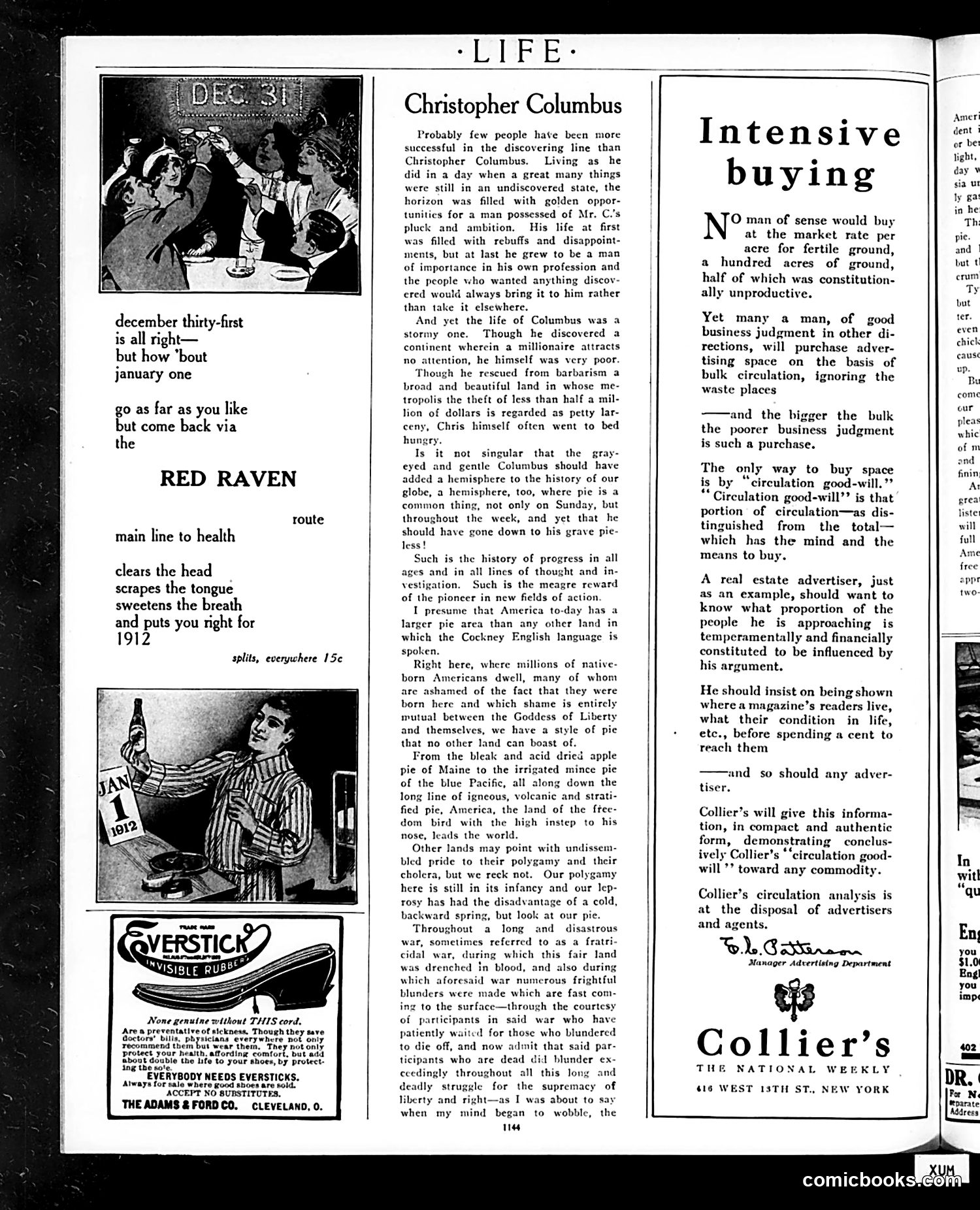
This page combines editorial content with advertisements, primarily satirizing American materialism and business practices around the 1912 New Year. **The Christopher Columbus Essay** mocks American exceptionalism through ironic praise. The piece celebrates Columbus's discovery of America while noting he died poor—then pivots to celebrating American pie as our national achievement, above polygamy or cholera. The satire suggests Americans take pride in trivial comforts rather than meaningful accomplishments. The digression about the Civil War and lingering blame subtly critiques unresolved national divisions. **The Advertisement Section** features the Red Raven route (likely a beverage or tonic) marketed as a "main line to health," and Eversticks (shoe products), both making dubious health claims typical of early 1900s patent medicine advertising. **The "Intensive Buying" Article** warns against poor real estate judgment, cautioning businessmen against purchasing unproductive land—practical advice amid what appears to be a speculative boom period. Overall, the page satirizes American consumerism and optimism while hawking dubious products.
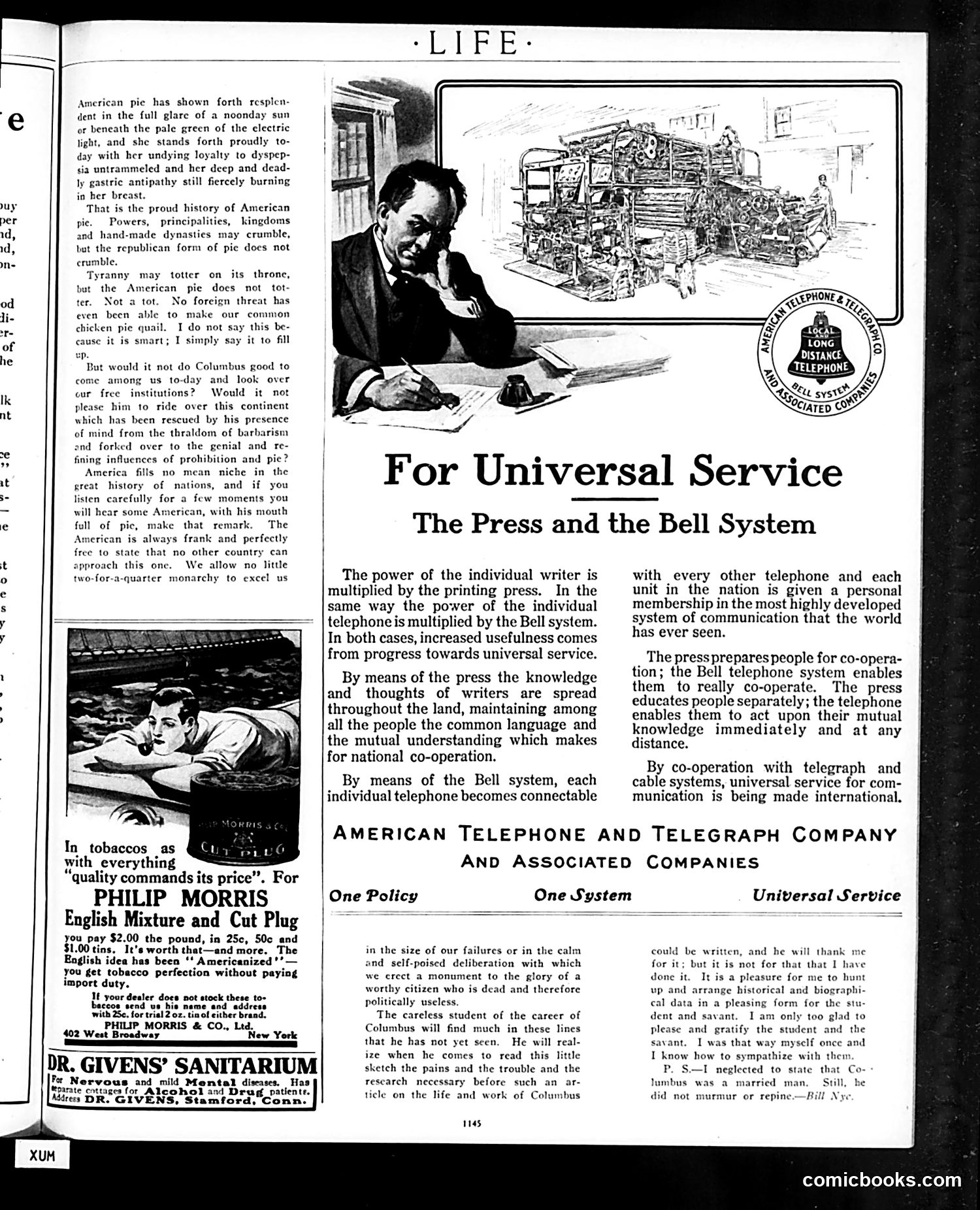
This page is primarily **advertising disguised as editorial content**, characteristic of early 20th-century *Life* magazine's satirical approach. The main text is a rambling, absurdist essay **mocking American exceptionalism** through hyperbolic praise of the American pie. The author sarcastically celebrates pie as a symbol of national superiority, then jokes about Columbus and prohibition—suggesting naive patriotism deserves ridicule. The page features **three separate advertisements** presented as editorial: 1. **Philip Morris tobacco** — uses the pie essay's opening to advertise cigarettes 2. **Bell Telephone System** — compares printing press to telephone technology, arguing both enable national unity and cooperation 3. **Dr. Givens' Sanitarium** — advertises medical treatment The satire works by juxtaposing bombastic American nationalism (the pie essay) with commercial appeals, implying corporate interests exploit patriotic sentiment. The Bell ad's claim about "universal service" promoting national cooperation is particularly ironic given the surrounding commercial context.
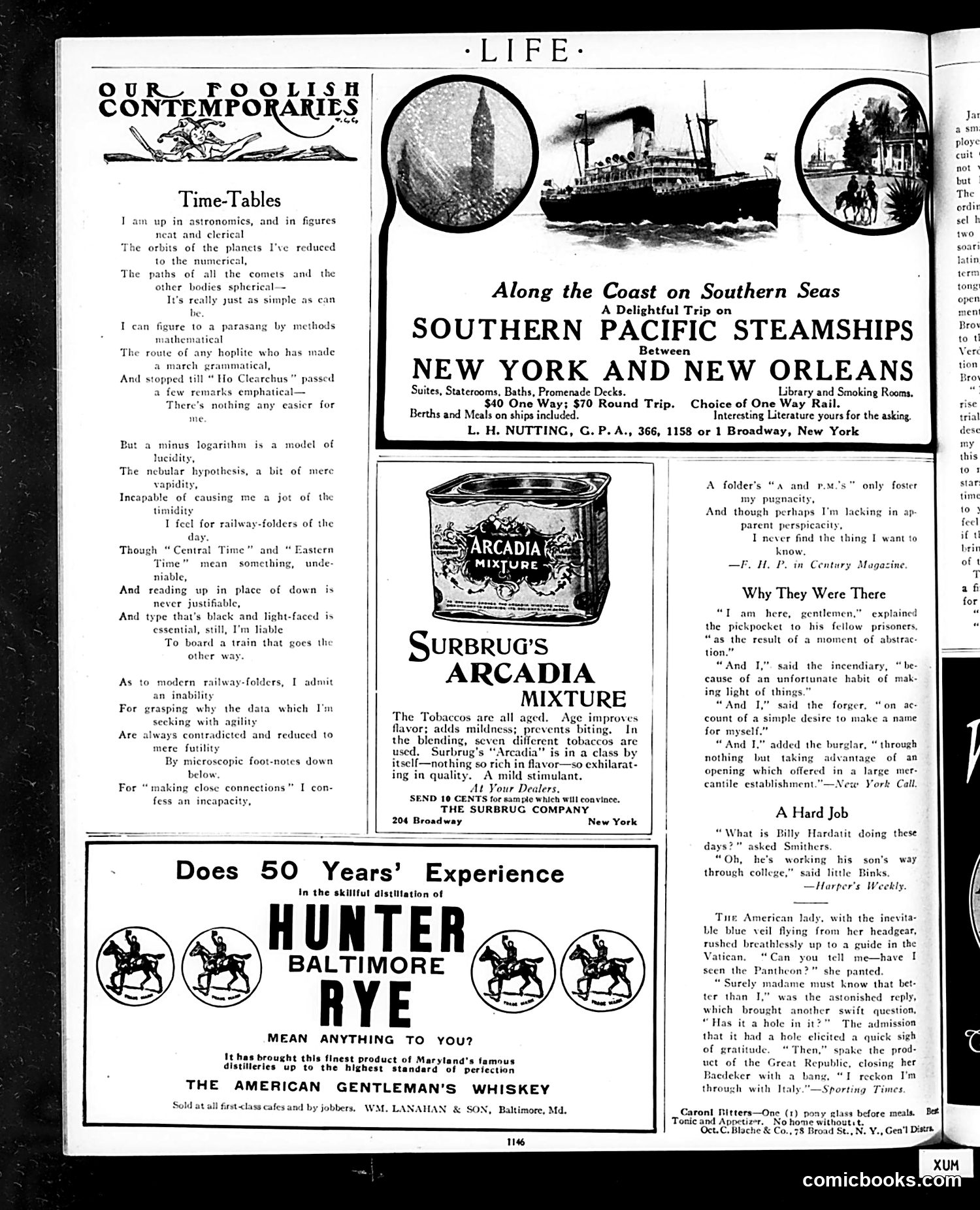
This page is primarily **advertisements and light humor**, not political satire. The main content includes: **"Time-Tables" poem (left):** A humorous complaint about railway scheduling confusion. The poet claims expertise in astronomy and mathematics but admits he can't figure out train timetables—the joke being that even an educated person finds these schedules baffling and boards trains going the wrong direction. This reflects **early 1900s frustrations with competing railway time zones** before standardization. **Illustrated anecdotes (right):** Brief jokes about criminals explaining their crimes, a tired father working to pay for his son's college, and an American tourist in Rome. These are gentle, general-audience humor with no specific political target. **Advertisements:** Steamship cruises, tobacco, and whiskey occupy significant space—typical Life magazine content from this era. The page reflects **Edwardian-era concerns**: railway logistics, leisure travel, and everyday social situations, rather than partisan politics or topical satire.
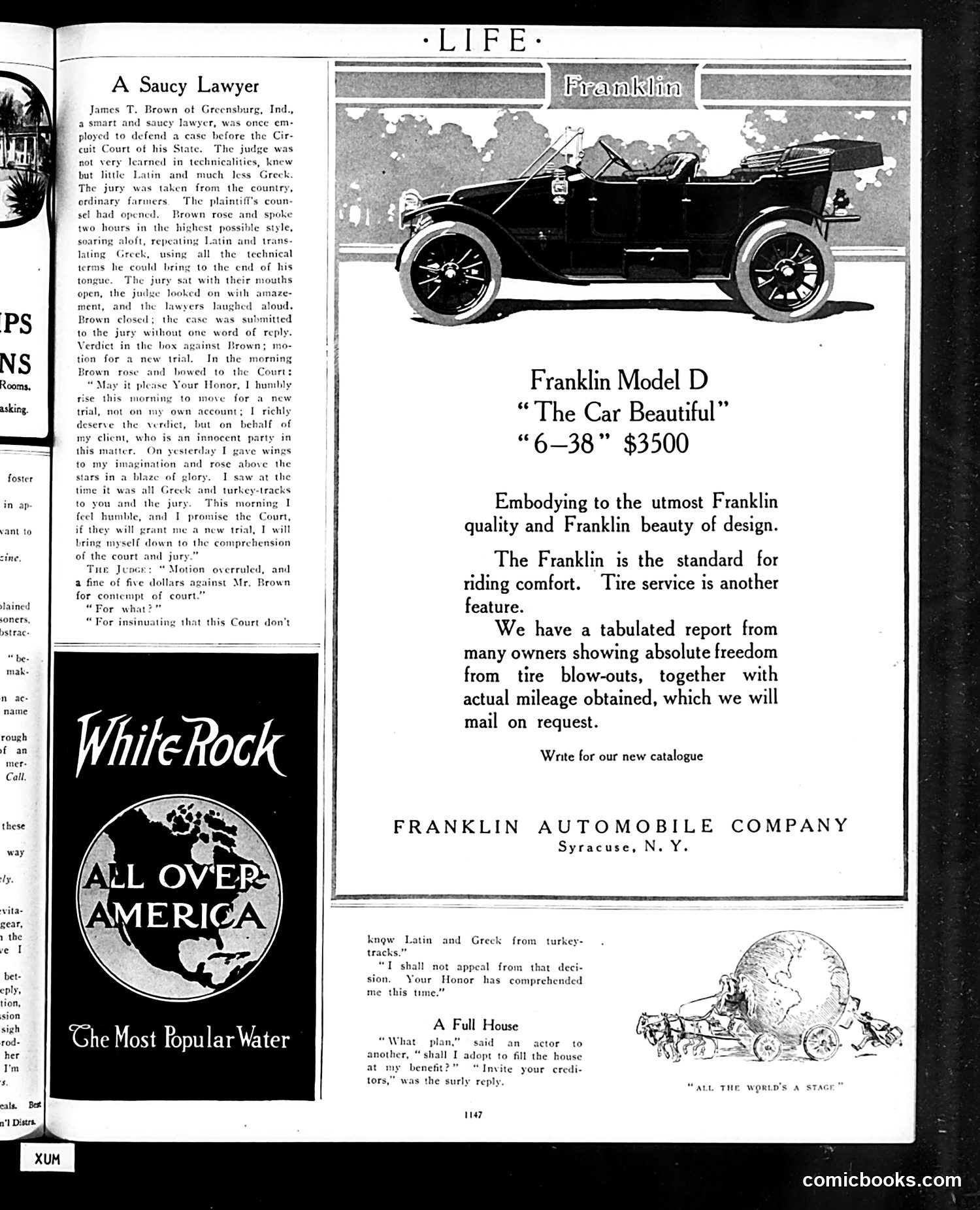
This is a humorous anecdote about lawyer James T. Brown of Greensburg, Indiana, who loses a case by over-complicating his argument. Brown speaks for two hours using excessive Latin and Greek legal terminology to a rural jury of ordinary farmers and a judge unfamiliar with such technicalities. The jury and court are baffled ("mouths open"). After losing, Brown sarcastically moves for a new trial, claiming the judge and jury couldn't understand his Greek references—essentially insulting the court's intelligence. The judge fines him five dollars for contempt of court. **The satire:** This mocks pretentious lawyers who use obscure jargon to impress rather than persuade, and highlights the gap between educated professionals and common people. Brown's comeuppance suggests that clarity and respect for one's audience matter more than verbose erudition. The irony is that Brown's own arrogance—not the judge's ignorance—caused his defeat.
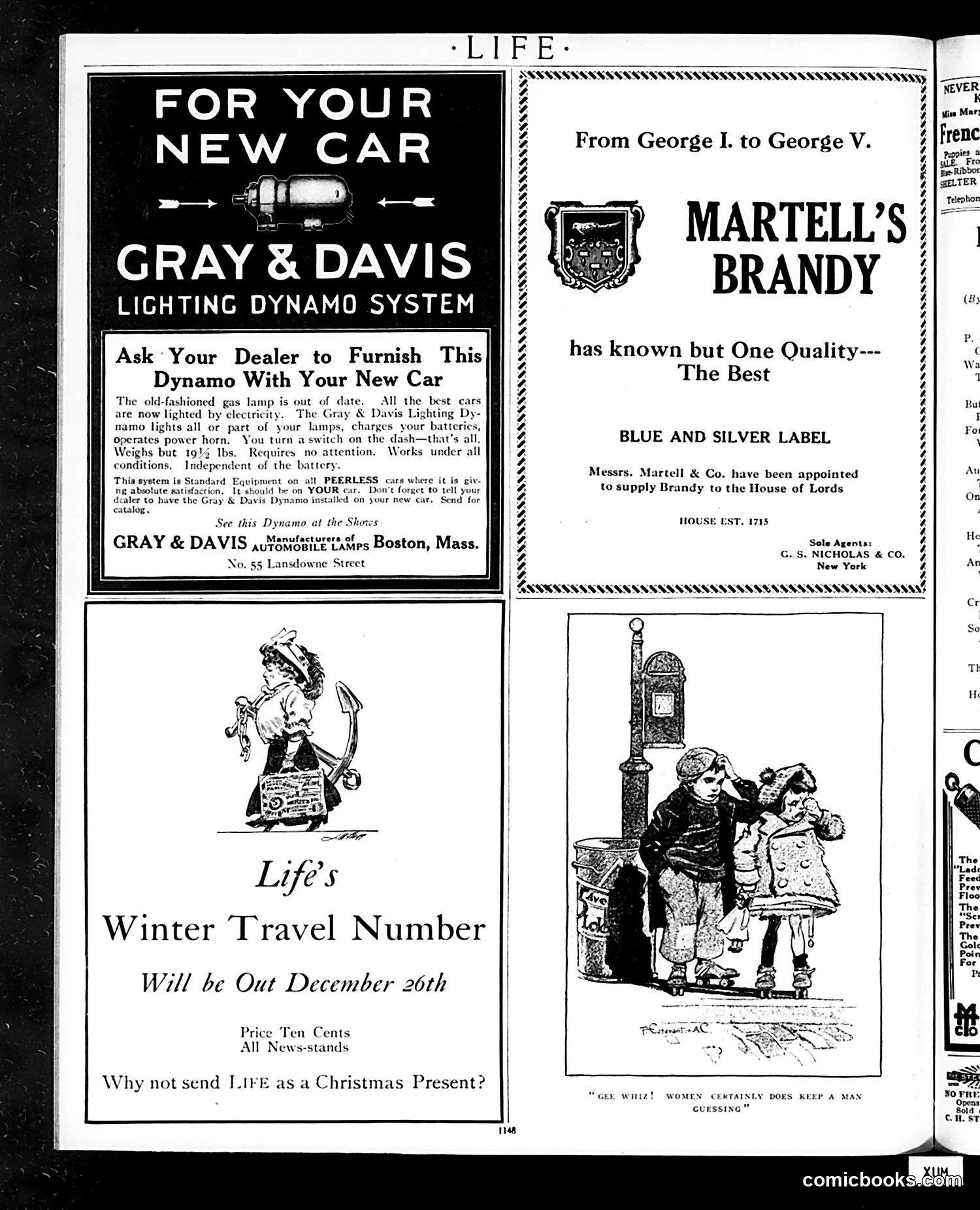
This page is primarily **advertisements and promotional content** rather than political satire. The main items are: - **Gray & Davis dynamo system**: An ad for early automobile electrical lighting technology, emphasizing modernity ("gas lamp is out of date") - **Martell's Brandy**: A luxury spirits ad leveraging prestige by claiming appointment to supply "the House of Lords," with the phrase "From George I. to George V." suggesting centuries of royal patronage - **Life's Winter Travel Number announcement**: Promoting an upcoming special issue The only cartoon is a small **domestic humor sketch** (bottom right) showing a man with two women at a street corner, with the caption "Gee whiz! Women certainly does keep a man guessing." This reflects early 20th-century gender stereotypes about female unpredictability rather than political commentary. The page reflects pre-WWI consumer culture and period attitudes toward technology, luxury goods, and gender relations.
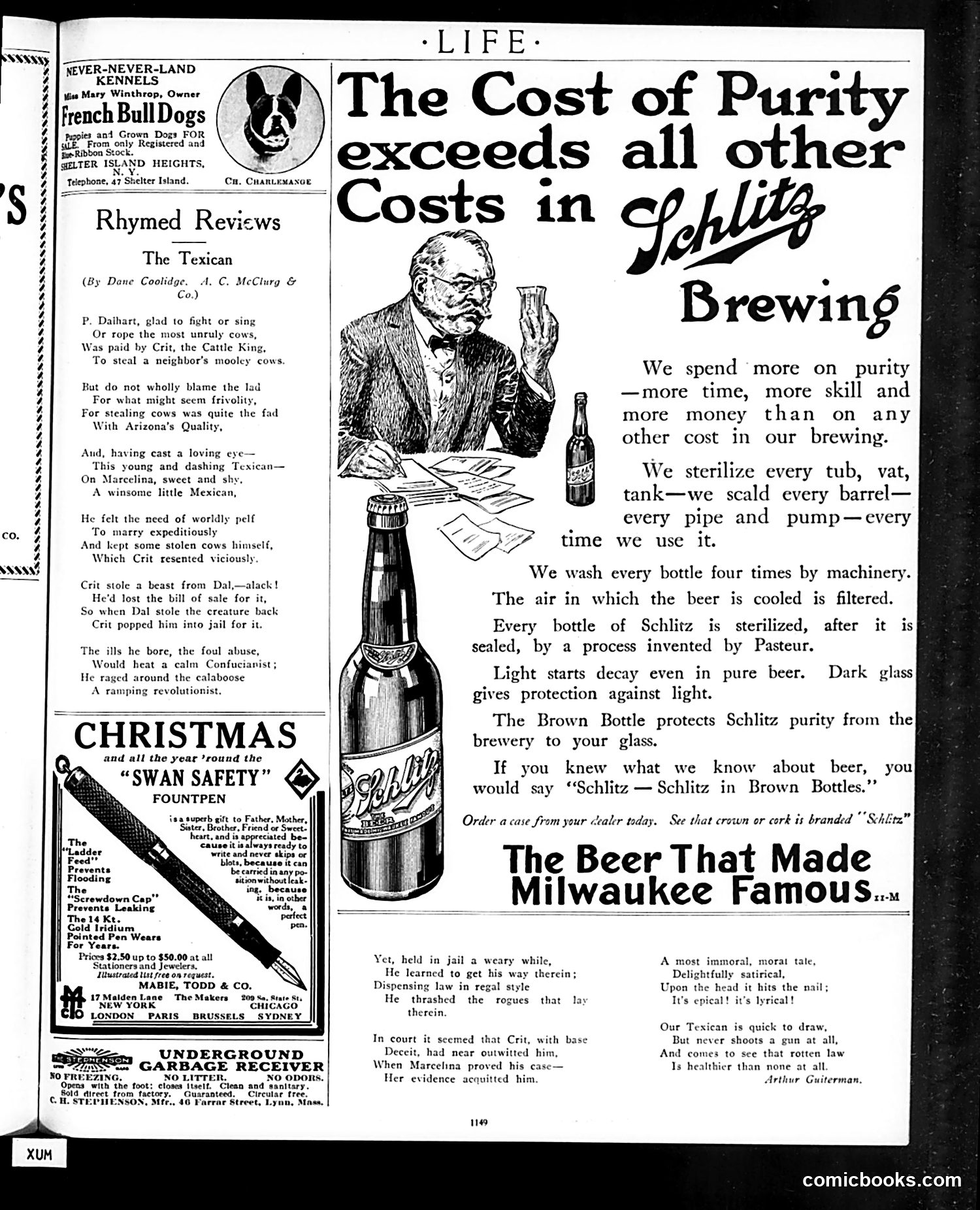
This page contains a **Schlitz beer advertisement** (the dominant feature) alongside literary and commercial content typical of Life magazine's mixed format. **The Main Advertisement:** The large Schlitz Brewing ad emphasizes purity standards, claiming they spend more on sanitation than competitors—sterilizing equipment, washing bottles four times, using Pasteur's sterilization process, and brown bottles to protect from light decay. This reflects early 20th-century advertising that capitalized on **germ theory and scientific progress** to build consumer confidence in beer quality during an era of food safety concerns. **"Rhymed Reviews":** A humorous poem reviewing "The Texican" (a novel) tells of a cattle thief named P. Daihart and his rival Crit. The satirical verse mocks the Western genre's romanticization of outlaws, following their comical legal battles. It's **literary satire** presented in accessible verse form. **Supporting Ads:** The page includes smaller advertisements for French Bulldogs, Swan Safety fountain pens, and an Underground Garbage Receiver—typical period product placement. The page reflects Life's dual role as **satirical magazine and advertising vehicle** for consumer goods.
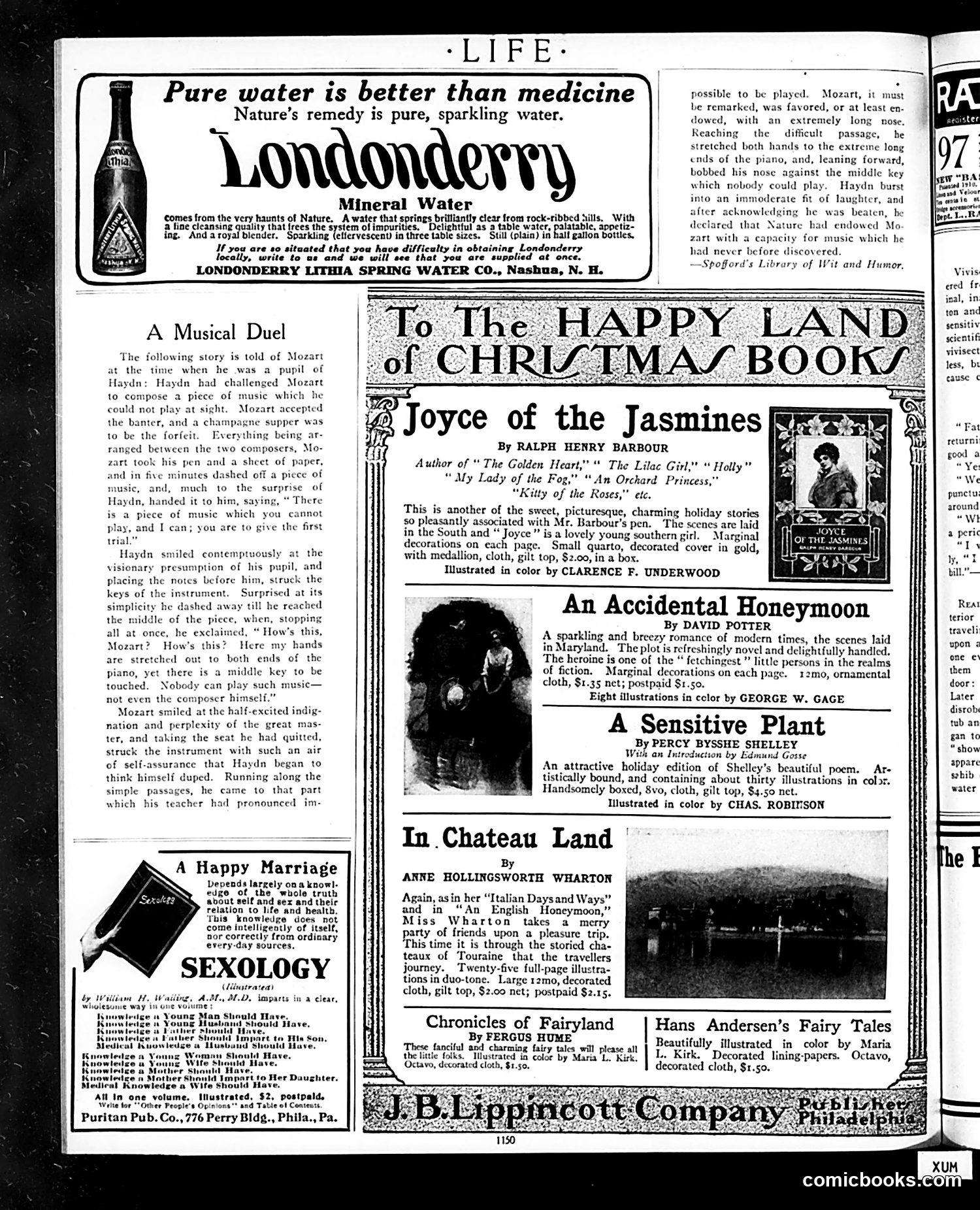
This page is primarily **book advertisements** for holiday gift editions, dominated by the J.B. Lippincott Company. The main narrative content is "A Musical Duel," a anecdote about Mozart as a young student of Haydn. The story illustrates Mozart's precocious genius: when Haydn challenges him to compose an unplayable piece, Mozart creates music so simple it appears trivial—until Haydn reaches the middle passage where Mozart deliberately uses an extremely high note that **only Mozart's notably long nose can physically play by striking the piano key**. This is the satirical "trick"—Mozart exploits his anatomical peculiarity to win the wager. The joke relies on period knowledge: Mozart was famously caricatured with an elongated nose. The anecdote humorously depicts artistic rivalry and youthful cleverness triumphing through unconventional means. The surrounding advertisements showcase other festive books: "Joyce of the Jasmines," "An Accidental Honeymoon," and a Shelley edition—typical 1910s-era gift literature.
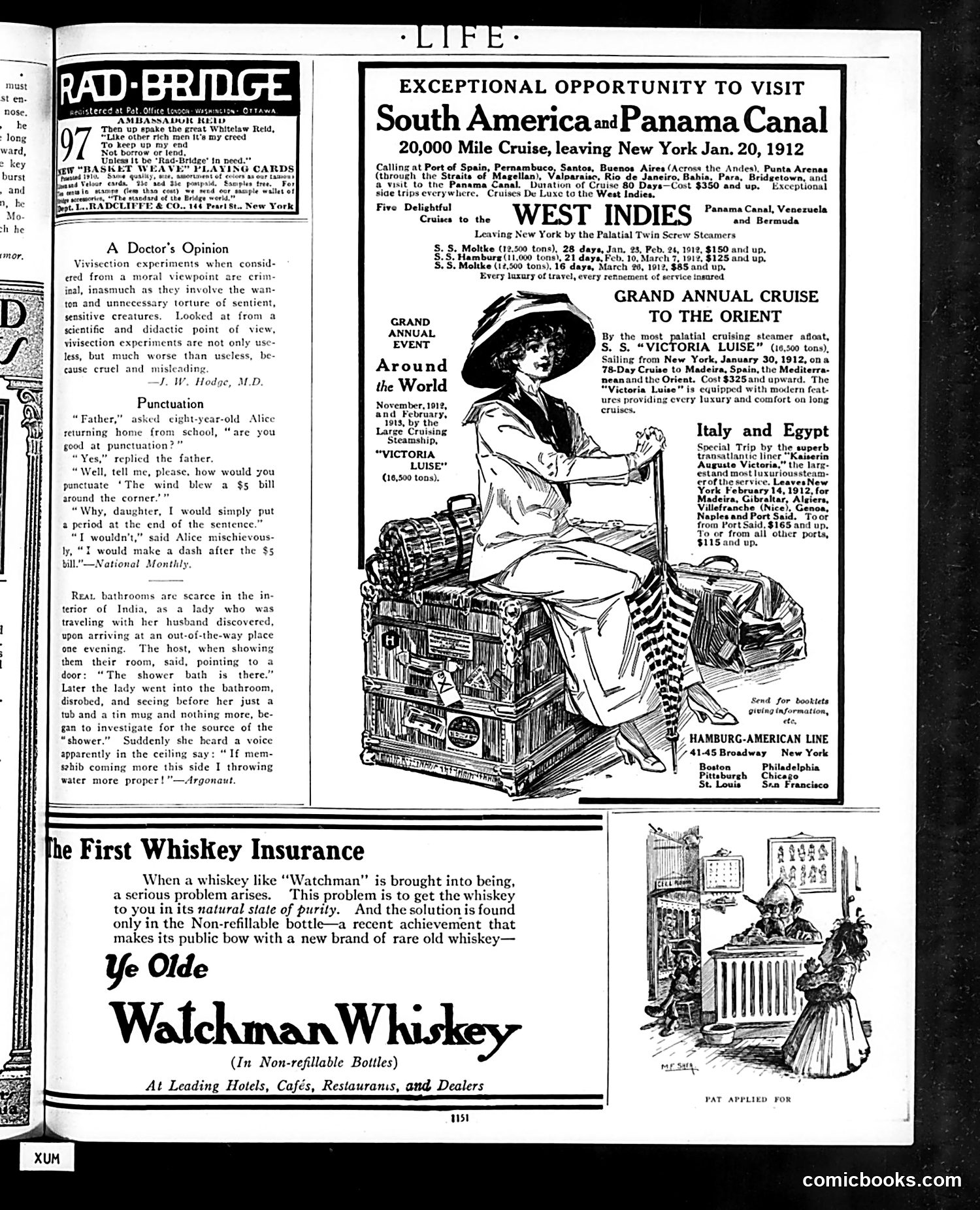
This page is primarily **advertising**, dominated by cruise line promotions and a whiskey advertisement. The editorial content consists of brief humorous anecdotes unrelated to politics or satire. **The advertisements** showcase luxury ocean travel to fashionable destinations—South America, the Panama Canal (recently opened in 1912), the Orient, and Egypt—targeting wealthy readers. The central illustration depicts a stylish woman with travel trunks, exemplifying the leisure class. **The editorial pieces** ("A Doctor's Opinion," "Punctuation," "Real Bathrooms") are lighthearted jokes with no political content. They mock vivisection, children's grammar pedantry, and colonial-era sanitation in India through gentle humor. **The Watchman Whiskey ad** addresses contemporary concerns about product authenticity and purity by promoting "non-refillable bottles" as insurance against tampering or adulteration—a real concern in the early 20th century before modern food safety regulations. The page reflects 1912 American consumer culture and advertising practices rather than political commentary or satire.
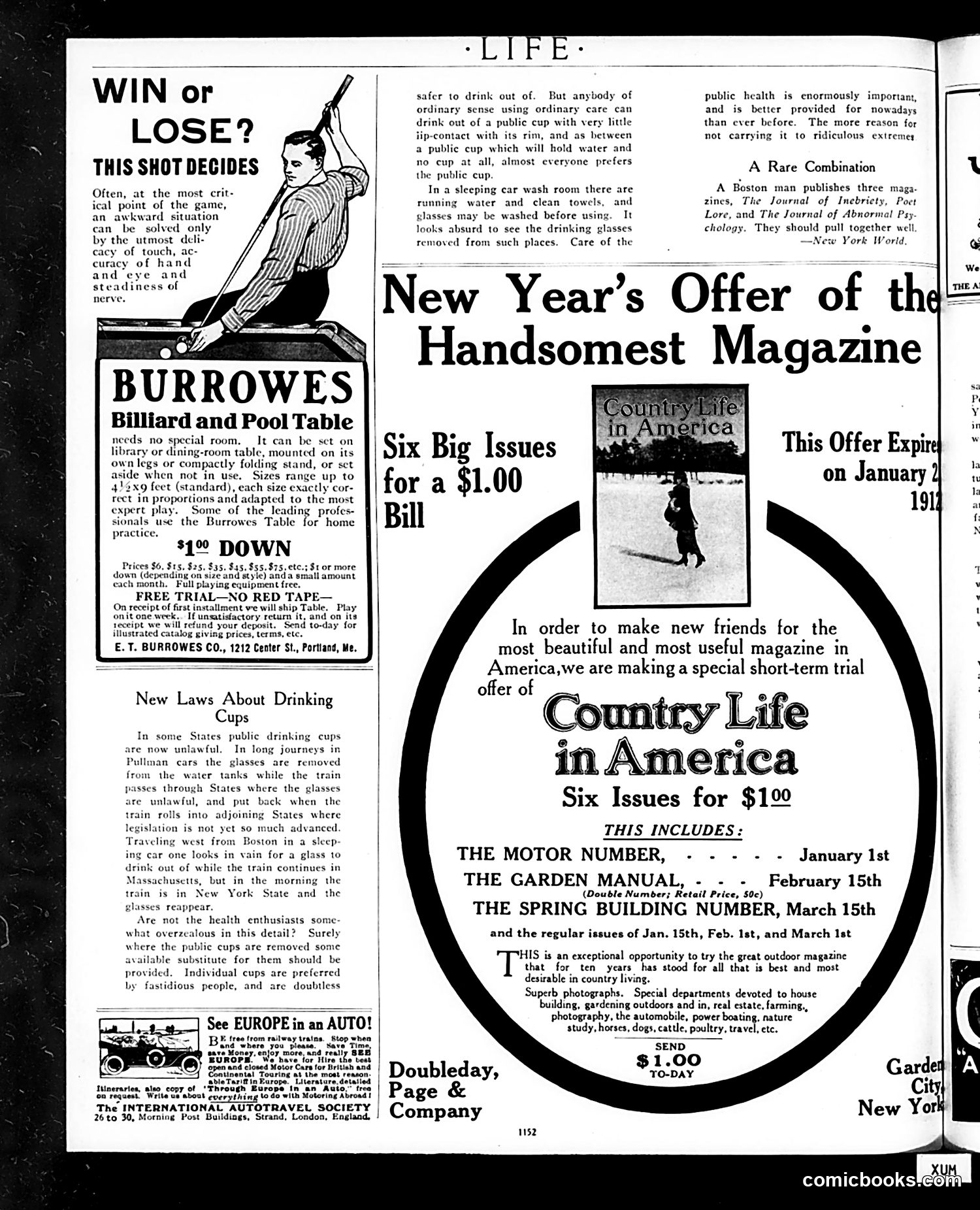
This page combines editorial content about public health with period advertisements. **The Billiards Cartoon ("Win or Lose?"):** A simple instructional illustration showing a billiards player taking a difficult shot. The accompanying text explains that crucial game moments require steady hands and careful technique—a straightforward sports diagram rather than satirical commentary. **Public Health Editorial:** The main text discusses concerns about shared drinking cups on trains and in public spaces, reflecting early 20th-century anxieties about disease transmission. It notes that some states were banning public cups, creating the absurd situation where trains had to remove glasses when crossing into states with such laws. The piece questions whether health reformers were being overzealous, while acknowledging that public health improvements were genuinely advancing. **Magazine Advertisement:** The bulk of the page promotes a subscription offer for *Country Life in America*—six issues for $1.00, marketed as a practical magazine for rural living covering gardening, automobiles, and farming. The page primarily serves as advertising rather than satirical content, with the public health discussion representing contemporary civic concern about hygiene standards.
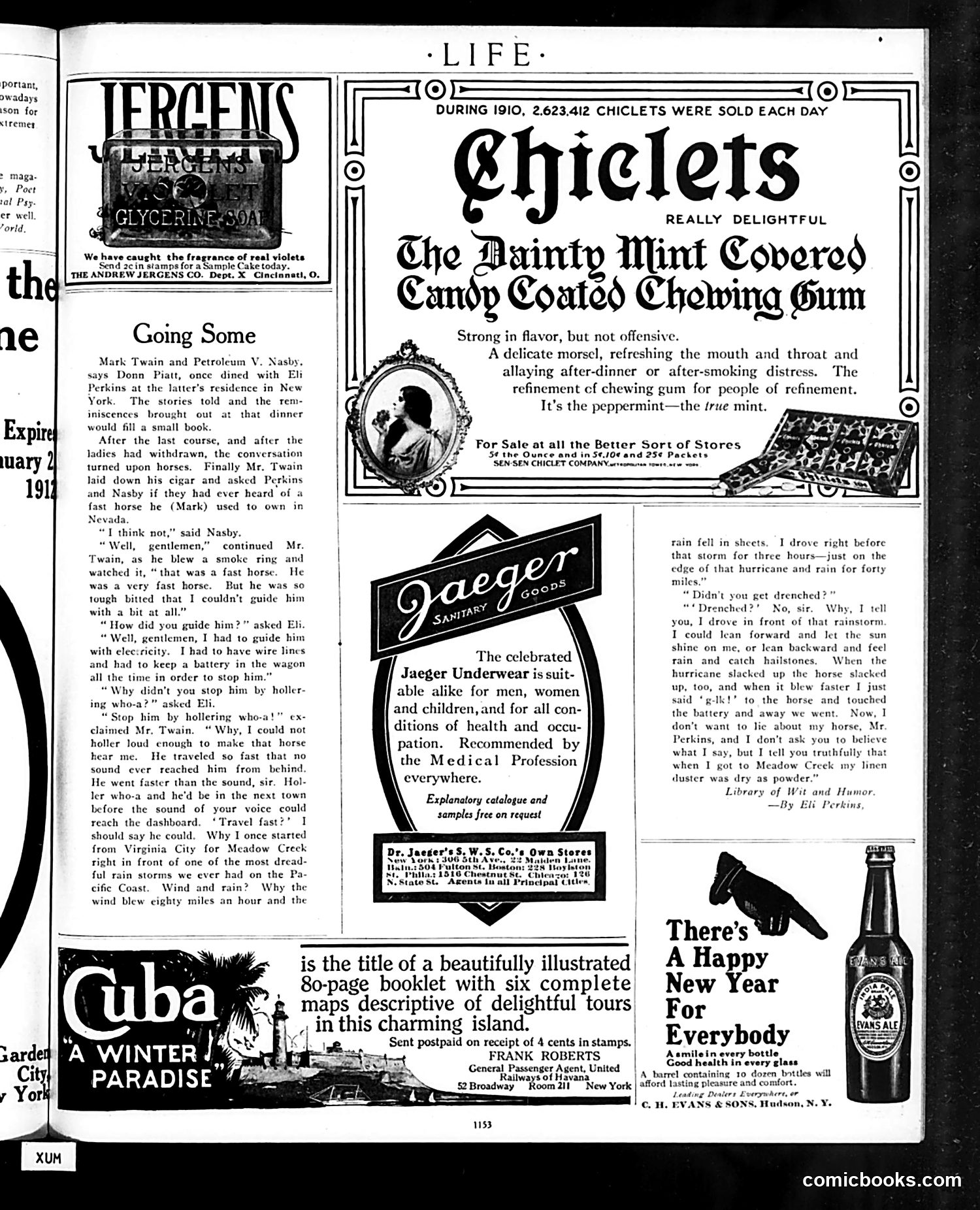
This is primarily an **advertising page** from Life magazine's January 1910 issue, not a political cartoon. The page features a humorous tall tale by Mark Twain (credited to Eli Perkins) about an impossibly fast horse that travels faster than sound—a classic 19th-century American frontier exaggeration. The joke relies on absurdist humor: the narrator drives *in front* of a rainstorm, keeping his clothes dry, because he's moving faster than the precipitation. **Advertisements include:** - Jergens Glycerine Soap - Chiclets chewing gum (promoting 2.6 million sold daily in 1910) - Jaeger Underwear (endorsed by "the Medical Profession") - Cuba travel booklet - Evans & Sons beer The Twain story's inclusion reflects Life's editorial mission: mixing sophisticated literary humor with commercial advertisements for educated, affluent readers. The tall tale format was popular American entertainment of the era.
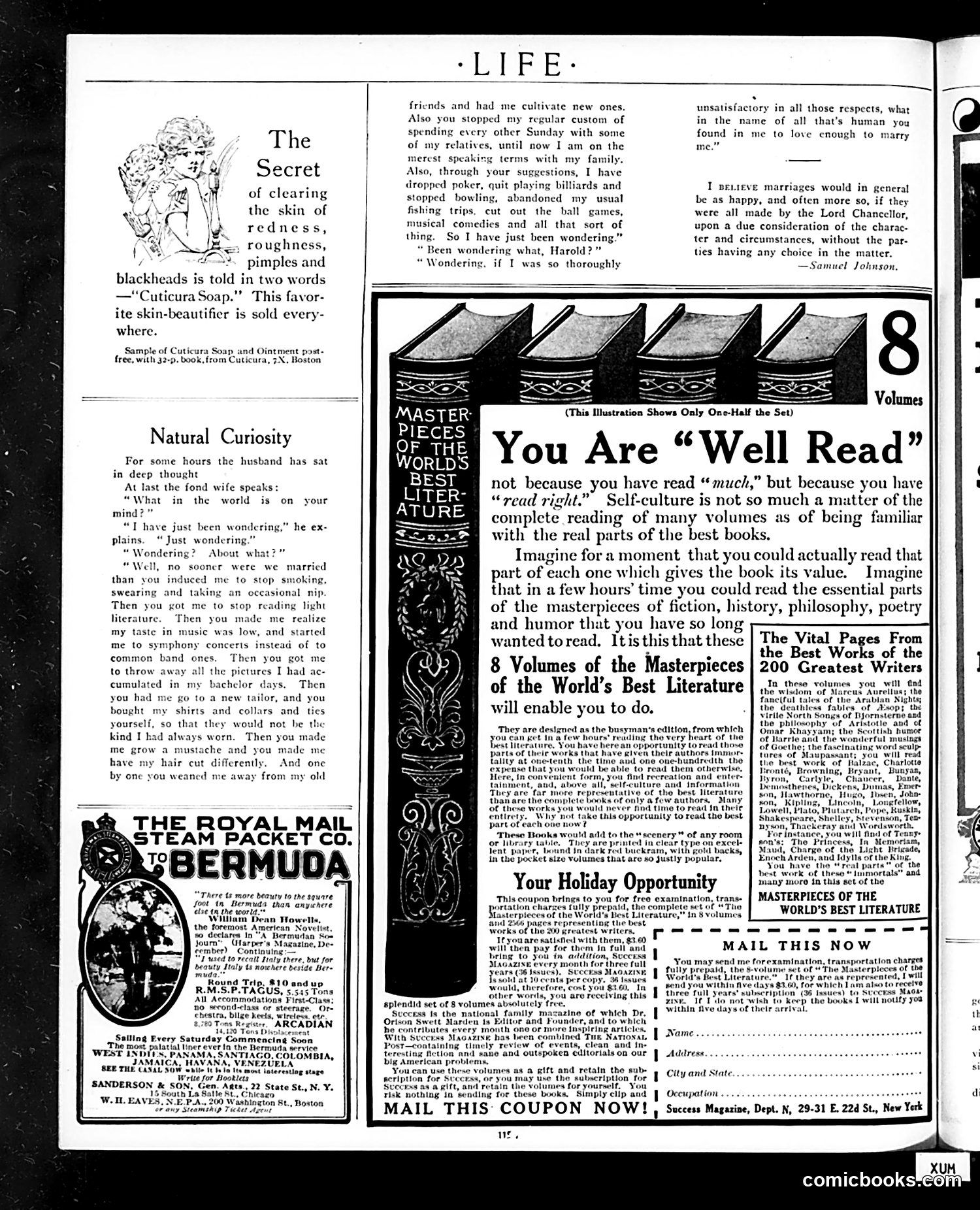
This page is primarily **advertising and editorializing**, not political satire. The main content consists of: **"Natural Curiosity" domestic sketch**: A husband lost in thought is questioned by his wife. He reveals he's been wondering whether marrying her was wise, since she's reformed him—stopping his smoking, gambling, theater-going, and friendships. The joke is his passive-aggressive regret at self-improvement. A Samuel Johnson quote defends arranged marriage by Lord Chancellor over personal choice, supporting the wife's apparent "improvement" agenda. **"Masterpieces of the World's Best Literature" advertisement**: The facing page promotes an 8-volume book set emphasizing selective, curated reading over comprehensive study—appealing to busy professionals seeking cultural education without effort. **Supporting advertisements**: Cuticura Soap (skin care) and Royal Mail Steam Packet Company (Bermuda travel). The page reflects early 20th-century anxieties about **domesticated masculinity** and **self-improvement culture**, presented with gentle irony rather than sharp satire.
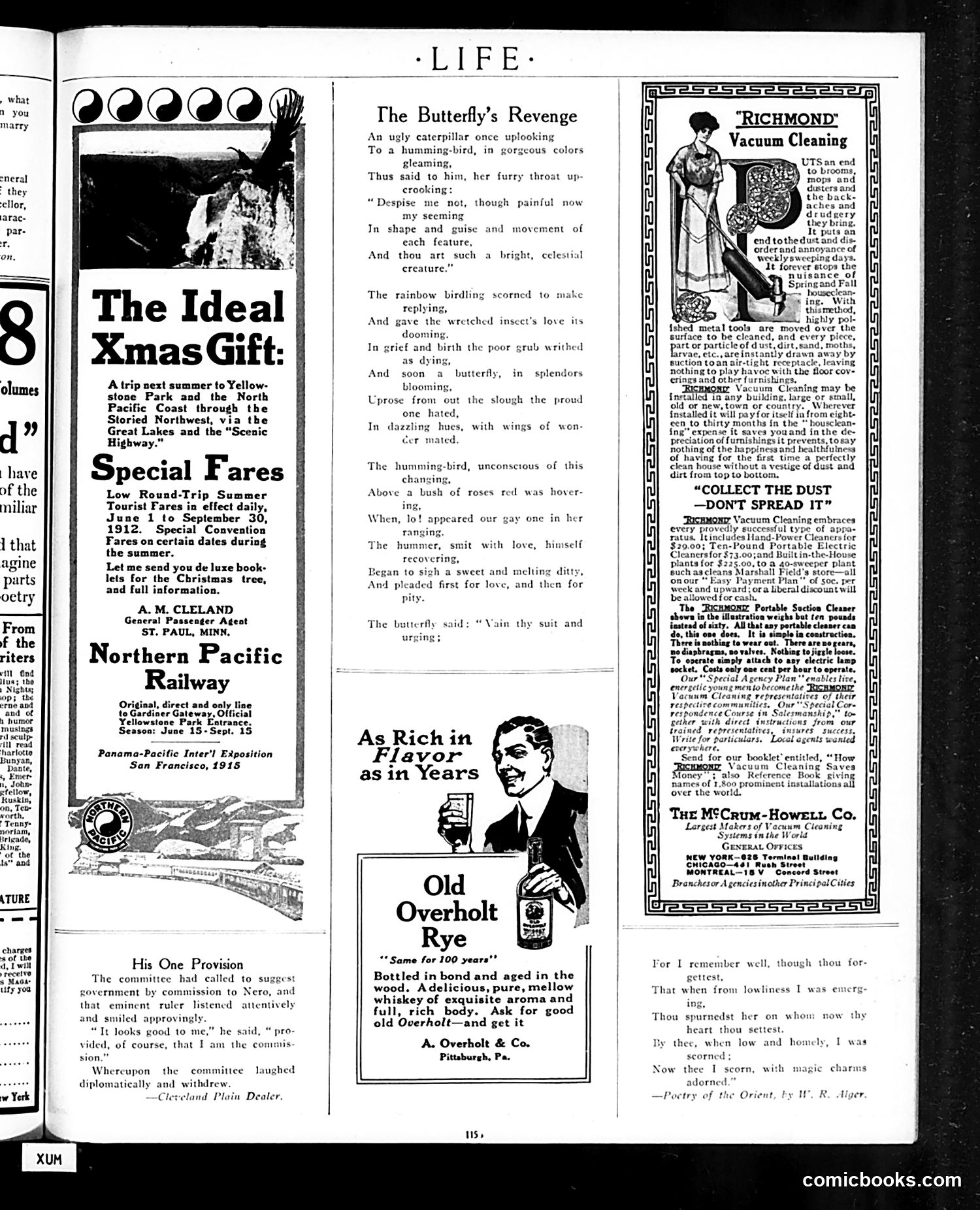
This page from Life magazine (a satirical publication) contains mostly **advertisements and light verse**, not political cartoons. The main content includes: **"His One Provision"**: A joke attributed to the Cleveland Plain Dealer about government by commission. When a committee proposes this to the Roman emperor Nero, he agrees—provided he himself is the commission. The humor mocks autocratic rulers who accept democratic-sounding reforms only if they maintain absolute control. This likely reflects early 1900s Progressive Era debates about commission-based city government. **"The Butterfly's Revenge"**: A sentimental poem about a caterpillar rejected by a hummingbird, who transforms into a beautiful butterfly and then rejects the hummingbird in return—a simple fable about comeuppance and metamorphosis. The page is otherwise filled with travel advertisements (Northern Pacific Railway, Panama-Pacific Exposition), whiskey ads (Old Overholt Rye), and a lengthy advertisement for Richmond Vacuum Cleaning machines. There are no caricatures or identifiable political figures—this is a typical early 20th-century magazine page mixing light humor with commercial content.
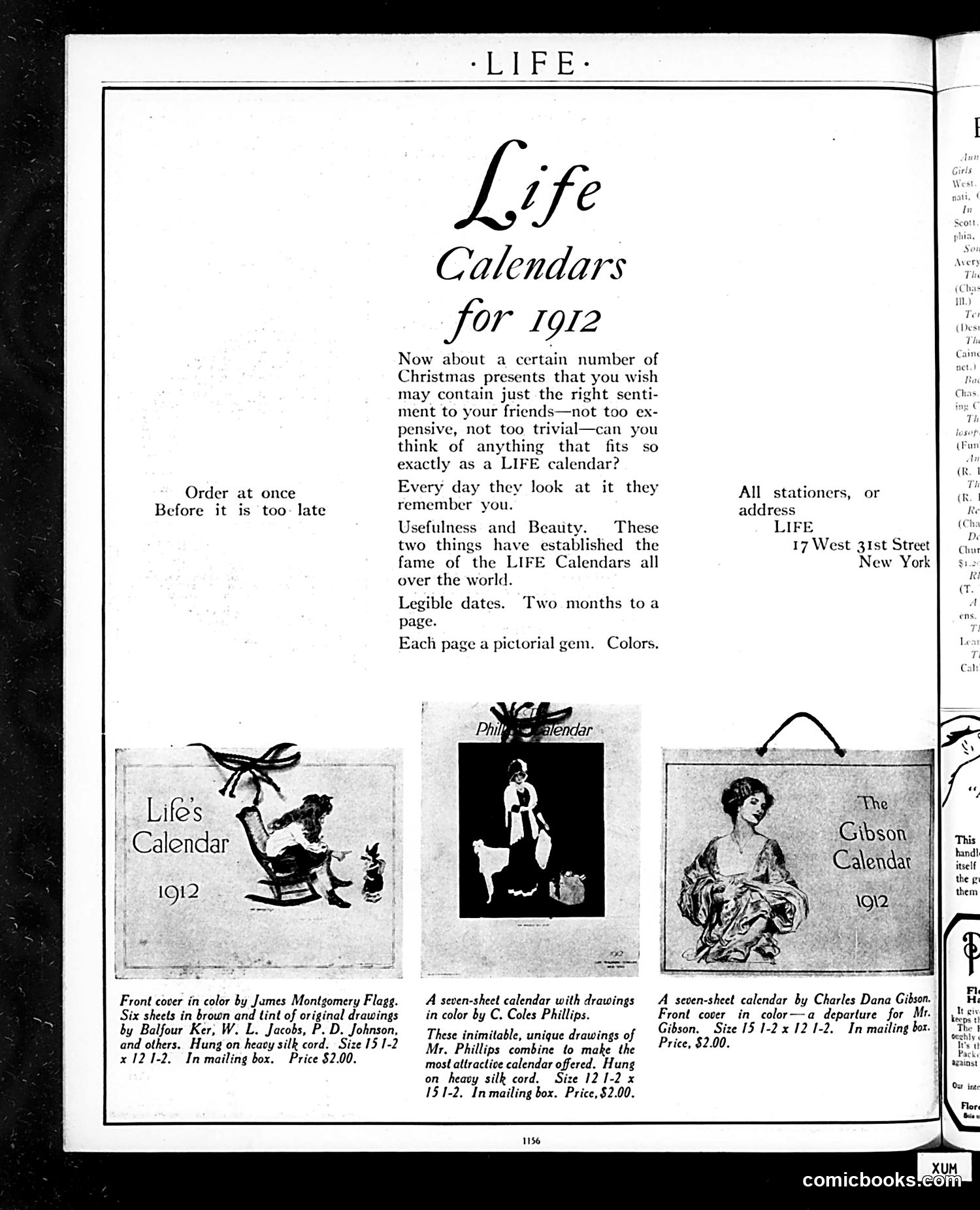
This is a Christmas gift advertisement promoting three illustrated calendars for 1912. Rather than satire, it's a straightforward product pitch targeting affluent readers. The three calendars featured are: 1. **Life's Calendar** by James Montgomery Flagg—featuring whimsical drawings (cover shows a child in a rocking chair) 2. **Phillips Calendar** by C. Coles Phillips—seven sheets with his distinctive Art Nouveau-style female portraits 3. **Gibson Calendar** by Charles Dana Gibson—noted as a "departure" for Gibson, showing an elegant woman Each calendar costs $2.00 (expensive for 1912) and emphasizes being a thoughtful yet affordable gift—useful, beautiful, with legible dates and color artwork. The ad stresses that recipients will see the giver's name daily. This represents typical early-20th-century luxury gift marketing targeting middle-to-upper-class consumers.
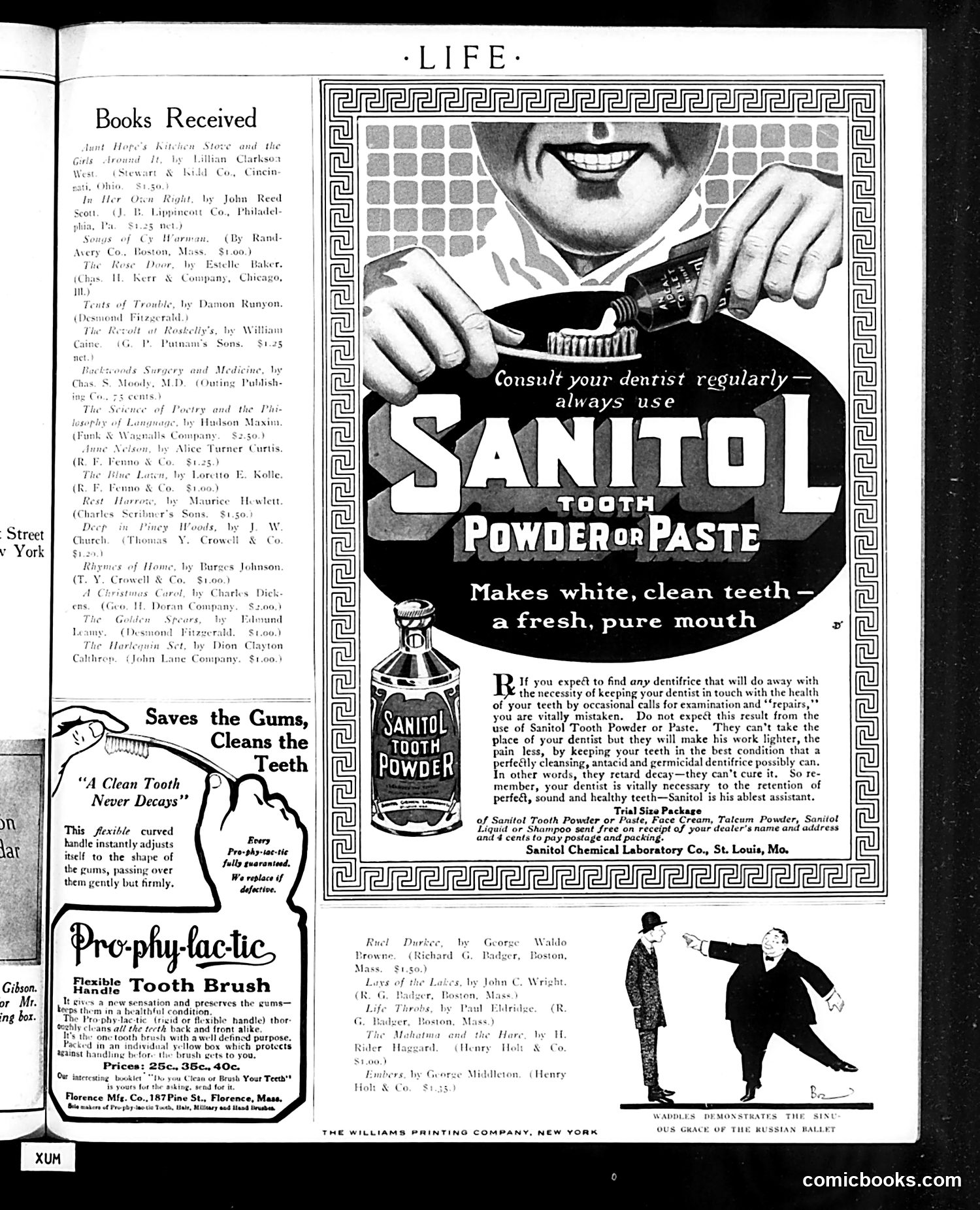
This page is primarily **advertising and book listings**, not political satire. The dominant content consists of two dental product advertisements (Santol Tooth Powder/Paste and Pro-phy-lac-tic Tooth Brush) and a "Books Received" section listing recently published volumes. At the bottom right, there is a small cartoon captioned "Waddles Demonstrates the Gracious Grace of the Russian Ballet," showing what appears to be a rotund figure in a theatrical pose. This is a brief joke mocking the then-fashionable Russian Ballet (likely referencing the Ballets Russes, popular in 1910s-20s America) by depicting someone unsuited to dance attempting classical ballet movements—humor based on physical contrast rather than political commentary. The page reflects early 20th-century magazine layout, mixing advertisements with literary content.
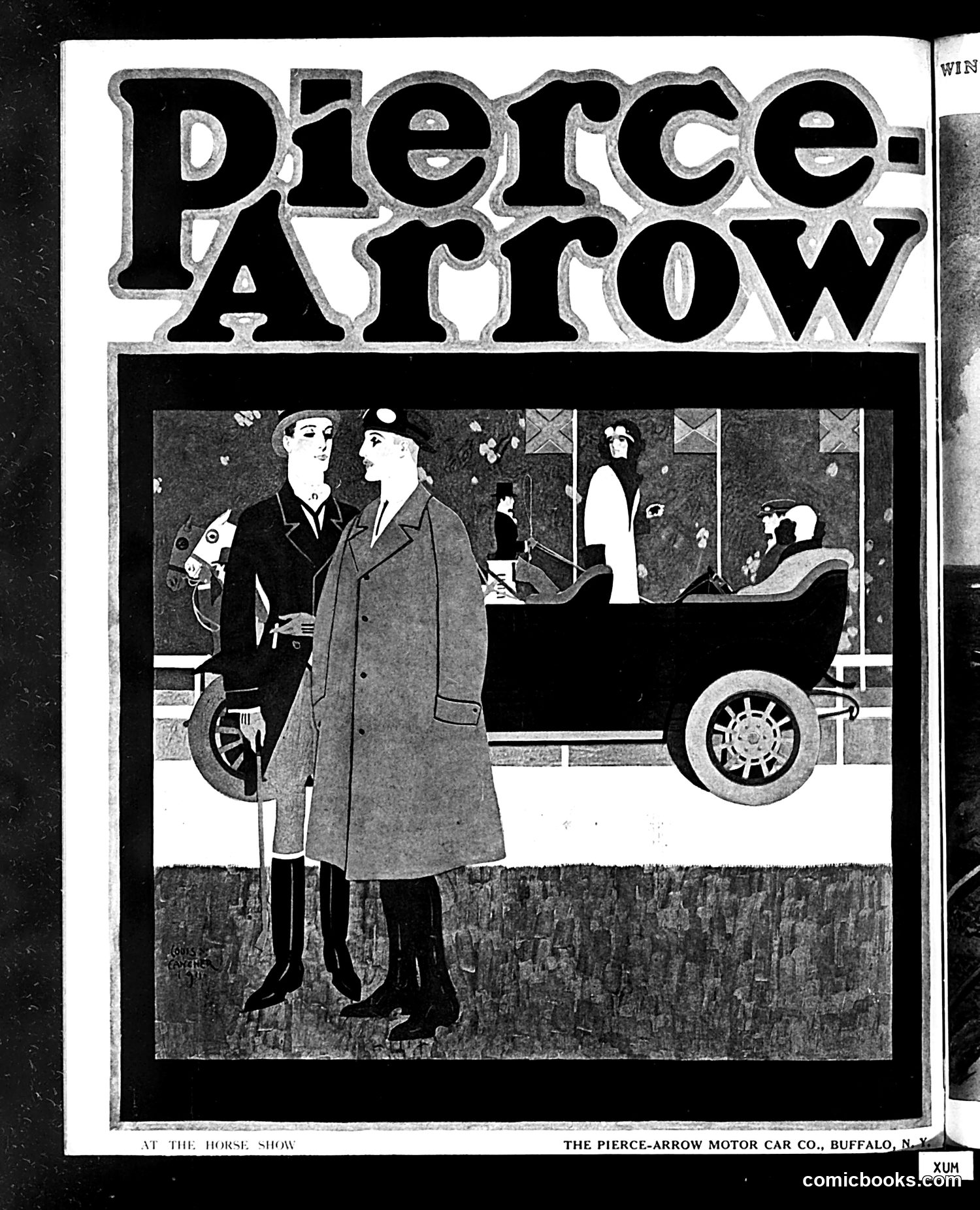
This is an advertisement for Pierce-Arrow automobiles, positioned as a luxury brand. The image depicts an elegant social scene at a horse show—a prestigious upper-class venue of the early 20th century. Two well-dressed men in overcoats stand conversing in the foreground, while a Pierce-Arrow motor car is prominently displayed behind them. The satire or point appears implicit: the advertisement juxtaposes horses (traditional symbols of wealth and status) with the modern automobile, suggesting that Pierce-Arrow represents the new marker of sophistication and affluence. The refined gentlemen and upscale setting communicate that this is a car for society's elite. The ad thus positions automobile ownership as the modern equivalent of—and successor to—the prestige once conferred by fine horses.