
Life, 1911-12-21 · page 8 of 44
Life — December 21, 1911 — page 8: what you’re looking at
What you’re looking at
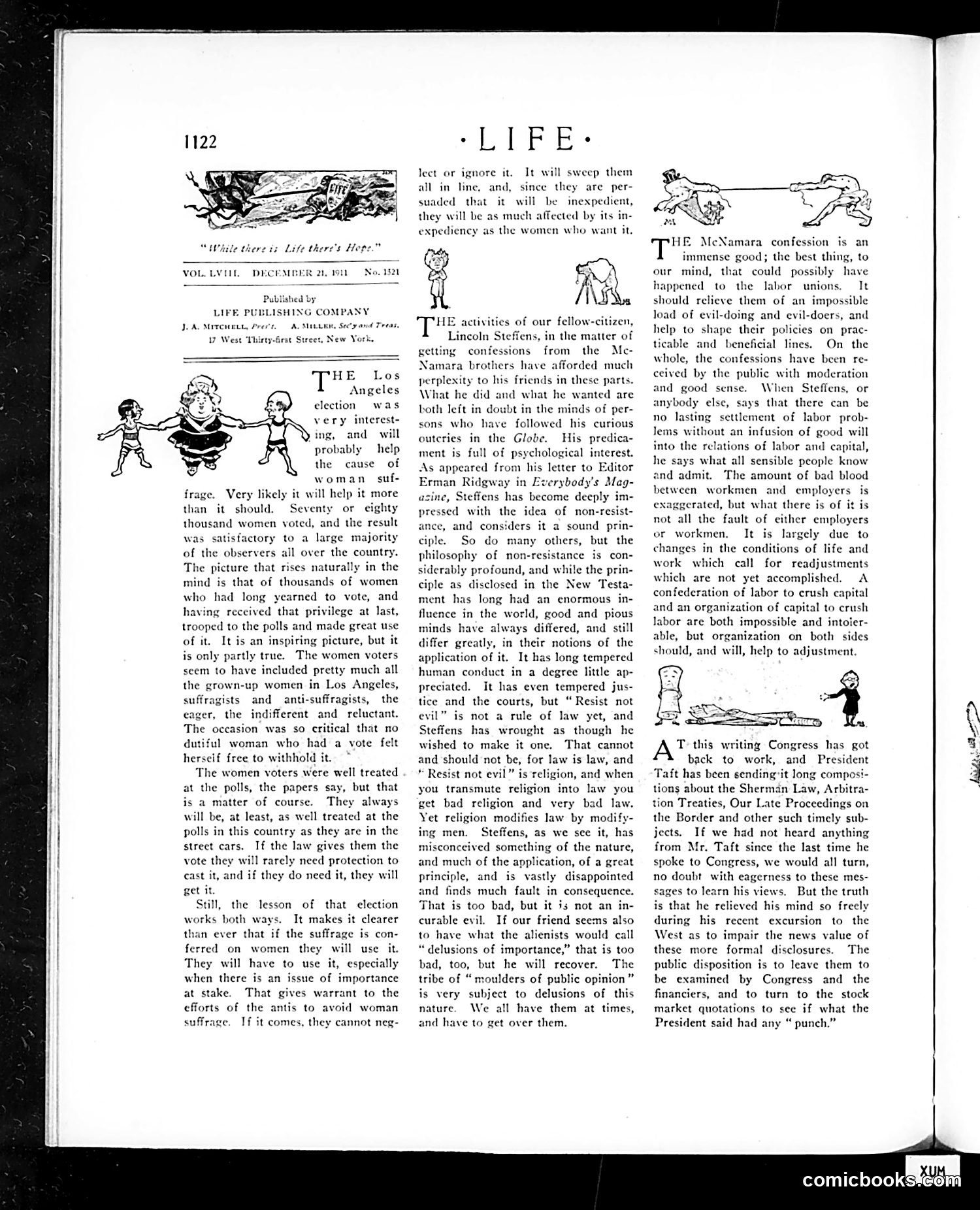
This page contains editorial commentary on two major contemporary issues. The left column discusses the Los Angeles election, praising women voters' participation while cautioning that suffrage alone won't solve labor problems. The accompanying cartoon (top left) appears to depict the tension between these groups—showing figures in what looks like a political struggle. The right column discusses Lincoln Steffens' McXamara confession piece, analyzing labor violence and non-resistance philosophy. The text debates whether Steffens' pacifist conclusions are practical, arguing that labor organization and capital negotiation are both necessary. The cartoons use caricature to satirize these debates about voting rights, labor unions, and political reform—core Progressive Era concerns.
📄 Transcribed text from this page (OCR, searchable)
Machine-transcribed from the original scan — historical spelling and the odd misread are preserved.
there iz Life there's Hope.” DECEMBER 2 ¥ JA, MrtowEnt, Press 7 West Thirty-Grst § AL MiLuKn, Sey. Sew ¥ HE Los Angeles election was very interest- ing, and wi probably help the cause of woman. suf- frage. Very likely it will help it more than it should. Seventy or eighty thousand women voted, and the result was satisfactory to a large majority of the observers all over the country. The picture that rises naturally in the mind is that of thousands of women who had long yearned to vote, and having received that privilege at last, trooped to the polls and made great use of it. It is an inspiring picture, but it is only partly true. The women voters seem to have included pretty much all the grown-up women in Los Angeles, suffragists and anti-suffragists, the eager, the indifferent and reluctant. The occasion was so critical that no dutiful woman who had a vote felt herself free to withhold it. he women voters were well treated at the polls, the papers say, but that is a matter of course. They always will be, at least, as well treated at the polls in this country as they are in the street cars. If the law gives them the vote they will rarely need protection to cast it, and if they do need it, they will get it. Still, the lesson of that election works both ways. It makes it clearer than ever that if the suffrage is con- ferred on women they will use it. They will have to use it, especially when there is an issue of importance at stake. That gives warrant to the efforts of the antis to avoid woman suffrage. If it comes, they cannot neg- ei OP Es lect or ignore it, It will sweep them all in line, and, since they are per- suaded that it will be inexpedient, they will be as much affected by its in- jency as the women who want it. HE activities of our fellow-citizen, Lincoln Steffens, in the matter of getting confessions from the Me- Namara brothers have afforded much perplexity to his friends in these parts. What he did and what he wanted are both left in doubt in the minds of per- sons who have followed his curious outcries in the Globe. His predica- ment is full of psychological interest. As appeared from letter to Editor Erman Ridgway in Everybody's Mag- azine, Steffens has become deeply im- pressed with the idea of non-resist- ance, and considers it a sound prin- ciple. So do many others, but the philosophy of non-resistance is con- siderably profound, and while the prin- ciple as disclosed in the New Testa- ment has long had an enormous in- fluence in the world, good and pious minds have always differed, and still differ greatly, in their notions of the application of it. It has long tempered human conduct in a degree little ap- preciated. It has even tempered jus- tice and the courts, but “ Resist not evil” is not a rule of law yet, and Steffens has wrought as though he wished to make it one. That cannot and should not be, for law is law, and * Resist not evil” is religion, and when you transmute religion into law you get bad religion and very bad law, Yet religion modifies law by modify- ing men. Steffens, as we see it, has misconceived something of the nature, and much of the application, of a great principle, and is vastly disappointed and finds much fault in consequence. That is too bad, but it is not an in- curable evil. If our friend seems also to have what the alienists would call “delusions of importance,” that is too bad, too, but he will recover. The tribe of “ moulders of public opinion” is very subject to delusions of this nature. We all have them at times, and have to get over them. HE MeNamara confession is an immense good; the best thing, to our mind, that could possibly have happened to the labor unions. It should relieve them of an impossible load of evil-doing and evil-doers, and help to shape their policies on prac- ticable and beneficial lines. On the whole, the confessions have been re- ceived by the public with moderation and good sense. When Steffens, or anybody else, says that there can be no lasting settlement of labor prob- Jems without an infusion of good will into the relations of labor and capital, he says what all sensible people know and admit. The amount of bad blood between workmen and employers is exaggerated, but what there is of it is not all the fault of either employers or workmen, It is largely due to changes in the conditions of life and work which call for readjustments which are not yet accomplished. A confederation of labor to crush capital and an organization of capital to crush labor are both impossible and intoier- able, but organization on both sides should, and will, help to adjustment. T this writing Congress has got back to work, and President Taft has been sending:it long composi tions about the Sherman Law, Arbitra- tion Treaties, Our Late Proceedings on the Border and other such timely sub- jects. If we had not heard anything from Mr. Taft since the last time he spoke to Congress, we would all turn, no doubt with eagerness to these mes- sages to learn his views. But the truth is that he relieved his mind so freely during his recent excursion to the West as to impair the news value of these more formal disclosures. The public disposition is to leave them to be examined by Congress and the financiers, and to turn to the stock market quotations to see if what the President said had any “ punch.”