
Life, 1911-12-21 · page 15 of 44
Life — December 21, 1911 — page 15: what you’re looking at
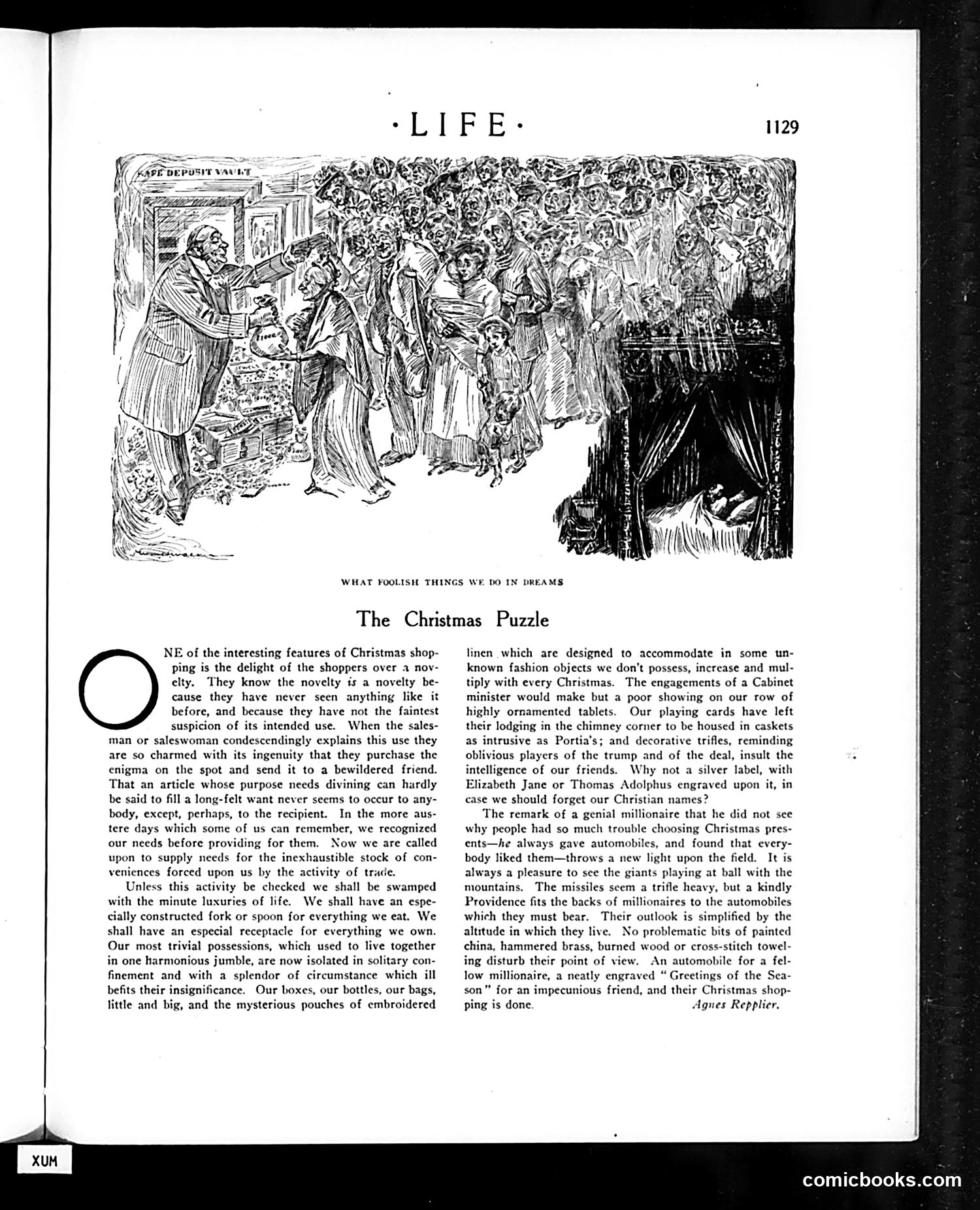
What you’re looking at
This is a satirical essay accompanying an illustration of a crowded Christmas shopping scene. Repplier mocks the modern consumer culture of her era (early 20th century), arguing that Christmas shopping has become absurd. The central complaint: retailers manufacture and sell "novelties"—useless gadgets whose purpose is unclear—and consumers eagerly buy these puzzling items as gifts, passing confusion to recipients. Repplier contrasts this with earlier times when people bought only genuine necessities. She satirizes how trivial possessions now get elaborate, specialized containers and decorative cases, and mocks the wealthy millionaire who simply gives automobiles as gifts, finding the problem trivial from his elevated perspective. The essay argues that modern commerce has created artificial "needs" and that Christmas gift-giving has devolved into exchanging incomprehensible objects. The cartoon depicts the chaotic shopping experience she describes.
📄 Transcribed text from this page (OCR, searchable)
Machine-transcribed from the original scan — historical spelling and the odd misread are preserved.
We Gre : WHAT FOOLISH THINGS WE DO IN DREAMS The Christmas Puzzle NE of the interesting features of Christmas shop- ping is the delight of the shoppers over a nov- elty. They know the novelty is a novelty be- cause they have never seen anything like it before, and because they have not the faintest suspicion of its intended use. When the sales- man or saleswoman condescendingly explains this use they are so charmed with its ingenuity that they purchase the enigma on the spot and send it to a bewildered friend. That an article whose purpose needs divining can hardly be said to fill a long-felt want never seems to occur to any- body, except, perhaps, to the recipient. In the more aus- tere days which some of us can remember, we recognized our needs before providing for them. Now we are called upon to supply needs for the inexhaustible stock of con- veniences forced upon us by the activity of trade. Unless this activity be checked we shall be swamped with the minute luxuries of life. We shall have an espe- cially constructed fork or spoon for everything we eat. We shall have an especial receptacle for everything we own. Our most trivial possessions, which used to live together in one harmonious jumble, are now isolated in solitary con- finement and with a splendor of circumstance which ill befits their insignificance. Our boxes, our bottles, our bags, little and big, and the mysterious pouches of embroidered linen which are designed to accommodate in some un- known fashion objects we don’t possess, increase and mul- tiply with every Christmas. The engagements of a Cabinet minister would make but a poor showing on our row of highly ornamented tablets. Our playing cards have left their lodging in the chimney corner to be housed in caskets as intrusive as Portia’s; and decorative trifles, reminding oblivious players of the trump and of the deal, insult the intelligence of our friends. Why not a silver label, with Elizabeth Jane or Thomas Adolphus engraved upon it, in case we should forget our Christian names? The remark of a genial millionaire that he did not see why people had so much trouble choosing Christmas pres- ents—he always gave automobiles, and found that every- body liked them—throws a new light upon the field. It is always a pleasure to sce the giants playing at ball with the mountains. The missiles seem a trifle heavy, but a kindly Providence fits the backs of millionaires to the automobiles which they must bear. Their outlook is simplified by the altitude in which they live. No problematic bits of painted china, hammered brass, burned wood or cross-stitch towel- ing disturb their point of view. An automobile for a fel- low millionaire, a neatly engraved “Greetings of the Sea- son” for an impecunious friend, and their Christmas shop- ping is done. Agnes Repplier. comicbooks.com