
Life, 1911-12-21 · page 26 of 44
Life — December 21, 1911 — page 26: what you’re looking at
What you’re looking at
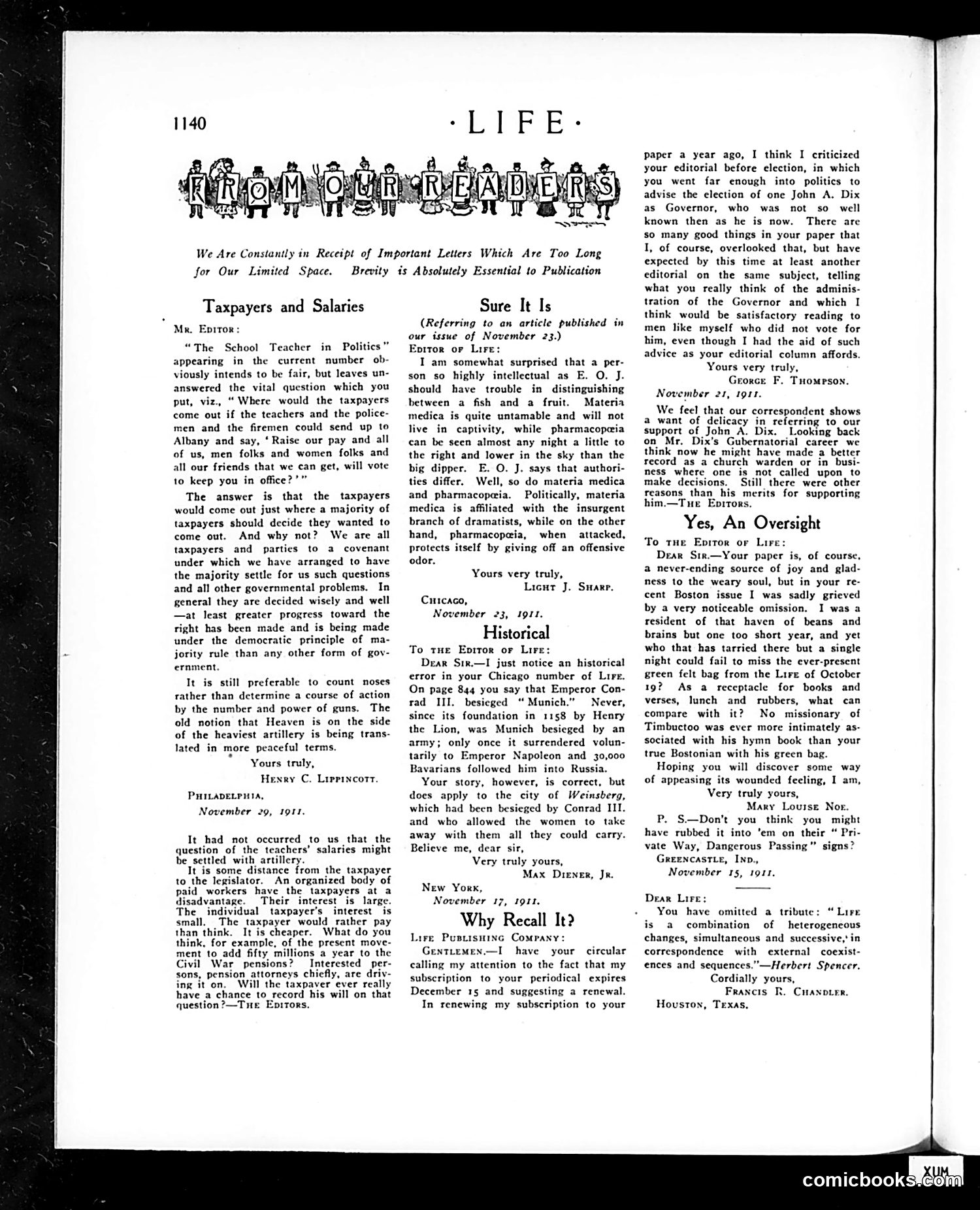
This page consists primarily of the magazine's letters section, featuring reader correspondence on various topics—not illustrated cartoons. The main content addresses three political/social issues of the era: 1. **Teachers' Salaries and Democratic Process**: Readers debate whether organized public employees (teachers, police, firefighters) should lobby legislators for raises. The editorial stance defends majority-rule democracy over special-interest pressure, citing concerns about "organized bodies of paid workers" having advantages over individual taxpayers. 2. **A Humorous Pseudo-Intellectual Letter**: One correspondent mockingly responds to an article by "E.O.J." with deliberately absurd definitions distinguishing "materia medica" from "pharmacopaia," satirizing obfuscatory academic writing. 3. **Historical Correction**: A reader corrects an error about Emperor Conrad III besieging Munich, clarifying it was actually Weinsberg—a pedantic but legitimate historical note. The page reflects Progressive Era debates about labor organization, government spending, and democratic representation circa 1911.
📄 Transcribed text from this page (OCR, searchable)
Machine-transcribed from the original scan — historical spelling and the odd misread are preserved.
We Are Constantly in Receipt of Important Letters Which Are Too Long for Our Limited Space. Taxpayers and Salaries Mx. Epitor: “The School Teacher in Politics” appearing in the current number ob- viously intends to be fair, but leaves un- answered the vital question which you put, viz. “Where would the taxpayers come out if the teachers and the police- men and the firemen could send up to Albany and say, ‘Raise our pay and all of us, men folks and women folks and all our friends that we can get, will vote to keep you in office?’” The answer is that the taxpayers would come out just where a majority of taxpayers should decide they wanted to come out. And why not? We are all taxpayers and parties to a covenant under which we have arranged to have the majority settle for us such questions and all other governmental problems. In general they are decided wisely and well —at least greater progress toward the right has been made and is being made under the democratic principle of ma- jority rule than any other form of gov- ernment. It is still preferable to count noses rather than determine a course of action by the number and power of guns. The old notion that Heaven is on the side of the heaviest artillery is being trans- lated in more peaceful terms. Yours truly, Henry C. Lippincott. LADELPHIA, November 29, 1911. It had not occurred to us that the question of the teachers’ salaries might be settled with artillery. It is some distance from the taxpayer to the legislator. An organized body of paid workers have the taxpayers at a disadvantage. Their interest is large. The individual taxpayer's interest is small. The taxpayer would rather pay than think. It is cheaper. What do you think, for example, of the present move- ment to add fifty millions a year to the Civil War pensions? Interested _per- sons, pension attorneys chiefly, are driv ing it on. Will the taxpaver ever really have a chance to record his will on that question?—Tite Epitors. Brevity is Absolutely Essential to Publication Sure It Is (Referring to an article published in our issue of November 23.) Eprtor or Lire: I am somewhat surprised that a per- son so highly intellectual as E. O. J. should have trouble in distinguishing between a fish and a fruit. Materia medica is quite untamable and will not live in captivity, while pharmacopaia can be seen almost any night a little to the right and lower in the sky than the big dipper. E. O. J. says that authori- ties differ. Well, so do materia medica and pharmacopaia. Politically, materia medica is affiliated with the insurgent branch of dramatists, while on the other hand, pharmacopeia, when attacked, protects itself by giving off an offensive odor. Yours very truly, Licur J. Sitarr. Cucaco, November Jgtt. Historical To tHe Eotror oF Livi Dear Six.—I just notice an historical error in your Chicago number of Lire. On page 844 you say that Emperor Con- rad III. besicged “Munich.” Never, since its foundation in 1158 by Henry the Lion, was Munich besieged by an army; only once it surrendered volun- tarily to Emperor Napoleon and 30,000 Bavarians followed him into Russia. Your story, however, is correct, but does apply to the city of Weinsberg, which had been besieged by Conrad III. and who allowed the women to take away with them all they could carry. Believe me, dear sir, Very truly yours, Max Diener, Jr. New York, November 17, 1911. Why Recall It? Lire Puptisinc Company: Gentiemen.—I have your circular calling my attention to the fact that my subscription to your periodical expires December 15 and suggesting a renewal. In renewing my subscription to your paper a year ago, I think I cri your editorial before election, in which you went far enough into politics to advise the election of one John A. Dix as Governor, who was not so well known then as he is now. There are so many good things in your paper that I, of course, overlooked that, but have expected by this time at least another editorial on the same subject, telling what you really think of the adminis- tration of the Governor and which I think would be satisfactory reading to men like myself who did not vote for him, even though I had the aid of such advice as your editorial column affords. Yours very truly, Grorce F. Tompson. November 21, 1911. We feel that our correspondent shows a want of delicacy in referring to our support of John A. Dix. Looking back on Mr. Dix’s Gubernatorial career we think now he might have made a better record as a church warden or in busi- ness where one is not called upon to make decisions. Still there were other reasons than his merits for supporting him.—Tue Eprtors. Yes, An Oversight To tne Epiror or Live: Dear Sir.—Your paper is, of course, a never-ending source of joy and glad- ness to the weary soul, but in your re- cent Boston issue I was sadly grieved by a very noticeable omission. I was a resident of that haven of beans and brains but one too short year, and yet who that has tarried there but a single night could fail to miss the ever-present green felt bag from the Lire of October 19? As a receptacle for books and verses, lunch and rubbers, what can compare with it? No missionary of Timbuctoo was ever more intimately as- sociated with his hymn book than your true Bostonian with his green bag. Hoping you will discover some way of appeasing its wounded feeling, I am, Very truly yours, Maxy Lousse Nor. P. S.—Don’t you think you might have rubbed it into ‘em on their “ Pri- vate Way, Dangerous Passing” signs? Greencastie, INp., November 15, 1911. Dear Lire: You have omitted a tribute: “Lire is a combination of heterogencous changes, simultaneous and successive,’ in correspondence with external coexist- ences and sequences.”—Herbert Spencer. Cordially yours, Francis R. Cuaxotrr. Houston, Texa! comicbook Meum