
Life, 1911-12-21 · page 21 of 44
Life — December 21, 1911 — page 21: what you’re looking at
What you’re looking at
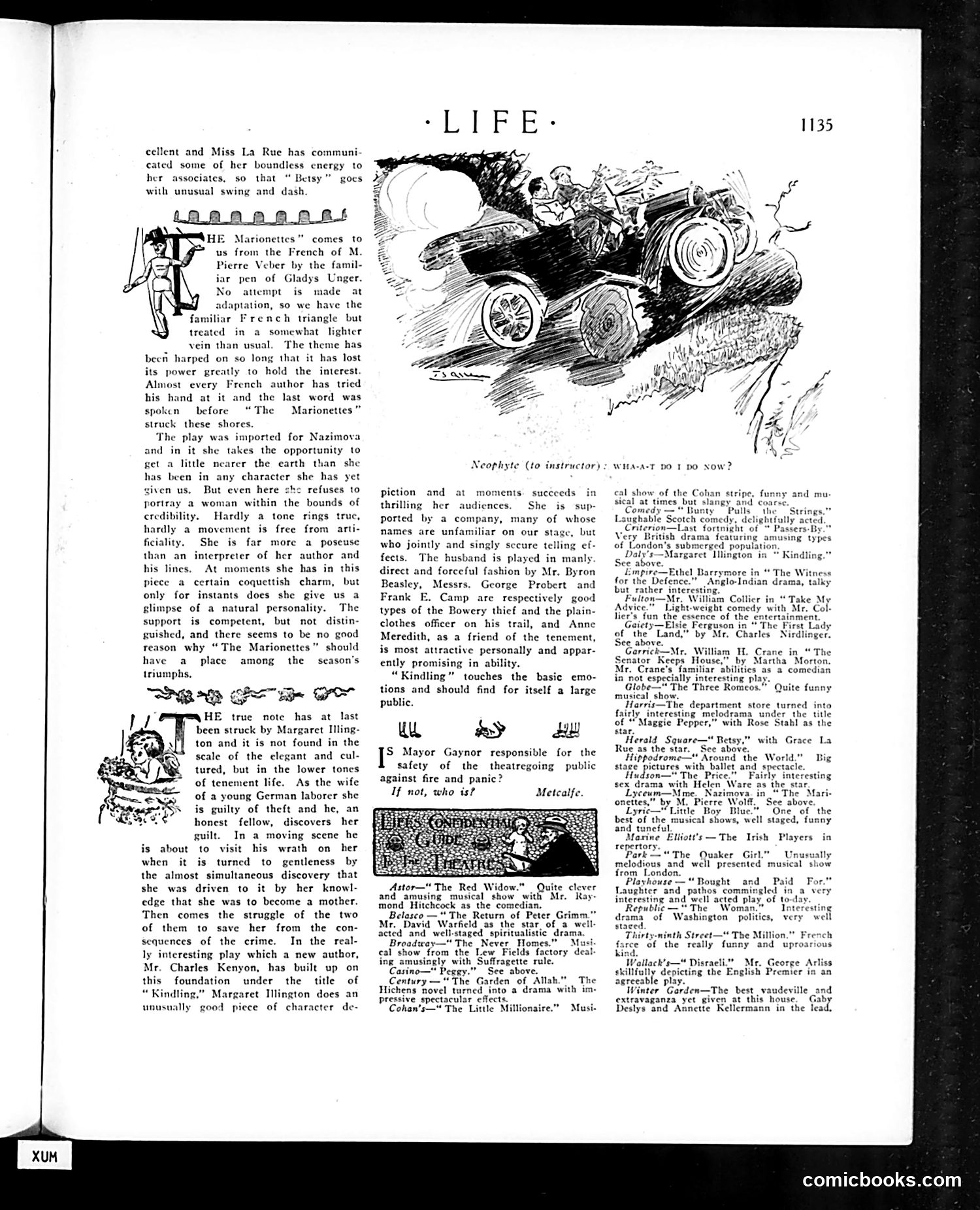
This page contains theatre reviews from an early 20th-century American satirical magazine. The main cartoons and commentary focus on Broadway productions and theatrical criticism rather than political satire. The prominent cartoon shows a car accident—likely satirizing early automobile dangers, a contemporary concern as cars were still novel and hazardous. The text reviews several plays, including critical commentary on actress Nazimova in "The Marionettes" (adapted from French), and praise for Margaret Illington in "Kindling," a new play about working-class tenement life by Charles Kenyon. A small political cartoon by "Metcalfe" asks whether Mayor Gaynor bears responsibility for theatre fire safety—referencing real fire-safety concerns at the time, particularly following major theatre disasters. The page also lists current Broadway shows with brief descriptions, demonstrating the magazine's focus on entertainment and urban culture rather than explicit political commentary.
📄 Transcribed text from this page (OCR, searchable)
Machine-transcribed from the original scan — historical spelling and the odd misread are preserved.
cellent and Miss La Rue has communi cated some of her boundless cnergy to her that “ Betsy" goes with unusual swing and dash, HE Marionettes” comes to us from the French of M Pierre Veber by the famil- iar pen of Gladys Unger. No attempt is made at adaptation, so we have the familiar French triangle but treated in a somewhat lighter vein than usual. The theme has been harped on so long that it has lost its power greatly to hold the interest Almost every French author has tried his hand at it and the last word was spoken “The Marionettes” these shores. associates, $0 before struck The play was imported for Nazimova and in it she takes the opportunity to get_a little nearer the earth than she has been in any character she has yet given us, But even here che refuses to portray a woman within the bounds of credibility. Hardly a tone rings true, hardly a movement is free from arti- ficiality, She is far more a poseuse than an interpreter of her author and his lines. At moments she has in this piece a certain coquettish charm, but only for instants does she give us a glimpse of a natural personality. The support is competent, but not distin- guished, and there seems to be no good reason why “The Marionettes” should have a place among the season's triumphs, “eG GO HE true note has at last been struck by Margaret Iling- ton and it is not found in the scale of the elegant and cul- tured, but in the lower tones of tenement life. As the wife of a young German laborer she is guilty of theft and he, an honest fellow, discovers her guilt. In a moving scene he is about to visit his wrath on her when it is turned to gentleness by the almost simultaneous discovery that she was driven to it by her knowl- edge that she was to become a mother. Then comes the struggle of the two of them to save her from the con- sequences of the crime. In the real- ly interesting play which a new author, Mr. Charles Kenyon, has built up on this foundation under the title of “ Kindling,” Margaret IMlington does an unusually good piece of character de- Neophyte (to instructor) piction and at succeeds in thrilling her audiences. She is sup- ported by a company, many of whose names are unfamiliar on our stage, but who jointly and singly sccure telling ef- fects. The husband is played in manly direct and forceful fashion by Mr. Byron Beasley, Messrs. George Probert and Frank E. Camp are respectively good types of the Bowery thief and the plain- clothes officer on his trail, and Anne Meredith, as a friend of the tenement, is most attractive personally and appar- ently promising in ability. “Kindling” touches the basic emo- tions and should find for itself a large public. Ue dey moments ey S Mayor Gaynor responsible for the safety of the theatregoing public against fire and panic? If not, who is? Metcalfe. eS hoes tnt a Bs eee PATE Bee HEATRES Astor—" The Red W uite clever and amusing musical show with Mr. Ray- mond Hitchcock as the comedian. Belasco —“ The Return of Peter Grimm.” Mr. David Warfield as the star of a well- acted and well-staged spiritualistic drama. Broadway—“ The Never Homes.” Musi. cal show from the Lew Fields factory deal. ing amusingly with Suffragette rule. Casino—" Peggy.” See above. Century The Garden of Allah." The Hichens novel turned into a drama with im- Pressive spectacular effects. Cohan’s—“ The Little Millionaire.” Musi WHA-A-T DOT pO Now? cal show of the Cohan stripe, f sical at times but slangy and cc Comedy —" Bunty Pulls the Laughable Scotch comedy, delight Criterion—L It Very British drama featuring an of London's submerged pop Dals’s—Margaret Mlingto: Kindling.” See above. Empire—Ethel Barrymore in “* The Witne: for the Defence.” Anglo-Indian drama, talk but rather interesting. Fulton—Mr, William Collier in “Take My Advice.” Light-weight comedy with Mr. Cole lier's fun the essence of the entertainment Gaiety—Elsie, Ferguson in “ The First Lady of the Land,” by Mr. Charles Nirdlinger. See above. Garrick—Mr, William H. Crane in “ The Senator Keeps House,” by Martha Morton. Mr. Crane’s familiar abilities as a comedian in not especially interesting play Globe—" The Three Romeos.” Qi fu: musical, show. Harris—The department store turned into fairly interesting melodrama under the title of “Maggie Pepper,” with Rose Stahl as the star. Herald Square— Rue as the star, | See above. Hippodrome—" Around the World.” Big stage pictures with ballet, and spectacle. Hudson—" The Price." Fairly interesting sex drama with Helen Ware as the star. Sime. Nazimova. in “The Mari- {. Pierre Wolff, See above. Lyric—"“Little Boy Blue.” One, of the best of the musical shows, well staged, funny Irish The Quaker Girl.” Un ally melodious and well presented musical show from London. Playhouse —“Tought and Paid For.” Laughter and pathos commingled in av interesting and well acted play, of to-day Republic —“ The Woman.” Interesting drama of Washington politics, very well staced. Thirty-ninth Street—* The Million.” F: bh farce of the really funny and uproarious Betsy,” with Grace La iott's — The Players in Wellack’s—“ Disraeli.” Mr. George Arliss skillfully depicting the English Premier in an agreeable play. Winter Garden—The best vaudeville and extravaganza yet given at this house. Gaby Deslys and Annette Kellermann in the lead, comicbooks.com