
Life, 1911-12-21 · page 9 of 44
Life — December 21, 1911 — page 9: what you’re looking at
What you’re looking at
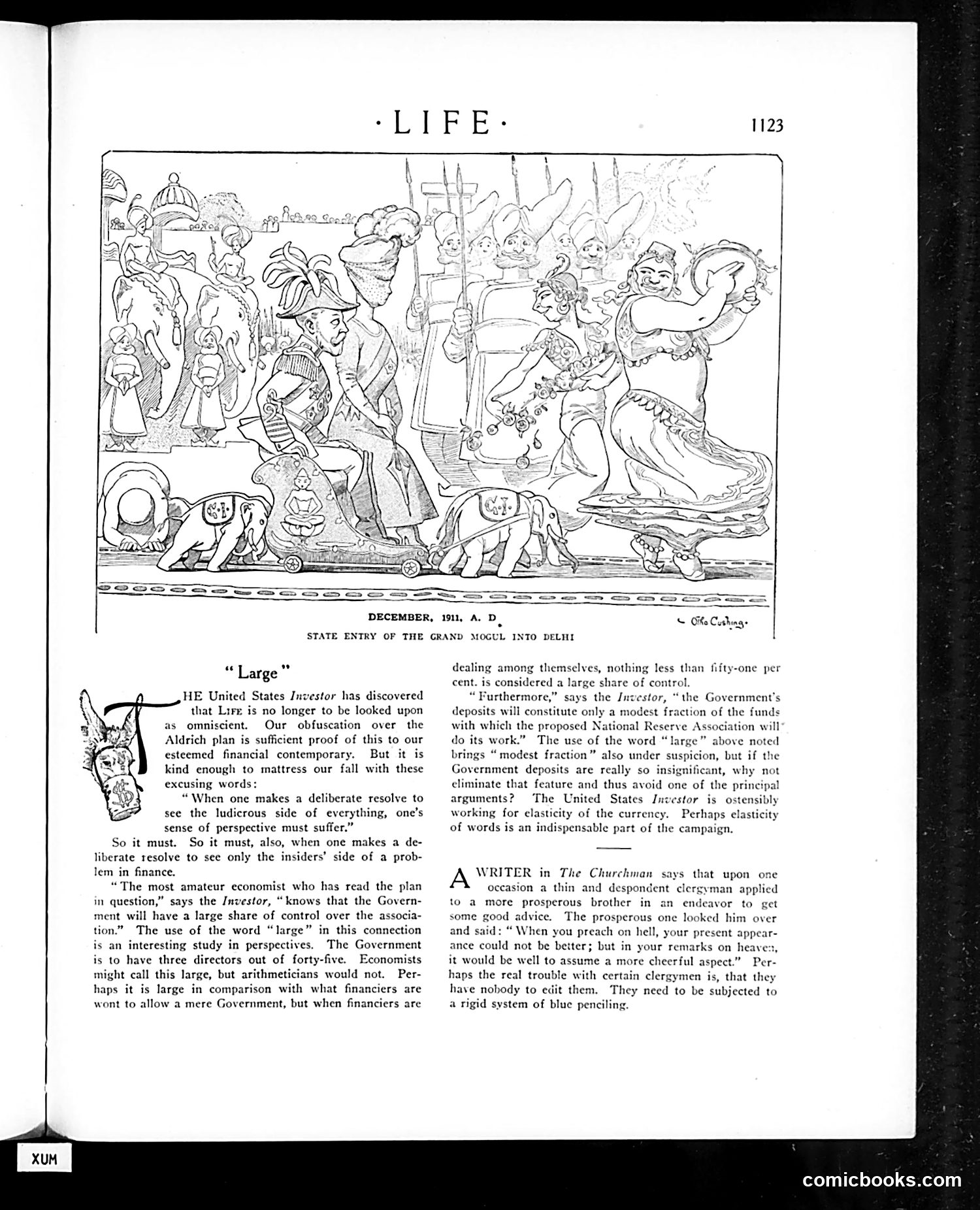
**The Cartoon:** Titled "State Entry of the Grand Mogul into Delhi," this satirical illustration depicts an elaborate procession with an Indian ruler (the "Grand Mogul") entering a city. The caricatures and exaggerated style mock the pageantry of British imperial rule in India during the Delhi Durbar period. **The Articles:** The page contains commentary on financial matters, discussing the U.S. Government's involvement in currency elasticity and a National Reserve Association. A separate piece references clergy needing editorial oversight regarding sermon content. **The Satire:** The cartoon likely critiques the pomp and ostentation of British imperial ceremonies in India, while the articles debate government economic intervention—typical 1911 Progressive Era concerns about monopolies, finance, and institutional authority.
📄 Transcribed text from this page (OCR, searchable)
Machine-transcribed from the original scan — historical spelling and the odd misread are preserved.
DECEMBER, 1911, A. D S Ole Cushing STATE ENTRY OF THE GRAND MOGUL INTO DELHI “Large” HE United States Investor has discovered that Lire is no longer to be looked upon as omniscient. Our obfuscation over the Aldrich plan is sufficient proof of this to our esteemed financial contemporary. But it is kind enough to mattress our fall with these excusing words: “When one makes a deliberate resolve to see the ludicrous side of everything, one’s sense of perspective must suffer.” So it must. So it must, also, when one makes a de- liberate resolve to see only the insiders’ side of a prob- lem in finance. “The most amateur economist who has read the plan in question,” says the Investor, “knows that the Govern- ment will have a large share of control over the associa- tion.” The use of the word “large” in this connection is an interesting study in perspectives. The Government is to have three directors out of forty-five. Economists might call this large, but arithmeticians would not. Per- haps it is large in comparison with what financiers are wont to allow a mere Government, but when financiers are dealing among themselves, nothing less than fifty-one per cent. is considered a large share of control. “Furthermore,” says the Jnvestor, “the Government's tion of the funds Association will C ove noted deposits will constitute only a modest f Government deposits are really so insi eliminate that feature and thus avoid one of the principal arguments? The United States Investor is ostensibly working for clasticity of the currency. Perhaps elasticity of words is an indispensable part of the campaign. WRITER in The Churchman says that upon one occasion a thin and despondent clergyman applied to a more prosperous brother in an endeavor to get some good advice. The prosperous one looked him over and said: “When you preach on hell, your present appea ance could not be better; but in your remarks on heav it would be well to assume a more cheerful aspect.” Per- haps the real trouble with certain clergymen is, that they have nobody to edit them. They need to be subjected to a rigid system of blue penciling. comicbooks.com