
A complete issue · 56 pages · 1911
Life — November 2, 1911
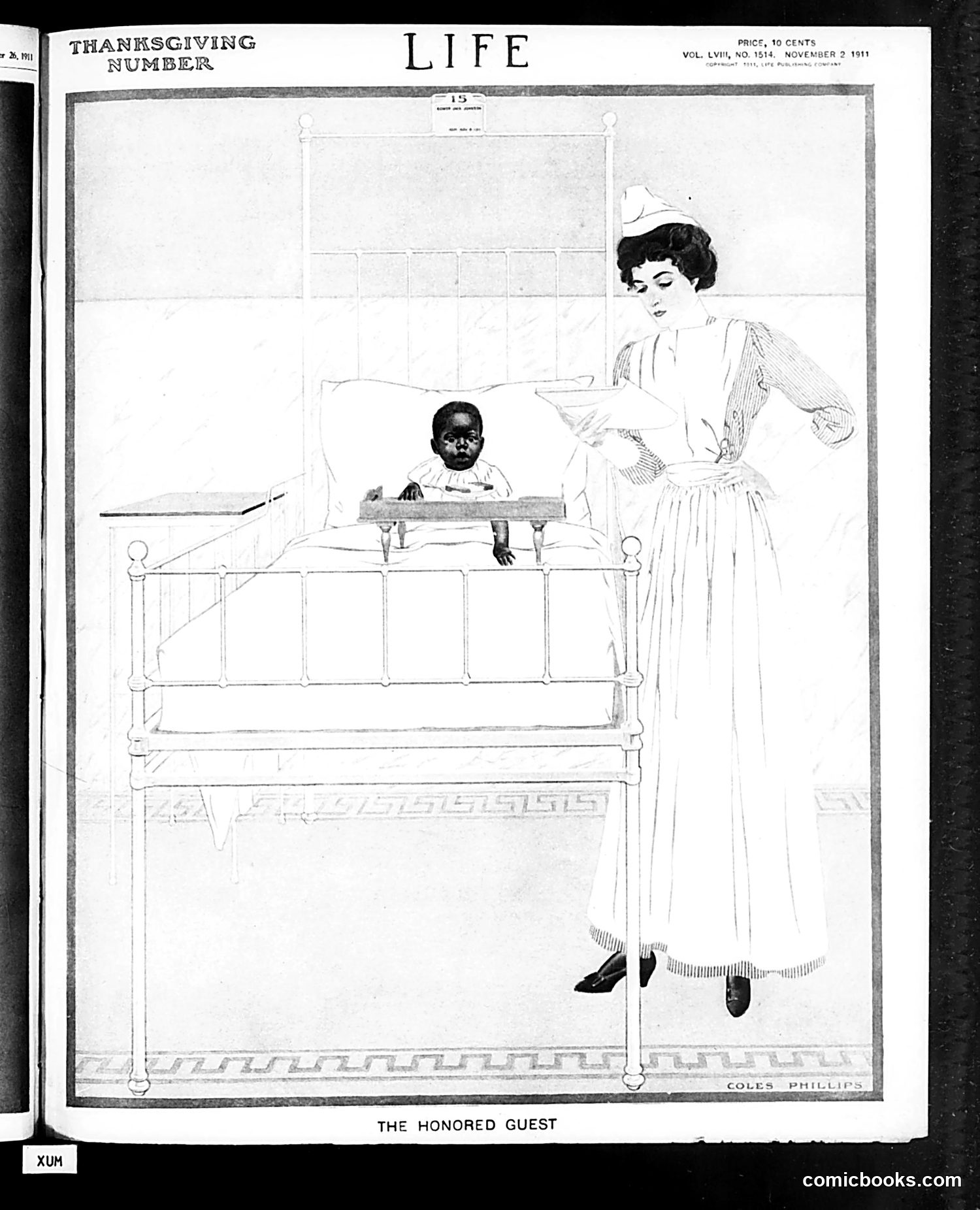
This illustration depicts a nurse tending to a Black infant in a crib, titled "The Honored Guest." The cartoon appears to be satirizing Thanksgiving hospitality, though the specific historical reference is unclear from the image alone. Given the 1911 date and the prominent depiction of a Black child in a domestic care context, this likely reflects contemporary social attitudes. The nurse's attentive posture and the child's prominence suggest irony—perhaps commenting on how Black Americans were positioned within white American households or society at large. Without additional context about events or debates from November 1911, the precise satirical target remains uncertain. The artwork credits Coles Phillips, a prominent illustrator of the era.
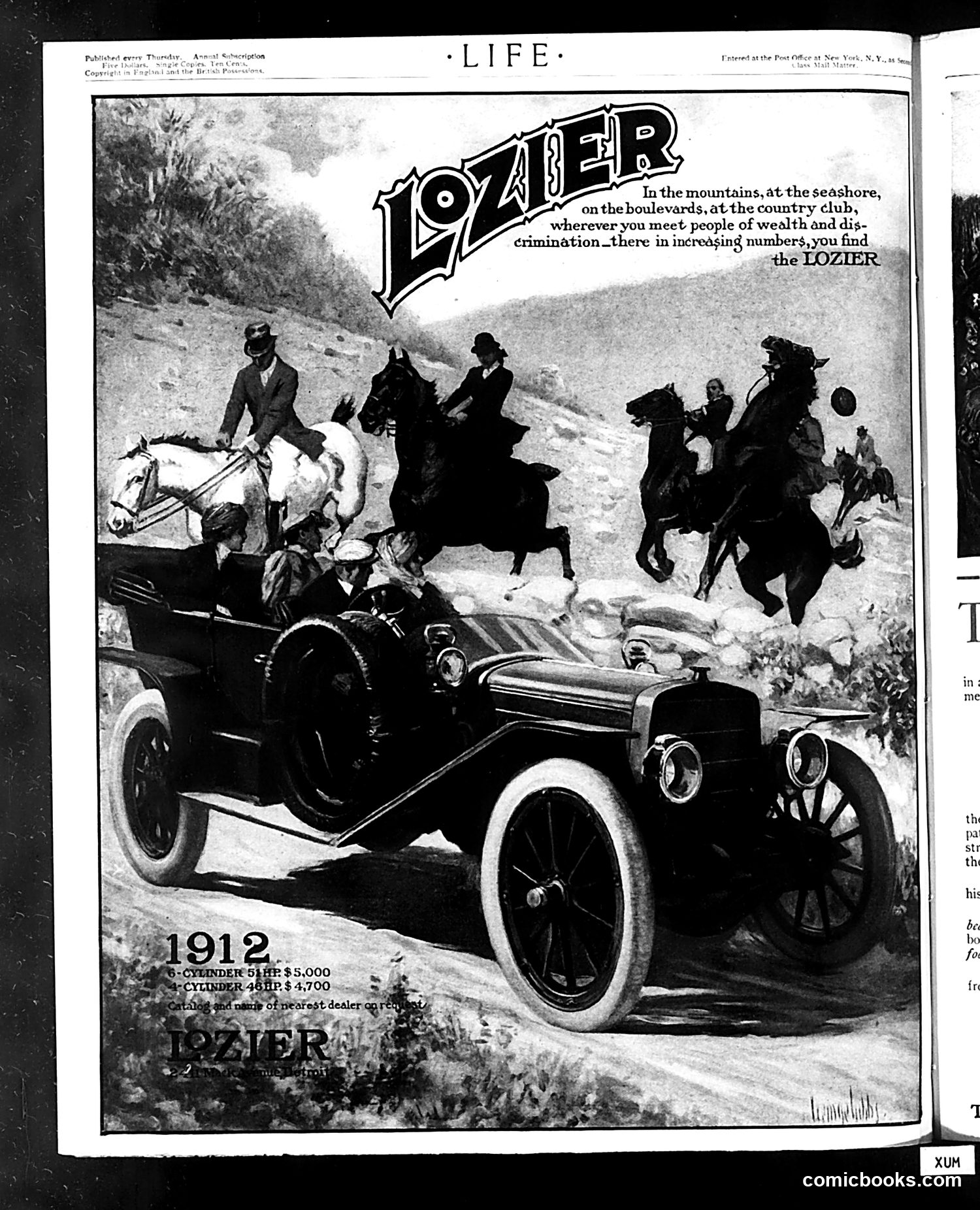
This is primarily a **product advertisement** for the 1912 Lozier automobile, not political satire. The ad uses social aspiration as its marketing appeal. The image shows a wealthy couple in their Lozier motor car encountering horseback riders on a country road—a scene contrasting modern automotive technology with traditional transportation. The advertising copy emphasizes that the Lozier is found "on the mountains, at the seashore, on the boulevards, at the country club, wherever you meet people of wealth and discrimination." The satire is implicit rather than explicit: it's gently mocking the aspirational consumer by suggesting that owning a Lozier signals membership in an elite social class. Pricing is listed at $5,000 (8-cylinder) and $4,700 (6-cylinder)—substantial sums in 1912, positioning this as a luxury good for the wealthy.
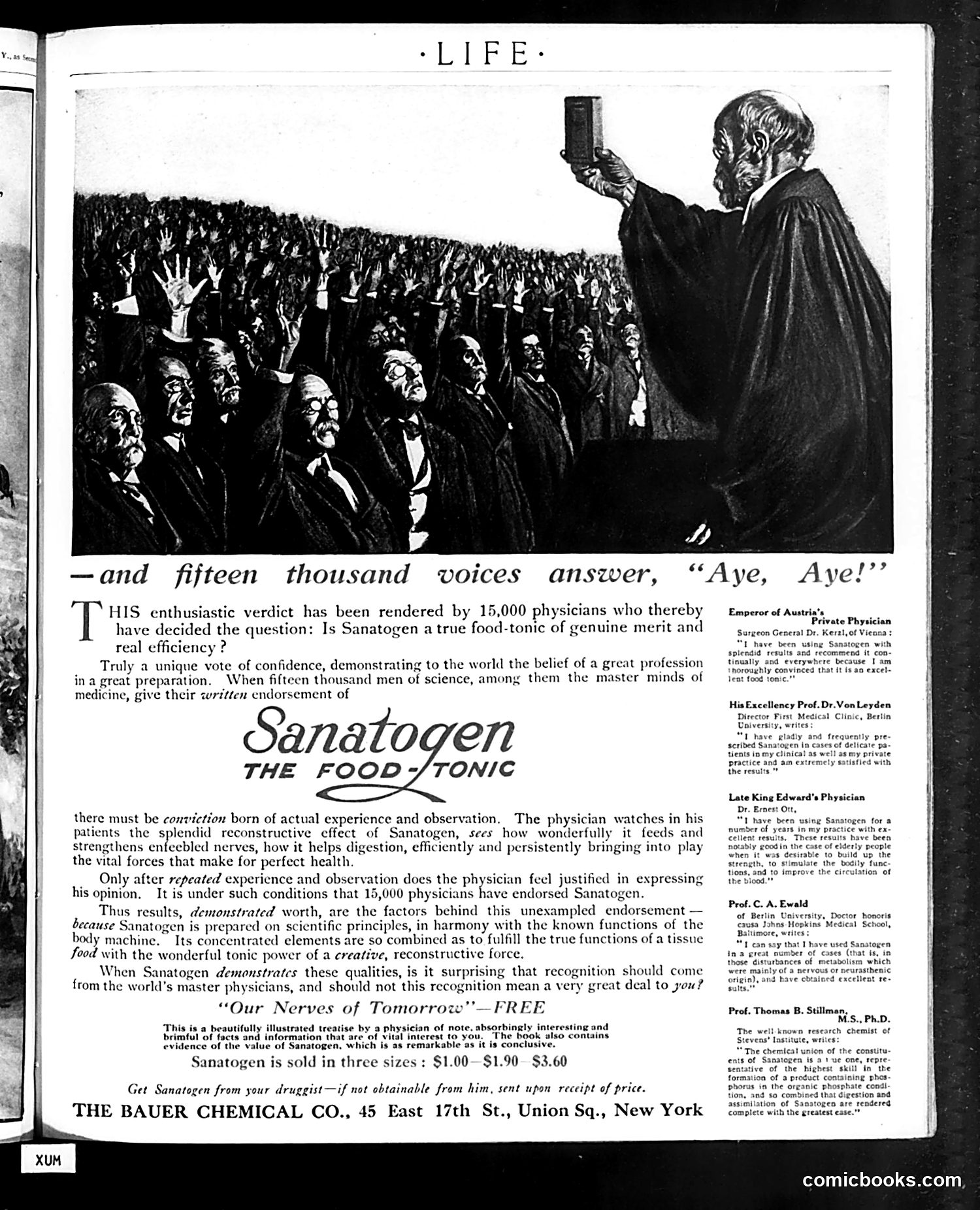
This page is primarily a **product advertisement** for Sanatogen, a food tonic marketed to physicians. The dramatic illustration shows a bearded man (appearing to be a religious or authority figure) displaying a book to thousands of raised hands—a visual metaphor for mass endorsement. The advertisement claims 15,000 physicians have endorsed Sanatogen as a legitimate health product. The text emphasizes scientific credibility, quoting various prominent doctors (Professor von Leyden, King Edward's physician, etc.) praising its efficacy for digestion, nerve health, and circulation. Rather than political satire, this reflects **early 20th-century advertising strategy**: using appeals to expert authority and pseudo-scientific testimonials to market patent medicines—a common practice before strict FDA regulations. The theatrical imagery aims to convey professional legitimacy to consumers.
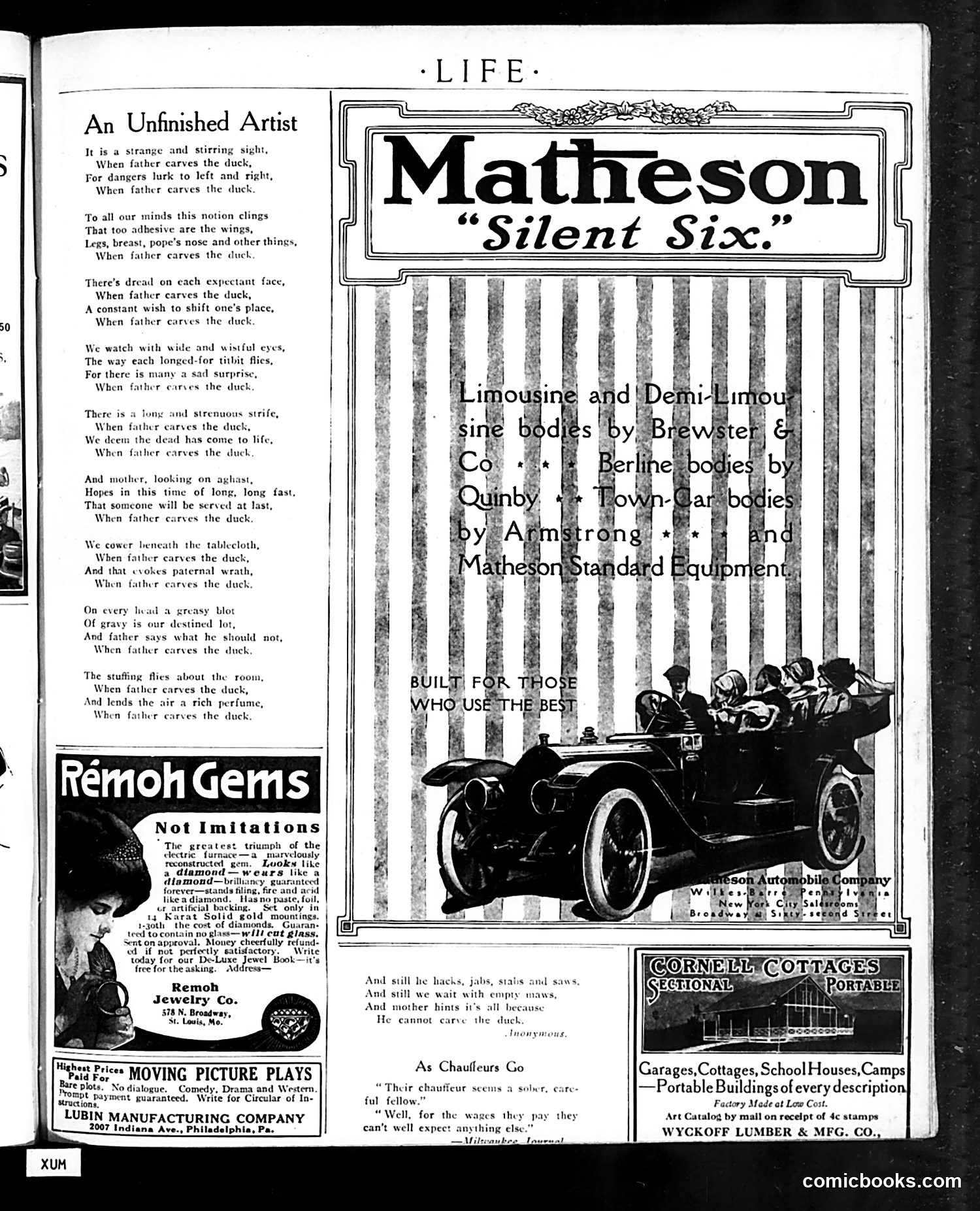
This page is **primarily advertising**, not political satire. The main content features: 1. **"An Unfinished Artist"** (left column): A poem about carving a duck—likely a humorous piece playing on the repetitive phrase "when father carves the duck," a common domestic scene in period humor. 2. **Matheson "Silent Six" automobiles** (center): A full-page car advertisement highlighting Limousine and Demi-Limousine models with various body styles. 3. **Secondary ads** (bottom/sides): Remoh Gems jewelry, Moving Picture Plays, Cornell Cottages (portable buildings), and Lubin Manufacturing Company. The "duck carving" poem appears to be light domestic humor rather than political commentary. This is a commercial magazine page typical of early 20th-century Life, mixing modest editorial content with substantial advertising revenue.
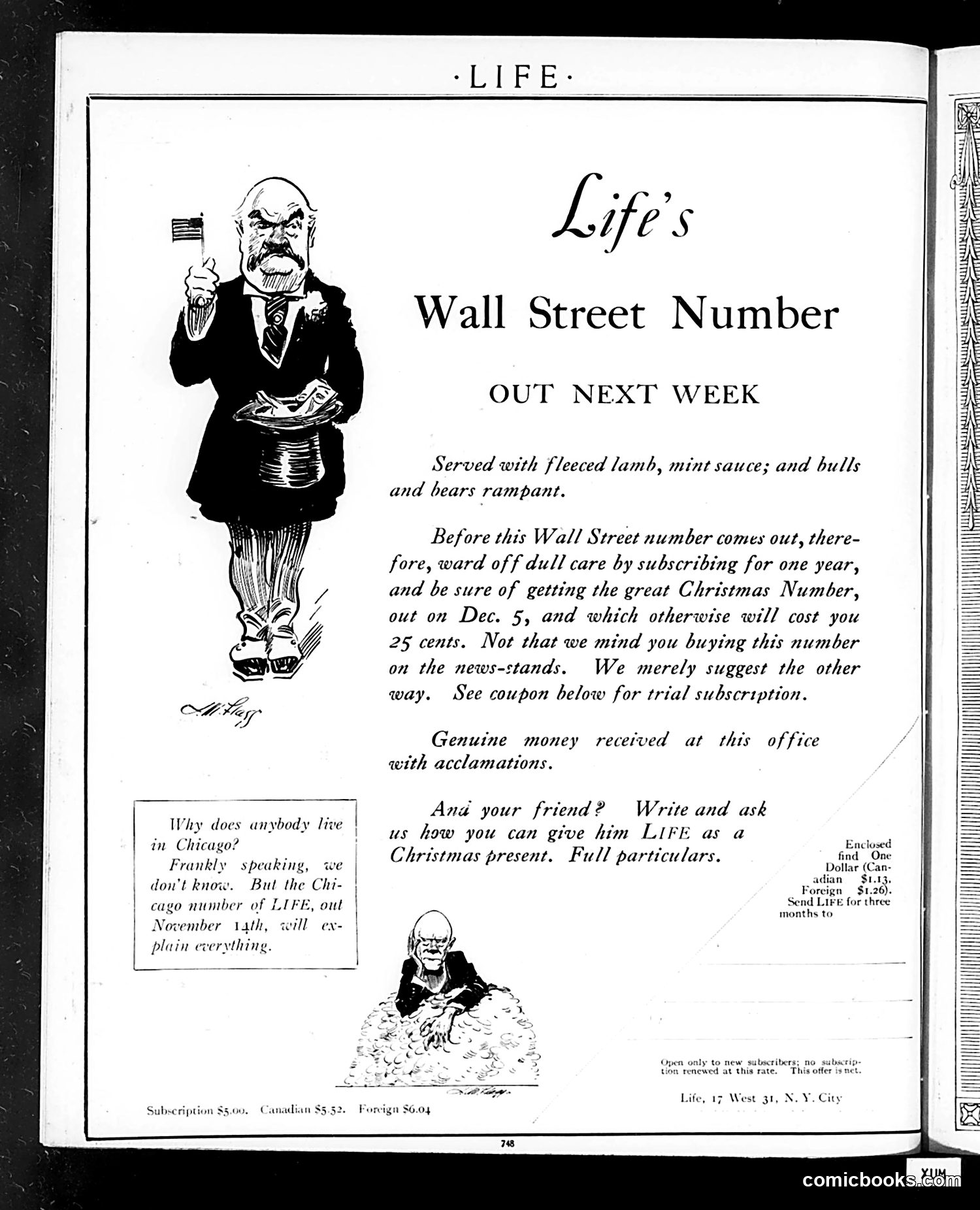
This is primarily a **subscription advertisement** for Life magazine's upcoming "Wall Street Number" issue, not political satire. The cartoons depict a portly, mustachioed businessman character—likely representing a stereotypical wealthy financier or speculator—in two poses holding money and financial documents. The humor is satirical toward Wall Street itself: the ad humorously "serves" financial content "with fleece'd lamb, mint sauce; and bulls and bears rampant"—puns on both menu language and stock market terminology ("bulls and bears" being market types). The copy encourages subscriptions to avoid missing the Christmas Number (costing 25 cents), positioning Life as essential reading for understanding American finance and current events. This reflects the early 20th-century magazine's social commentary on wealth and commerce.
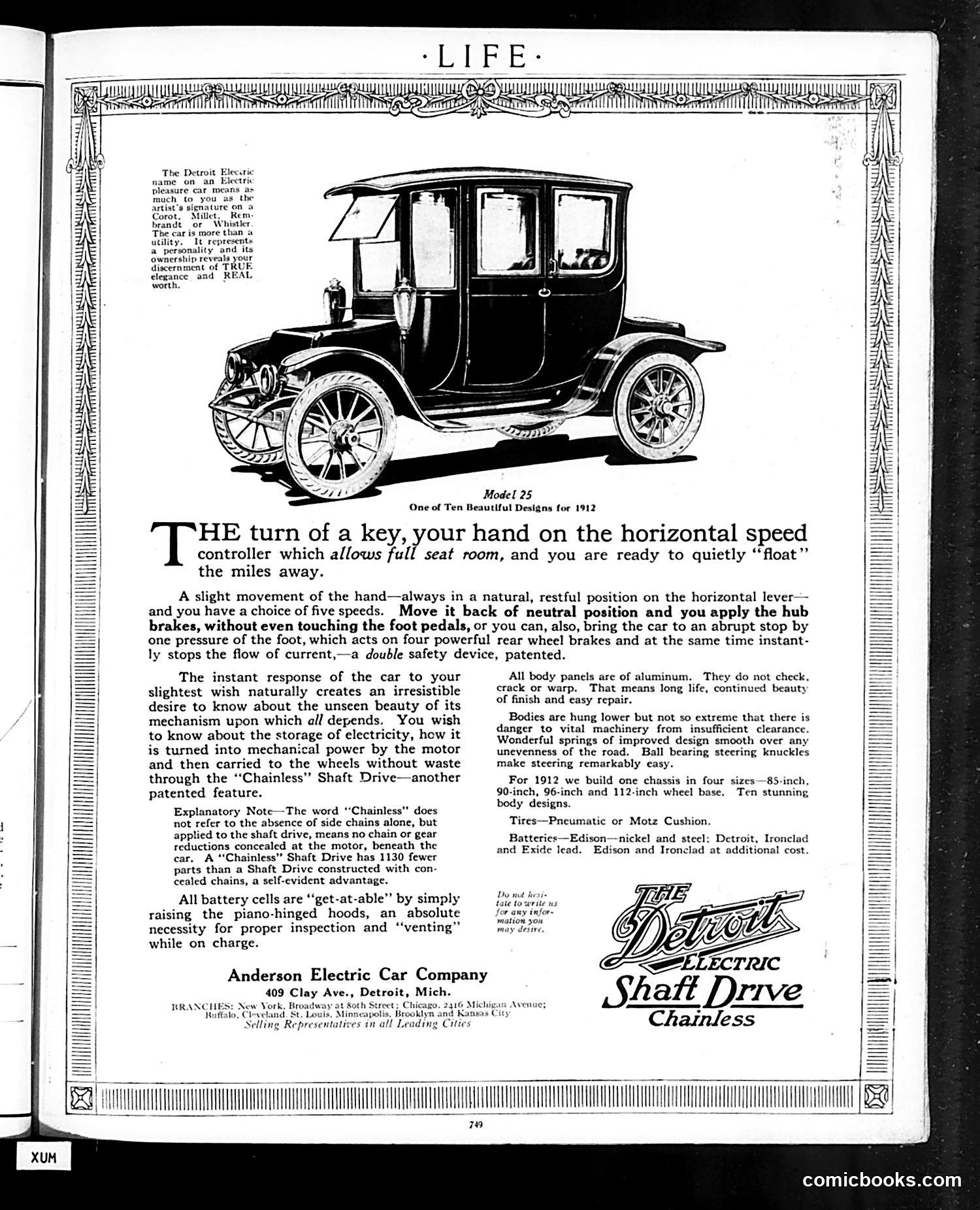
This page is **primarily an advertisement**, not satirical content. It promotes the Detroit Electric automobile, Model 25, manufactured by the Anderson Electric Car Company of Detroit, Michigan. The ad emphasizes the car's innovative features: a key-start ignition system, hand controls for speed and braking (requiring no foot pedals), and a patented "Chainless Shaft Drive." It highlights the vehicle's aluminum body panels, ease of repair, and available battery options. The appeal targets practical buyers valuing convenience and safety—notably, electric cars were popular among early 1900s consumers, particularly women, as they were quieter and easier to operate than gasoline-powered vehicles. The advertisement's focus on user-friendly controls and mechanical simplicity reflects this market positioning.
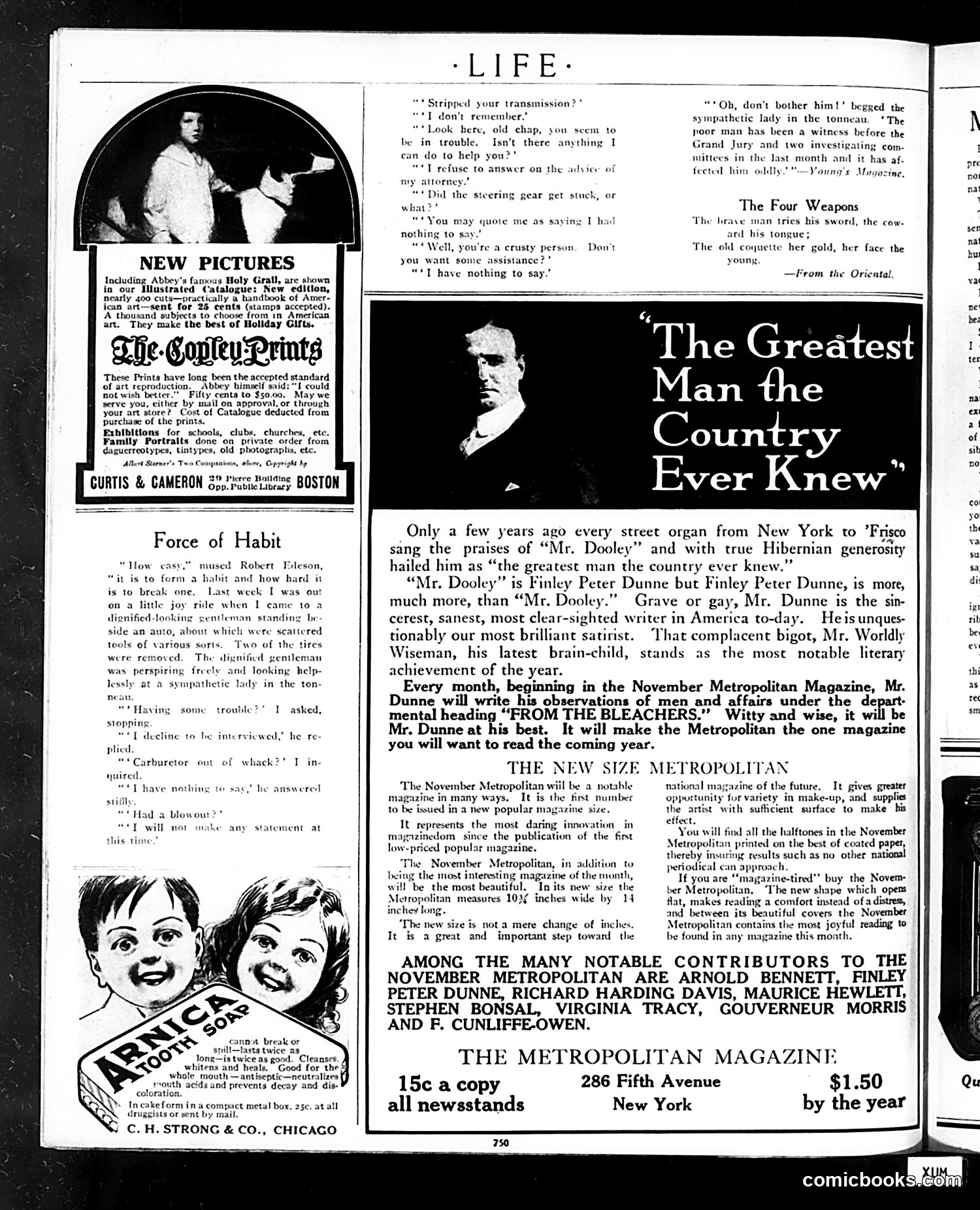
This page is primarily **advertising and promotional content** rather than satirical cartoons. The main feature promotes the November *Metropolitan Magazine*, advertising it as "The Greatest Man the Country Ever Knew"—referring to an unnamed public figure (the text mentions "Mr. Dooley" and writers like Peter Dunne). Other advertisements include: - **Godsey Prints** (art reproductions) - **Force of Habit** (a humorous dialogue about breaking habits, featuring Robert Edison) - **Arnica** (a patent medicine for children) The page emphasizes the *Metropolitan's* new larger format and notable contributors (Arnold Bennett, Peter Dunne, Richard Harding Davis, and others). The content reflects early 20th-century magazine promotion rather than political satire.
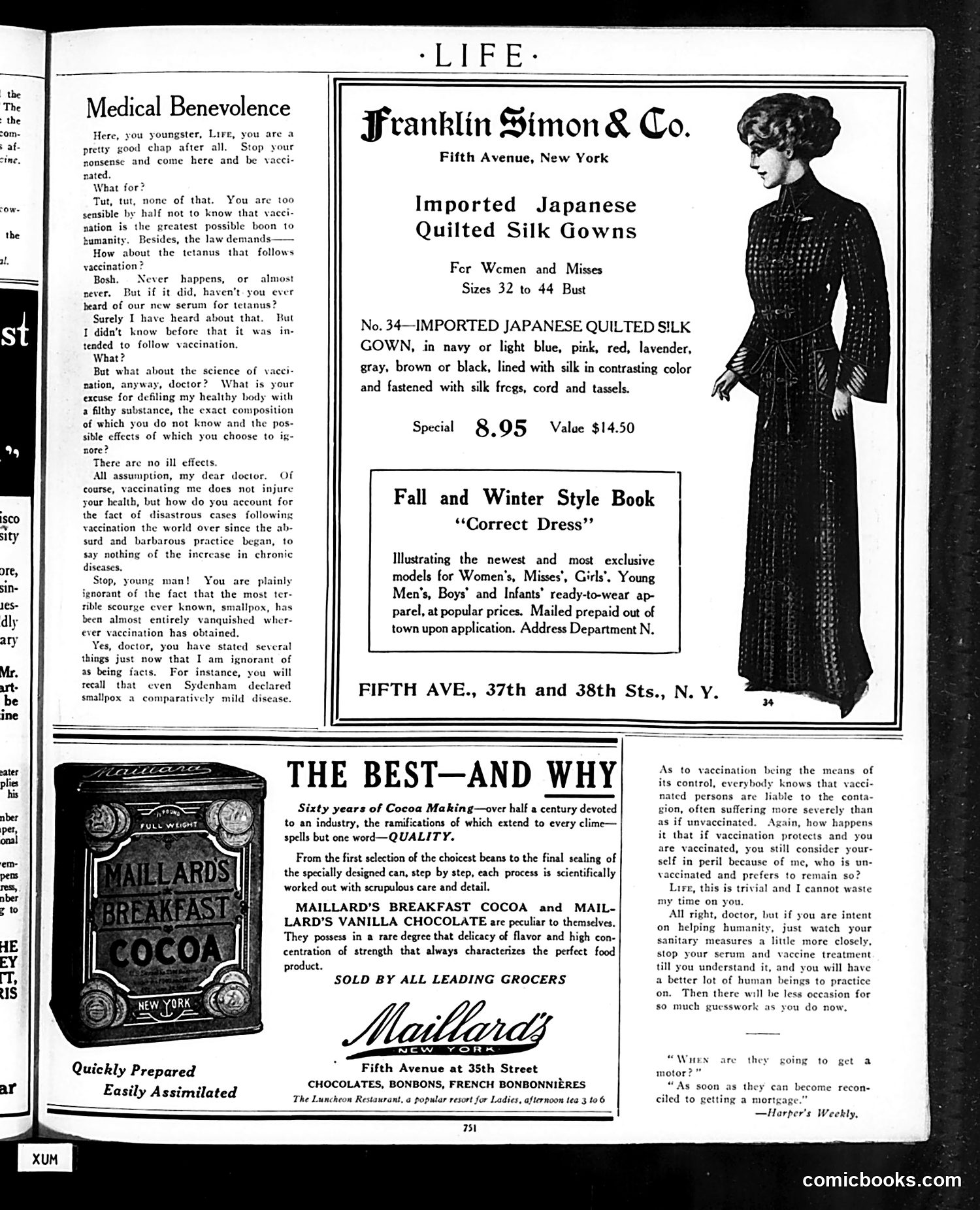
This is primarily **a advertisements page** from Life magazine, not a political cartoon page. The main content includes: 1. **Franklin Simon & Co. advertisement** for imported Japanese quilted silk gowns, with an illustration of a woman in an elegant long dark dress 2. **Maillard's Breakfast Cocoa advertisement** emphasizing quality and scientific processing 3. **A dialogue on vaccination** in the upper left, presenting an anti-vaccination argument and the doctor's rebuttal. The text debates whether vaccination causes disease, with the doctor defending vaccination as safe and beneficial for public health. The vaccination debate reflects **early 20th-century public health controversies**, where vaccine hesitancy and misinformation existed even then—a historically parallel concern to modern debates.
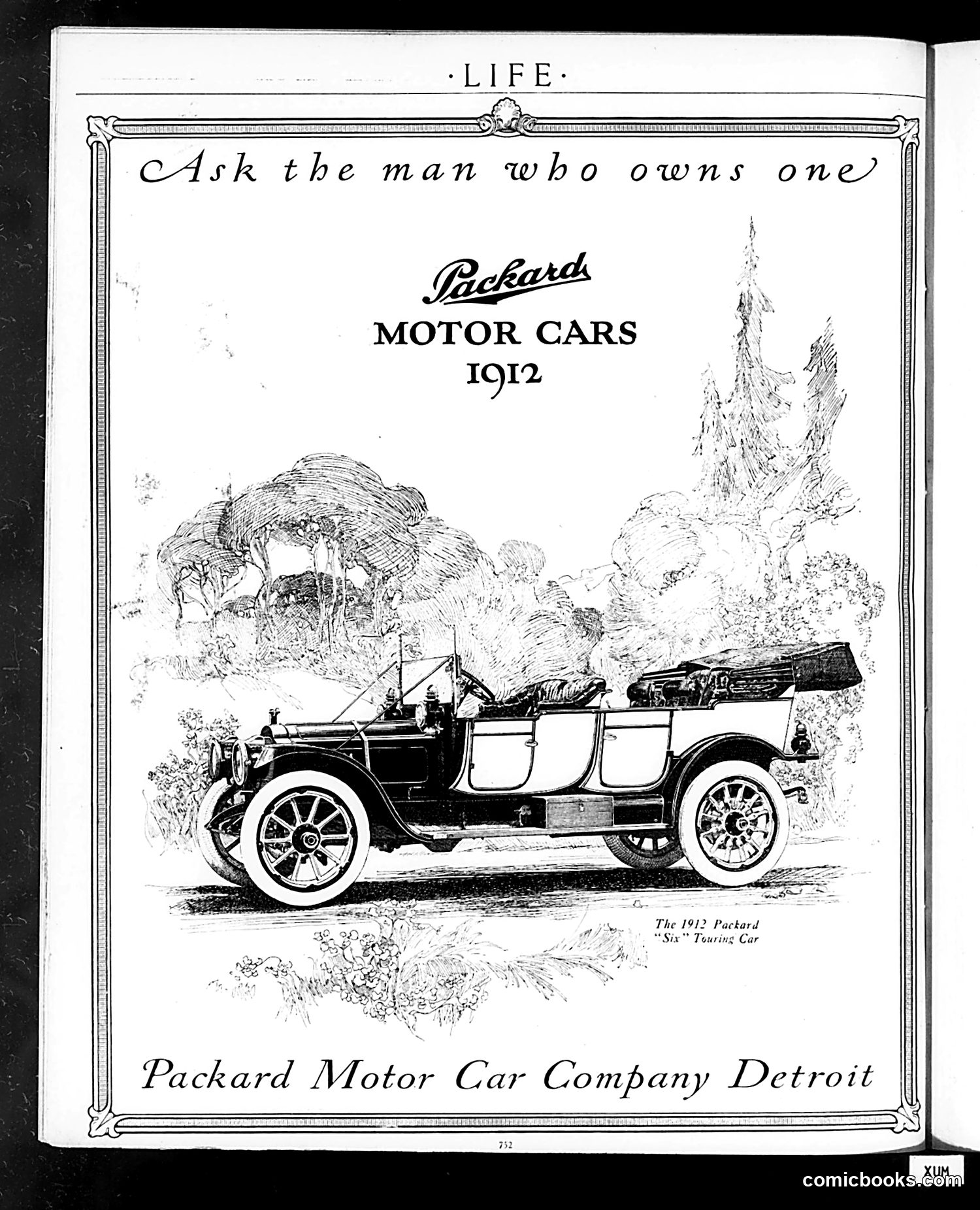
This is primarily a **product advertisement**, not political satire. The page appears from *Life* magazine's 1912 issue and advertises the Packard Motor Car Company of Detroit. The advertisement uses aspirational imagery: a detailed sketch of the 1912 Packard "Six" Touring Car positioned in an idealized natural landscape with mountains and trees. The opening line—"Ask the man who owns one"—was Packard's actual marketing slogan, suggesting owner satisfaction and credibility through word-of-mouth reputation. There is no political cartoon or satire here. Rather, this represents early automotive advertising targeting affluent readers of *Life*, emphasizing the car's quality and prestige through elegant presentation and testimonial appeal.
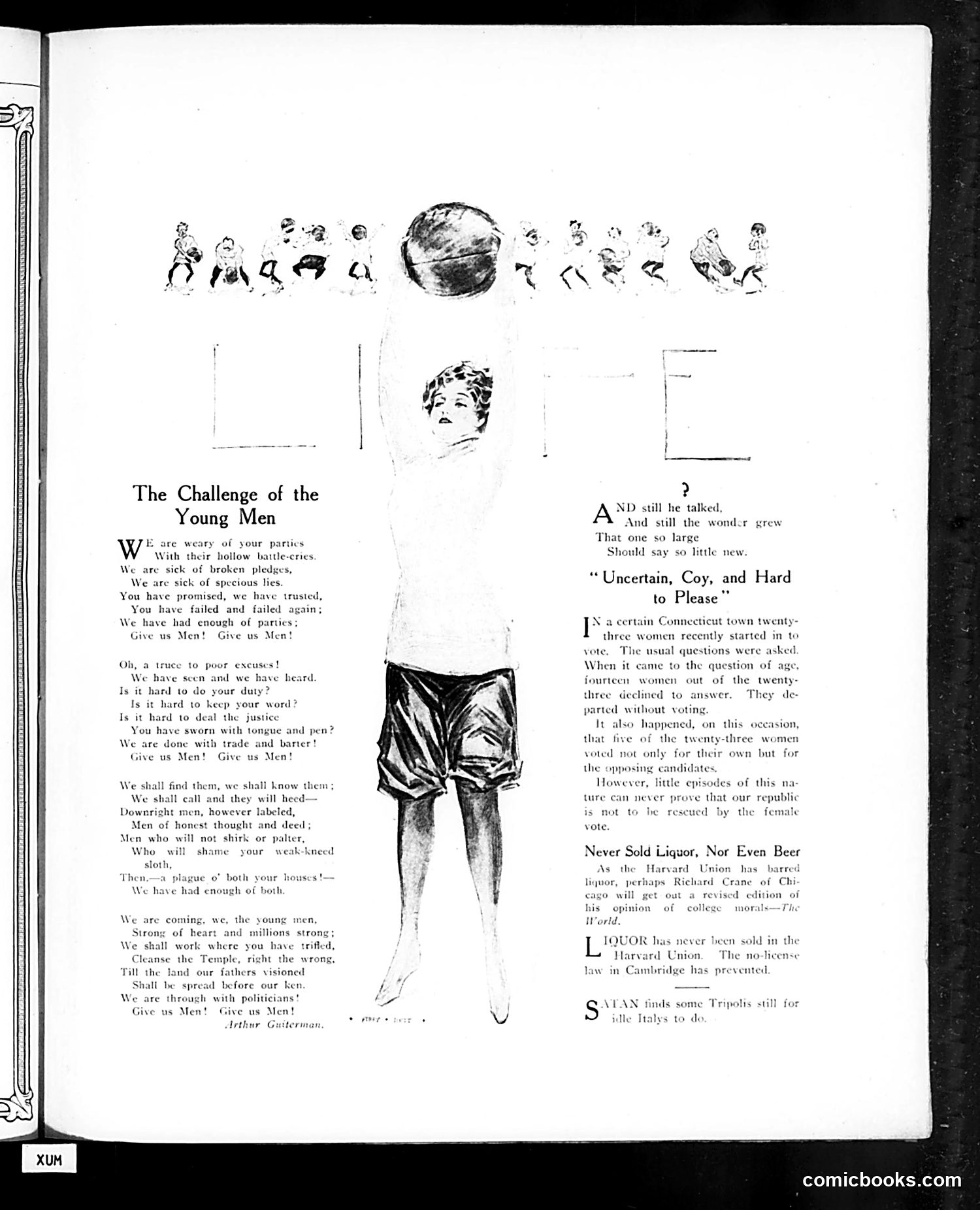
This page contains a satirical poem by Arthur Guiterman criticizing political failures and broken promises. The verse attacks what appears to be corrupt governance—references to "hollow battle-cries," "broken pledges," and "specious lies" suggest disillusionment with politicians who've repeatedly failed constituents. The accompanying illustration shows a woman in 1920s dress, likely representing female voters (women had recently gained voting rights). Below are smaller figures in athletic poses surrounding a large globe, suggesting young men as global actors or soldiers. The right column includes brief satirical items mocking Harvard's alcohol prohibition and references to Tripoli, possibly alluding to naval/military adventures. The overall theme appears to be youthful frustration with political establishment corruption and failed leadership.
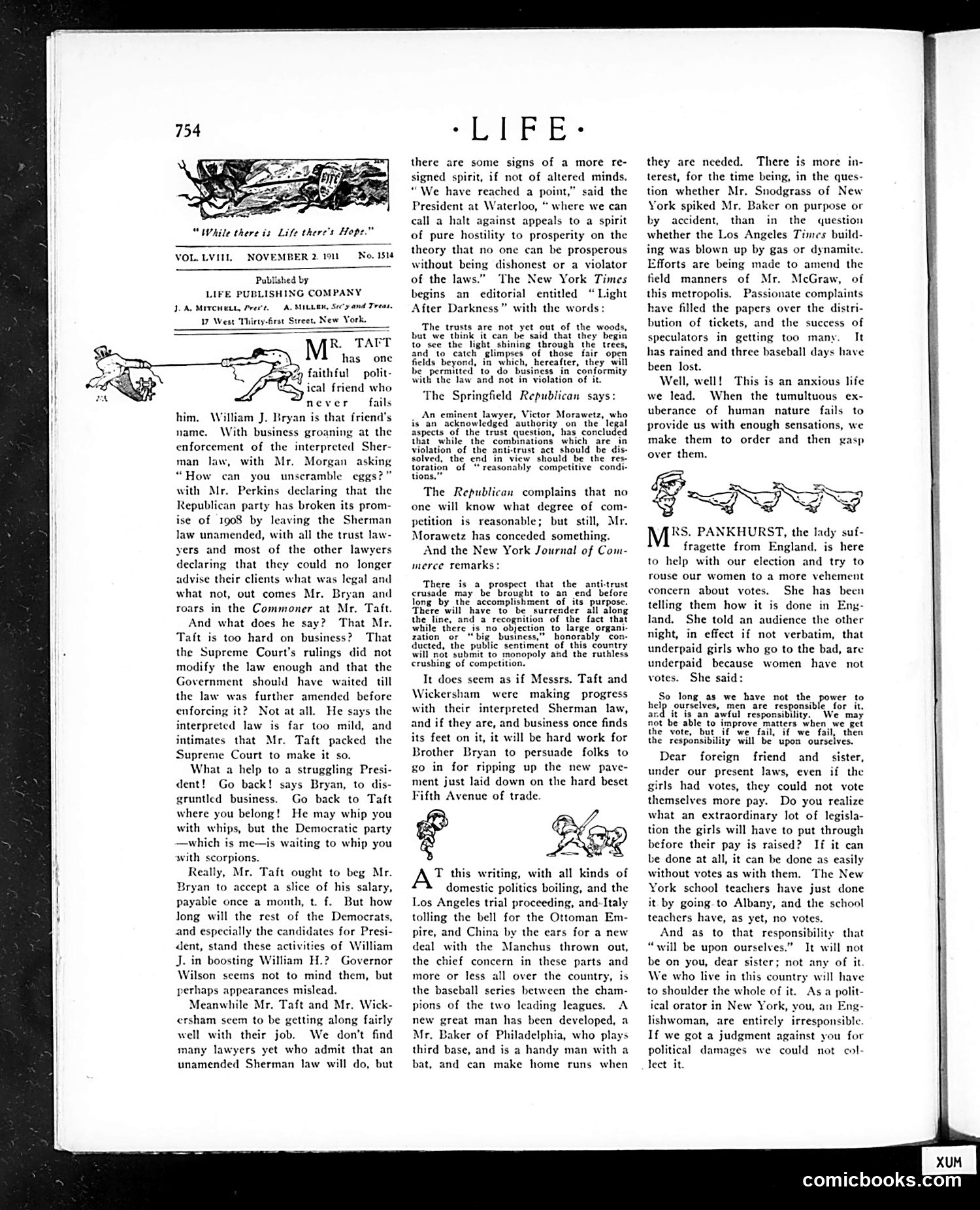
This page contains editorial commentary on contemporary political issues rather than cartoons. The text discusses: **William Jennings Bryan** and Republican party politics—specifically criticism of how the GOP has "broken its promise of 1908" regarding Sherman Antitrust law enforcement. The editorial mocks Mr. Taft's mild interpretation of the law as insufficient. **Trust regulation debates** between Taft and Bryan, with commentary on whether antitrust enforcement has been adequately pursued. **Women's suffrage** is addressed through "Mrs. Pankhurst," the British suffragist visiting to advocate for women's votes, drawing parallels to American electoral reform debates. The page reflects Progressive Era concerns about corporate monopolies, executive power, and women's political participation circa 1911.
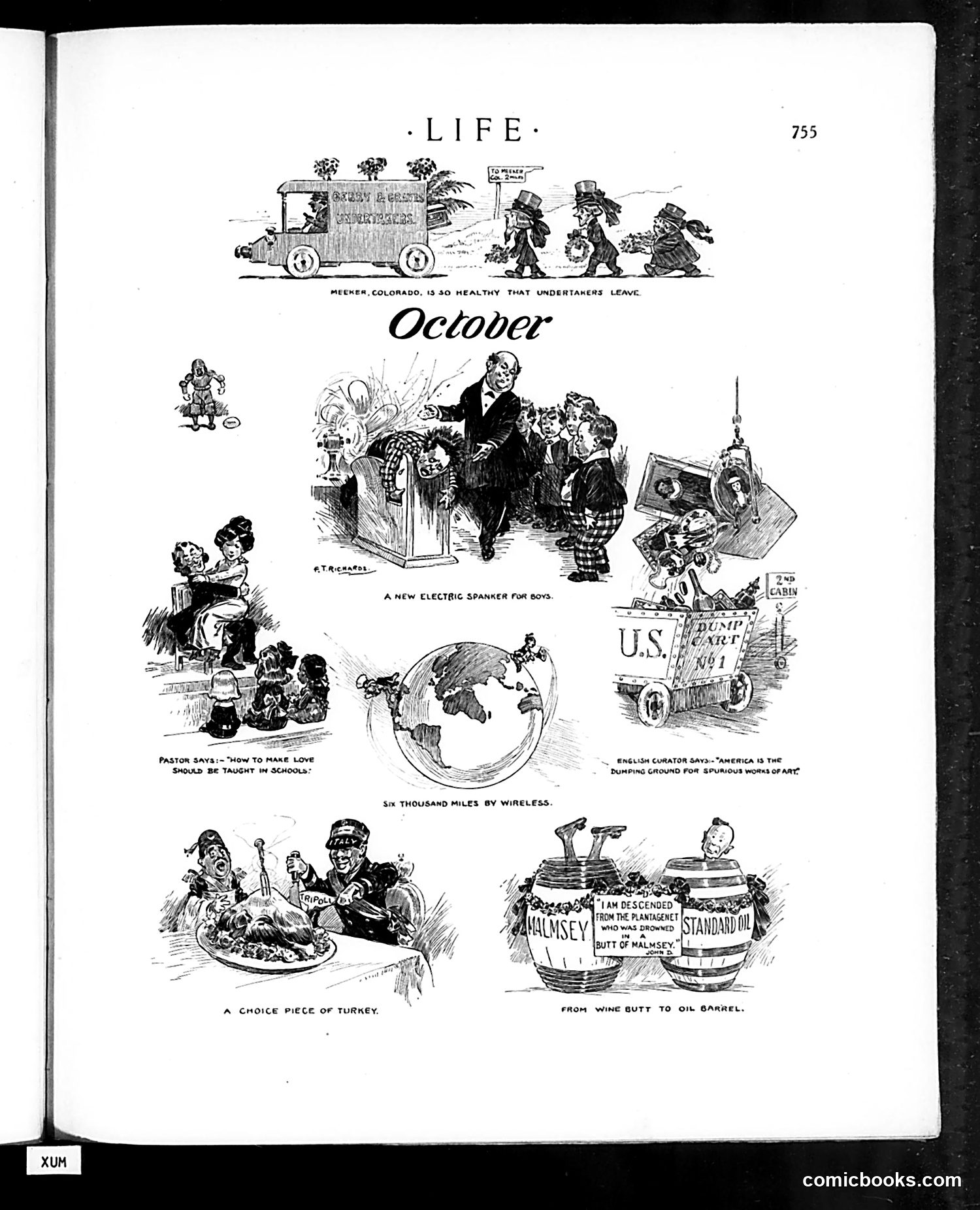
This page collects six October-themed satirical cartoons mocking contemporary 1910s-1920s concerns: 1. **Top**: "Meeker, Colorado, is so healthy..." jokes about health fads and wellness tourism. 2. **"Electric Spanker for Boys"**: Satirizes new technology marketed to parents as educational/disciplinary tools. 3. **Pastor's quote on teaching love**: Mocks religious hypocrisy regarding education and morality. 4. **Wireless transmission**: References the era's fascination with new wireless technology. 5. **English curator's comment**: Appears to critique American cultural pretensions and art collecting. 6. **Halmsey/Standard Oil barrels**: Satirizes the oil industry (likely Standard Oil's dominance), showing transformation "from wine butt to oil barrel"—suggesting industrial capitalism replacing traditional commerce. The cartoons use exaggerated caricature and wordplay typical of Life's satirical approach to technology, religion, and business.
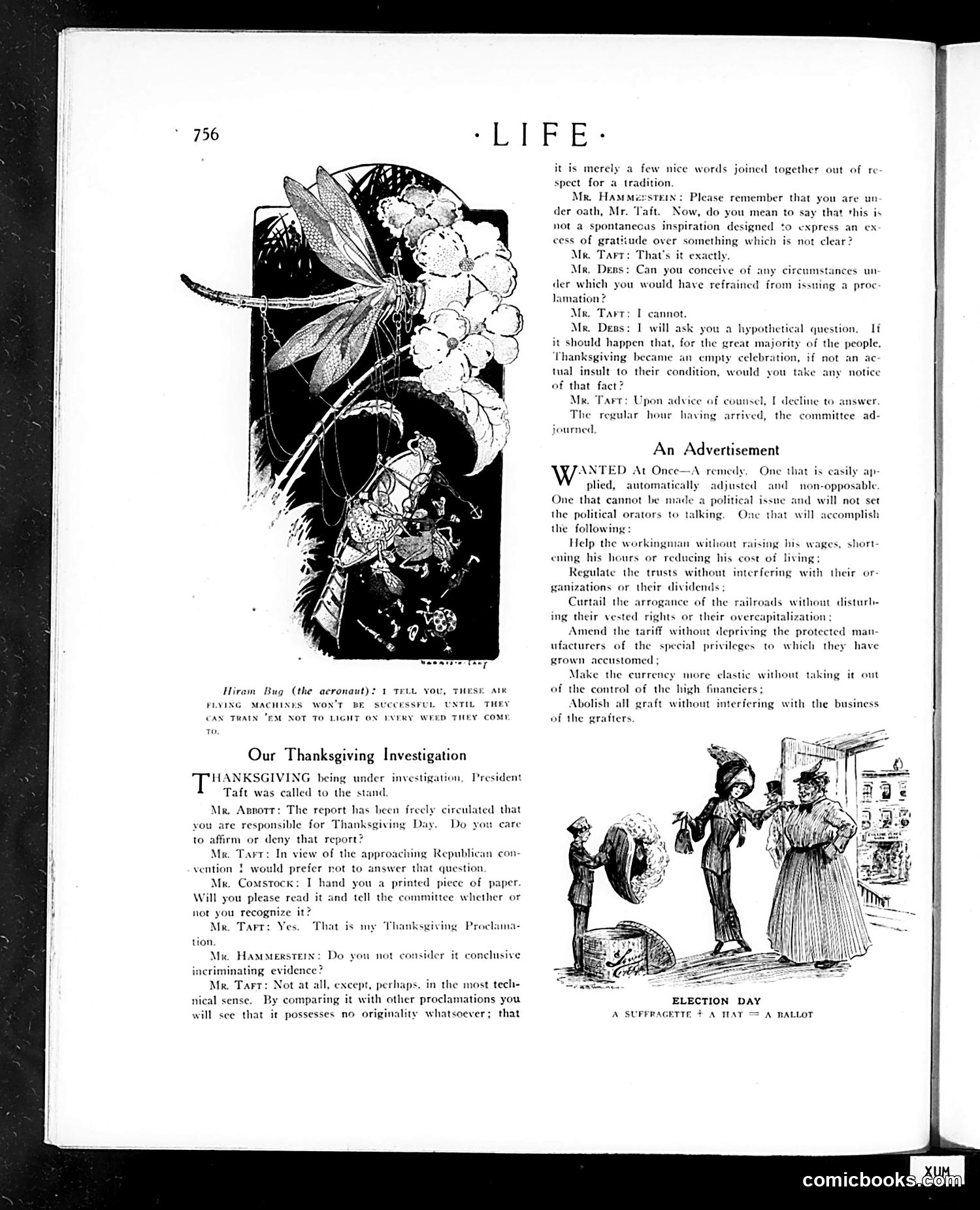
This page contains satirical political content from *Life* magazine, featuring two main sections: **"Our Thanksgiving Investigation"** presents a dialogue between Mr. Abbott (likely a journalist or investigator) and President Taft, questioning Taft's responsibility for the Thanksgiving Proclamation. The exchange mocks Taft's evasiveness—he refuses to confirm or deny authorship, claiming it lacks originality compared to other proclamations. This appears to satirize Taft's tendency toward non-committal political responses. **"An Advertisement"** presents an ironic wish-list of impossible political remedies: preventing workers' wage cuts, regulating trusts, curtailing railroad monopolies, eliminating graft—all presented as things that "cannot be made" happen. The satire criticizes the political establishment's inability or unwillingness to address economic inequality and corporate corruption. The bottom cartoon, "Election Day," depicts women with suffragette imagery (a hat and ballot), reflecting early 20th-century debates over women's voting rights.
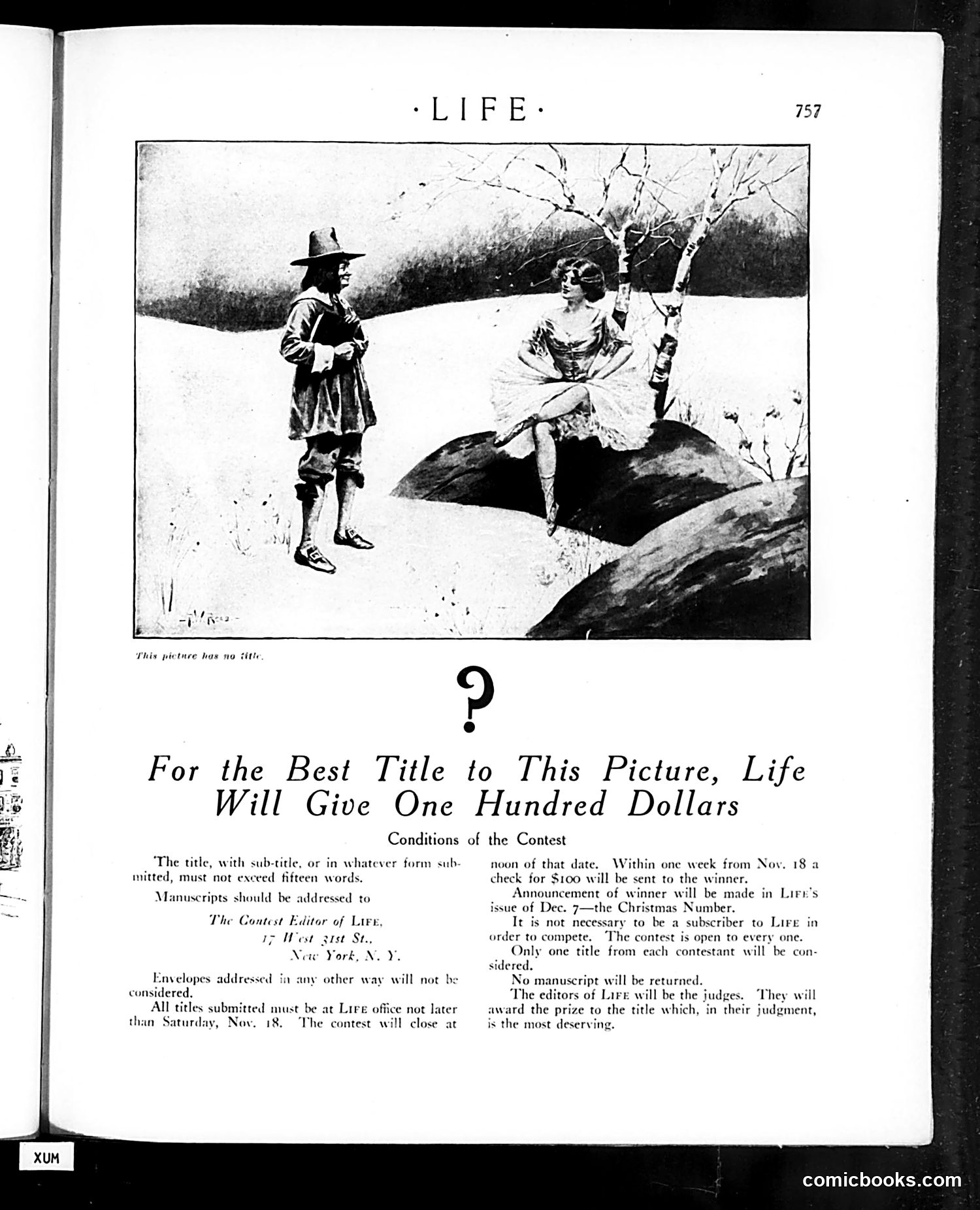
This page presents a reader-submission contest rather than a completed cartoon. The image shows a winter scene: a man in old-fashioned clothing and hat stands conversing with a woman in a white dress near a dark hole in snowy ground, with bare birch trees visible. Life magazine—a satirical weekly—is crowdsourcing witty captions, offering $100 (substantial money at the time) to readers who submit the cleverest title within fifteen words. The contest reflects Life's format: combining illustrations with reader participation and humor. The image's meaning is deliberately obscure—the incongruous scene (formal dress in winter, unexplained hole) begs explanation. Readers would submit humorous interpretations, likely involving romantic mishaps, social commentary, or absurdist humor typical of Life's satirical style. The contest was common editorial practice, engaging readers while filling content pages economically.
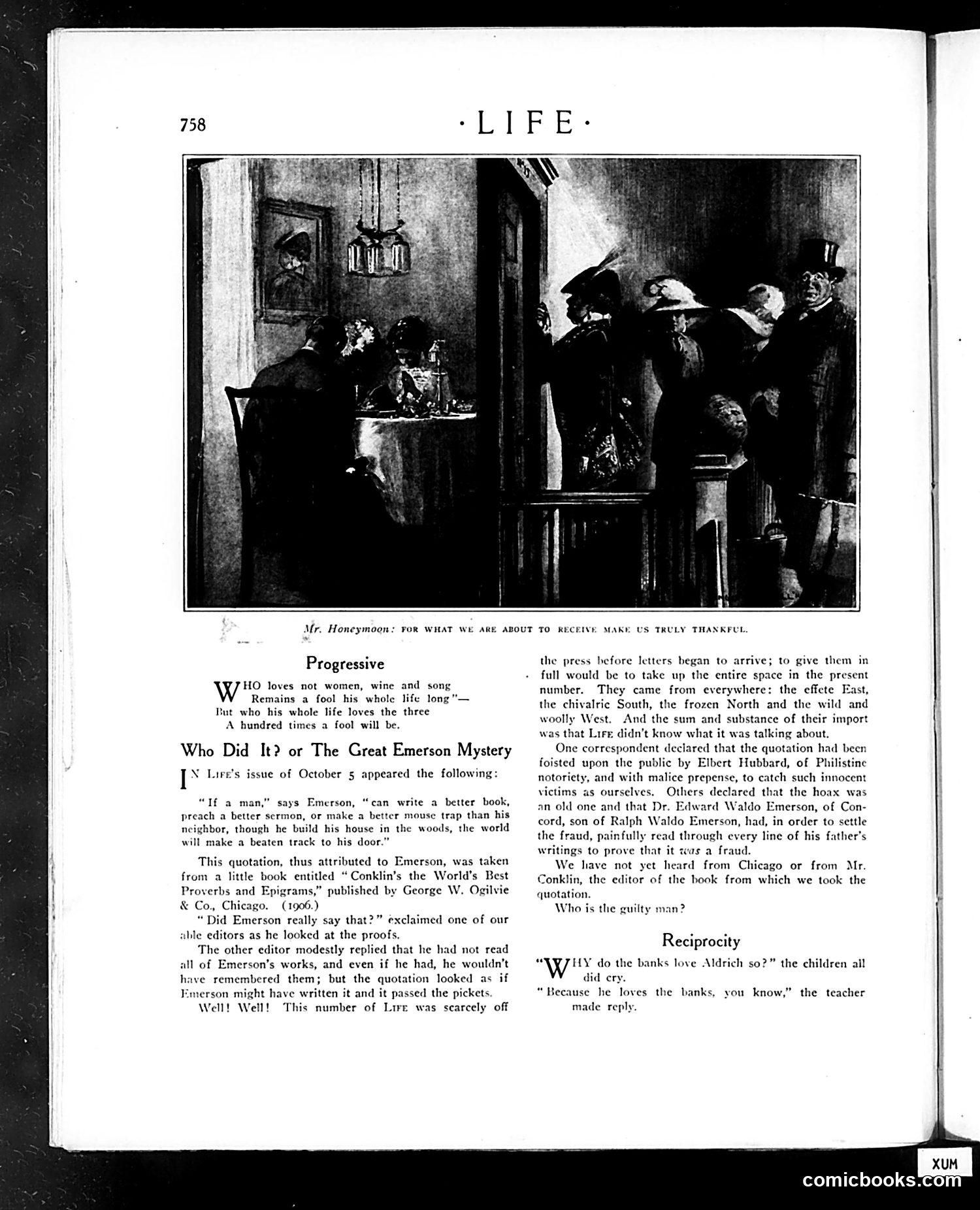
**The Image:** Shows a domestic scene where a woman sits alone at a table while a man entertains guests in an adjacent room, illustrating the caption "Mr. Honeymoon: for what we are about to receive make us truly thankful." **The Satire:** The cartoon mocks newlyweds, suggesting the husband ignores his bride to socialize with others—a cynical commentary on marriage losing its romance once the honeymoon phase ends. **The Text Content:** The page primarily addresses a *Life* magazine error: they misattributed a famous quote about building a better mousetrap to Ralph Waldo Emerson, when it actually came from "Conklin's World's Best Proverbs and Epigrams." The article humorously documents the ensuing chaos—readers from across America wrote angry letters claiming various people were responsible for the hoax (including Elbert Hubbard and Emerson's own son). *Life* playfully asks "Who is the guilty man?"—a tongue-in-cheek acknowledgment of their own editorial carelessness. The final joke about banker Aldrich is separate political commentary on financial influence.
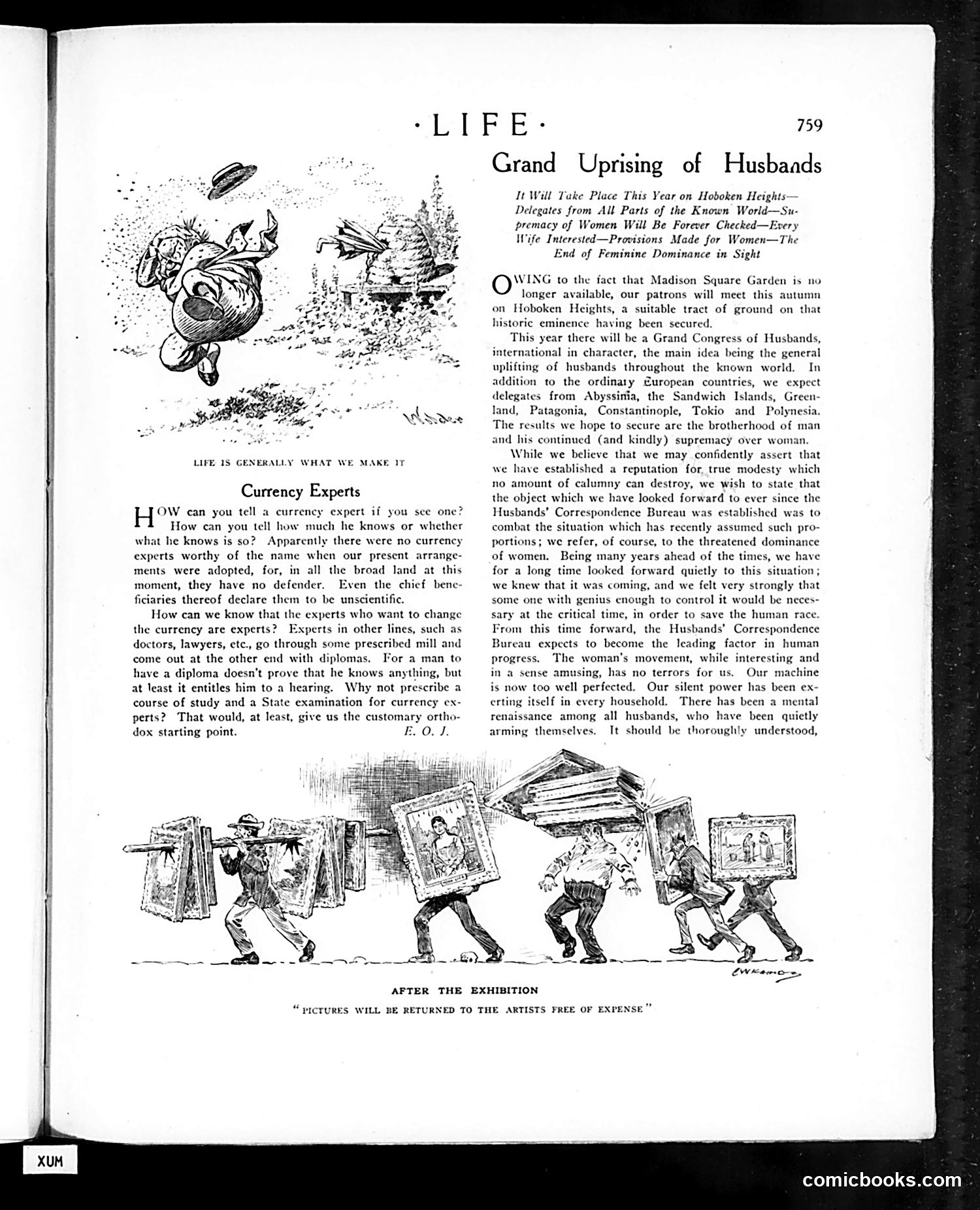
This page satirizes the early women's suffrage and feminist movements through mock-serious rhetoric. The text announces a fake "Grand Congress of Husbands" featuring international delegates, ostensibly to combat "the threatened dominance of women" and restore male "supremacy." The satire works by inverting reality: the author presents husbands as an organized, coordinated force "quietly arming themselves" against women's liberation, when in fact women were the marginalized group fighting for basic rights. The absurdist proposal (meeting on "Hoboken Heights" since Madison Square Garden is unavailable) and the overwrought language about male "mental renaissance" mock both anti-feminist rhetoric and the contemporary women's movement itself. The bottom cartoon depicts men struggling to transport framed pictures—likely representing art or cultural works—suggesting the disarray that supposedly results from women's advancing influence. The piece reflects Life's satirical stance on gender politics circa this era, using ridicule to comment on these social tensions.
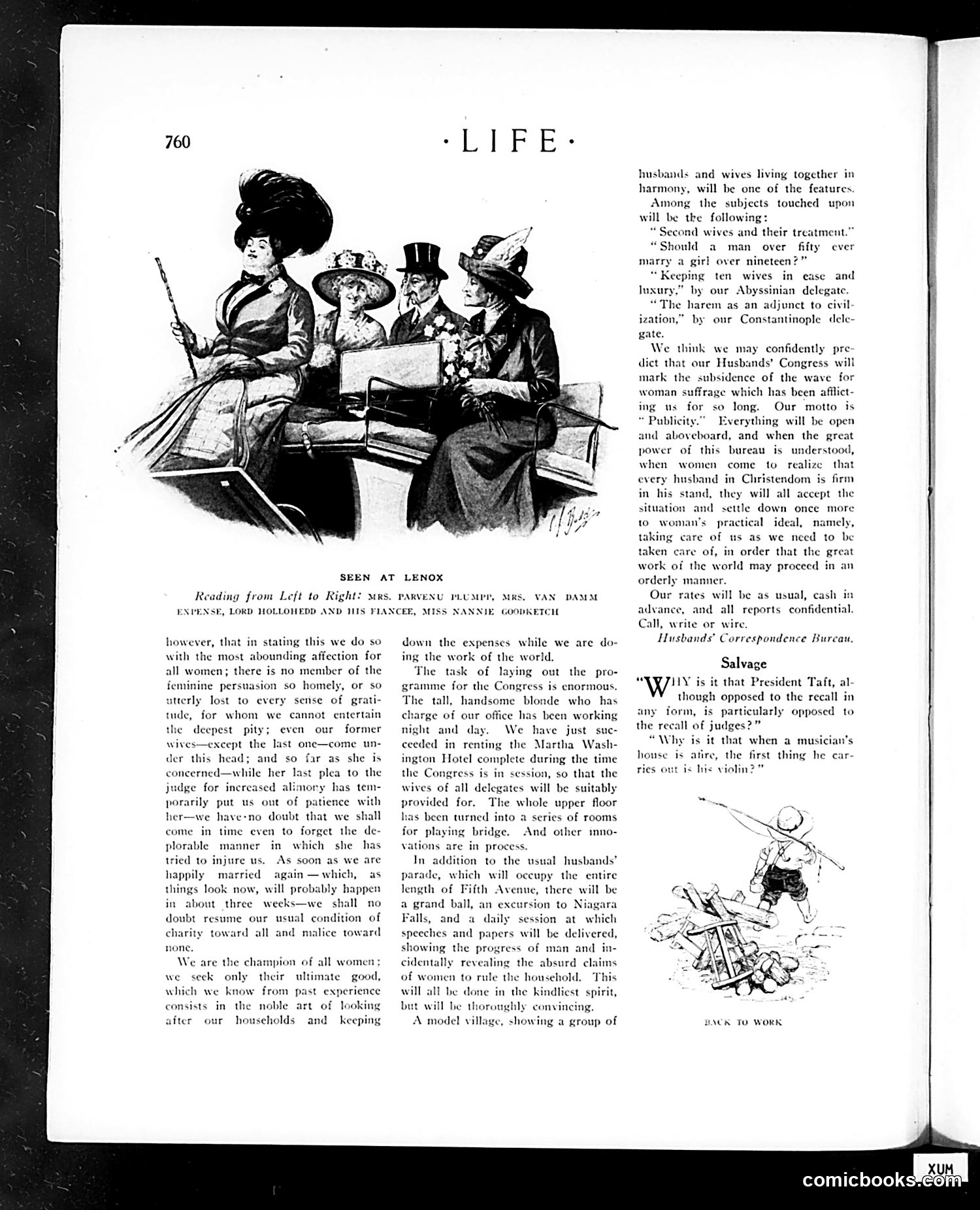
This is satirical commentary on the women's suffrage movement, presented as a mock "Husbands' Correspondence Bureau" advertising a congress to oppose women's rights. The cartoon depicts wealthy society women at Lenox (a fashionable resort), identified by their elaborate hats and clothing. The accompanying text parodies men organizing to combat women's demands for equality and voting rights. The satire mocks male anxieties by having the bureau propose absurd solutions: discussing "second wives," polygamy (referencing an "Abyssinian delegate" with ten wives), and a model village showing "wives living together in harmony" under husbands' control—presenting these as reasonable responses to suffrage activism. The tone is deliberately ironic: the author claims men are "champions of all women" while proposing to prove women unfit to "rule the household," using "publicity" to convince women to abandon their political aspirations. The lower cartoon titled "Salvage" makes an unrelated quip about musicians rescuing violins during house fires. This reflects early-20th-century anti-suffrage sentiment disguised as humor.
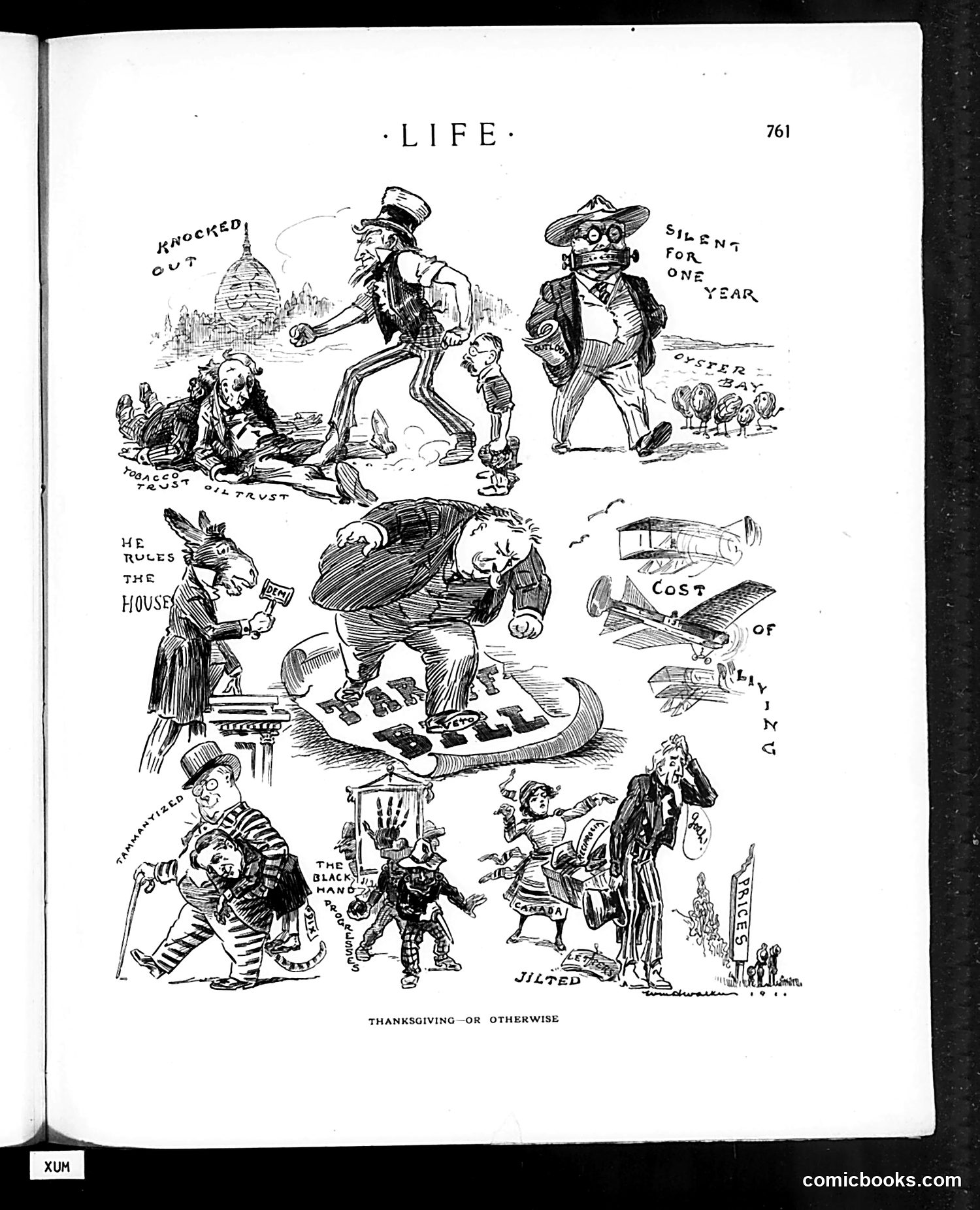
This Life magazine cartoon satirizes the consequences of political corruption and mismanagement around Thanksgiving. The central figure appears to be a politician or public official drowning in bills and financial obligations labeled "Cost of Living." The surrounding vignettes depict various social problems: one figure is "knocked out" (likely referencing a scandal), another remains "silent for one year" (possibly alluding to legal troubles), while others show "trust" being broken, someone "rules the house," and final panels show figures being "jilted." The overall message appears critical of how political failures and corruption result in ordinary citizens bearing the financial and social burden during the holiday season, transforming what should be a time of gratitude into one of hardship and disappointment.
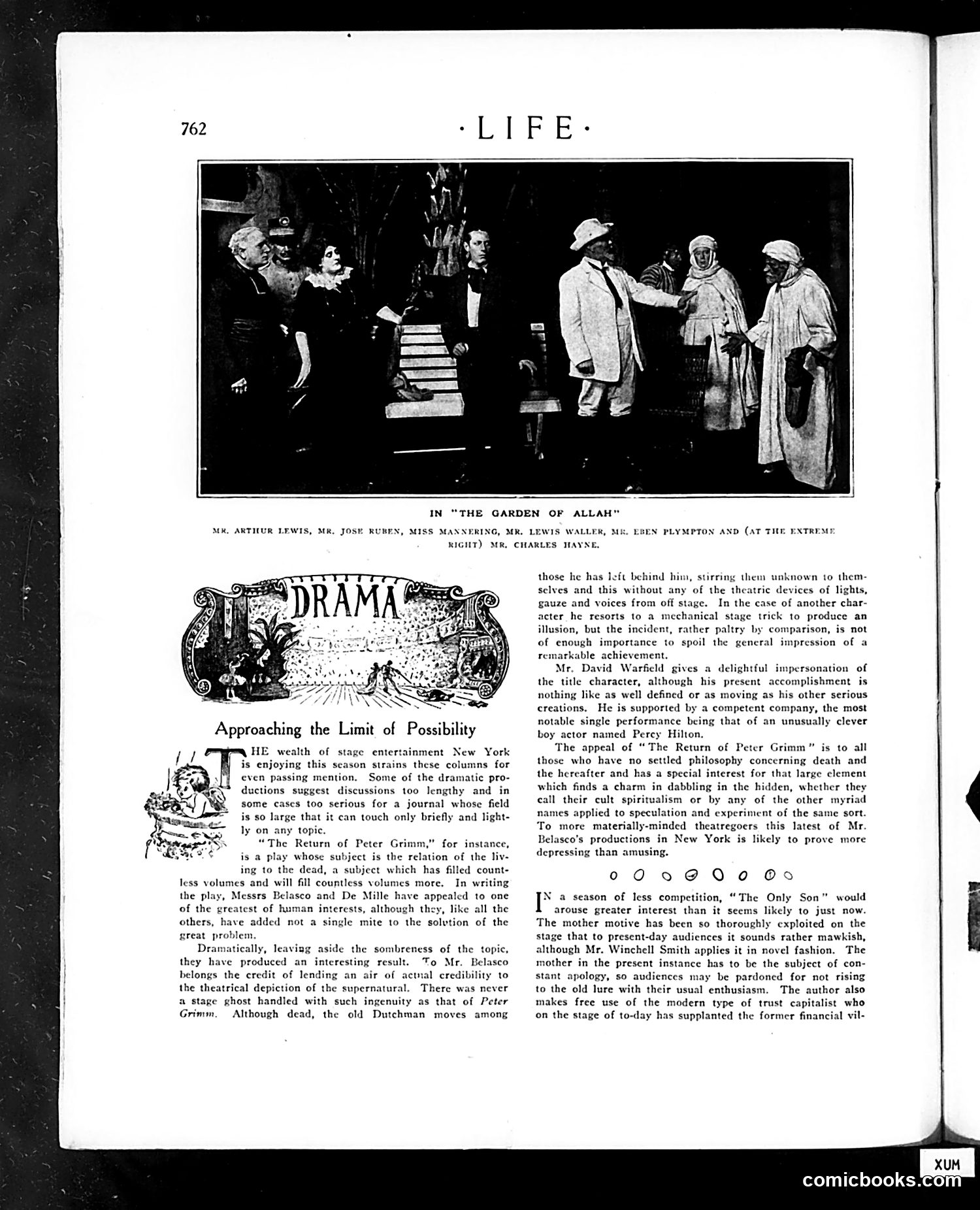
This page reviews two theatrical productions on Broadway. The photograph shows a scene from "The Garden of Allah," featuring actors including Arthur Lewis, Josh Rumen, Lewis Waller, and others in period costume. The main text discusses "The Return of Peter Grimm," a play by Belasco and De Mille about communication between the living and dead—appealing to spiritualist interests popular in the early 20th century. The reviewer credits Belasco with skillfully depicting the supernatural without theatrical tricks, and praises David Warfield's performance as the ghost. A secondary review critiques "The Only Son," noting its tired "mother motive" plot has been overused on stage. The reviewer suggests audiences find it sentimental rather than moving, and objects to the stock villain of modern capitalism. The satirical tone is gentle—the magazine pokes fun at theatrical trends and audience taste rather than political figures.
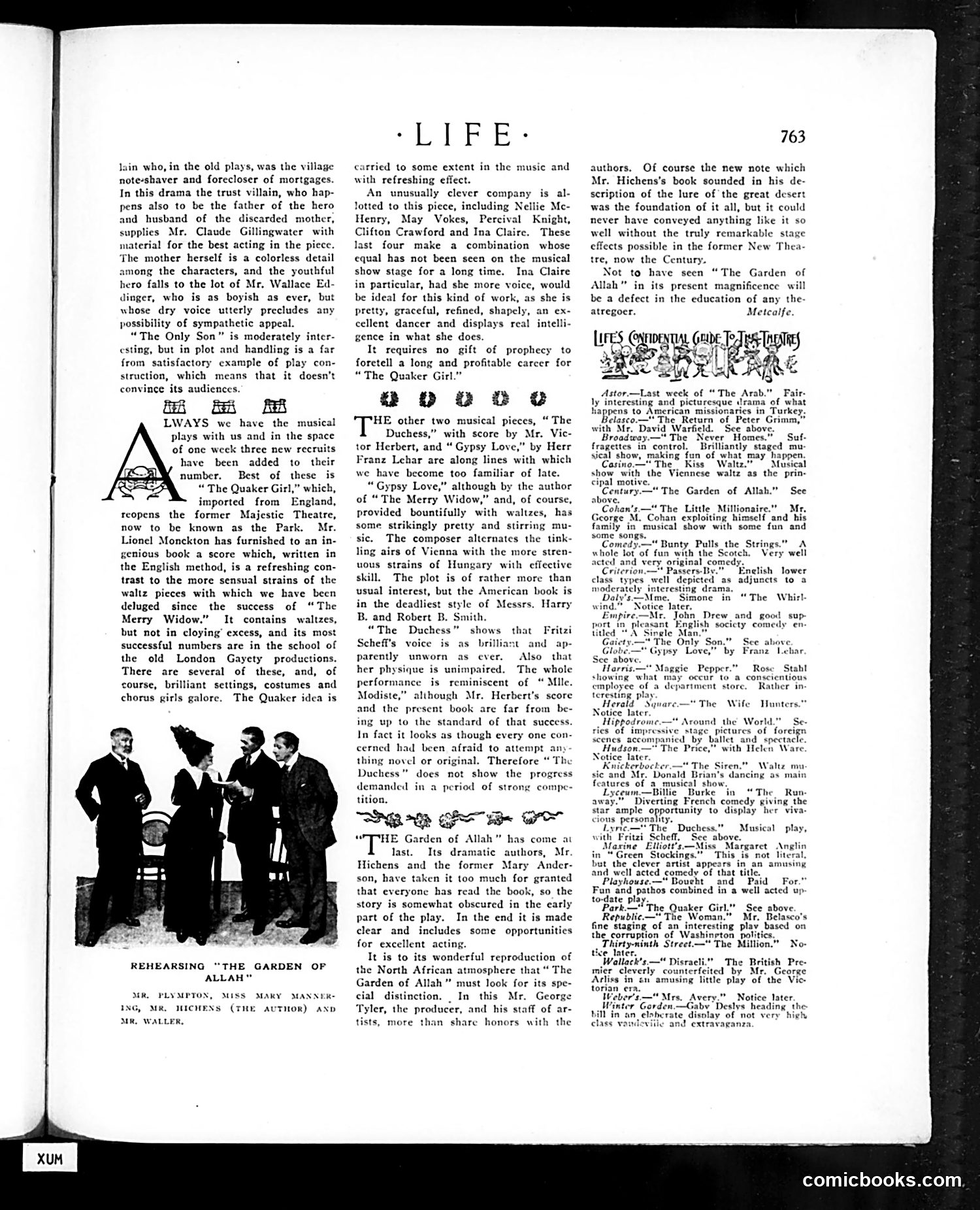
This page reviews three Broadway musical productions. The photograph shows cast members rehearsing "The Garden of Allah," a dramatic adaptation of a popular novel by Mr. Hichens and former actress Mary Anderson. The text praises "The Quaker Girl" (imported from England) as the best of the three shows, particularly commending the ensemble cast including Ina Claire, whom the critic calls "pretty, graceful, refined" and an "excellent dancer," though noting her voice could be stronger. The other two productions—Victor Herbert's "The Duchess" and Franz Lehár's "Gypsy Love"—receive mixed reviews. The critic finds them derivative and criticizes their American-written plots as uninspired and overly familiar, suggesting the creative team "had been afraid to attempt anything novel or original." The reviews reflect early 20th-century Broadway's heavy reliance on European operetta imports and star performers.
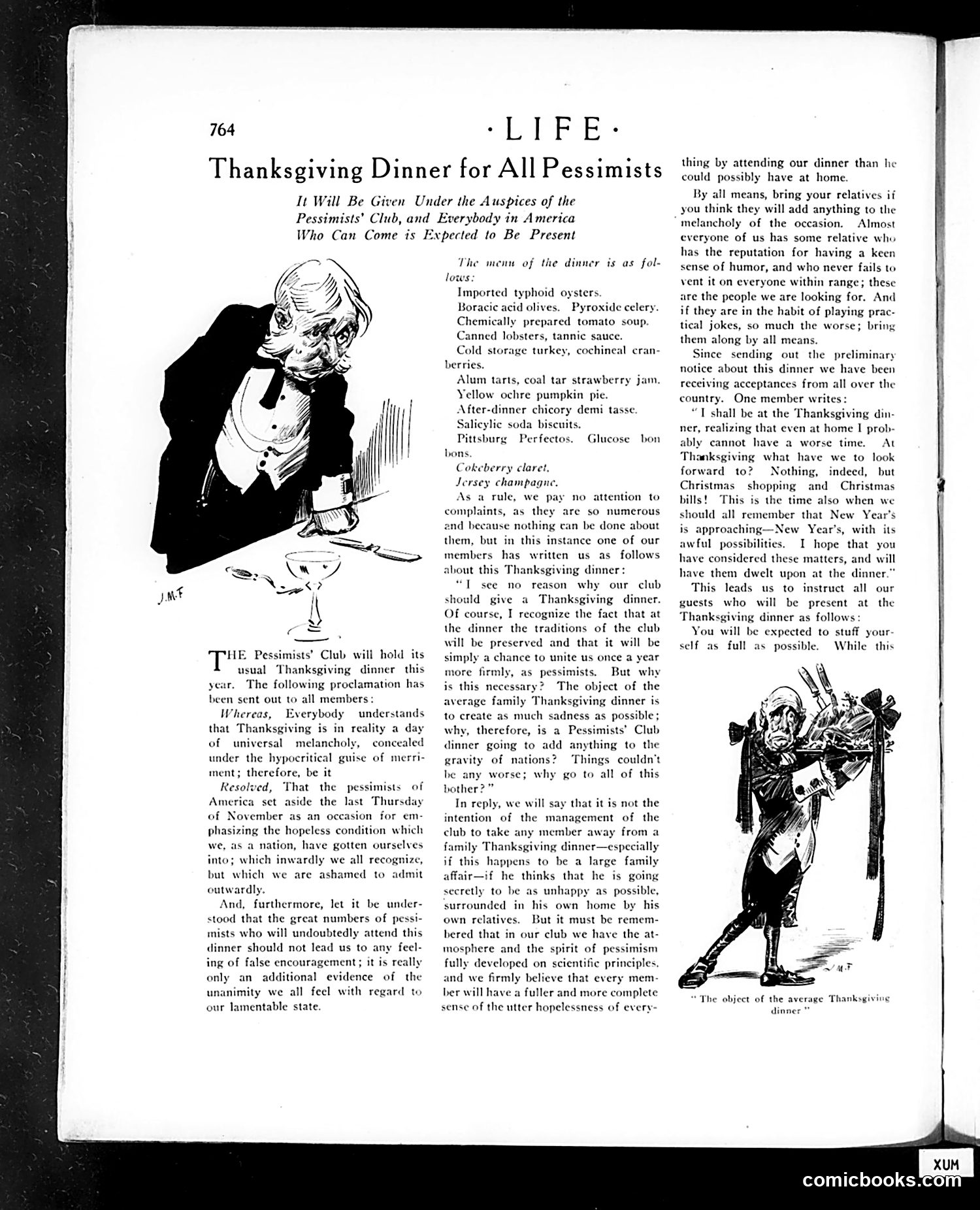
This satirical piece mocks the American tendency to disguise negativity as tradition. The "Pessimists' Club" proclamation exposes Thanksgiving as fundamentally melancholy—a day of "universal melancholy, concealed under the hypocritical guise of merriment." The joke lies in the menu: foods contaminated with toxic substances (typhoid oysters, boracic acid olives, coal tar strawberry jam)—darkly comic imagery suggesting life's poisons. The accompanying cartoons show a dejected man and a woman in distress, visualizing the "utter hopelessness" the club celebrates. The satire targets American optimism as performative hypocrisy. Rather than pretend Thanksgiving brings joy, the club institutionalizes pessimism as honest philosophy. The piece suggests that gathering to acknowledge shared misery is more authentic than family gatherings that force artificial cheer. It's social commentary on American denial and the gap between public celebration and private discontent.
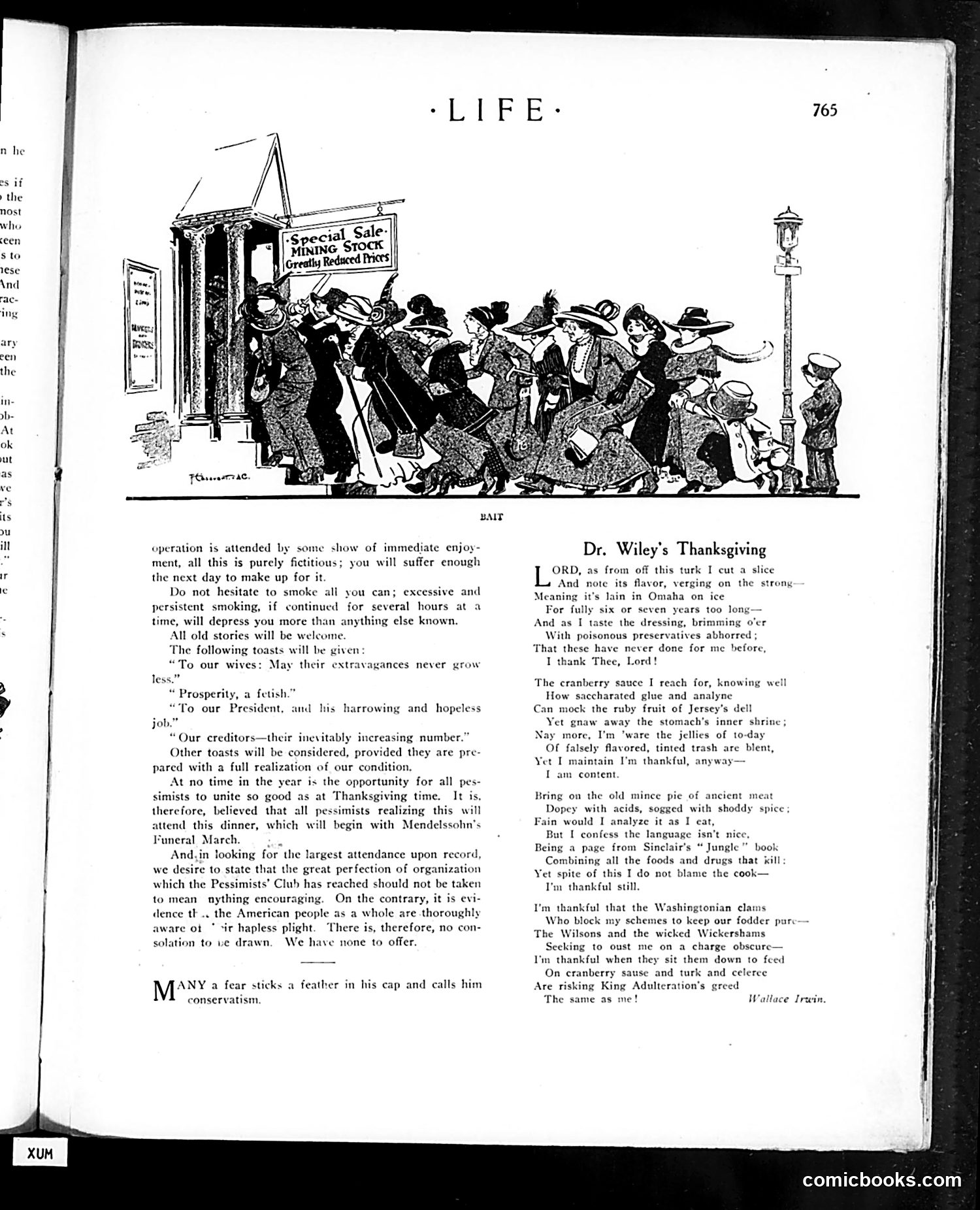
The top cartoon depicts a crowd rushing toward a "Special Sale—Mining Stock" window, satirizing the public's gullible enthusiasm for speculative investments despite warnings. The masses are depicted as sheep-like, pursuing obviously risky ventures. Below, the text presents a mock "Pessimists' Club" Thanksgiving dinner agenda, mocking American optimism through deliberately depressing toasts about the President's "harrowing and hopeless job," creditors, and wives' extravagances. The dinner opens with Mendelssohn's Funeral March—dark humor about national pessimism. "Dr. Wiley's Thanksgiving" is a satirical poem by Wallace Irwin praising adulterated, contaminated food while thanking God—likely referencing **Harvey Wiley**, the Progressive-era food safety crusader who exposed food industry corruption (evoking Sinclair's *The Jungle*). The poem sarcastically "thanks" corrupt officials like those blocking pure food legislation, mocking both the food industry's poisoning practices and political obstruction of reform.
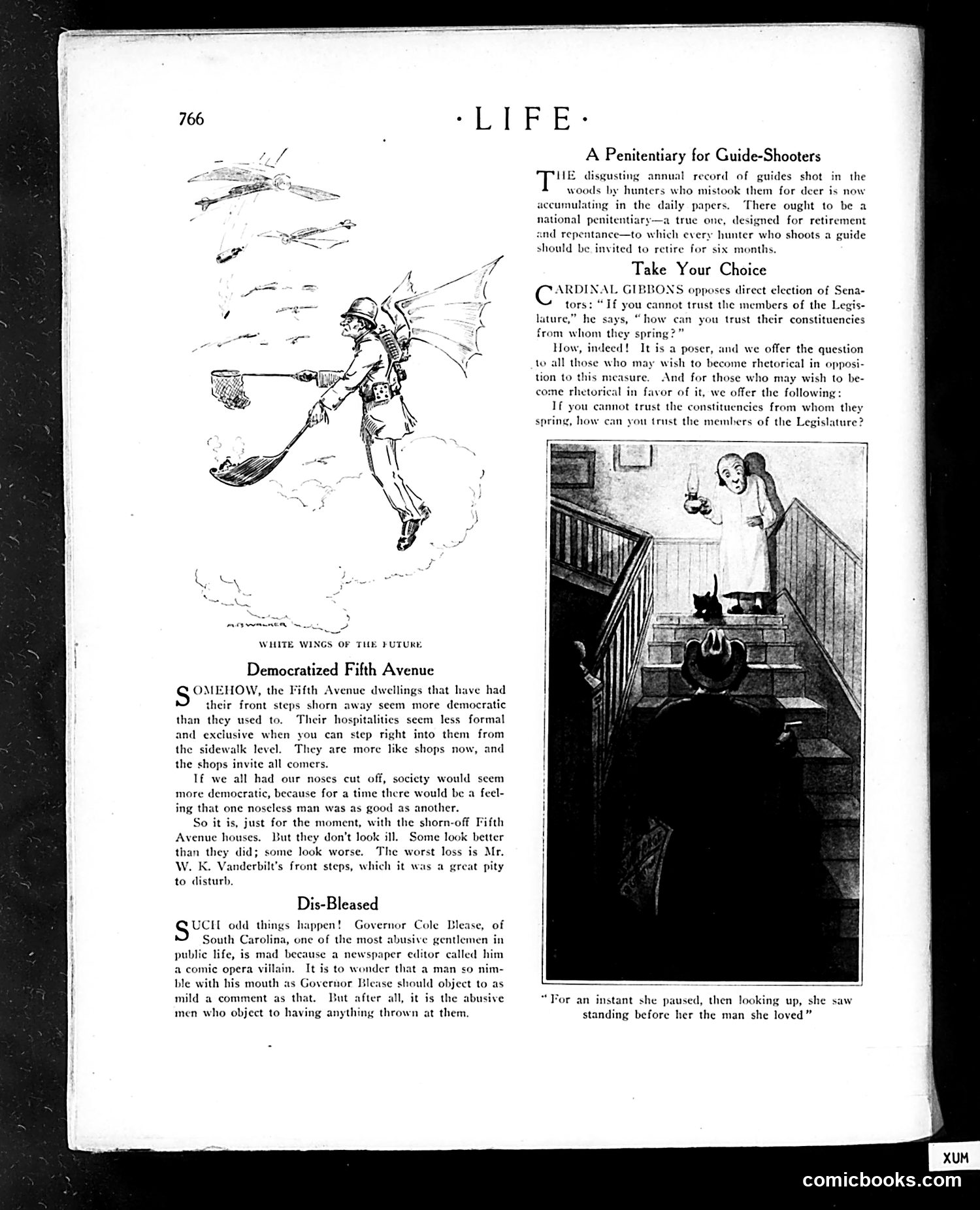
This page contains three separate satirical pieces: **"A Penitentiary for Guide-Shooters":** Commentary on hunting accidents where guides are mistakenly shot for deer. The satire proposes a mandatory national penitentiary for such negligent hunters—sarcastically treating accidental manslaughter as requiring formal institutional penance. **"Take Your Choice":** Political satire on Cardinal Gibbons's opposition to direct Senate election. Life presents his logical argument against trusting constituencies, then flips it—if constituencies can't be trusted, how can we trust legislators *they* elect? This exposes the circular illogic of his position on democratic reform. **"Democratized Fifth Avenue":** Social satire on wealthy New York homes losing their front steps (likely due to street construction). The piece mockingly notes this makes Fifth Avenue seem more "democratic" by removing class barriers, then absurdly compares this to society becoming more equal if everyone lost their noses—highlighting how artificial such leveling is. All three pieces use ironic argumentation to critique complacency, illogical opposition to reform, and false equality claims.

I can see this is a page from Life magazine (as indicated by the "comicbooks.com" text and "XUM" label visible), but the image itself is almost entirely black or extremely dark, making it impossible to discern any cartoon imagery, text, figures, or satirical content. Without being able to see the actual cartoon or read the accompanying text clearly, I cannot identify who is depicted, what political or social references are present, or what the satire's point might be. To provide accurate analysis as requested, I would need a clearer, higher-contrast version of this page where the content is actually visible.

I can see this is a mostly blank black page with "XUM" and "comicbooks.com" visible in the bottom right corner. The page appears to be either: 1. A blank page from a Life magazine issue 2. A severely degraded or poorly scanned document where the original content is not visible 3. A back cover or endsheet Without legible content—whether text, cartoons, illustrations, or advertisements—I cannot identify any political figures, social references, satire, or jokes. To provide meaningful analysis of the cartoon or editorial content you're asking about, I would need a page where the actual image and text are clearly visible and readable.
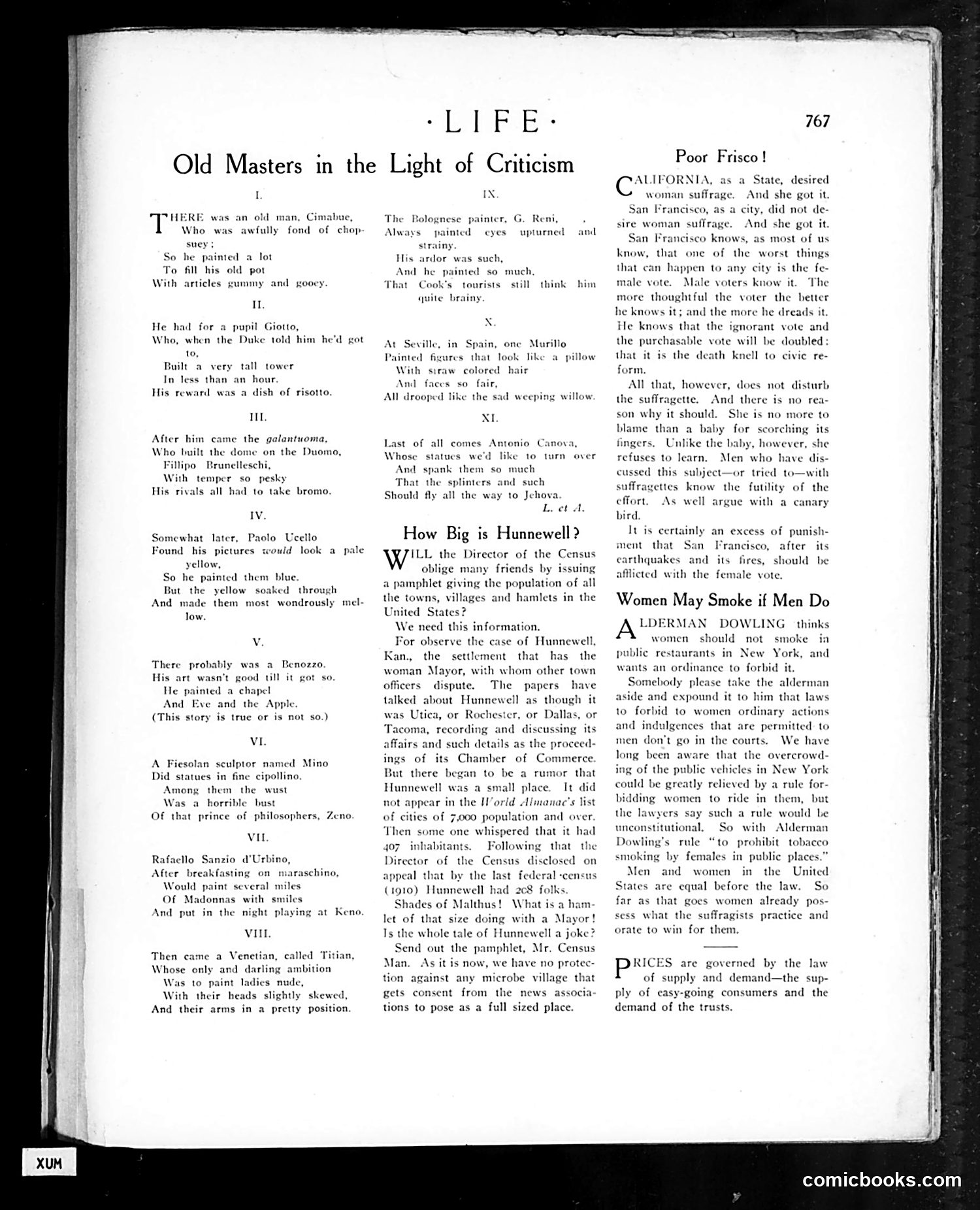
This page contains two distinct sections: **Left side:** "Old Masters in the Light of Criticism" is a humorous poem mocking famous Renaissance Italian painters (Cimabue, Giotto, Paolo Uccello, Raphael, Titian, etc.). The satire exaggerates their quirks—Uccello's obsession with perspective making his work yellow, Titian's fixation on painting nude women with skewed heads. It's lighthearted art-world mockery, poking fun at how art history romanticizes these figures. **Right side contains three separate pieces:** 1. **"How Big is Hunnewell?"** satirizes the 1910 Census, mocking a small Kansas town that claimed city status based on inflated population figures, only to be revealed as having just 268 inhabitants. 2. **"Poor Frisco!"** opposes women's suffrage in San Francisco, arguing that female voters—particularly "ignorant" and "purchasable" ones—will harm civic reform. This reflects anti-suffrage arguments common before 1920. 3. **"Women May Smoke if Men Do"** supports women smoking in public restaurants, arguing the practice should be permitted equally for both genders. The page exemplifies *Life*'s satirical approach to contemporary politics and social issues.
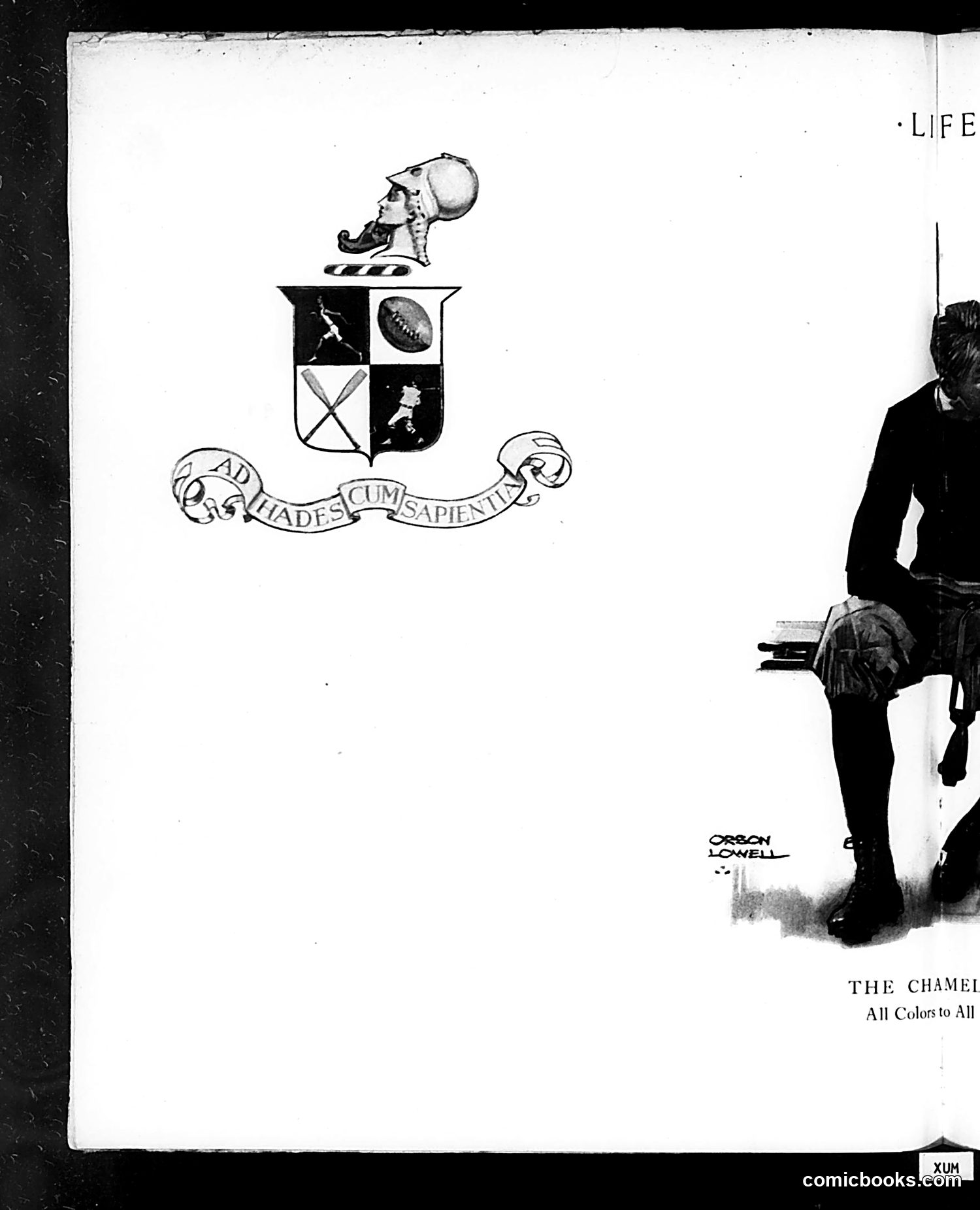
This appears to be a title page or cover from *Life* magazine. The central image is a heraldic coat of arms topped with a classical head bust, beneath which runs a banner reading "HADES CUM SAPIENTIS" (Latin: roughly "Hades with wisdom"). The coat of arms quarters four symbols: a lightning bolt, a football, crossed swords, and what appears to be a map or profile. On the right, an illustration by Orson Lowell shows a woman in period dress reading or holding papers. The text fragment "THE CHAMELEON / All Colors to All" suggests this page introduces a satirical piece about adaptability or hypocrisy—someone/something changing appearance to suit all audiences. Without fuller context, the specific target of satire remains unclear, though the heraldic imagery suggests this concerns institutional or social authority.
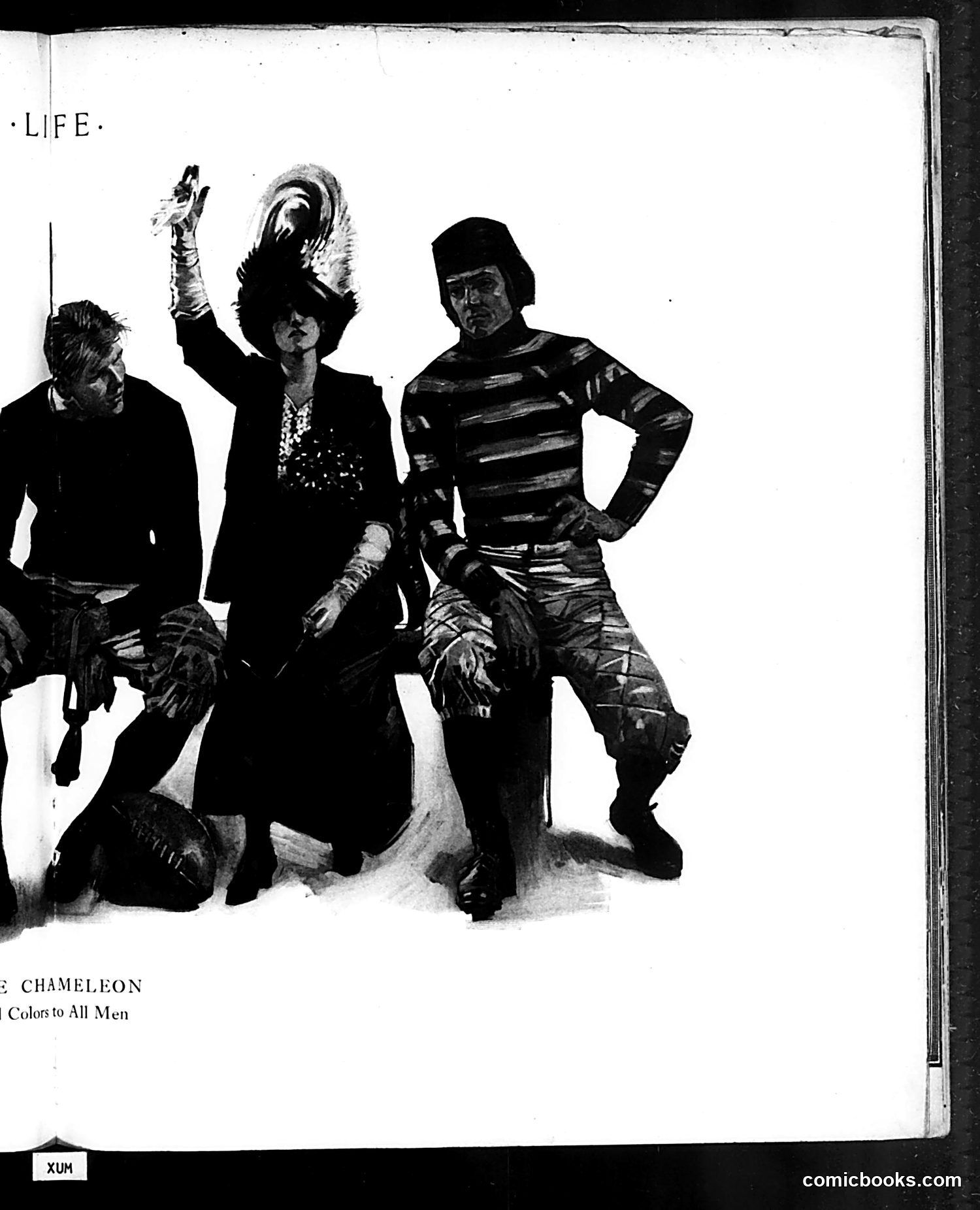
This Life magazine page satirizes political or social opportunism through the image of three figures in theatrical costume. The title "Chameleon—Colors to All Men" is the key: a chameleon changes colors to blend with its environment, making this a metaphor for someone who adopts whatever beliefs or personas suit their audience. The three costumed figures likely represent different roles or ideologies the same person assumes depending on context—perhaps a politician or public figure who shifts positions opportunistically. The dramatic black-and-white illustration, with varied costumes (formal wear, military-style outfit, and hooded garment), emphasizes the performative nature of this behavior. The satire mocks political hypocrisy and the willingness to abandon principles for advantage—a timeless critique of insincerity in public life.
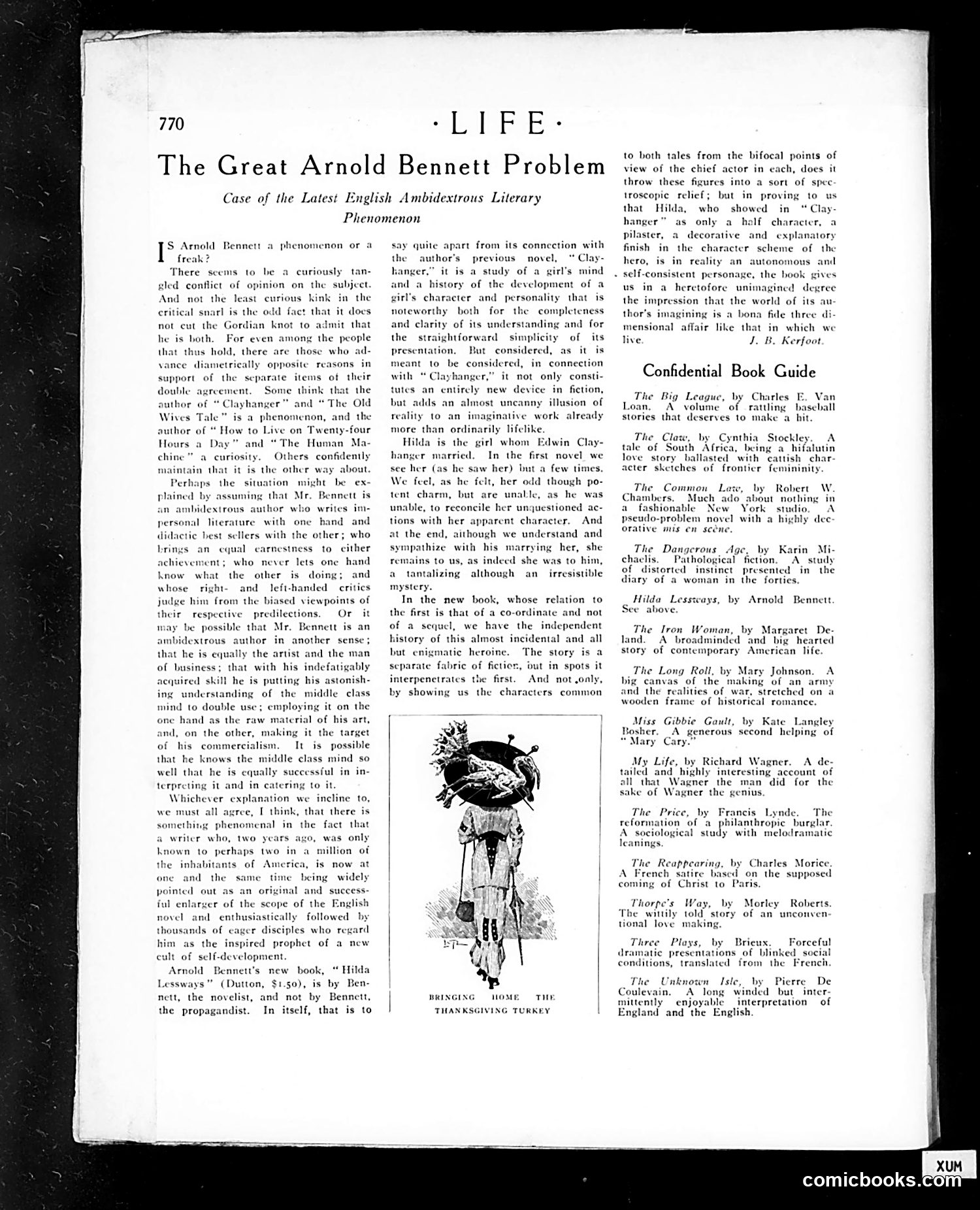
This article discusses whether English author Arnold Bennett is a literary "phenomenon or a freak." The piece explores the paradox that Bennett simultaneously succeeds as both a serious novelist (writing "Clayhanger" and "The Old Wives Tale") and a popular self-help author (writing "How to Live on Twenty-four Hours a Day"). Critics are divided: some admire his artistic novels while dismissing his practical guides as curiosities, or vice versa. The author proposes Bennett may be "ambidextrous"—equally skilled at serious art and commercial writing, or perhaps uniquely understanding the middle-class mind enough to both elevate and cater to it. The accompanying illustration shows a figure on a bicycle, captioned "BRINGING HOME THE THANKSGIVING TURKEY"—apparently Bennett's dual nature delivering both artistic and practical/commercial goods simultaneously. The article examines Bennett's new novel "Hilda Lessways," positioning it as serious fiction rather than propagandist work.

I can see this is a mostly blank or heavily darkened page from what appears to be a Life magazine archive (as indicated by the "comicbooks.com" credit and "XUM" reference marker). The image is too dark and unclear for me to reliably identify any cartoon content, figures, or satirical elements. Without being able to see legible text or distinct illustrations, I cannot accurately explain what political or social commentary this page contains. The page may be a title page, advertisement, or the image quality/scanning may have rendered the content illegible. I would need a clearer version to provide accurate historical analysis.

I can see this is a nearly blank or extremely dark page from Life magazine with only a watermark visible in the bottom right corner reading "XUM" and "comicbooks.com". The page appears to be either: - A blank page from the original publication - A scanning/image quality issue where the content is not visible - A back cover or filler page Without visible cartoon imagery, text, or discernible content, I cannot identify any figures, political references, or satirical points. To provide meaningful analysis of the cartoon's historical context and meaning, a clearer image or legible page content would be necessary.
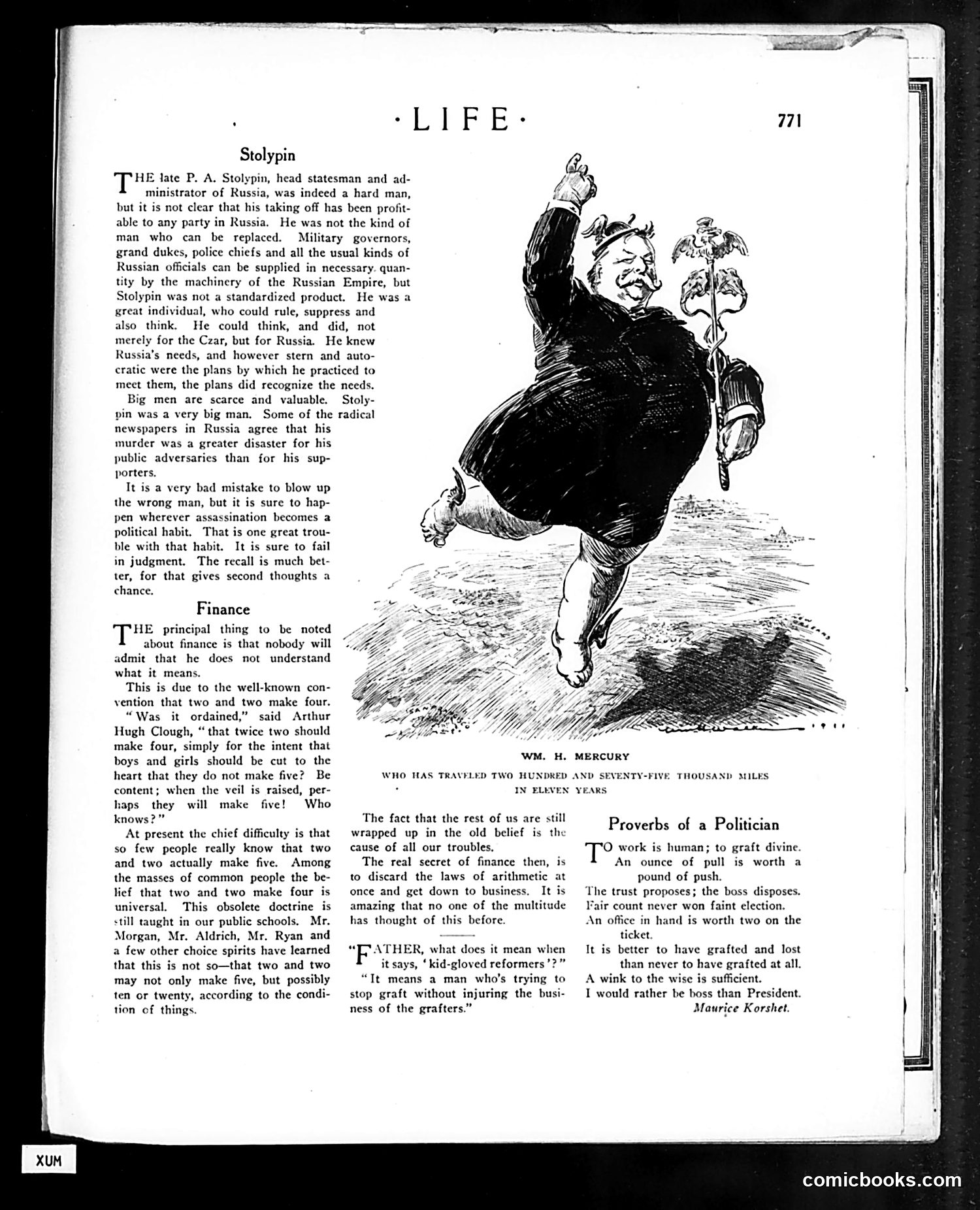
This page contains two distinct satirical pieces from Life magazine. **Stolypin Section:** A tribute to P. A. Stolypin, the recently assassinated Russian statesman. The text praises him as a capable administrator who understood Russia's needs, lamenting his death as a greater loss to his political opponents than supporters. The accompanying caricature (by Wm. H. Mercury) depicts a figure in exaggerated mid-leap with flowers, likely mocking either Russian political violence or the romanticization of radical assassination. **Finance Section:** A scathing satire on wealthy industrialists and financial manipulation. Life mockingly argues that financiers like Morgan, Aldrich, and Ryan have discovered that "two and two" needn't equal four—implying they've mastered creative accounting and fraud. The "Proverbs of a Politician" section extends this, cynically listing corruption principles: graft supersedes honest work, political connections ("pull") matter more than merit, and bosses control outcomes. The satire targets Gilded Age financial corruption and the perceived untouchability of wealthy manipulators.
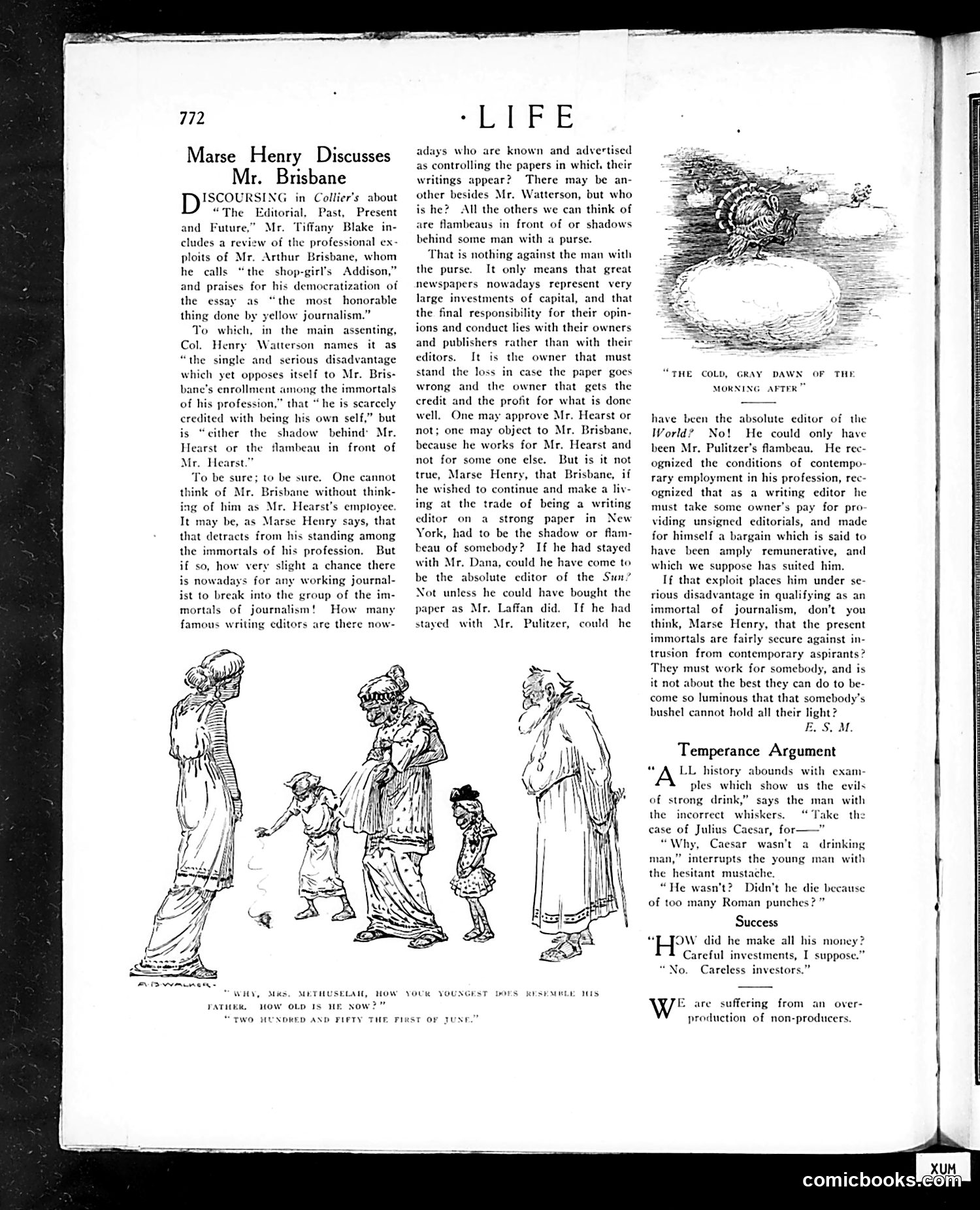
This page features a debate about **Arthur Brisbane**, a prominent newspaper editor working for William Randolph Hearst's publishing empire. **The Main Essay** discusses whether Brisbane deserves recognition among journalism's "immortals" despite being employed by Hearst rather than running his own publication. The argument defends Brisbane: modern newspapers require massive capital investment, so even talented editors necessarily work *for* owners. Brisbane accepted this reality, negotiated good terms, and succeeded within those constraints—hardly a shameful compromise. **The Cartoon** (bottom left) depicts a woman asking an elderly man about his youngest son's resemblance to someone, likely a humorous domestic scene unrelated to the main text. **Other Brief Items** include a joke about Julius Caesar and drinking (playing on "Roman punches"), and a quip about financial success through "careless investors." The page reflects early-20th-century debates about editorial independence versus corporate ownership—issues still relevant today.
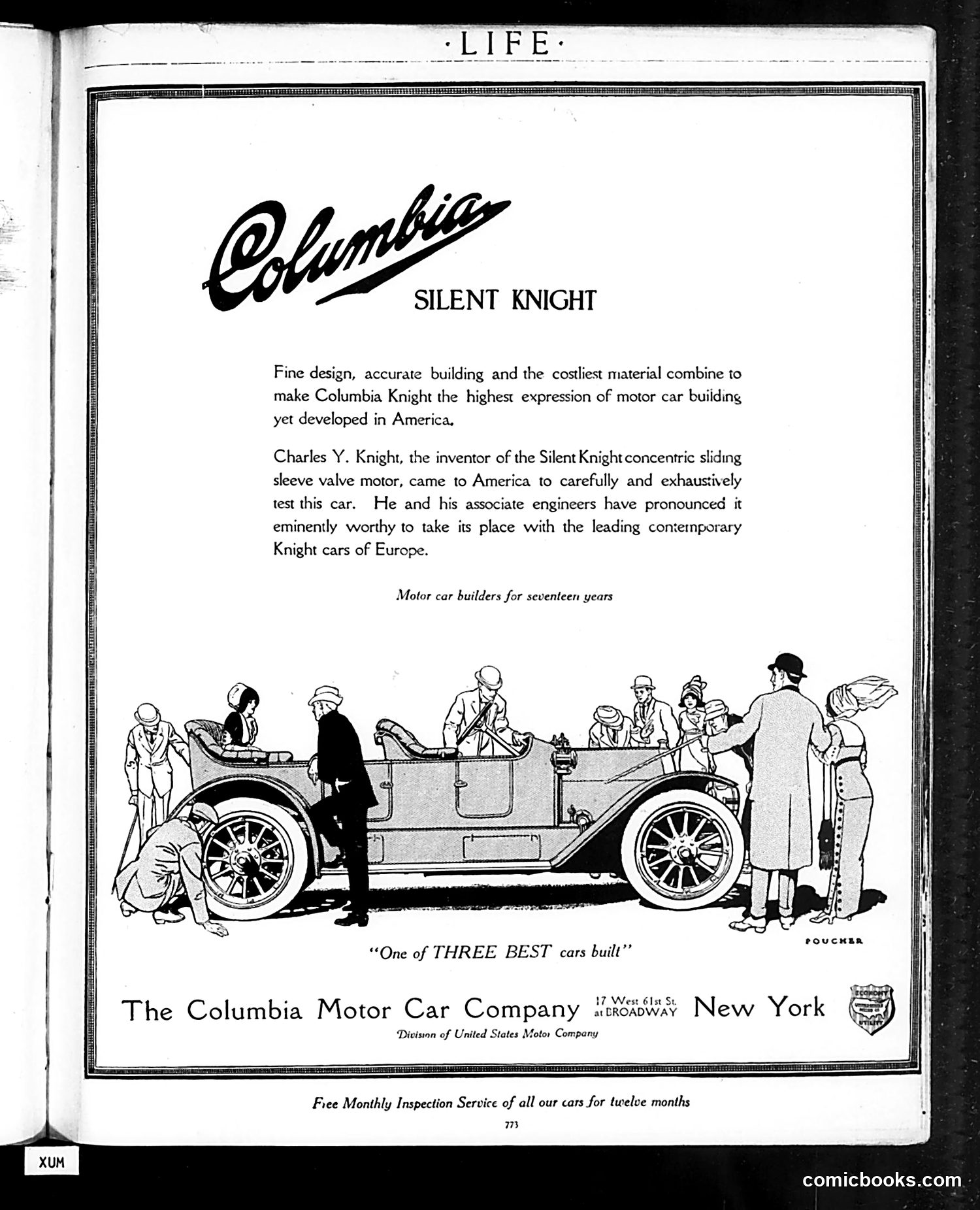
This is **not a satirical cartoon page**—it's a straightforward **automobile advertisement** from Life magazine's early automotive era. The page promotes the Columbia Silent Knight motor car, emphasizing its superior engineering. Charles Y. Knight (a real inventor) developed the "Silent Knight" engine with a sliding sleeve valve mechanism, positioning it as comparable to prestigious European Knight automobiles. The illustration shows elegantly dressed figures examining the vehicle, a common advertising trope suggesting sophistication and quality. The claim "One of THREE BEST cars built" appeals to aspirational buyers. The mention of "Motor car builders for seventeen years" establishes the company's experience and reliability. **Modern context**: This represents early-20th-century automotive marketing before mass production. Columbia Motor Car Company was an actual manufacturer that competed with early rivals like Ford before eventually failing. The emphasis on luxury materials and engineering reflects pre-assembly-line attitudes toward automobiles as premium goods.
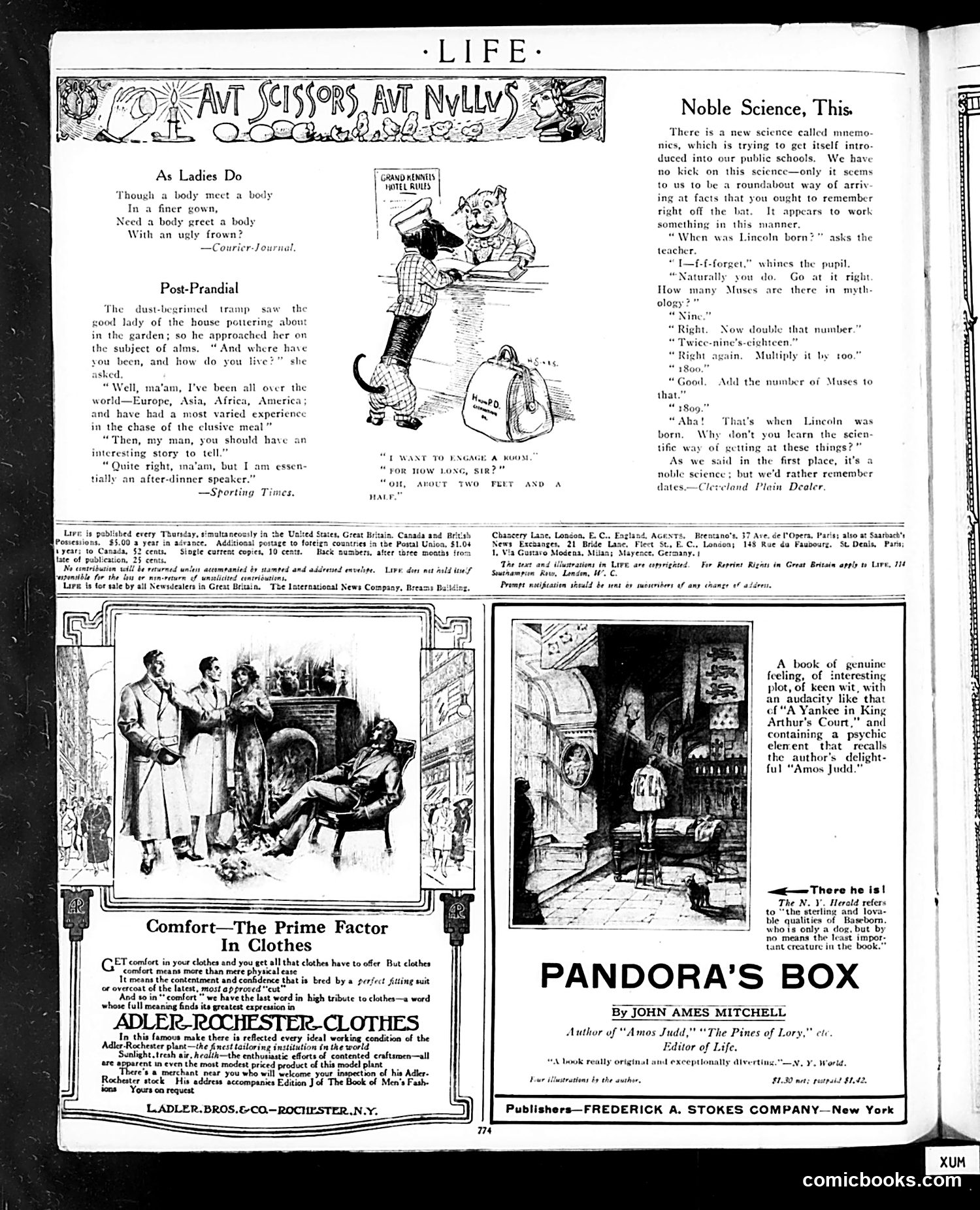
This Life magazine page contains three satirical pieces: **"Noble Science, This"** mocks a teaching method using mnemonic devices to memorize facts, specifically Lincoln's birth year. A pupil multiplies numbers to arrive at 1809—shown as absurdly convoluted compared to simply remembering dates. The Cleveland Plain Dealer caption dismisses this "noble science," suggesting educators should teach meaningful understanding rather than arithmetic tricks. **"Post-Prandial"** presents a vagrant claiming world travel but admitting he's "essentially an after-dinner speaker"—satirizing men who tell elaborate stories without substance. **"As Ladies Do"** and **"I Want to Engage a Room"** are brief humorous quips about gendered behavior and miscommunication. The page is primarily advertising for Adler-Rochester clothes and a book called *Pandora's Box*.
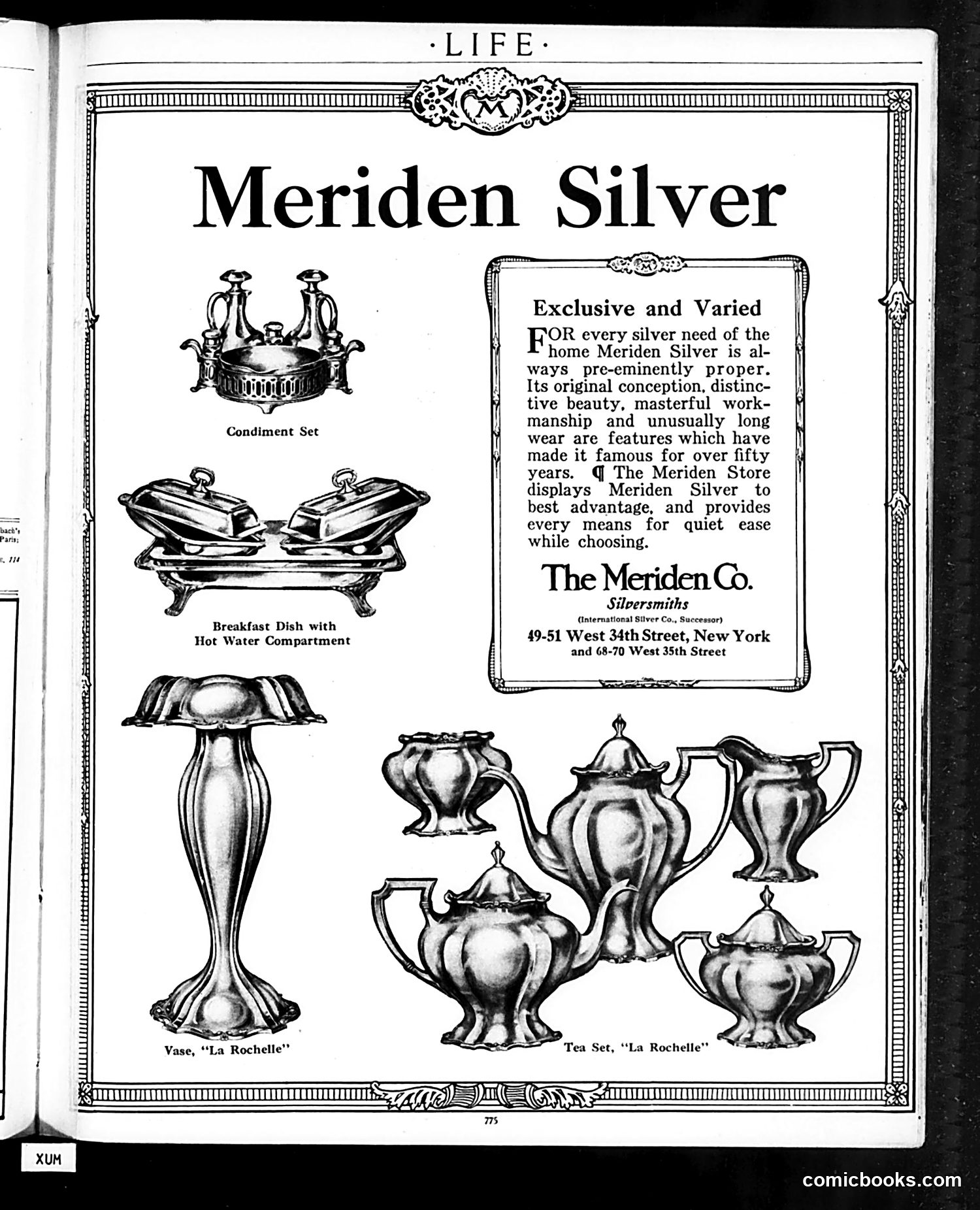
This is not a cartoon or satire—it's a straightforward **advertisement** for Meriden Silver, a silverware manufacturer. The page displays product images including a condiment set, breakfast dish, decorative vase ("La Rochelle"), and a tea service set, all rendered as detailed product illustrations. The accompanying text emphasizes the company's 50+ year reputation for quality craftsmanship and distinctive design. The Meriden Co. (successor to International Silver Co.) advertises two New York showroom locations, promising customers easy browsing of their exclusive silverware collection. This represents early 20th-century luxury goods marketing in *Life* magazine, targeting affluent households furnishing their homes with fine tableware. There is no political content, satire, or hidden meaning—simply commercial promotion.
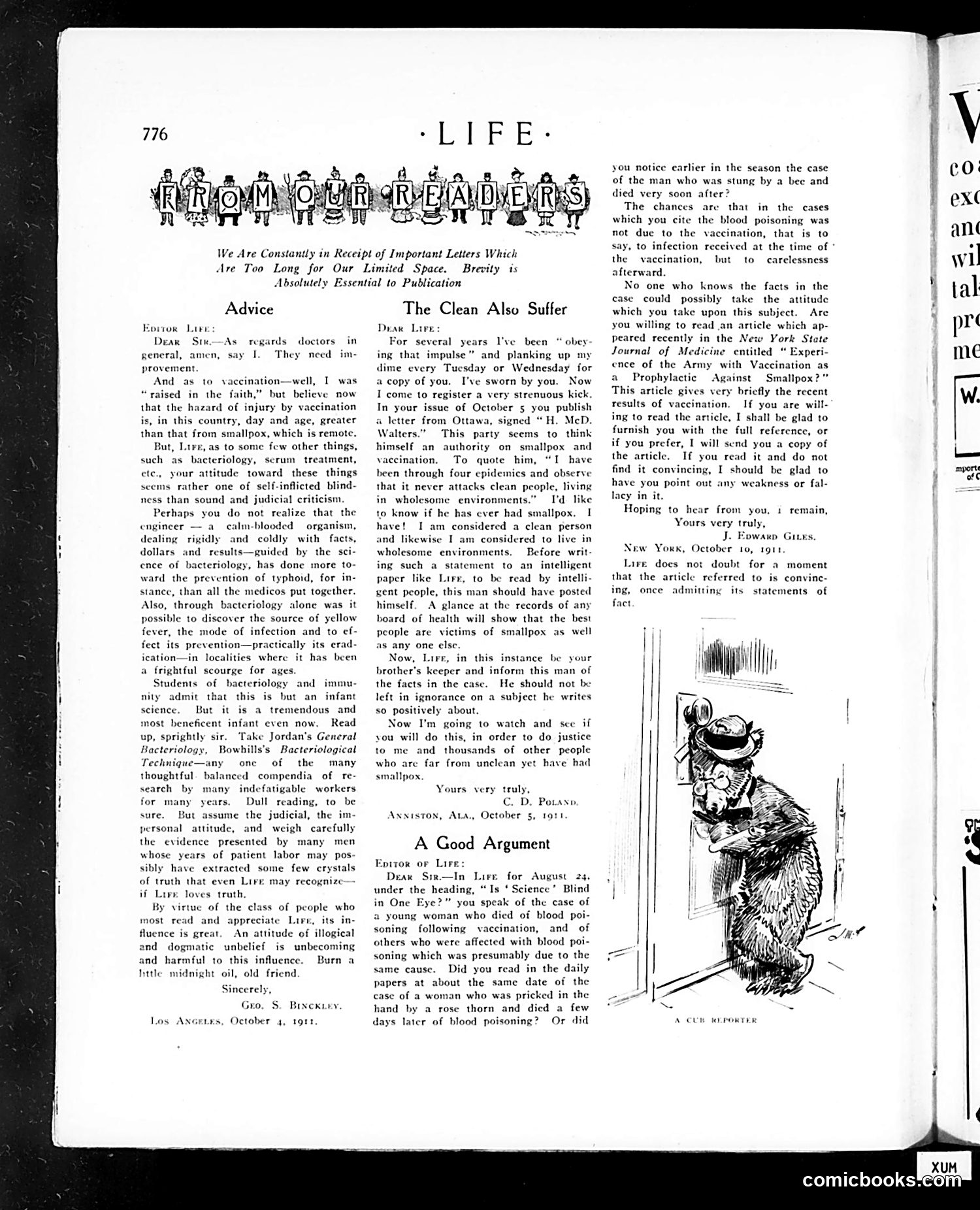
This page features readers' letters debating vaccination and public health during the early 20th century. The satire centers on anti-vaccination arguments circulating at the time. **The debates:** - One letter criticizes Life's skepticism toward modern bacteriology and vaccination, defending scientific advancement - "The Clean Also Suffer" directly refutes a previous letter claiming smallpox only affects "unclean" people in poor environments. The writer, who identifies as clean and healthy, contracted smallpox anyway, exposing the fallacy of this argument **The cartoon** (right side) shows "A CUB REPORTER"—likely representing naive journalism or public credulity—as an actual cub (young animal) peering inside, suggesting gullibility toward misinformation. **Context for moderns:** This reflects early-1900s vaccine hesitancy, where pseudoscientific claims about hygiene replacing vaccination were popular. Life's role here was satirizing such misconceptions while championing scientific evidence—a role remarkably similar to modern health journalism debates.
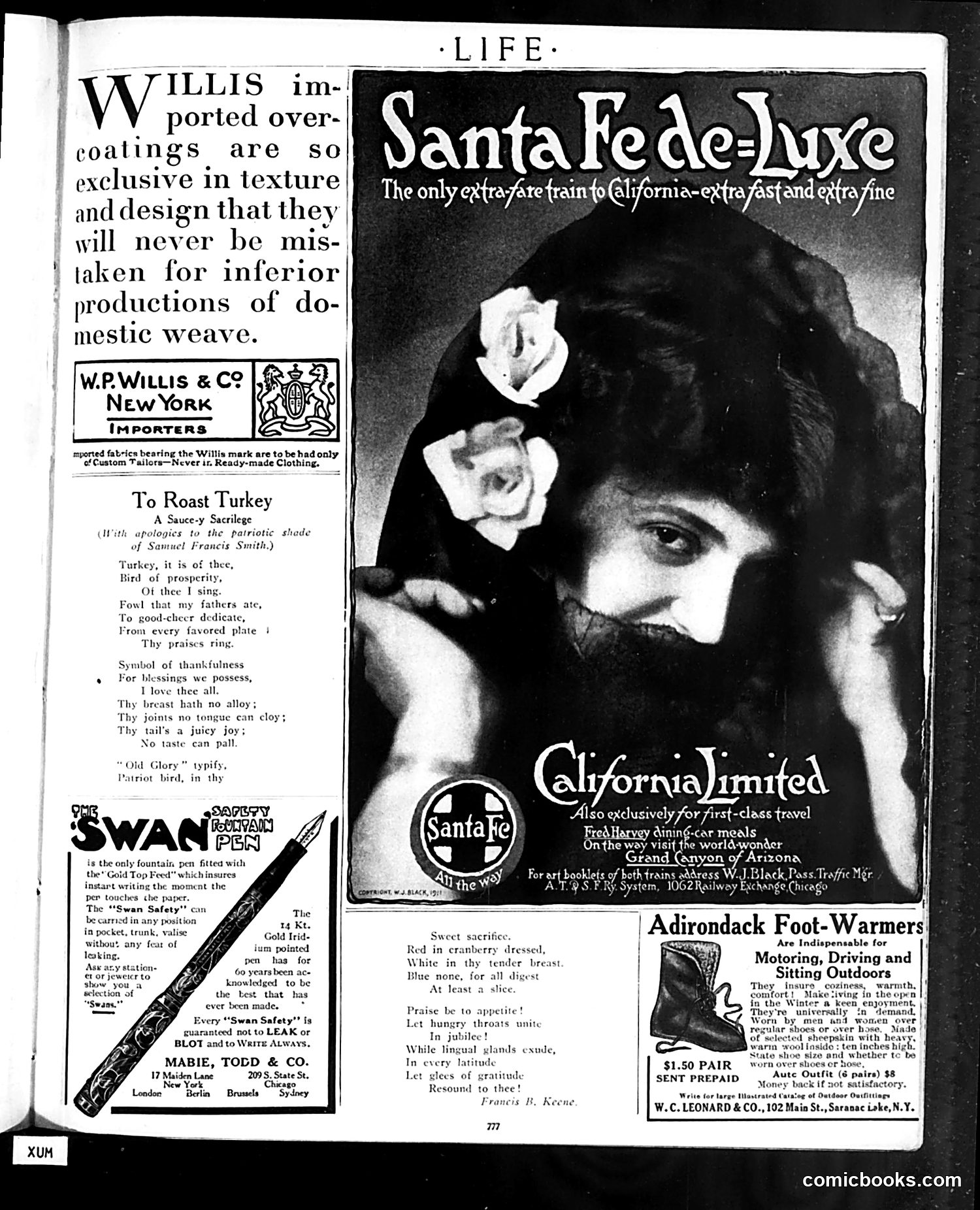
This page is primarily **advertising** with a small satirical poem. The main content includes: **"To Roast Turkey" Poem**: A mock-patriotic satire that parodies Samuel Francis Smith's hymn "America" ("My Country, 'Tis of Thee"). The poem humorously treats the turkey—a traditional Thanksgiving bird—with patriotic reverence, calling it a "patriot bird" and "symbol of thankfulness." The joke lies in the exaggerated solemnity applied to what is ultimately dinner. It's gentle holiday satire, poking fun at Americans' sentimental attachment to turkey and Thanksgiving traditions. **Advertisements**: The page features typical early-20th-century luxury ads: Willis imported overcoatings, Swan Safety fountain pens, Santa Fe railway travel, and Adirondack foot-warmers. These ads target affluent readers. The satirical content is secondary to the commercial purpose—typical for Life magazine, which blended humor with advertising to reach upper-class audiences.
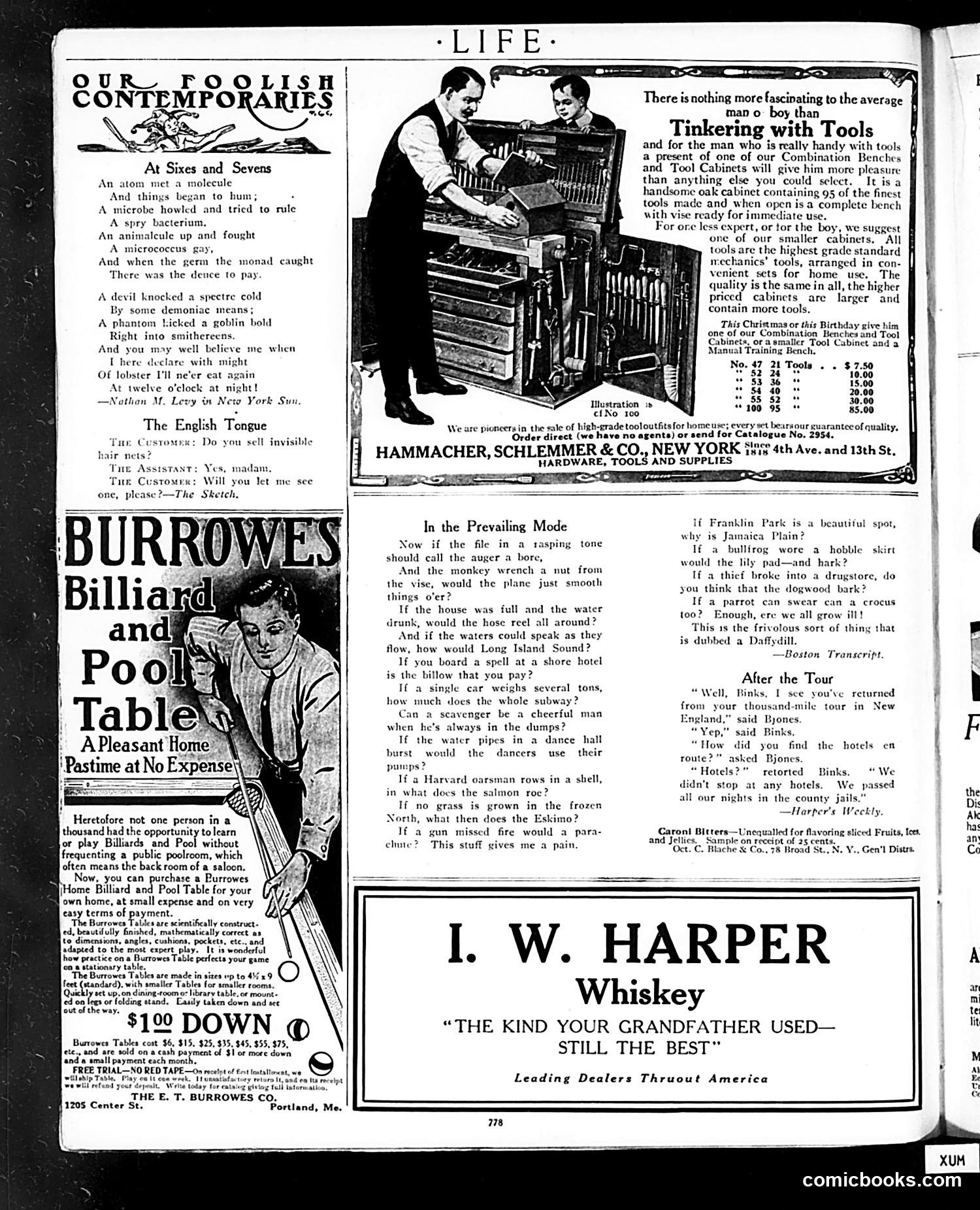
This page is primarily **advertising and light humor** rather than political satire. Key elements: **Main Advertisement (Upper Right):** Hammacher, Schlemmer & Co. promotes combination tool benches and cabinets—gift suggestions for men and boys interested in tinkering. The illustration shows two men examining an open tool cabinet. This reflects early 20th-century assumptions about masculinity and gift-giving. **Humor Sections:** - "The English Tongue" presents a brief joke about invisible hair nets—absurdist humor typical of the era - "In the Prevailing Mode" offers whimsical wordplay riddles (if a file called an auger "boring," would a plane "smooth things over?") - "After the Tour" jokes that a traveler passed all nights in county jails rather than hotels **Other Advertisements:** Burrowes Billiard and Pool Tables, and I.W. Harper Whiskey The page contains **no significant political content**—it's a consumer-oriented magazine showcase mixing advertisements with period-typical "clever" wordplay humor meant to entertain middle-class readers.
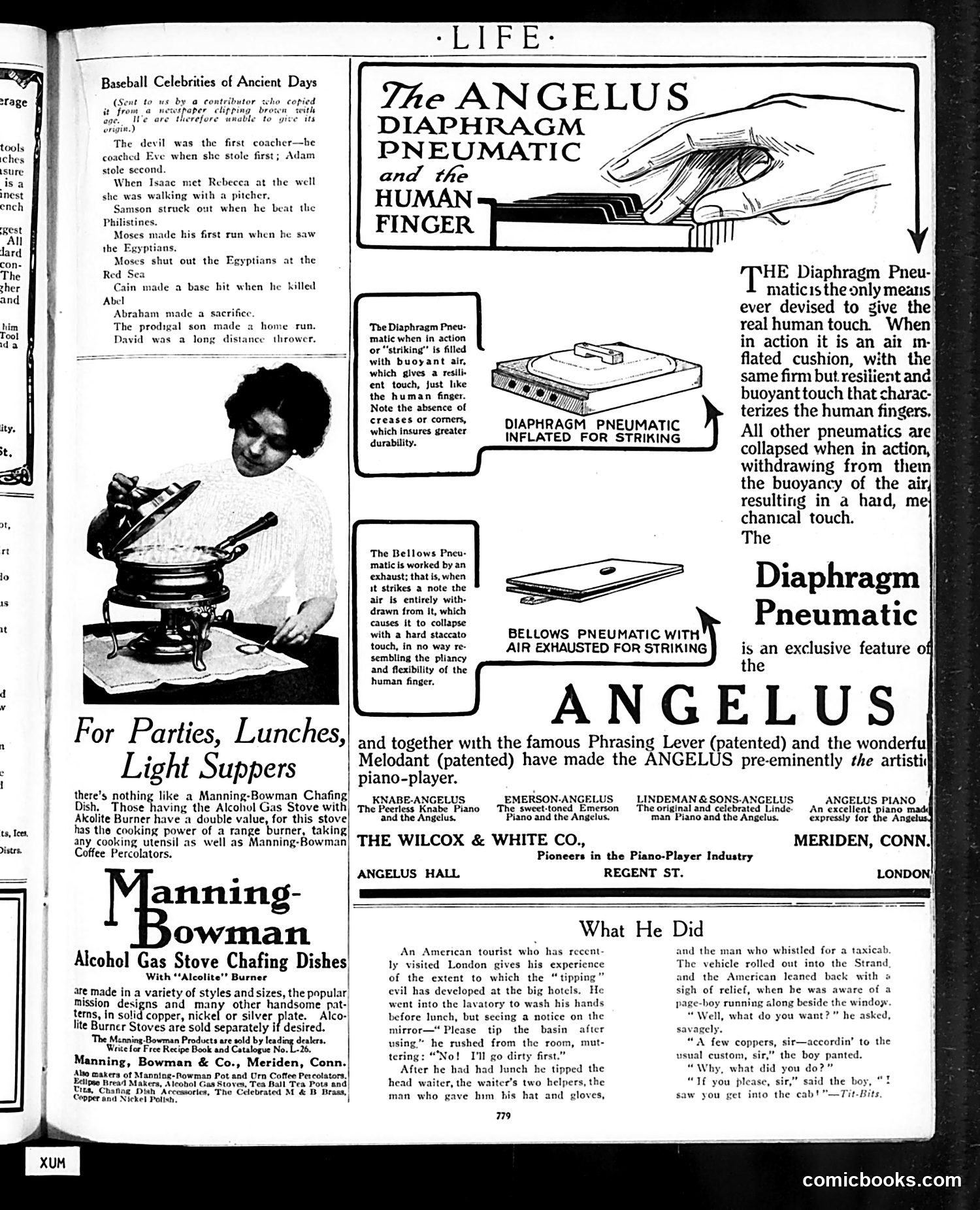
This page contains **mostly advertisements** for player pianos and kitchen appliances, with two minor satirical elements: **"Baseball Celebrities of Ancient Days"** (left column): A brief humorous list reframing Biblical figures as baseball players—Adam "stole second," Moses "made his first run," David was "a long distance thrower." It's gentle wordplay treating Scripture as if the characters were actual baseball statistics, typical of early 20th-century American magazine humor. **"What He Did"** (bottom): A short anecdote about an American tourist in London learning about the British "tipping culture." The joke: he finds a sign saying "Please tip the basin after using," misunderstands it literally as requesting payment, and abandons hygiene rather than pay. The humor relies on Americans' unfamiliarity with British customs and the absurdity of tipping inanimate objects. Both pieces are lightweight social commentary, characteristic of *Life* magazine's humor style of this era.
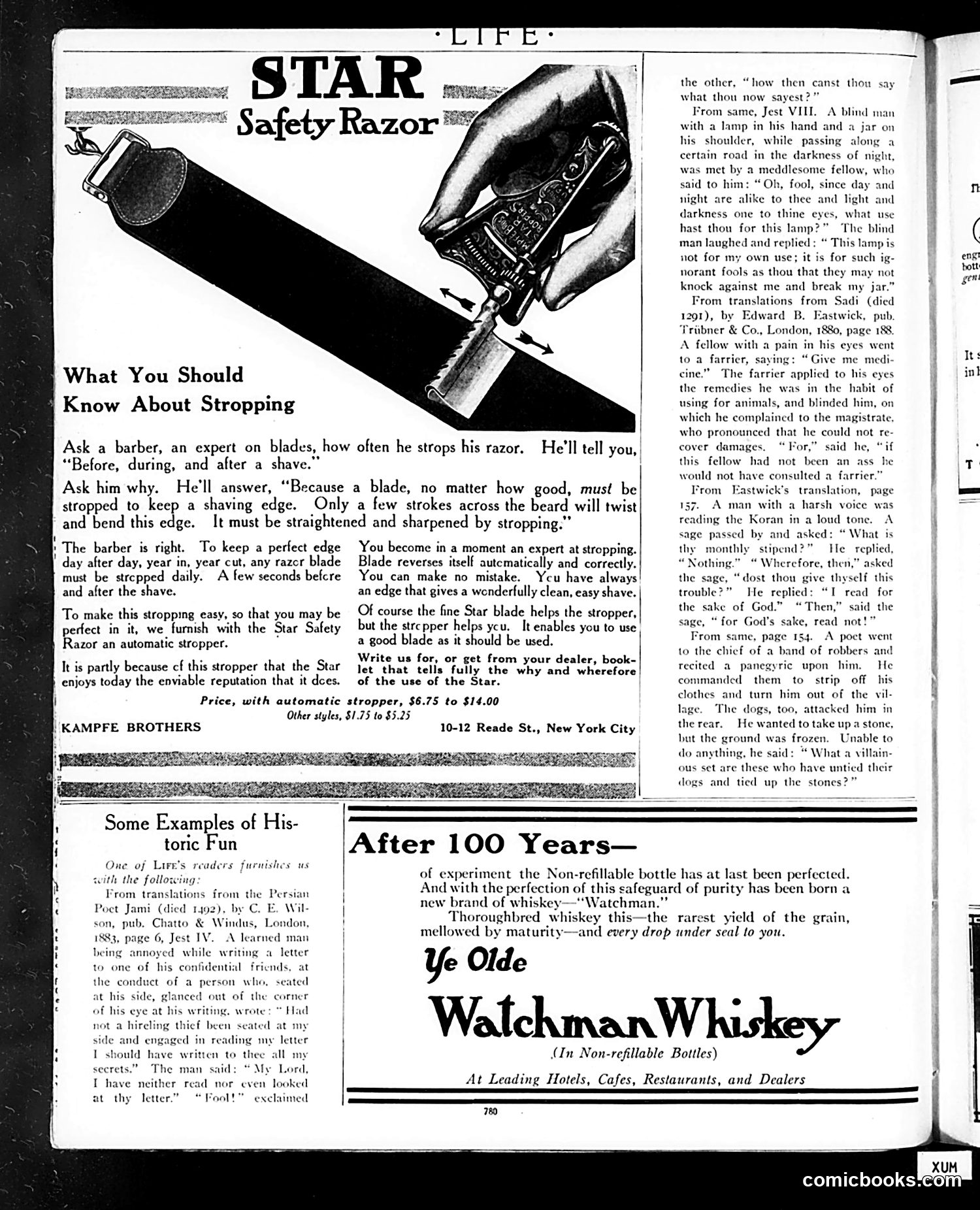
This page is primarily **advertising**, featuring two major product ads: Star Safety Razor and Ye Olde Watchman Whiskey. The **Star Razor ad** dominates the left side, explaining stropping (blade maintenance) to consumers. It uses the authority of barbers as experts to justify why regular stropping keeps razors sharp—a practical consumer education piece. The right column contains **"Some Examples of Historic Fun,"** which republishes Persian poetry anecdotes from classical texts (Sadi and Jami, medieval Persian poets). These are humorous moral tales: a blind man's lamp protecting fools, a farrier blinding a patient, a poet mocked by robbers. They serve as light editorial content between advertisements. The **Watchman Whiskey ad** emphasizes non-refillable bottles as a purity guarantee—a selling point during an era of adulteration concerns and before strict food regulations. This page reflects early 20th-century *Life* magazine's mix of satirical commentary, practical advertising, and literary reprints aimed at educated middle-class readers.
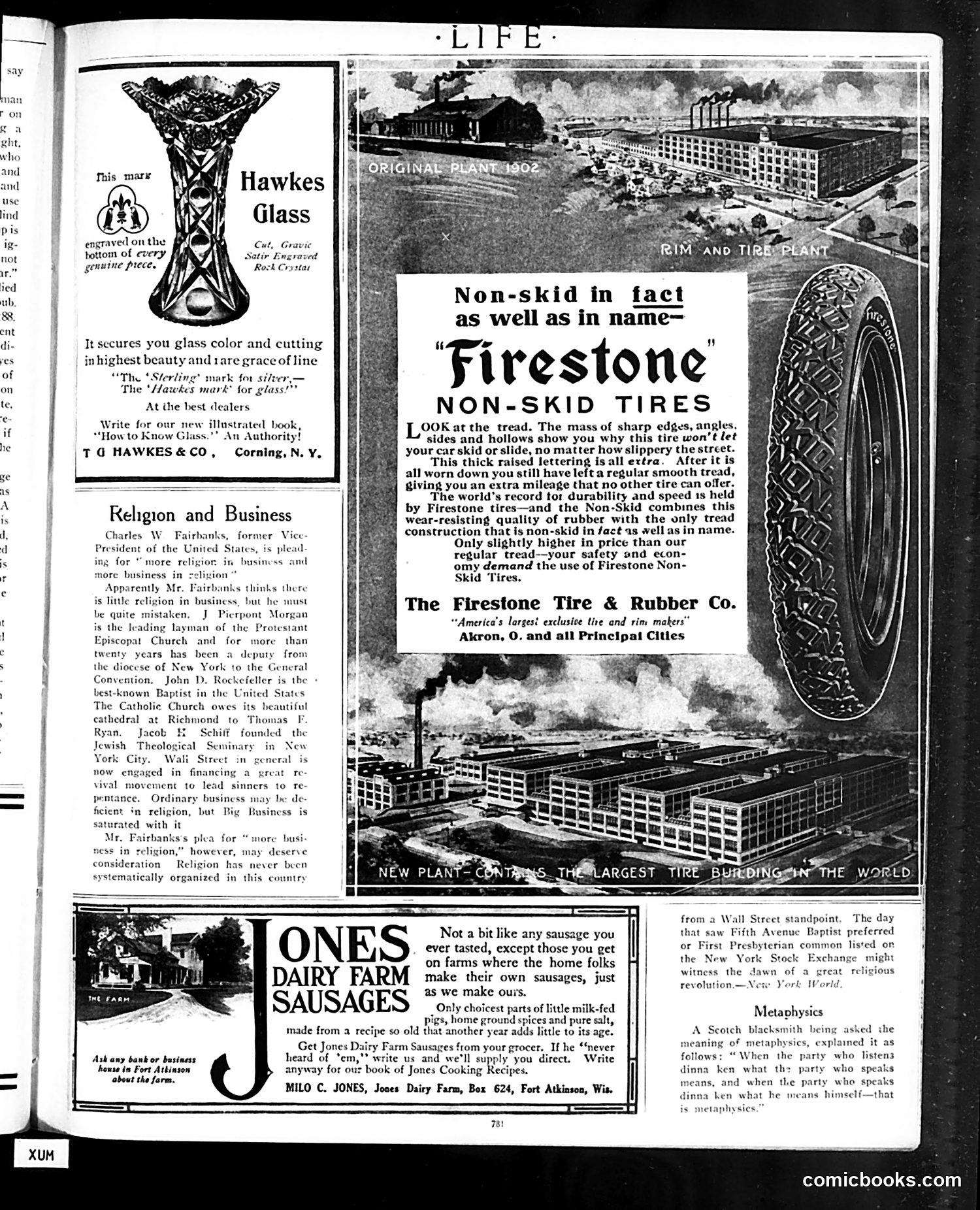
This page is primarily **advertising**, not political satire. It features four distinct ads: 1. **Hawkes Glass** (top left): A decorative glassware maker promoting their "Sterling" and "Hawkes" marks as quality guarantees. 2. **Firestone Non-Skid Tires** (center/right): The dominant advertisement showcases the company's manufacturing plant and emphasizes their tire tread design, claiming superior safety and durability. 3. **Jones Dairy Farm Sausages** (bottom left): A product ad promoting homemade-style sausages. The page also contains two brief editorial pieces: "Religion and Business" (discussing prominent businessmen's religious affiliations like Rockefeller and Morgan) and "Metaphysics" (a humorous anecdote about a Scottish blacksmith's definition). These are filler content typical of Life magazine's format—satirical commentary mixed with advertising. There is no political cartoon present on this page.
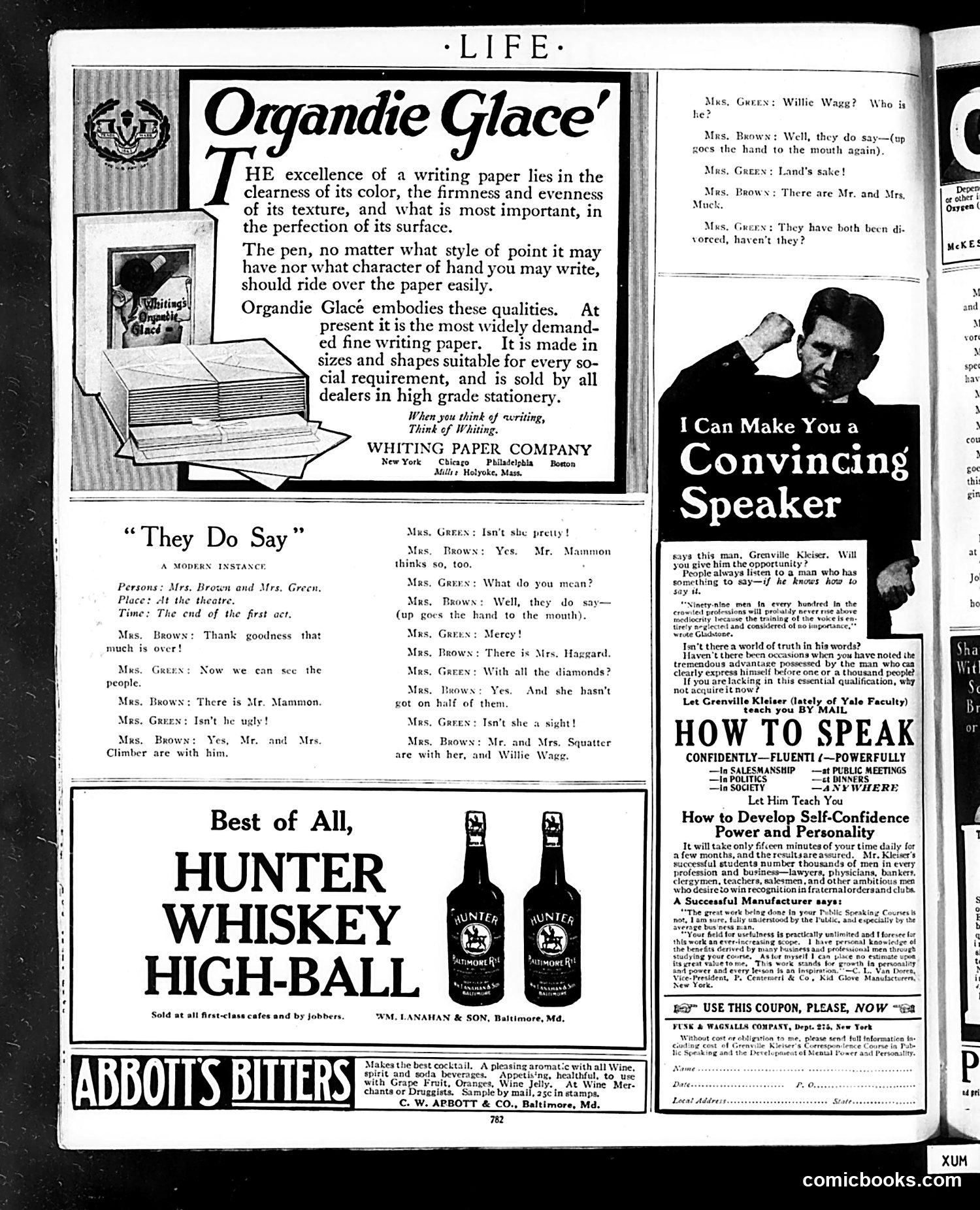
This cartoon satirizes the social vice of gossip, particularly among women of means. The sketch depicts two theater-going women, Mrs. Brown and Mrs. Green, engaging in a running commentary about other patrons—cataloging their appearances, wealth, and scandals. The humor lies in the repeated gesture: whenever Mrs. Brown begins spreading rumors ("they do say"), her hand goes to her mouth—a physical acknowledgment of gossip-mongering. The targets include Mr. Mammon (likely a reference to wealth worship), Mrs. Haggard with her excessive diamonds, divorced couples, and the mysterious Willie Wagg. The title "A Modern Instance" suggests this depicts contemporary (early 20th-century) American social behavior. The satire critiques not just idle chatter, but the class-conscious scrutiny of others' appearances, morality, and financial status—exposing how gossip functions as a tool of social surveillance among the wealthy leisure class.
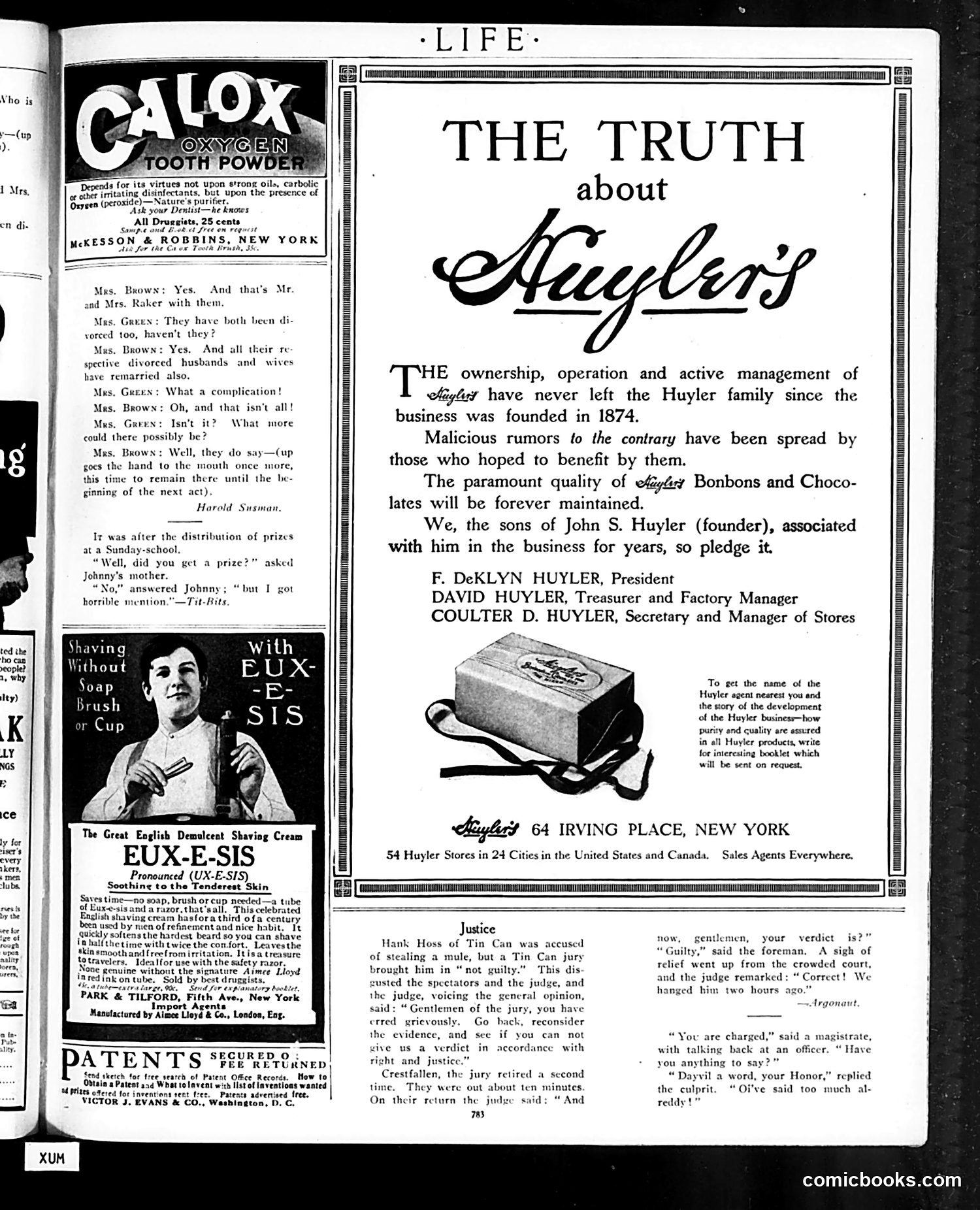
This page is primarily **advertisements and filler content** from Life magazine, with minimal satirical punch. The left column contains a brief dialogue joke about divorce: Mrs. Brown describes an increasingly tangled social situation where multiple people have divorced and remarried each other—the humor relies on the era's fascination with scandal and complicated marital entanglements, presented as gossipy small talk. Below that is a short anecdote about a Sunday school prize distribution with mild humor about a child's misunderstanding. The right page features a **full-page advertisement** for Huyler's candy/bonbons, presenting the family business's ownership credentials to counter "malicious rumors" (likely about quality or authenticity). Lower sections advertise shaving cream and patent services—standard period advertising. The "Justice" section at bottom contains two very brief courtroom jokes with minimal wit: one about a mule-stealing verdict, another about a magistrate's reprimand. Overall, this appears to be a standard magazine page mixing light humor fillers with advertisements rather than substantive satire or political commentary.
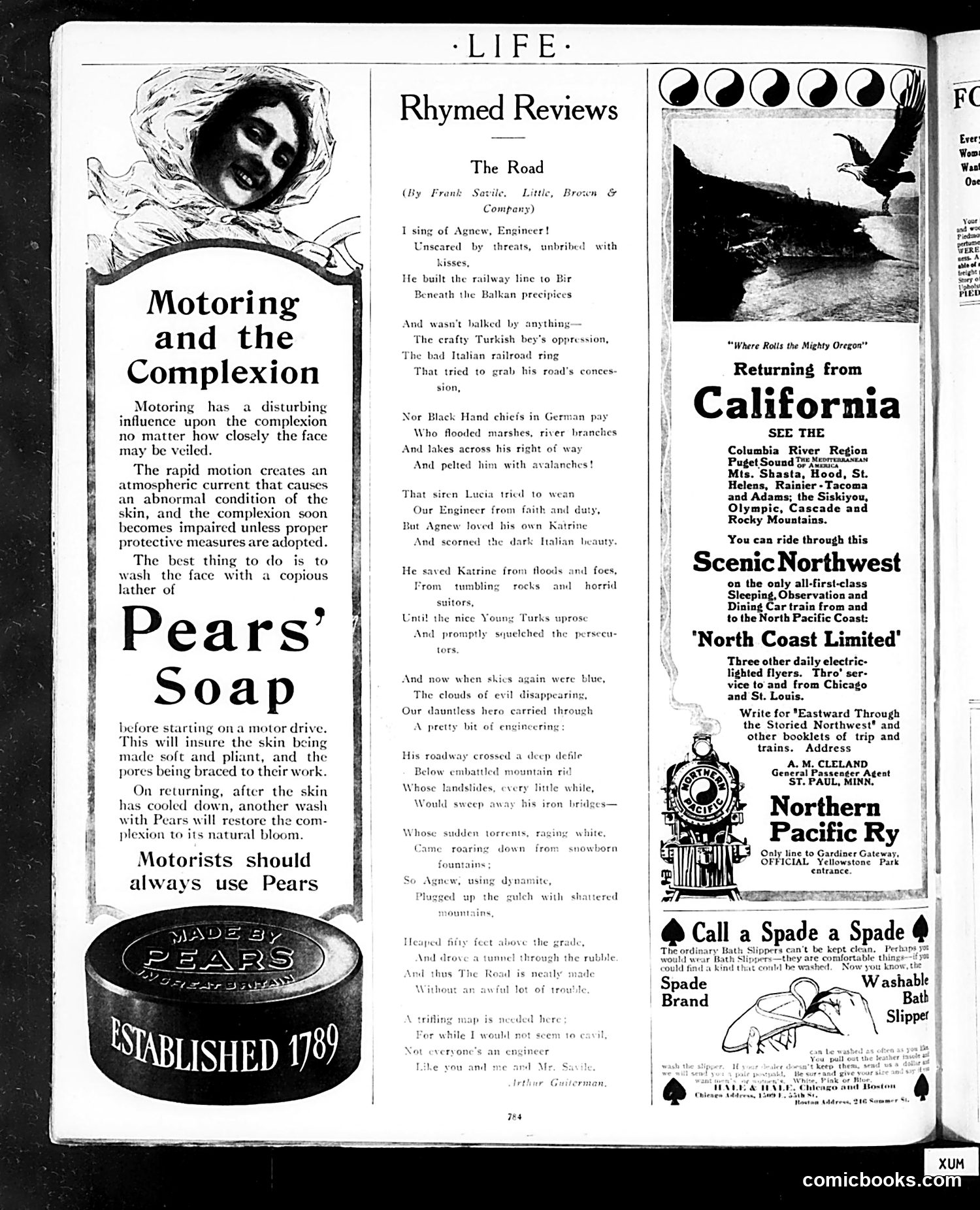
This page is primarily **advertising content**, not satire. The left side features a Pears' Soap advertisement addressing a genuine concern of the early automotive era: the belief that rapid motorcar travel created harmful atmospheric conditions that damaged complexion. The ad warns that "rapid motion creates an atmospheric current that causes an abnormal condition of the skin," and recommends washing with Pears' Soap before and after drives to protect facial skin. This reflects actual anxieties of the period when automobiling was new—concerns about wind damage, dust, and speed's effects on the body. The "Rhymed Reviews" section in the center reviews a theatrical production called "The Road" about an engineer named Agnew building a railway through the Balkans, overcoming Turkish and Italian opposition. The right side contains travel advertisements for California tourism and Northern Pacific Railway services—typical magazine advertising of the era.
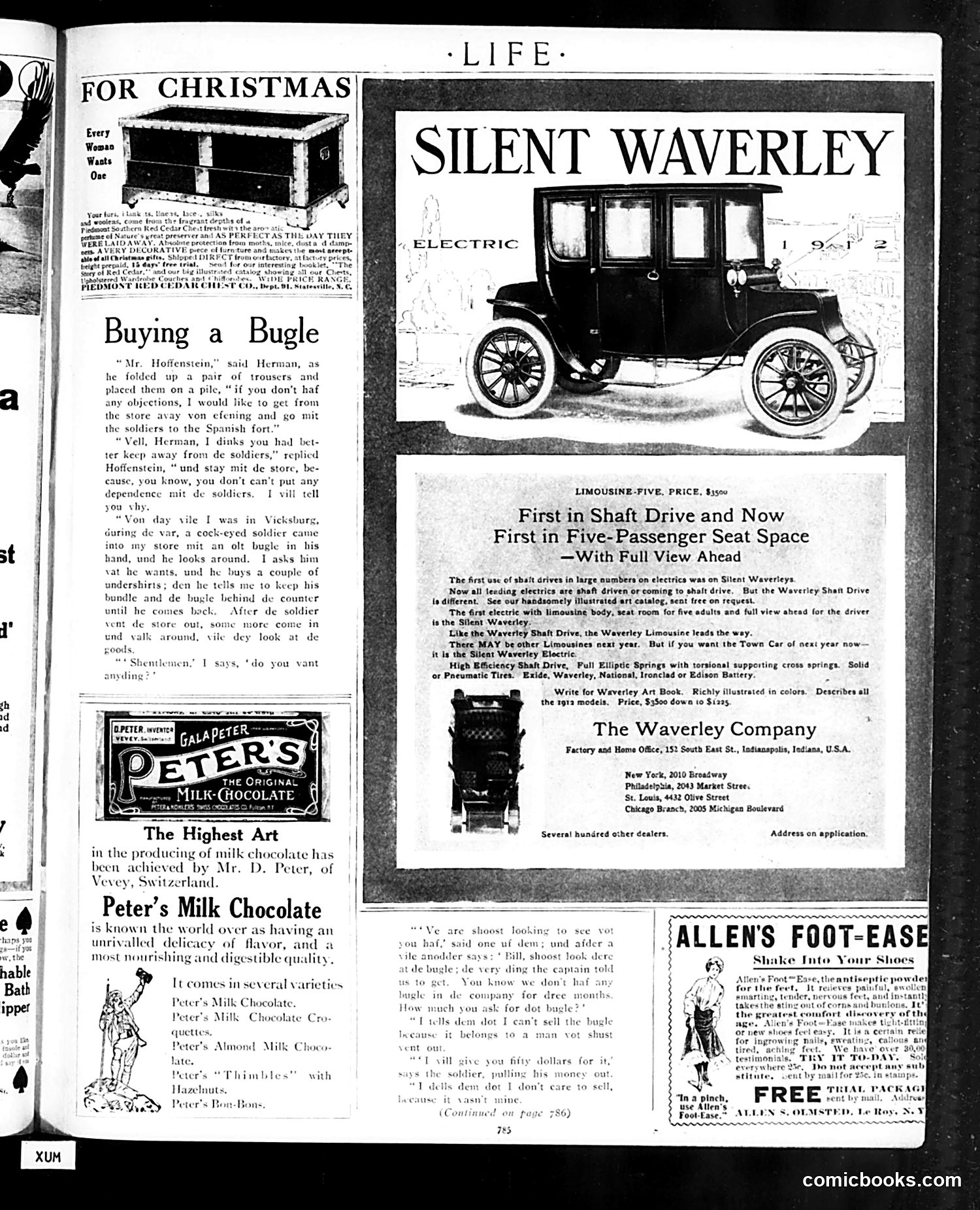
This is a humorous story (not a political cartoon) told by Herman, a Jewish immigrant shopkeeper with a heavy Yiddish accent, warning his employee against fraternizing with soldiers. The narrative recounts Herman's wartime experience in Vicksburg: a soldier left his bugle in Herman's store, and subsequent soldiers offered increasingly large sums ($50, then implied higher amounts) to purchase it. Herman repeatedly refused, protecting the bugle for the original owner. **The satire's point:** The story mocks both the soldiers' desperation and impulsiveness, while portraying Herman as honest and trustworthy—a counterpoint to common anti-immigrant stereotypes depicting Jewish merchants as greedy. The exaggerated dialect (typical of early 20th-century American humor) and the anticlimactic resolution suggest gentle ethnic comedy rather than mean-spirited caricature. The moral is simple: avoid entanglement with unreliable soldiers. The remaining page contains vintage advertisements for automobiles, chocolate, and foot powder—typical Life magazine content.
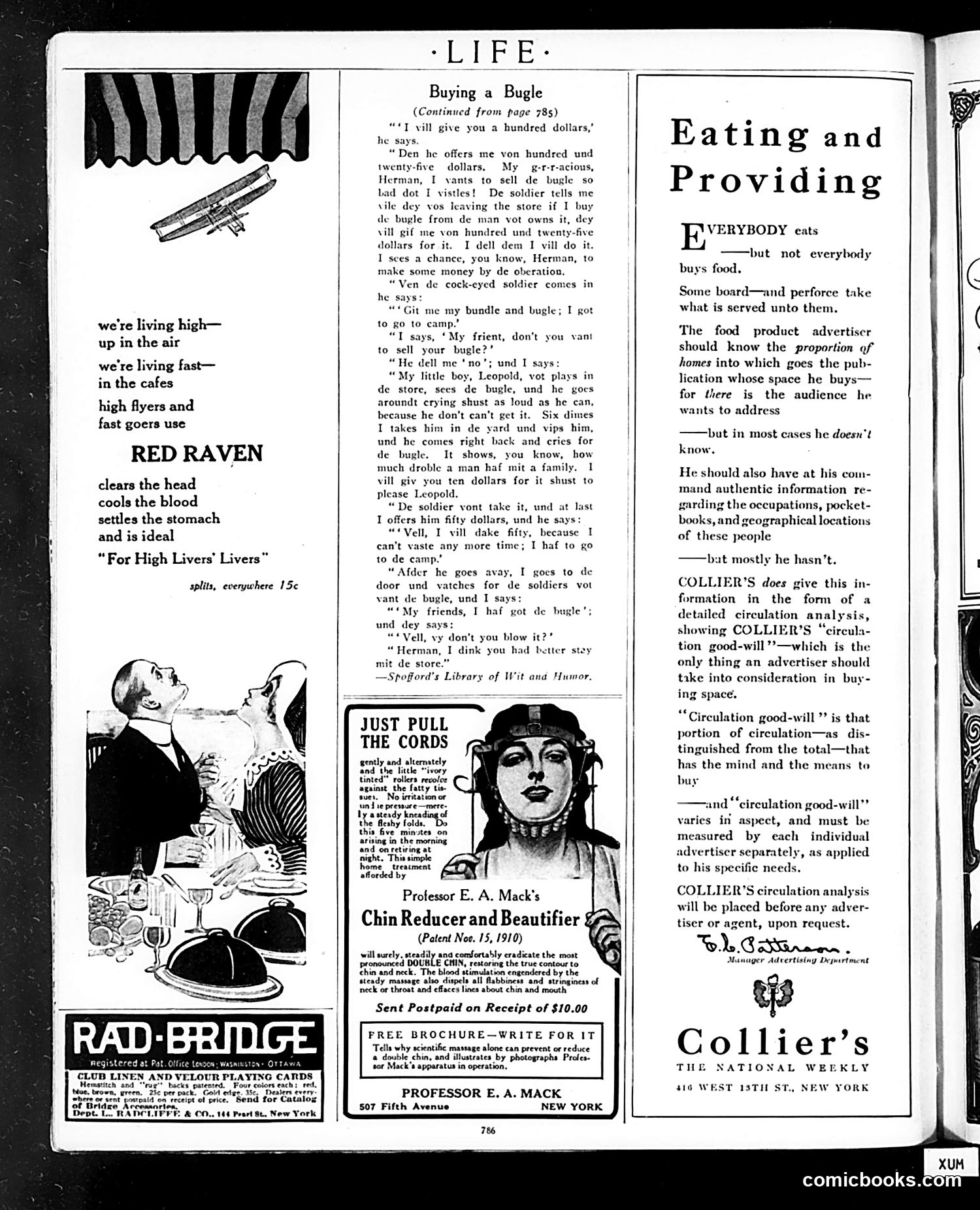
This page mixes humor, advertising, and editorial content typical of early 20th-century *Life* magazine. **The main cartoon** depicts a Jewish immigrant character (indicated by dialect and name "Leopold") recounting a shrewd business deal involving a soldier's bugle. The humor relies on ethnic stereotype—the Yiddish-inflected English and the character's cunning negotiation tactics. The joke illustrates how he manipulates multiple parties (soldier, store owner, potential buyers) to profit from the bugle's sale, exploiting his son's manufactured desire for it as a sales tactic. **Advertisements** include "Red Raven" (a digestive beverage for "high livers"), "Rad-Bridge" playing cards, and notably Prof. Mack's "Chin Reducer"—a mechanical device promising to eliminate double chins through massage, reflecting early 1900s beauty-treatment marketing. **The editorial content** on the right discusses advertising strategy, arguing that food advertisers should target homes with actual purchasing power, not just raw circulation numbers—an early articulation of audience demographics in marketing. The page reflects period attitudes toward immigrants and early advertising theory.
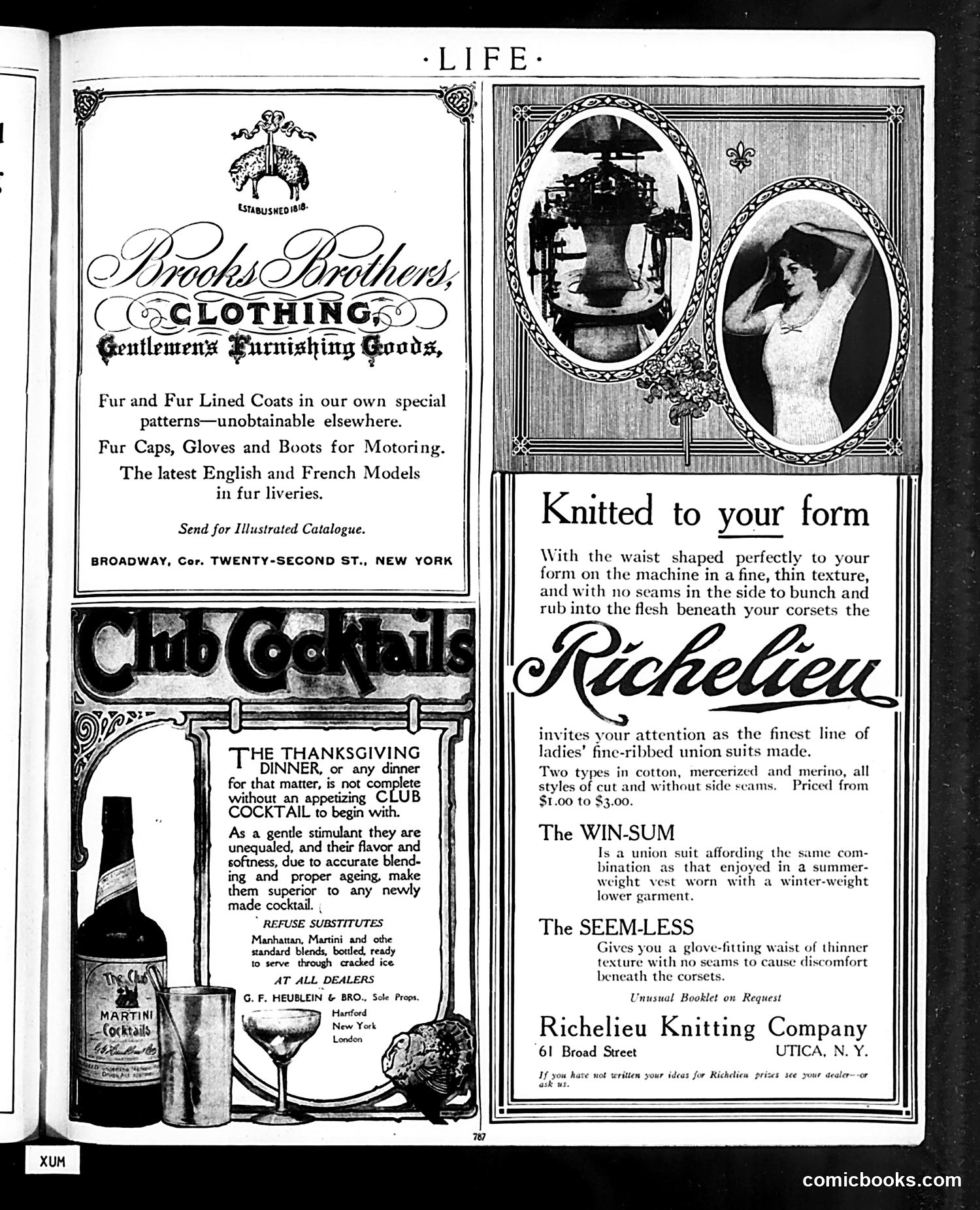
This is primarily an **advertising page**, not political satire. It contains four period product advertisements: 1. **Brooks Brothers** (top left): Upscale menswear—fur-lined coats and motoring accessories for wealthy gentlemen. 2. **Club Cocktails** (center-left): Martini advertisement emphasizing that cocktails are essential to proper dinner entertaining. References "Thanksgiving dinner" and promotes pre-made bottled cocktails as superior to homemade versions. 3. **Richelieu Knitting Company** (right): Women's undergarments—union suits marketed with specific design features (seamless waists, no side bunching under corsets). Targets women concerned with proper fitting undergarments beneath corsets. 4. **Heublein & Bros** (bottom): Spirits distributor listing cocktail brands available at dealers. The page reflects **early 20th-century consumer culture**: luxury goods marketed to affluent Americans, gendered product targeting, and emphasis on convenience (pre-made cocktails). No political commentary or satirical content is evident.
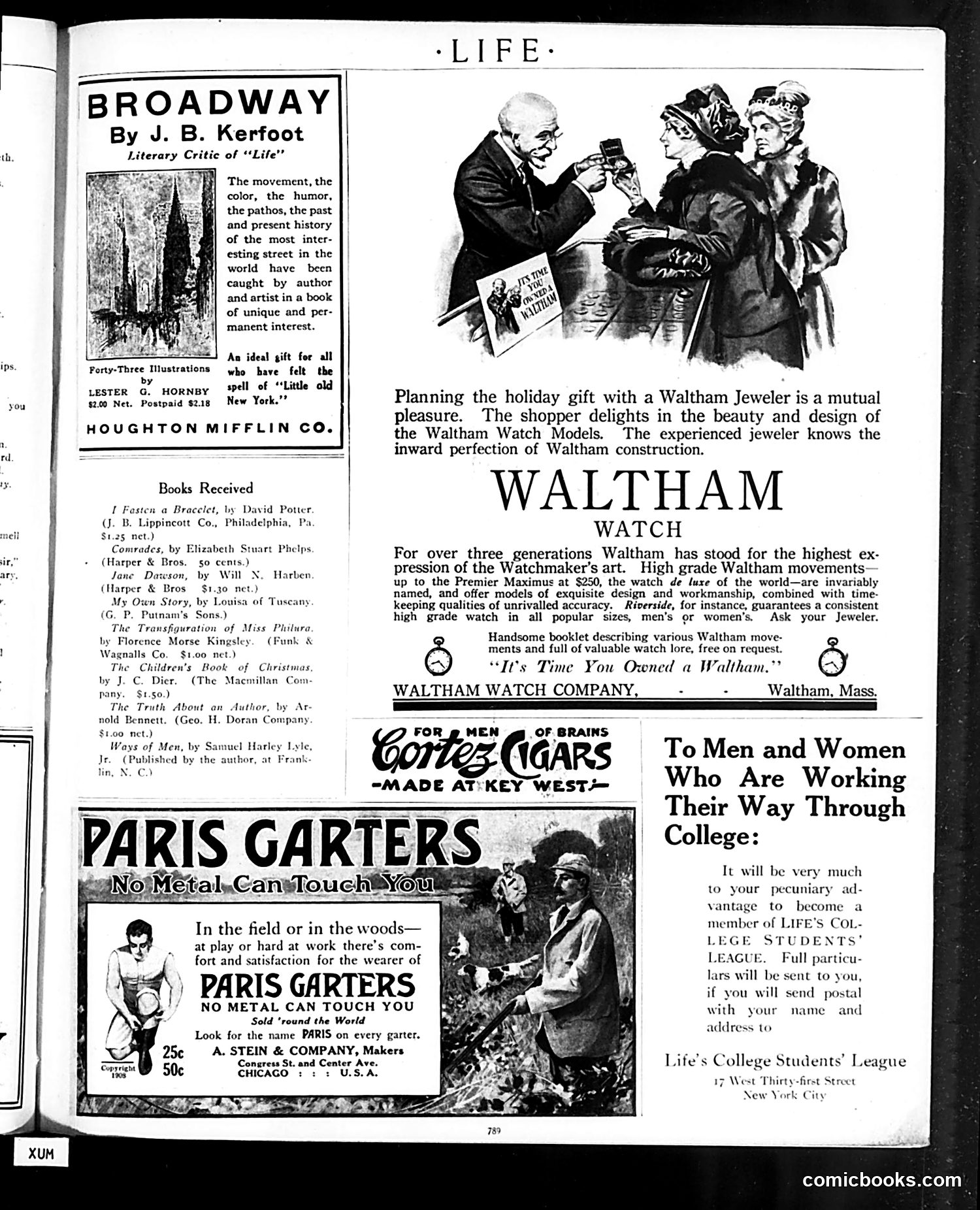
This page is primarily **advertising and book reviews** rather than satirical cartoons. The main content includes: **Top Section:** A book advertisement for J.B. Kerfoot's illustrated guide to Broadway, emphasizing the street's "movement, color, humor, pathos" as a tourist attraction ("Little old New York"). **Advertisements featured:** - Waltham Watches: positioned as an ideal holiday gift, emphasizing three generations of quality craftsmanship - Paris Garters: highlighting that "no metal can touch you" — a practical selling point for outdoor workers - Cortez Cigars: "for men of brains" - Life's College Students' League: recruiting working students **Books Reviewed:** Standard literary titles of the period. The page reflects **early 20th-century consumer culture** targeting middle-class gift-givers and working professionals. There is no significant political satire visible — this is straightforward commercial and literary content typical of Life magazine's business model during this era.
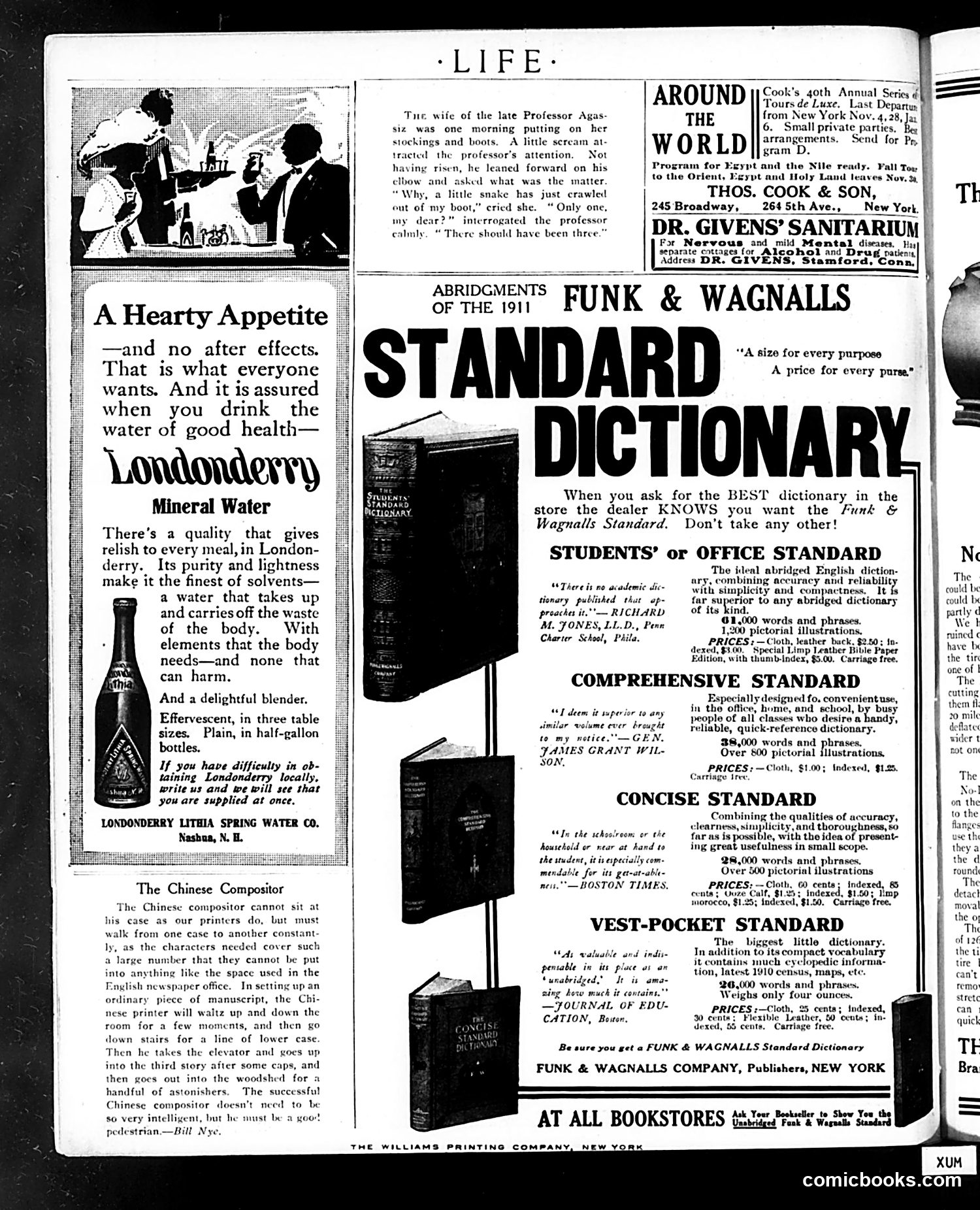
This page is primarily **advertising**, not political satire. The main content consists of three dictionary advertisements from Funk & Wagnalls (occupying roughly half the page) promoting their various Standard Dictionary editions at different price points and sizes. The smaller editorial sections include: 1. **"A Hearty Appetite"** — An advertisement for Londonderry Mineral Water, promoting its digestive benefits 2. **"The Chinese Compositor"** — A brief humorous piece about Chinese printing, noting that Chinese typesetters must walk between type cases because the vast number of characters cannot fit in one location (unlike English). The joke plays on the practical challenges of Chinese typography versus Western printing. 3. **"Around the World"** — A travel advertisement for Thomas Cook & Son offering tours to Egypt and the Nile. There is a small illustration at the top depicting what appears to be a domestic scene with a woman and man, accompanying a brief anecdote about Professor Agassiz and a snake, but this is minor content relative to the dictionary advertising dominating the page.
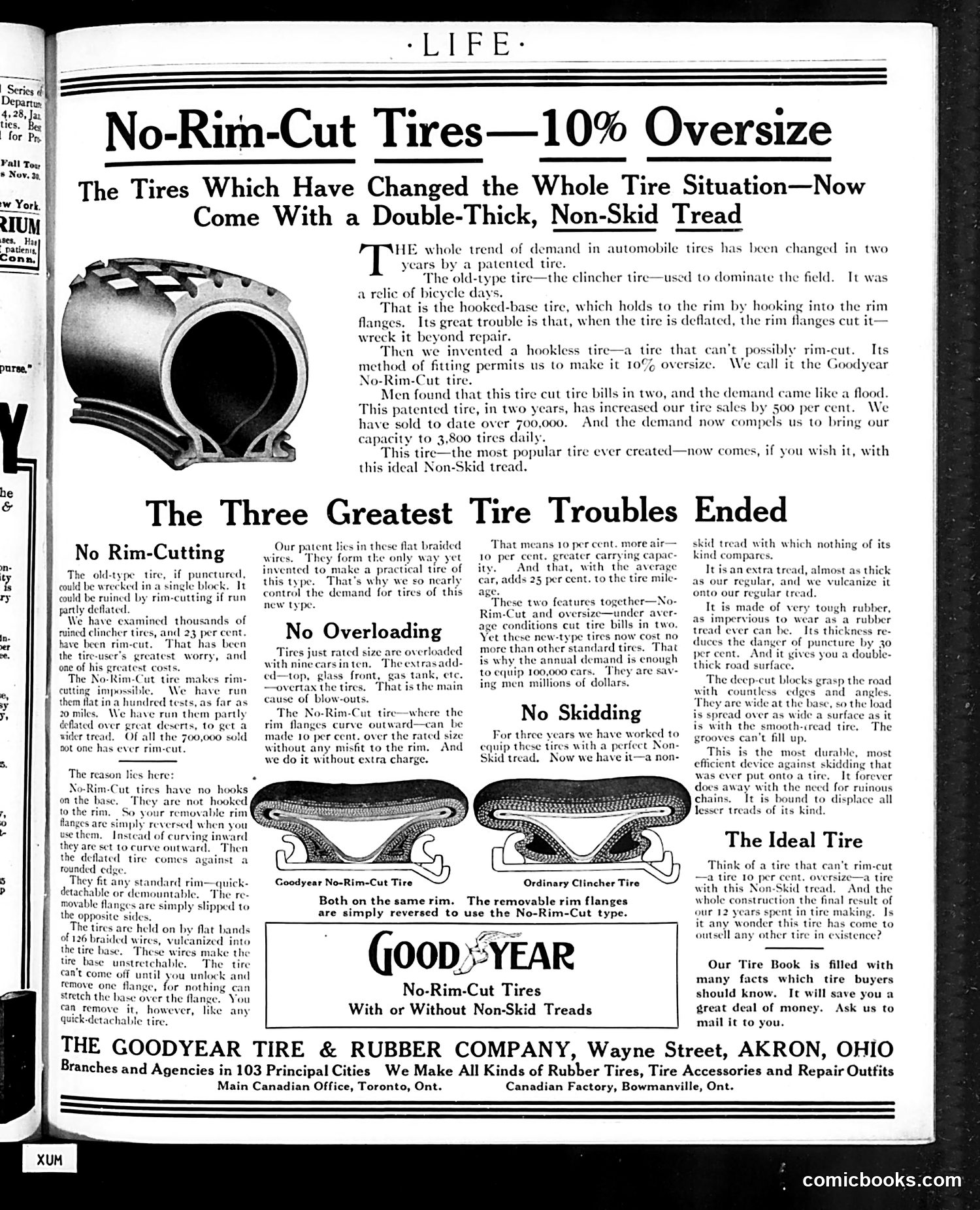
This is **not a political cartoon or satire**—it's a straightforward **product advertisement** for Goodyear's newly patented "No-Rim-Cut" tire, appearing in *Life* magazine. The page showcases three claimed innovations: the hookless tire design (which prevents rim-cutting when deflated), an oversized construction (10% larger without extra cost), and a non-skid tread. The diagrams compare the Goodyear tire's flat braided wire construction to traditional "clincher" tires with curved rim flanges. The marketing emphasizes market dominance: Goodyear claims 500% sales growth and 700,000 units sold in two years. This reflects the early automotive boom (pre-1920s), when tire reliability was a major consumer concern and competitive advantage. There is no satire here—merely the era's typical aggressive advertising copy, presenting engineering specifications as revolutionary breakthroughs to convince readers that Goodyear's patents solved critical automobile problems.
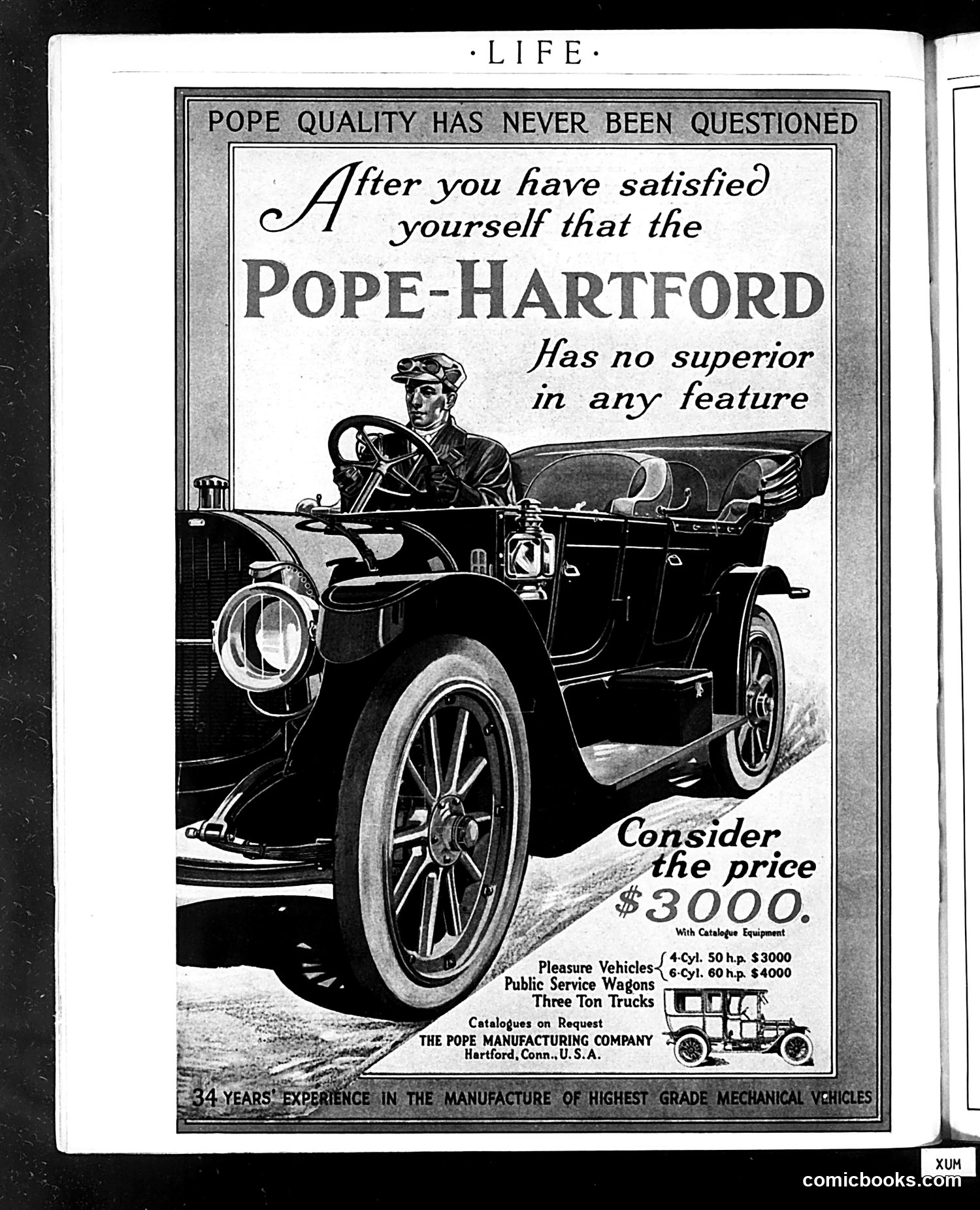
This is **not satire** but a genuine automobile advertisement from Life magazine's early era (likely 1900s-1910s). The Pope Manufacturing Company of Hartford, Connecticut manufactured "Pope-Hartford" automobiles and marketed them as premium vehicles with "34 years' experience in the manufacture of highest grade mechanical vehicles." The ad's headline—"Pope Quality Has Never Been Questioned"—asserts the brand's reliability and prestige. The phrase "has no superior in any feature" makes a competitive claim about the car's engineering. The $3,000 price point (roughly $90,000 in today's money) positioned it as a luxury vehicle. The ad emphasizes multiple vehicle types: pleasure cars, commercial wagons, and trucks. **The visual** shows a well-dressed driver, suggesting the aspirational lifestyle associated with automobile ownership during the automobile's early adoption period. This represents marketing to wealthy Americans when cars were still luxury goods rather than mass-market commodities.
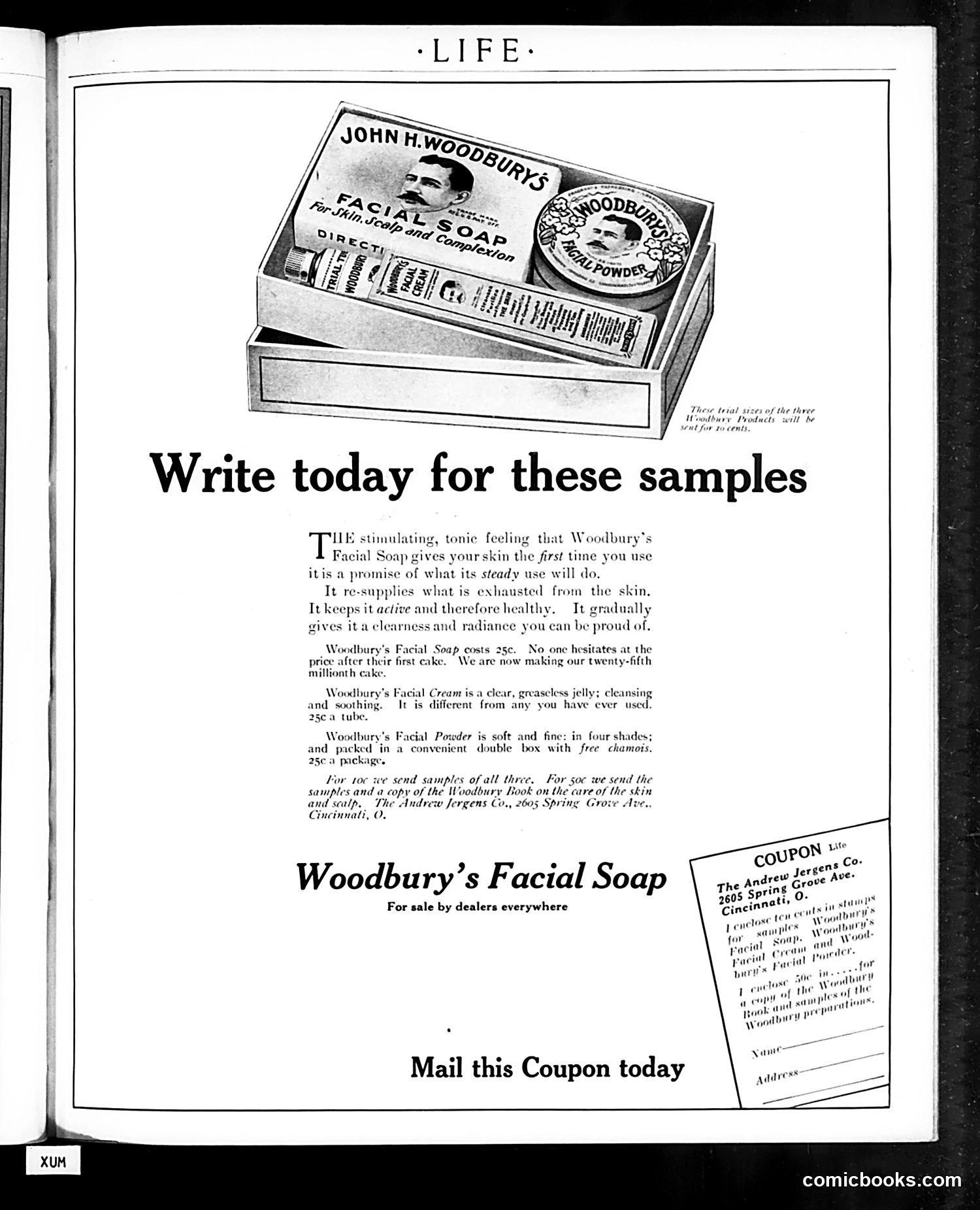
This is primarily a **beauty product advertisement**, not political satire. It promotes Woodbury's Facial Soap, a genuine brand from the early 20th century. The page features a product display box at top and persuasive copy emphasizing the soap's benefits: it "re-supplies what is exhausted from the skin" and provides "clearness and radiance." The ad notes the product costs 25¢ and claims they're producing their "twenty-fifth millionth cake." A detachable coupon invites readers to mail for free samples (10¢) or samples plus a skincare book (50¢) from the Andrew Jergens Company in Cincinnati, Ohio. **For modern readers:** This represents vintage consumer advertising targeting women's beauty routines. The formal language, emphasis on scientific-sounding benefits, and direct mail strategy are typical of early 1900s marketing. There is no political cartoon or satire present—this is straightforward commercial promotion appearing in *Life* magazine's advertising section.
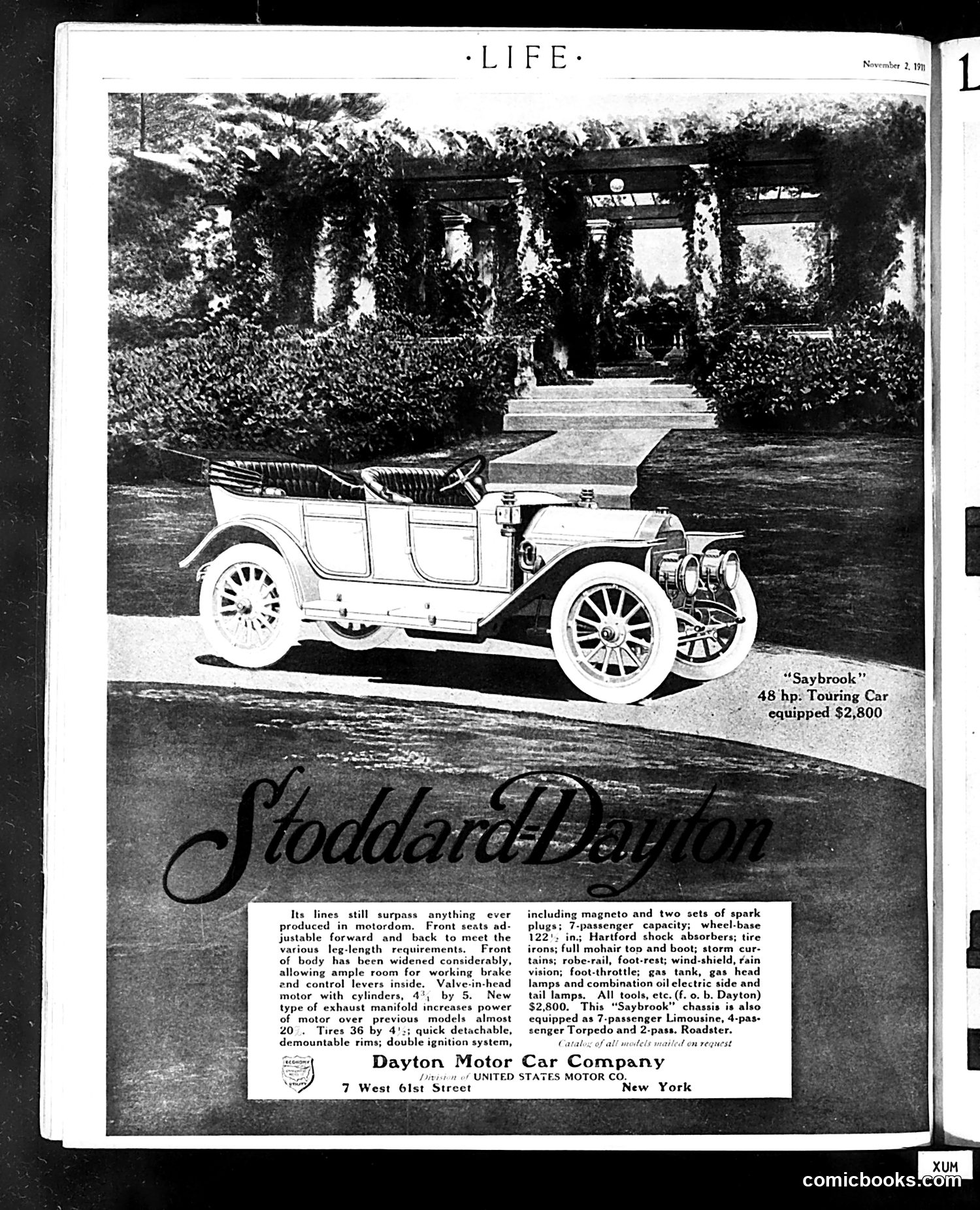
This is **not a cartoon or satire**—it's a straightforward automobile advertisement from *Life* magazine (November 2, 1912). The page showcases the Stoddard-Dayton "Saybrook," a 48-horsepower touring car priced at $2,800. The image displays the vehicle in an elegant garden setting, emphasizing its luxury status. The accompanying text highlights technical specifications: valve-in-head motor, adjustable front seats, quick-detachable tires, double ignition system, and various amenities like electric lamps and gas tank. This represents early automotive advertising targeting wealthy consumers. The garden backdrop and refined presentation suggest this was a premium vehicle. The extensive technical details were typical of car ads from this era, when such specifications were novel selling points to an audience still getting familiar with motorized transportation.