
Life, 1911-11-02 · page 30 of 56
Life — November 2, 1911 — page 30: what you’re looking at
What you’re looking at
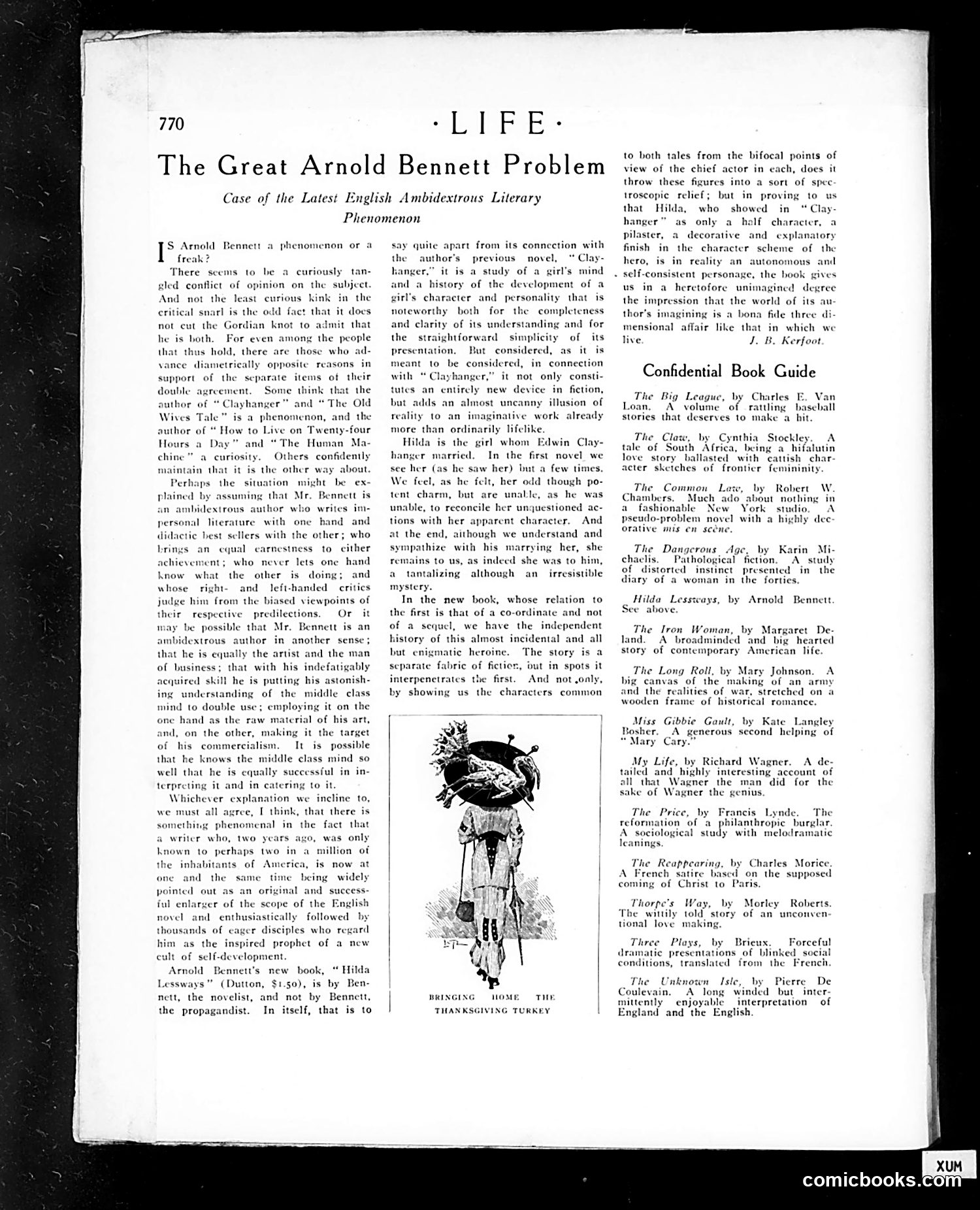
This article discusses whether English author Arnold Bennett is a literary "phenomenon or a freak." The piece explores the paradox that Bennett simultaneously succeeds as both a serious novelist (writing "Clayhanger" and "The Old Wives Tale") and a popular self-help author (writing "How to Live on Twenty-four Hours a Day"). Critics are divided: some admire his artistic novels while dismissing his practical guides as curiosities, or vice versa. The author proposes Bennett may be "ambidextrous"—equally skilled at serious art and commercial writing, or perhaps uniquely understanding the middle-class mind enough to both elevate and cater to it. The accompanying illustration shows a figure on a bicycle, captioned "BRINGING HOME THE THANKSGIVING TURKEY"—apparently Bennett's dual nature delivering both artistic and practical/commercial goods simultaneously. The article examines Bennett's new novel "Hilda Lessways," positioning it as serious fiction rather than propagandist work.
📄 Transcribed text from this page (OCR, searchable)
Machine-transcribed from the original scan — historical spelling and the odd misread are preserved.
770 UNI ole cle The Great Arnold Bennett Problem Case of the Latest English Ambidextrous Literary Phenomenon IS Arnold Bennett a phenomenon or a freak? There scems to be a curiously tan- gled conflict of opinion on the subject. And not the curious kink in the critical snarl is the odd fact th: not cut the Gordian knot to admit that least it does For even among the people those who ad- opposite he is both. thus hold, there diametrically that reasons in support of the separate their agreement. Some think that the and “The Old nd the vance items ot double author of Clayhanger” Wives Tale” is a phenomenon, author of “ How to Live on Twenty-four Hours a Day” and “The Human Ma- chine” a curiosity. Others confidently maintain that it is the other way ab imation might be plained by assuming that Mr. Bennett an ambidextrous author who writes i Perhaps the personal literature with one hand and didactic best sellers with the other; who carnesiness to cither hand know what the other is doing; and right- and left-handed judge him from the biased viewpoints of their predilections, Or it nay be possible that Mr. Bennett is an nother sense ; brings an equal achievement; who never lets one whose critics respective mbidextrous author in he is equally the artist and the man ; that with his indefatigably astonish- that of busines ired skill he is putting hi middle mind to double use; employing it on the one hand as the raw material of his art, and, on the other, making it the target f his possible that he knows the middle class mind so well that he is equally successful in in- terpreting it and in catering to it Whichever explanation we incline to, agree, [ think, that there is the fact th was only ing understanding of the class commercialism. It is we must all something phenomenal in a Writer who, two years ago, »wn to perhaps two in a million of America, is now at widely an original and success- the inhabitants of one and the same time being pointed out as iul enlarger of the scope of the F and enthusiastically followed by thousands of eager disciples who regard mas the inspired prophet of a new cult of self-development. Arnold Bennett's new book, Lessways” (Dutton, $1.50), is by nett, the novelist, and not by Bennett, the propagandist. In itself, that is to lish novel “Hilda Ben- say quite apart from its connection with novel, “Clay of a girl's mind the author's previous hanger,” it is a study nda history of the development of a girl's character and personality that is noteworthy both for the and clarity of its understanding and for the straightforward simplicity of — its presentation, But considered, as it is to be considered, in connection anger,” it new device in fiction, but adds an almost uncanny illusion of reality to. an ims work already more than ordinarily lifelike. Hilda is the girl whom Edwin Clay hanger married. In the first_ novel. we w her) but a few times. completeness meant with “ Clayh not only consti- tes an entirely ginative see her (as We feel, as he felt, her odd though po- tent charm, but are unable, was unable, to reconcile her unquestioned ac- tions with her apparent character. And the end, aithough we understand and sympathize with his marrying her, she as he remains to us, as indeed she was to him, a tantalizing although an_ irresistible mystery. In the new book, whose relation to the first is that of a co-ordinate and not of a sequel, history of but enigmatic heroine. arate fabric of fiction, he first we have the independent is almost incidental and all The story is a ut in spots it And not only, by showing us the characters common interpenctrates BRINGING MOME THY THANKSGIVING TURKEY to both tales from the bifocal points of view of the chief actor in each, does it throw these figures into a sort of spec troscopic relief; but in proving to that Hilda, showed in “Cl hanger” as half character, a pilaster, a decorative finish in the hero, is in reality an autonomous and who only a and explanatory character scheme of the self-consistent personage, the hook gives unimagined degree the impression that the world of its au thor’s imagining is a bona fide three affair that in which we J. B. Kerfoot Confidential Book Guide The Big League, by Charles E. Van Loan. A volume of rattling baseball stories that deserves to make a bit. us in a heretofore mensional like live. Claw, by Cynthia Stockley. A of South Africa, being a_hifalutin love story ballasted with cattish char: acter sketches of frontier femininity The Common Law, by Robert W. Chambers, Much ado about nothing ir a fashionable New York studio. A pseudo-problem novel with a highly dee orative mis en scene The Dangerous Ag chaclis. Pathological fiction. study of distorted instinct presented in the diary of a woman in the forties, Karin Mi- Hilda Lesstways, by See above. Arnold Bennett The Iron Woman, by Mar land. A_ broadminded story of contemporary ret De- hearted The Long Roll, by Mary Johnson. A big canvas of the making of an army and the realities of war, stretched on a wooden frame of historical romance. Miss Gibbie Gault, by Kate Langley tosher. A generous second helping of Mary Cary. My Life, by Richard Wagner. A de- tailed and highly interesting account of all that Wagner the man did for the sake of Wagner the genius. The Price, by Francis Lynde, The reformation of a philanthropic burglar A sociological study with melodramatic leanings. The Reappearing, by Charles Morice. A French satire based on the supposed coming of Christ to Paris. Roberts. unconven Thorpe's The witti tional love Way, by told ‘story making. Three Plays, by Brieux, — Force dramatic presentations of blinked _ so conditions, translated from the French: The Unknown Isle, by Pierre De Coulevain. A long winded but inter mittently enjoyable interpretation of England and the English. Morley of an comicbooks.