
Life, 1911-11-02 · page 12 of 56
Life — November 2, 1911 — page 12: what you’re looking at
What you’re looking at
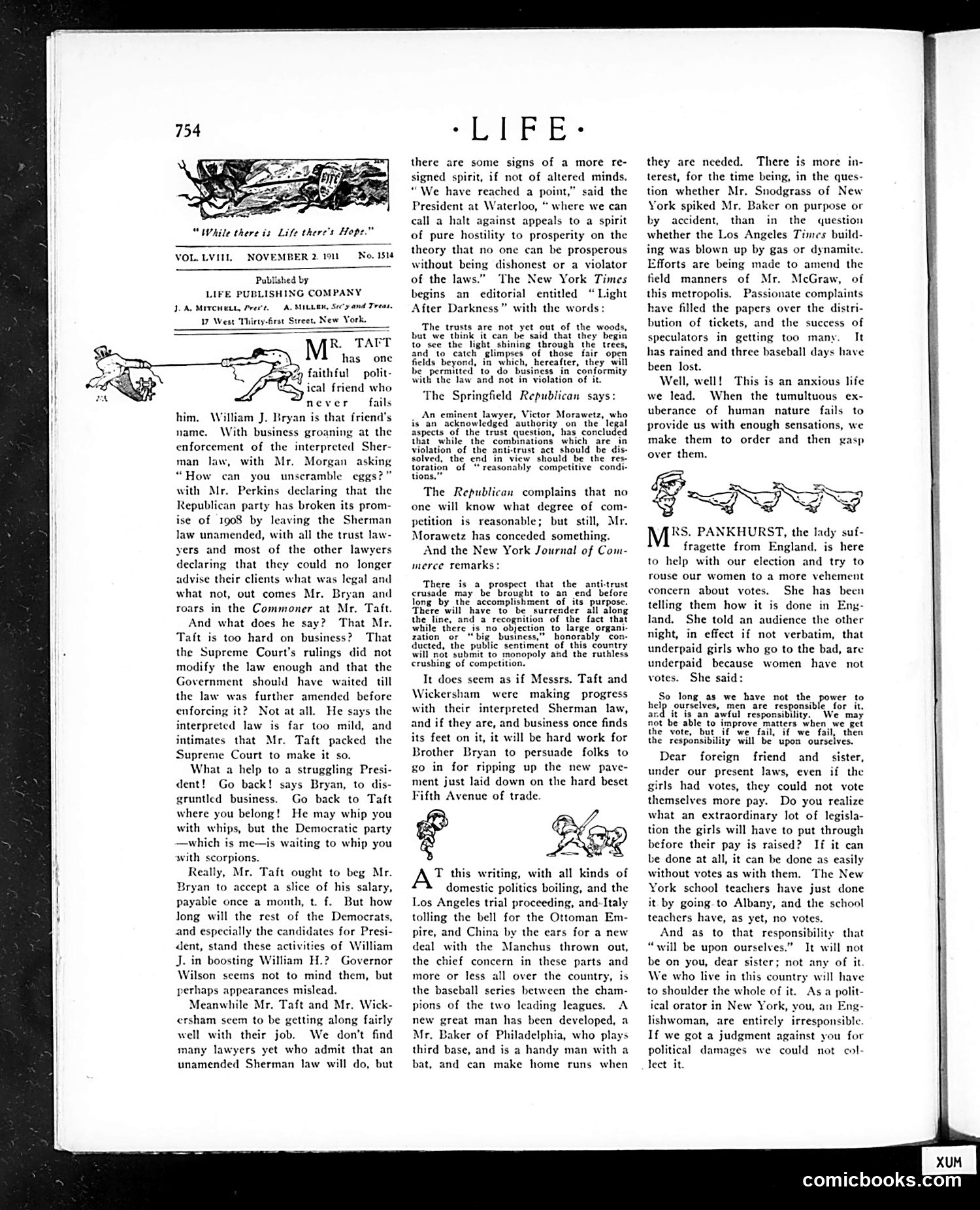
This page contains editorial commentary on contemporary political issues rather than cartoons. The text discusses: **William Jennings Bryan** and Republican party politics—specifically criticism of how the GOP has "broken its promise of 1908" regarding Sherman Antitrust law enforcement. The editorial mocks Mr. Taft's mild interpretation of the law as insufficient. **Trust regulation debates** between Taft and Bryan, with commentary on whether antitrust enforcement has been adequately pursued. **Women's suffrage** is addressed through "Mrs. Pankhurst," the British suffragist visiting to advocate for women's votes, drawing parallels to American electoral reform debates. The page reflects Progressive Era concerns about corporate monopolies, executive power, and women's political participation circa 1911.
📄 Transcribed text from this page (OCR, searchable)
Machine-transcribed from the original scan — historical spelling and the odd misread are preserved.
“While there is Life there's Hope.” VOL. LVIIl, NOVEMBER 2 1911 No. 1514 Published by LIFE PUBLISHING COMPANY J Ac MITCHELL, Preet, A. MILLEN, Sey and Treas, 17 West Thirty-6rot Street, New York. M® TAFT has one 2p faithful _polit- ical friend who never — fails him, William J. Bryan is that friend's name, With business groaning at the enforcement of the interpreted Sher- man law, with Mr. Morgan asking “How can you unscramble eggs?” with Mr, Perkins declaring that the Republican party has broken its prom- ise of 1908 by leaving the Sherman Jaw unamended, with all the trust law- yers and most of the other lawyers declaring that they could no longer advise their clients what was legal and what not, out comes Mr. Bryan and roars in the Commoner at Mr. Taft. And what does he say? That Mr. Taft is too hard on business? That the Supreme Court’s rulings did not modify the law enough and that the Government should have waited till the law was further amended before enforcing it? Not at all. He says the interpreted law is far too mild, and intimates that Mr. Taft packed the Supreme Court to make it so. What a help to a struggling Presi- dent! Go back! says Bryan, to d gruntled business. Go back to Taft where you belong! He may whip you with whips, but the Democratic party —which is me—is waiting to whip you sith scorpions. Really, Mr. Taft ought to beg Mr. Bryan to accept a slice of his salary, payable once a month, t. f. But how Jong will the rest of the Democrats, and especially the candidates for Presi- alent, stand these activities of William J. in boosting William H.? Governor Wilson seems not to mind them, but perhaps appearances mislead. Meanwhile Mr. Taft and Mr. Wick- ersham seem to be getting along fairly well with their job. We don’t find many lawyers yet who admit that an unamended Sherman law will do, but at PEs there are some signs of a more re- signed spirit, if not of altered minds. “We have reached a point,” said the President at Waterloo, “ where we can call a halt against appeals to a spirit of pure hostility to prosperity on the theory that no one can be prosperous without being dishonest or a violator of the laws.” The New York Times begins an editorial entitled “ Light After Darkness” with the words: The trusts are not yet out of the woods, but we think it can be said that they begin to see the light shining through the trees, and to catch glimpses of those fair open fields beyond, in which, hereafter, they will be permitted to do business in conformity with the law and not in violation of it. The Springfield Republican says: An eminent lawyer, Victor Morawetz, who is an acknowledged authority on the legal aspects of the trust question, has concluded that while the combinations which are in violation of the a ust act should be dis- solved, the end w should be the res- v toration of “reasonably competitive condi- tions,” The Republican complains that no one will know what degree of com- petition is reasonable; but still, Mr. Morawetz has conceded something. And the New York Journal of Com- merce remarks: There is a. prospect that the anti-trust crusade may be brought to an end before long by the accomplishment of, its purpose. There will have to be surrender all along the line, and a recognition of the fact that while there is no objection to large organi- zation or “big business,” honorably con- ducted, the public sentiment of this country will not submit to monopoly and the ruthless crushing of competition. It does seem as if Messrs. Taft and Wickersham were making progress with their interpreted Sherman law, and if they are, and business once finds its feet on it, it will be hard work for Brother Bryan to persuade folks to go in for ripping up the new pave- ment just laid down on the hard beset Fifth Avenue of trade. Pe A’ this writing, with all kinds of domestic politics boiling, and the Los Angeles trial proceeding, and-Italy tolling the bell for the Ottoman Em- pire, and China by the ears for a new deal with the Manchus thrown out, the chief concern in these parts and more or less all over the country, is the baseball series between the cham- pions of the two leading leagues. new great man has been developed, Mr, Baker of Philadelphia, who plays third base, and is a handy man with a bat, and can make home runs when they are needed. There is more in- terest, for the time being, in the ques- tion whether Mr, Snodgrass of New York spiked Mr. Baker on purpose or by accident, than in the question whether the Los Angeles Times build- ing was blown up by gas or dynamite. Efforts are being made to amend the field manners of Mr. McGraw, of this metropolis. Passionate complaints have filled the papers over the distri- bution of tickets, and the success of speculators in getting too many. It has rained and three baseball days have been lost. Well, well! This is an anxious life we lead. When the tumultuous ex- uberance of human nature fails to provide us with enough sensations, we make them to order and then gasp over them. GIG RS, PANKHURST, the lady suf- fragette from England, is here to help with our election and try to rouse our women to a more vehement concern about votes. She has been telling them how it is done in Eng- land. She told an audience the other night, in effect if not verbatim, that underpaid girls who go to the bad, are underpaid because women have not votes. She said: So long as we have not the forse to le men are responsible for it, it is an awful responsibility. We may t be able to improve matters when we get the vote, but if we fail, if we fail, then the responsibility will be’ upon ourselves. Dear foreign friend and _ sister, under our present laws, even if the girls had votes, they could not vote themselves more pay. Do you realize what an extraordinary lot of legisla- tion the girls will have to put through before their pay is raised? If it can Le done at all, it can be done as easily without votes as with them. The New York school teachers have just done it by going. to Albany, and the school teachers have, as yet, no votes. And as to that responsibility that “will be upon ourselves.” It will not be on you, dear sister; not any of it We who live in this country will have to shoulder the whole of it. As a polit- ical orator in New York, you, an Eng- lishwoman, are entirely irresponsible. If we got a judgment against you for political damages we could not col- lect it. help ourselves i comicbooks.co