
Life, 1911-11-02 · page 16 of 56
Life — November 2, 1911 — page 16: what you’re looking at
What you’re looking at
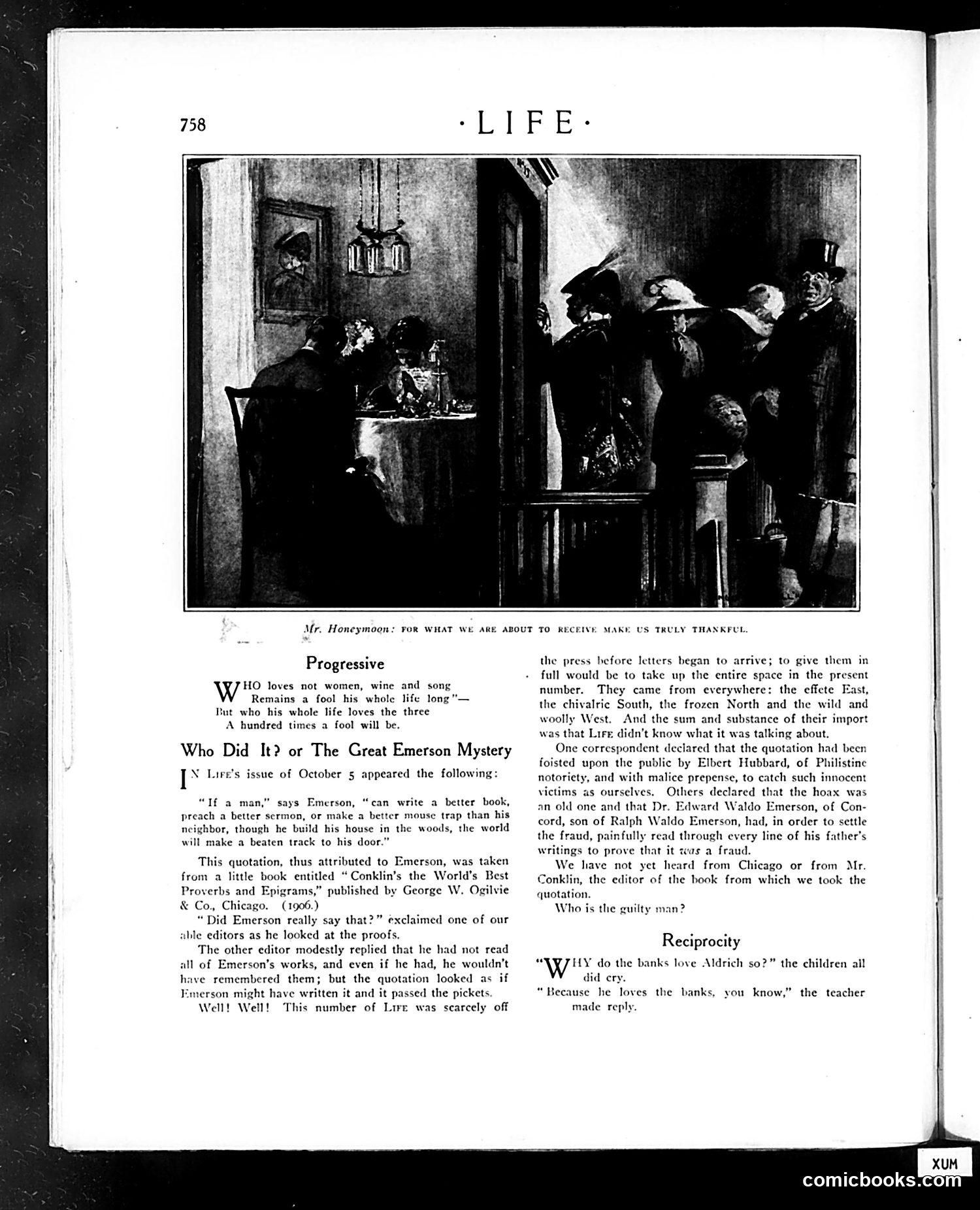
**The Image:** Shows a domestic scene where a woman sits alone at a table while a man entertains guests in an adjacent room, illustrating the caption "Mr. Honeymoon: for what we are about to receive make us truly thankful." **The Satire:** The cartoon mocks newlyweds, suggesting the husband ignores his bride to socialize with others—a cynical commentary on marriage losing its romance once the honeymoon phase ends. **The Text Content:** The page primarily addresses a *Life* magazine error: they misattributed a famous quote about building a better mousetrap to Ralph Waldo Emerson, when it actually came from "Conklin's World's Best Proverbs and Epigrams." The article humorously documents the ensuing chaos—readers from across America wrote angry letters claiming various people were responsible for the hoax (including Elbert Hubbard and Emerson's own son). *Life* playfully asks "Who is the guilty man?"—a tongue-in-cheek acknowledgment of their own editorial carelessness. The final joke about banker Aldrich is separate political commentary on financial influence.
📄 Transcribed text from this page (OCR, searchable)
Machine-transcribed from the original scan — historical spelling and the odd misread are preserved.
i 5 1 i Mr. Honeymoon: ror Wuat we are about Progressive HO loves not women, wine and song Remains a fool his whole life long”"— Rut who his whole life loves the three A hundred times a fool will be. Who Did It? or The Great Emerson Mystery [¥ Lit issue of October 5 appeared the following: “If a man,” says Emerson, “can write a better book, preach a better sermon, or make a better mouse trap than his neighbor, though he build his house in the woods, the world will make a beaten track to his door.” This quotation, thus attributed to Emerson, was taken from a little book entitled “Conklin’s the World’s Best Proverbs and Epigrams,” published by George W. Ogilvie & Co, Chicago. (1906.) “Did Emerson really say that?” exclaimed one of our able editors as he looked at the proofs, The other editor modestly replied that he had not read all of Emerson’s works, and even if he had, he wouldn't have remembered them; but the quotation looked as if Emerson might have written it and it passed the pickets Well! Well! This number of Lrre was scarcely off TO RECEIVE MAKE US TRULY THANKFUL. the press hefore letters began to arrive; to give them in full would be to take up the entire space in the present They came from everywhere: the effete East, the chivalric South, the frozen North and the wild and woolly West. And the sum and substance of their import was that Lire didn’t know what it was talking about. One correspondent declared that the quotation had been foisted upon the public by Elbert Hubbard, of Philistine notoriety, and with malice prepense, to catch such innocent victims as ourselves. Others declared that the hoax was an old one and that Dr. Edward Waldo Emerson, of Con- cord, son of Ralph Waldo Emerson, had, in order to settle the fraud, painfully read through every line of his father’s writings to prove that it was a fraud. We have not yet heard from Chicago or from Mr. Conklin, the editor of the book from which we took the quotation. Who is the guilty man? Reciprocity “AYTHY do the banks love Aldrich so?” the children all did cry. “Because he loves the banks, you know,” the teacher made reply. comicbooks -com