
Life, 1911-11-02 · page 20 of 56
Life — November 2, 1911 — page 20: what you’re looking at
What you’re looking at
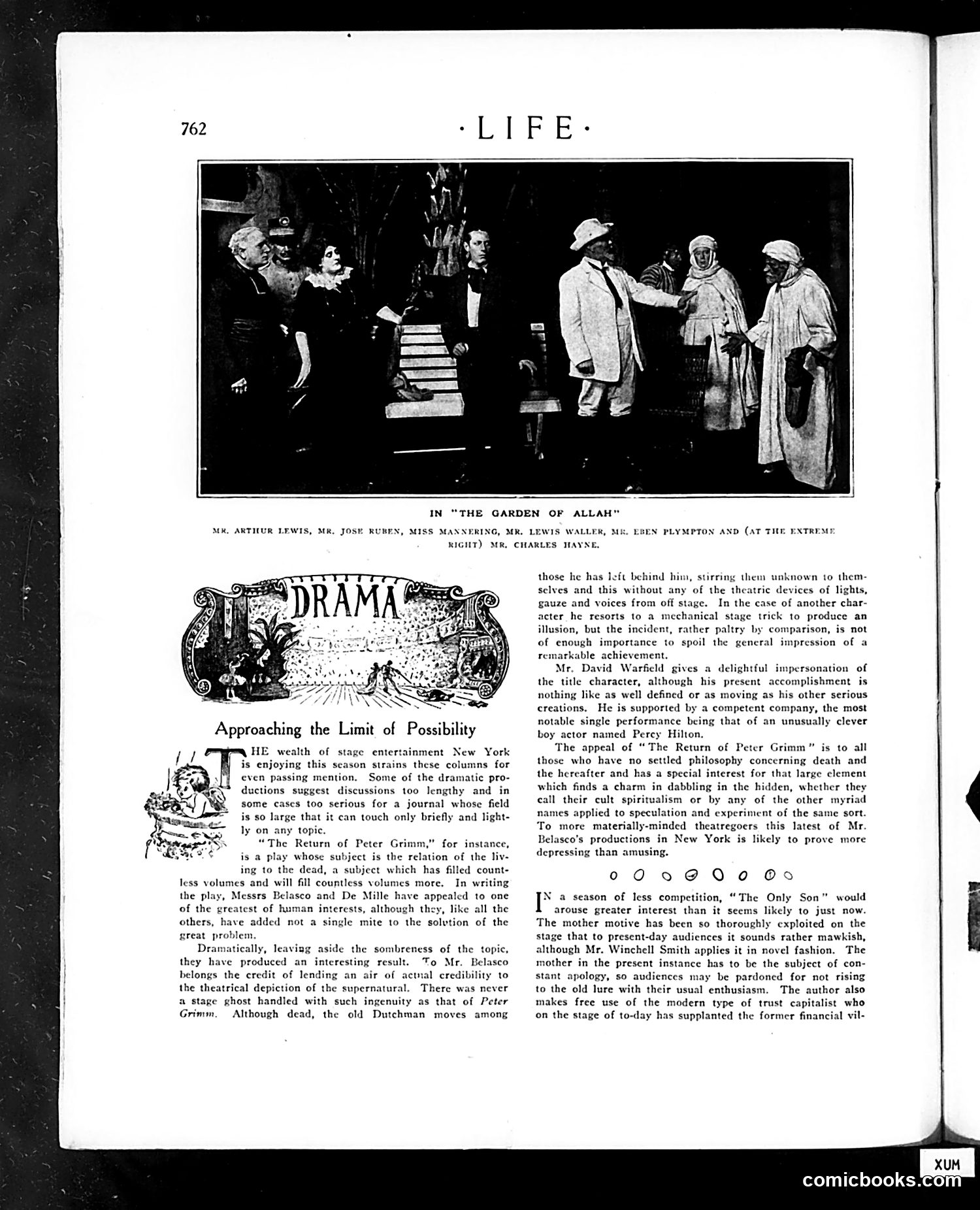
This page reviews two theatrical productions on Broadway. The photograph shows a scene from "The Garden of Allah," featuring actors including Arthur Lewis, Josh Rumen, Lewis Waller, and others in period costume. The main text discusses "The Return of Peter Grimm," a play by Belasco and De Mille about communication between the living and dead—appealing to spiritualist interests popular in the early 20th century. The reviewer credits Belasco with skillfully depicting the supernatural without theatrical tricks, and praises David Warfield's performance as the ghost. A secondary review critiques "The Only Son," noting its tired "mother motive" plot has been overused on stage. The reviewer suggests audiences find it sentimental rather than moving, and objects to the stock villain of modern capitalism. The satirical tone is gentle—the magazine pokes fun at theatrical trends and audience taste rather than political figures.
📄 Transcribed text from this page (OCR, searchable)
Machine-transcribed from the original scan — historical spelling and the odd misread are preserved.
IN “THE GARDEN OF ALLAH" MX. ARTITUR LEWIS, MR, JOSH RUMEN, MISS MANNERING, MR. LEWIS WALLER, Mi. EGEN PLYMPTON AND (AT Tit EXTREM RIGHT) MR. entertainment New York is enjoying this scason strains these columns for even passing mention. Some of the dramatic pro- ductions suggest discussions too lengthy and in some cases too serious for a journal whose field is so large that it can touch only briefly and light- ly on any topic. “The Return of Peter Grimm," for instance, is a play whose subject is the relation of the li ing to the dead, a subject which has filled count- less volumes and will fill countless volumes more. In writing the play, Messrs Belasco and De Mille have appealed to one of the greatest of human interests, although they, like all the others, have added not a single mite to the solvtion of the great problem, Dramatically, leaving aside the sombreness of the topic, they have produced an interesting result. To Mr. Belasco belongs the credit of lending an air of actnal credibility to the theatrical depiction of the supernatural. There was never a stage ghost handled with such ingenuity as that of Peter Grimm, Although dead, the old Dutchman moves among CHARLES HAYNE, those he has left behind him, stirring them unknown to them- selves and this without any of the theatric devices of lights, gauze and voices from off stage. In the case of another char- acter he resorts to a mechanical stage trick to produce an illusion, but the incident, rather paltry by comparison, is not of enough importance to spoil the gencral impression of a remarkable achievement. Mr. David Warficld gives a delightful impersonation of the title character, although his present accomplishment is nothing like as well defined or as moving as his other serious creations. He is supported by a competent company, the most notable single performance being that of an unusually clever boy actor named Percy Hilton. The appeal of “The Return of Peter Grimm” is to all those who have no settled philosophy concerning death and the hereafter and has a special interest for that large clement which finds a charm in dabbling in the hidden, whether they call their cult spiritualism or by any of the other myriad names applied to speculation and experiment of the same sort. To more materially-minded theatregoers this latest of Mr. Belasco’s productions in New York is likely to prove more depressing than amusing. 0009000 06 I a season of less competition, “The Only Son” would arouse greater interest than it seems likely to just now. The mother motive has been so thoroughly exploited on the stage that to present-day audiences it sounds rather mawkish, although Mr. Winchell Smith applies it in novel fashion. The mother in the present instance has to be the subject of con- stant apology, so audiences may be pardoned for not rising to the old lure with their usual enthusiasm. The author also makes free use of the modern type of trust capitalist who on the stage of to-day has supplanted the former financial vil- comicbooks co