
Life, 1911-11-02 · page 21 of 56
Life — November 2, 1911 — page 21: what you’re looking at
What you’re looking at
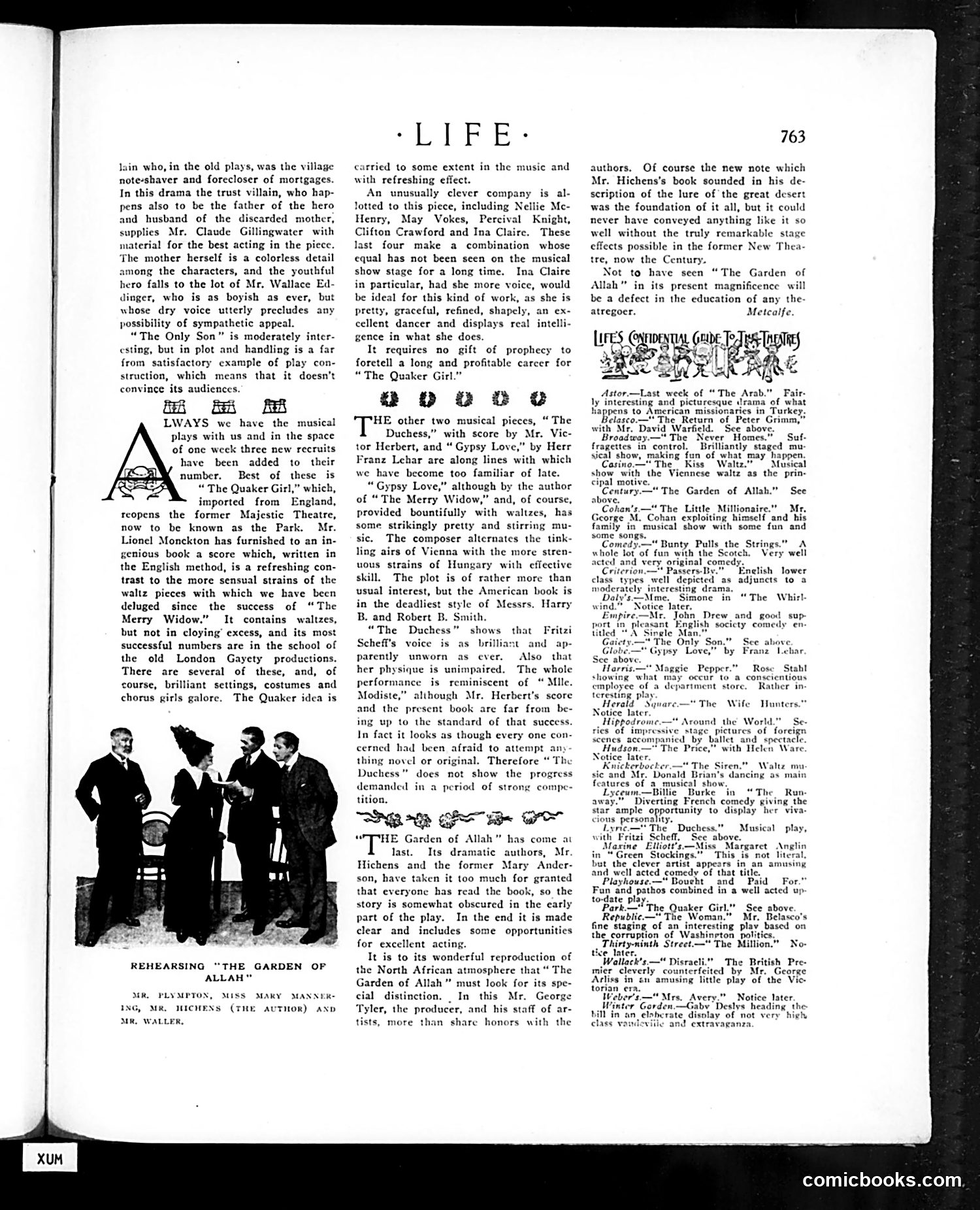
This page reviews three Broadway musical productions. The photograph shows cast members rehearsing "The Garden of Allah," a dramatic adaptation of a popular novel by Mr. Hichens and former actress Mary Anderson. The text praises "The Quaker Girl" (imported from England) as the best of the three shows, particularly commending the ensemble cast including Ina Claire, whom the critic calls "pretty, graceful, refined" and an "excellent dancer," though noting her voice could be stronger. The other two productions—Victor Herbert's "The Duchess" and Franz Lehár's "Gypsy Love"—receive mixed reviews. The critic finds them derivative and criticizes their American-written plots as uninspired and overly familiar, suggesting the creative team "had been afraid to attempt anything novel or original." The reviews reflect early 20th-century Broadway's heavy reliance on European operetta imports and star performers.
📄 Transcribed text from this page (OCR, searchable)
Machine-transcribed from the original scan — historical spelling and the odd misread are preserved.
lain who, in the old plays, was the village noteshaver and forecloser of mortgages. In this drama the trust villain, who hap- pens also to be the father of the hero and husband of the discarded mother, supplies Mr. Claude Gillingwater with material for the best acting in the piece. The mother herself is a colorless detail among the characters, and the youthful hero falls to the lot of Mr, Wallace Ed- dinger, who is as boyish as ever, but whose dry voice utterly precludes any possibility of sympathetic appeal. “The Only Son” is moderately inter- esting, but in plot and handling is a far from satisfactory example of play con- struction, which means that it doesn’t convince its audiences. i i RA LWAYS we have the musical plays with us and in the space of one week three new recruits have been added to their number. Best of these is “ The Quaker Girl,” which, imported from England, reopens the former Majestic Theatre, now to be known as the Park. Mr. Lionel Monckton has furnished to an in- genious book a score which, written in the English method, is a refreshing con- trast to the more sensual strains of the waltz pieces with which we have been deluged since the success of “The Merry Widow.” It contains waltzes, but not in cloying’ excess, and its most successful numbers are in the school of the old London Gayety productions. There are several of these, and, of course, brilliant settings, costumes and chorus girls galore. The Quaker idea is REHEARSING “THE GARDEN OF ALLAH” MR. PLYMPTON, ING, MR, MICHENS (7H MR, WALLER, MISS MAKY MANNER AUTHOR) AND ‘LIFE: carried to some extent in the music and with refreshing effect. An unusually clever company is al- lotted to this piece, including Nellie Mc- Henry, May Vokes, Percival Knight, Clifton Crawford and Ina Claire. These last four make a combination whose equal has not been seen on the musical show stage for a long time. Ina Claire in particular, had she more voice, would be ideal for this kind of work, she is pretty, graceful, refined, shapely, an ex- cellent dancer and displays real intelli- gence in what she does. It requires no gift of prophecy to foretell a long and profitable carcer for “The Quaker Girl.” @ Oo 2 BB HE other two musical pieces, “ The Duchess,” with score by Mr. Vic- tor Herbert, and “ Gypsy Love,” by Herr Franz Lehar are along lines with which we have become too familiar of late. “ Gypsy Love,” although by the author of “The Merry Widow,” and, of course, provided bountifully with waltzes, has some strikingly pretty and stirring mu- sic. The composer alternates the tink- ling airs of Vicnna with the more stren- uous strains of Hungary with effective skill. The plot is of rather more than usual interest, but the American book is in the deadliest style of Messrs, Harry B. and Robert B. Smith. “The Duchess” shows Schefi’s voice is as parently unworn as ever. Also. that her physique is unimpaired. The whole performance is reminiscent of “ Mlle. Modiste,” although Mr. Herbert's score and the present book are far from be- ing up to the standard of that success. In fact it looks as though every one con- cerned had been afraid to attempt any thing novel or original. Therefore “T Duchess" does not show the progres demanded in a period of strong compe- tition. ‘“"TCHE Garden of Allah” has come at last. Its dramatic authors, Mr Hichens and the former Mary Ander- son, have taken it too much for granted that everyone has read the book, so the story is somewhat obscured in the early part of the play. In the end it is made clear and includes some opportunities for excellent acting. It is to its wonderful reproduction of the North African atmosphere that “ The Garden of Allah” must look for its spe- cial distinction. In this Mr. George Tyler, the producer, and his staff of ar- tists, more than share honors with the that Fritzi brilliant and ap- 763 authors. Of course the new note which Mr. Hichens’s book sounded in his de- scription of the lure of the great desert was the foundation of it all, but it could never have conveyed anything like it so well without the truly remarkable stage effects possible in the former New T tre, now the Century. Not to have seen “The Garden of Allah” in its present magnificence will be a defect in the education of any the- atregoer, Metcalfe. [UES € Oey, Gude: Te Astor.—Last week of “The Arab.” | Fair. ly interesting and picturesque drama of what happens to American missionaries in Turkey. Beiagco-—" The Return of Peter Grimm,” with Mr. id Warfield. See above. Broadivay.—" The Never Homes.” | Suf- fragettes in control. Brilliantly staged mu- sical show, making fun of what may happen. Casino. The Kiss Waltz.” — Musical show with the Viennese waltz as the prin- cipal motive. The Garden of Allah.” Sce Century above. Colan’s.—“ The Little Millionaire.” Mr. George M. Cohan exploiting himself ‘and his family in musical show with some fun and some songs. Comedy.—" Bunty Pulls the Strings.” A whole lot of fun with the Scotch, Very well acted and very original comedy. Criterion.—" Passers-By." English lower class types well depicted as adjuncts to a moderately interesting drama, Daly's.—Mme, Simone in Notice later. Mr. John Drew and good sup- pleasant English society comedy en: le Man,” Gaicty.—* The Only Son.” See above Globe.—" Gypsy Love,” by Franz Lebar See above Harris.—" Maggie Pepper.” Rose Stahl showing what may occur to a conscientious cmployee of a department store. Rather in teresting play Herald Square—" The Wife Notice later Hippodrome.—" Around the World.” ries of impressive ‘stage pictures of foreig scenes accompanied by ballet and spectacle Hudson. ne Price,” with Helen Ware. “The Whirl- titled Hunters.” 3 later. Knickerbocker. —" The Siren.” Waltz m; sic and Mr. Donald B n's dancing as mai features of a musical show Lyceum.—Billie Burke in “ The away.” Diverting French comedy i Star ample opportunity to display cious personality. Lyrte-—" The Duchess.” Musical with Fritai Scheff, See above. Maxine Elliott’s—Miss Margaret .\nglin in “Green Stockings.” This is not literal, but the clever artist appears in an amusing and well acted comedy of that title. Playhouse.—" Bouht and Paid _ For.” Fun and pathos combined in a well acted up- to-date play. - Park.—" The Quaker Gi See above. Republic—" The Woman.” Mr, Belasco’s fine staging of an interesting plav based on the corruption of Washineton politics, Thirty-ninth Street.—" The Million.” No- the later. Wallack’s —" Disraeli.” The British Pre- mier cleverly counterfeited by Mr. George Arliss in cu amusing little play of the Vic- Run. ing the + viva. play, Mrs. Avery." Notice later. Gerden.—Gaby Deslys heading the clahcrate disolay of not very hig nd extravaganza. comicbooks.com