
Life, 1911-11-02 · page 34 of 56
Life — November 2, 1911 — page 34: what you’re looking at
What you’re looking at
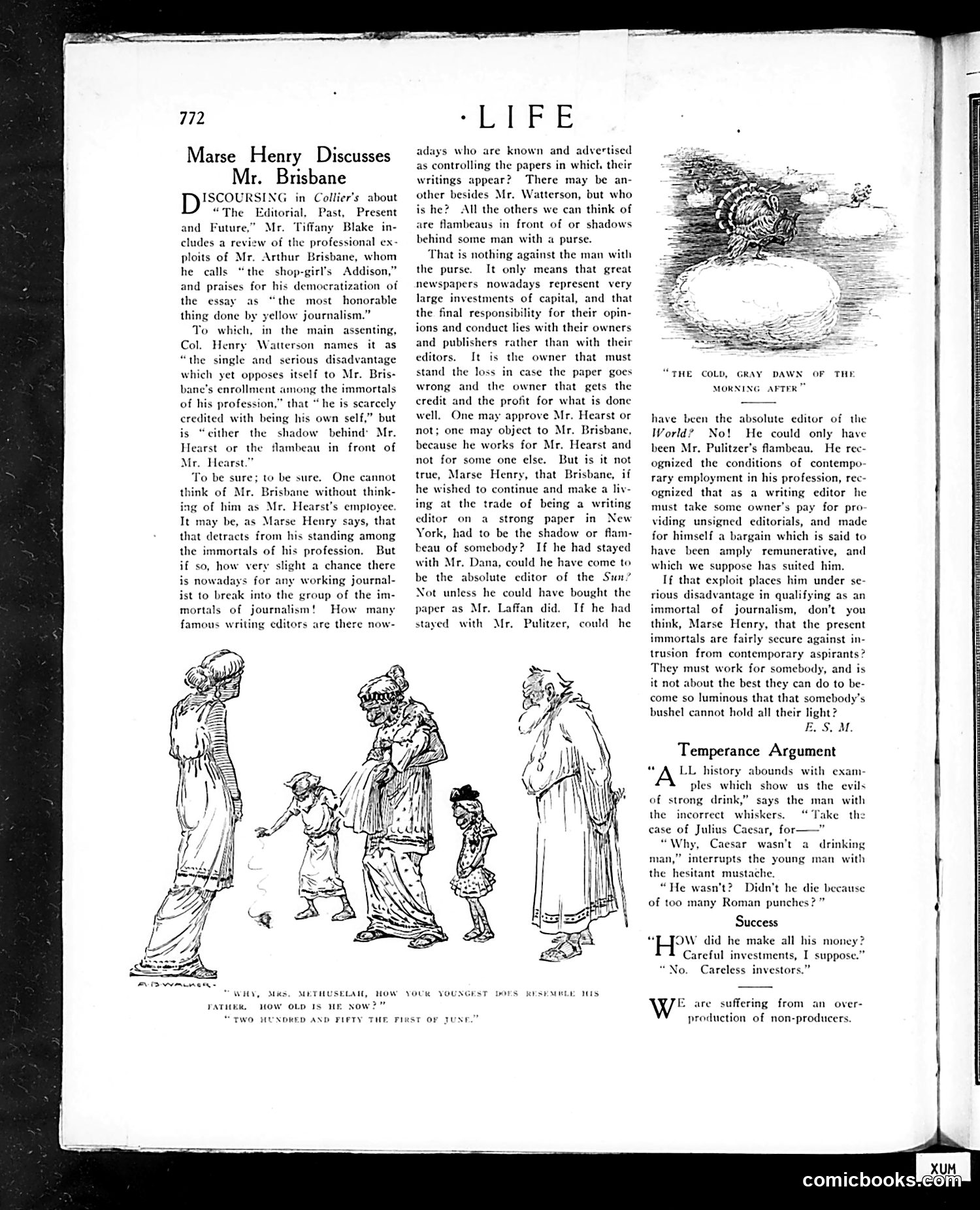
This page features a debate about **Arthur Brisbane**, a prominent newspaper editor working for William Randolph Hearst's publishing empire. **The Main Essay** discusses whether Brisbane deserves recognition among journalism's "immortals" despite being employed by Hearst rather than running his own publication. The argument defends Brisbane: modern newspapers require massive capital investment, so even talented editors necessarily work *for* owners. Brisbane accepted this reality, negotiated good terms, and succeeded within those constraints—hardly a shameful compromise. **The Cartoon** (bottom left) depicts a woman asking an elderly man about his youngest son's resemblance to someone, likely a humorous domestic scene unrelated to the main text. **Other Brief Items** include a joke about Julius Caesar and drinking (playing on "Roman punches"), and a quip about financial success through "careless investors." The page reflects early-20th-century debates about editorial independence versus corporate ownership—issues still relevant today.
📄 Transcribed text from this page (OCR, searchable)
Machine-transcribed from the original scan — historical spelling and the odd misread are preserved.
Marse Henry Discusses Mr. Brisbane ISCOURSING in Collier's about ditorial, Past, Present and Future,” Mr. Tiffany Blake in- cludes a review of the professional ex- ploits of Mr. Arthur Brisbane, whom he calls “the shop-girl’s Addison,” and praises for his democratization of the essay as “the most honorable thing done by yellow journalism.” To which, in the main assenting, Col. Henry Watterson names it as “the single and serious disadvantage which yet opposes itself to Mr. Bris- bane’s enrollment among the immortals of his profession,” that “he is scarcely credited with being his own self,” but is ither the shadow behind’ Mr. Hearst or the flambeau in front of Mr. Hearst.” To be sure; to be sure. One cannot think of Mr. Brisbane without think- ing of him as Mr. Hearst’s employee. It may be, as Marse Henry says, that that detracts from his standing among the immortals of his profession, But if so, how very slight a chance there is nowadays for any working journal- ist to break into the group of the im- mortals of journalism! How many famous writing editors are there now- AI WARE Mow “wit, PATIO. Mas, METHUSELAI, HOW OLD IS WE NOW adays who are known and advertised as controlling the papers in which their writings appear? There may be an- other besides Mr. Watterson, but who is he? All the others we can think of are flambeaus in front of or shadows behind some man with a purse. That is nothing against the man with the purse. It only means that great newspapers nowadays represent very large investments of capital, and that the final responsibility for their opin- ions and conduct lies with their owners and publishers rather than with their editors. It is the owner that must stand the loss in case the paper goes wrong and the owner that gets the credit and the profit for what is done well, One may approve Mr. Hearst or not; one may object to Mr. Brisbane, because he works for Mr. Hearst and not for some one else. But is it not true, Marse Henry, that Brisbane, if he wished to continue and make a liv- ing at the trade of being a writing editor on a strong paper in New York, had to be the shadow or flam- beau of somebody? If he had stayed with Mr, Dana, could he have come to be the absolute editor of the Sun’ Not unless he could have bought the paper as Mr. Laffan did. If he had stayed with Mr. Pulitzer, could he YOUR YOUNGEST DOFS RESEMELE 1S “THE COLD, GRAY DAWN OF MORNING AFTER” have been the absolute editor of the World? No! He could only have been Mr. Pulitzer’s flambeau, He rec- ognized the conditions of contempo- rary employment in his profession, rec- ognized that as a writing editor he must take some owner's pay for pro- viding unsigned editorials, and made for himself a bargain which is said to have been amply remunerative, and which we suppose has suited him. If that exploit places him under se- rious disadvantage in qualifying as an immortal of journalism, don’t you think, Marse Henry, that the present immortals are fairly secure against in- trusion from contemporary aspirants? They must work for somebody, and is it not about the best they can do to be- come so luminous that that somebody's bushel cannot hold all their light? M. Temperance Argument LL history abounds with ples which show us the of strong drink,” says the man with the incorrect whisk “Take the of Julius Caesar, for—” Why, Caesar wasn't drinking man,” interrupts the young man with the hesitant mustache. “He wasn't? Didn't he die be of too many Roman punches?” Success “LOW did he make all his mone Careful investments, I suppose.” “No. Careless investor: are suffering from an over- Ww production of non-producers. 0 HUNDRED AND FLETY THE FIRST OF JUNE.” comicbooksMemd