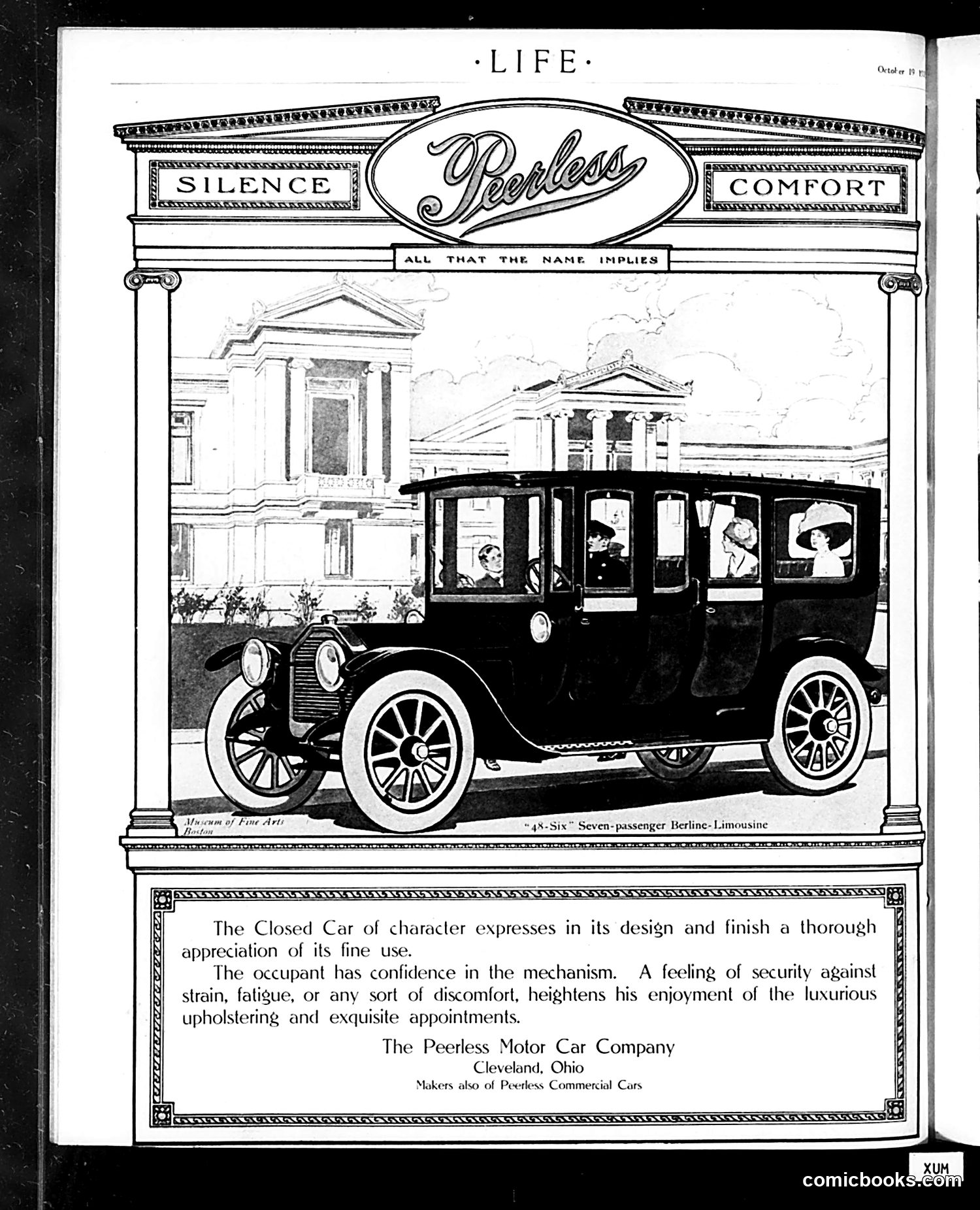
A complete issue · 48 pages · 1911
Life — October 19, 1911
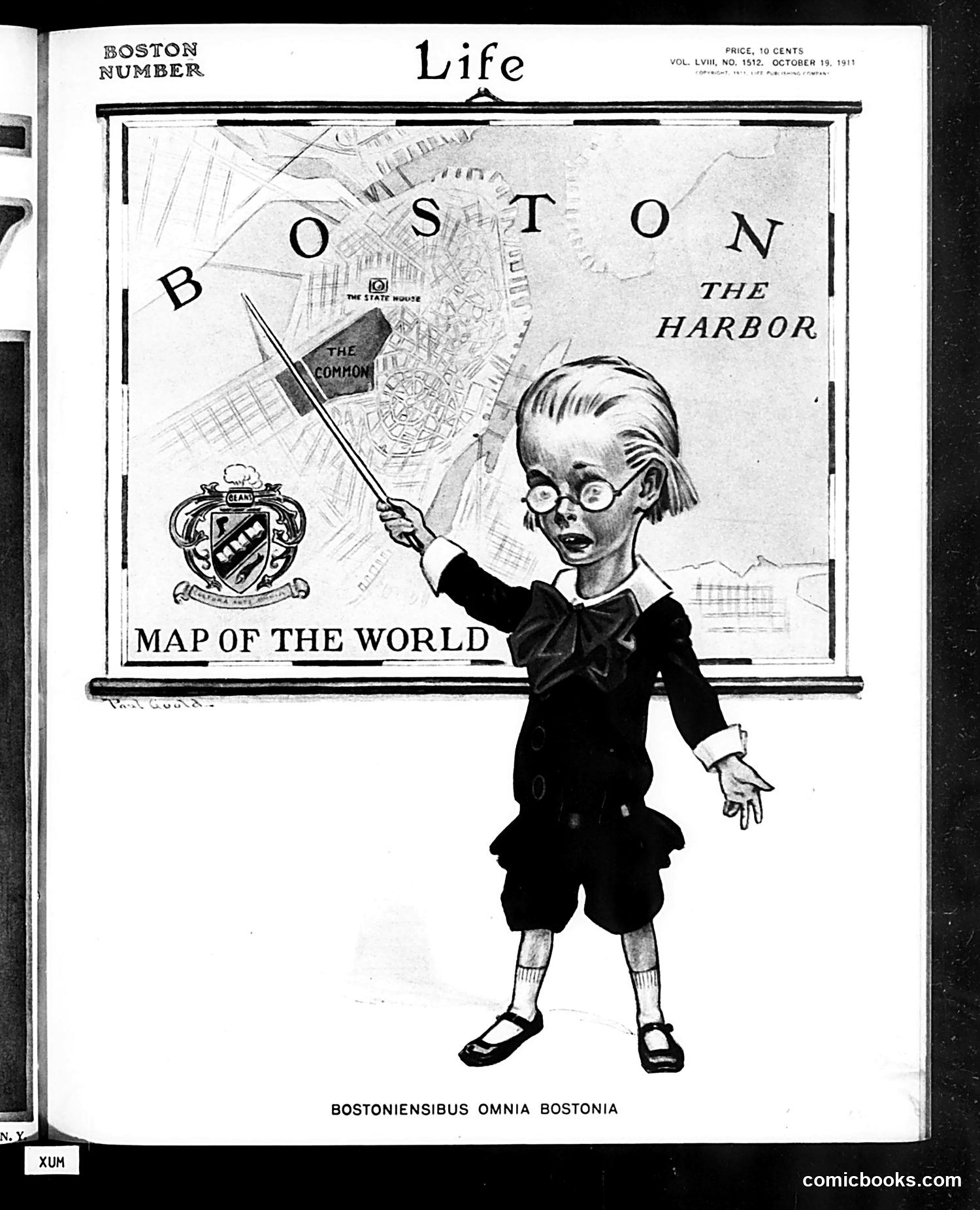
This is the cover of Life magazine's Boston Number from October 19, 1911. It depicts a young schoolboy pointing at a wall map with a pointer stick, showing Boston Harbor and "The Common" (Boston's central public park). The boy wears glasses and formal attire typical of the era. The satire appears to be gentle civic pride humor: the Latin motto "BOSTONIENSBIUS OMNIA BOSTON" (roughly "Boston is everything to Bostonians") suggests the cartoon mocks Bostonians' provincial self-importance and tendency to see their city as the center of the world. The "Map of the World" label is ironic—the map shows only Boston, implying locals are so parochial they view their hometown as globally significant. This plays on Boston's historical intellectual prominence and residents' reputation for civic boosterism.
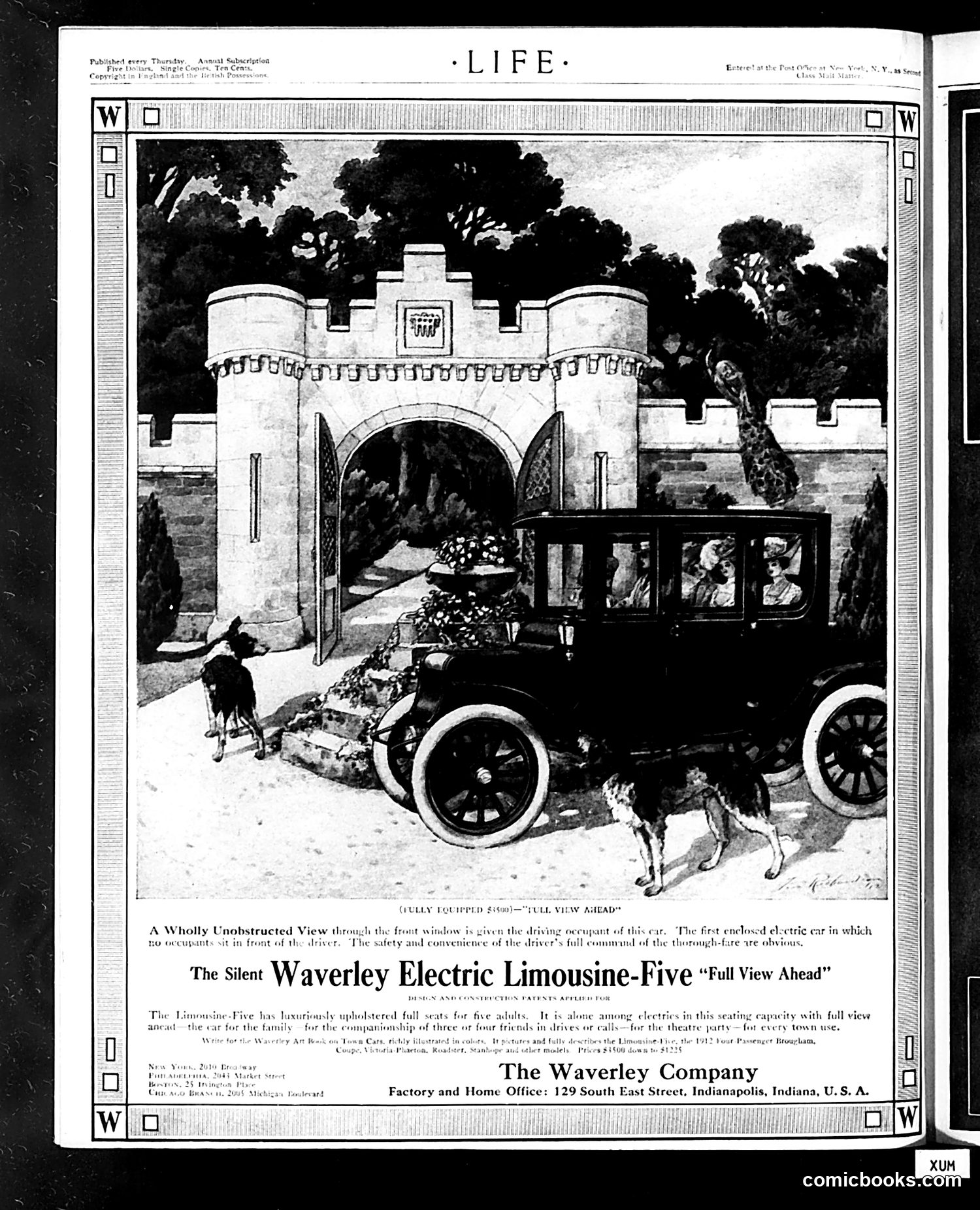
This page is primarily **advertising**, not satire or political commentary. It features a full-page ad for the Waverley Electric Limousine-Five automobile, manufactured by The Waverley Company of Indianapolis, Indiana. The advertisement emphasizes the car's "full view ahead" feature—showing a drawing of the vehicle with passengers visible through windows, approaching a castle-like gate. Two dogs are depicted in the foreground. The marketing copy highlights that this enclosed electric car offers "a wholly unobstructed view through the front window," emphasizing safety and the driver's full command of the road. This represents early automotive advertising aimed at wealthy buyers, showcasing electric vehicles (which were popular luxury items before gasoline engines dominated). The castle imagery suggests elegance and status.
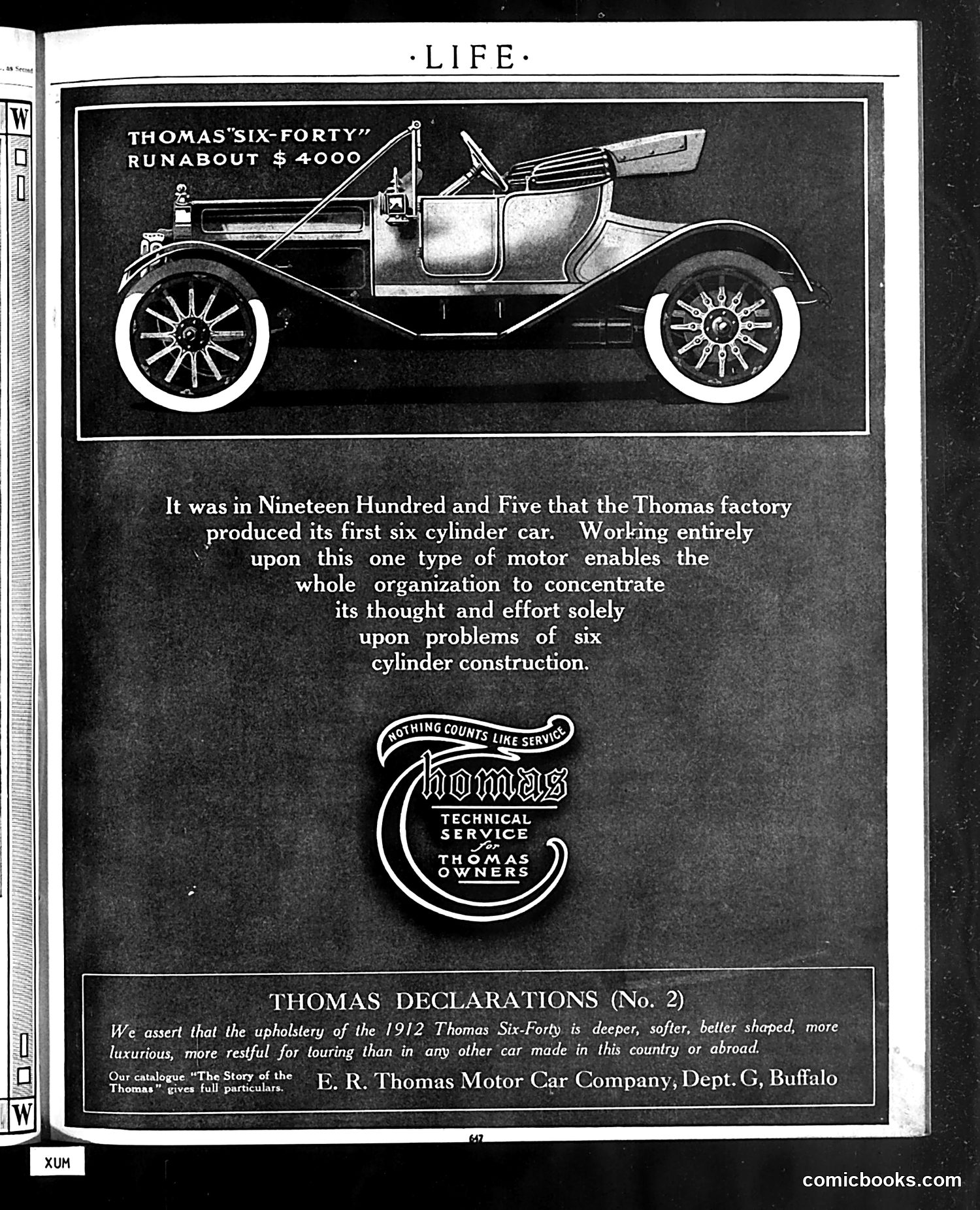
This is **not a cartoon or satire page** — it's a straightforward advertisement for the Thomas Motor Car Company, appearing in Life magazine. The page showcases the Thomas "Six-Forty" runabout, priced at $4,000 (substantial in 1905), featuring a side-view technical illustration of an early automobile with spoke wheels and open-air seating. The text emphasizes that Thomas's decision to manufacture exclusively six-cylinder engines allows concentrated expertise in that technology. The "Thomas Declarations" claim superiority in comfort and luxury for touring compared to competitors. The tagline "Nothing Counts Like Service" and the technical service promise reflect early automotive-era concerns: cars were unreliable, and dealer support was a genuine selling point differentiating manufacturers. This represents standard early-1900s automotive advertising, not satire.
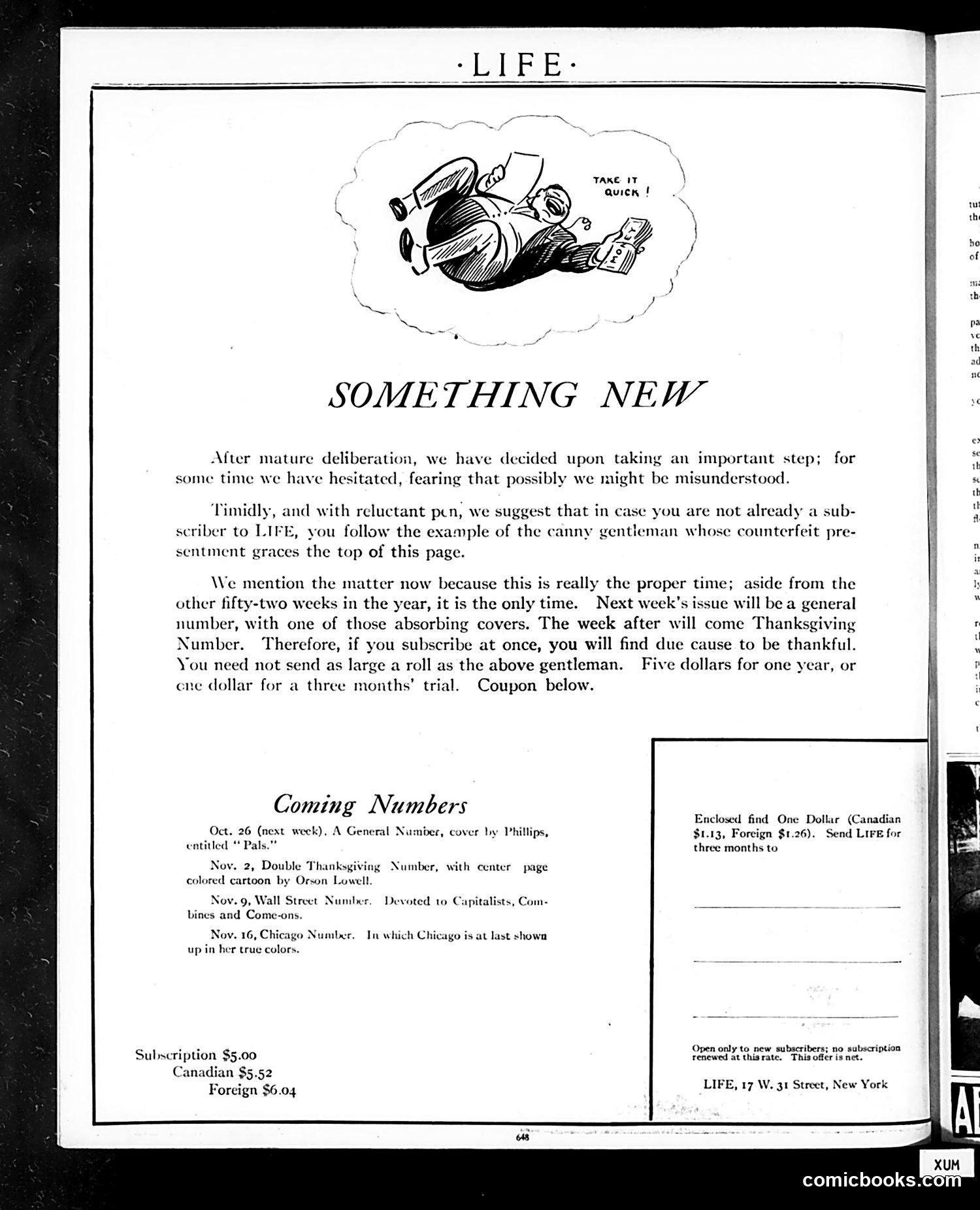
This is primarily a **subscription solicitation page**, not political satire. The main illustration shows a rotund gentleman in a cloud, appearing to fall or tumble while saying "TAKE IT QUICK!" — he holds papers labeled as a "counterfeit presentment," likely referring to currency or financial documents. The joke appeals to readers by suggesting subscription is urgent and worthwhile. The "canny gentleman" reference indicates this imagery invokes a recognizable figure, though his specific identity is unclear from the image alone. The page emphasizes timing: next week offers a "general number" with an absorbing cover, followed by a Thanksgiving issue — creating urgency for subscriptions. Pricing is listed ($5.00 annually; $1 for three-month trial), making this essentially a humorous advertisement encouraging immediate subscription action.
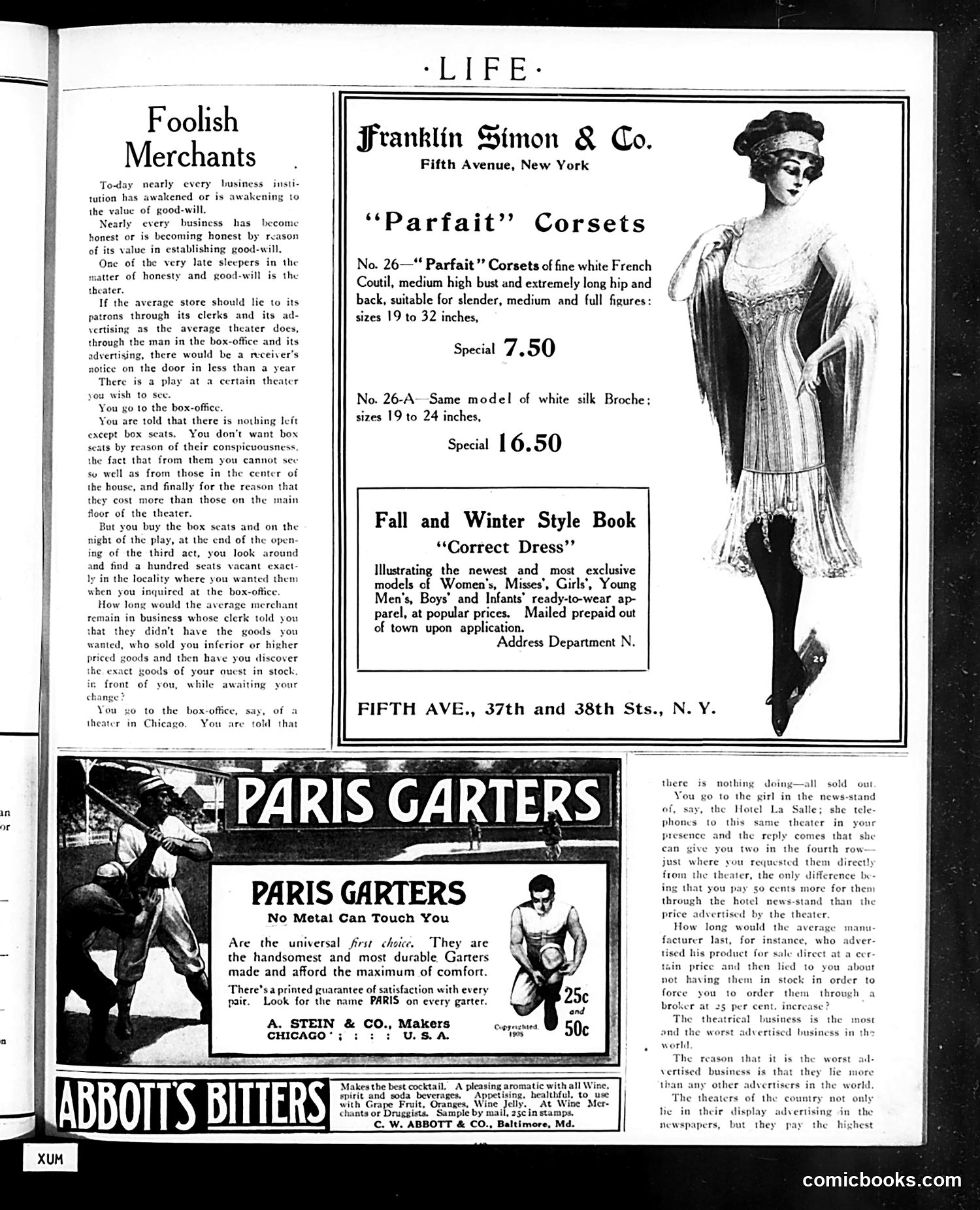
This page is primarily **advertising rather than satire**. It contains three ads: 1. **Franklin Simon & Co.** promotes "Parfait" corsets with a fashionable illustration of a woman in early 20th-century dress, priced at $7.50-$16.50. 2. **Paris Garters** advertises men's garters as "universal first choice," manufactured by A. Stein & Co. of Chicago, priced 25¢ and 50¢. 3. **Abbott's Bitters** promotes a cocktail mixer. The left column contains an editorial piece titled "Foolish Merchants" critiquing poor business practices in theaters—specifically how box-office staff treat customers seeking tickets. It's social commentary rather than political satire, addressing consumer service complaints common to the era.
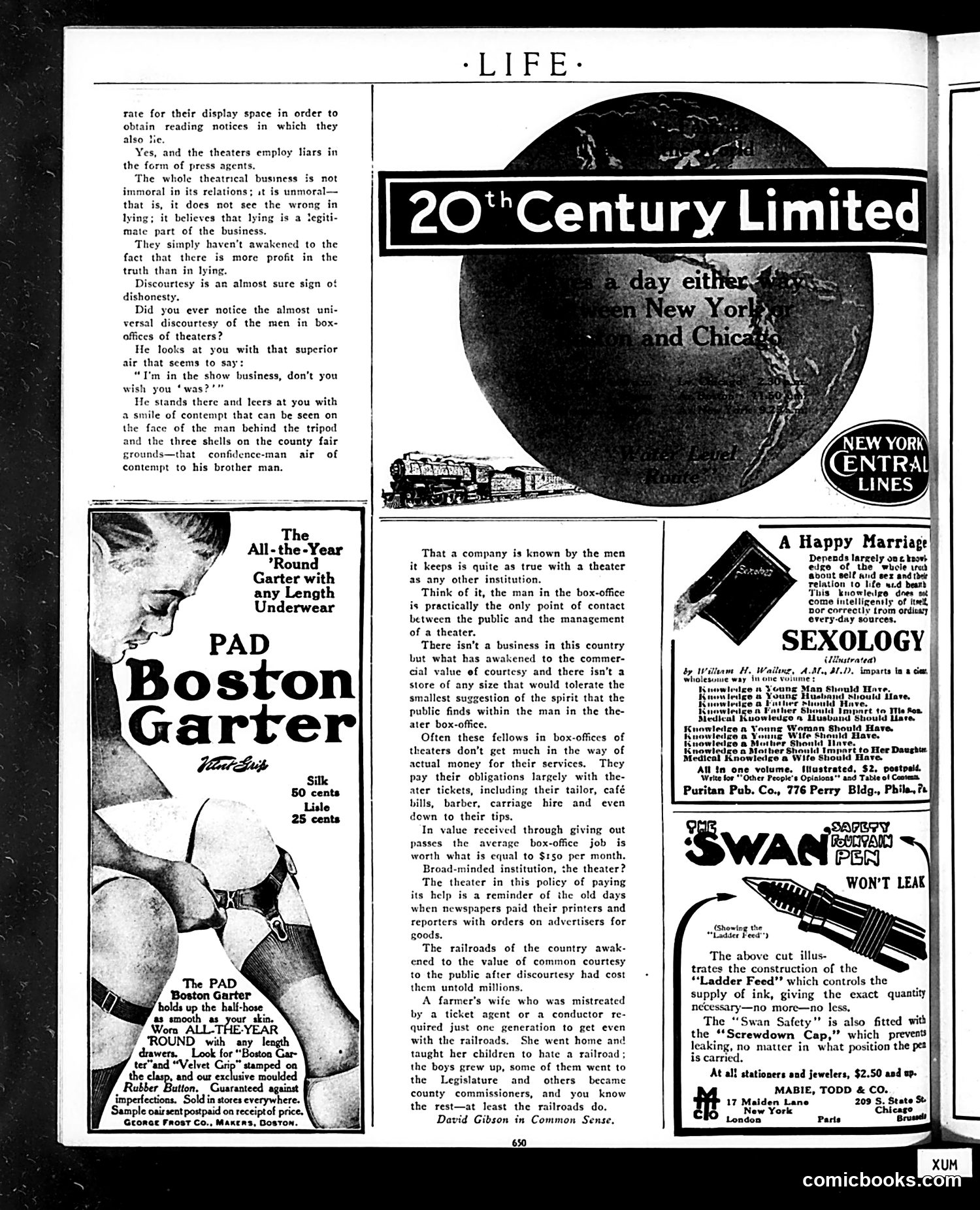
This page is primarily **advertising and editorial content** from an early 20th-century *Life* magazine, not political satire. The main items are: 1. **PAD Boston Garter** advertisement (left): A men's undergarment ad emphasizing comfort and durability with a photograph. 2. **20th Century Limited train advertisement** (top right): Promotes the New York Central Lines' luxury passenger service between New York and Chicago. 3. **"A Happy Marriage" / Sexology book advertisement** (right): Promotes a relationship/sex advice manual. 4. **"The Swag" illustration** (bottom right): Appears to be a technical diagram about ink distribution mechanisms. The article text discusses theater box-office practices and courtesy in business. There is **no political cartoon or satire evident** on this page—it's a typical magazine layout mixing editorial content with commercial advertising.
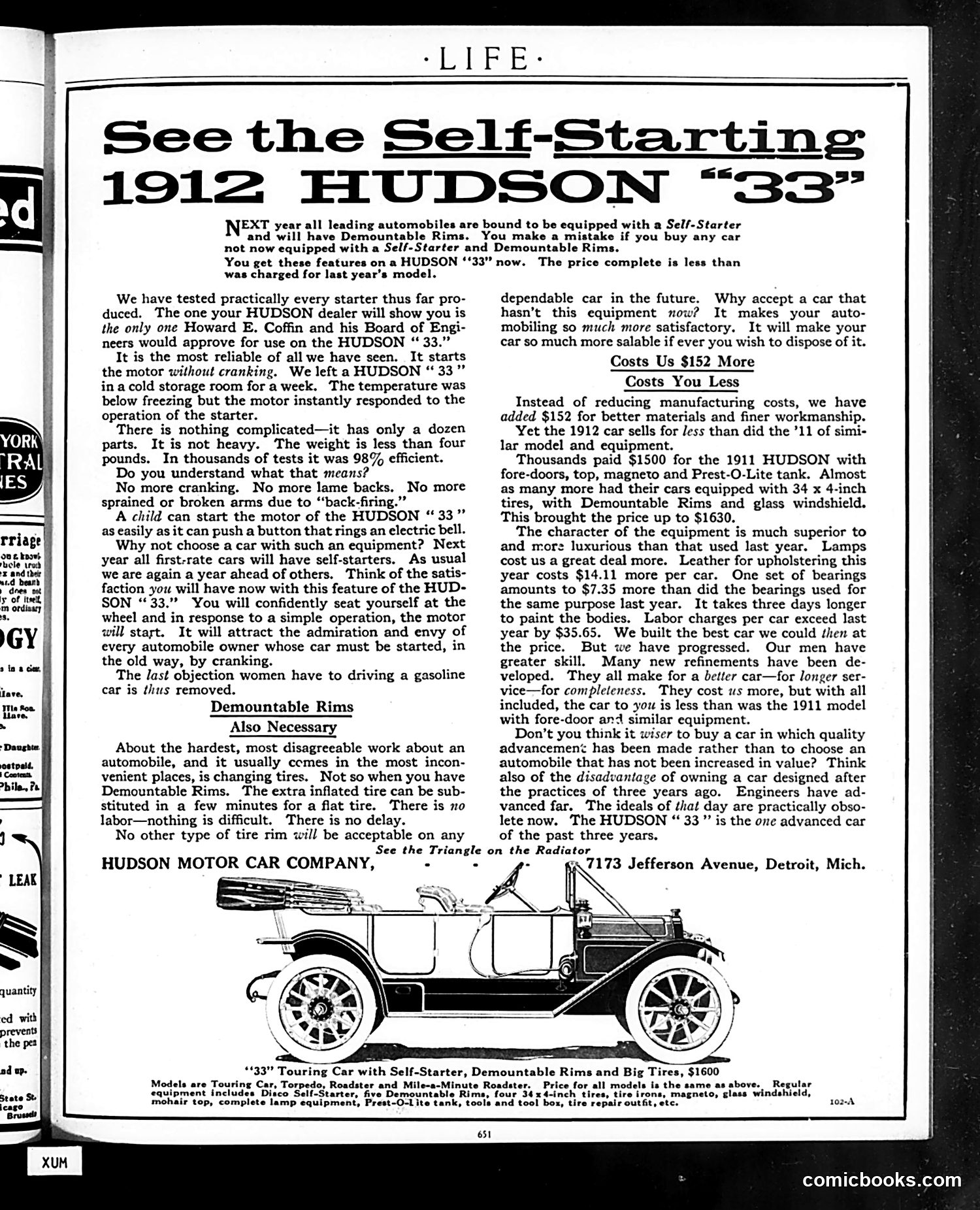
This is **not a political cartoon or satire page** — it's a straightforward advertisement for the 1912 Hudson "33" automobile, published in *Life* magazine. The page promotes the car's new self-starting motor (eliminating hand-crank starting), demountable rims, and other features as major innovations. The text emphasizes reliability, with claims that the starter works even in freezing conditions and that "last job women have to driving a gasoline car is thus removed." The lone illustration shows a side-view diagram of the touring car with these features labeled. This reflects genuine automotive progress in 1912 — the self-starter was indeed a significant safety and convenience innovation, particularly for female drivers who found hand-cranking difficult. The ad is purely commercial marketing, not satirical commentary.
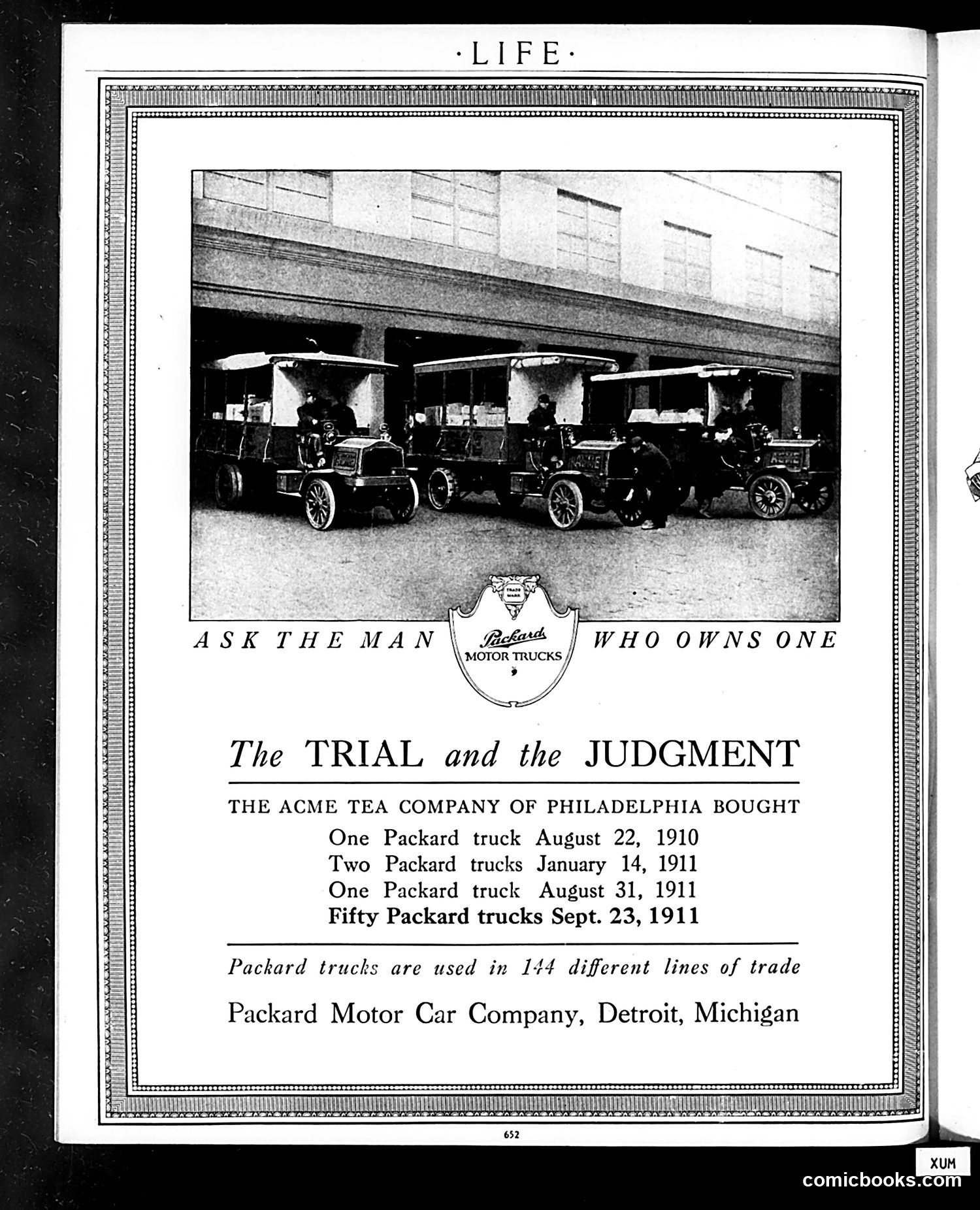
This is primarily a **product advertisement** rather than political satire. It promotes Packard Motor Trucks through testimonial evidence. The page shows five identical commercial trucks parked in a row under a covered structure. The headline "Ask the Man Who Owns One" frames trucks as proven, reliable vehicles worthy of trust. The advertisement emphasizes that the Acme Tea Company of Philadelphia—a substantial business—purchased multiple Packard trucks across 1910-1911, demonstrating their practical value in commercial operations. The closing statement that "Packard trucks are used in 144 different lines of trade" functions as social proof, suggesting widespread adoption across diverse industries validated the product's quality. This represents early automotive advertising strategy: using real customer testimonials and adoption statistics rather than claims alone.
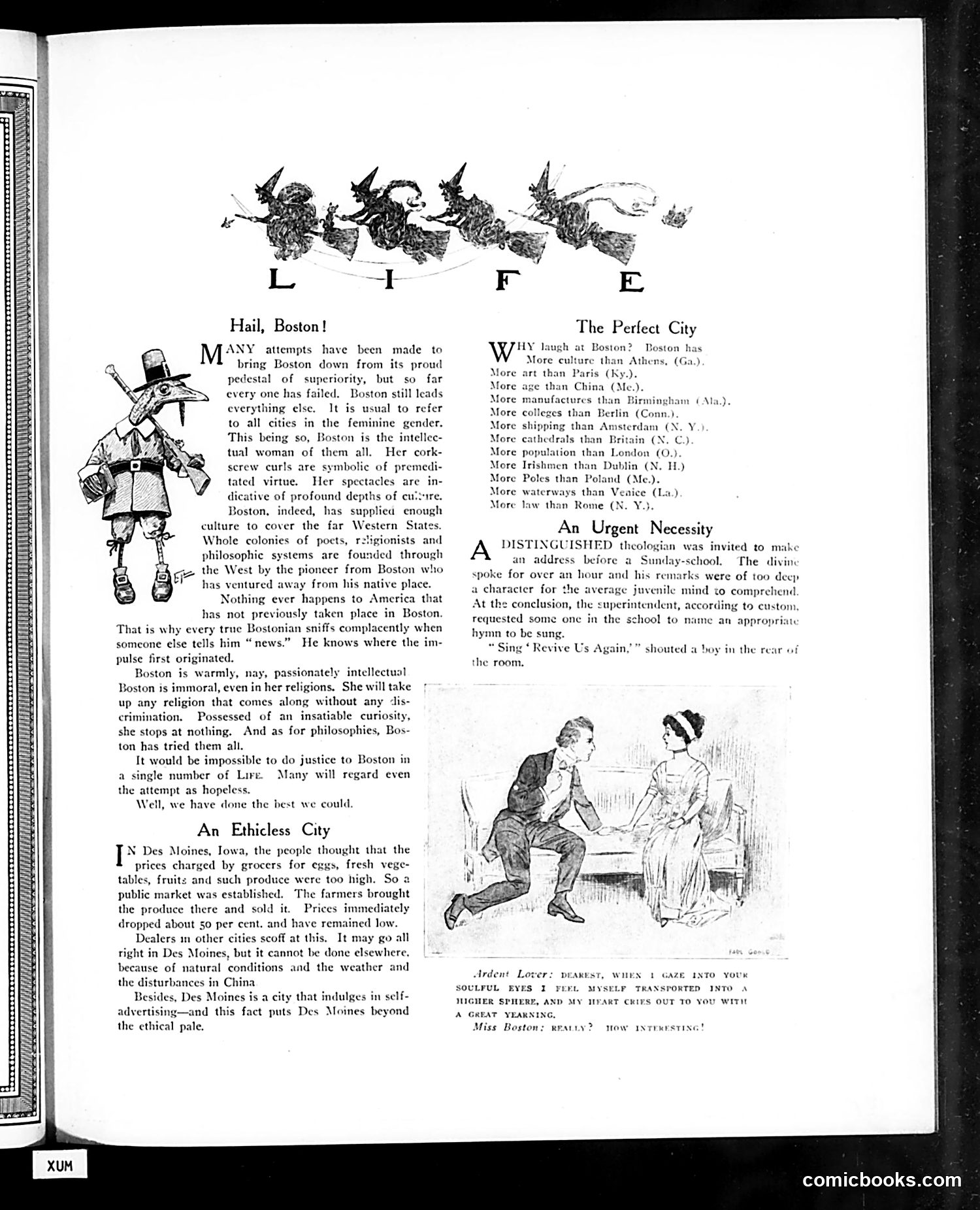
This page satirizes American cities through exaggerated comparison. The "Hail, Boston!" section mocks Boston's intellectual pretensions, portraying it as arrogantly superior while claiming to represent culture for the entire nation. The illustration shows a caricatured Boston woman in stereotypical dress. "The Perfect City" lists statistics humorously suggesting Boston exceeds other major cities (Athens, Paris, China) in various metrics—a joke about provincial boasting. "An Ethicless City" critiques Des Moines, Iowa for establishing a farmers' market that undercut local prices. The satire suggests Des Moines engages in unethical price-fixing while claiming economic virtue—hypocrisy the text explicitly labels beyond "the ethical pale." The page generally mocks American regional vanity and moral self-deception.
This *Life* magazine page discusses President William Howard Taft's potential re-election prospects. The text expresses skepticism about Taft's political viability, noting he's "been holding office a good while now" and faces Democratic opposition. The article credits Taft with accomplishments (tariff revisions, Sherman law enforcement) but suggests he cannot win re-election. It praises his character as "a live man" capable of making decisions. The cartoon at the bottom (skull and crossbones imagery) appears to represent the threat posed by keeping water in the Austin dam after it became unsafe—criticizing governmental negligence that endangered lives. The overall tone is cautiously supportive of Taft personally while politically pessimistic about his electoral future.
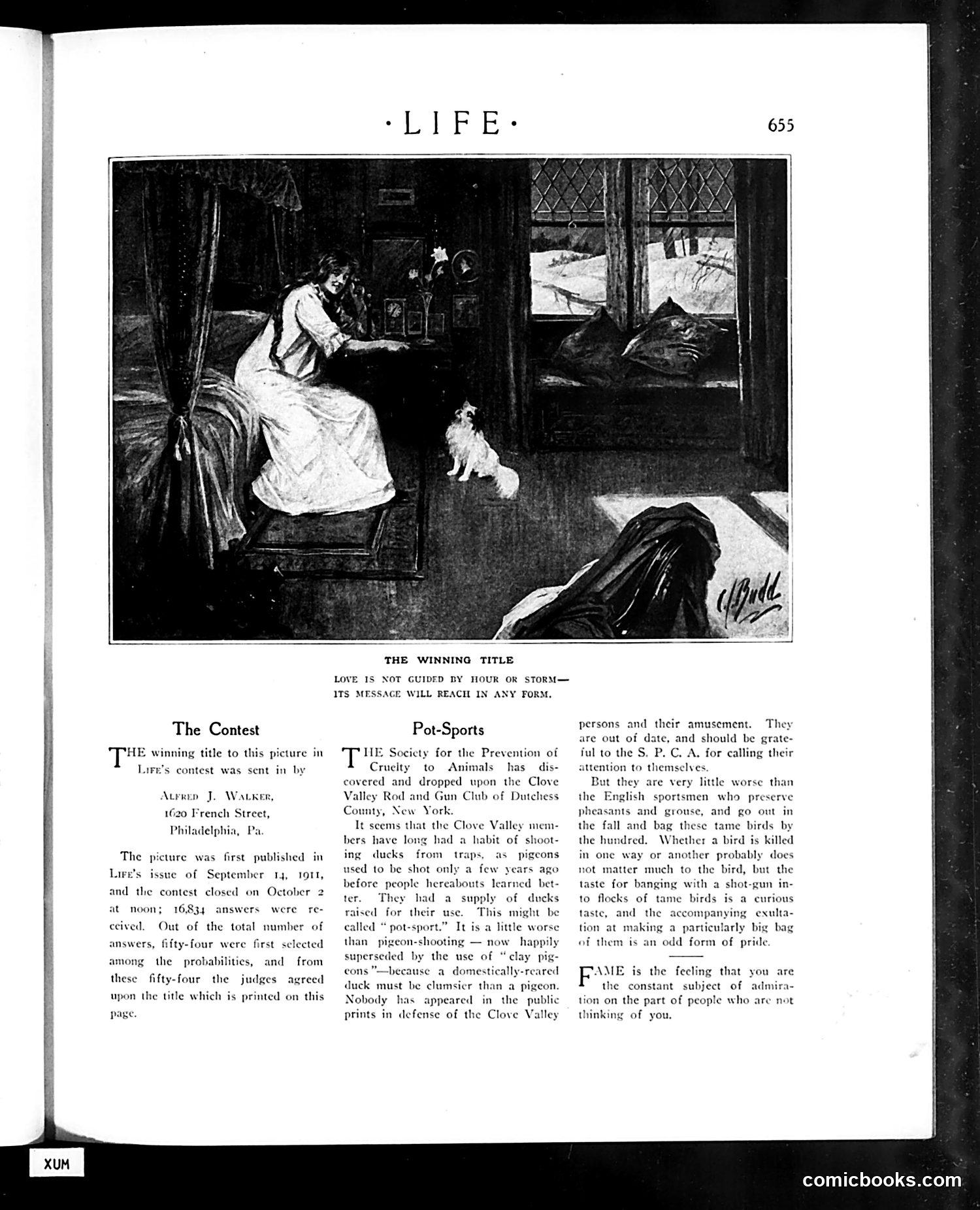
This page announces Life's picture contest, won by Alfred J. Walker of Philadelphia. The winning illustration shows a domestic interior scene with a woman at a desk, a small dog, and a figure on a bed—depicting the caption "Love is not guided by hour or storm—its message will reach in any form." The secondary article "Pot-Sports" critiques the Clove Valley Rod and Gun Club's practice of shooting captive ducks for sport—calling it worse than pigeon-shooting. The author argues such "pot-sport" hunting is unsporting and cruel, contrasting it with traditional field hunting. The piece sarcastically defends the club's members against public criticism while emphasizing that killing tame birds represents poor sportsmanship and questionable taste.
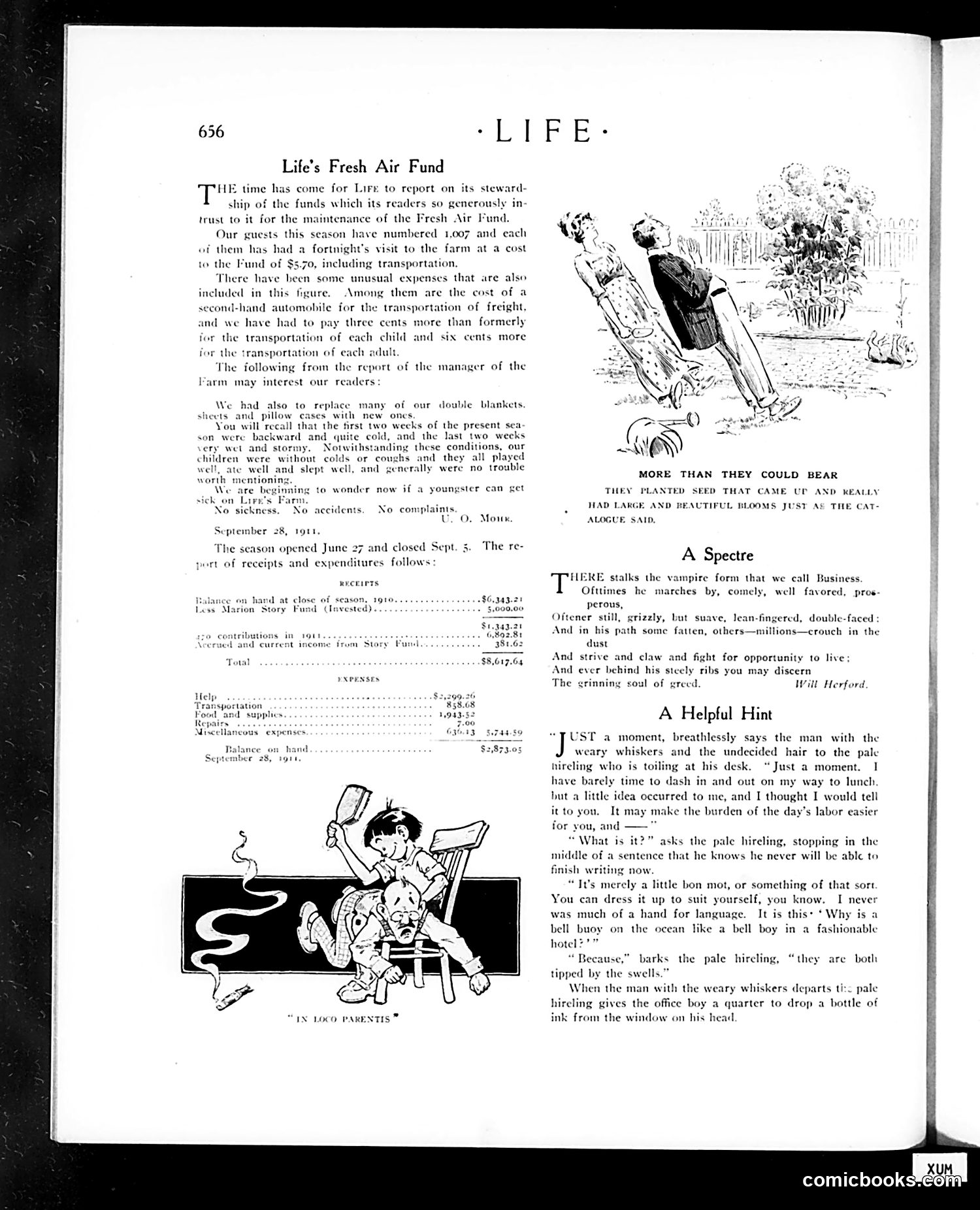
This page contains **two separate cartoon/literary pieces**, not a unified political cartoon: 1. **"Life's Fresh Air Fund"** (left): A report on charitable fundraising for a children's camp program, with financial accounting. The accompanying illustration shows children playing outdoors. 2. **"In Loco Parentis"** (bottom left): A humorous cartoon depicting what appears to be a bureaucratic or institutional figure managing children, satirizing institutional care or guardianship. 3. **"A Spectre," "A Helpful Hint"** (right): Two brief literary pieces—one poetic, one a comedic dialogue between office workers about workplace jargon and communication. The page mixes philanthropic reporting with light satirical humor about institutions and workplace absurdities. No clear political figures are caricatured; the satire targets social institutions and bureaucratic language generally.
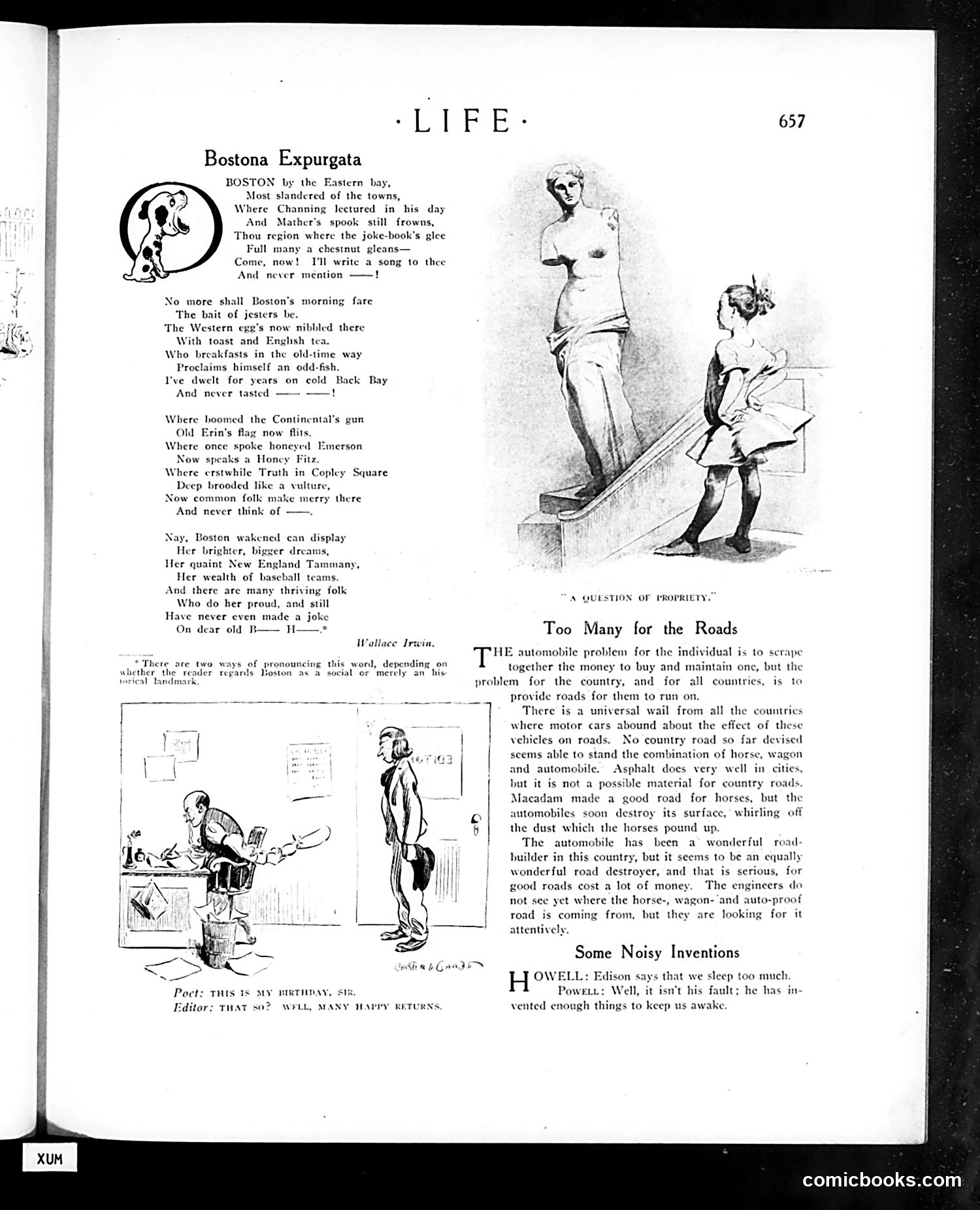
The page contains two distinct pieces: **"Bostona Expurgata"** (left): A poem by Wallace Irwin satirizing Boston's decline from its historical prominence. The verse laments that Boston no longer offers distinctive experiences—no more intellectual "jesters," distinctive cuisine, or cultural uniqueness. The opening illustration shows a dog, likely referencing Boston's "Brahmin" heritage. **"Too Many for the Roads"** (right): An article addressing automobile damage to country roads. It argues that while automobiles are "wonderful road-builders," they're equally "wonderful road-destroyers." The piece advocates for better road infrastructure to handle increased motor vehicle traffic, a pressing concern as automobile ownership was rapidly expanding in early 20th-century America. Both pieces reflect anxieties about modernization and social change.
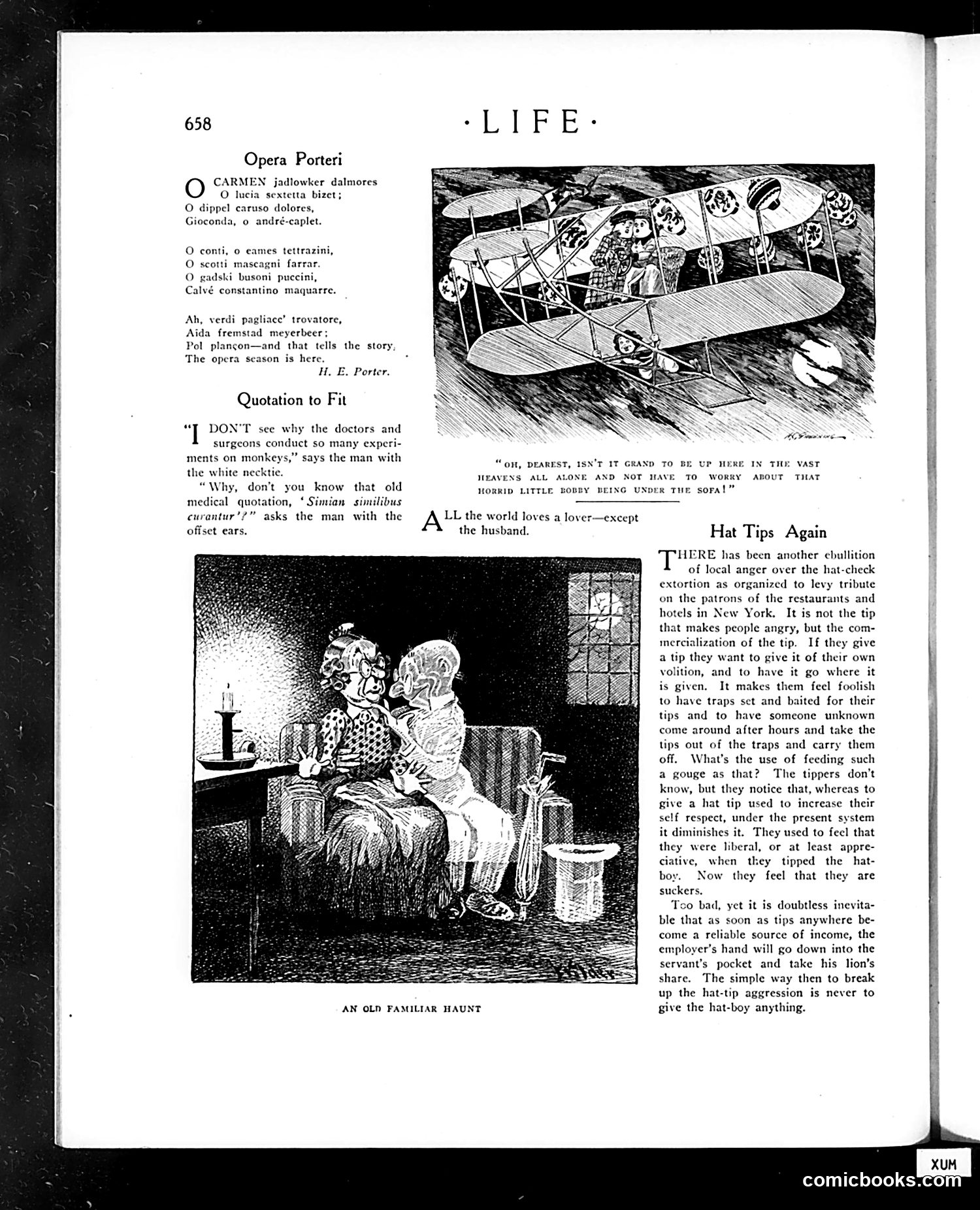
This page contains two distinct sections: **Upper Section - "Opera Porteri"**: A Latin-language poem mocking operatic conventions, followed by a quote from H.E. Porter about the opera season. **Lower Section - "Hat Tips Again"**: A social commentary piece criticizing the practice of hat-check extortion in New York restaurants and hotels. The accompanying cartoon ("An Old Familiar Haunt") depicts a couple in what appears to be an intimate or compromising situation at an establishment—likely illustrating how such venues enable questionable behavior while profiting from patrons via excessive tipping requirements. The article satirizes how hat-check attendants exploit the tipping system, making patrons feel obligated to overpay. The cartoon suggests these establishments attract dubious clientele while normalizing uncomfortable social dynamics through commercialized service expectations.
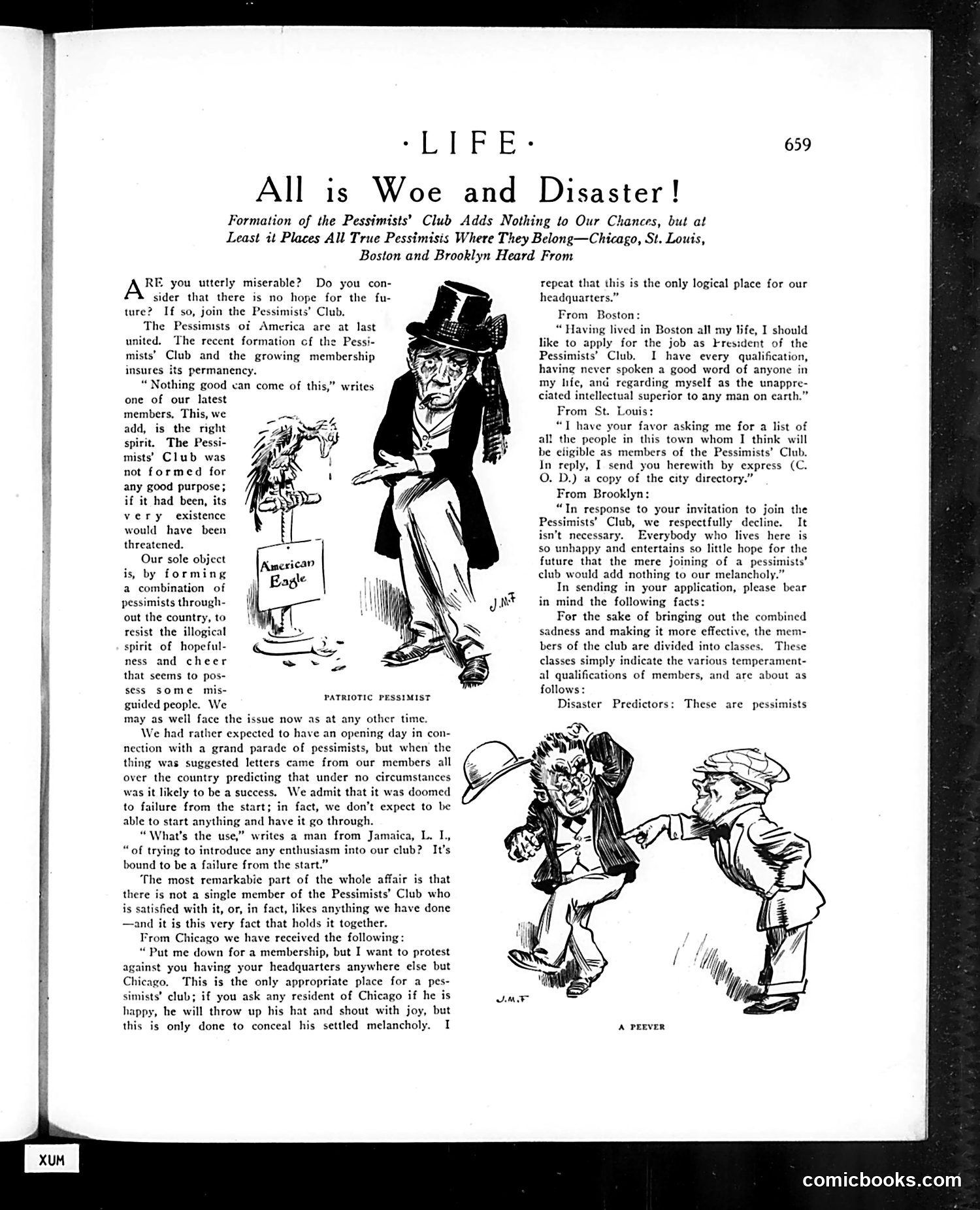
This satirical piece mocks the formation of a national "Pessimists' Club"—a fictional organization uniting chronically negative Americans. The humor lies in the contradiction: pessimists organizing to formalize their misery, yet finding solidarity through shared hopelessness. The cartoon features caricatured members from major American cities (Chicago, Boston, St. Louis, Brooklyn) responding with letters. Each city's "pessimist" claims their hometown is *most* deserving of club headquarters because residents there are uniquely depressed and cynical—disguising melancholy beneath superficial cheerfulness (particularly Boston). The satire targets early 1900s American social attitudes: regional rivalries, urban self-deprecation, and intellectual snobbishness. The "Patriotic Pessimist" illustration shows a downtrodden figure crushing American optimism. The underlying joke satirizes those who wear pessimism as a badge of sophistication, ironically converting defeatism into collective identity.
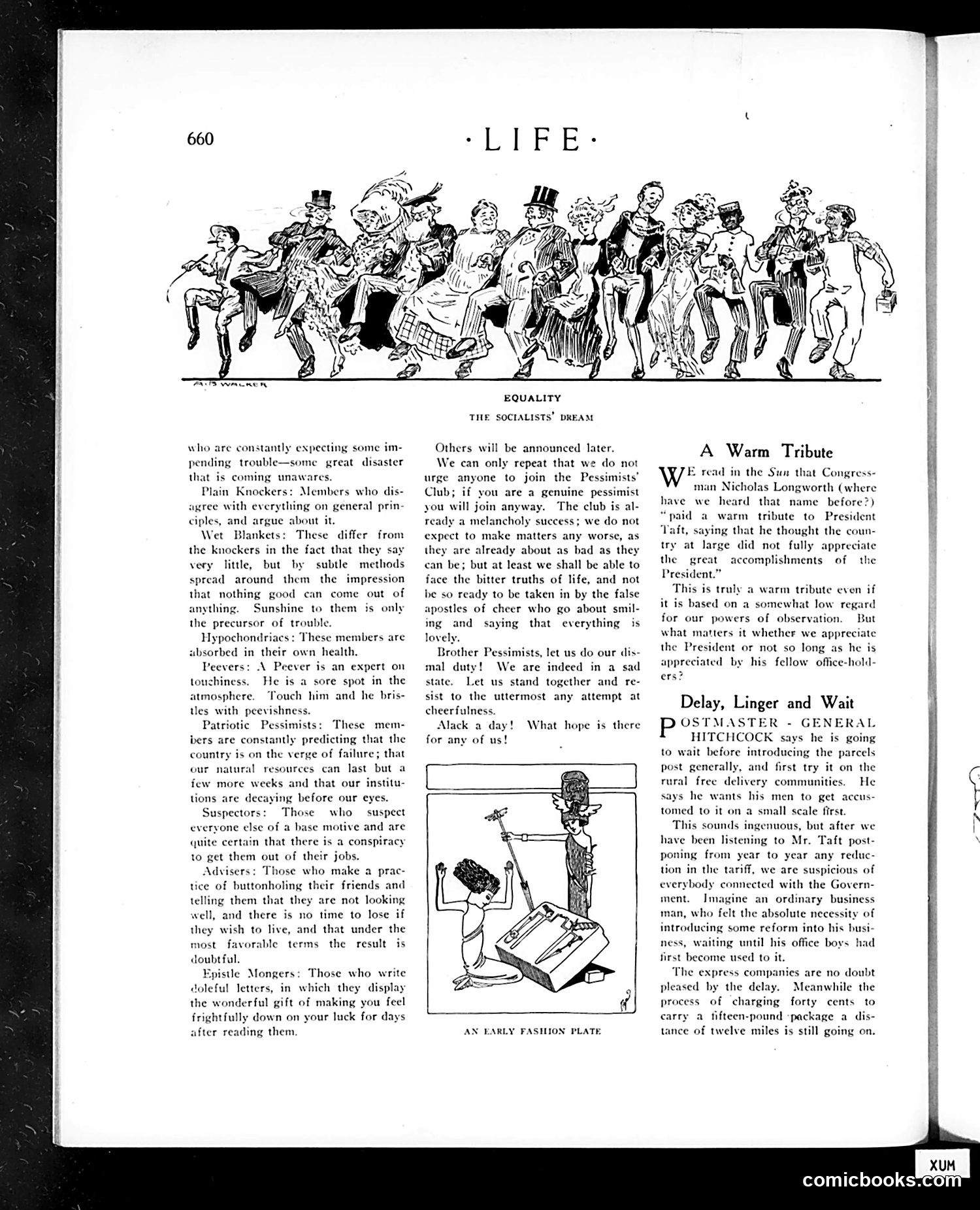
This page satirizes American pessimism and political delay through multiple pieces. **"Equality: The Socialists' Dream"** mocks various types of chronic complainers—"Patriotic Pessimists," "Plain Knockers," "Wet Blankets"—who constantly predict national failure. Life sardonically invites genuine pessimists to join a "Pessimists' Club," suggesting such negative attitudes are already epidemic. **"A Warm Tribute"** ridicules Congressman Nicholas Longworth's praise of President Taft, implying the tribute reflects low expectations rather than genuine accomplishment. **"Delay, Linger and Wait"** criticizes Postmaster General Hitchcock for postponing general parcel post service, testing it first in rural areas. Life compares this to a businessman delaying necessary reforms, suggesting the delay benefits express companies while ordinary citizens continue paying inflated shipping rates (forty cents for fifteen pounds over twelve miles). The cartoon "An Early Fashion Plate" (caption only visible) appears unrelated to the political content.
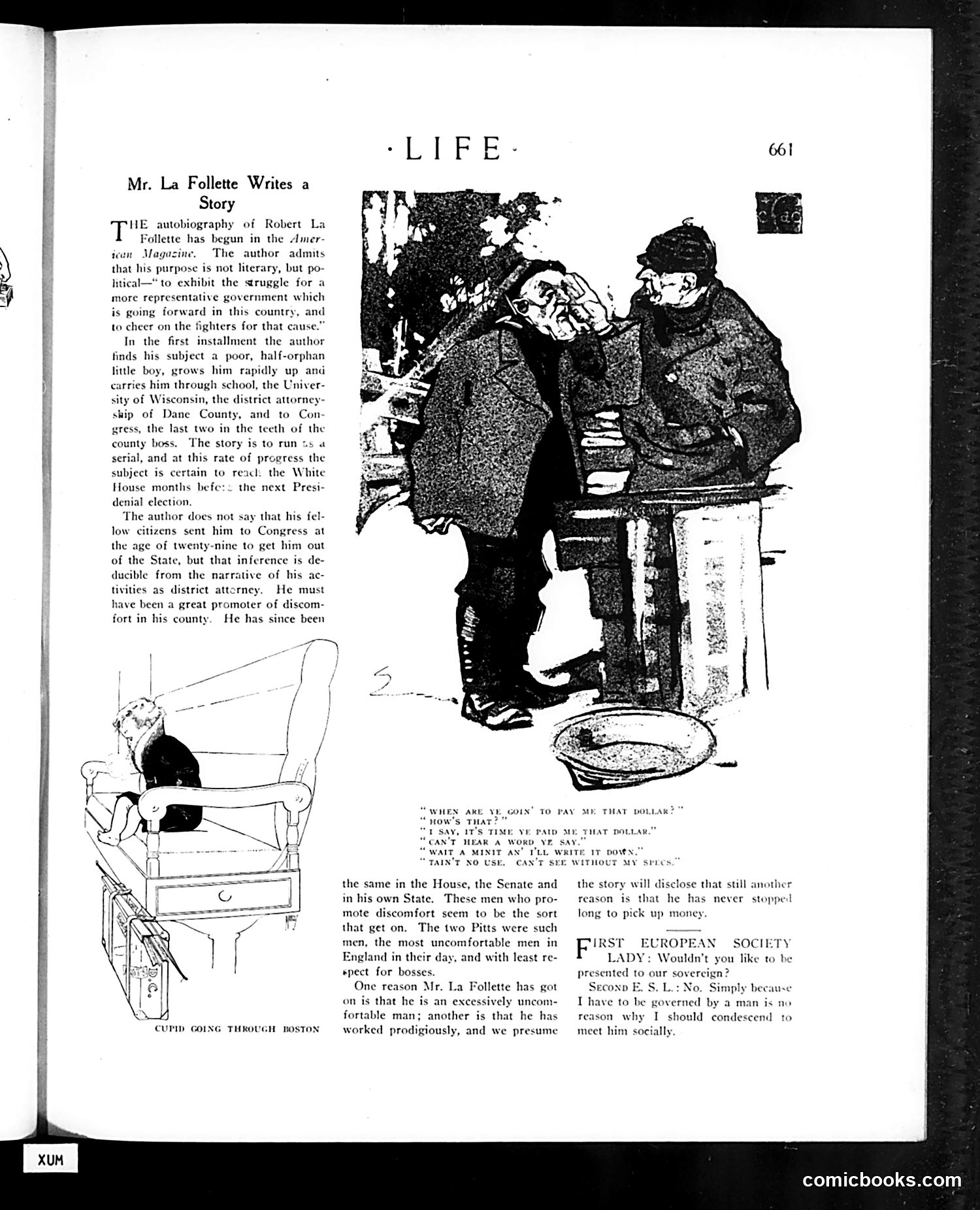
**Main Content: La Follette Biography Commentary** This article discusses Robert La Follette's autobiography serialized in American Magazine. Life satirizes La Follette's political narrative—presenting himself as a self-made man who rose from poverty through Wisconsin institutions despite corrupt "county bosses." The piece praises him as an "uncomfortable" reformer (like historical figures the Pitts), noting he succeeds through hard work rather than money-seeking. **Cartoons:** 1. **"Cupid Going Through Boston"** (lower left): A crude sketch showing Cupid attempting to collect payment from Boston residents, who claim poverty or inability to hear/see him. This appears to mock Boston's stinginess or indifference to sentiment. 2. **"First European Society Lady"** (lower right): A woman refuses presentation to a sovereign, arguing that being governed by a man doesn't obligate her to socialize with him—early feminist sentiment expressing resistance to male authority. Both cartoons use humor to critique social hypocrisy or rigid class/gender conventions.
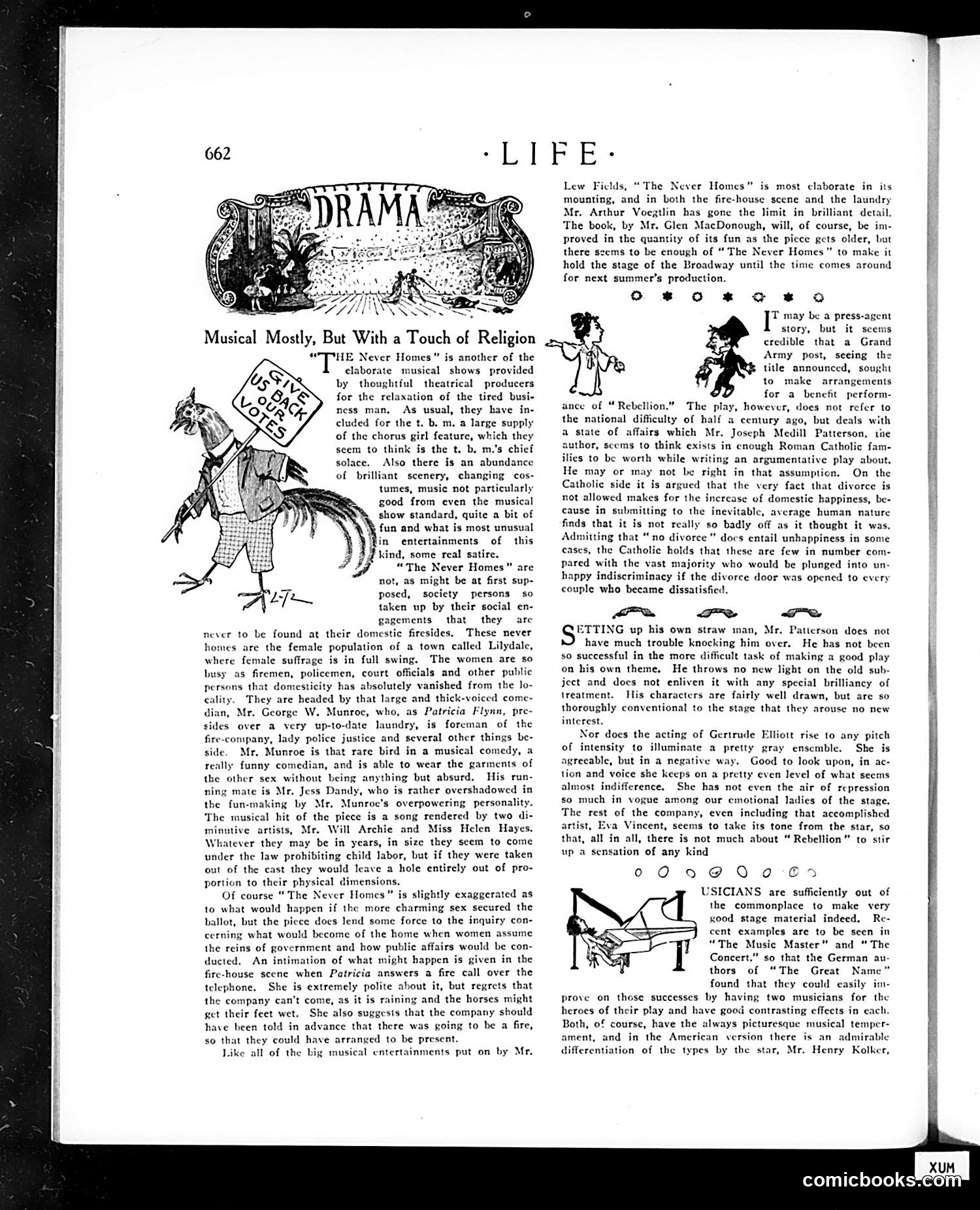
This review covers a musical comedy about a town called Lilydale where women have achieved full suffrage and abandoned domestic life entirely. Women now work as firefighters, police officers, and public officials instead of managing homes—hence "never homes." The satire mocks fears about women's suffrage by exaggerating its consequences. A scene depicts a female fire chief (Patricia Flynn, played by cross-dressing comedian George W. Munroe) so concerned with politeness that she refuses a fire call because it's raining and might wet the horses' feet—absurd incompetence presented as the inevitable result of female governance. The review notes this "slightly exaggerated" premise reflects contemporary anxieties about what happens "when women assume the reins of government." The humor relies on the audience finding the idea of women in public roles inherently ridiculous. The production featured elaborate sets and included child performers Will Archie and Helen Hayes.
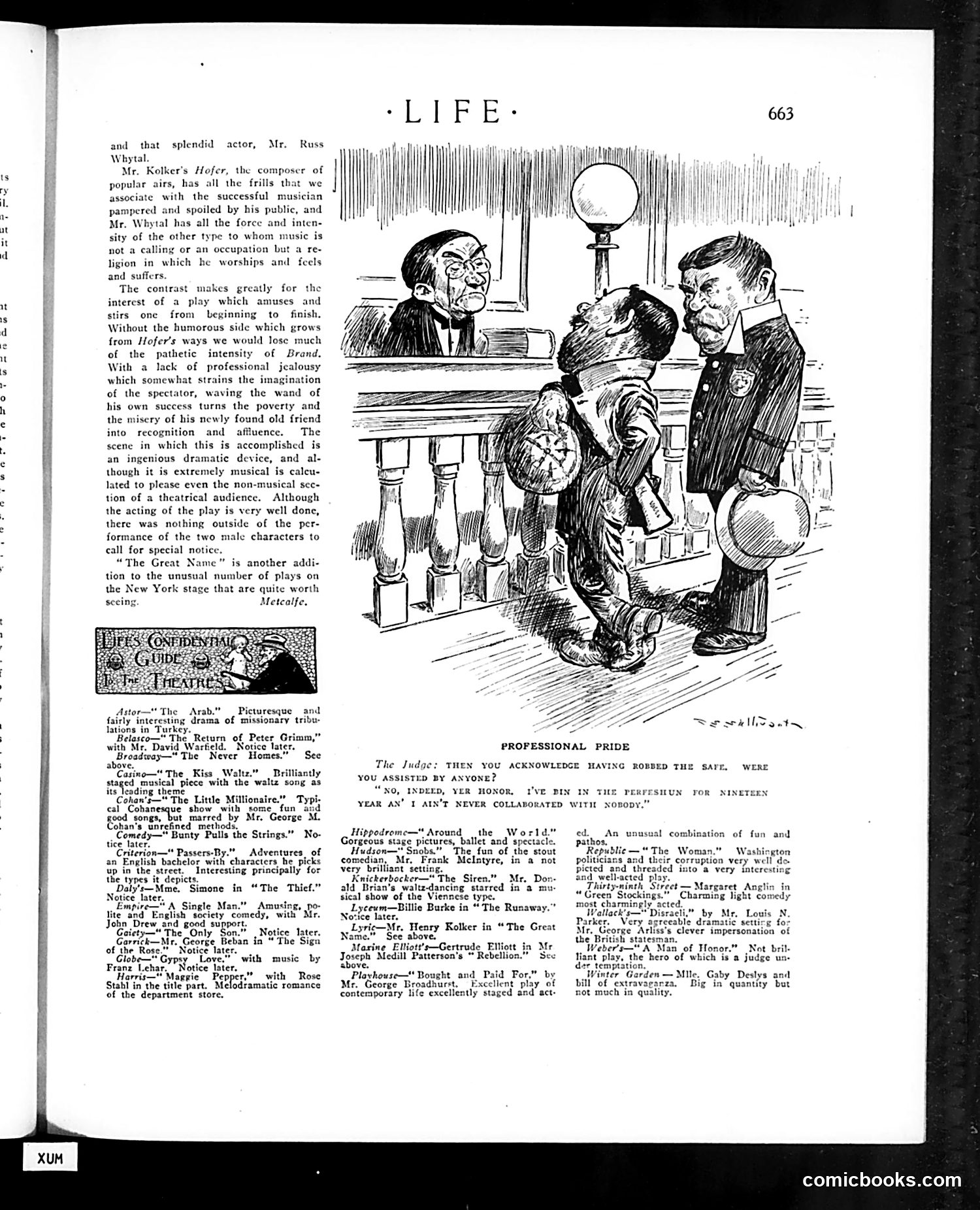
The central cartoon, titled "Professional Pride," depicts a judge questioning a defendant who has been caught robbing a safe. The defendant protests his innocence by claiming he's never "collaborated with nobody"—implying the robbery required assistance, which he denies having received. The satire targets criminal pride and professional standards even among thieves. The joke hinges on the defendant's refusal to implicate accomplices, presenting this as a matter of personal honor or professional integrity. It's darkly comic commentary on how criminals maintain their own code of conduct: even when caught, they won't betray associates. The caricatured facial features and exaggerated expressions are typical of Life magazine's satirical style. The humor derives from the absurdity of applying concepts like professional dignity to criminal enterprise—the irony that a robber would draw ethical lines about collaboration.
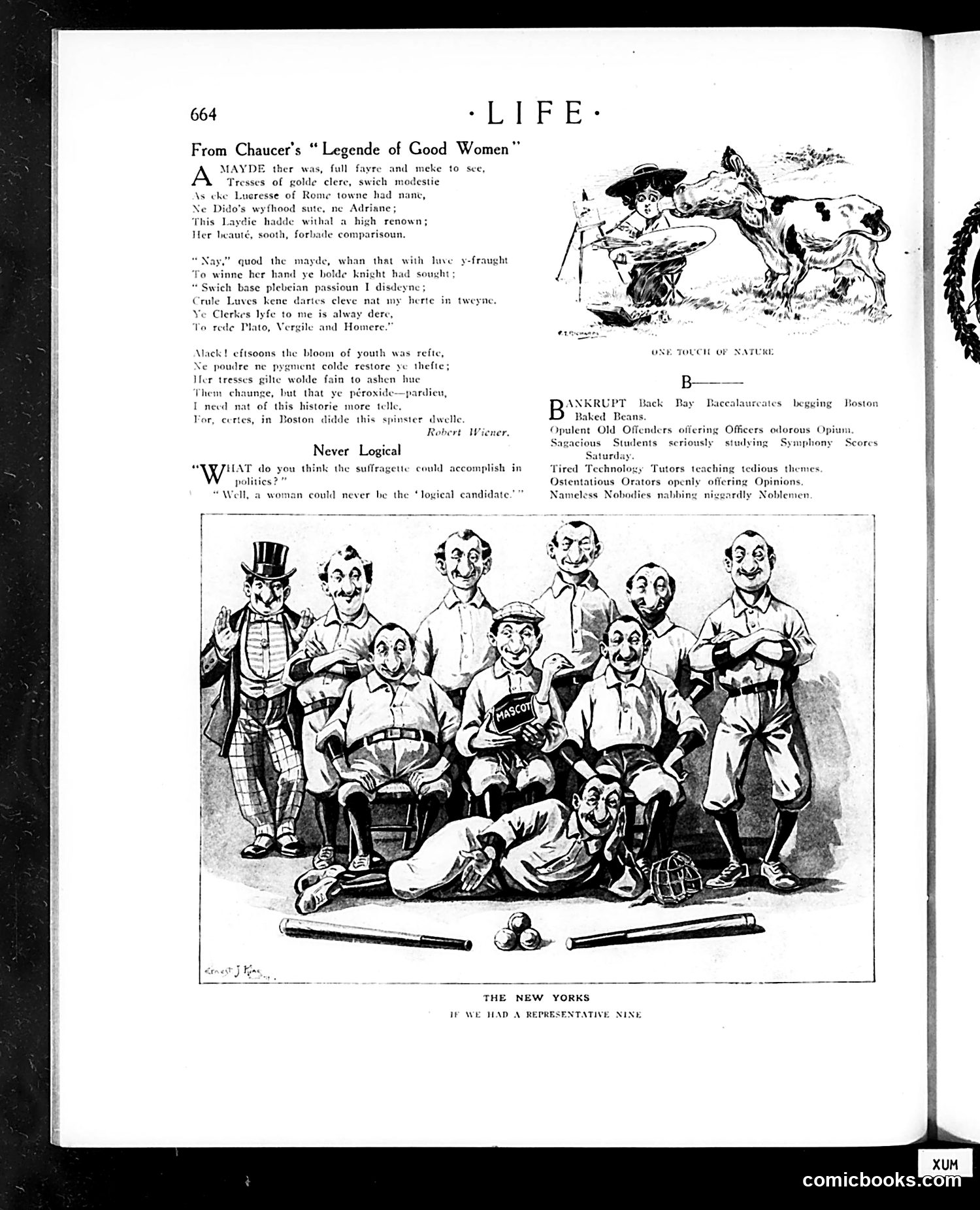
This page contains two distinct satirical pieces from *Life* magazine: **Top Section:** A mock-medieval poem (styled after Chaucer) mocking women who reject romantic advances in favor of intellectual pursuits. The joke: a woman chooses scholarly life over marriage, ages poorly, and ends up a spinster in Boston. The satire ridicules both the pretension of women claiming intellectual interests and the consequences they supposedly face. **Bottom Section:** A debate about women's suffrage. When asked what suffragettes could accomplish in politics, the response is that "a woman could never be the 'logical candidate.'" This reflects anti-suffrage arguments claiming women lacked logical reasoning for political participation. **Bottom Cartoon:** Titled "The New Yorks: If We Had a Representative Nine," this caricatures prominent New York figures (identities unclear from image alone) through exaggerated facial features—a common satirical technique of the era. The alliterative descriptions are mockery. The overall page satirizes both women's intellectual ambitions and their push for political rights, reflecting early 20th-century anti-feminist sentiment.
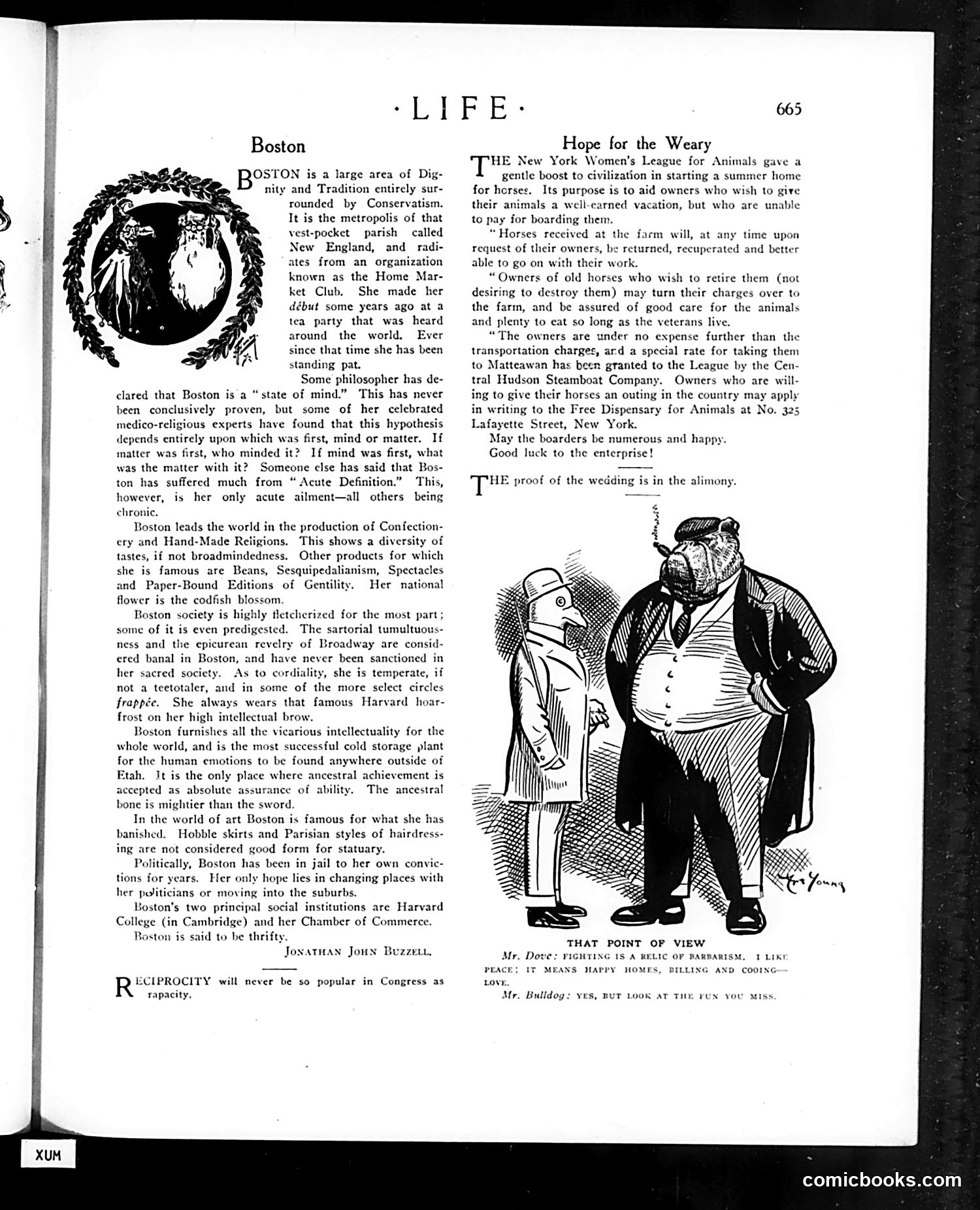
**The Boston Essay** is a satirical portrait of Boston as intellectually pretentious and socially rigid. It mocks the city's obsession with ancestry, "acute definition," homemade religions, and cold emotional reserve. The author (Jonathan John Buzzell) jabs at Boston's self-satisfied conservatism, its reliance on ancestral achievement rather than merit, and its prudish rejection of modern fashion—positioning it as emotionally frozen and intellectually self-congratulatory. **"That Point of View"** is a cartoon joke about marriage. Two men debate whether fighting in marriage is barbaric (Mr. Dose's view) or actually "means happy homes, billing and cooling love" (Mr. Holliday's position). The humor lies in the cynical suggestion that marital discord is inevitable and even desirable—a sardonic commentary on contemporary marriage expectations. Both pieces exemplify *Life* magazine's satirical approach: mocking American social pretension and romantic idealism with sharp, witty observations.
**"The Cerebral City"** is a scathing essay mocking Boston's self-regard. The piece sarcastically celebrates Boston's past intellectual dominance—when its citizens wrote in Sanskrit and Greek—then laments its decline after Irish Catholic immigration ("Celto-Latin invasion"). The satire targets Boston's nostalgia and pretension: the city clings to ancestral glory while becoming a commercialized tourist trap, monetizing its graveyards and "ancestors yield profits." Author Joseph Smith uses exaggerated praise to expose the city's hypocrisy and obsolescence. **"The Piety Game"** is a cynical poem exposing wealthy businessmen's moral hypocrisy. The satire advises readers to mask greed with religious performance—adopting pious expressions, becoming deacons or wardens, while exploiting workers and violating laws (blaming subordinates). The joke: respectability and wealth matter more than actual virtue; society forgives the wealthy's sins if they maintain pious appearances. Both pieces critique American society's gap between stated values and actual behavior.
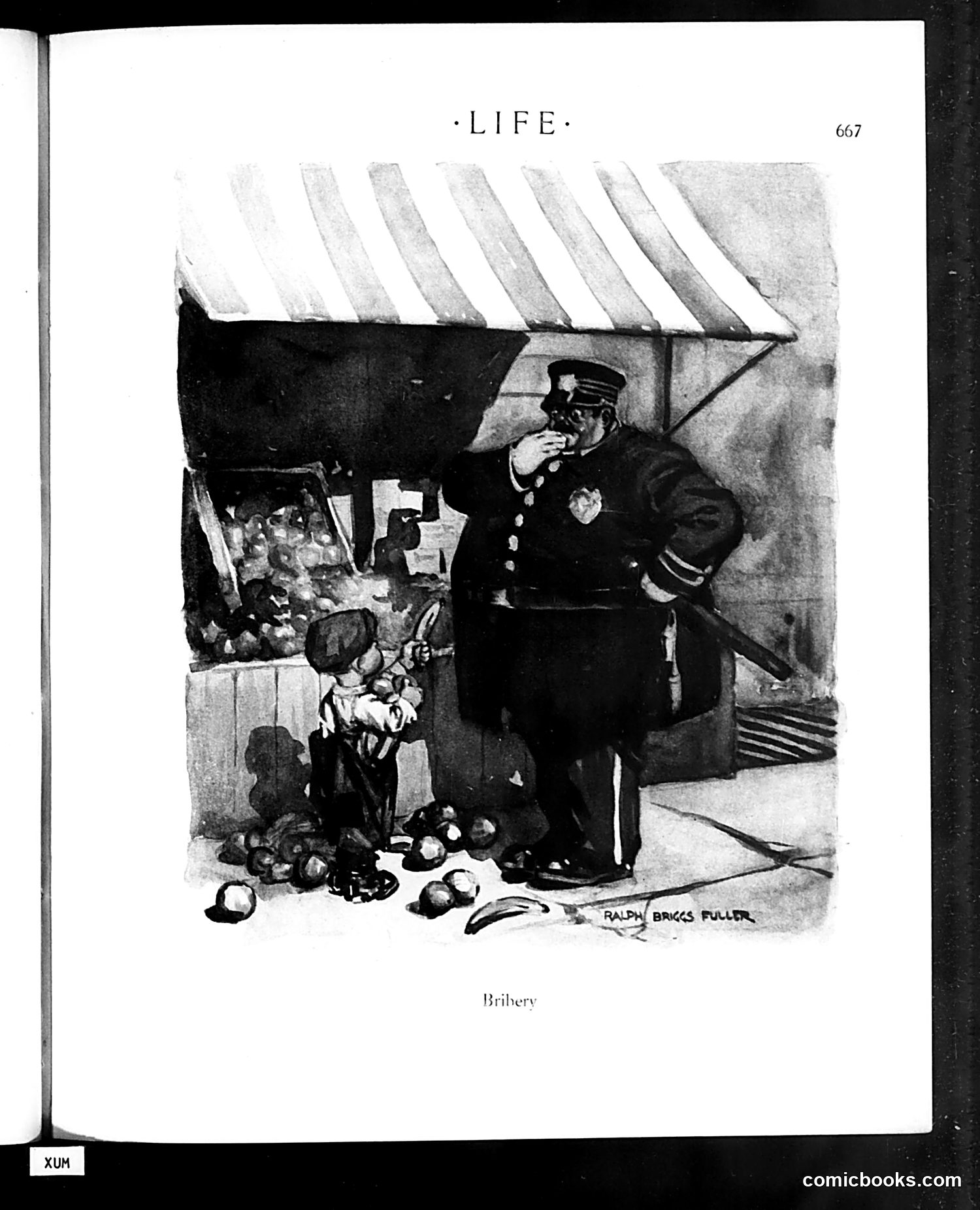
This cartoon depicts a uniformed police officer or official accepting what appears to be produce (apples or similar fruit) from a street vendor with a child nearby. The title "Bribery" indicates the satire: the cartoon mocks corruption where law enforcement officers accept bribes—in this case, modest goods—from street vendors, likely in exchange for overlooking violations or permit infractions. The humor lies in the mundane nature of the bribe (simple fruit rather than money) and the presence of the child, perhaps suggesting both the casual acceptance of corruption and its normalization even in front of the young. This satirizes petty official corruption common in early-to-mid 20th century urban America, where street vendors frequently negotiated with police through small gifts or favors.
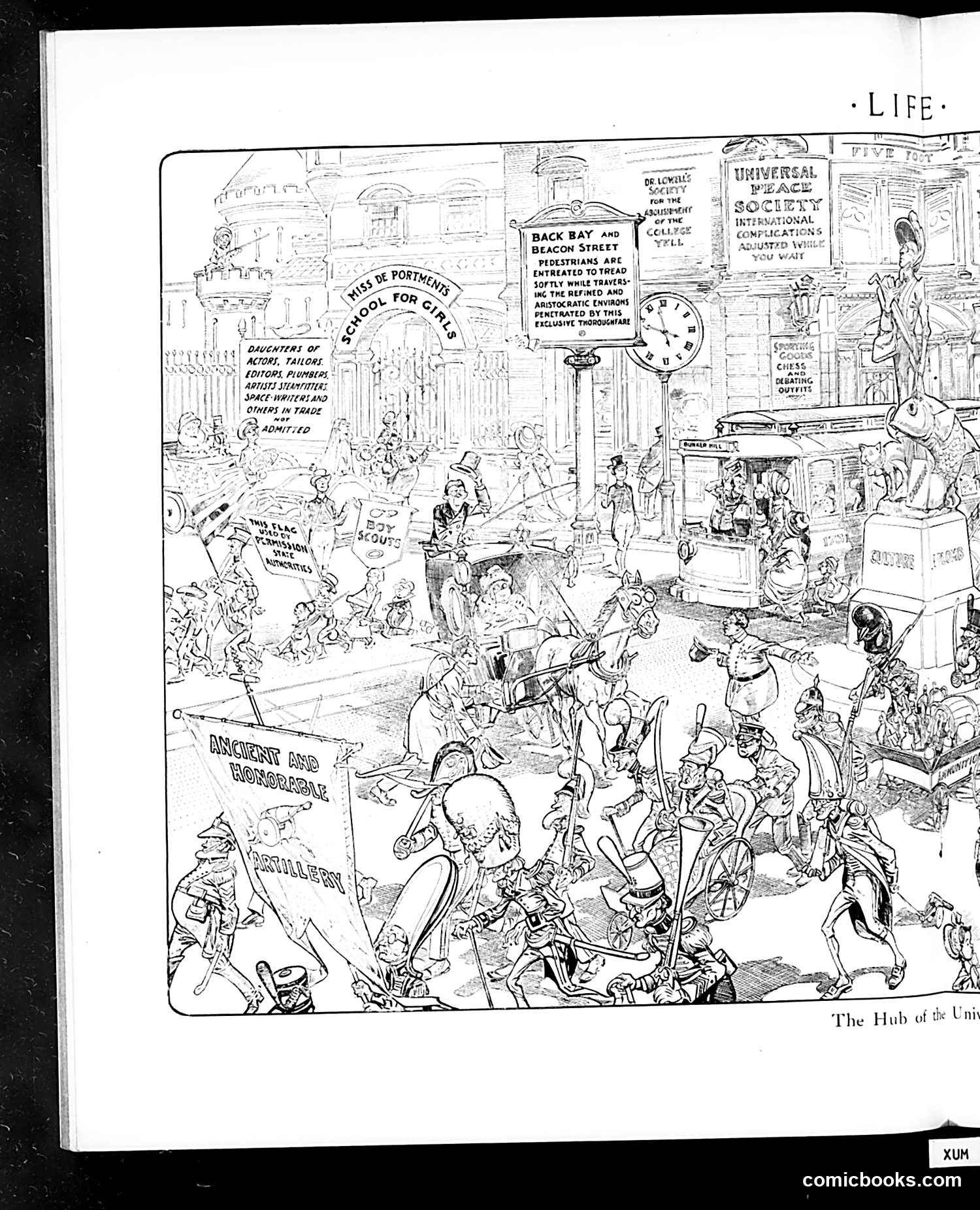
This Life magazine cartoon satirizes Boston's upper-class pretensions, particularly the wealthy residents of Back Bay and Beacon Street. The title references Boston's self-aggrandizing nickname, "the Hub of the Universe." The satire mocks the contradiction between Boston's elite self-image and reality: the sign reads that "Daughters of Actors, Tailors, Editors, Plumbers, Artists, Steamfitters and Others in Trade" are admitted to a school for girls—yet the refined residents insist pedestrians "tread softly" through their aristocratic environs, as if walking through sacred ground. The joke targets Boston Brahmin snobbery: these supposedly refined families actually descended from working-class tradespeople, yet they've adopted affected airs of superiority. The crowded street scene with various institutions and people underscores the gap between their pretended exclusivity and Boston's actual democratic, working-class origins.
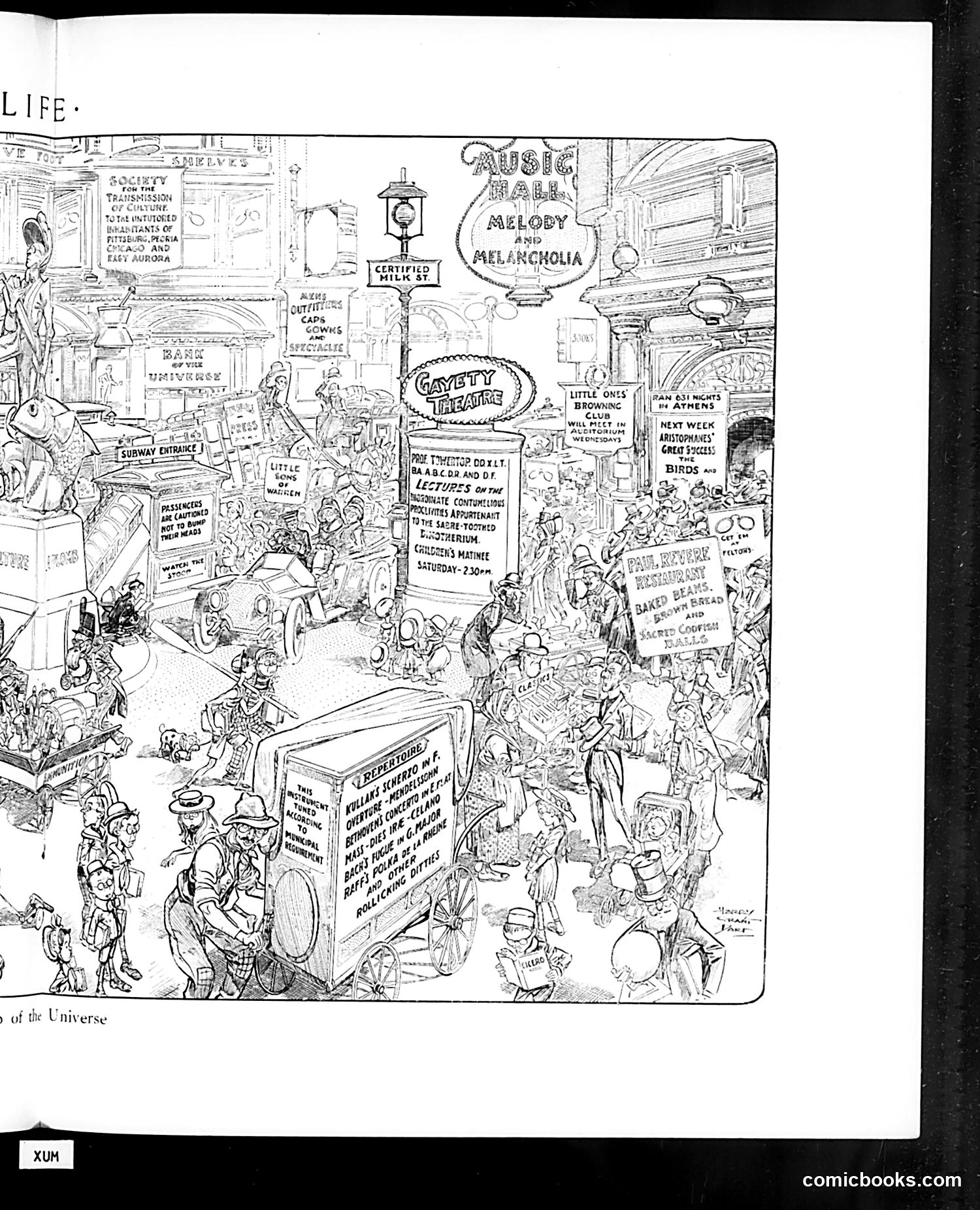
This is a densely detailed satirical street scene showing urban life and entertainment venues. The cartoon depicts various theaters and attractions: the Gayety Theatre, a Music Hall featuring "Melody and Melancholia," and references to performances including lectures and a children's matinee. The crowded street teems with pedestrians, vendors (including what appears to be a "Refreshments" cart), and period automobiles, suggesting early-to-mid 20th century urban bustle. Various storefronts and signs advertise entertainment options and products available to passersby. The satire appears to mock the commercialization and overwhelming sensory chaos of urban entertainment districts—the proliferation of competing attractions, vendors, and advertisements all vying for attention in a single crowded space. The intricate detail emphasizes the frenetic energy and consumer culture of the era.
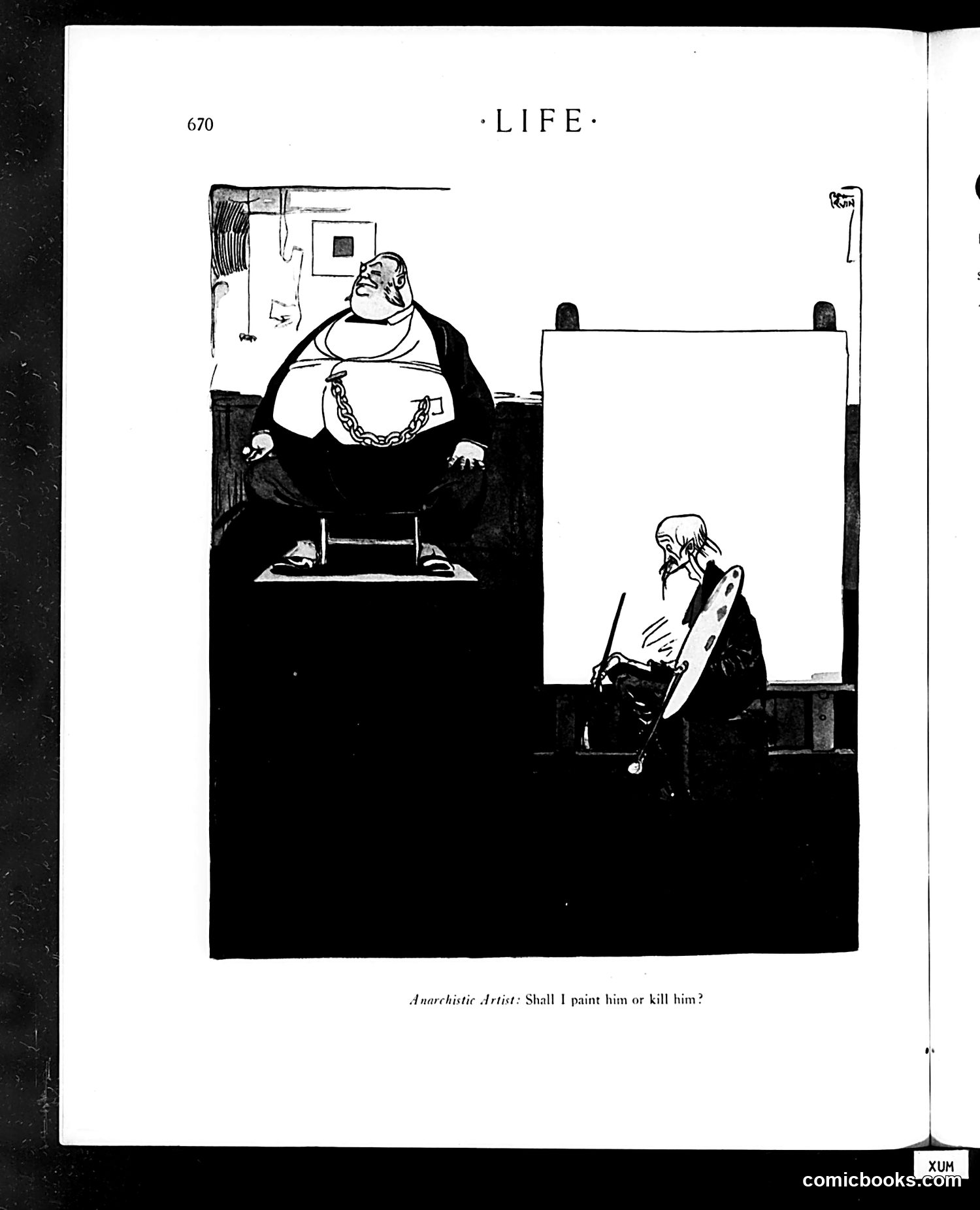
This Life magazine cartoon satirizes the perceived threat of anarchism in early 20th-century America. The image shows two figures: a well-fed, wealthy man seated comfortably (appearing to represent capitalist establishment or authority), and an "anarchistic artist" on the right holding what appears to be a paintbrush or weapon, contemplating violence. The caption's dark humor—"Shall I paint him or kill him?"—plays on anxieties about radical anarchists who were associated with bombings and assassination attempts during this era. The cartoon mocks both the anarchist threat and the establishment's paranoia about it, using the ambiguity between "painting" and "killing" to comment on revolutionary fervor. The wealthy man's chain and confident posture contrast with the artist's agitated pose, emphasizing class tensions of the period.
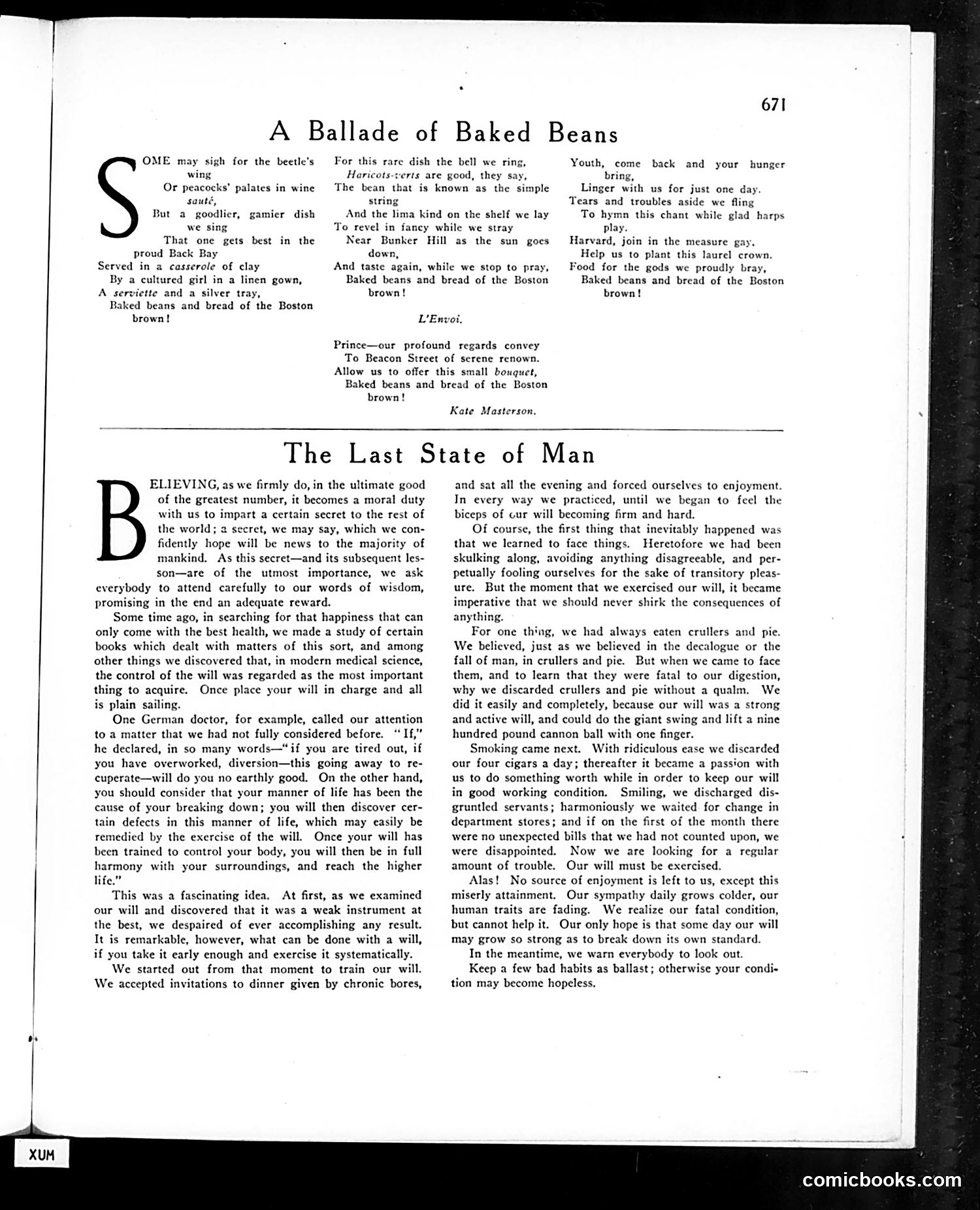
This page contains two satirical pieces mocking American pretension and self-help culture. **"A Ballade of Baked Beans"** playfully elevates humble Boston baked beans—a working-class dish—to high art through flowery poetic language. It satirizes Boston's cultural snobbery by treating this simple food with the reverence typically reserved for fancy French cuisine, while invoking Harvard and Beacon Street (markers of Boston's elite). The joke is the contrast between the grandiose form and the mundane subject. **"The Last State of Man"** parodies the era's obsession with willpower and self-improvement through pseudoscientific philosophy. The narrator describes training his will like a muscle by forcing himself to attend boring dinners and endure unpleasant situations. The satire targets both the German doctor's dubious advice and the American tendency toward self-denial masquerading as virtue—treating the painful suppression of natural desires as moral improvement. Both pieces mock class pretension and the era's faith in willpower as a solution to life's problems.
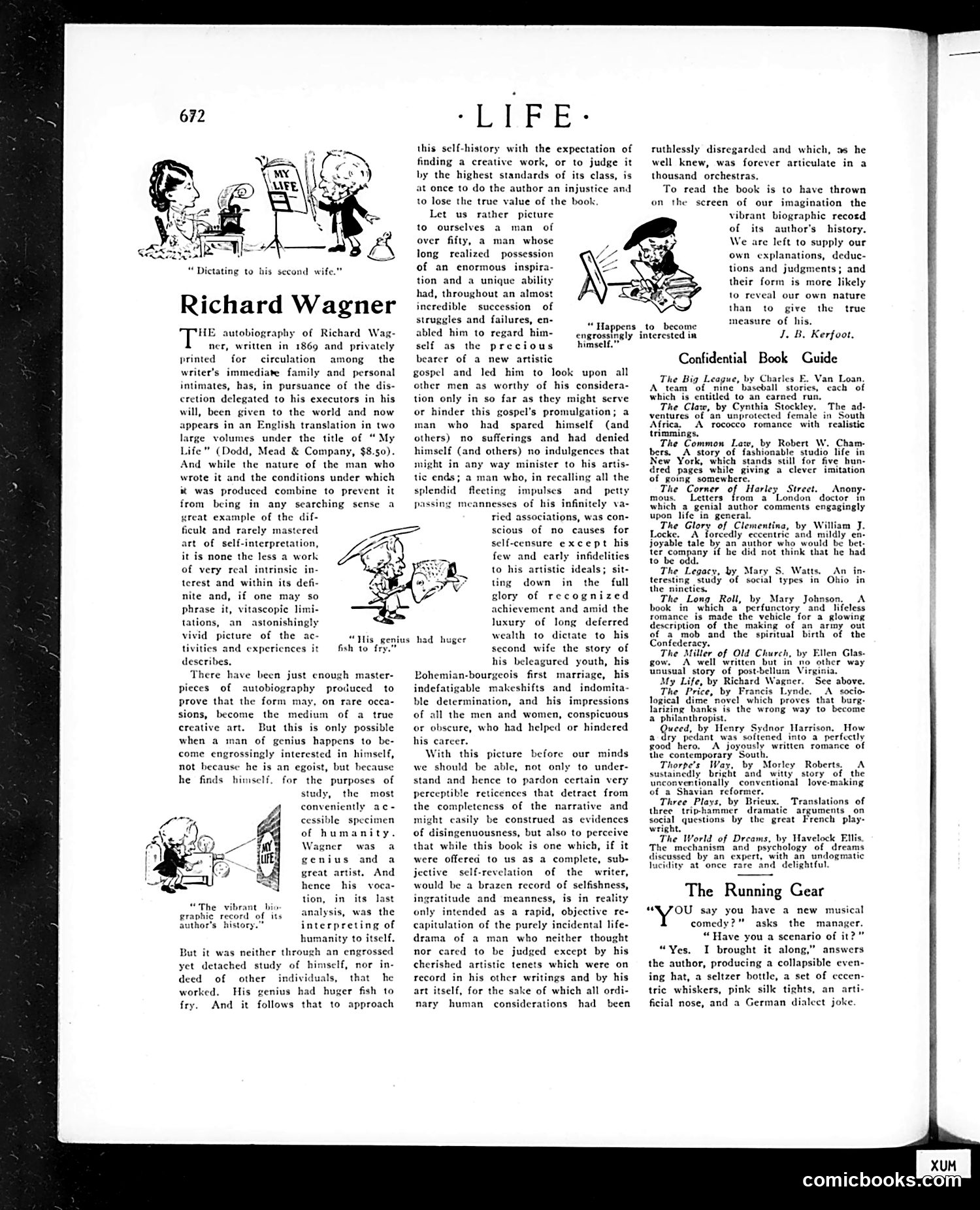
This page reviews Wagner's autobiography, published in English translation. The cartoons illustrate the article's central satire: Wagner dictating his life story to his second wife. The satire targets Wagner's monumental ego and self-absorption. The article describes him as a genius convinced of his artistic superiority, who viewed other people merely as servants to his creative mission—or obstacles to it. He spared neither himself nor others suffering in pursuit of his art. The joke in the caption "Dictating to his second wife" operates on multiple levels: Wagner's willingness to impose even his *autobiography* on others, his narcissism requiring an audience for self-justification, and the implicit absurdity of expecting his wife to transcribe his self-aggrandizing account. The cartoon's visual presentation of this domestic scene—a man dictating grandiose narratives while his wife dutifully records—mocks both Wagner's egomania and the tedious performance it demands of those around him.
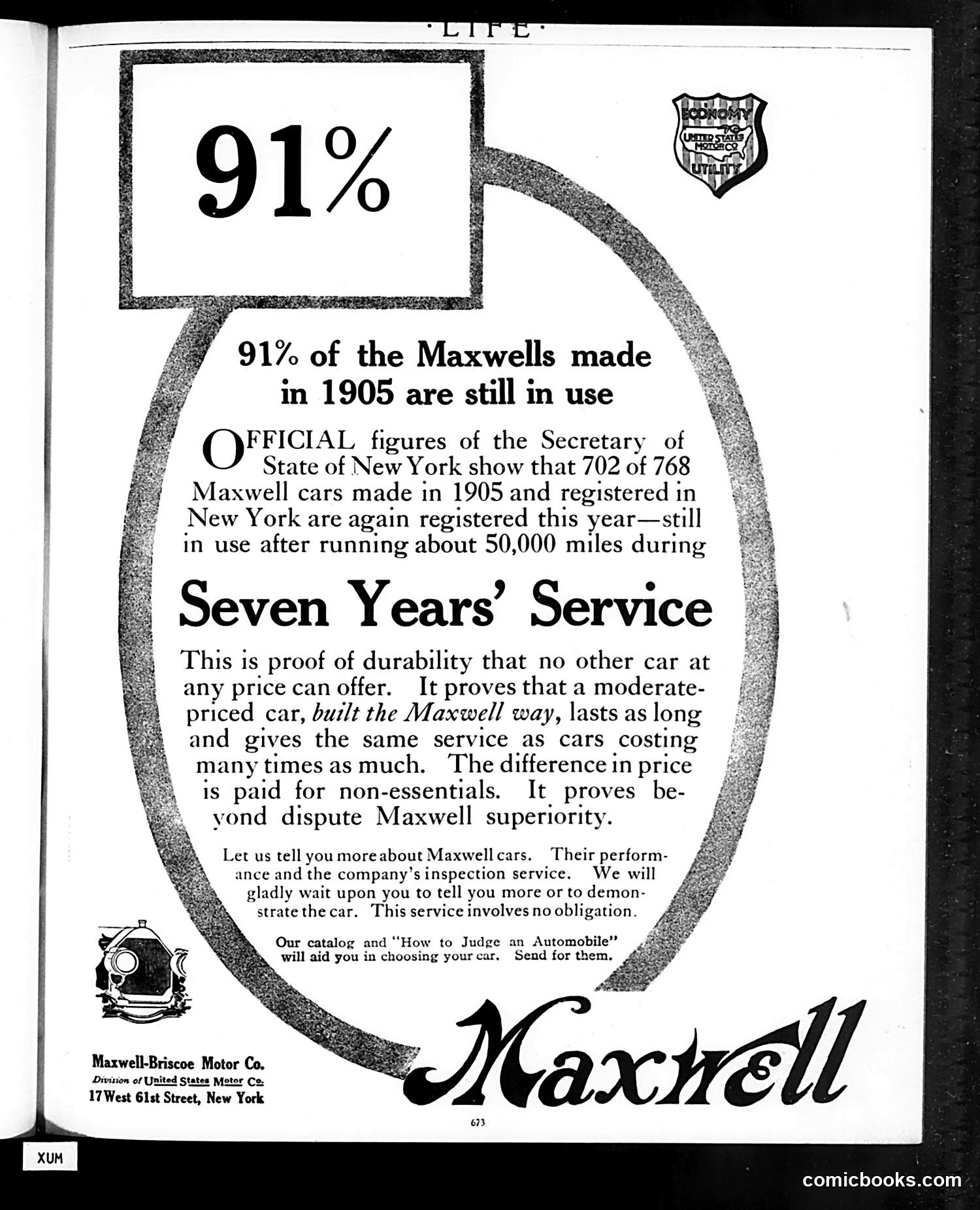
This is a **product advertisement**, not satire or political commentary. Maxwell-Briscoe Motor Company uses statistical claims to market their moderately-priced automobiles. The ad claims that 91% of Maxwell cars manufactured in 1905 remain registered and in use seven years later—citing official New York State Secretary records (702 of 768 vehicles). This durability statistic is presented as proof that Maxwell cars rival far more expensive vehicles in longevity and reliability. The sales pitch argues that price differences between cars reflect "non-essentials" rather than quality, making Maxwell's moderate pricing a smart value proposition. The company invites potential customers to learn more about Maxwell performance and inspection service "without obligation." The large "91%" display is the advertisement's primary visual emphasis, designed to catch readers' attention with this seemingly impressive longevity claim.
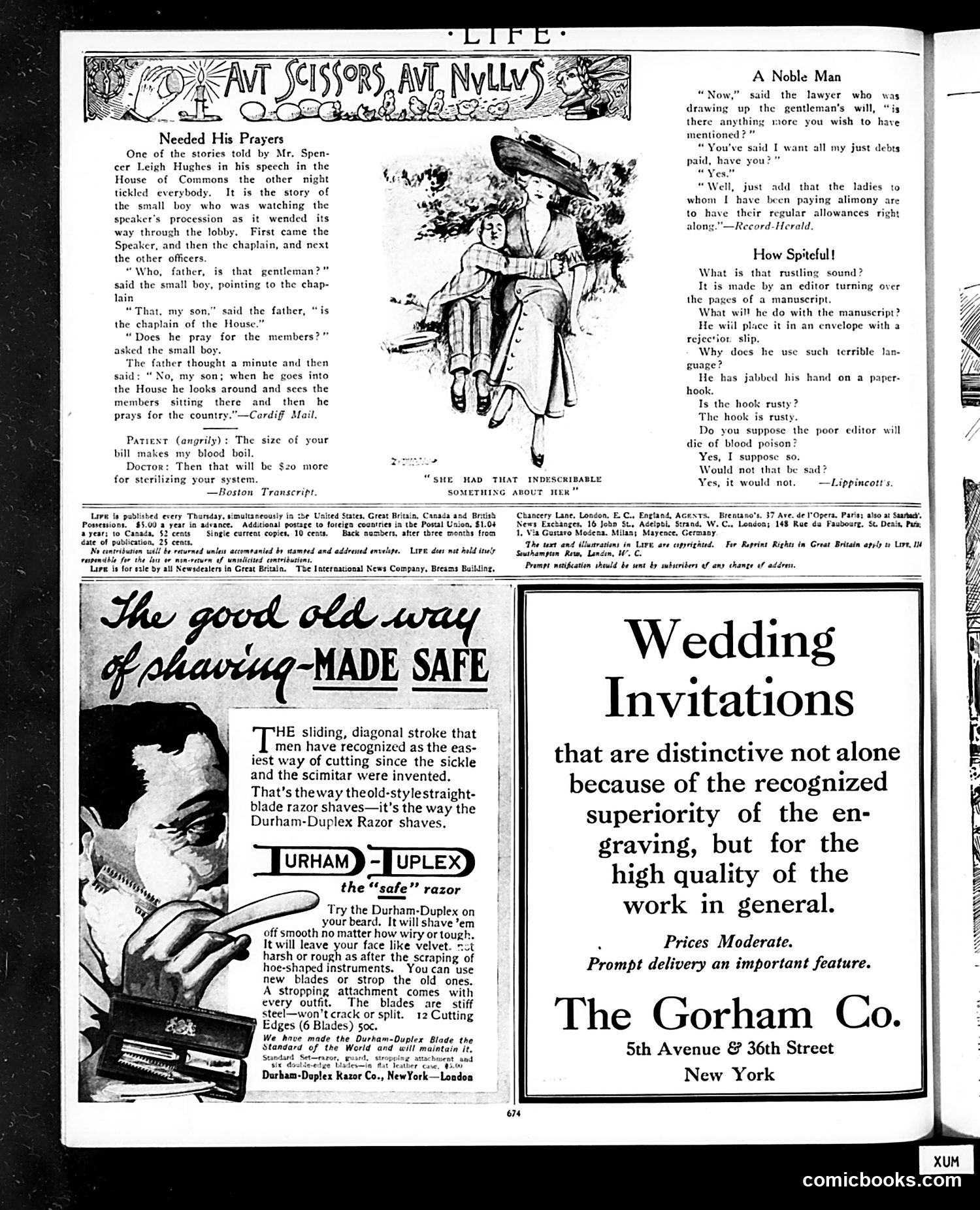
This page contains three unrelated humor pieces typical of early 20th-century American satire magazines: **"Needed His Prayers"** presents a joke about the House of Commons chaplain. When a boy asks if the chaplain prays for members, his father responds that upon seeing the assembled members, the chaplain instead "prays for the country"—implying Parliament members are so morally compromised they require national-level divine intervention rather than individual prayers. **"How Spiteful"** is a Q&A joke mocking editorial rejection practices. It depicts an editor's violent frustration at manuscript rejection, culminating in dark humor about potential blood poisoning—suggesting editors' contempt for submitted work is so intense it causes self-injury. The remaining content consists of advertisements (Durham-Duplex razors, Gorham wedding invitations) and publication information, reflecting the magazine's commercial structure. These pieces exemplify Life's satirical approach: poking fun at institutional incompetence (Parliament, publishing) through brief, punchy humor.
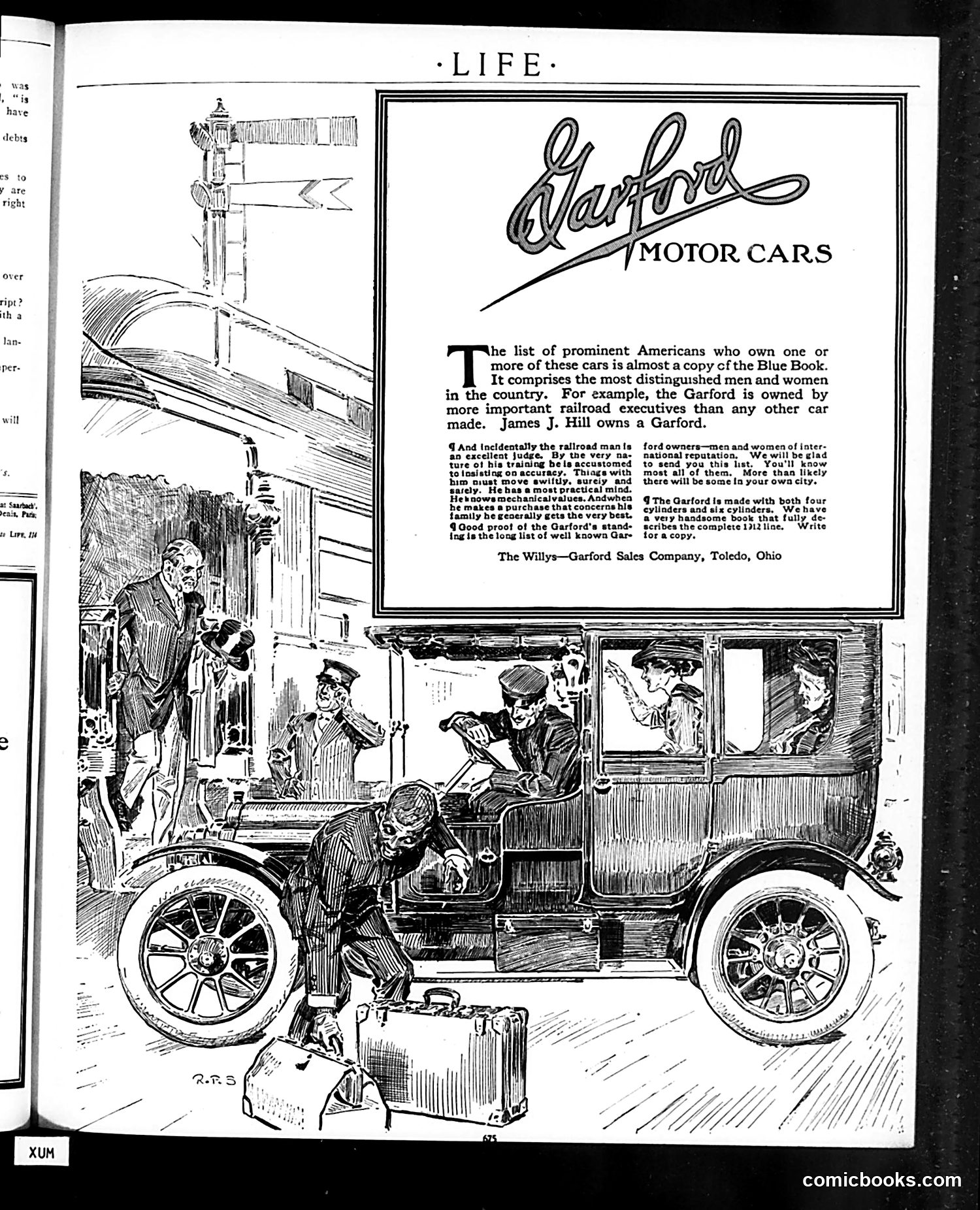
This is primarily a **commercial advertisement**, not political satire. The page promotes Garford automobiles by appealing to wealthy, prominent Americans' status consciousness. The ad claims that major railroad executives—particularly James J. Hill, a famous industrialist—own Garfords, positioning the car as a luxury item for the nation's elite ("almost a copy of the Blue Book," referring to the social registry of prominent families). The accompanying illustration shows the car being loaded with luggage by porters, emphasizing its association with wealth and travel. The smaller inset cartoon appears to humorously depict loading procedures, though the specific satirical point is unclear without additional context. The ad's strategy: **aspiration marketing**—if important people own this car, buying one signals your own prominence and good judgment.
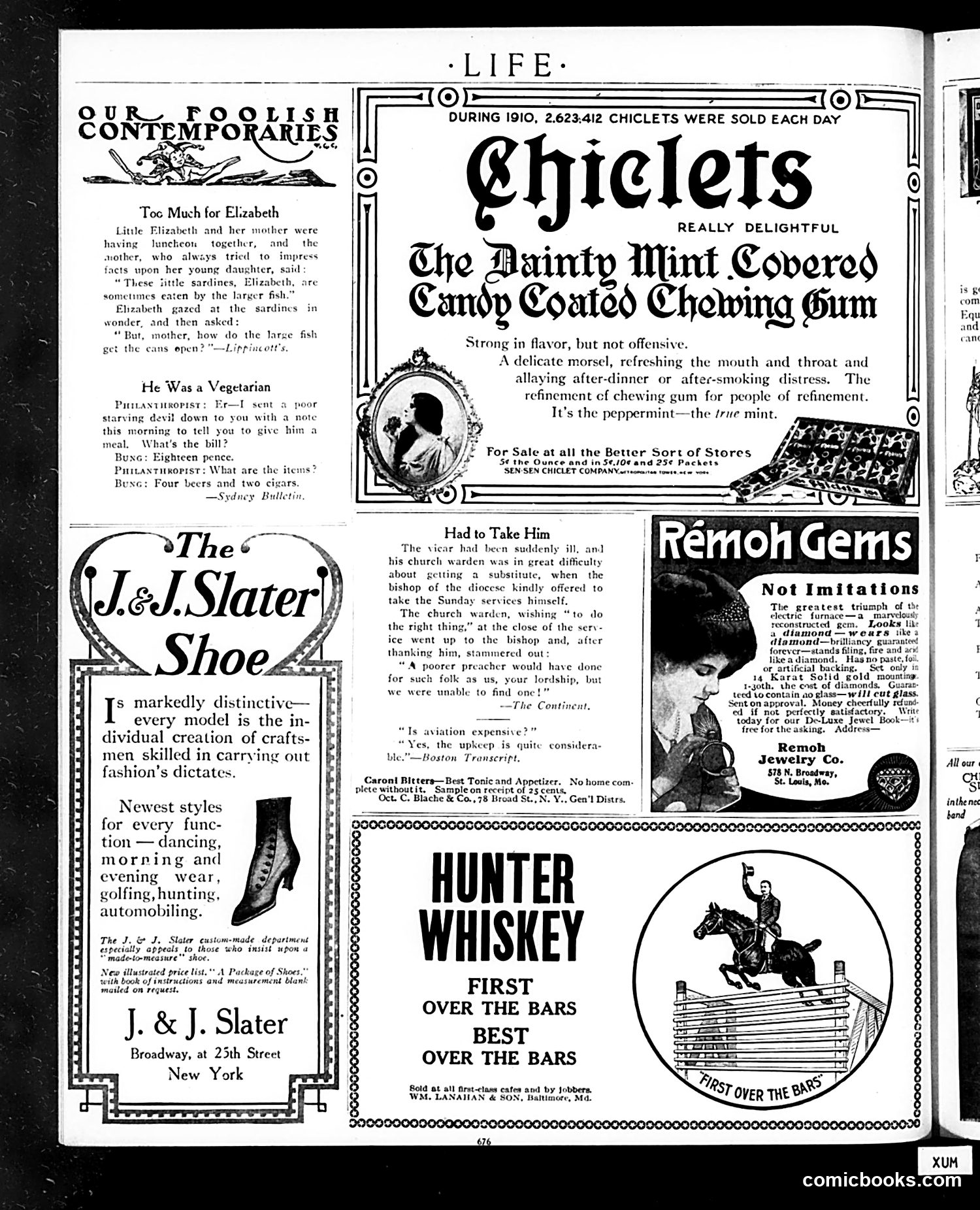
This page is primarily **advertising with brief humorous anecdotes**, not political cartoons. The "Our Foolish Contemporaries" section contains three short jokes: 1. **"Too Much for Elizabeth"**: A child's innocent misunderstanding—she asks how large fish open tin cans, not grasping the metaphor about food chains. 2. **"He Was a Vegetarian"**: A philanthropist sends a starving man to a church, expecting charity. The punchline reveals the man is a vagrant drunkard (ordering "four beers and two cigars"), mocking both poor relief efforts and working-class behavior. 3. **"Had to Take Him"**: A church warden awkwardly thanks a bishop for substitute preaching, inadvertently insulting him by implying he's adequate "for such folk as us"—class-based humor about social hierarchies. The surrounding advertisements promote Chiclets gum, J&J Slater shoes, Hunter Whiskey, and Remoh gem jewelry. The page reflects early 1900s consumer culture and genteel satirical humor targeting class pretensions and naive observations.
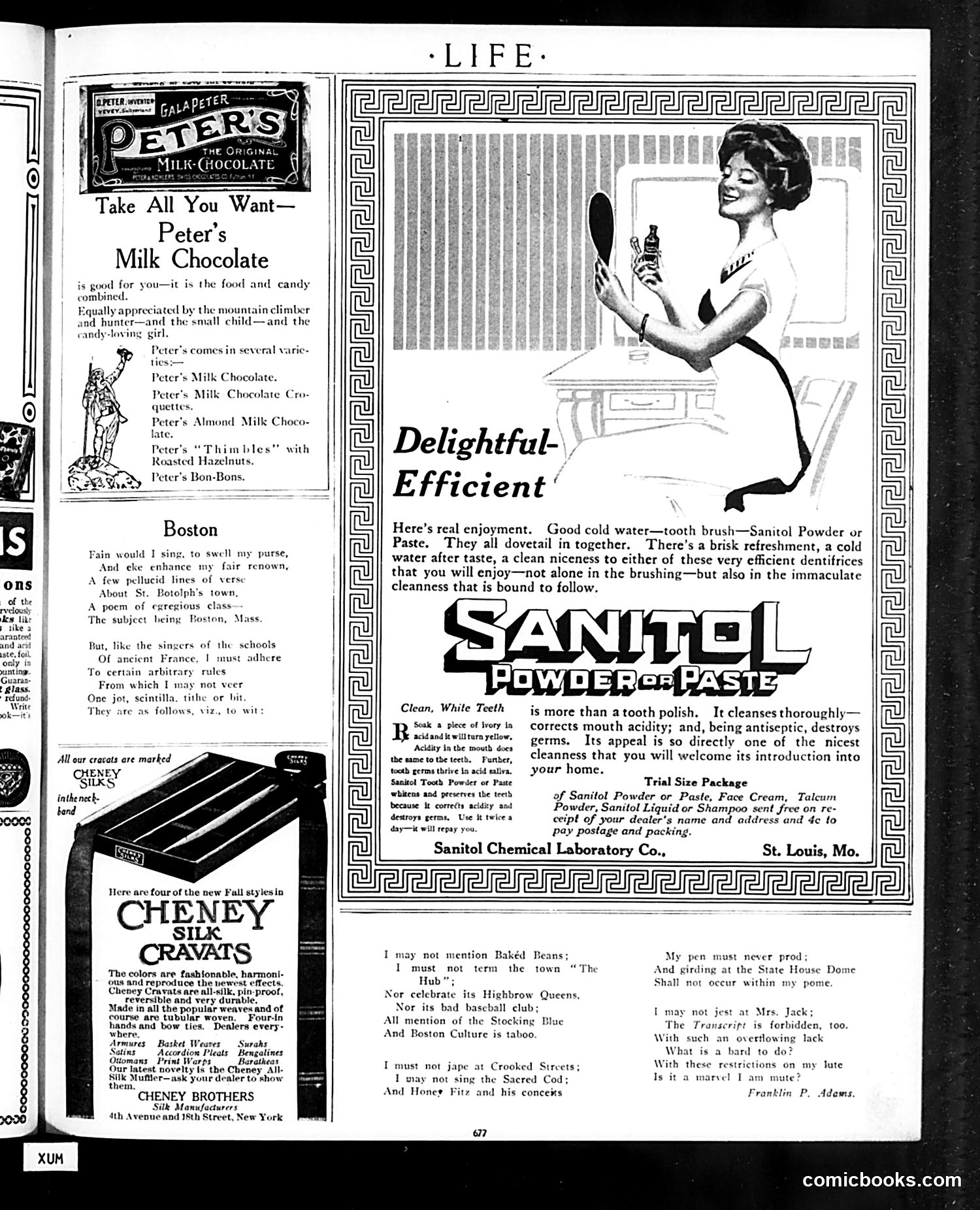
This is primarily an **advertising page** rather than a satirical cartoon page. The main content consists of product advertisements for Peter's Milk Chocolate, Sanitol tooth powder/paste, and Cheney silk cravats. The only satirical content is a **poem by Franklin P. Adams** titled "Boston," printed in the lower right. It humorously lists absurd restrictions supposedly placed on poets writing about Boston: they cannot mention baked beans, call it "The Hub," reference Highbrow Queens, the baseball club, or Crooked Streets. The joke satirizes Boston's cultural pretensions and touchy civic pride—Adams suggests the city is so sensitive about its image that poets are left with nothing safe to write about, leaving him "mute." This appears to be typical Life magazine content from the early 20th century: mixing light verse satire with full-page advertisements, using wit to poke gentle fun at American institutions and regional vanity.
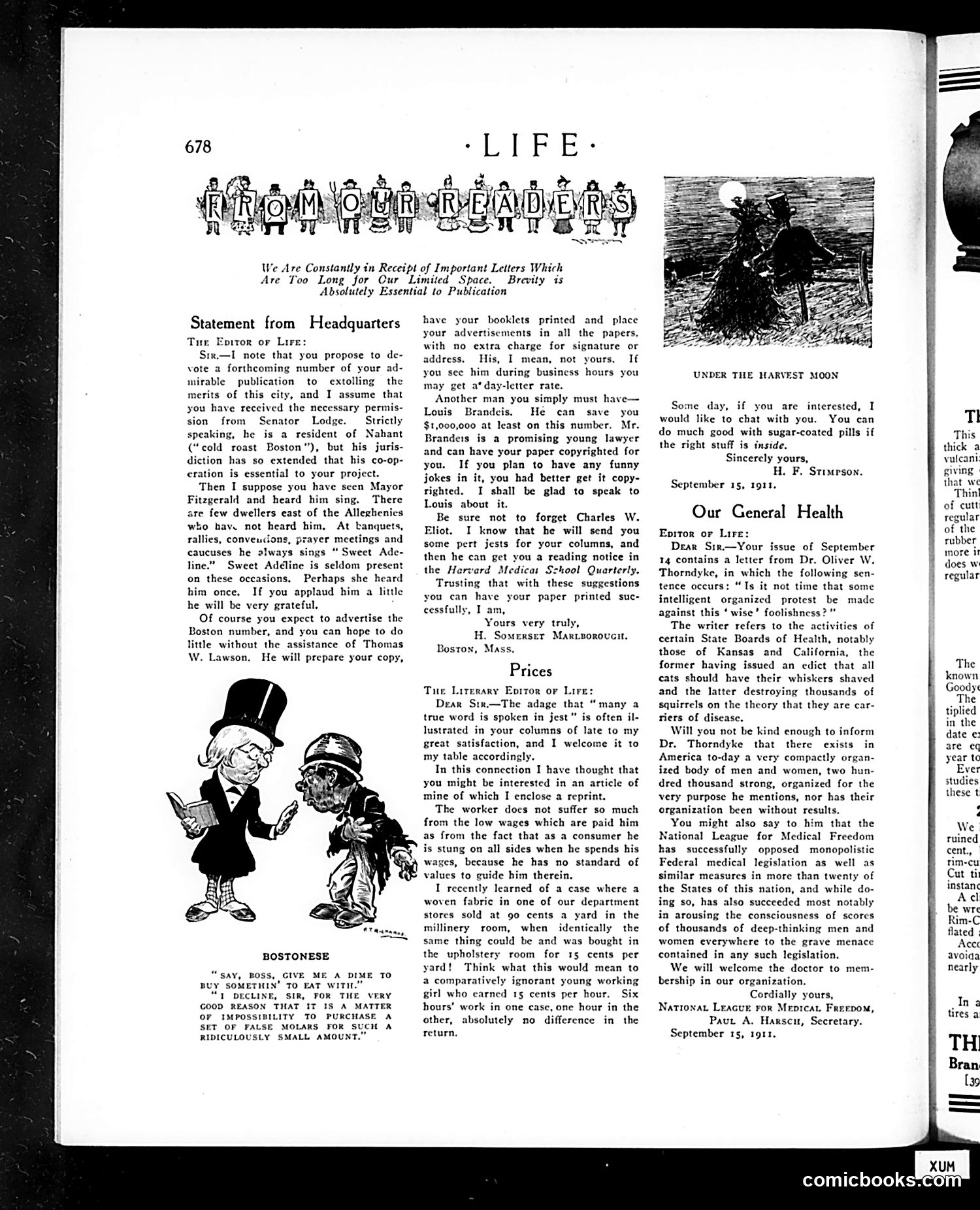
This page satirizes Boston's cultural pretension through a mock "Statement from Headquarters" about covering the city. The letter humorously suggests that publishing about Boston requires permission from Senator Henry Cabot Lodge and cooperation from Mayor Fitzgerald (who apparently sings "Sweet Adeline" constantly at public events). The cartoon below, labeled "Bostonese," mocks Boston's distinctive accent and affected speech patterns. A working-class man asks for a dime to buy food, but a well-dressed Bostonian responds in exaggerated, overly formal language about the "impossibility" of purchasing "false molars" for such a small sum—satirizing how wealthy Bostonians used pretentious vocabulary to distance themselves from common people. The satire targets Boston's elite's snobbish attitudes and self-regard during the Progressive Era.
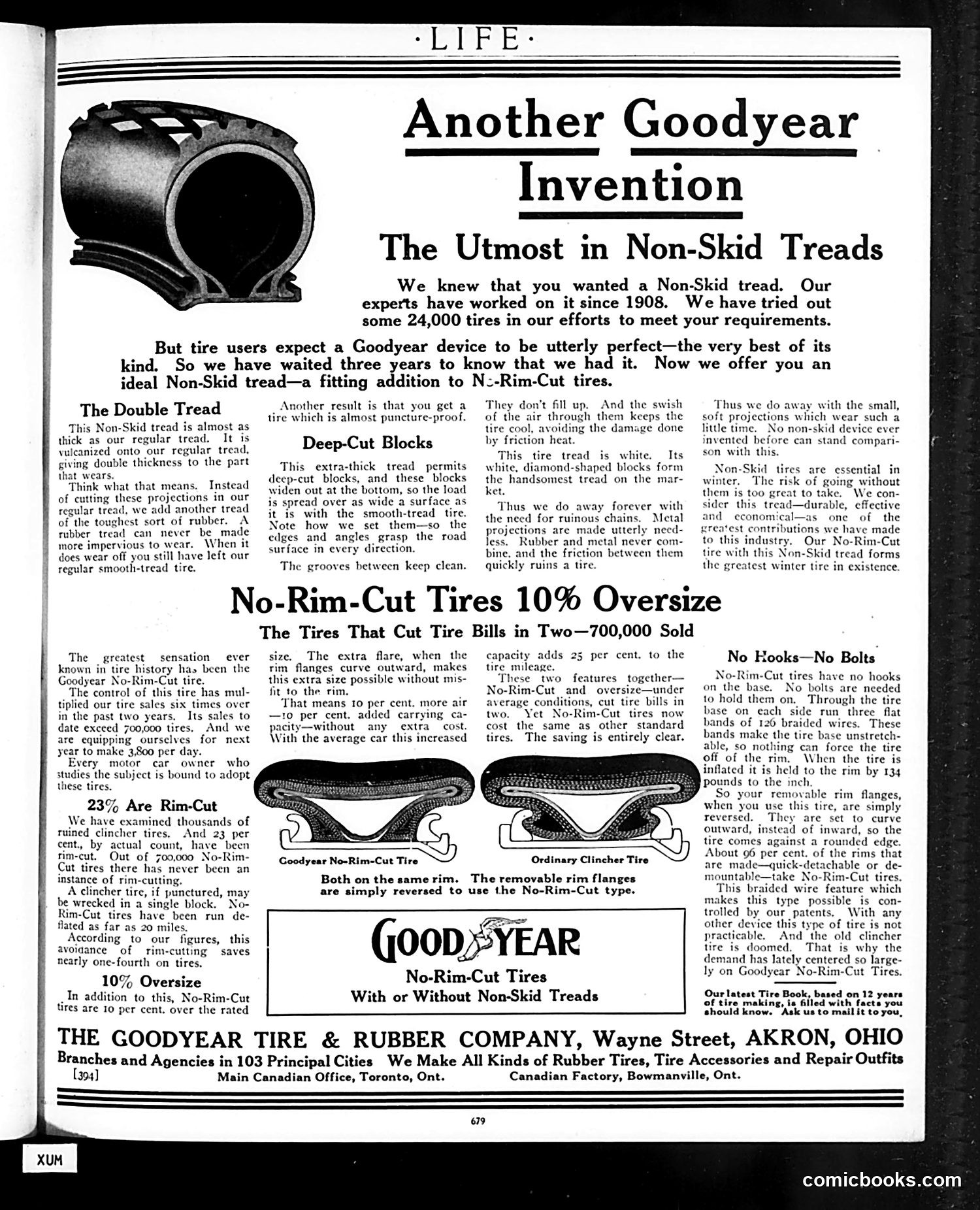
This is **not satire or a political cartoon** — it's a straightforward **product advertisement** for Goodyear tires, appearing in Life magazine (which published both humor and advertising). The page promotes Goodyear's "No-Rim-Cut" tire with its new "Non-Skid" tread design. The advertiser claims: - The tire prevents rim-cutting (damage from tire deflation), which they say affects 23% of competing "clincher" tires - Deep-cut tread blocks improve traction and durability - 10% oversizing increases air capacity and mileage without extra cost - No metal chains needed (relevant for winter driving) - 700,000 units already sold The diagrams compare Goodyear's removable-rim design to ordinary clincher tires. The text emphasizes extensive testing (24,000 tires) and manufacturing capacity (3,800 daily production). This represents early automotive advertising targeting car owners concerned with tire safety and economy—practical consumer messaging rather than satire.
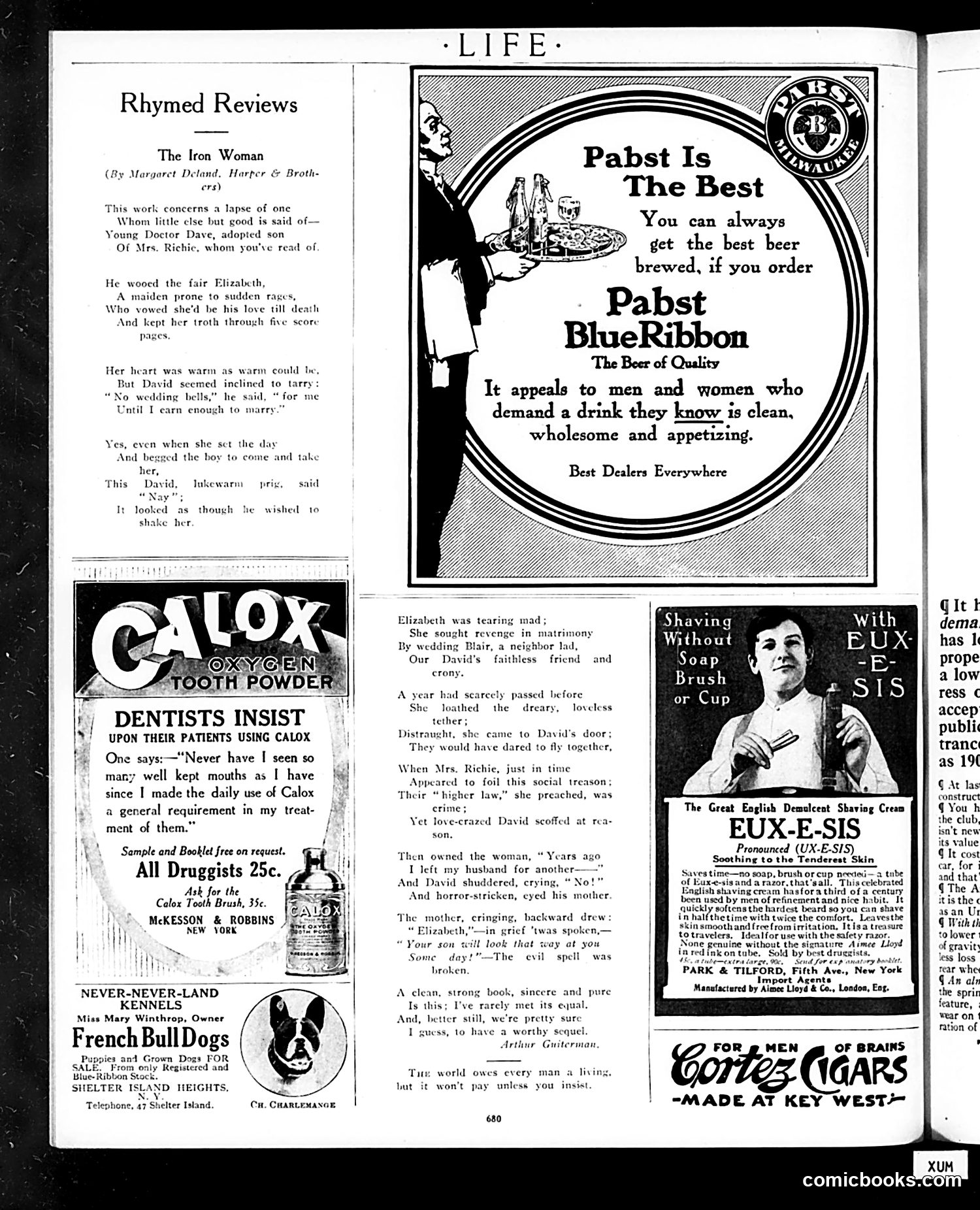
This page contains a **book review in verse** alongside period advertisements—not political cartoons per se, but reflecting early 20th-century consumer culture. **The Review:** Arthur Guiterman humorously summarizes Margaret Deland's novel *The Iron Woman*. The satire targets the protagonist David, a prudish, self-righteous doctor who refuses to marry Elizabeth until financially secure, then morally condemns her when she divorces another man and seeks reconciliation. Guiterman mocks David's hypocrisy and emotional coldness ("lukewarm prig"), suggesting the "iron woman" title ironically applies to Elizabeth's moral endurance rather than David's supposed virtue. **The Advertisements** reveal period values: dental hygiene products, French bulldogs, Pabst Blue Ribbon beer (marketed as "clean, wholesome"), and Eux-e-sis shaving cream. The beer ad notably addresses "men and women," somewhat progressive for the era. The page demonstrates how *Life* blended literary criticism with commercial culture—satirizing romantic melodrama while selling consumer goods as markers of respectability.
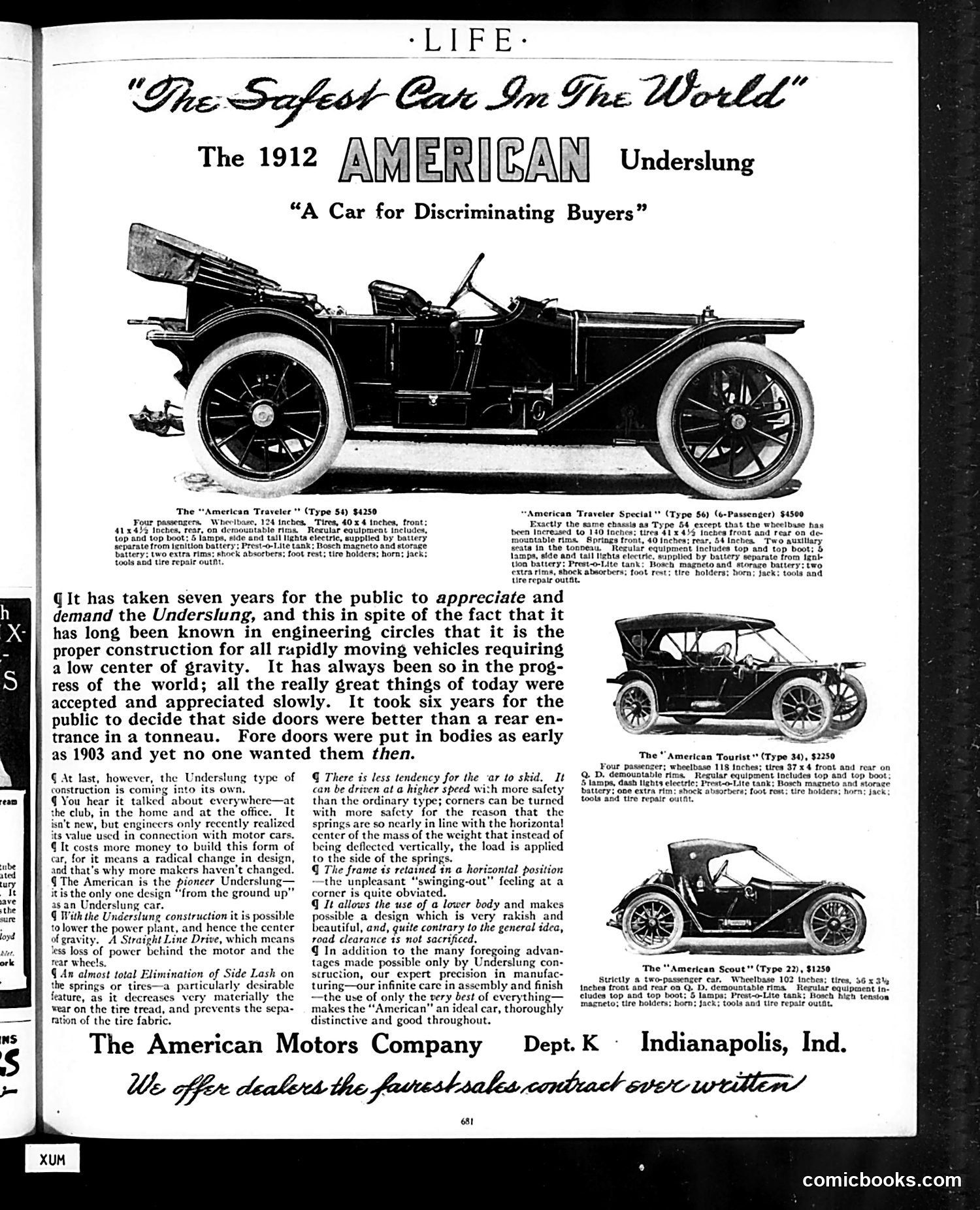
This page is **primarily an advertisement**, not a satirical cartoon. It promotes the 1912 American Underslung automobile, featuring three models with detailed specifications and pricing ($4,250-$4,500). The "satire" is subtle and implicit in the advertising copy itself: the text ironically acknowledges that truly superior engineering takes years for the public to accept. American Motors claims the Underslung design—lowering the car's center of gravity for safety and stability—was known to engineers for seven years before gaining public demand. The ad notes it took six years before people wanted side doors instead of rear entrances. **The point**: This is self-aware marketing that turns a liability (late adoption) into proof of the car's innovative superiority. By admitting the design's slow acceptance, American Motors positions itself as an engineering pioneer vindicated by eventual consumer recognition. The three illustrated car models demonstrate the design's versatility across price points for "discriminating buyers."
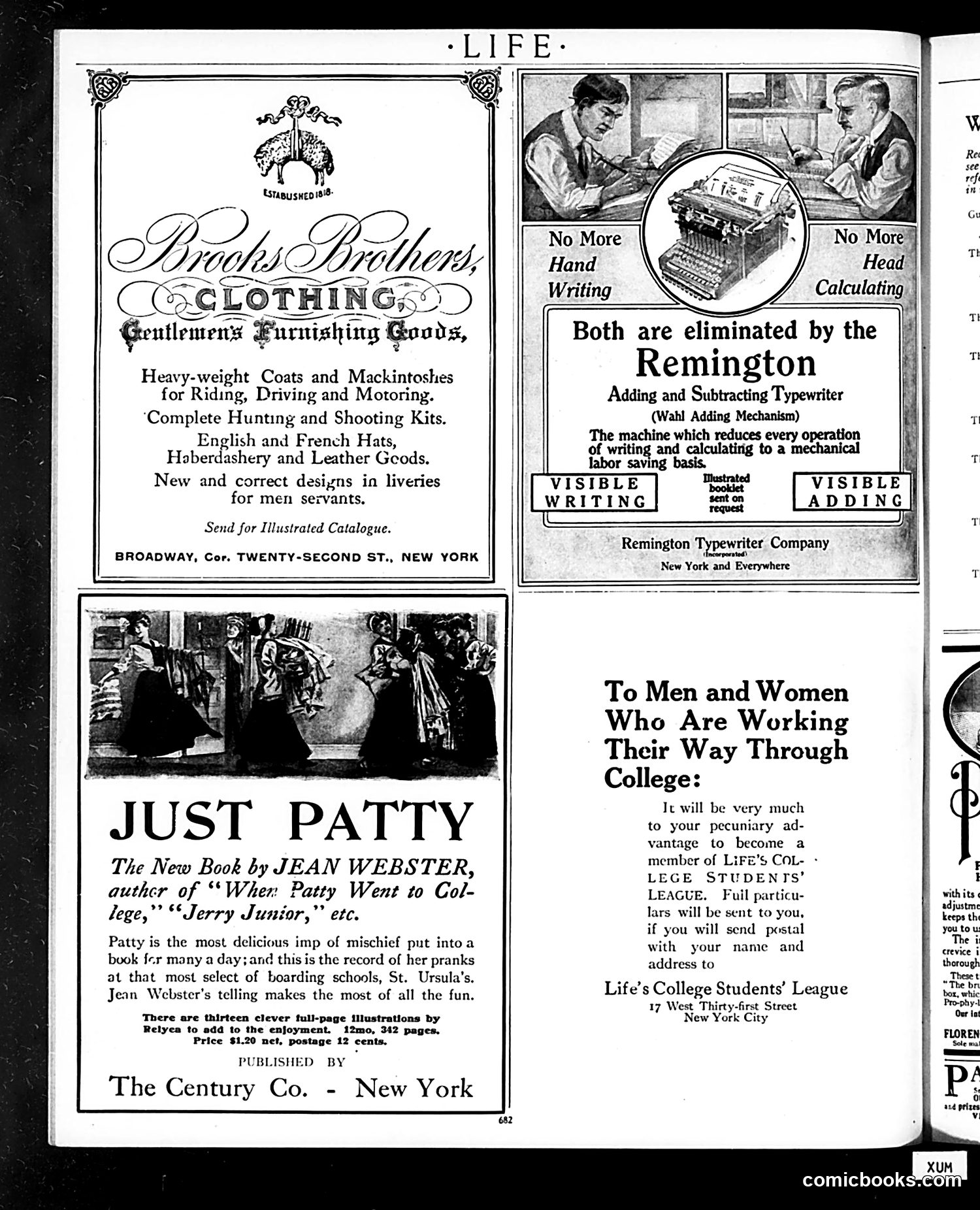
This page is primarily **advertising**, not satire or political commentary. It contains four distinct advertisements from what appears to be an early 1900s issue of *Life* magazine: 1. **Brooks Brothers** (top left): Clothing and gentlemen's furnishings advertisement 2. **Remington Typewriter** (top right): Promotes an "Adding and Subtracting Typewriter" as labor-saving technology, eliminating hand writing and mental calculation 3. **"Just Patty" book** (center): Jean Webster's novel about a mischievous girl at a boarding school, featuring humorous illustrations 4. **Life's College Students' League** (right): A membership organization offering advantages to working college students The only potential humor appears in the Remington ad's messaging about eliminating tedious mental work—reflecting early 20th-century optimism about mechanical efficiency. The page otherwise reflects period consumer culture and publishing interests rather than satirical commentary.
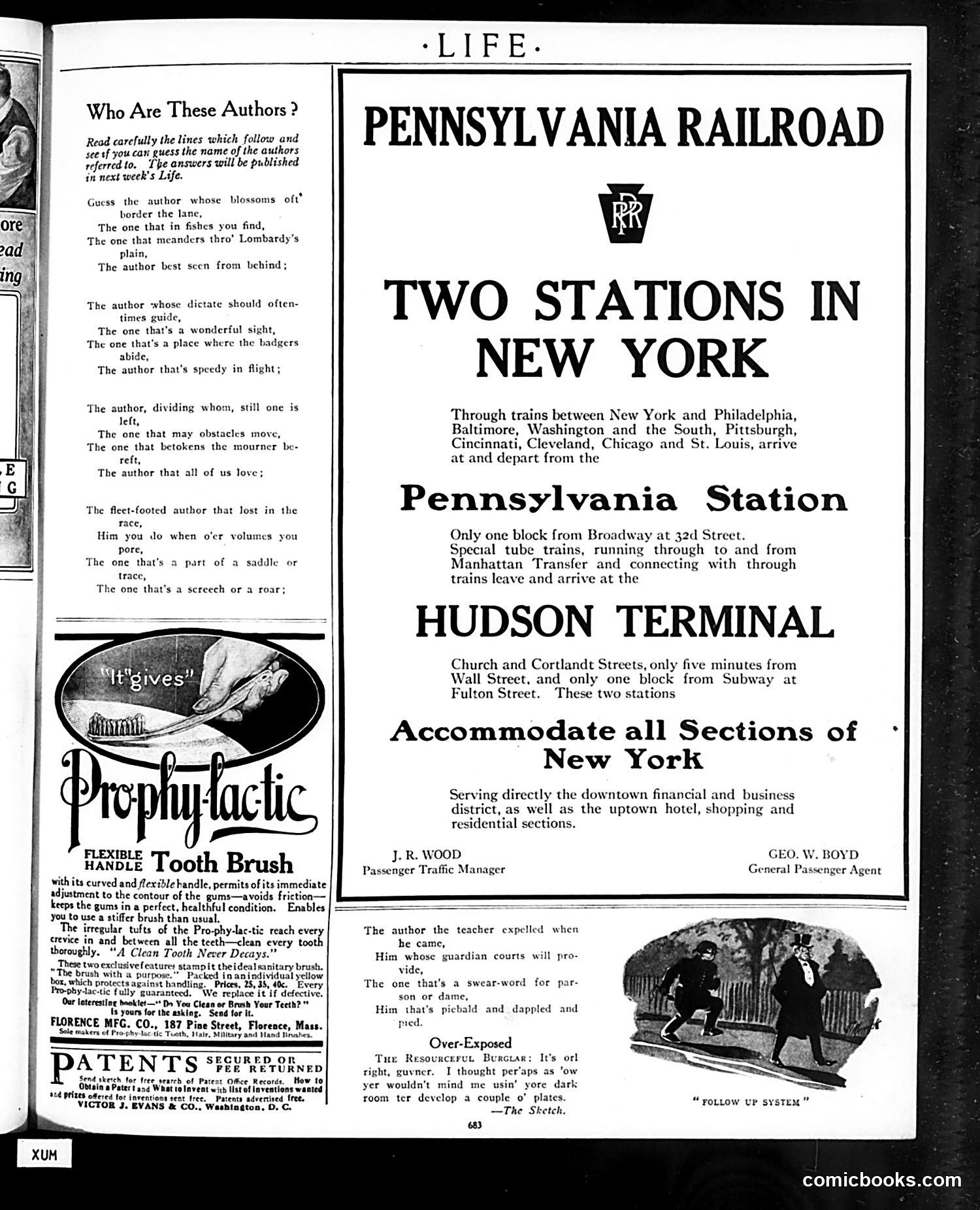
This is primarily a **advertisements and puzzle page** from Life magazine, not a political cartoon page. The main content is a riddle game titled "Who Are These Authors?" — readers guess literary figures from clever clues (e.g., "the author whose blossoms oft border the lane" = *Rose*; "the one best seen from behind" = *Bacon*). Answers would publish next week. The page also features advertisements: a **Pro-phy-lac-tic toothbrush** (promoting its curved handle and cleaning capability); a **patent search service**; and the **Pennsylvania Railroad**, advertising two New York stations and rail service to major cities. At bottom right is a small cartoon called "Over-Exposed" from *The Sketch* — a burglar asks permission to use someone's darkroom to develop photographs, a joke about audacious theft disguised as politeness. The page reflects early 1900s advertising and humor conventions rather than political satire.
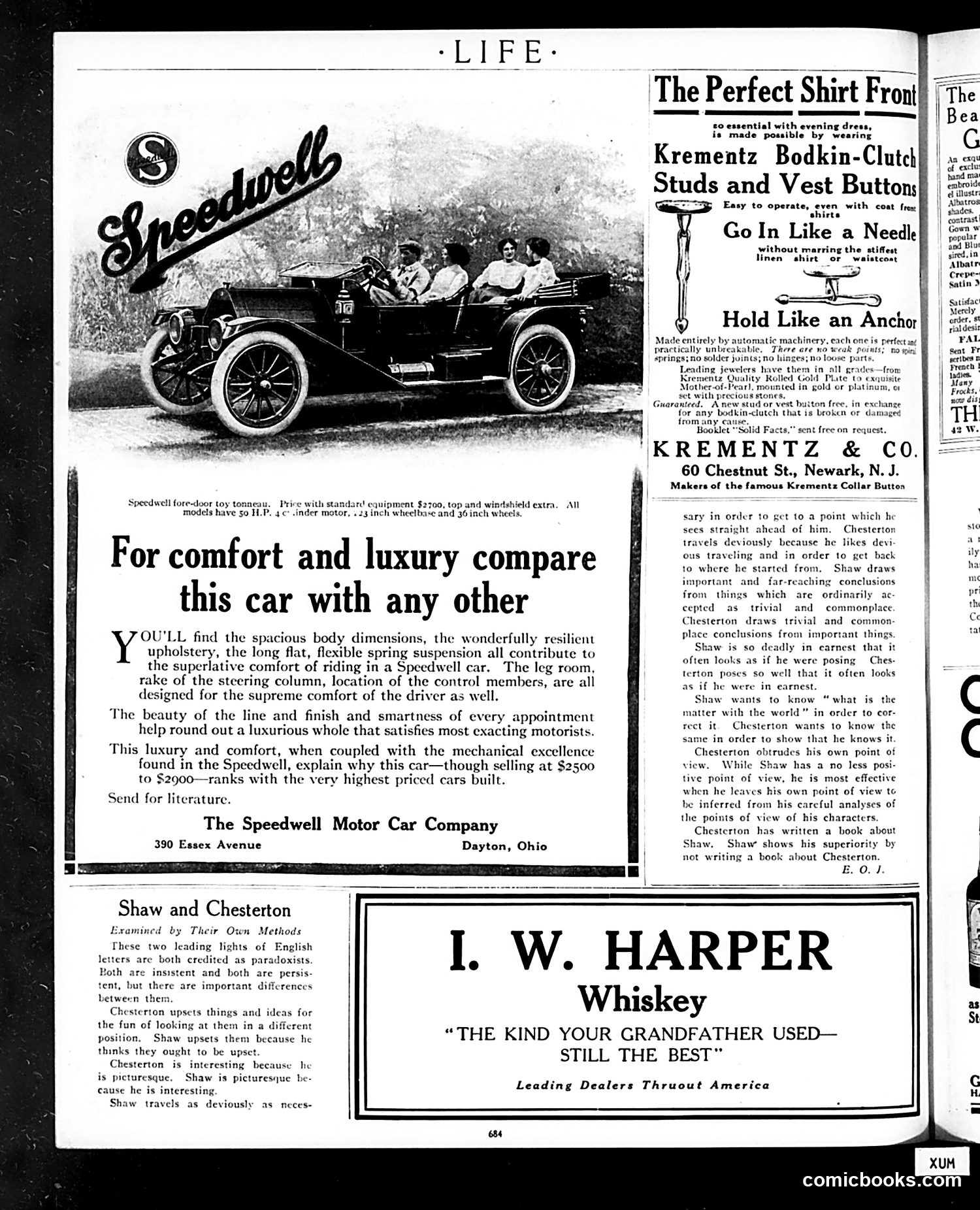
This page contains primarily **advertisements** rather than editorial cartoons. The main content includes ads for the Speedwell automobile, Krementz shirt studs/buttons, and I.W. Harper whiskey. The only satirical content is a short **comparative essay titled "Shaw and Chesterton: Examined by Their Own Methods."** This discusses two famous English writers—George Bernard Shaw and G.K. Chesterton—as paradoxists with contrasting personalities and approaches. The piece humorously catalogs their differences: Chesterton upsets ideas "for fun," while Shaw upsets them because he thinks they "ought to be"; Shaw is interesting because he travels deviously, while Chesterton travels deviously because he enjoys it; Shaw draws important conclusions from trivial things, while Chesterton does the reverse. The satire's final joke: Chesterton wrote a book about Shaw, but Shaw didn't bother writing one about Chesterton—demonstrating Shaw's superiority through restraint rather than retaliation.
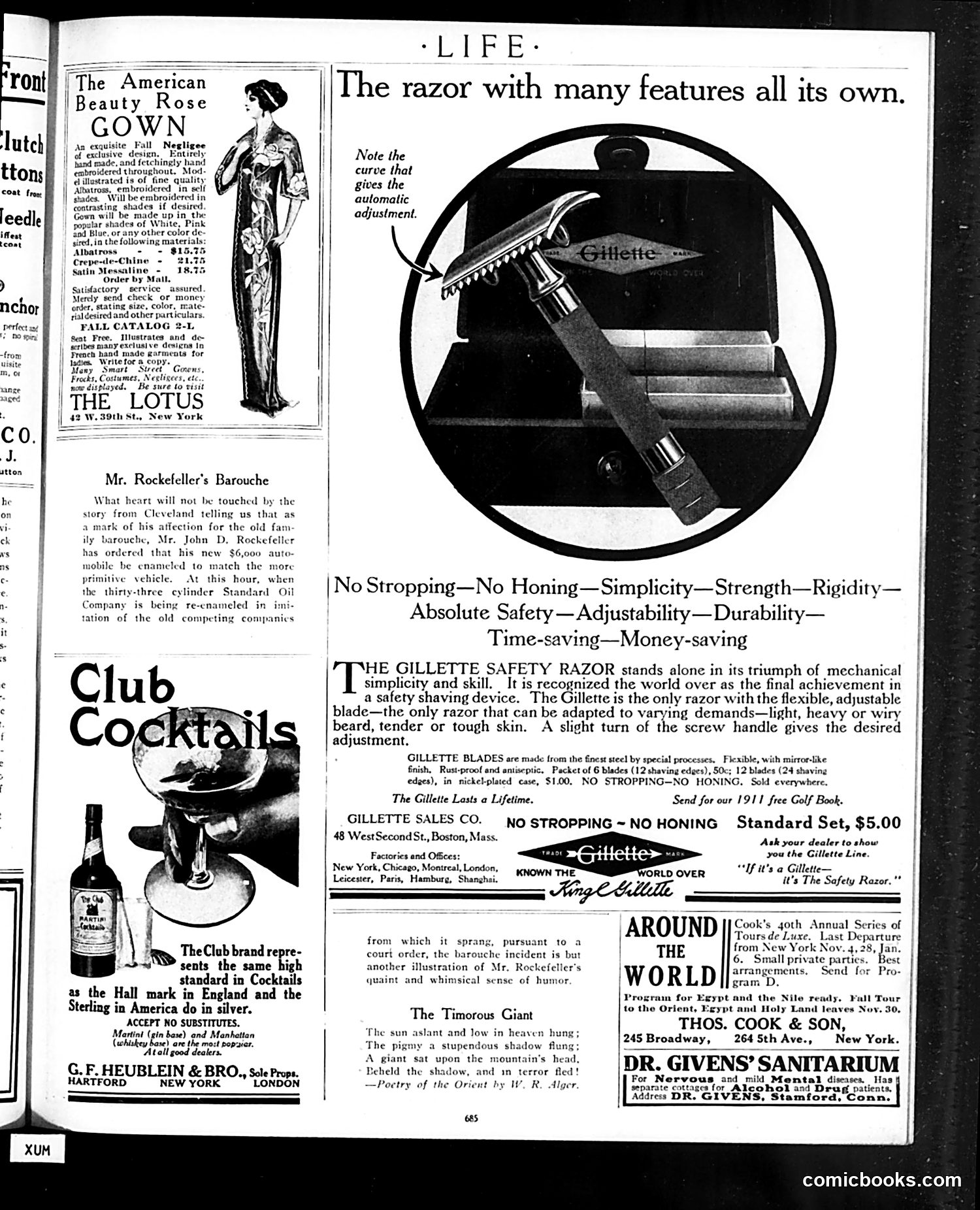
This page is primarily **advertisements** from a 1911 Life magazine, with one satirical item. The main satire appears in the "Mr. Rockefeller's Barouche" section: it mocks **John D. Rockefeller's** reported sentimentality. The joke is that this ruthless oil magnate—whose Standard Oil Company aggressively eliminated competitors—has ordered his new $6,000 automobile enameled to match his old family carriage out of "affection." The satire undercuts this touching gesture by noting it occurs while Standard Oil is being "re-enameled in imitation of the old competing companies," suggesting his nostalgia is hypocritical given his cutthroat business practices. The rest of the page features period advertisements for women's fashion (The Lotus gowns), cocktail mixers (Club brand), Gillette Safety Razors, travel services, and medicinal treatments—typical of early 20th-century magazine content. No political cartoons appear here.
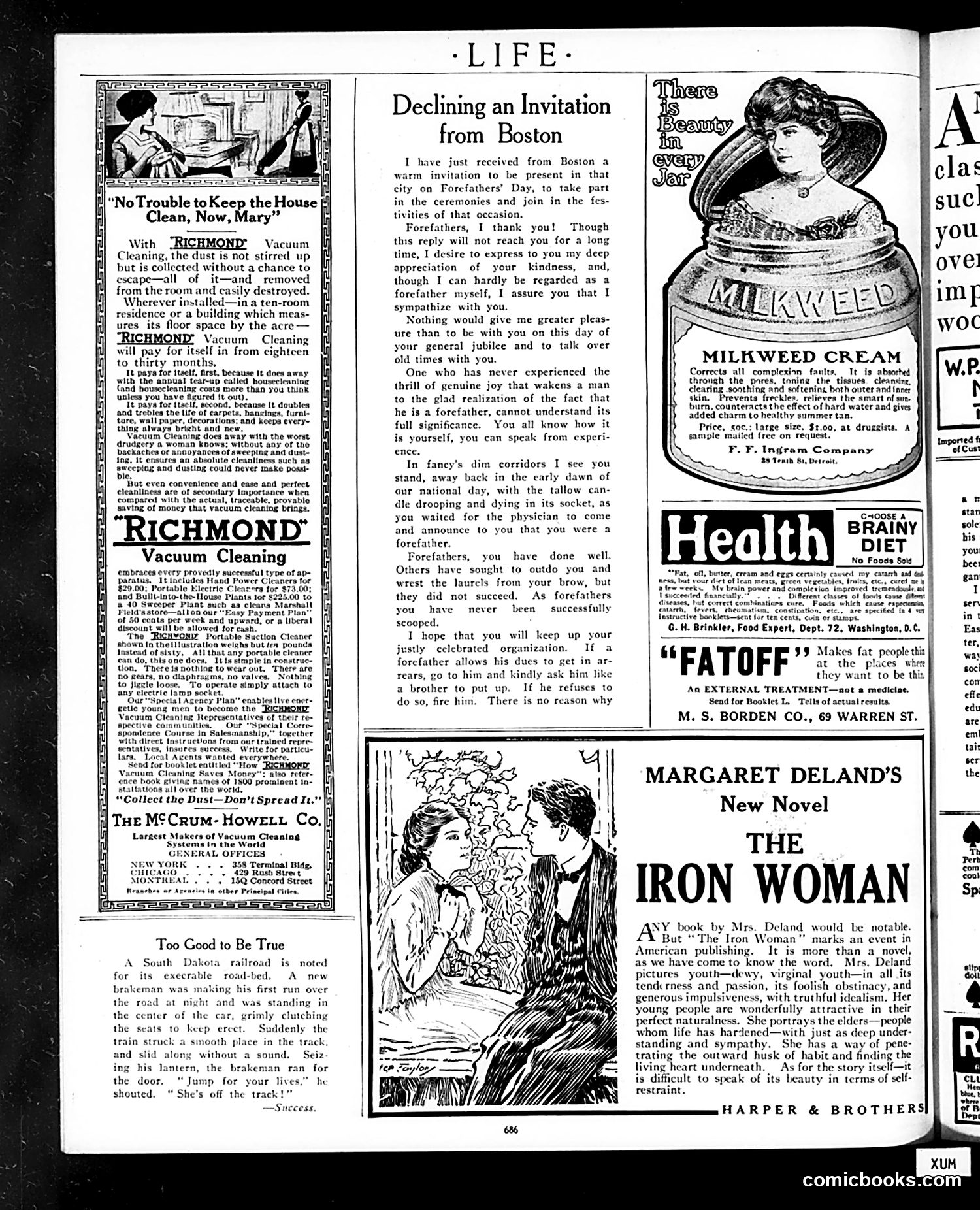
This is humorous mock-formal correspondence declining a Forefathers' Day invitation to Boston. The satire lies in the writer's extended, elaborate wordplay on the term "forefather"—treating it as an amusing personal achievement rather than a historical designation. The joke centers on the absurdity of nostalgic pride in ancestry: the writer pretends to envy those who can recall the exact moment they "became" a forefather (imagining them anxiously awaiting news from a physician), and congratulates them on their organization's success at remaining "forefathers" without being "scooped" (outdone). The piece gently mocks both the earnestness of New England heritage societies and the self-importance of their members. It's typical *Life* magazine satire—affectionate ridicule of American pretension and civic ritual, using exaggerated politeness and absurdist logic as comedic weapons.
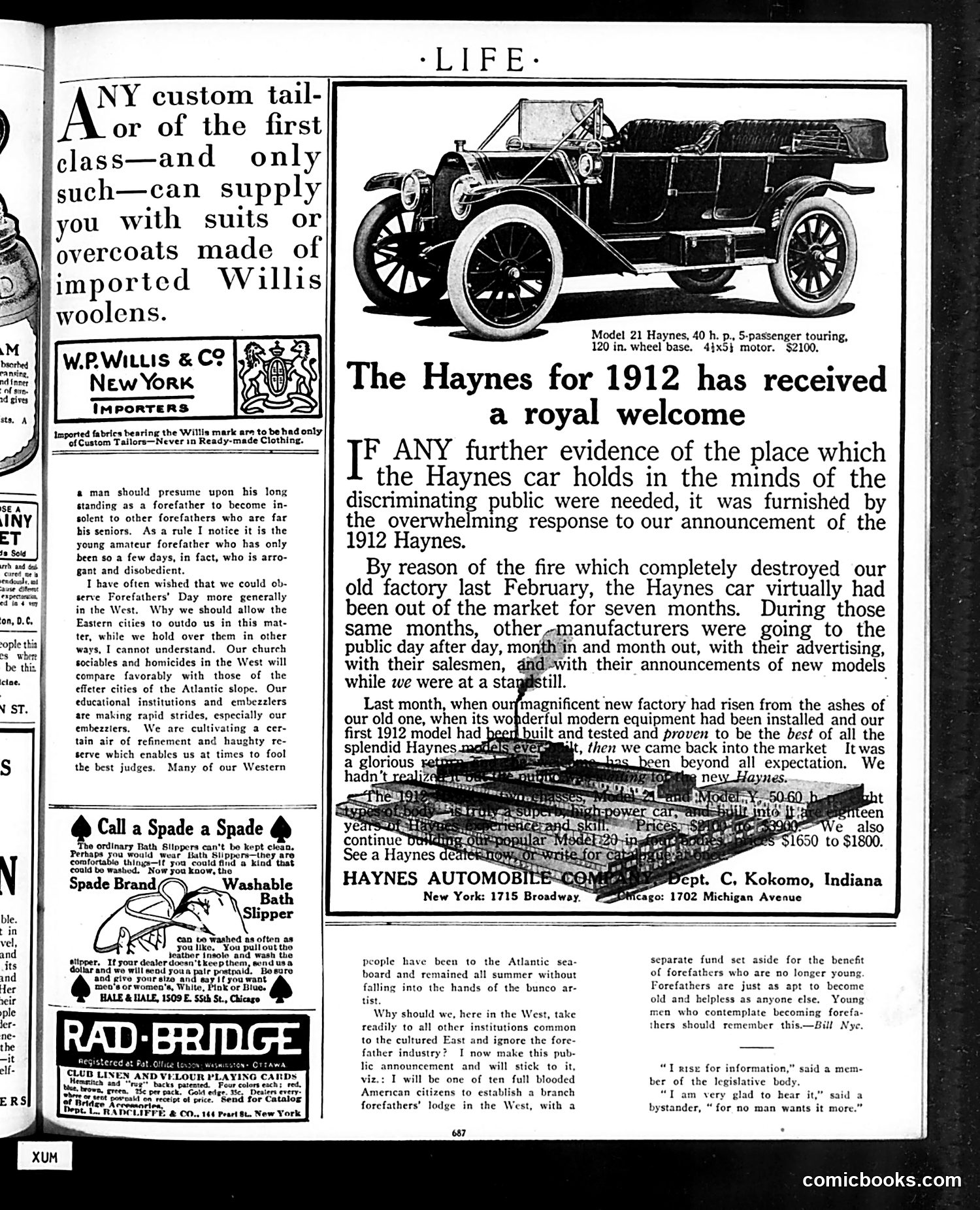
This page is primarily **advertising with satirical commentary**, not a political cartoon. The main content includes: 1. **Willis Woolens ad** (top left): A luxury tailoring firm advertising imported fabrics—standard early 1900s advertising. 2. **Haynes Automobile ad** (center/right): The dominant feature showcasing the 1912 Haynes Model 21 touring car, emphasizing its quality and market reception after the factory's February fire destroyed production. 3. **Satirical essay** (left column): Attributed to "Bill Nyc" (likely Bill Nye), this is humorous commentary on "Forefathers' Day," mocking young upstart citizens who presume superiority based on genealogy. Nye sarcastically suggests establishing "forefathers' lodges" in the West to rival Eastern traditions. 4. **Bath Slippers ad** (bottom left): "Call a Spade a Spade"—promoting washable slippers. The page reflects early 1900s consumer culture, regional East-West rivalry, and genteel humor rather than political satire.
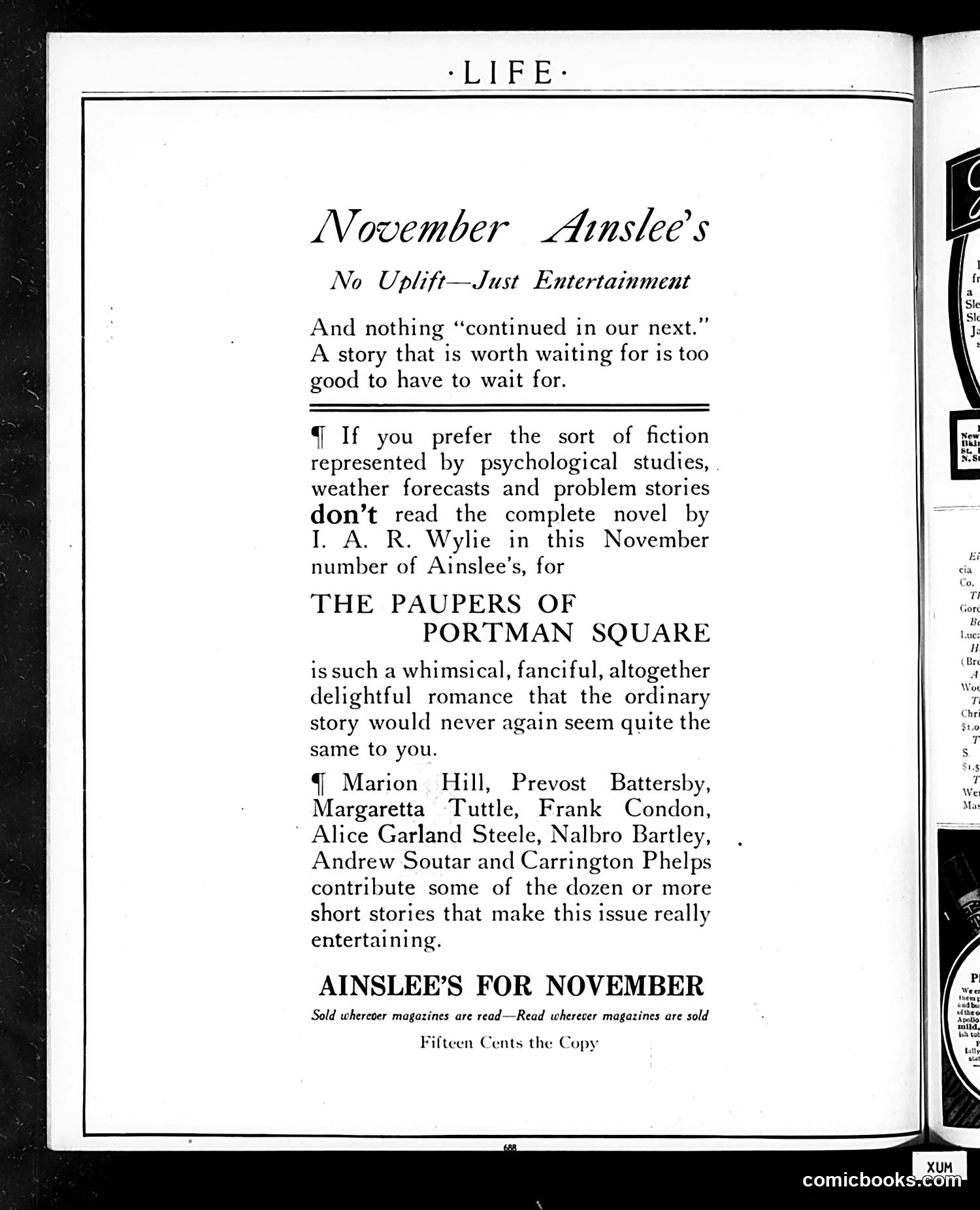
This is an advertisement for *Ainslee's* magazine's November issue, not a political cartoon. The page promotes the magazine's content by contrasting it with supposedly serious, "uplifting" fiction. The ad uses reverse psychology: it warns readers who enjoy "psychological studies, weather forecasts and problem stories" to *avoid* this issue because I.A.R. Wylie's novel "The Paupers of Portman Square" is too delightfully entertaining—so charming that ordinary stories will seem dull afterward. The satire targets pretentious, earnest fiction popular in the era (likely early 20th century). By sarcastically praising "uplift" and serious themes only to dismiss them, *Life* magazine positions *Ainslee's* as offering pure escapist pleasure instead. The listed contributing authors (Marion Hill, Margaretta Tuttle, etc.) were contemporary writers whose names would have signaled quality to readers of the time. The magazine cost fifteen cents and was widely available. This represents commercial advertising disguised as editorial commentary—using *Life's* satirical voice to sell a competitor's product.
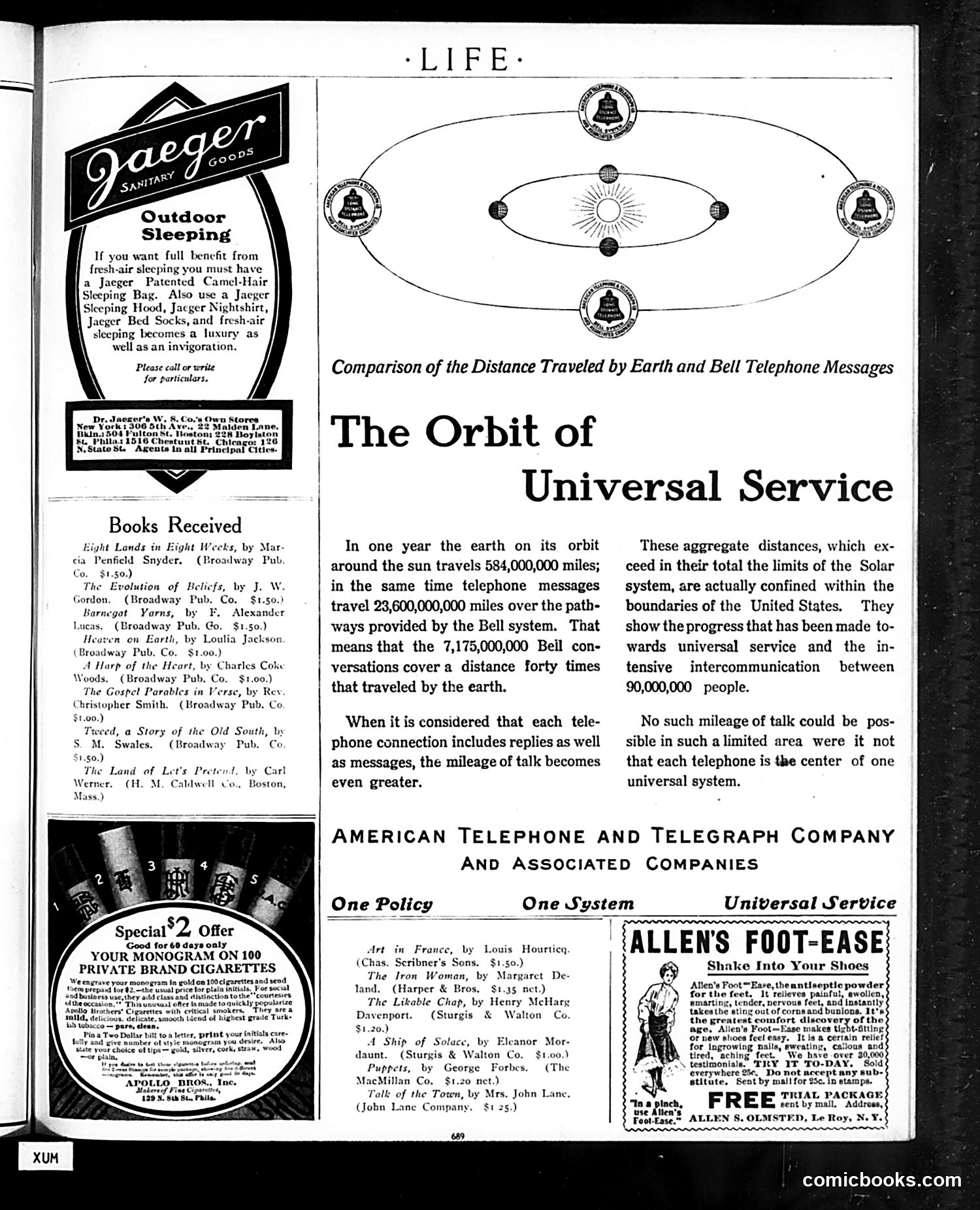
This page is primarily **advertising and editorial content**, not satire or political commentary. The main feature is a **Bell Telephone System advertisement** presenting statistics to promote "Universal Service." It uses a diagram comparing Earth's orbital distance (584 million miles annually) to telephone message distances (23.6 billion miles), arguing that Bell's infrastructure enables unprecedented communication across America's 90 million people. The implicit message: Bell's telephone network is as vast and essential as planetary motion. The page also contains: - A **Jaeger brand ad** for outdoor sleeping gear - A **books received** section listing recently published titles - **Apollo Bros. cigarette monogramming offer** - **Allen's Foot-Ease** powder advertisement There is **no identifiable political cartoon or satire** on this page. It represents typical early-20th-century magazine advertising mixed with literary notices—straightforward commercial and editorial material rather than humorous commentary.
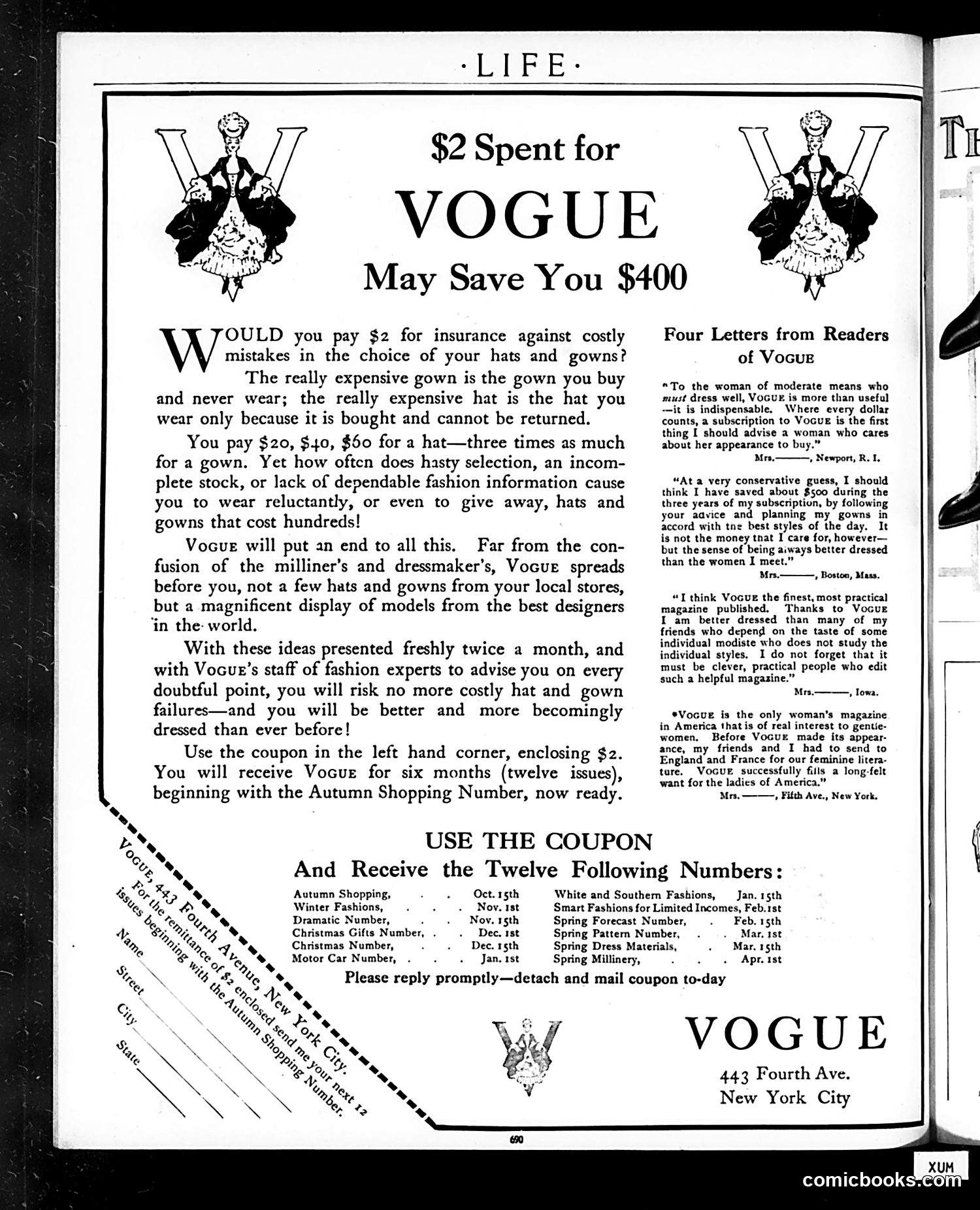
This is primarily a **subscription advertisement for Vogue magazine**, not a political cartoon. The page promotes a $2 subscription to Vogue for six months, framed as "insurance" against expensive fashion mistakes. The pitch claims that women waste hundreds of dollars on hats and gowns they never wear due to poor fashion choices. Vogue's "staff of fashion experts" would prevent costly errors by providing curated designs from "the best designers in the world." The "Four Letters from Readers" are testimonials—likely fabricated or selected—praising Vogue's practical value. One reader claims $500 savings; another appreciates that Vogue eliminates dependence on expensive dressmakers; a third notes it rivals European fashion magazines. The decorative **"V" logos** flanking the headline are Vogue's branding. The coupon offers twelve special issues covering seasonal fashion topics. This reflects early-20th-century consumer culture targeting middle-class women anxious about fashion propriety and wasteful spending.
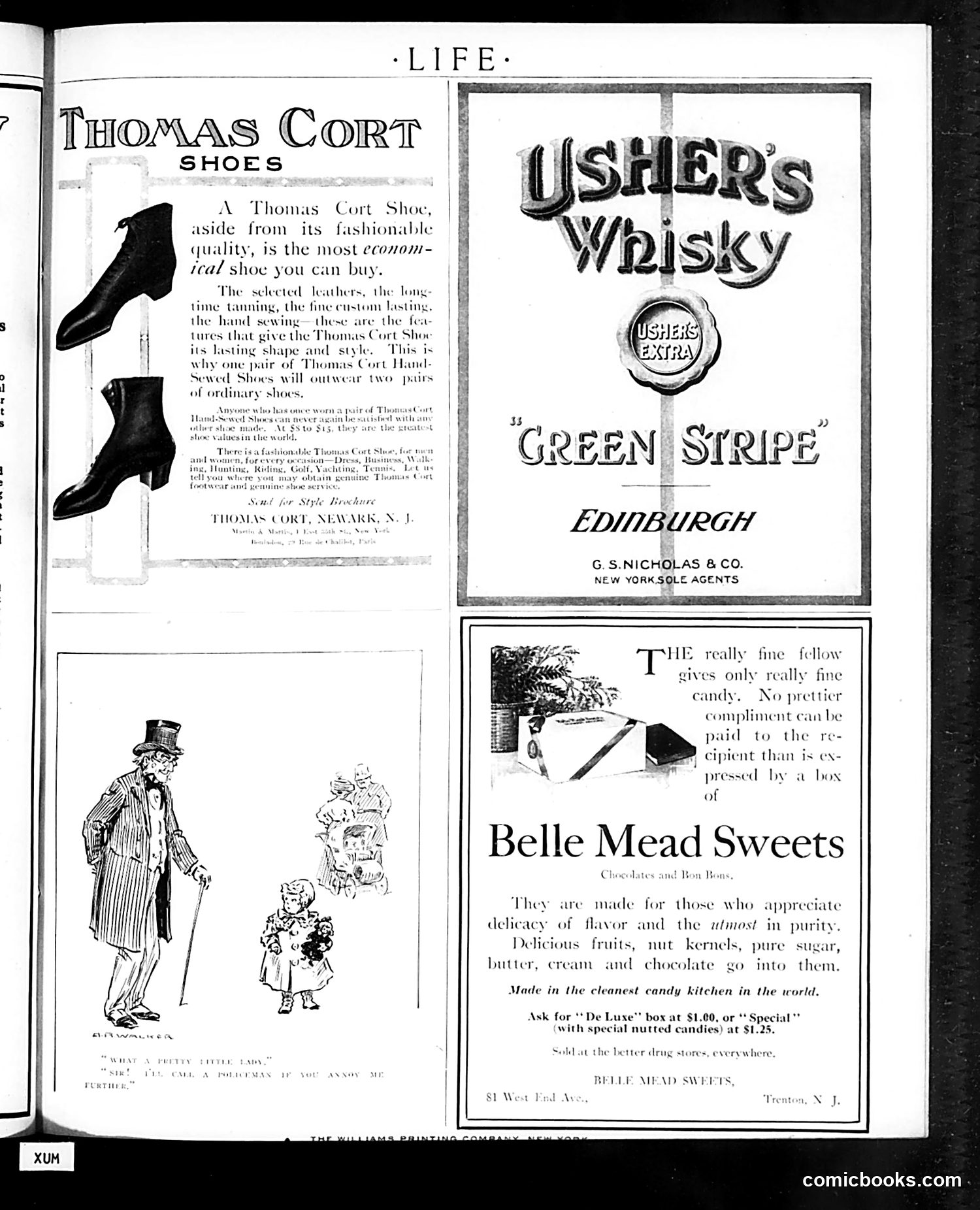
This page is primarily **advertising**, not political satire. It contains four distinct ads: 1. **Thomas Cort Shoes** (top left): Promotes hand-sewn shoes from Newark, N.J., emphasizing durability and value—claiming one pair outlasts two ordinary pairs. 2. **Usher's Whisky** (top right): Markets "Green Stripe" Edinburgh whisky through G.S. Nicholas & Co., the New York distributor. 3. **Untitled cartoon** (bottom left): A sketch showing a well-dressed man with a top hat and cane alongside children with flowers. The caption references calling a policeman, suggesting a humorous domestic or social scene—though the specific joke is unclear without fuller context. 4. **Belle Mead Sweets** (bottom right): Advertises chocolates and bon-bons, emphasizing purity, quality ingredients, and cleanliness of manufacture—standard luxury candy marketing for the era. The page reflects early 20th-century consumer advertising conventions, with one cartoon of indeterminate satirical intent.