
Life, 1911-10-19 · page 13 of 48
Life — October 19, 1911 — page 13: what you’re looking at
What you’re looking at
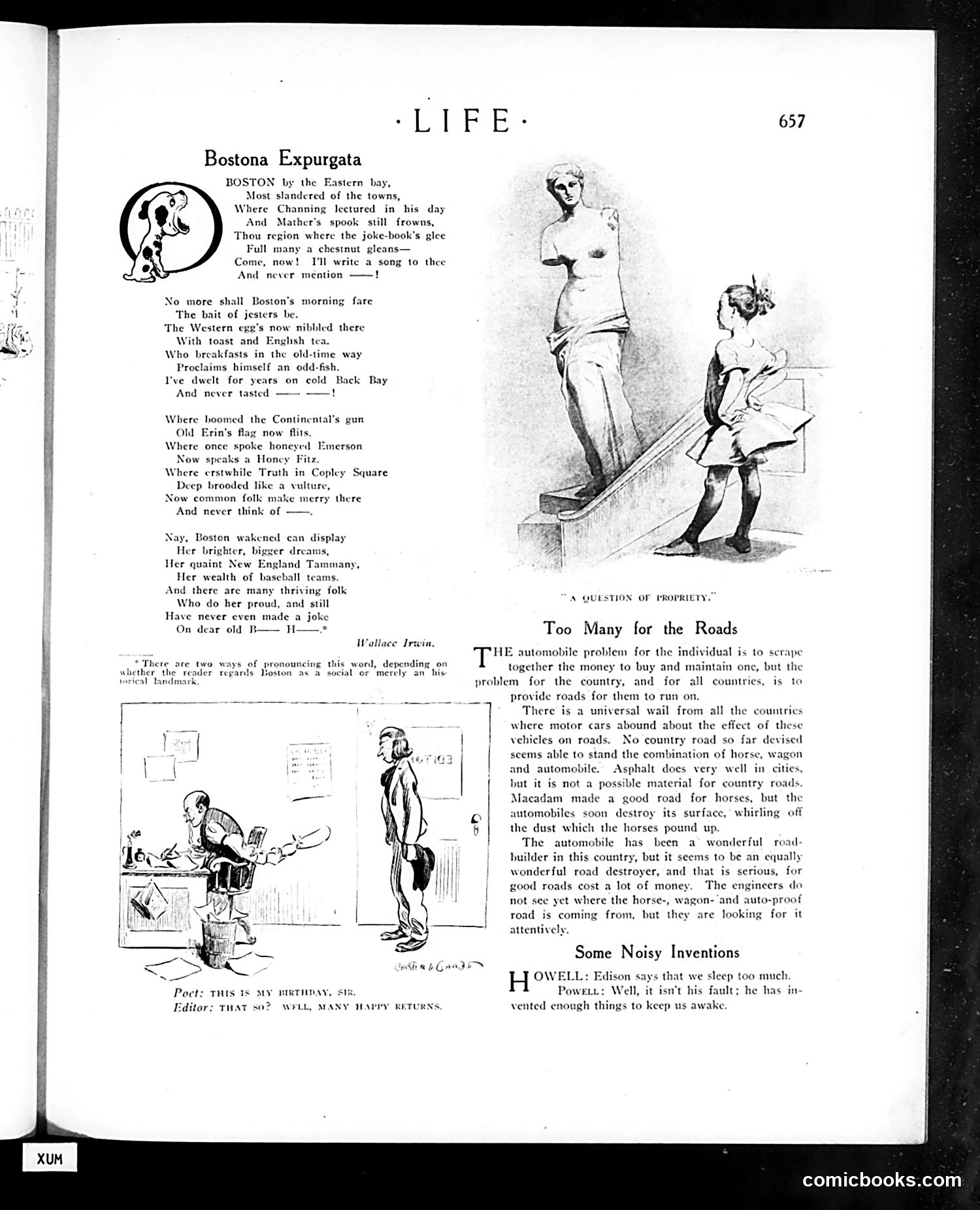
The page contains two distinct pieces: **"Bostona Expurgata"** (left): A poem by Wallace Irwin satirizing Boston's decline from its historical prominence. The verse laments that Boston no longer offers distinctive experiences—no more intellectual "jesters," distinctive cuisine, or cultural uniqueness. The opening illustration shows a dog, likely referencing Boston's "Brahmin" heritage. **"Too Many for the Roads"** (right): An article addressing automobile damage to country roads. It argues that while automobiles are "wonderful road-builders," they're equally "wonderful road-destroyers." The piece advocates for better road infrastructure to handle increased motor vehicle traffic, a pressing concern as automobile ownership was rapidly expanding in early 20th-century America. Both pieces reflect anxieties about modernization and social change.
📄 Transcribed text from this page (OCR, searchable)
Machine-transcribed from the original scan — historical spelling and the odd misread are preserved.
-LIFE- 657 | Bostona Expurgata BOSTON by the Eastern bay, Most slandered of the towns, F 3 Where Channing lectured in his day 7 4 And Mather's spook still frowns, Thou region where the joke-book’s glee Full many a chestnut gleans— Come, now! I'll write a song to thee And never mention ! No more shall Boston's morning fare ‘The bait of jesters be. The Western egg’s now nibbled there With toast and Enghsh tea. Who breakfasts in the old-time way Proclaims himself an odd-fish, I've dwelt for years on cold Back Bay And never tasted —— ——! Where hoomed the Continental's gun Old Erin's flag now fits. Where once spoke honeyed Emerson Now speaks a Honcy Where erstwhile Trath in Copley Square Deep brooded like a vulture, Now common folk make merry there And never think of itz Joston wakened can display ghter, bigger dreams, Her quaint New England Tammany, Her wealth of baseball teams. And there are many thriving folk Who do her proud, and still Have never even made a joke On dear old R—— H——.* Too Many for the Roads Wallace Irwin, “4 QUESTION OF FROPRIETY.” HE automobile problem for the individual is to sc ancl a6 two ways of pronouncing this work, depending on together the money to buy and maintain one, but the trical landmark, problem for the country, and for all countries, is to provide roads for them to run on. There is a universal wail from all the countries where motor cars abound about the effect of these vehicles on roads. No country road so far devised scems able to stand the combination of horse, w: and automobile. Asphalt does very well in cities, but it is not a possible material for country roads Macadam made a good road for horses, but the automobiles soon destroy its surface, whirling off the dust which the horses pound up. The automobile has been a wonderful road- builder in this country, but it seems to be an equally wonderful road destroyer, and that is serious, for good roads cost a lot of money. The engineers do not see yet where the horse-, wagon-'and auto-proof road is coming from, but they are looking for it attentively. on Some Noisy Inventions OWELL: Edison says that we sleep too much SIRTHDAY, S15 Powett: Well, it isn’t his fault; he has in- HAGPY RETURNS vented enough things to keep us awake. Shab GAAQ ES Poct: THIS is MY Editor: THAT so?) WFLL, MANY comicbooks.com