
Life, 1911-10-19 · page 17 of 48
Life — October 19, 1911 — page 17: what you’re looking at
What you’re looking at
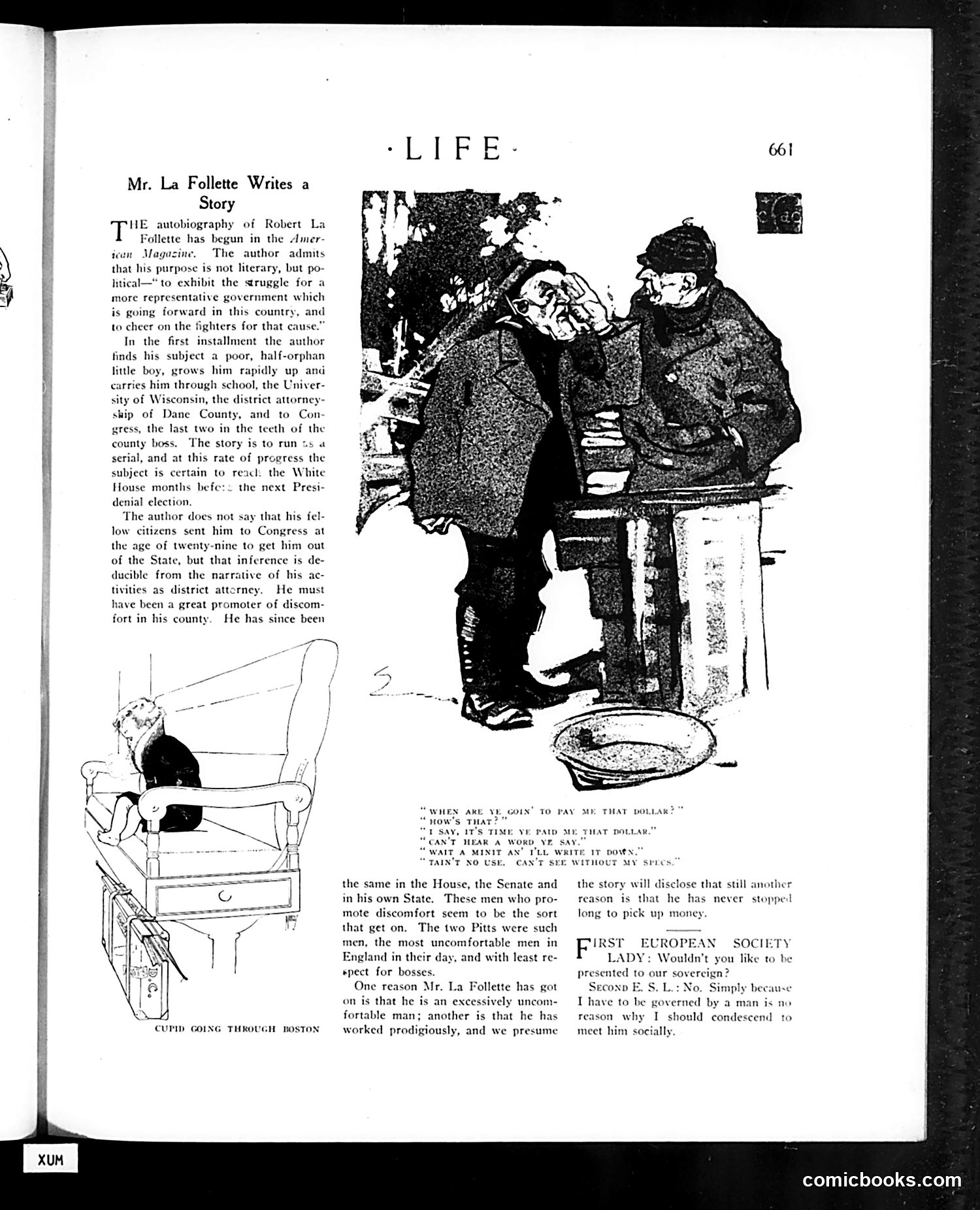
**Main Content: La Follette Biography Commentary** This article discusses Robert La Follette's autobiography serialized in American Magazine. Life satirizes La Follette's political narrative—presenting himself as a self-made man who rose from poverty through Wisconsin institutions despite corrupt "county bosses." The piece praises him as an "uncomfortable" reformer (like historical figures the Pitts), noting he succeeds through hard work rather than money-seeking. **Cartoons:** 1. **"Cupid Going Through Boston"** (lower left): A crude sketch showing Cupid attempting to collect payment from Boston residents, who claim poverty or inability to hear/see him. This appears to mock Boston's stinginess or indifference to sentiment. 2. **"First European Society Lady"** (lower right): A woman refuses presentation to a sovereign, arguing that being governed by a man doesn't obligate her to socialize with him—early feminist sentiment expressing resistance to male authority. Both cartoons use humor to critique social hypocrisy or rigid class/gender conventions.
📄 Transcribed text from this page (OCR, searchable)
Machine-transcribed from the original scan — historical spelling and the odd misread are preserved.
Mr. La Follette Writes a Story HE autobiography of Robert La Follette has begun in the Amer- ican Magazine, The author admits that his purpose is not literary, but po- htical— to exhibit the struggle for a more representative government which is going forward in this country, and to cheer on the fighters for that caus In the first installment the author finds his subject a poor, half-orphan little boy, grows him rapidly up and carries him through school, the Univer- sity of Wisconsin, the district attorney- ship of Dane County, and to Con gress, the last two in the teeth of the county boss. The story is to run serial, and at this rate of progress the subject is certain to reach the White House months befe: the next Presi- denial election The author does not say that his fel- low citizens sent him to Congress at the age of twenty-nine to get him out of the State, but that inference is de- ducible from the narrative of his ac- tivities as district attcrney. He must have been a great pr joter of discom- fort in his county. He has since been 7a) CUPID GOING THROUGH BOSTON WIN’ TO PAY “WHEN AKE Y “now's THAT I SAY, IT'S TIME YE PAID ME “TAIN'T NO USE. the same in the House, the Senate and in his own State. These men who pro- mote discomfort scem to be the sort that get on. The two Pitts were such men, the most uncomfortable men in England in their day, and with least re- spect for bosses. One reason Mr. La Follette has got on is that he is an excessively uncom- fortable man; another is that he has worked prodigiously, and we presume ME THAT poLLAR? THAT poLLaR.” CAN'T HEAR A WORD YE SAY.” AIT A MINIT AN’ I'LL WRITE CAN'T SEE WITHOUT MY sires.” IT poten.” the story will disclose that still another reason is that he has never stopped long to pick up money. IRST SOCIETY LADY: Wouldn't you like to be presented to our sovereign Seconn L.: No. Simply beeaure I have to be governed by a man is no reason why I should condescend to meet him socially. comicbooks.com