
Life, 1911-10-19 · page 22 of 48
Life — October 19, 1911 — page 22: what you’re looking at
What you’re looking at
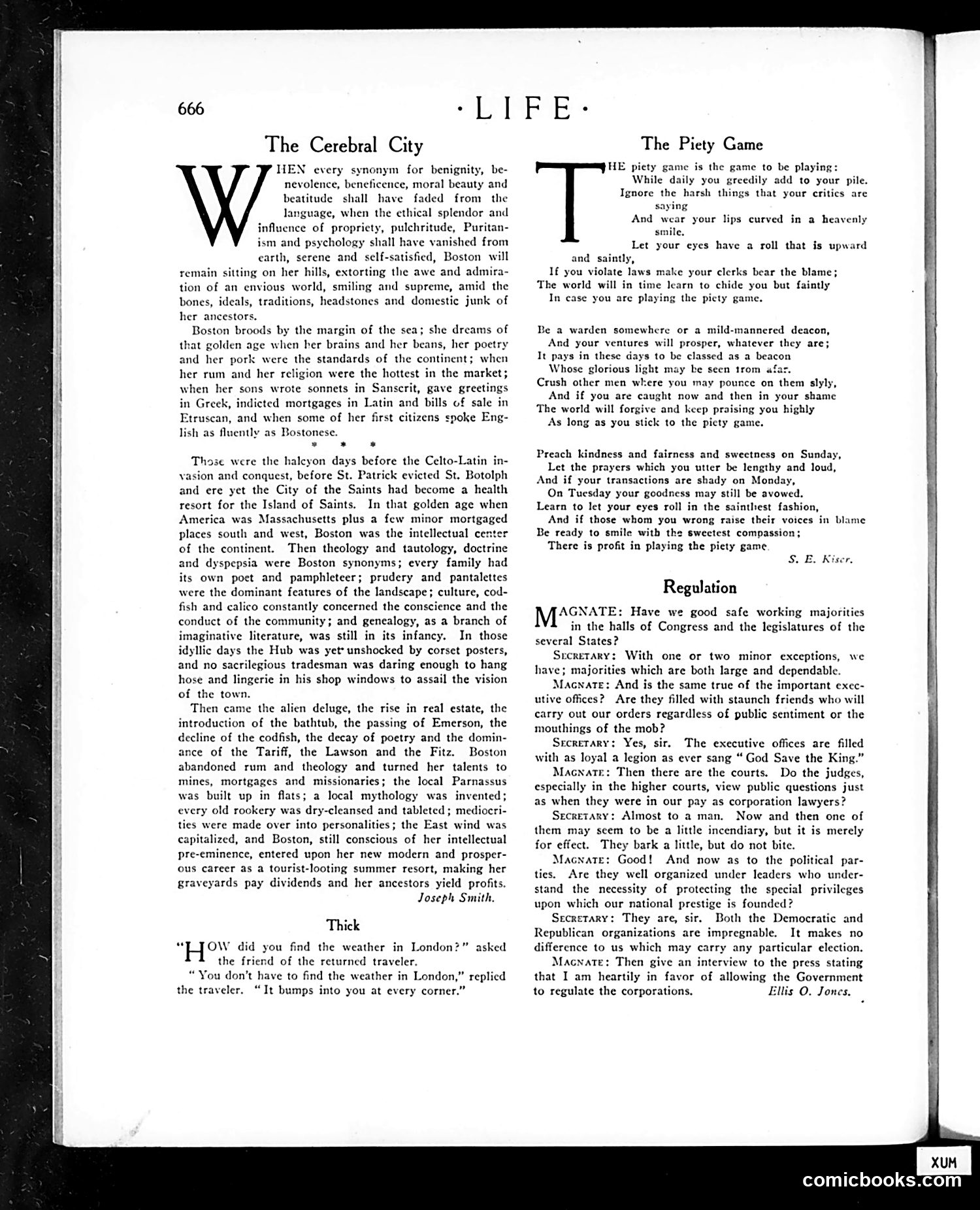
**"The Cerebral City"** is a scathing essay mocking Boston's self-regard. The piece sarcastically celebrates Boston's past intellectual dominance—when its citizens wrote in Sanskrit and Greek—then laments its decline after Irish Catholic immigration ("Celto-Latin invasion"). The satire targets Boston's nostalgia and pretension: the city clings to ancestral glory while becoming a commercialized tourist trap, monetizing its graveyards and "ancestors yield profits." Author Joseph Smith uses exaggerated praise to expose the city's hypocrisy and obsolescence. **"The Piety Game"** is a cynical poem exposing wealthy businessmen's moral hypocrisy. The satire advises readers to mask greed with religious performance—adopting pious expressions, becoming deacons or wardens, while exploiting workers and violating laws (blaming subordinates). The joke: respectability and wealth matter more than actual virtue; society forgives the wealthy's sins if they maintain pious appearances. Both pieces critique American society's gap between stated values and actual behavior.
📄 Transcribed text from this page (OCR, searchable)
Machine-transcribed from the original scan — historical spelling and the odd misread are preserved.
ASPB « The Cerebral City HEN every synonym for benignity, be- nevolence, beneficence, moral beauty and beatitude shall have faded from the language, when the ethical splendor and influence of propriety, pulchritude, Puritan- ism and psychology shall have vanished from earth, serene and self-satisfied, Boston will remain sitting on her hills, extorting the awe and admira- tion of an envious world, smiling and supreme, amid the bones, ideals, traditions, headstones and domestic junk of her ancestors, Boston broods by the margin of the sea; she dreams of that golden age when ber brains and her beans, her poetry and her pork were the standards of the continent; when her rum and her religion were the hottest in the market; when her sons wrote sonnets in Sanscrit, gave greetings in Greek, indicted mortgages in Latin and bills of sale in Etruscan, and when some of her first citizens spoke Eng- lish as fluently as Bostonese. . 8 8 Those were the halcyon days before the Celto-Latin in- vasion and conquest, before St. Patrick evicted St. Botolph and ere yet the City of the Saints had become a health resort for the Island of Saints. In that golden age when America was Massachusetts plus a few minor mortgaged places south and west, Boston was the intellectual center of the continent. Then theology and tautology, doctrine and dyspepsia were Boston synonyms; every family had its own poet and pamphleteer; prudery and pantalettes were the dominant features of the landscape; culture, cod- fish and calico constantly concerned the conscience and the conduct of the community; and genealogy, as a branch of imaginative literature, was still in its infancy. In those idyllic days the Hub was yet’ unshocked by corset posters, and no sacrilegious tradesman was daring enough to hang hose and lingerie in his shop windows to assail the vision of the town. Then came the alien deluge, the rise in real estate, the introduction of the bathtub, the passing of Emerson, the decline of the codfish, the decay of poetry and the domin- ance of the Tariff, the Lawson and the Fitz. Boston abandoned rum and theology and turned her talents to mines, mortgages and missionaries; the local Parnassus was built up in flats; a local mythology was invented; every old rookery was dry-cleansed and tableted ; mediocri- ties were made over into personalities; the East wind was capitalized, and Boston, still conscious of her intellectual pre-eminence, entered upon her new modern and prosper- ous career as a tourist-looting summer resort, making her graveyards pay dividends and her ancestors yield profits. Joseph Smith. Thick OW did you find the weather in London?” asked the friend of the returned traveler. “You don’t have to find the weather in London,” replied the traveler. “It bumps into you at every corner. The Piety Game HE piety game is the game to be playing: While daily you greedily add to your pile. Ignore the harsh things that your critics are saying And wear your lips curved in a heavenly smile. Let your eyes have a roll that is upward and saintly, If you violate laws make your clerks bear the blame; The world will in time learn to chide you but faintly In case you are playing the picty game. Be a warden somewhere or a mild-mannered deacon, And your ventures will prosper, whatever they are; It pays in these days to be classed as a beacon Whose glorious light may ke seen trom afar. Crush other men wkere you may pounce on them slyly, And if you are caught now and then in your shame The world will forgive and keep praising you highly As long as you stick to the picty game. Preach kindness and fairness and sweetness on Sunday, Let the prayers which you utter be lengthy and loud, And if your transactions are shady on Monday, On Tuesday your goodness may still be avowed. Learn to let your eyes roll in the sainthest fashion, And if those whom you wrong raise their voices in blame Be ready to smile with the sweetest compassion; There is profit in playing the piety game Regulation AGNATE: Have we good safe working majorities in the halls of Congress and the legislatures of the several States? Secretary: With one or two minor exceptions, we have; majorities which are both large and dependable. Macnate: And is the same true of the important exec- utive offices? Are they filled with staunch friends who will carry out our orders regardless of public sentiment or the mouthings of the mob? Secretary: Yes, sir, The executive offices are filled with as loyal a legion as ever sang “ God Save the King.” Macnate: Then there are the courts. Do the judges, especially in the higher courts, view public questions just as when they were in our pay as corporation lawyers? Secretary: Almost to a man. Now and then one of them may scem to be a little incendiary, but it is merely for effect. They bark a little, but do not bite. Macnate: Good! And now as to the political par- ties. Are they well organized under leaders who under- stand the necessity of protecting the special privileges upon which our national prestige is founded? Secretary: They are, sir. Both the Democratic and Republican organizations are impregnable. It makes no difference to us which may carry any particular election. Macnate: Then give an interview to the press stating that I am heartily in favor of allowing the Government to regulate the corporations, Ellis O. Jones. comicbooks.co