
Life, 1911-10-19 · page 19 of 48
Life — October 19, 1911 — page 19: what you’re looking at
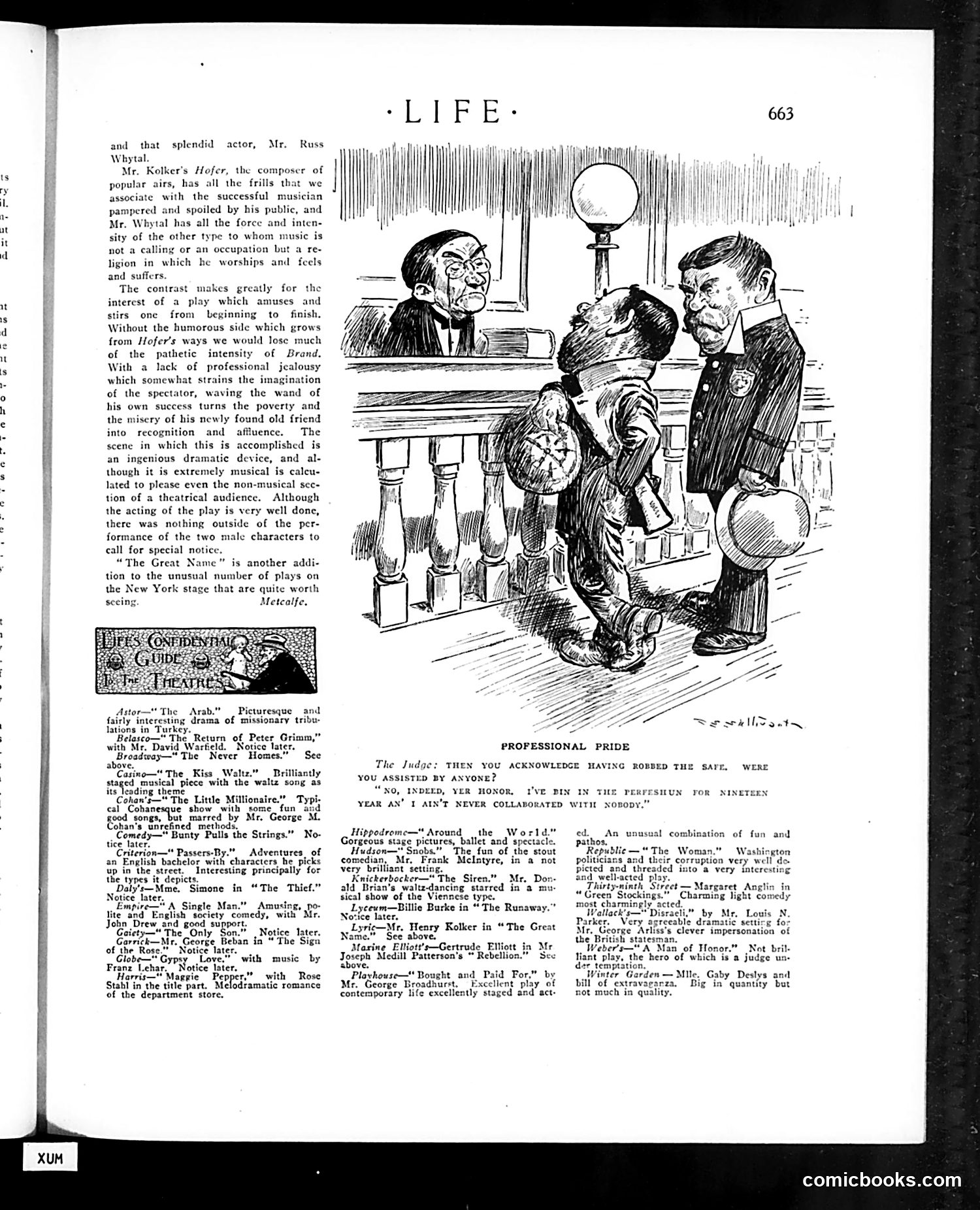
What you’re looking at
The central cartoon, titled "Professional Pride," depicts a judge questioning a defendant who has been caught robbing a safe. The defendant protests his innocence by claiming he's never "collaborated with nobody"—implying the robbery required assistance, which he denies having received. The satire targets criminal pride and professional standards even among thieves. The joke hinges on the defendant's refusal to implicate accomplices, presenting this as a matter of personal honor or professional integrity. It's darkly comic commentary on how criminals maintain their own code of conduct: even when caught, they won't betray associates. The caricatured facial features and exaggerated expressions are typical of Life magazine's satirical style. The humor derives from the absurdity of applying concepts like professional dignity to criminal enterprise—the irony that a robber would draw ethical lines about collaboration.
📄 Transcribed text from this page (OCR, searchable)
Machine-transcribed from the original scan — historical spelling and the odd misread are preserved.
ry 1. 1 at : and that splendid actor, Mr. Russ Whytal. Mr. Kolker’s Hofer, the composer of has all the frills that we with the successful musician spoiled by his public, and 1 has all the force and inte | , sity of the other type to whom music is not a call or an occupation but a re- ligion in which he worships and fcels and suffers. The contrast makes greatly for the interest of a play which amuses and stirs one from beginning to finish, Without the humorous side which grows from Hofer’s ways we would lose much of the pathetic intensity of Brand. With a lack of professional jealousy which somewhat strains the imagination of the spectator, waving the wand of his own success turns the poverty and the misery of his newly found old friend | into recognition and affluence. The j scene in which this is accomplished is 1 an ingenious dramatic device, and al- } though it is extremely musical is caleu- lated to please even the non-musical see- tion of a theatrical audience. Although the acting of the play is very well done, there was nothing outside of the per- formance of the two male characters to call for special notice. The Great Name” is another addi- tion to the unusual number of plays on the New York stage that are quite worth Metcalfe. Astor—"The Arab.” __ Picturesque fairly interesting drama of missionary tribu- lations in Turkey. Belasco— The Return of Peter Grimm,” with Mr. Day Warfield. Notice later. sBroadivay—" The Never Hom a above. Casino— The Kiss Waltz.” Brilliantly aged [musical piece with the waltz song as its leading theme . Cohan's—" The Little Millionaire.” Typi. cal Cohanesque show with some fun ax gongs, but marred by Mr. George M. ‘ohan’s unrefined methods, Comedy—" Bunty Pulls the Strings.” No- tice later, Criterion—"* Passers-By." Adventures of an English bachelor with characters he picks up in the street. Interesting principally for the types it depicts. ‘i Daly's—Mme, Simone in “The Thief. Notice later, . "Empire—" A Single Man.” Amusing, po- lite and English society comedy, with’ Mr. John Drew and good support," Gaiety—" The Only Son.” Notice later. Garrick—Mr. George Beban ia “ The Sign of the Rose." Notice later. Globe—" Gypsy Love.” with music by Franz Lehar. Notice later. Harris—" Maggie Pepper,” with Rose Stabl in the title part. Melodramatic romance ‘of the department store. PROFESSIONAL PRIDE The Judge: you assis: “ INDEED, YER HONOR, THEN Hippodrome—" Around the Worl Gorgeous stage pictures, ballet and spectacl Hudson—" Snobs." The fun of the st comedian, Mr, Frank Melntyre, in a not very brilliant setting. Mr. D Knickerbocker—* The Siren.” ald Brian’s waltz-dancing starred in a sical show of the Viennese type. Lyceum—Billie Burke in “ The Runaway.” Nosice later. Lyric—Mr. Henry Kolker in “The Great Name.” See above. Marine Elliott’s—Gertrude Elliott in Mr Joseph Medill Patterson's “ Rebellion.” See above. Playhouse— Bought and Paid For,” by Mr. George Broadhurst. Excellent play of conteraporary life excellently staged and act- YOU ACKNOWLEDGE MAVING ROBBED THE Sarr. ve BIN I AIN'T NEVER COLLABORATED WITIE NOBODY. WERE IN THE PERFESMUN FOR NINETERN ed. An unusual combination of fun and pathos, Republic —“ The Woman.” — Washirg politicians and their corruption very well picted and threaded into a very intere and well-acted play. Thirty-ninth “ Green Stockings.”” most charmingly acted. Wellack’s—“ Disraeli.” by Mr, Louis N. Parker. Very agreeable dramatic settirg fo7 Mr. George Arliss’s clever impersonation of the British statesman. _Weber’s—" A Man of Honor.” Not b Tiant play, the hero of which is a judge der temptation, “Winter Garden — Mlle, Gaby Deslys and Dill of extravaganza, Big in quantity but not much in quality. comicbooks.com