
Life, 1911-10-19 · page 18 of 48
Life — October 19, 1911 — page 18: what you’re looking at
What you’re looking at
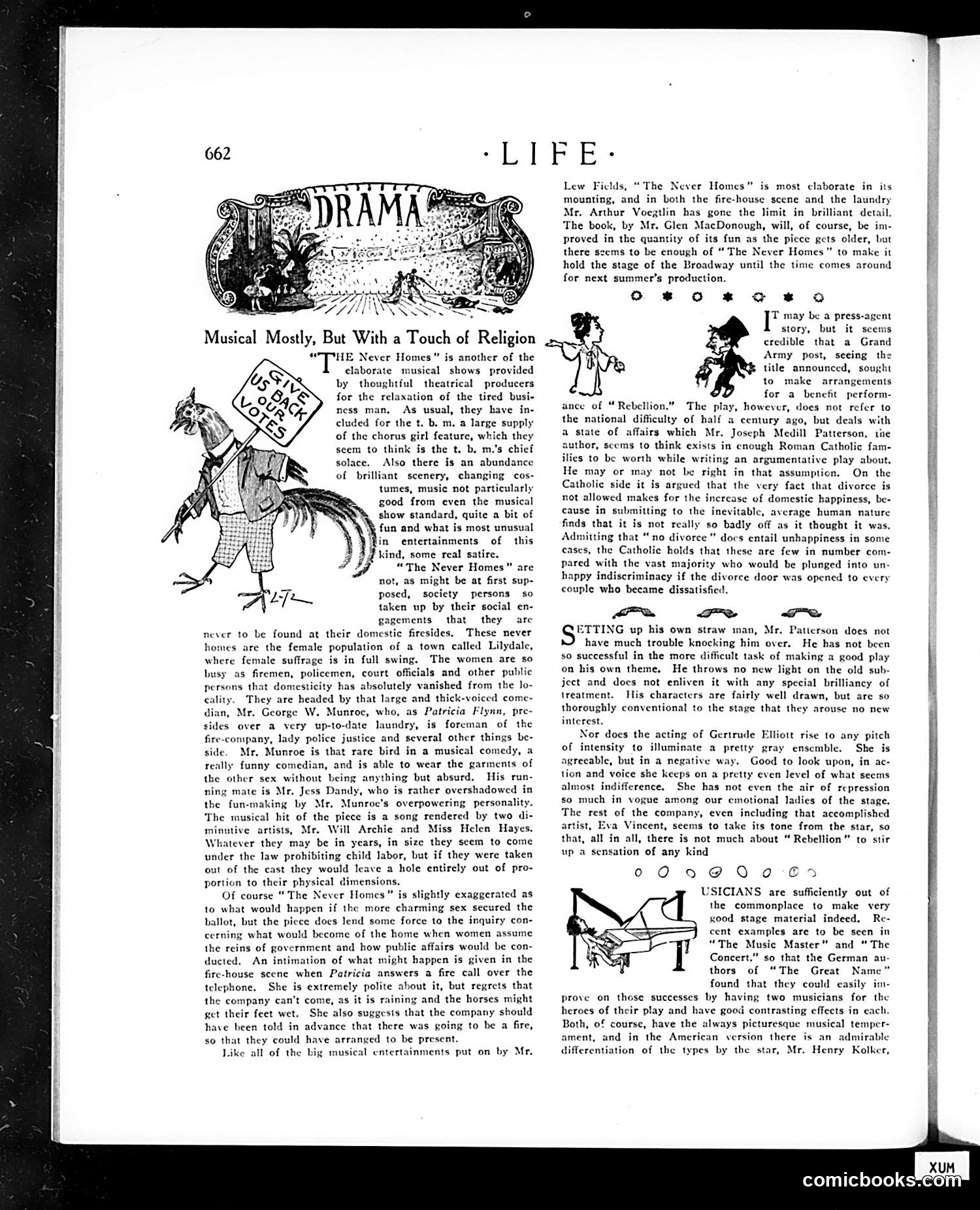
This review covers a musical comedy about a town called Lilydale where women have achieved full suffrage and abandoned domestic life entirely. Women now work as firefighters, police officers, and public officials instead of managing homes—hence "never homes." The satire mocks fears about women's suffrage by exaggerating its consequences. A scene depicts a female fire chief (Patricia Flynn, played by cross-dressing comedian George W. Munroe) so concerned with politeness that she refuses a fire call because it's raining and might wet the horses' feet—absurd incompetence presented as the inevitable result of female governance. The review notes this "slightly exaggerated" premise reflects contemporary anxieties about what happens "when women assume the reins of government." The humor relies on the audience finding the idea of women in public roles inherently ridiculous. The production featured elaborate sets and included child performers Will Archie and Helen Hayes.
📄 Transcribed text from this page (OCR, searchable)
Machine-transcribed from the original scan — historical spelling and the odd misread are preserved.
Musical Mostly, But With a Touch of Religion “CHE Never Homes” is another of the elaborate musical shows provided by thoughtful theatrical producers for the relaxation of the tired busi- ness man, As usual, they have in- cluded for the t. b, m. a large supply of the chorus girl feature, which they seem to think is the t. b, m.’s chief solace. Also there is an abundance of brilliant scenery, changing cos- tumes, music not particularly good from even the musical show standard, quite a bit of fun and what is most unusual in entertainments of this 4} kind, some real satire. Sf“ The Never Homes" are not, as might be at first sup- posed, society persons so taken up by their social en- gagements that they are never to be found at their domestic firesides. These never homes are the female population of a town called Lilydale, where female suffrage is in full swing. The women are so busy as firemen, policemen, court officials and other public persons that domesticity has absolutely vanished from the lo- ality. They are headed by that large and thick-voiced com n, Mr. George W. Munroc, who, as Patricia Flynn, pre- sides over a very up-to-date laundry, is foreman of the fire-company, lady police justice and several other things be- side. Mr, Munroe is that rare bird in a musical comedy, a really funny comedian, and is able to wear the garments of the other sex without being anything but absurd. His run- ning mate is Mr, Jess Dandy, who is rather overshadowed in the fun-making by Mr, Munroe’s overpowering personality, The musical hit of the piece is a song rendered by two di minutive artists, Mr. Will Archie and Miss Helen Hayes. Whatever they may be in years, in size they seem to come under the law prohibiting child labor, but if they were taken out of the cast they would leave a hole entirely out of pro- portion to their physical dimensions. Of course “ The Never Homes” is slightly exaggerated as to what would happen if the more charming sex secured the ballot, but the piece docs lend some force to the inquiry con- cerning what would become of the home when women assume the reins of government and how public affairs would be con- ducted. An intimation of what might happen is given in the firc-house scene when Patricia answers a fire call over the telephone. She is extremely polite about it, but regrets that the company can't come, as it is raining and the horses might get their feet wet. She also suggests that the company should have been told in advance that there was going to be a fire, so that they could have arranged to be present. Like all of the big musical entertainments put on by Mr. -LIFE- Lew Ficlds, “The Never Homes” is most elaborate in its mounting, and in both the fire-house scene and the laundry Mr. Arthur Voegtlin has gone the limit in brilliant detail. The book, by Mr. Glen MacDonough, will, of course, be im- proved in the quantity of its fun as the picce gets older, but there seems to be cnough of “ The Never Homes” to make it hold the stage of the Broadway until the time comes around for next summer's production. oO # 0 *£ GG € 6 T may be a press-agent story, but it scems credible that a Grand Army post, seeing the title announced, sought to make arrangements for a benefit perform- ance of “Rebellion.” The play, however, does not refer to the national difficulty of half a century ago, but deals with a state of affairs which Mr. Joseph Medill Patterson, tae author, scems to think exists in cnough Roman Catholic fam- ilies to be worth while writing an argumentative play about. He may or may not be right in that assumption. On the Catholic side it is argued that the very fact that divorce is not allowed makes for the increase of domestic happiness, be- cause in submitting to the inevitable, average human nature finds that it is not really so badly off as it thought it was. Admitting that “no divorce” docs entail unhappiness in some cases, the Catholic holds that these are few in number com- pared with the vast majority who would be plunged into un- happy indiscriminacy if the divorce door was opened to every couple who became dissatisfied. Fe Fe raw SPTTING up his own straw man, Mr. Patterson does not have much trouble knocking him over. He has not been so successful in the more difficult task of making a good play on his own theme, He throws no new light on the old sub- ject and does not enliven it with any special brilliancy of treatment. His characters are fairly well drawn, but are so thoroughly conventional to the stage that they arouse no new interest. Nor does the acting of Gertrude Elliott rise to any pitch of intensity to illuminate a pretty gray ensemble. She is agreeable, but ina negative way. Good to look upon, in ac- tion and voice she keeps on a pretty even level of what seems almost indifference. She has not even the air of repression so much in vogue among our emotional ladies of the stage. The rest of the company, even including that accomplished artist, Eva Vincent, seems to take its tone from the star, so that, all in all, there is not much about “ Rebellion” to stir up a sensation of any kind 0009000 6% USICIANS are sufficiently out of the commonplace to make very xood stage material indeed. Re- cent examples are to be seen in ~ T “The Music Master” and “ The Concert.” so that the German au thors of “The Great Name” found that they could easily im- prove on those successes by having two musicians for the heroes of their play and have good contrasting effects in each. Both, of course, have the always picturesque musical temper- ament, and in the American version there is an admirable differentiation of the types by the star, Mr. Henry Kolker, comicbookseom