
Life, 1911-10-19 · page 27 of 48
Life — October 19, 1911 — page 27: what you’re looking at
What you’re looking at
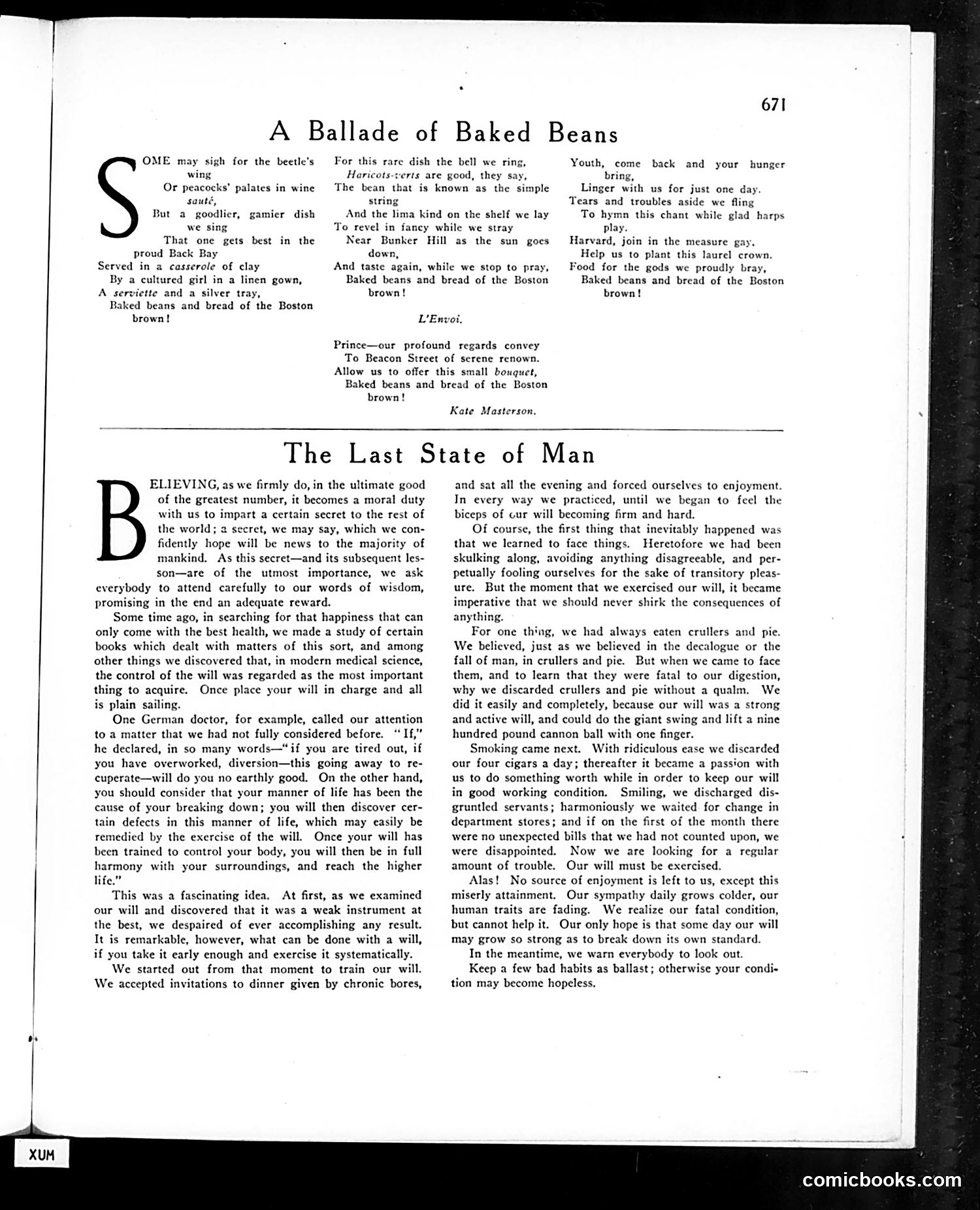
This page contains two satirical pieces mocking American pretension and self-help culture. **"A Ballade of Baked Beans"** playfully elevates humble Boston baked beans—a working-class dish—to high art through flowery poetic language. It satirizes Boston's cultural snobbery by treating this simple food with the reverence typically reserved for fancy French cuisine, while invoking Harvard and Beacon Street (markers of Boston's elite). The joke is the contrast between the grandiose form and the mundane subject. **"The Last State of Man"** parodies the era's obsession with willpower and self-improvement through pseudoscientific philosophy. The narrator describes training his will like a muscle by forcing himself to attend boring dinners and endure unpleasant situations. The satire targets both the German doctor's dubious advice and the American tendency toward self-denial masquerading as virtue—treating the painful suppression of natural desires as moral improvement. Both pieces mock class pretension and the era's faith in willpower as a solution to life's problems.
📄 Transcribed text from this page (OCR, searchable)
Machine-transcribed from the original scan — historical spelling and the odd misread are preserved.
671 A Ballade of Baked Beans OME may sigh for the beetle’s wing Or peacocks’ palates in wine sauté, But a goodlicr, gamier dish we sing That one gets best in the proud Back Bay Served in a casserole of clay By a cultured girl in a linen gown, A serviette and a silver tray Baked beans and bread of the Boston brown! For this rare dish the bell we ring, Haricots-verts are good, they say, The bean that is known as the simple string And the lima kind on the shelf we lay To revel in fancy while we stray Near Bunker Hill as the sun gocs down, And taste again, while we stop to pray, Baked beans and bread of the Boston brown! L’Envoi. Prince—our profound regards convey To Beacon Street of serene renown. Allow us to offer this small bouquet, Baked beans and bread of the Boston brown! Kate Masterson. Youth, come back and your bring, Linger with us for just one day Tears and troubles aside we fling To hymn this chant while glad harps play. Harvard, join in the measure gay. Help us to plant this laurel crown. Food for the gods we proudly bray, Baked beans and bread of the Boston brown! hunger The Last State of Man ELIEVING, as we firmly do, in the ultimate good of the greatest number, it becomes a moral duty with us to impart a certain secret to the rest of the world; a secret, we may say, which we con- fidently hope will be news to the majority of mankind. As this secret—and its subsequent les- son—are of the utmost importance, we ask everybody to attend carefully to our words of wisdom, promising in the end an adequate reward. Some time ago, in searching for that happiness that can only come with the best health, we made a study of certain books which dealt with matters of this sort, and among other things we discovered that, in modern medical science, the control of the will was regarded as the most important thing to acquire. Once place your will in charge and all is plain sailing. One German doctor, for example, called our attention to a matter that we had not fully considered before. “If,” he declared, in so many words—“if you are tired out, if you have overworked, diversion—this going away to re- cuperate—will do you no earthly good. On the other hand, you should consider that your manner of life has been the cause of your breaking down; you will then discover cer- tain defects in this manner of life, which may easily be remedied by the exercise of the will. Once your will has been trained to control your body, you will then be in full harmony with your surroundings, and reach the higher life.” This was a fascinating idea, At first, as we examined our will and discovered that it was a weak instrument at the best, we despaired of ever accomplishing any result. It is remarkable, however, what can be done with a will, if you take it early enough and exercise it systematically. We started out from that moment to train our will. We accepted invitations to dinner given by chronic bores, and sat all the evening and forced ourselves to enjoyment. In every way we practiced, until we began to feel the biceps of cur will becoming firm and hard. Of course, the first thing that inevitably happened was that we learned to face things. Heretofore we had been skulking along, avoiding anything disagreeable, and per- petually fooling ourselves for the sake of transitory pleas- ure. But the moment that we exercised our will, it became imperative that we should never shirk the consequences of anything. For one thing, we had always eaten crullers and pie. We believed, just as we believed in the decalogue or the fall of man, in crullers and pie. But when we came to face them, and to learn that they were fatal to our digestion, why we discarded crullers and pie without a qualm. We did it easily and completely, because our will was a strong and active will, and could do the giant swing and lift a nine hundred pound cannon ball with one finger. Smoking came next. With ridiculous ease we discarded our four cigars a day; thereafter it became a passion with us to do something worth while in order to keep our will in good working condition. Smiling, we discharged dis- gruntled servants; harmoniously we waited for change in department stores; and if on the first of the month there were no unexpected bills that we had not counted upon, we were disappointed. Now we are looking for a regular amount of trouble. Our will must be exercised. Alas! No source of enjoyment is left to us, except this miserly attainment. Our sympathy daily grows colder, our human traits are fading. We realize our fatal condition, but cannot help it. Our only hope is that some day our will may grow so strong as to break down its own standard. In the meantime, we warn everybody to look out. Keep a few bad habits as ballast; otherwise your condi- tion may become hopeless. comicbooks.com