
Life, 1911-10-19 · page 28 of 48
Life — October 19, 1911 — page 28: what you’re looking at
What you’re looking at
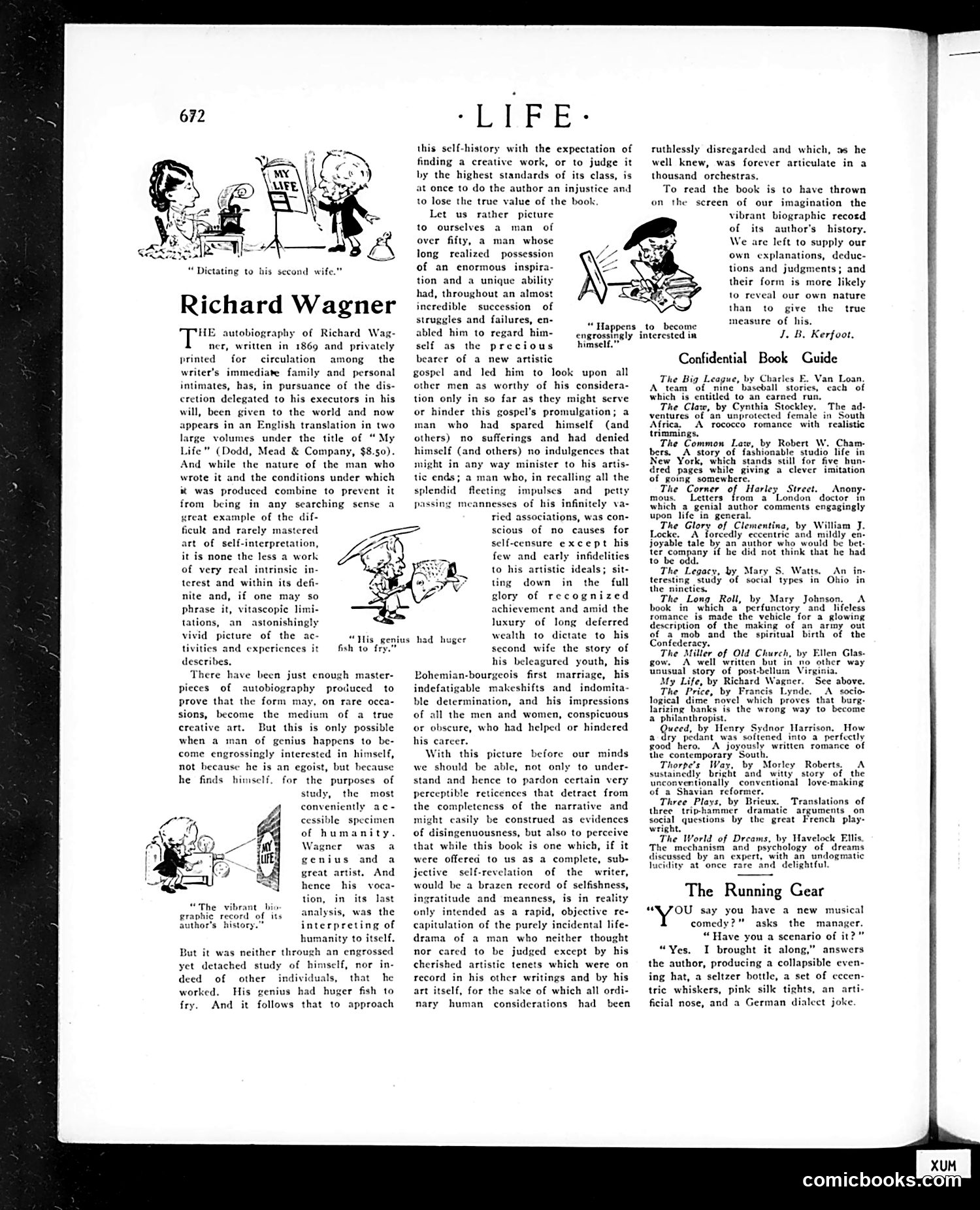
This page reviews Wagner's autobiography, published in English translation. The cartoons illustrate the article's central satire: Wagner dictating his life story to his second wife. The satire targets Wagner's monumental ego and self-absorption. The article describes him as a genius convinced of his artistic superiority, who viewed other people merely as servants to his creative mission—or obstacles to it. He spared neither himself nor others suffering in pursuit of his art. The joke in the caption "Dictating to his second wife" operates on multiple levels: Wagner's willingness to impose even his *autobiography* on others, his narcissism requiring an audience for self-justification, and the implicit absurdity of expecting his wife to transcribe his self-aggrandizing account. The cartoon's visual presentation of this domestic scene—a man dictating grandiose narratives while his wife dutifully records—mocks both Wagner's egomania and the tedious performance it demands of those around him.
📄 Transcribed text from this page (OCR, searchable)
Machine-transcribed from the original scan — historical spelling and the odd misread are preserved.
“ Dictating to his second wife." Richard Wagner HE autobiography of Richard Wag- ner, written in 1869 and privately printed for circulation among the writer's immediate family and personal ntimates, has, in pursuance of the dis- cretion delegated to his executors in his will, been given to the world and now appears in an English translation in two large volumes under the title of “ My Life” (Dodd, Mead & Company, $8.50). nd while the nature of the man who wrote it and the conditions under which % was produced combine to prevent it from being in any searching sense a xreat example of the dif- ficult and rarely mastered art of self-interpretation, it is none the less a work 4 of very real intrinsic in- B terest and within its defi- £ nite and, if one may so phrase it, vitascopic limi tations, an_ astonishingly vivid picture of the ac- tivities and experiences it describes, There have been just cnough master- pieces of autobiography produced to prove that the form may, on rare occa- sions, become the medium of a true creative art. But this is only possible when a man of genius happens to be- come engrossingly interested in himself, not because he is an egoist, but because he finds himself. for the purposes of study, the most conveniently ac- cessible specimen of humanity. Wagner was a genius and a great artist. And hence his voca- tion, in its last analysis, was the interpreting of humanity to itself. But it was neither through an engrossed yet detached study of himself, nor in- deed of other individuals, that he worked. His genius had huger fish to fry. And it follows that to approach “THis genius fish to fry.” “The vibrant graphic record of its author's history.” a ‘LPPE- this self-history with the expectation of finding a creative work, or to judge it by the highest standards of its class, is at once to do the author an injustice and to lose the true value of the book, Let us rather picture to ourselves a man of over fifty, a man whose long realized possession of an enormous inspira- tion and a unique ability had, throughout an almost incredible succession of struggles and failures, en- abled him to regard him- self as the precious bearer of a new artistic gospel and led him to look upon all other men as worthy of his considera- tion only in so far as they might serve or hinder this gospel’s promulgation; a man who had spared himself (and others) no sufferings and had denied himself (and others) no indulgences that might in any way minister to his artis- tic ends; a man who, in recalling all the splendid fleeting petty passing meannesses of his infinitely va- ried associations, was con- scious of no causes for self-censure except his few and carly infidelitics to his artistic ideals; sit- ting down in the full glory of recognized achievement and amid the luxury of long deferred wealth to dictate to his second wife the story of his beleagured youth, his Bohemian-bourgeois first marriage, his indefatigable makeshifts and indomita- ble determination, and his impressions of all the men and women, conspicuous or obscure, who had helped or hindered his career. With this picture before our minds we should be able, not only to under- stand and hence to pardon certain very perceptible reticences that detract from the completeness of the narrative and easily be construed as evidences of disingenuousness, but also to perceive that while this book is one which, if it were offered to us as a complete, sub- jective self-revelation of the writer, would be a brazen record of selfishness, ingratitude and meanness, is in reality only intended as a rapid, objective re- itulation of the purely incidental life- drama of a man who neither thought nor cared to be judged except by his cherished artistic tenets which were on record in his other writings and by his art itself, for the sake of which all ordi- nary human considerations had been impulses and had huger ruthlessly disregarded and which, as he well knew, was forever articulate in a thousand orchestras. To read the book is to have thrown on the screen of our imagination the vibrant biographic record of its author's history. We are left to supply our own explanations, deduc- tions and judgments; and their form is more likely to reveal our own nature than to give the true measure of his, J. B. Kerfoot. Confidential Book Guide The Big League, by Charles E. Van Loan. A team “of nine baseball stories, cach of which is entitled to an earned run, The Claw, by Cynthia Stockley. The ad- ventures of ‘an unprotected female in South Africa. A rococco romance with realistic trimmings, The Common Law, by Robert W. Cham- bers. A story of fashionable studio life in New York, which stands still for five hun- dred pages while giving a clever imitation of going somewhere. The Corner of Harley Street. Anony- mous. Letters from a London doctor in which a genial author comments engagingly upon life in general. The Glory of Clementina, by William J. Locke. “A forcedly eccentri¢ and mildly en- joyable tale by an author who would be bet- ter company if he did not think that he had to be odd. The Legacy, by Mary S. Watts. An in- teresting study of social types in Ohio in the nineties. The Long Roll, by Mary Johnson. A book in which a’ perfunctory “and lifeless romance is made the vehicle for a glowing description of the making of an army out of a mob and the spiritual birth of the Confederacy. The Miller of Old Church, by Ellen Glas- gow. A well written but in no other way unusual story of post-bellum Virginia, My Life, by Richard Wagner. See above. The Price, by Francis Lynde. A socio- logical dime novel which proves that burg- larizing banks is the wrong way to become a philanthropist. Queed, by Henry Sydnor Harrison, How a dry pedant_ was softened into a perfectly Rood hero, A joyously written romance of the contemporary South. Thorpe’s Way, by Morley Roberts, A sustainedly bright and witty story of, the unconventionally conventional love-making of a Shavian reformer. Three Plays, by Bricux. Translations of three trip-hammer dramatic arguments on social questions by the great French play- wright. The World of Dreams, by Havelock Fllis The mechanism and psychology of dreams discussed by an expert, with an undogmatic lucidity at once rare and delightful. The Running Gear “\ZOU say you have a new musical comedy?" asks the manager. “ Have you a scenario of it?” “Yes. I brought it along,” answers the author, producing a collapsible even- ing hat, a seltzer bottle, a set of eccen- tric whiskers, pink silk tights, an arti- ficial nose, and a German dialect joke. comicbooks -CO