
Life, 1911-10-19 · page 10 of 48
Life — October 19, 1911 — page 10: what you’re looking at
What you’re looking at
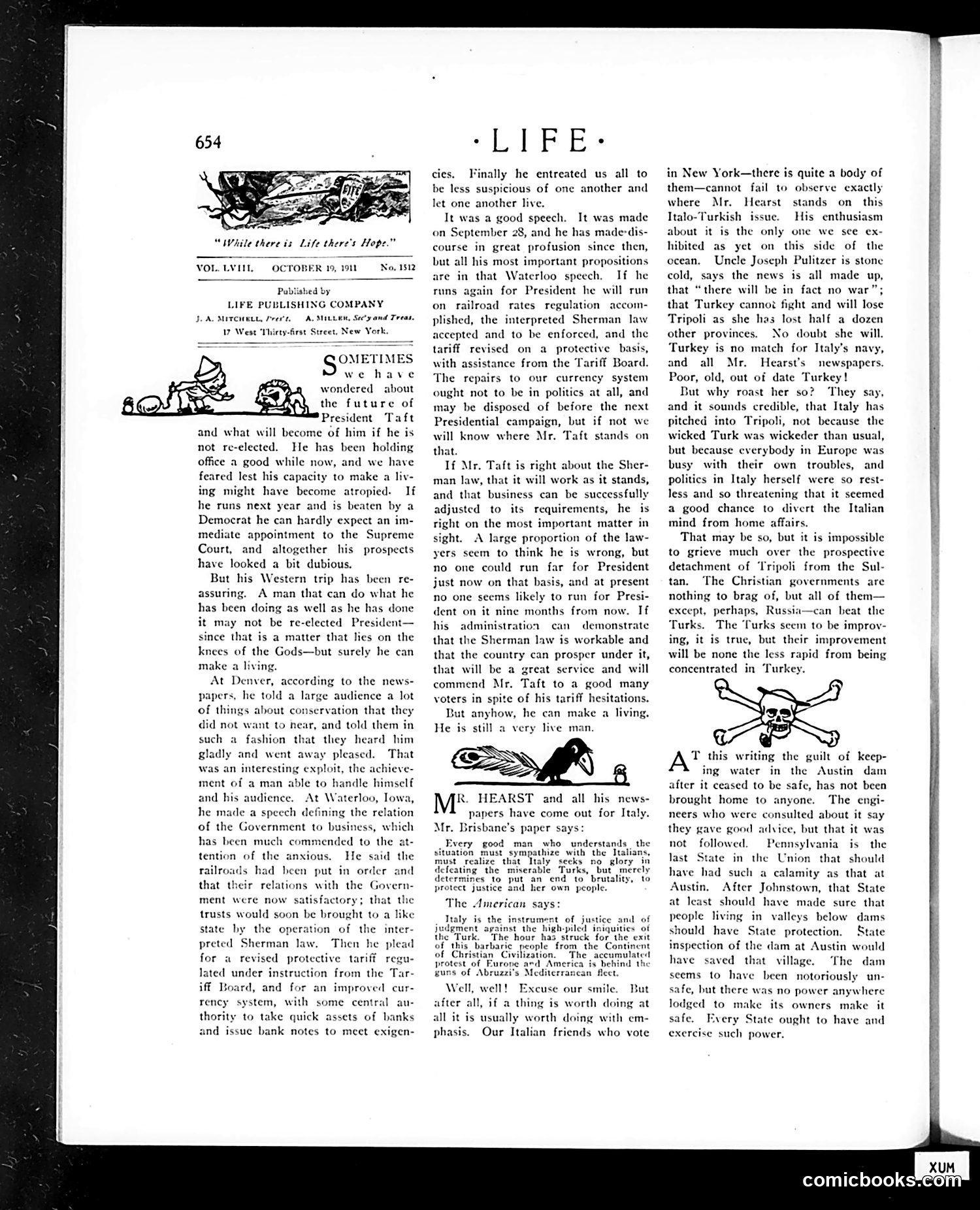
This *Life* magazine page discusses President William Howard Taft's potential re-election prospects. The text expresses skepticism about Taft's political viability, noting he's "been holding office a good while now" and faces Democratic opposition. The article credits Taft with accomplishments (tariff revisions, Sherman law enforcement) but suggests he cannot win re-election. It praises his character as "a live man" capable of making decisions. The cartoon at the bottom (skull and crossbones imagery) appears to represent the threat posed by keeping water in the Austin dam after it became unsafe—criticizing governmental negligence that endangered lives. The overall tone is cautiously supportive of Taft personally while politically pessimistic about his electoral future.
📄 Transcribed text from this page (OCR, searchable)
Machine-transcribed from the original scan — historical spelling and the odd misread are preserved.
“While there is Life there's Hope.” VOL. LVI, OCTOBER 19, 1911 No. 1512 Pablished by LIFE PUBLISHING COMPANY JAS MITOWRLE, Prert, AL MILLEN, Sec’y and Tr 17 West ‘Thirty-first Street. New York OMETIMES we have wondered about the future of President Taft and what will become of him if he is not re-elected. He has been holding office a good while now, and we have feared lest his capacity to make a liv- ing might have become atropied. If he runs next year and is beaten by a Democrat he can hardly expect an im- mediate appointment to the Supreme Court, and altogether his prospects have looked a bit dubious. But his Western trip has been re- assuring. A man that can do what he has been doing as well as he has done it may not be re-elected President— since that is a matter that lies on the knees of the Gods—but surely he can make a living. At Denver, according to the news- papers, he told a large audience a lot of things about conservation that they did not want to hear, and told them in such a fashion t! they heard him gladly and went away pleased. That was an interesting exploit, the achieve- ment of a man able to handle himself and his audience. At Waterloo, Iowa, he made a speech defining the relation of the Government to business, which has been much commended to the tention of the anxious. He said the railroads had been put in order and that their relations with the Govern- ment were now satisfactory; that the trusts would soon be brought to a like state by the operation of the inter- preted Sherman law. Then he plead for a revised protective tariff regu- lated under instruction from the Tar- iff Board, and for an improved cur- rency system, with some central au- thority to take quick assets of banks and issue bank notes to meet exigen- *LIFE» cies. inally he entreated us all to be less suspicious of one another and let one another live. It was a good speech. It was made on September 28, and he has made-dis- course in great profusion since then, but all his most important propositions are in that Waterloo speech. If he runs again for President he will run on railroad rates regulation a plished, the interpreted Sherman law accepted and to be enforced, and the riff revised on a protective basis, with assistance from the Tariff Board. The repairs to our currency system ought not to be in politics at all, and may be disposed of before the next Presidential campaign, but if not we will know where Mr. Taft stands on that. If Mr. Taft is right about the Sher- man law, that it will work as it stands, and that business can be successfully adjusted to its requirements, he is right on the most important matter in sight. A large proportion of the law- yers seem to think he is wrong, but no one could run far for President just now on that basis, and at present no one seems likely to run for Presi- dent on it nine months from now. If his administration can demonstrate that the Sherman law is workable and that the country can prosper under it, that will be a great service and will commend Mr. Taft to a good many voters in spite of his tariff hesitations. Sut anyhow, he can make a living, He is still a very live man. HEARST and all his news- R M papers have come out for Italy. Mr. Brisbane's paper says: ‘com Every good man who understands the situation must sympathize with the Italians, must realize that Italy secks no. glory in lefeating the miserable Turks, but. merely jetermines to put an end to’ brutality, to protect justice and her own people. The American says: Italy is the instrument of j judgment against the high-piled iniquities of the Turk. The hour has struck for th of this barbaric people from the C of Christian Civil he rotest of Fi Well, well! Excuse our smile. But after all, if a thing is worth doing at all it is usually worth doing with em- phasis. Our Italian friends who vote in New York—there is quite a body of them—cannot fail to observe exactly where Mr. Hearst stands on_ this Ttalo-Turkish issue. His enthusiasm about it is the only one we see ex- hibited as yet on this side of the ocean. Uncle Joseph Pulitzer is stone cold, says the news is all made up, that “there will be in fact no war”; that Turkey cannot fight and will lose Tripoli as she has lost half a dozen other provinces. No doubt she will. Turkey is no match for Italy’s navy, and all Mr. Hearst's newspaper: Poor, old, out of date Turkey! But why roast her so? They say, and it sounds credible, that Italy has pitched into Tripoli, not because the wicked Turk was wickeder than usual, but because everybody in Europe v busy with their own troubl and politics in Italy herself were so rest- Jess and so threatening that it seemed a good chance to divert the Italian mind from home affairs. That may be so, but it is impossible to grieve much over the prospective detachment of ‘Tripoli from the Sul- tan. The Christian governments are nothing to brag of, but all of them— except, perhaps, Russia—can beat the Turks. The Turks seem to be improv- ing, it is true, but their improvement will be none the less rapid from being concentrated in Turkey. A this writing the guilt of keep- ing water in the Austin dam after it ceased to be safe, has not been brought home to anyone. The engi- neers who were consulted about it say they gave good advice, but that it was not followed. Pennsylvania is the last State in the Union that should have had such a calamity as that at Austin. After Johnstown, that State least should ¢ made sure that people living in valleys below dams State should have State protection. inspection of the dam at Austin would have saved that village. The dam seems to have been notoriously un- safe, but there was no power anywhere lodged to make its owners make it safe. Every State ought to hav exercise such power. comicbooks' i ‘Onl