
A complete issue · 40 pages · 1911
Life — July 27, 1911
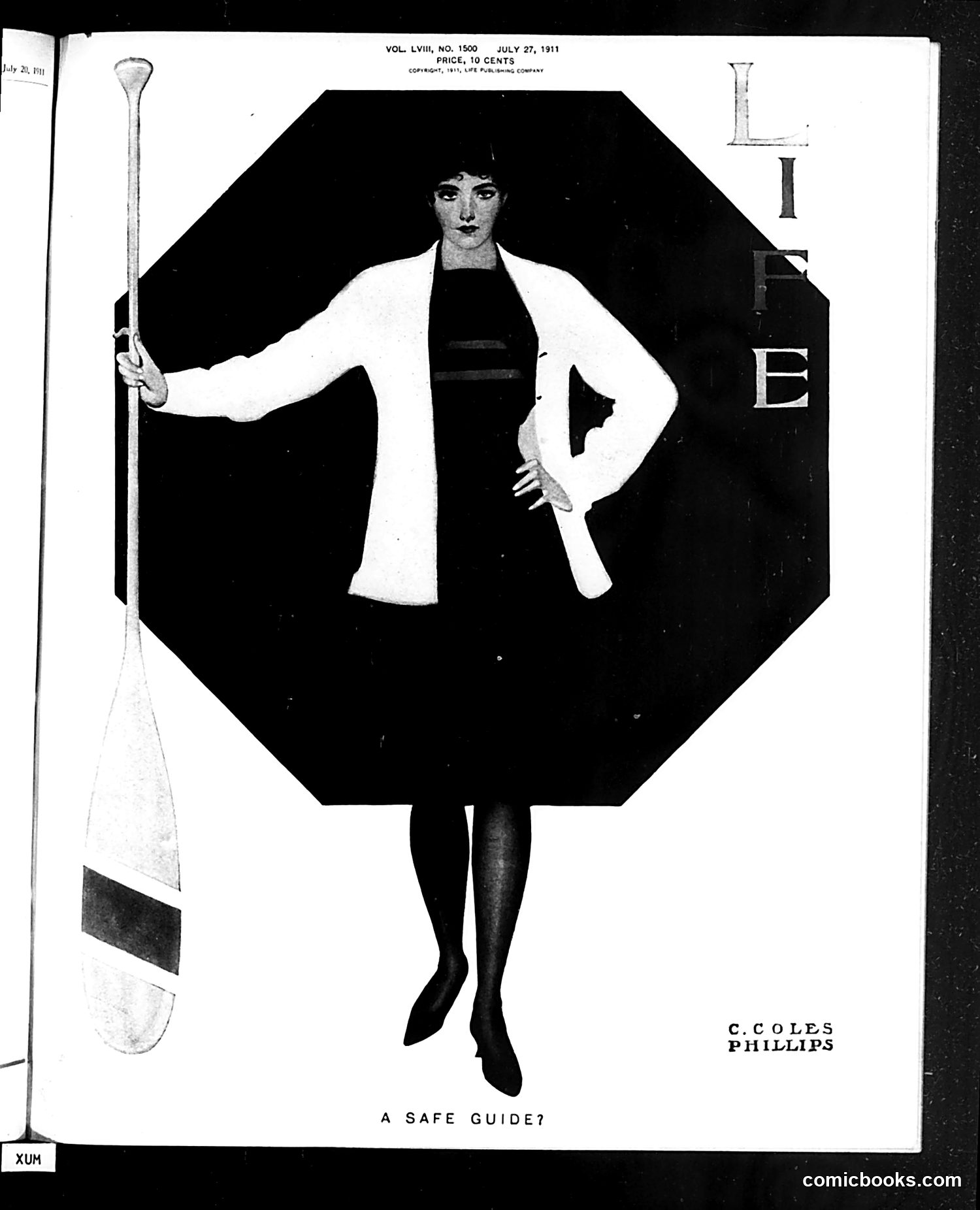
This satirical illustration by Coles Phillips critiques women's fashion, specifically the adoption of dramatically long, flowing garments like cloaks or wraps. The woman pictured wears an impractically long white cape that extends far beyond her body, making ordinary movement difficult. The caption "A Safe Guide?" is ironic—the garment is anything but safe. The joke targets contemporary fashion trends that prioritized dramatic visual effect over practicality and functionality. The absurdly elongated cape symbolizes how fashion designers and magazines promote styles that are actually dangerous or cumbersome for women's daily activities. This reflects early-20th-century satirical commentary on the excess and impracticality of haute couture.
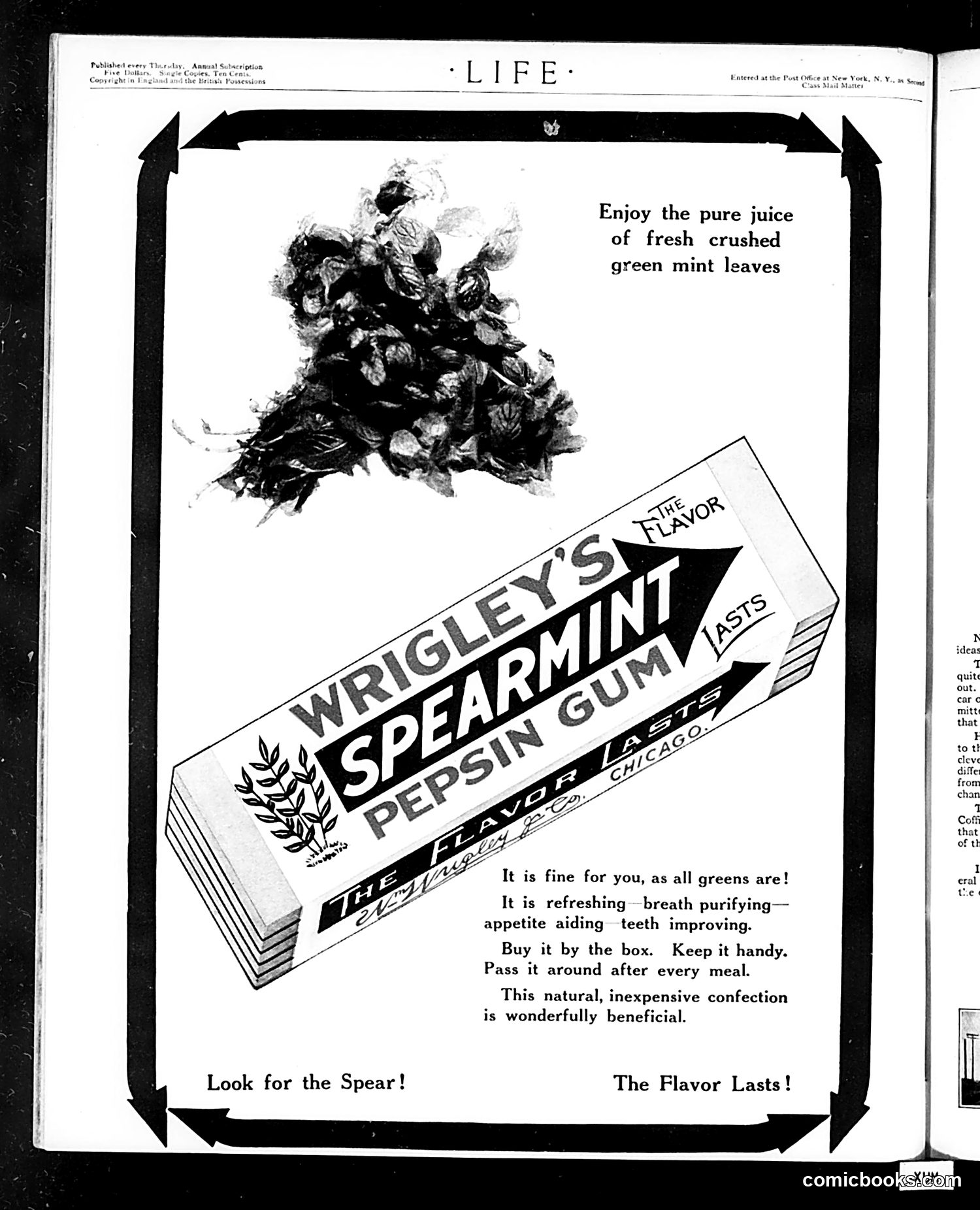
This page is primarily **advertising, not satire or political commentary**. It's a full-page advertisement for Wrigley's Spearmint Pepsin Gum, published in *Life* magazine. The ad features fresh mint leaves at top and a product box image, promoting the gum's benefits: "refreshing—breath purifying—appetite aiding—teeth improving." The copy emphasizes it should be "passed around after every meal" and describes it as a "natural, inexpensive confection" that is "wonderfully beneficial." The taglines "Look for the Spear!" and "The Flavor Lasts!" are marketing slogans. This represents early 20th-century consumer advertising conventions—making health and social claims about chewing gum that would be considered exaggerated by modern standards.
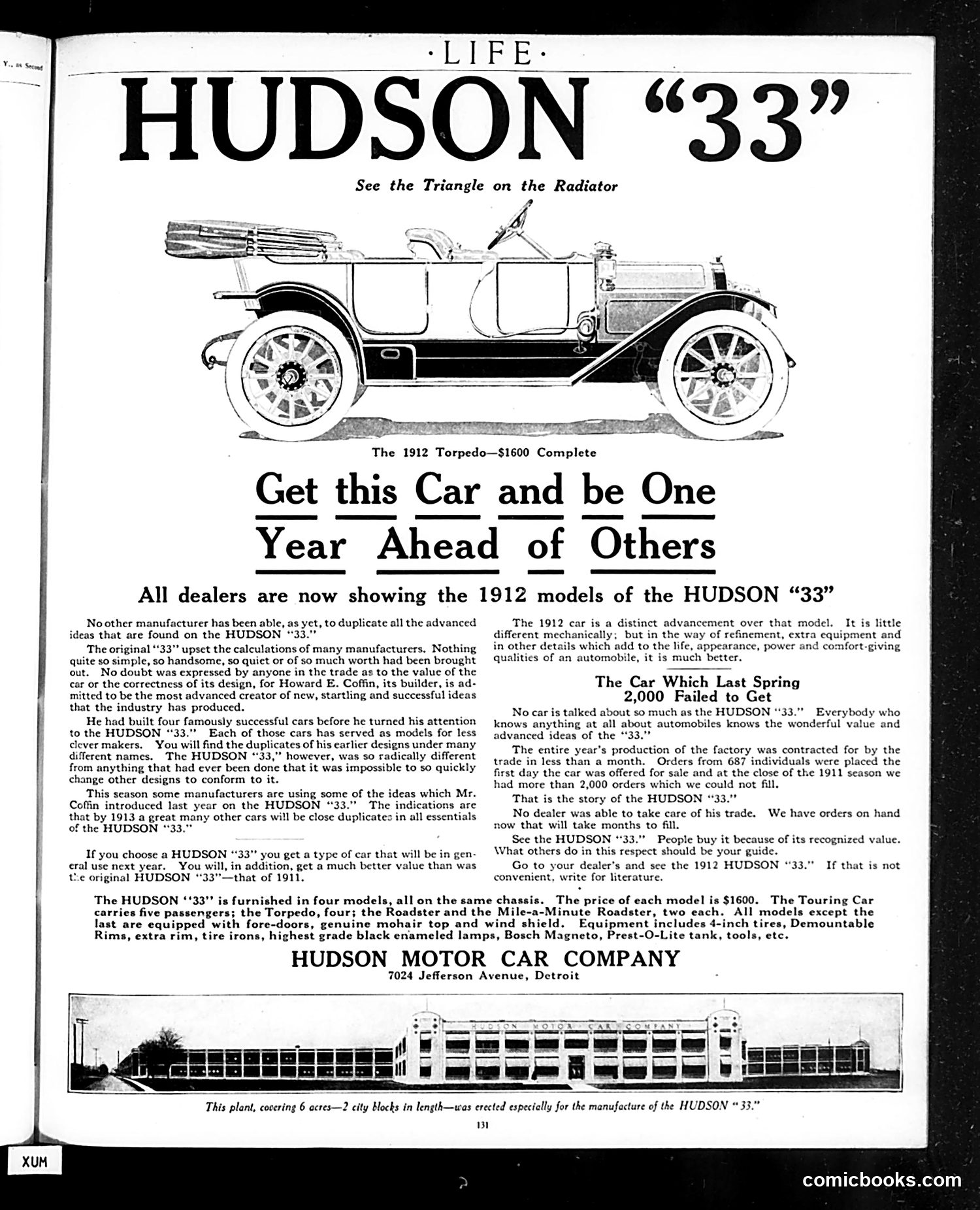
This page is **primarily an advertisement**, not satire or political commentary. It promotes the Hudson "33" automobile, manufactured by the Hudson Motor Car Company in Detroit. The ad highlights the 1912 Torpedo model, priced at $1600 complete. The marketing strategy emphasizes being "one year ahead of others"—claiming the Hudson introduces advanced mechanical features that competitors will eventually copy. The text notes exceptional sales success: 687 orders on the first day, with over 2,000 total orders exceeding factory capacity. This appears to be genuine marketing boasting rather than satire. The accompanying factory photograph shows the manufacturing plant built specifically for Hudson "33" production. This represents early automotive advertising emphasizing innovation and market dominance rather than humorous or political commentary typical of *Life* magazine's satirical content.
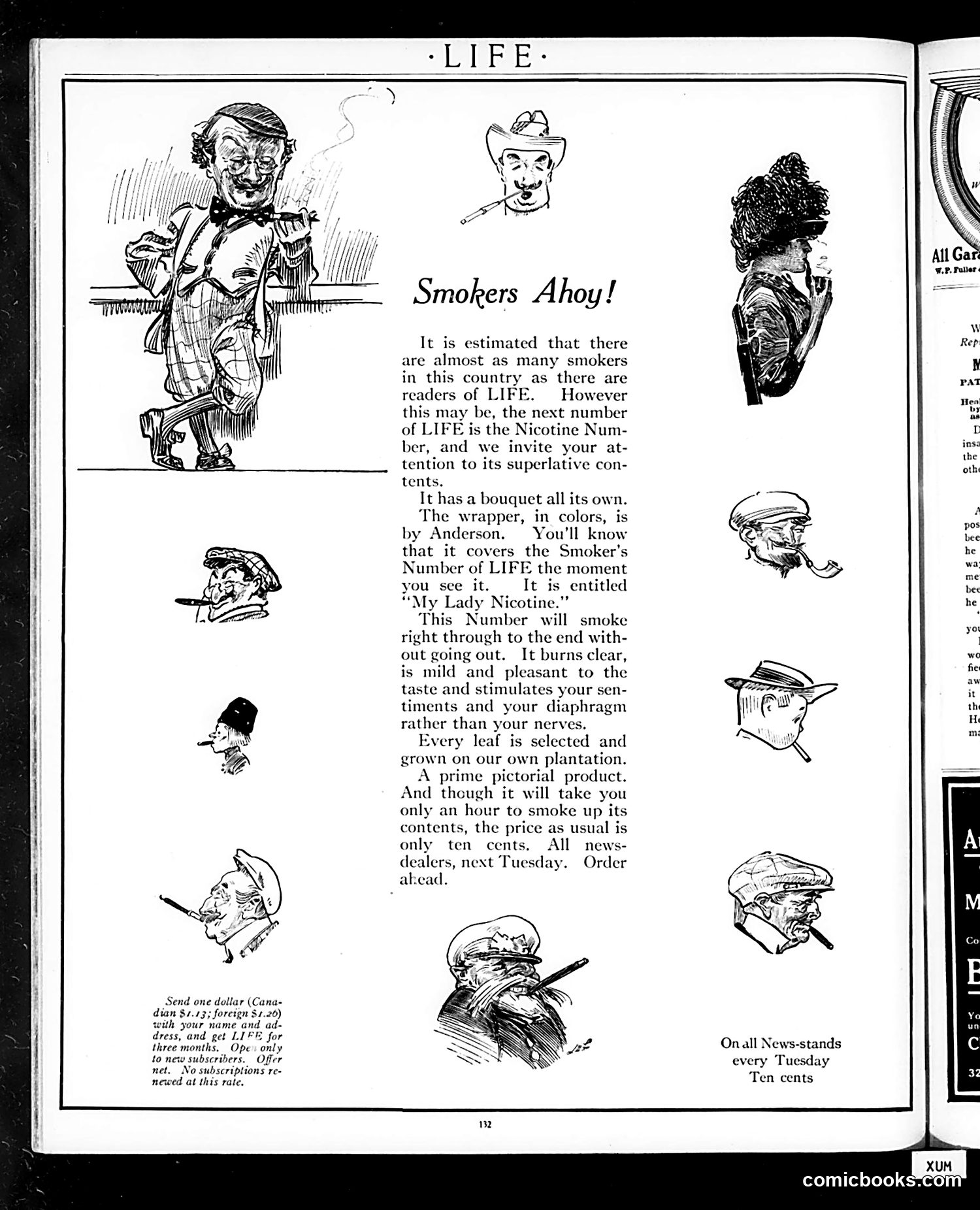
This is a **cigarette advertisement** for "The Nicotine Number" of Life magazine, disguised as editorial content. The page promotes a product called "My Lady Nicotine" cigars, priced at ten cents. The numerous caricatured male faces surrounding the text—many wearing hats and smoking—represent various "types" of smokers, a common advertising technique of the era (appears to be early 1900s). The exaggerated features are characteristic of period illustration style. The advertisement claims the cigar "burns clear, is mild and pleasant" and emphasizes it's a "prime pictorial product" made from carefully selected leaves. The casual, humorous tone and satirical framing reflect Life magazine's identity as a humor publication that mixed editorial content with advertising.
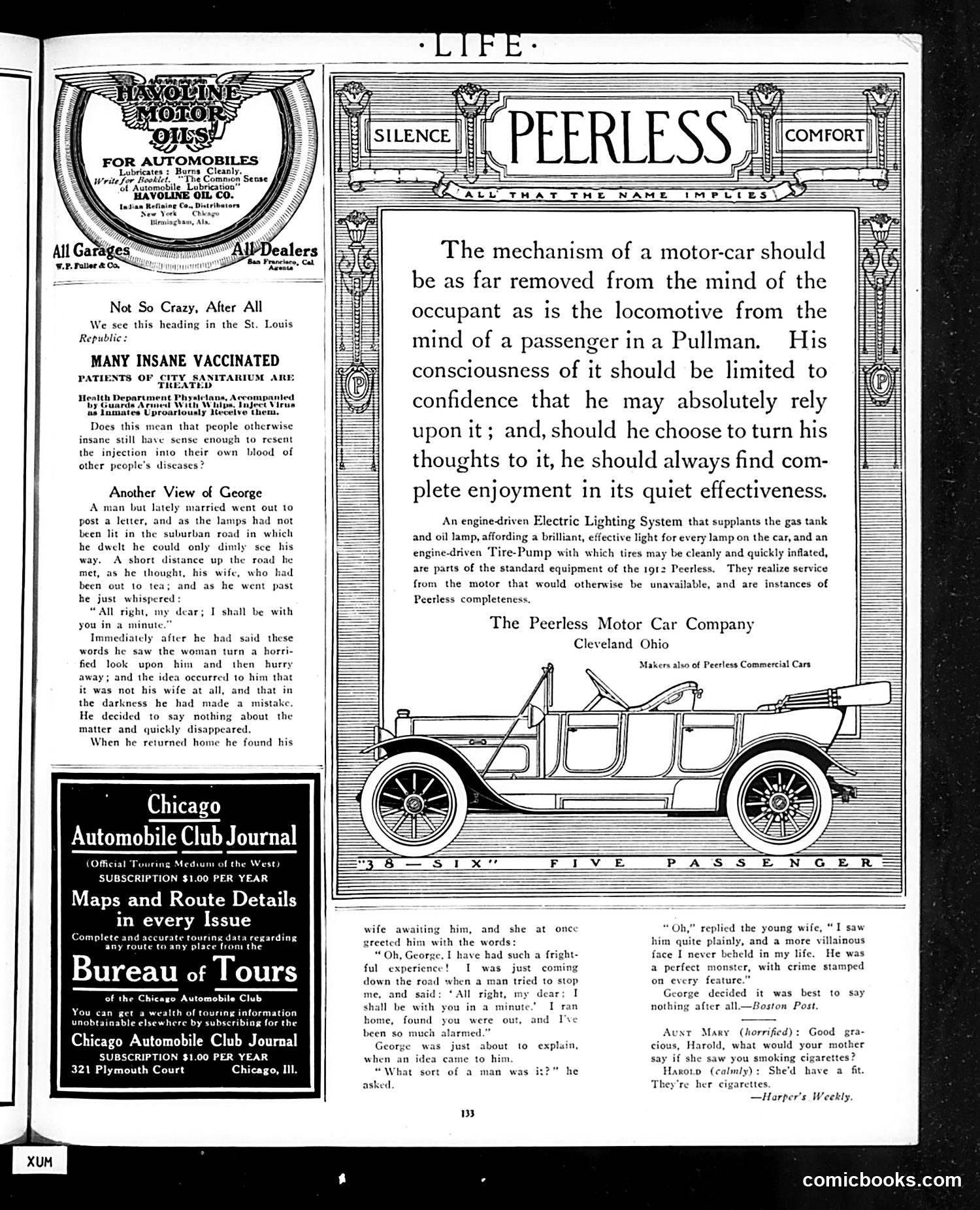
This page is primarily **advertising**, not satire or political commentary. The dominant content is a full-page Peerless Motor Car advertisement (center-right), emphasizing engineering sophistication and reliability. The left sidebar contains smaller ads for Hayoline Motor Oil, the Chicago Automobile Club Journal, and related automotive services—reflecting early-1910s car culture. The small story excerpts ("Not So Crazy, After All" and "Another View of George") appear to be humorous anecdotes about automobile mishaps and domestic misunderstandings, typical of Life magazine's light satirical humor. They target contemporary anxieties about the still-novel automobile and marital dynamics, but contain no identifiable political figures or specific events. This represents Life's shift toward commercial advertising revenue rather than editorial satire.
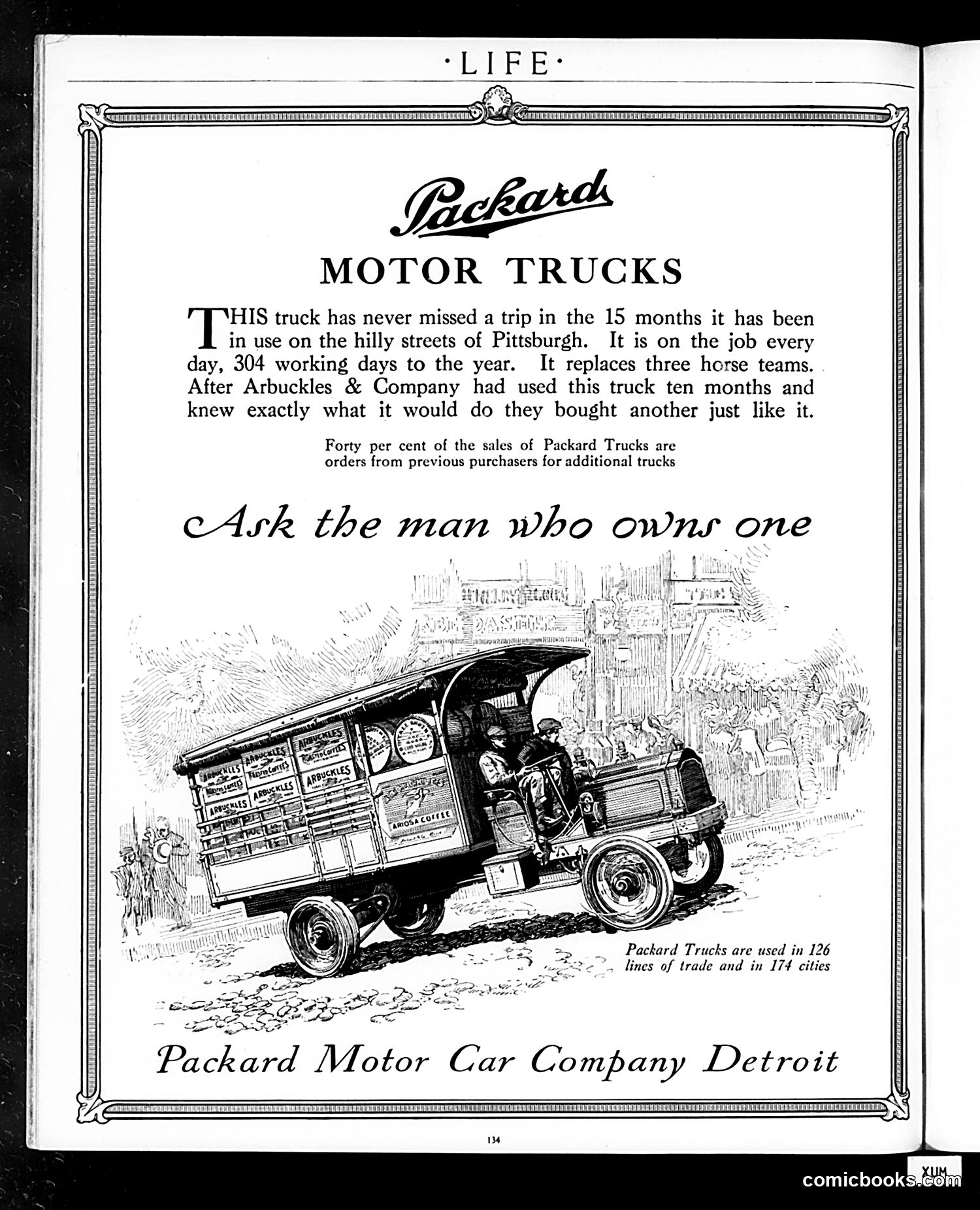
This is primarily a **straightforward advertisement**, not satire or political commentary. The Packard Motor Car Company advertises their commercial trucks through Life magazine. The ad emphasizes practical reliability: a Packard truck in Pittsburgh has operated 304 days yearly for 15 months without missing trips on hilly terrain, replacing three horse teams. The illustration shows a loaded delivery truck navigating an urban street. The key sales pitch is the testimonial approach: "Ask the man who owns one." The ad notes that 40% of Packard truck sales are repeat purchases from satisfied customers, and that these trucks operate in 126 trade lines across 174 cities. This reflects early automotive marketing strategy—demonstrating real-world utility to convince businesses that motor trucks were reliable replacements for horse-drawn transport.
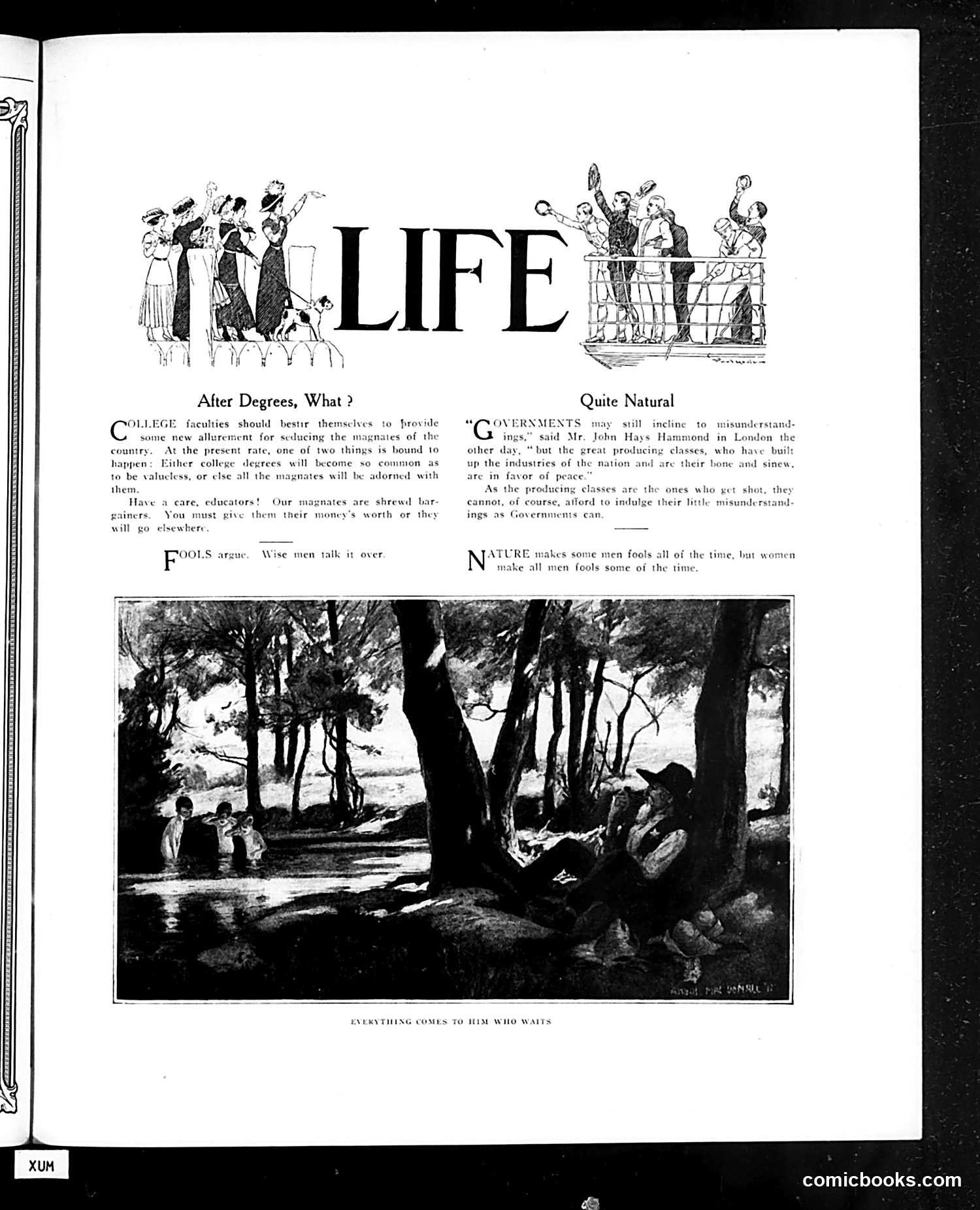
This page contains satirical commentary and aphorisms rather than a political cartoon. The main sections are: **"Alter Degrees, What?"** - Critiques college education, arguing that magnates (wealthy industrialists) benefit most from degrees, while other graduates become "gainers" or "boobs." The satire questions whether expensive college education actually benefits society broadly. **"Quite Natural"** - A brief quip about governments misunderstanding producing classes, with a follow-up aphorism about wise men and fools talking. **"Fools argue. Wise men talk it over"** and **"Nature makes some men fools all the time, but women make all men fools some of the time"** - General witticisms about human nature and gender relations. The accompanying pastoral illustration titled "Everything Comes to Him Who Waits" shows people relaxing by a stream, supporting themes of leisure and patience over striving.
This page contains editorial commentary on New York summer politics, not primarily cartoons. The text discusses the dangerous July heat affecting judgment and work efficiency, then pivots to criticizing Governor Dis's handling of legislative matters—particularly a railroad accident on July 11th at Bridgeport. The piece attacks the Governor's credibility on multiple fronts: his vetoing of bills, his handling of the Income Tax bill, and his appointment of a Board of Education with members the editors view as unsuitable (noting it has 46 members with poor leadership). The satirical thrust is that the Governor's recent actions harm his own reputation while doing little to help the schools. The overall tone suggests editorial frustration with what they view as incompetent or self-serving governance during the hot summer months.
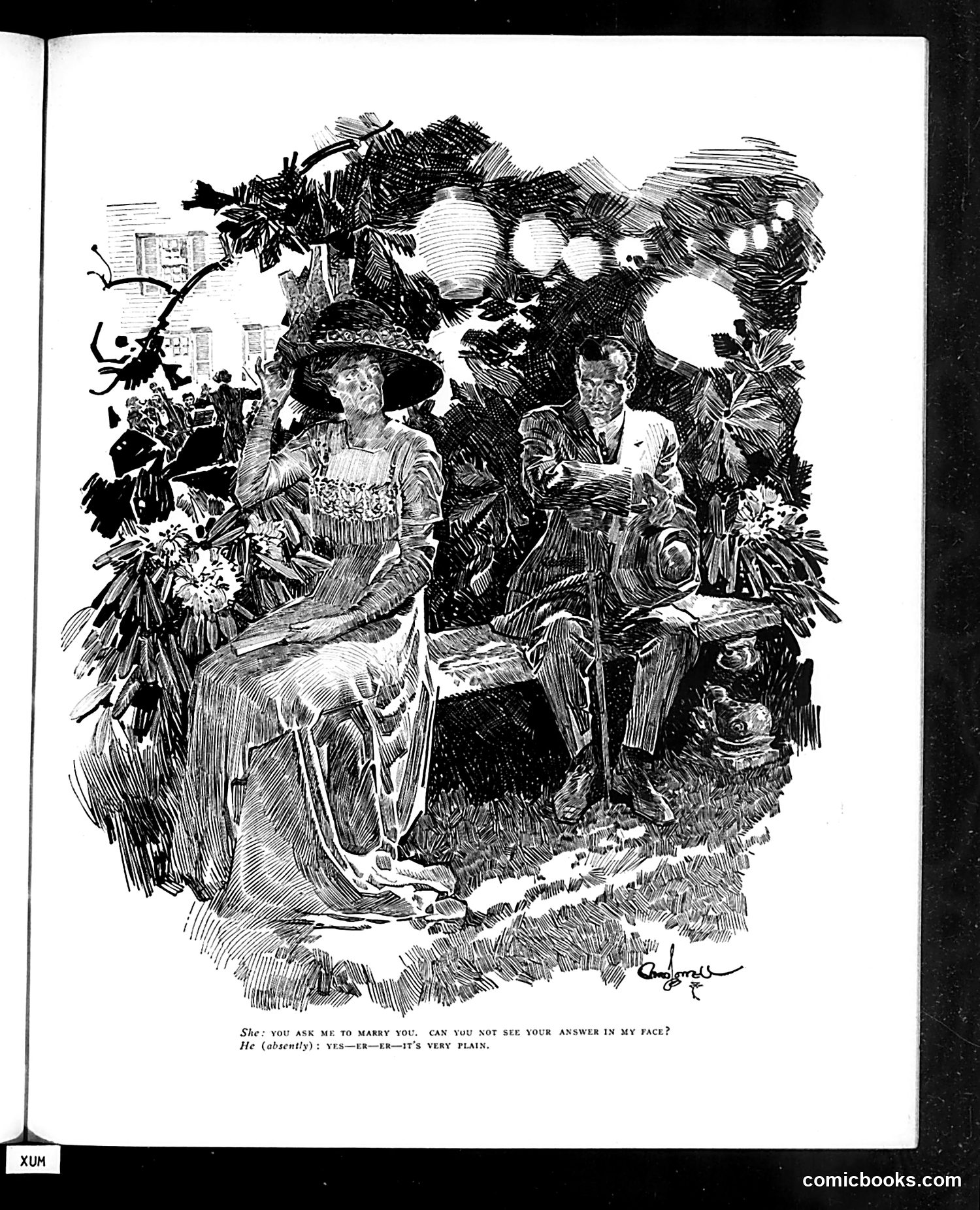
This single-panel cartoon depicts a marriage proposal scene. The caption reads: "She: You ask me to marry you. Can you not see your answer in my face? He (absently): Yes—er—er—it's very plain." The satire targets male inattentiveness in romance. Despite the woman's elaborate gesture—she's surrounded by flowers and dressed formally—the man responds with distracted vagueness ("yes—er—er"), failing to read her emotional response. The joke suggests men are oblivious to women's feelings and body language, even during crucial romantic moments. The detailed cross-hatching background and decorative floral arrangements emphasize the woman's effort to make this moment meaningful, contrasting sharply with the man's casual, absent-minded reply. This reflects early-twentieth-century social commentary on gender dynamics and courtship rituals.
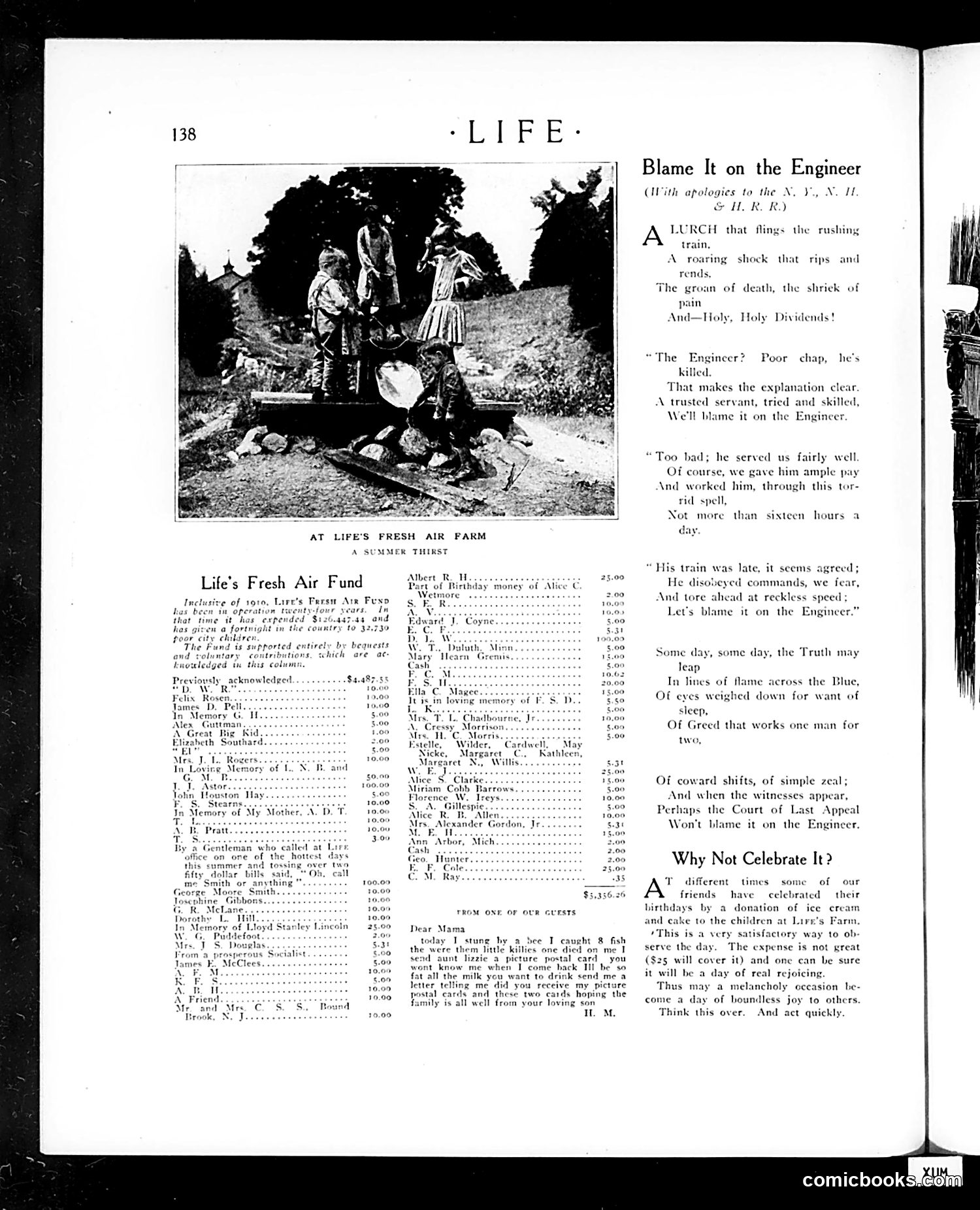
This page features a poem titled "Blame It on the Engineer" responding to a train accident. The illustration shows a derailed locomotive with casualties, depicting the immediate aftermath of a crash. The poem's narrative frames the engineer as responsible for the disaster—he's "killed" and "that makes the explanation clear." It presents a "trusted servant, tried and skilled" who will be blamed for the tragedy. The verses suggest this blame-assignment is convenient: authorities blame the dead engineer rather than investigating systemic failures or corporate responsibility. The poem's final lines imply the truth may eventually emerge through legal proceedings ("the Court of Last Appeal"), hinting that initial blame-shifting may not represent the actual cause. The satire critiques how disasters are handled by scapegoating individual workers rather than addressing deeper institutional problems.
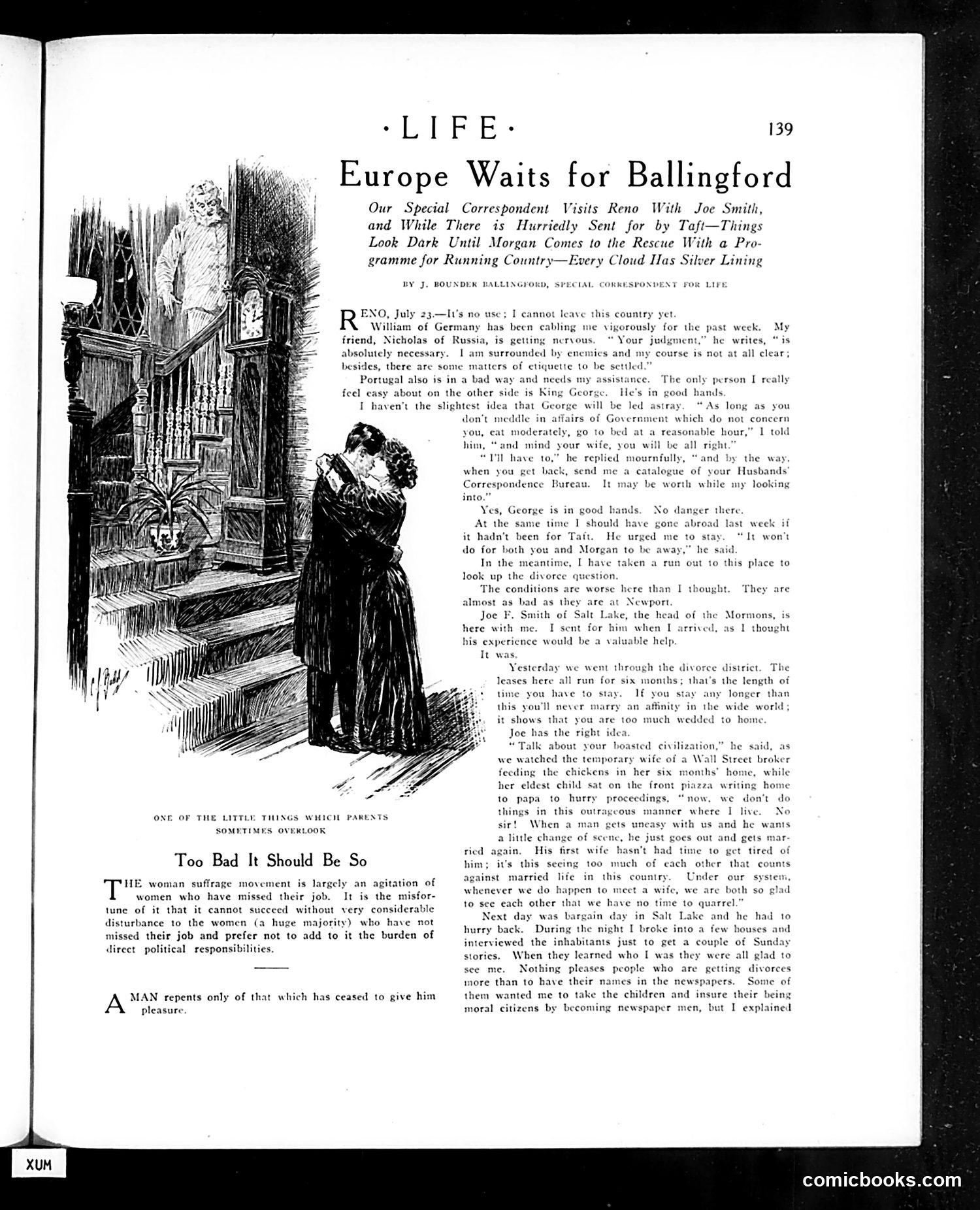
This page contains two pieces: 1. **"Europe Waits for Ballingford"** (main article): A correspondent's dispatch from Reno, Nevada, discussing divorce proceedings. The accompanying sketch shows a woman at a doorway—likely depicting someone involved in a Reno divorce case. The article references "Morgan" and discusses European concern about American divorce practices. 2. **"Too Bad It Should Be So"** (sidebar essay): A brief commentary on the women's suffrage movement, arguing that women activists "missed their job" and that women would "prefer not to add to the burden of direct political responsibilities." The page reflects early 20th-century American anxieties about divorce (particularly Reno's reputation as a divorce destination), women's rights, and changing social norms. The tone is satirical and somewhat dismissive of progressive social movements.
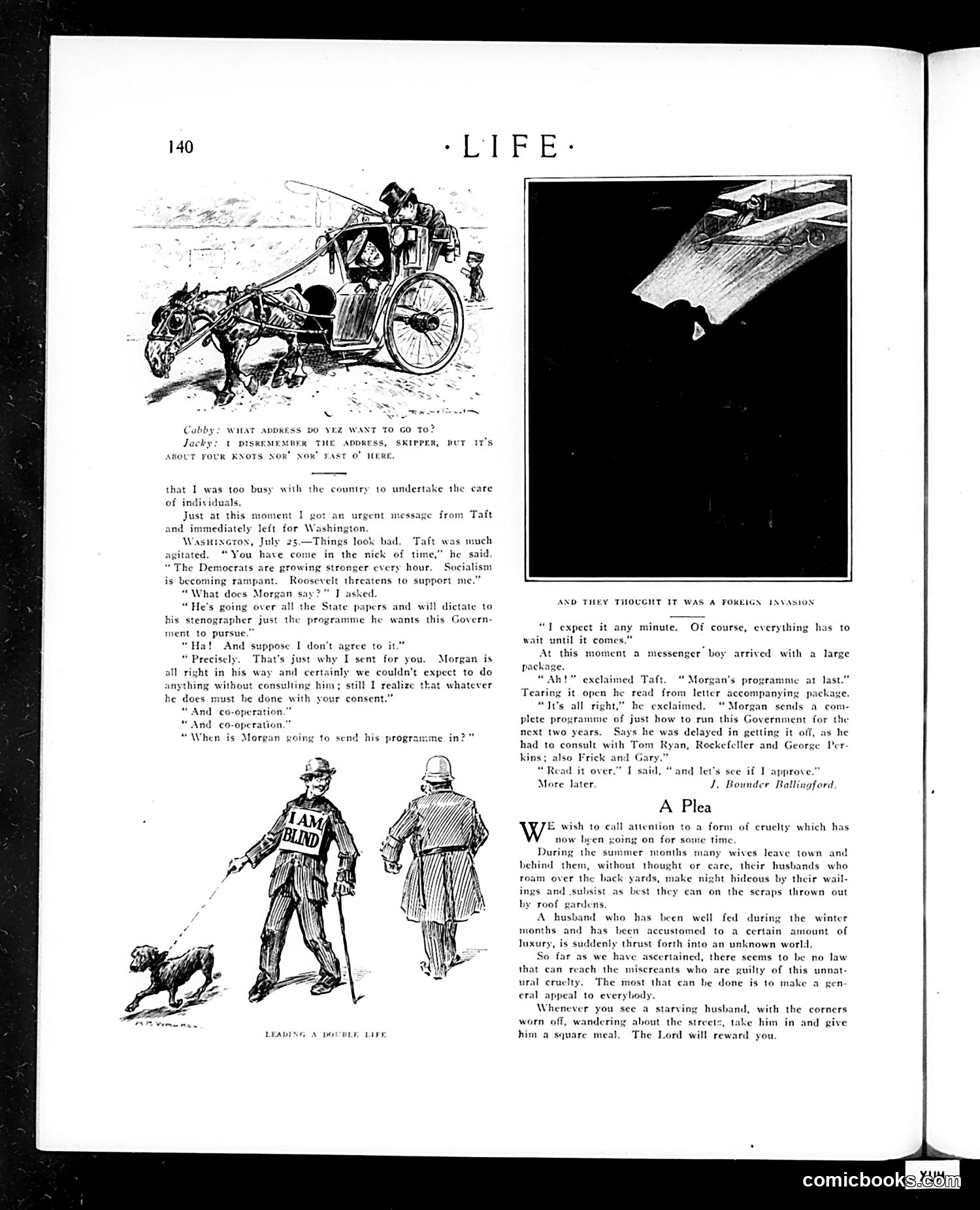
This page from *Life* magazine contains a conversation about President Taft's political program. The dialogue references Democratic and Socialist opposition growing stronger, with mentions of Morgan's (likely J.P. Morgan, the financier) involvement in government policy. The top cartoon shows a horse-drawn cab, illustrating a joke about directions—apparently a play on working-class confusion or miscommunication. The bottom illustration labeled "LEADING A DOUBLE LIFE" depicts two figures walking with a dog, likely satirizing hypocrisy or duplicitous behavior, though the specific target remains unclear from the visible text. The separate section "A Plea" addresses animal cruelty—husbands mistreating homeless or starving individuals during winter months—framing social responsibility as a moral imperative. This reflects early 20th-century progressive concerns about poverty and human dignity.
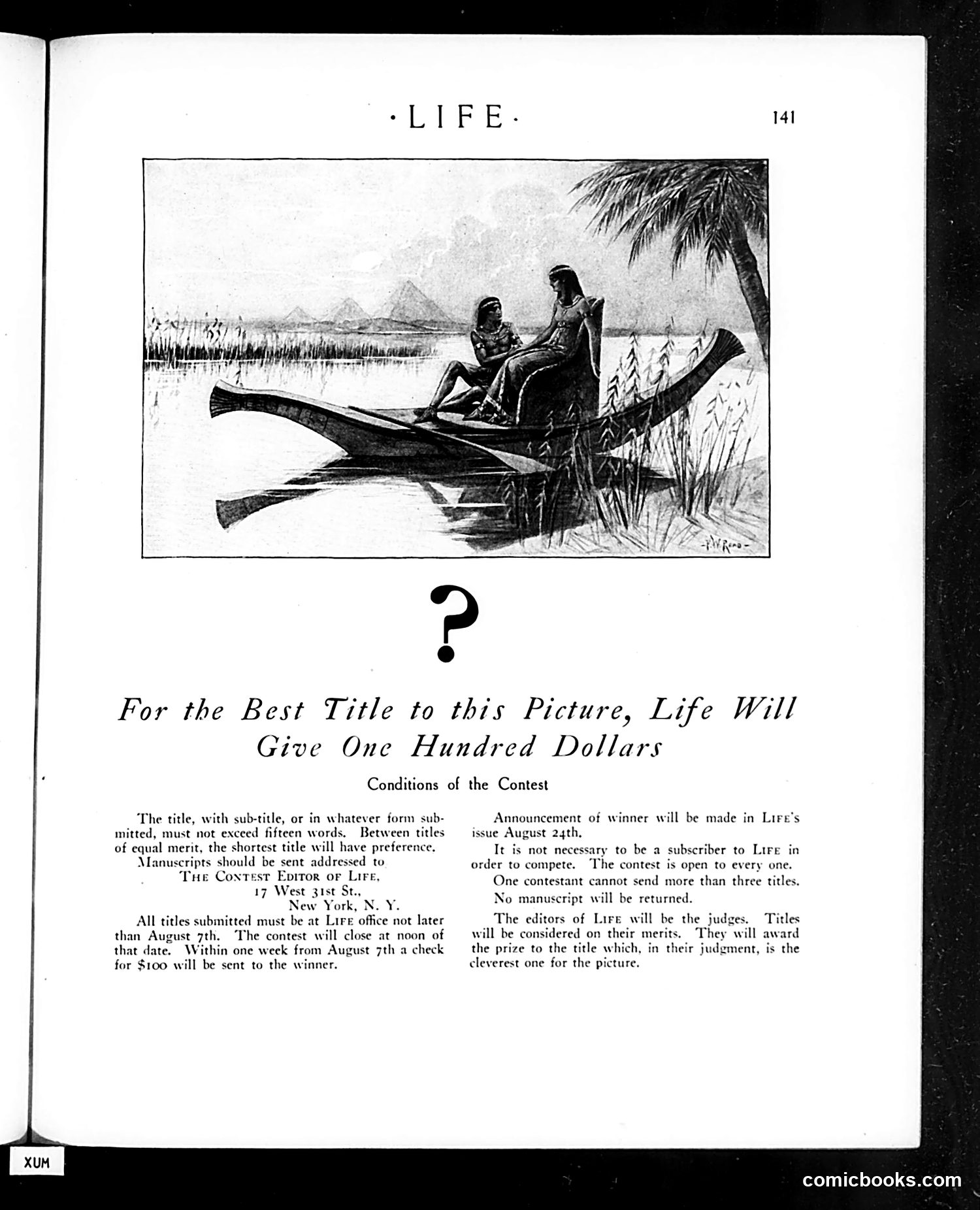
This page features a **contest announcement**, not a political cartoon. Life magazine is soliciting title suggestions for an illustration showing two figures in a small boat on a river or wetland, with pyramids visible in the background—suggesting an Egyptian setting. The contest offers $100 to the winner for the "best title" to this picture. The conditions specify that titles should be brief, submitted by August 7th, and that the winner will be announced August 24th. Notably, contestants need not be Life subscribers. The illustration itself depicts what appears to be a leisurely moment between two people in a romantic or intimate setting, though without a title, the exact satirical or humorous intent remains unclear to modern viewers.
This is a short romantic story by Sigmund Spaeth, not a political cartoon. The narrative describes a chance encounter between Elaine, a modern woman described as fashionable and independent, and an elevator operator named John. The story plays on the romantic possibilities of their brief, repeated interactions in the elevator. The piece satirizes early 20th-century romantic conventions and class differences—a wealthy, refined woman and a working-class elevator operator finding connection. The title "Uplifted" puns on the elevator setting while suggesting emotional elevation through romance. This type of whimsical, mildly satirical short fiction was typical *Life* magazine content for entertainment rather than political commentary.
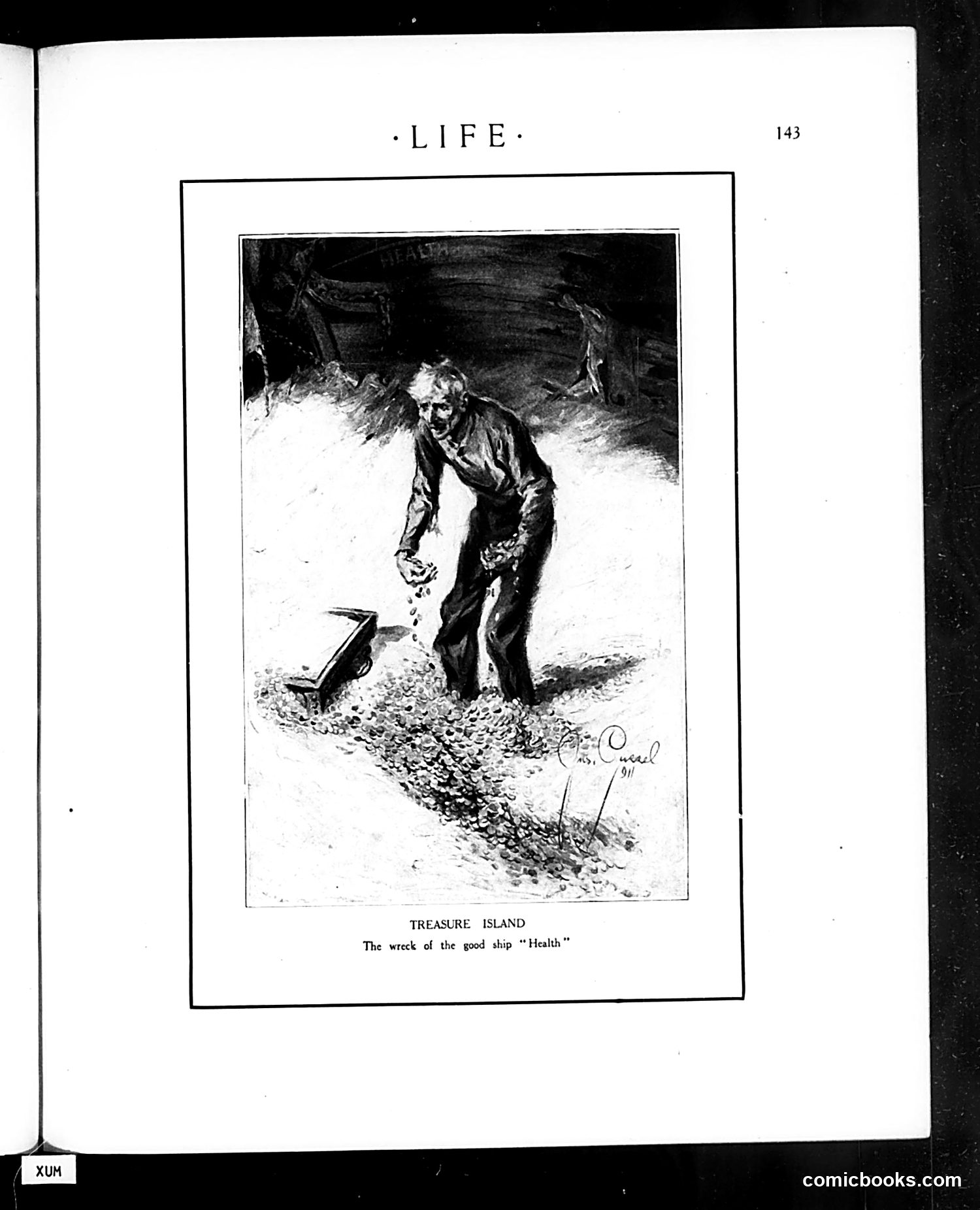
This illustration depicts a man in formal attire shoveling or digging among scattered debris on a beach, with a wrecked ship labeled "Health" visible in the background. The caption reads "The wreck of the good ship 'Health.'" The cartoon appears to be satirical commentary on public health deterioration, likely from the early 20th century. The "shipwreck" metaphor suggests that health—presented as a vessel that should protect the public—has been destroyed or neglected. The figure's digging suggests either futile attempts to recover something valuable from the wreckage, or perhaps scavenging amid the damage. Without additional context from the magazine's publication date, the specific target of this satire remains unclear, though it likely critiques contemporary health policies or conditions.
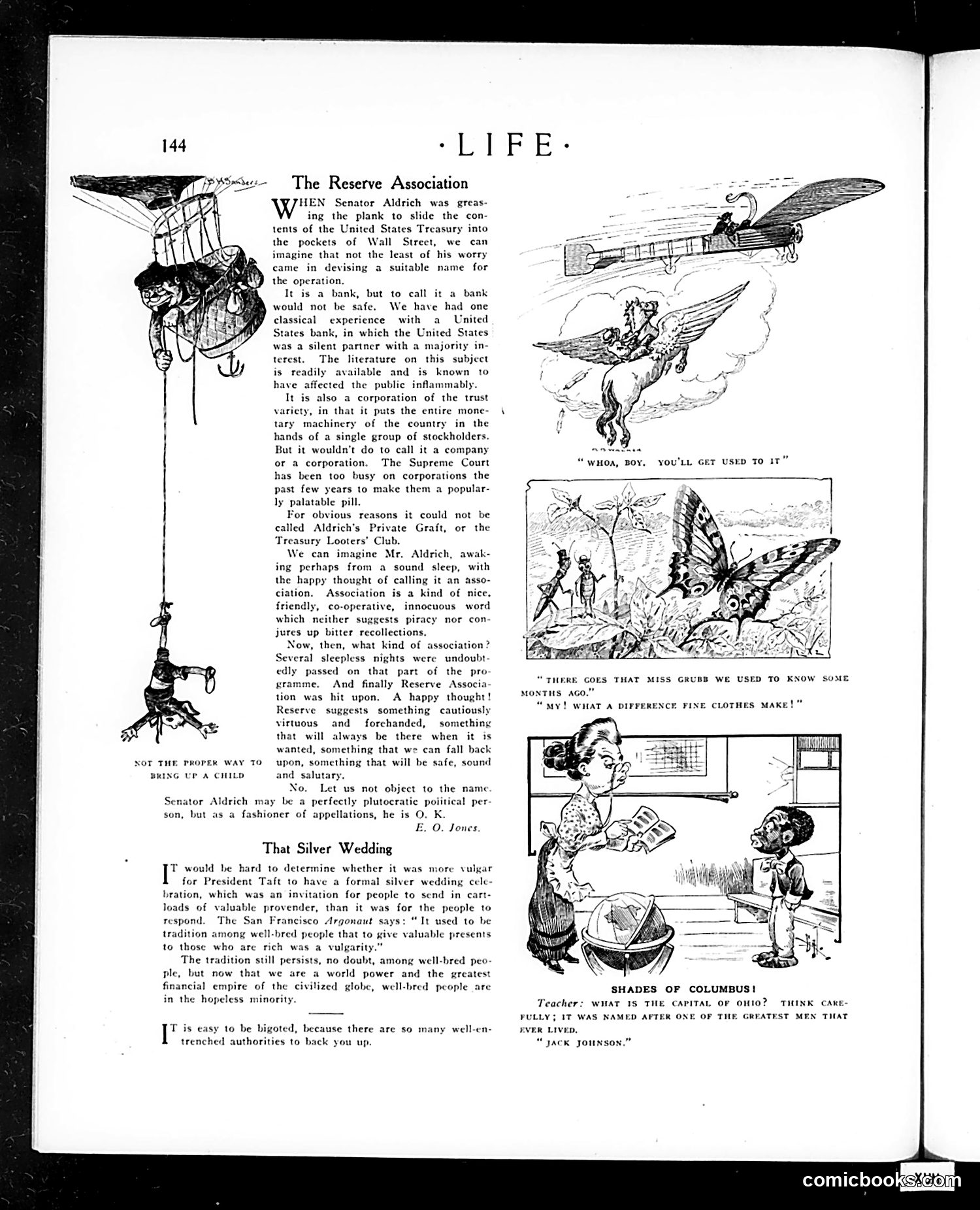
## "The Reserve Association" This article attacks Senator Nelson Aldrich's proposed Federal Reserve system as a disguised scheme to hand control of U.S. Treasury funds to Wall Street bankers. The satire mocks Aldrich for needing to obscure the operation's true nature—calling it an "association" rather than a "bank" or "corporation"—because Americans had negative historical experiences with both institutions. The cartoons show money being siphoned away and a child learning to accept this theft as normal ("you'll get used to it"), suggesting the public is being conditioned to accept financial manipulation. ## "That Silver Wedding" This criticizes President Taft's formal silver wedding celebration as vulgar—particularly his solicitation of valuable gifts from wealthy donors. The satire notes this contradicts old upper-class norms against giving expensive presents to the rich. The implication: America's new imperial status has corrupted traditional manners. ## Bottom Cartoon An unrelated joke about a teacher asking a student Ohio's capital; the student answers "Jack Johnson" (the famous Black boxer), conflating geography with celebrity.
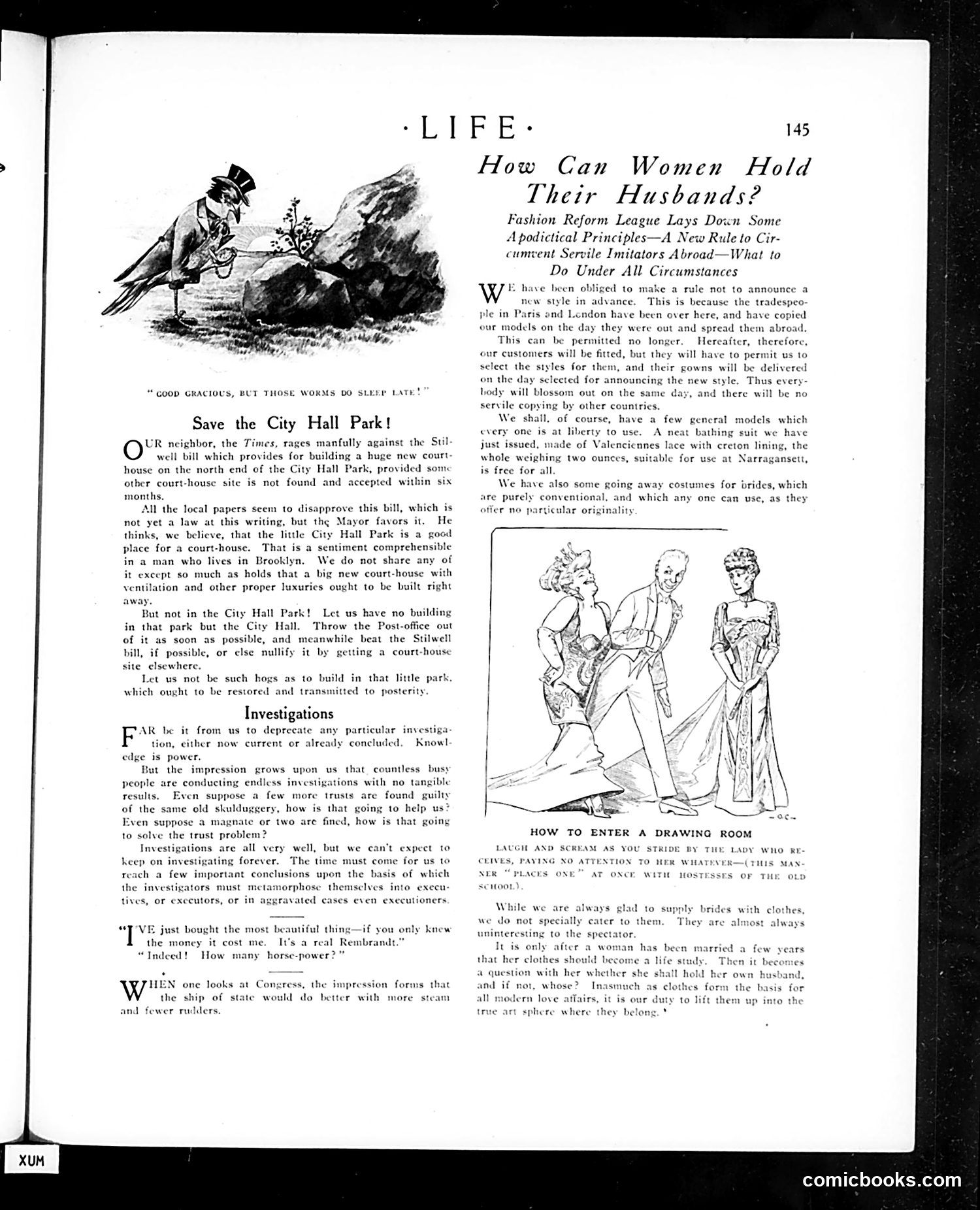
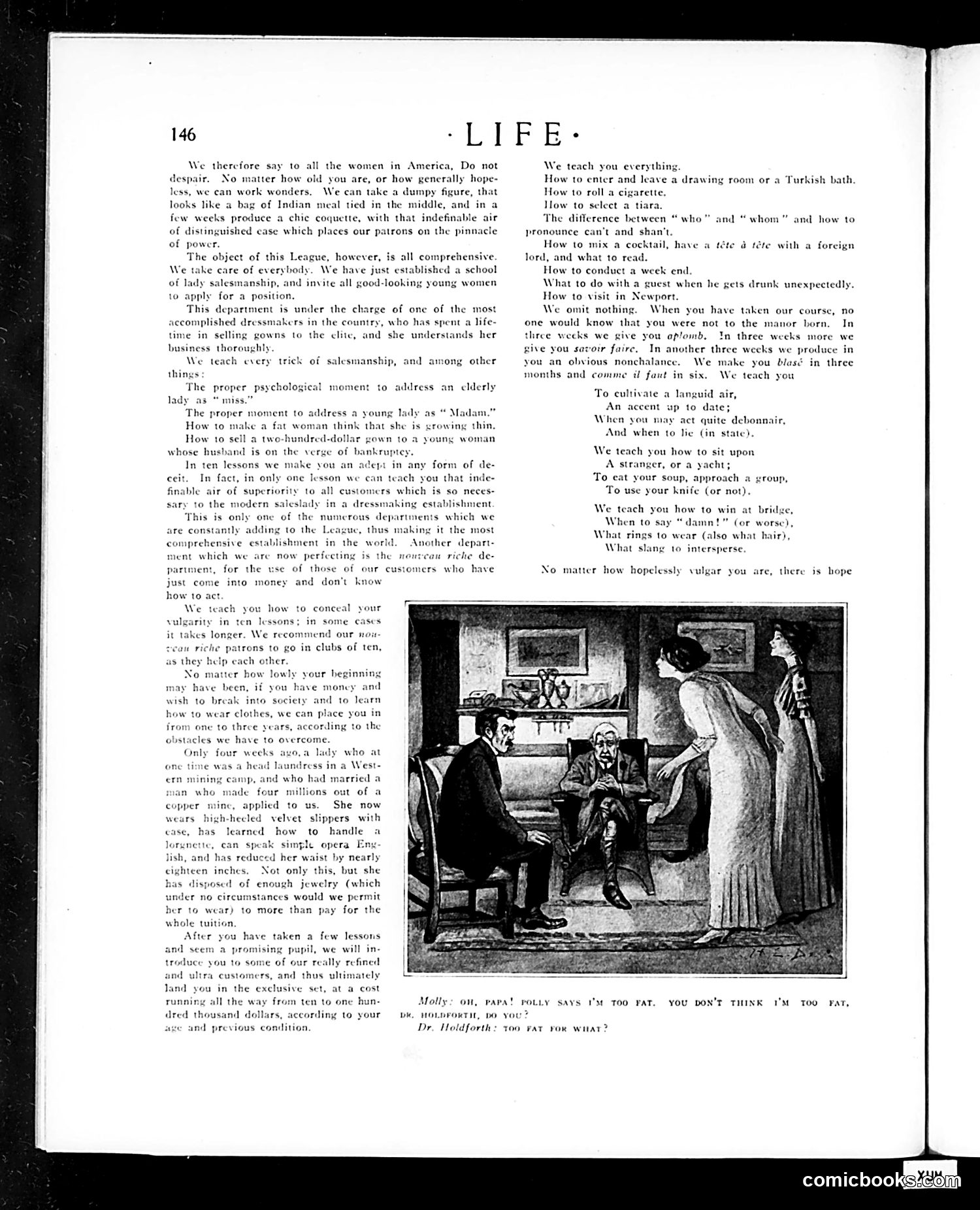
This page contains three distinct satirical pieces: **"Good Gracious, But Those Worms Do Sleep Late!"** (top left): A bird illustration accompanying a joke about someone purchasing a "real Rembrandt" painting—the humor mocking wealthy people's pretension about art acquisitions and cost-consciousness. **"Save the City Hall Park!"** (left column): A editorial advocating against New York's proposed Stilwell bill to build a courthouse in City Hall Park. The satire targets the Mayor (likely a Brooklyn resident) for supporting the project, while the magazine argues the park should remain green space and be "restored and transmitted to posterity." **"How Can Women Hold Their Husbands?"** (right side): Fashion industry satire mocking the Fashion Reform League's rules about coordinated dress announcements to prevent European copying. The accompanying illustration "How to Enter a Drawing Room" humorously depicts crude social behavior—laughing loudly and ignoring the hostess—satirizing both fashion pretension and wealthy society etiquette. The page generally lampooms elite institutions: municipal bureaucracy, art collecting snobbery, and high society customs.
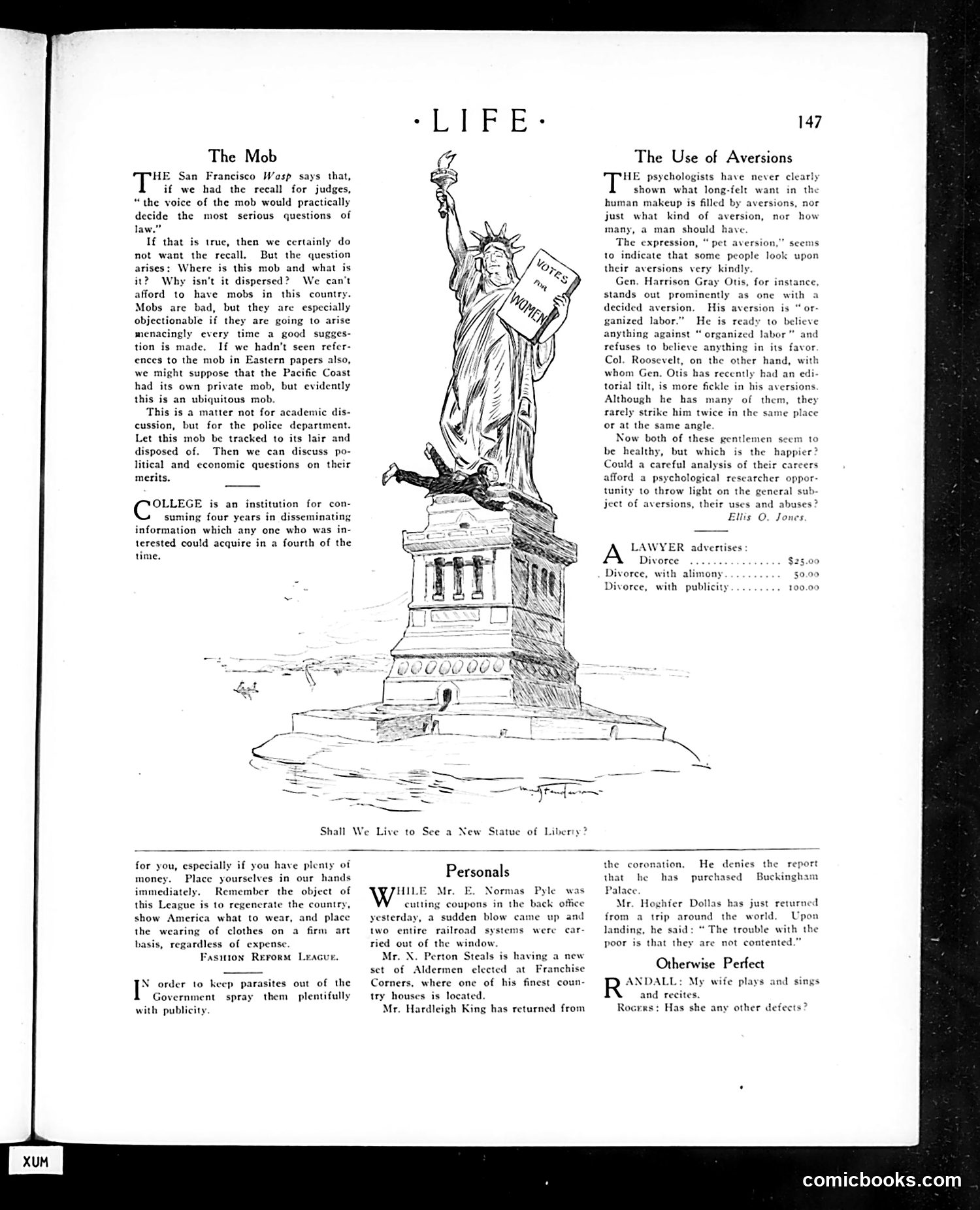
This page contains three satirical pieces typical of early 20th-century American humor journalism: **"The Mob"** critiques the debate over judicial recall, mocking the vague invocation of "the mob" as a threat. The author points out the irony: if a mob exists and poses danger, it should be tracked down by police rather than used as an abstract argument against democratic reforms. **"The Use of Aversions"** compares two prominent figures with fixed dislikes: Gen. Harrison Gray Otis (vehemently anti-labor) versus Col. Roosevelt (whose aversions shift unpredictably). The satire questions which man's inflexibility serves him better psychologically. **The central cartoon** depicts the Statue of Liberty damaged/falling, captioned "Shall We Live to See a New Statue of Liberty?"—likely commenting on American ideals being compromised by political corruption or mob violence. The page concludes with brief humorous "Personals" (gossip items about wealthy individuals' trivial concerns) and a lawyer's divorce advertisement, emphasizing Life's satirical critique of contemporary American society and values.
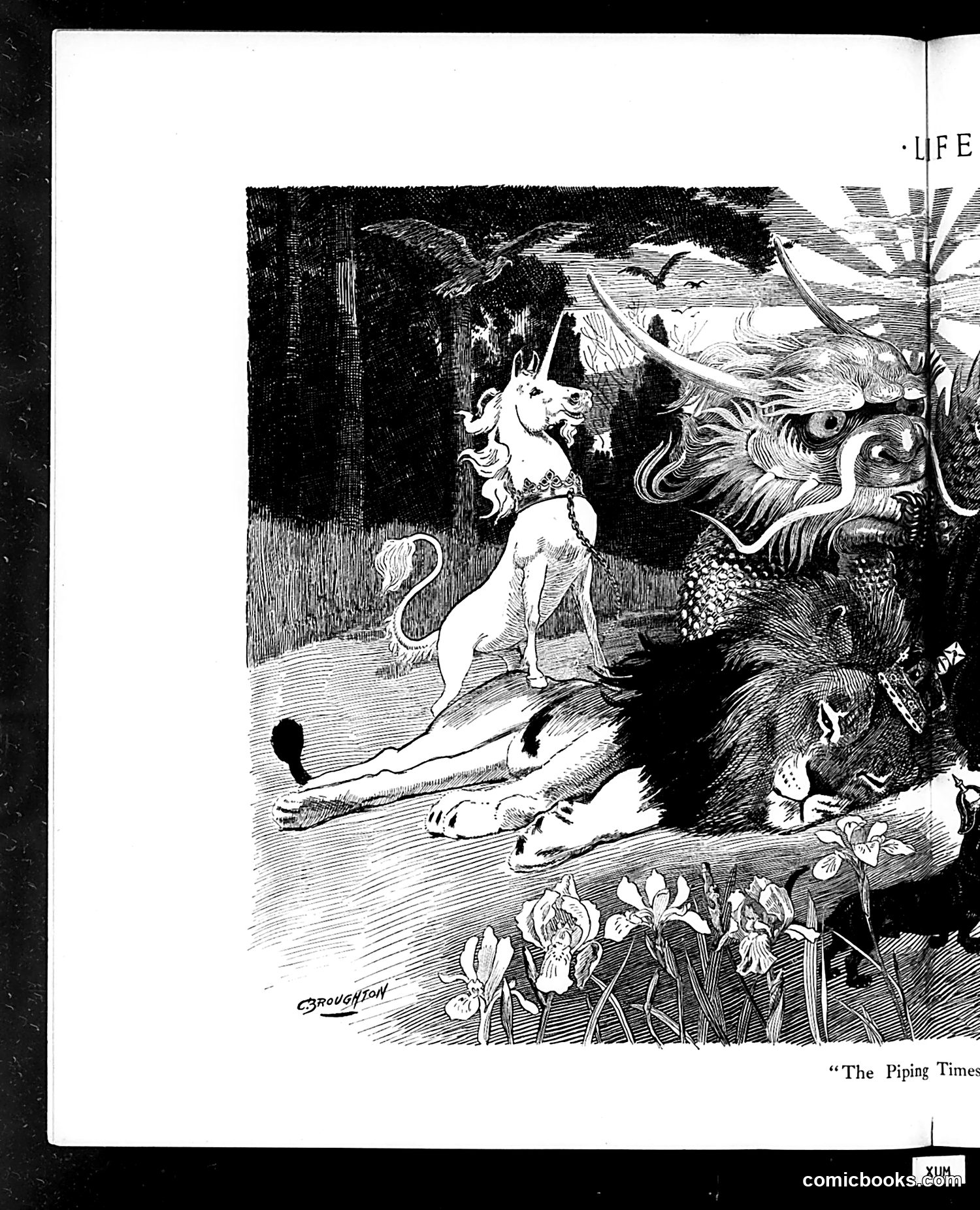
This page features an illustration signed by **Broughton** titled "The Piping Times." The satirical image depicts a **unicorn-like creature standing upright**, apparently charming or entertaining a large, ornate **beast or lion figure** through music (suggested by the "piping" reference in the title). The scene includes **flowers in the foreground** and **birds in the sky**, creating a fantastical, allegorical setting. The contrast between the delicate unicorn and the powerful beast suggests the cartoon's satirical point: **the power of music, charm, or persuasion to tame or control something dangerous or brutal**. Without additional context about Life magazine's specific publication date or political climate, the exact historical reference remains unclear, though the imagery suggests commentary on civilizing influence or diplomatic persuasion overcoming raw power.
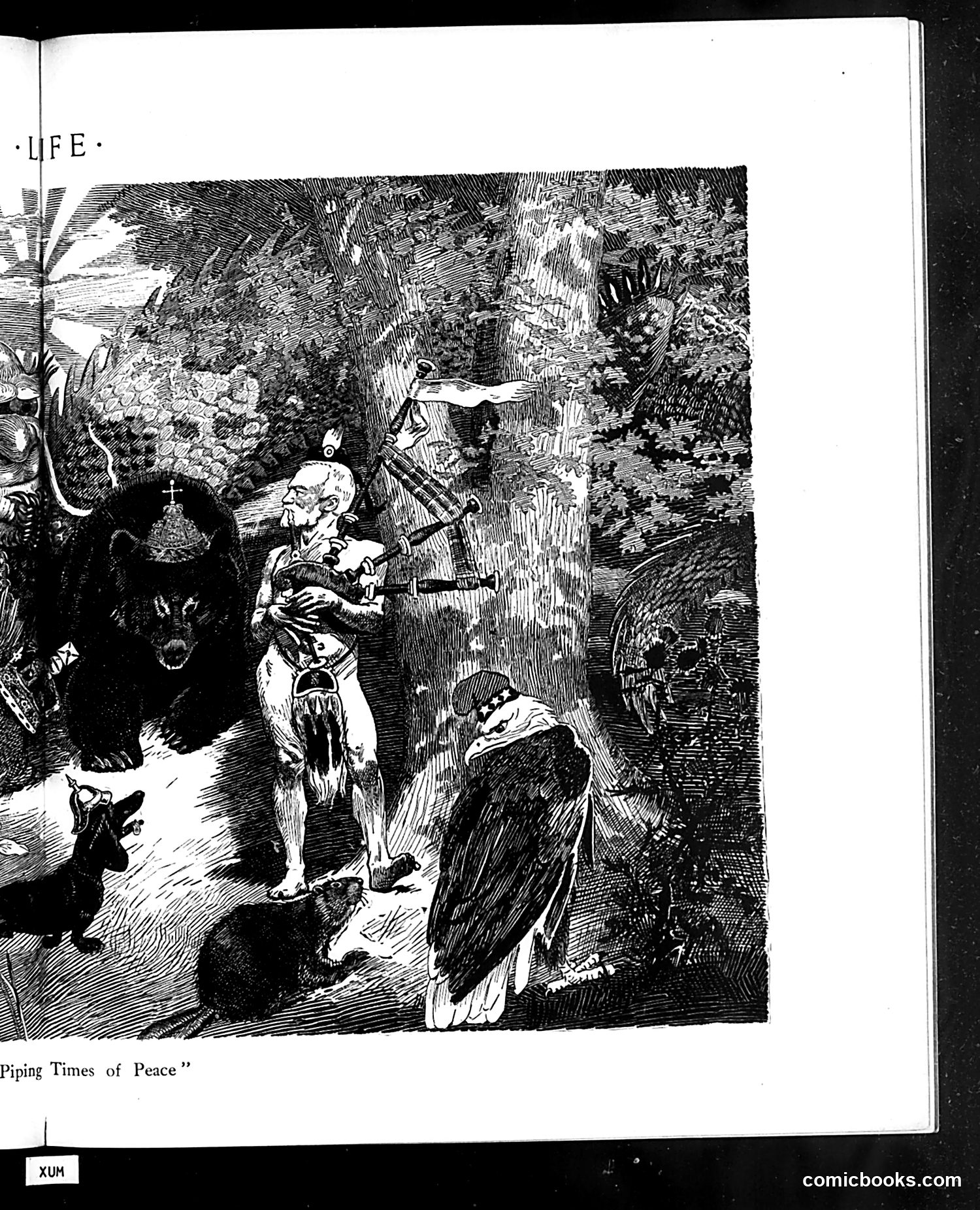
This engraving depicts a fantastical woodland scene where various creatures and figures gather—appearing to include exotic animals (possibly a bear and bird), human figures in period dress, and what seems to be a piper or musician. The title "Piping Times of Peace" likely references a historical phrase suggesting peaceful, carefree times accompanied by music and celebration. Without additional context or visible publication date, the specific political references remain unclear. The imagery appears allegorical—possibly satirizing peacetime conditions or social harmony through the contrast of civilized humans mingling with wild creatures in nature. The detailed engraving style suggests 19th-century production. The exact satirical target or contemporary political reference cannot be determined from the visible information alone.
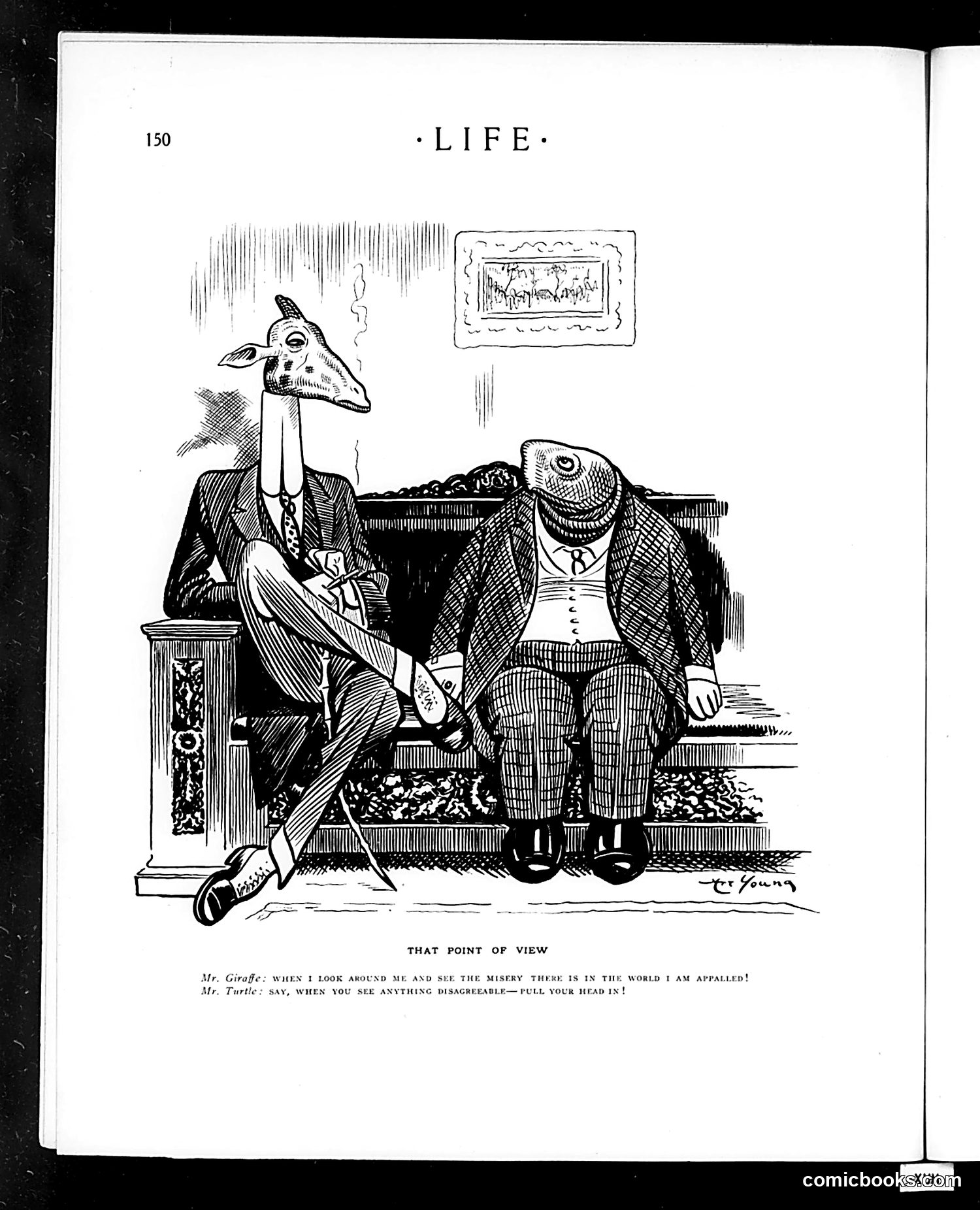
This cartoon satirizes contrasting responses to witnessing worldly suffering. Mr. Giraffe, depicted with his characteristically long neck, represents someone who looks around and perceives the world's misery, responding with moral outrage ("appalled"). Mr. Turtle offers cynical counter-advice: when confronted with anything disagreeable, simply "pull your head in"—a reference to the turtle's literal ability to retract into its shell. This mocks willful ignorance and avoidance of uncomfortable truths. The satire targets two philosophical positions: idealistic moral sensitivity versus deliberate escapism. The animal caricatures emphasize the contrast—the giraffe cannot hide (its height makes awareness unavoidable), while the turtle can literally withdraw from reality. The cartoon critiques both naïve idealism and complacent denial as inadequate responses to genuine social problems.
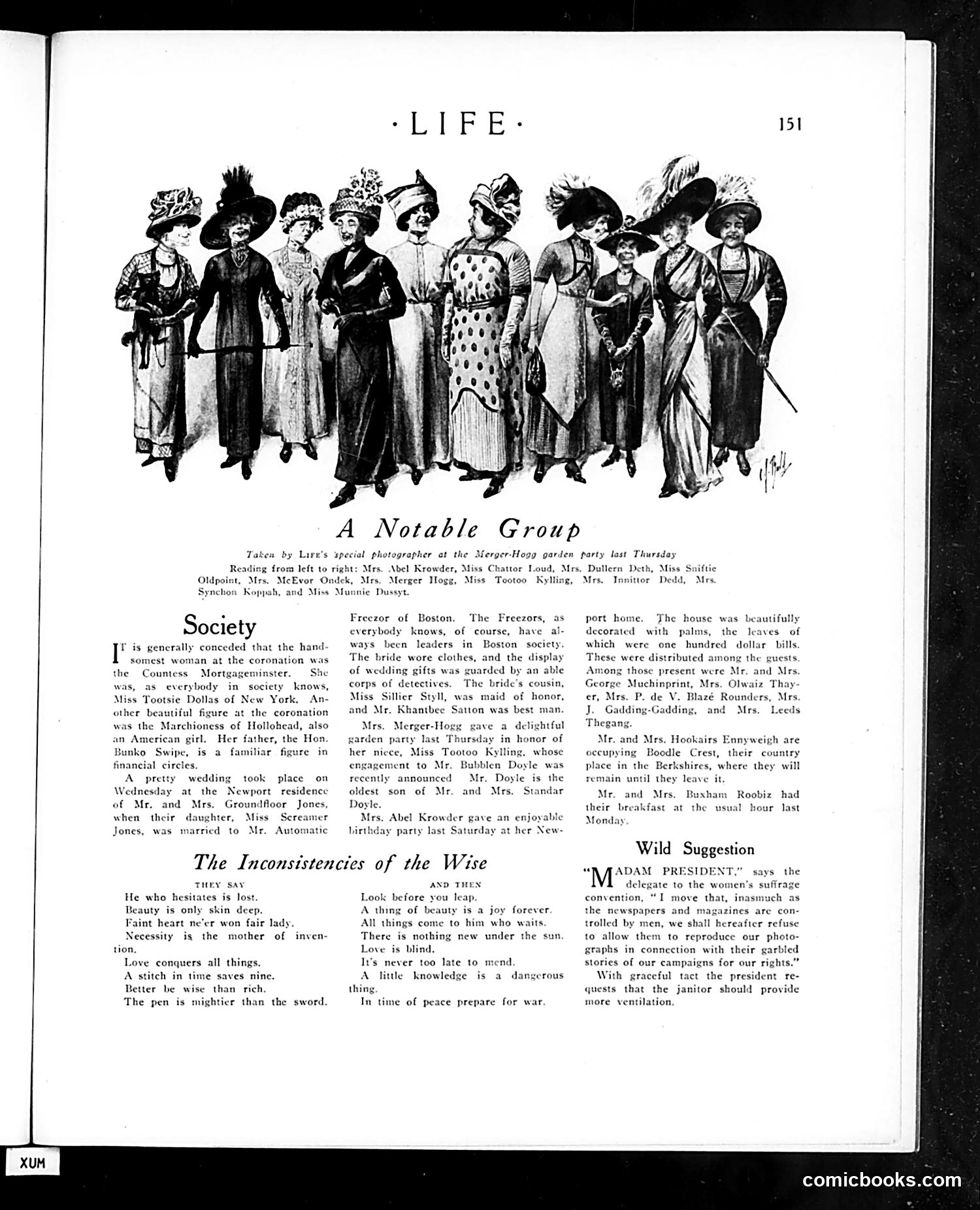
This page satirizes wealthy American high society through absurdist humor. The top illustration shows fashionable women at a garden party, captioned with deliberately ridiculous names (Mrs. "Merger Hogg," "Tootoo Kylling," "Munnie Dussyt") that mock the pretension of society reporting. The "Society" section parodies breathless society-page coverage of weddings and parties, featuring characters with satirical names suggesting greed and superficiality. One detail mocks excessive wealth: palms decorated with hundred-dollar bills at a party. "The Inconsistencies of the Wise" juxtaposes contradictory proverbs—a gentle mockery of conventional wisdom's reliability. "Wild Suggestion" satirizes the women's suffrage movement by depicting a delegate proposing that women's suffrage publications refuse to publish photographs in newspapers "controlled by men"—absurdist commentary on gendered media control and the movement's strategies, likely published skeptically given Life's satirical stance. The overall effect ridicules both upper-class pretension and contemporary social movements.
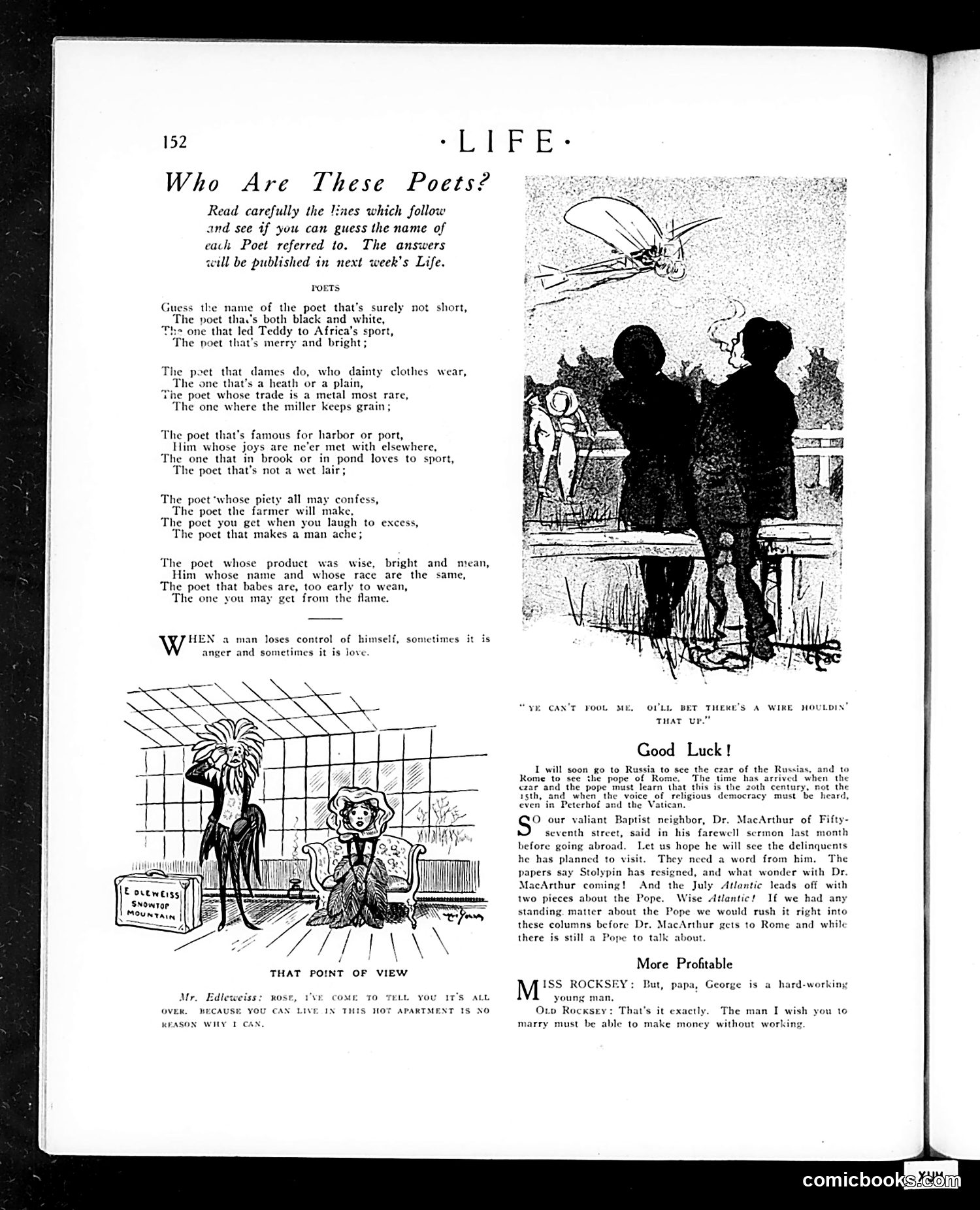
This page contains a **poetry guessing game** where readers identify poets from riddle-like clues. The clues use wordplay—for example, "the poet that's famous for harbor or port" likely refers to "Longfellow" (long fellow = tall). Similar cryptic references appear throughout. The page also includes **two satirical cartoons**: 1. **"That Point of View"**: A landlord tells a tenant he can stay in a hot apartment rent-free because "you can live in this hot apartment is no reason why I can"—satirizing landlord logic and poor living conditions. 2. **"More Profitable"**: Old Rocksey tells Miss Rocksey her suitor George is hardworking, but she corrects him: she wants a man who can "make money without working"—mocking materialistic marriage expectations and the desire for wealth without effort. The page also mentions **Dr. MacArthur's upcoming trip to Russia and Rome** to lecture the czar and pope about 20th-century democratic values—satirizing American religious leaders' presumption in trying to "reform" foreign powers.
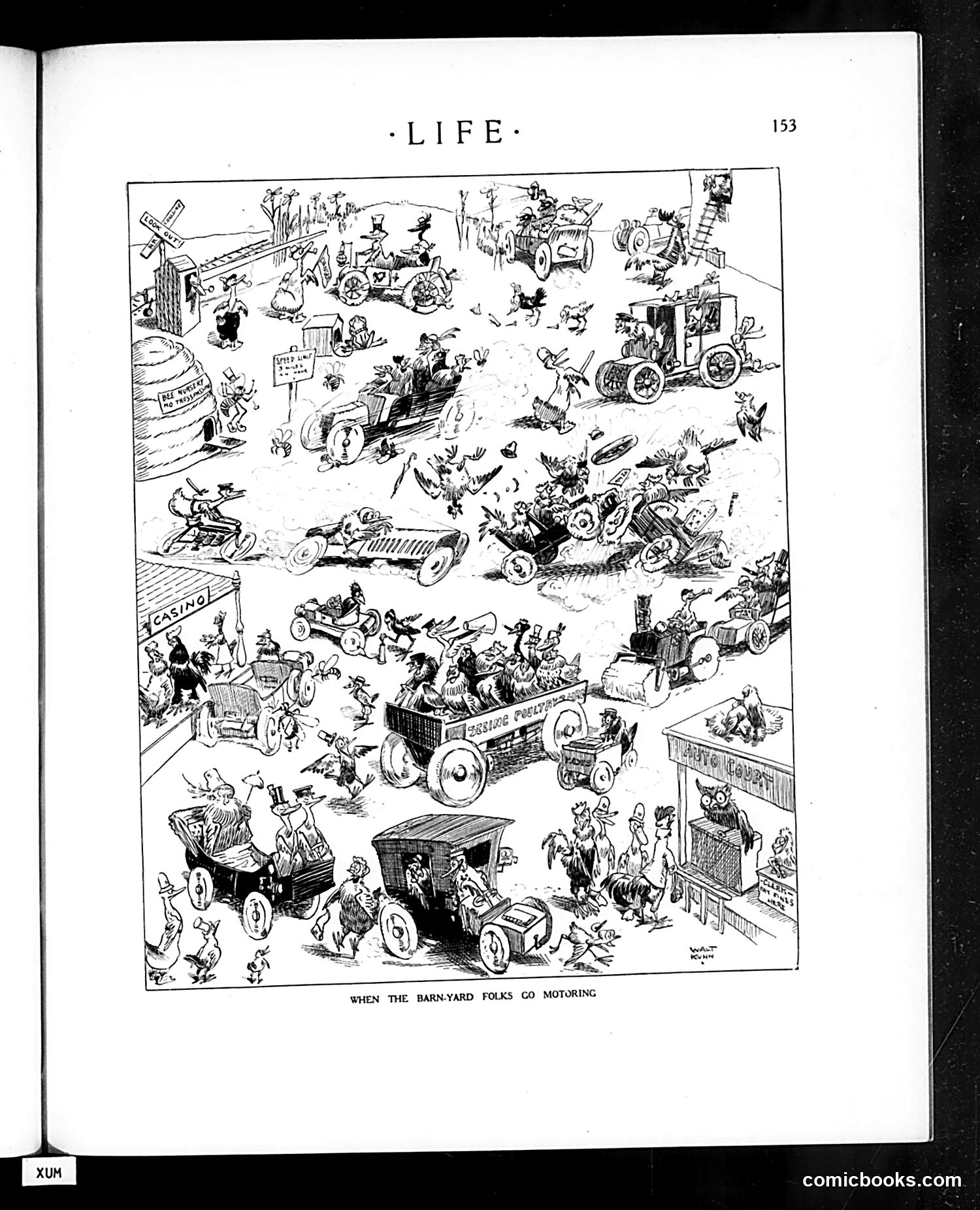
This is a humorous cartoon depicting anthropomorphic farm animals driving various automobiles and contraptions in chaotic fashion. The scene shows chickens, cows, pigs, and other barnyard creatures operating cars, motorcycles, and vehicles of increasingly ridiculous design—some appear to be homemade or improvised. The satire likely mocks early 1900s motoring culture: the chaos suggests incompetent or reckless drivers, mechanical mishaps, and the general pandemonium of newly motorized society. The juxtaposition of rustic farm animals with modern automobiles creates absurdist comedy, poking fun at both rural folks adopting new technology and the dangers/absurdity of the early automotive era. The cartoon reflects concerns about traffic safety and driver competence during the transition from horse-drawn to motorized transport.
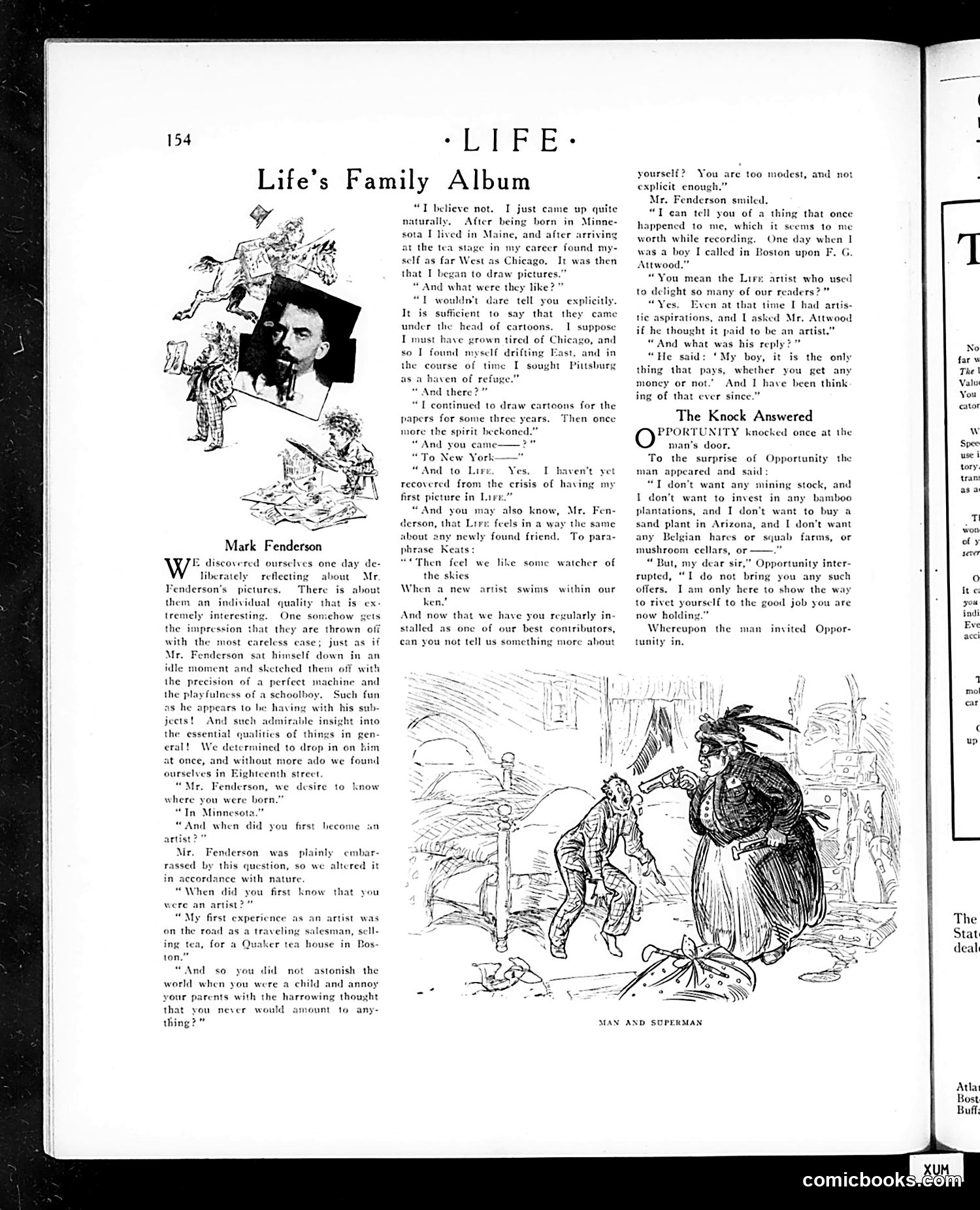
This page features an interview with cartoonist **Mark Fenderson**, presented as part of Life magazine's "Family Album" series profiling notable contributors. ## The Content: The text is a Q&A biography where Fenderson recounts his career path: born in Minnesota, worked as a traveling tea salesman in Boston, then drifted to Chicago before beginning cartooning, working in Pittsburgh for three years, and eventually joining Life magazine in New York. ## The Cartoons: Two illustrations accompany the piece: 1. **Portrait sketch** of Fenderson surrounded by his cartoon characters, establishing him as a prolific artist 2. **"Man and Superman"** - depicts a man meeting "Opportunity" at his door. The joke: Opportunity arrives expecting to pitch dubious investment schemes (mining stocks, bamboo plantations, mushroom farms), but the man—focused on his current honest employment—welcomes Opportunity in anyway, having lowered his expectations. The satire gently mocks American get-rich-quick culture and speculative fever while celebrating honest work.
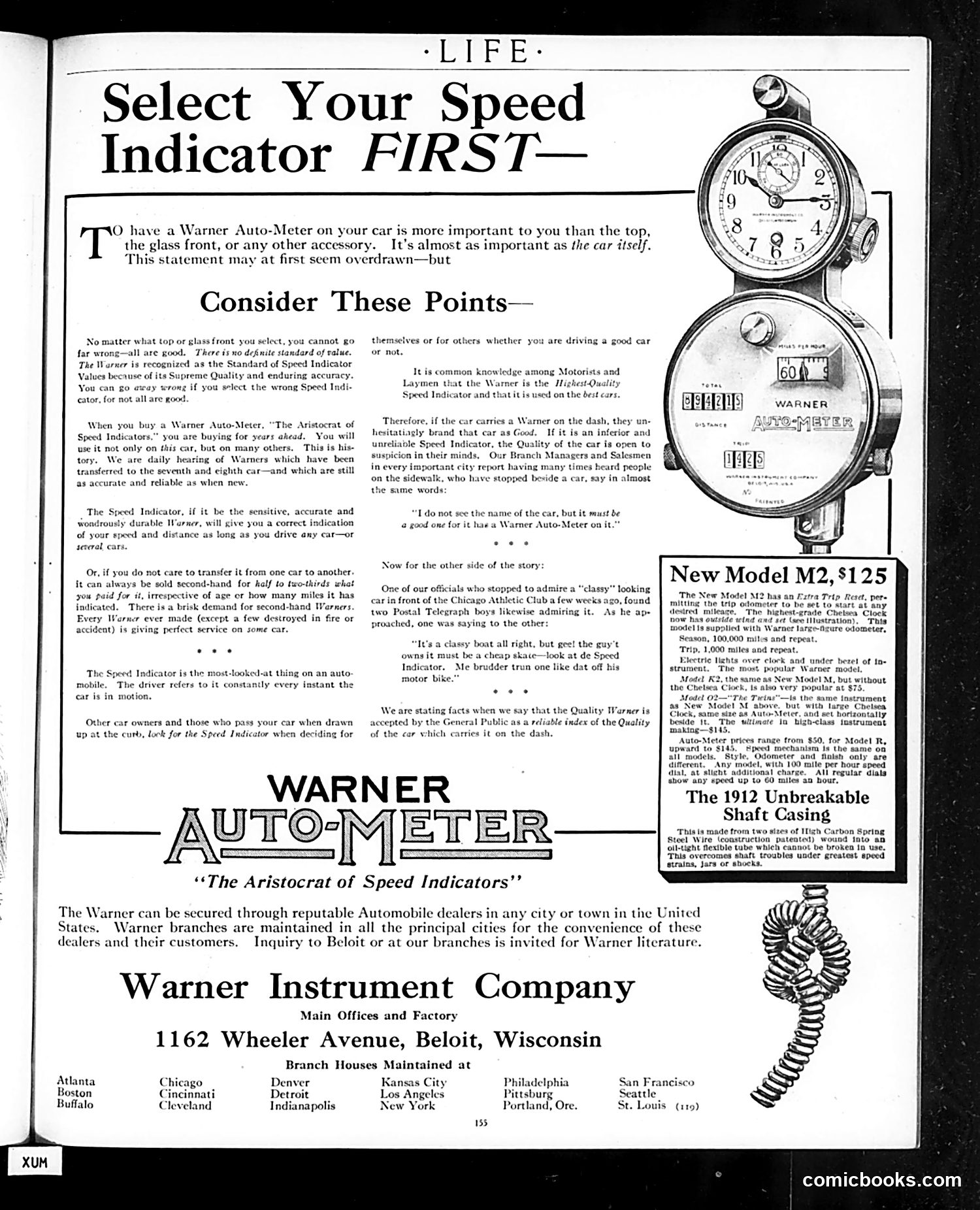
This is primarily an **advertisement**, not a political cartoon. It promotes the Warner Auto-Meter speedometer as essential automotive equipment. The page uses a storytelling approach: testimonial-style anecdotes suggest that passersby judge a car's quality by whether it has a Warner speedometer on its dashboard. One dialogue shows observers saying "I do not see the name of the car, but it must be a good one for it has a Warner Auto-Meter on it"—implying the speedometer is a status symbol and quality indicator. The ad emphasizes durability (claiming Warners survive multiple car transfers), accuracy, and brand prestige by calling it "The Aristocrat of Speed Indicators." Product details list models ranging from $50–$145, with features like Chelsea Clock mechanisms and trip odometers. This reflects early 1910s consumer culture: speedometers were still novel luxury items, and manufacturers marketed them as marks of quality and refinement.
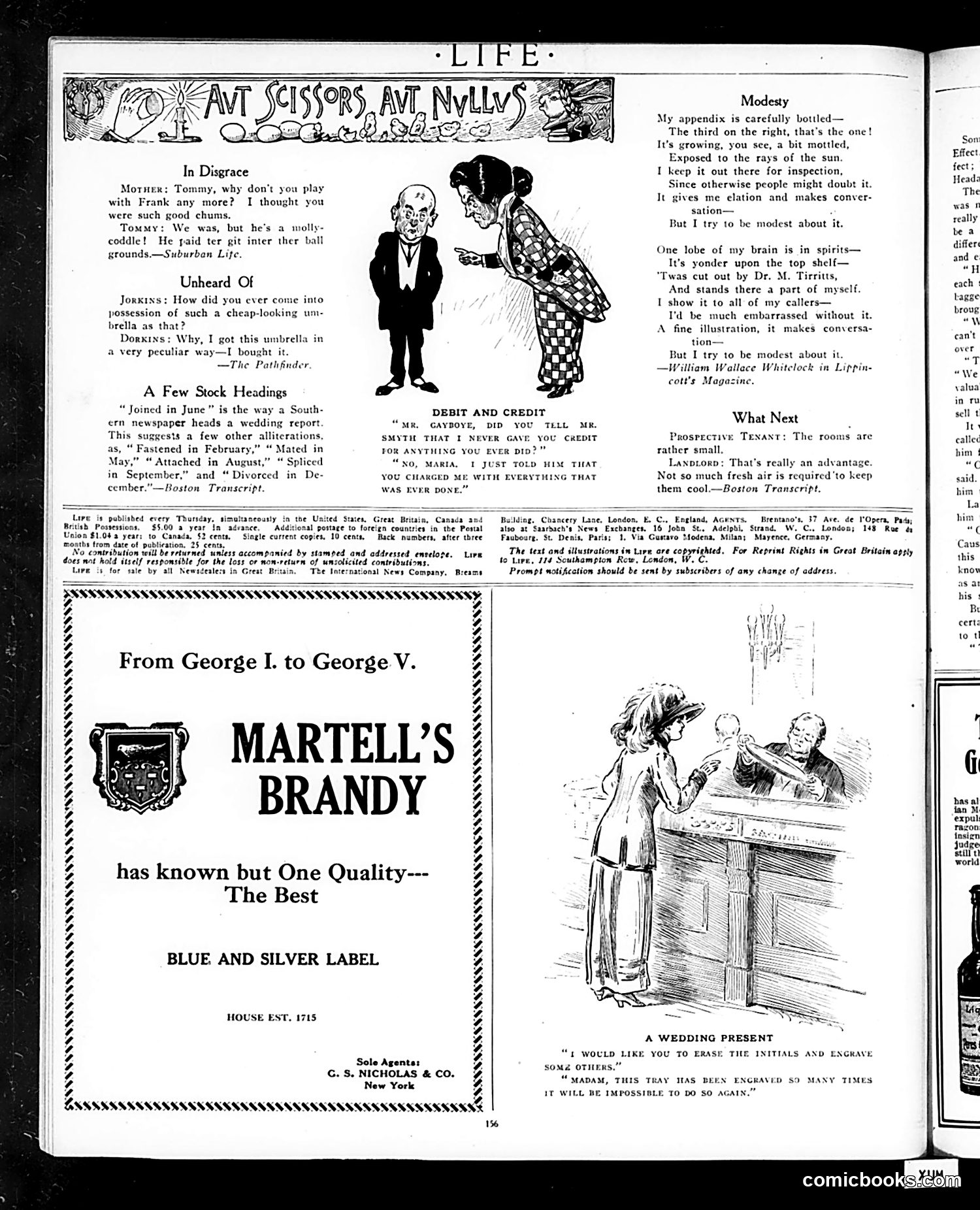
This page from *Life* magazine contains several brief humorous pieces typical of early 20th-century American satire: **"In Disgrace"** mocks a boy called a "molly-coddle" (an insult for an effeminate or weak male) because he paid entry fees rather than sneaking into baseball grounds—depicting class-consciousness and masculine expectations of working-class boys. **"Unheard Of"** jokes about buying an umbrella legitimately rather than acquiring it through dubious means, playing on assumptions about lower-class petty theft. **"Debit and Credit"** presents marital bickering where a husband reports his wife credits him with everything wrong, inverting blame dynamics. **"Modesty"** is a poem mocking Victorian-era displays of medical oddities (preserved organs, brain specimens) while claiming modesty—satirizing both the era's fascination with anatomy and false humility. **"A Wedding Present"** depicts a woman requesting repeated re-engraving of a silver tray's initials, eventually frustrating the jeweler. The page is primarily **advertising-driven**, with a large Martell's Brandy advertisement dominating the lower half.
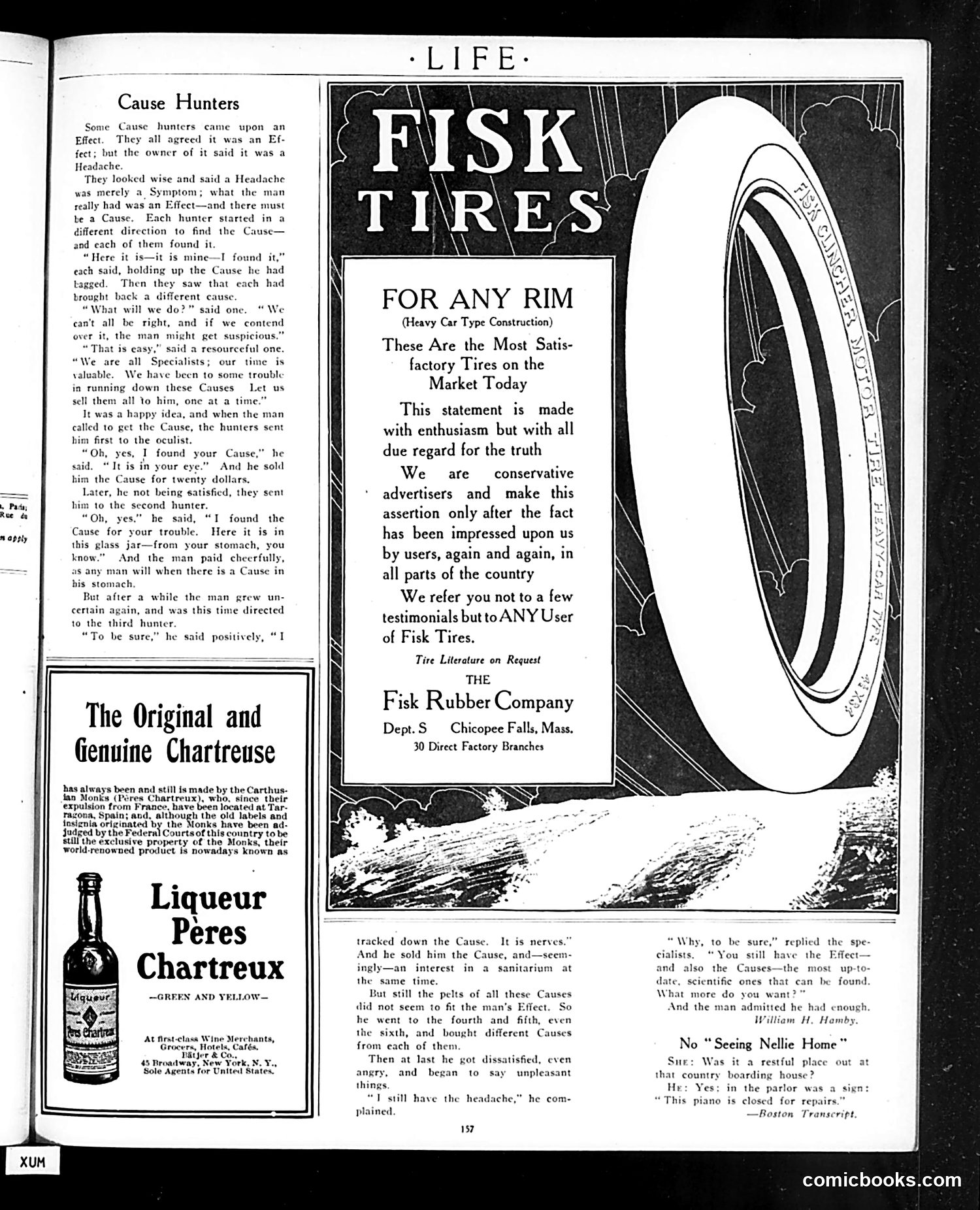
This cartoon satirizes the early 20th-century medical and pseudo-scientific practice of blaming vague ailments on multiple competing "causes." A man with a headache consults various specialists—an eye doctor, stomach specialist, and nerve doctor—each claiming to have found *the* cause and selling him a different diagnosis (eye problem, stomach issue, nerves). The joke critiques both credulous patients and opportunistic practitioners who profit by multiplying explanations for a single symptom rather than actually solving the problem. The man ends up paying multiple specialists for contradictory "causes" while his original headache persists. This reflects skepticism toward the proliferation of medical specialization and commercial exploitation of health anxiety in that era—a satire on how capitalism can turn even diagnosis into a money-making scheme where the patient remains unsolved but financially drained. The accompanying Fisk Tires advertisement is unrelated commercial content.
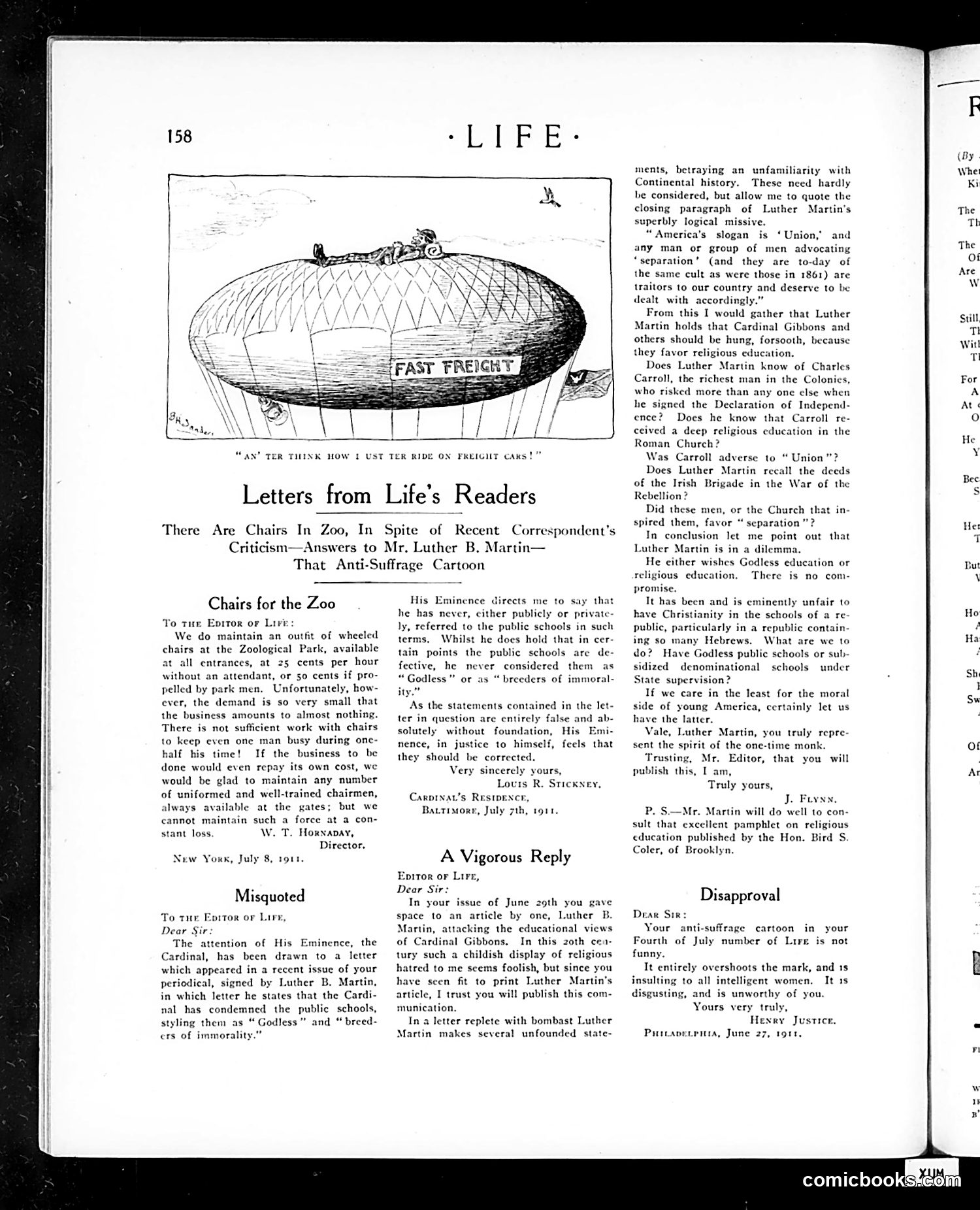
This page contains reader letters responding to a satirical cartoon about zoo chairs and a heated debate over religious education in American public schools. The cartoon shows an airship labeled "FAST FREIGHT" with someone asking "An' ter think how I ust ter ride on freight cars!"—likely mocking the absurdity of expensive new technologies replacing humble transport. The main controversy involves Luther B. Martin's attack on Cardinal Gibbons for supporting religious education, which Martin apparently labeled as "Godless" or breeding "immorality." Readers defend Gibbons and historical Catholic figures (Charles Carroll, Irish Brigade members) who were simultaneously patriotic and religiously educated. One respondent notes Martin presents a false dilemma: either "Godless education" or "denominational schools"—ignoring middle-ground options. The debate reflects early-1900s tensions over secularization, Catholic influence in schools, and competing visions of American patriotism and education.
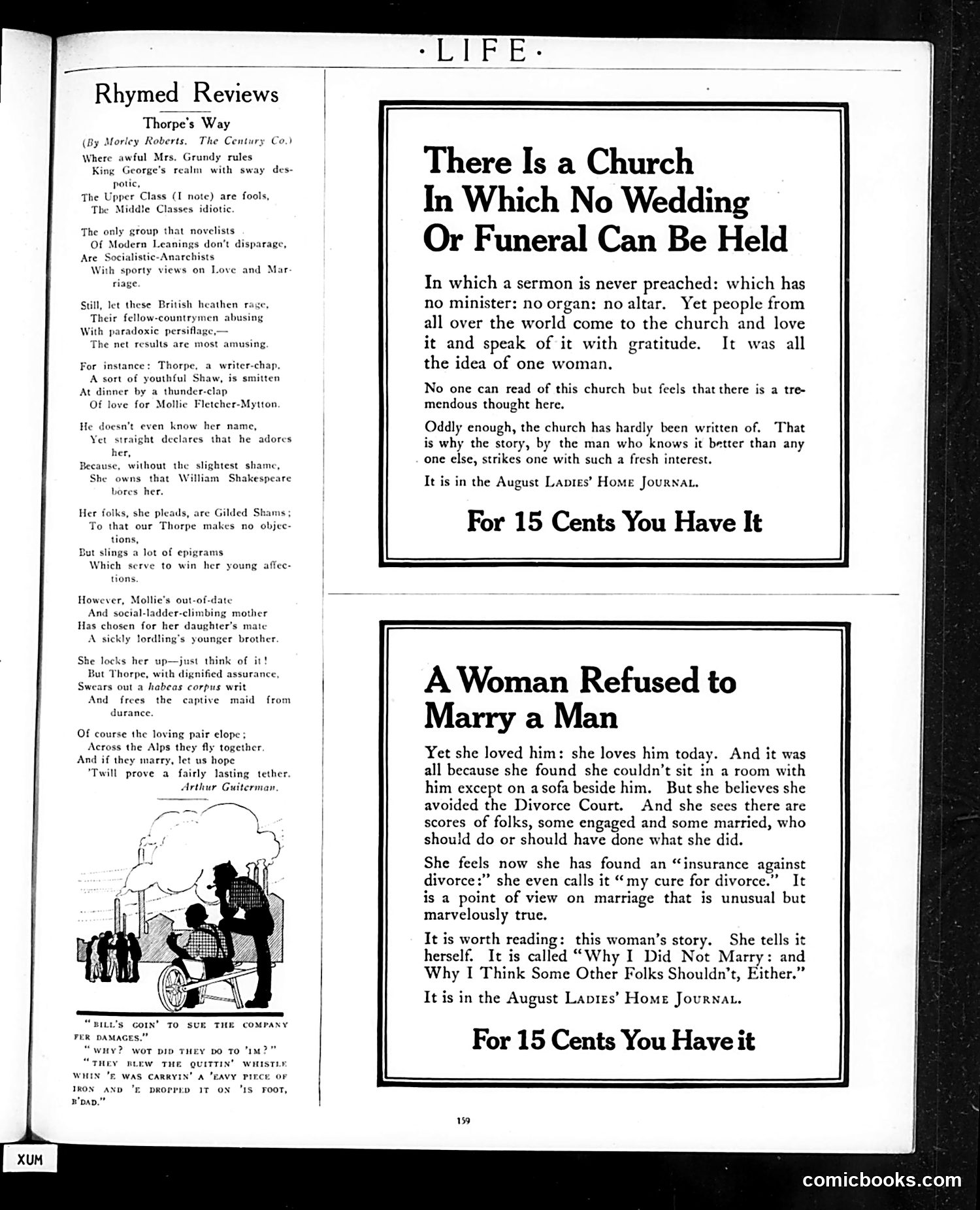
This page contains a book review, two advertisements for *Ladies' Home Journal* articles, and a cartoon. **The Rhymed Review** critiques Morley Roberts's novel *Thorpe's Way*, satirizing British social hierarchies. The reviewer mocks how the novel portrays the upper and middle classes as foolish while romanticizing socialistic-anarchist characters. The plot—a young writer falls for a woman who disdains Shakespeare, pursues her despite her mother's objections, and helps her elope—is presented as typical melodramatic fare. **The Cartoon** depicts a workplace accident: a man dropped an iron piece on his foot after being startled by a factory whistle. The dialogue jokes darkly about suing the company for damages from this self-inflicted injury, poking fun at emerging workers' compensation claims. **The Advertisements** promote two *Ladies' Home Journal* articles costing 15 cents: one about an unusual church with no sermons or minister, another about a woman who refused marriage to avoid divorce. Both sensationalize unconventional lifestyle choices as "fresh interest" for readers.
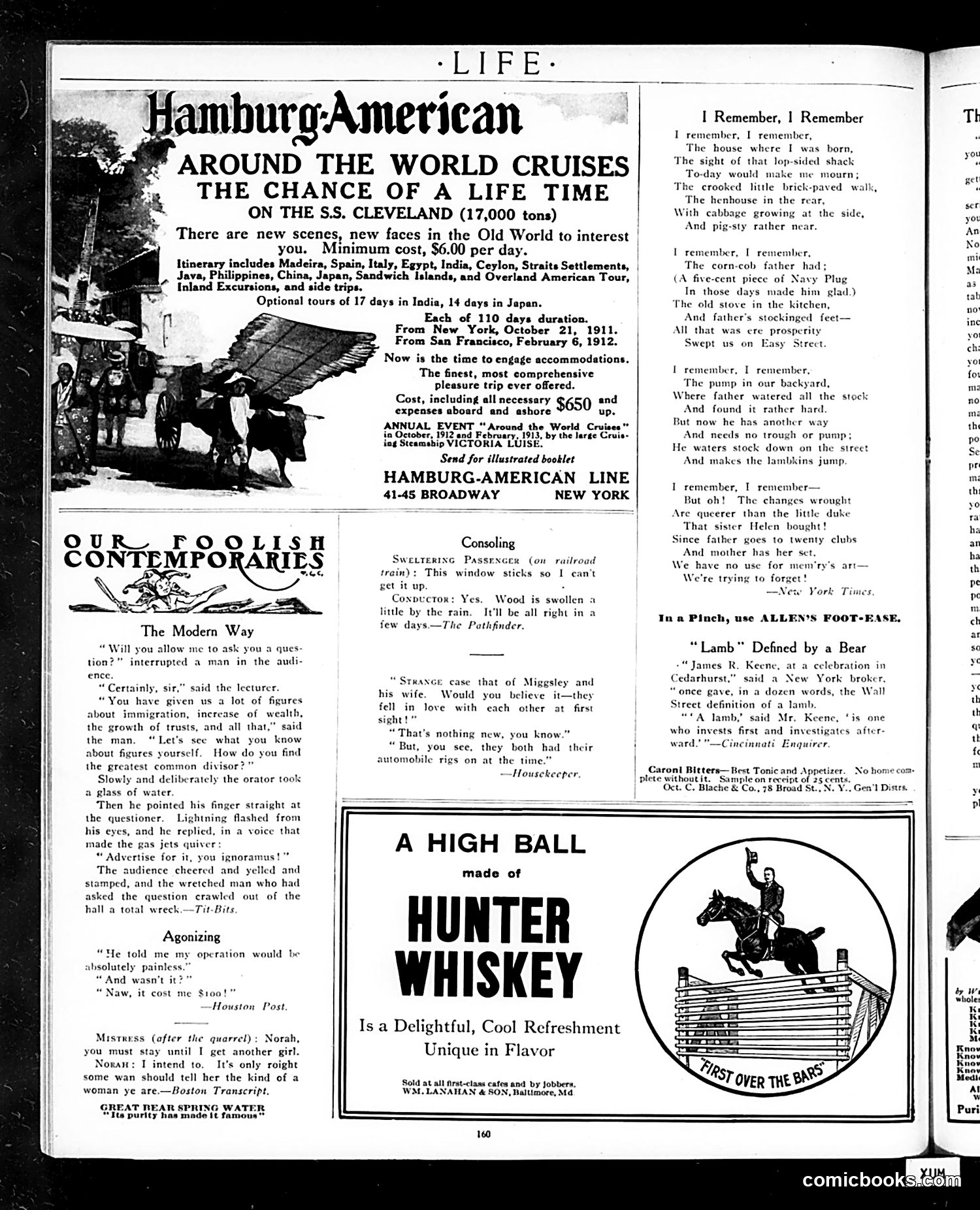
This is primarily an **advertising and humor page** from Life magazine's early 1900s era. The dominant content is a **Hamburg-American cruise line advertisement** promoting around-the-world voyages on the S.S. Cleveland for $650—positioned as an aspirational luxury experience. The page includes several brief **satirical humor pieces** typical of Life's format: - "The Modern Way" mocks a lecturer's evasive answer about "the greatest common divisor," with the punchline being he advertises for it—satirizing both pseudo-intellectual speakers and reliance on advertising. - Short jokes about marital discord, dental costs, and Irish domestic servants reflect period class attitudes. - A poem, "I Remember, I Remember," ironically contrasts modest rural poverty (outhouses, pig-sties, corn-cob pipes) with newfound middle-class prosperity and social climbing, suggesting discomfort with rapid social mobility. The **Hunter Whiskey advertisement** features a horse-jumping illustration. Overall, the page reflects turn-of-the-century American consumer culture and genteel satirical humor targeting the aspiring middle class.
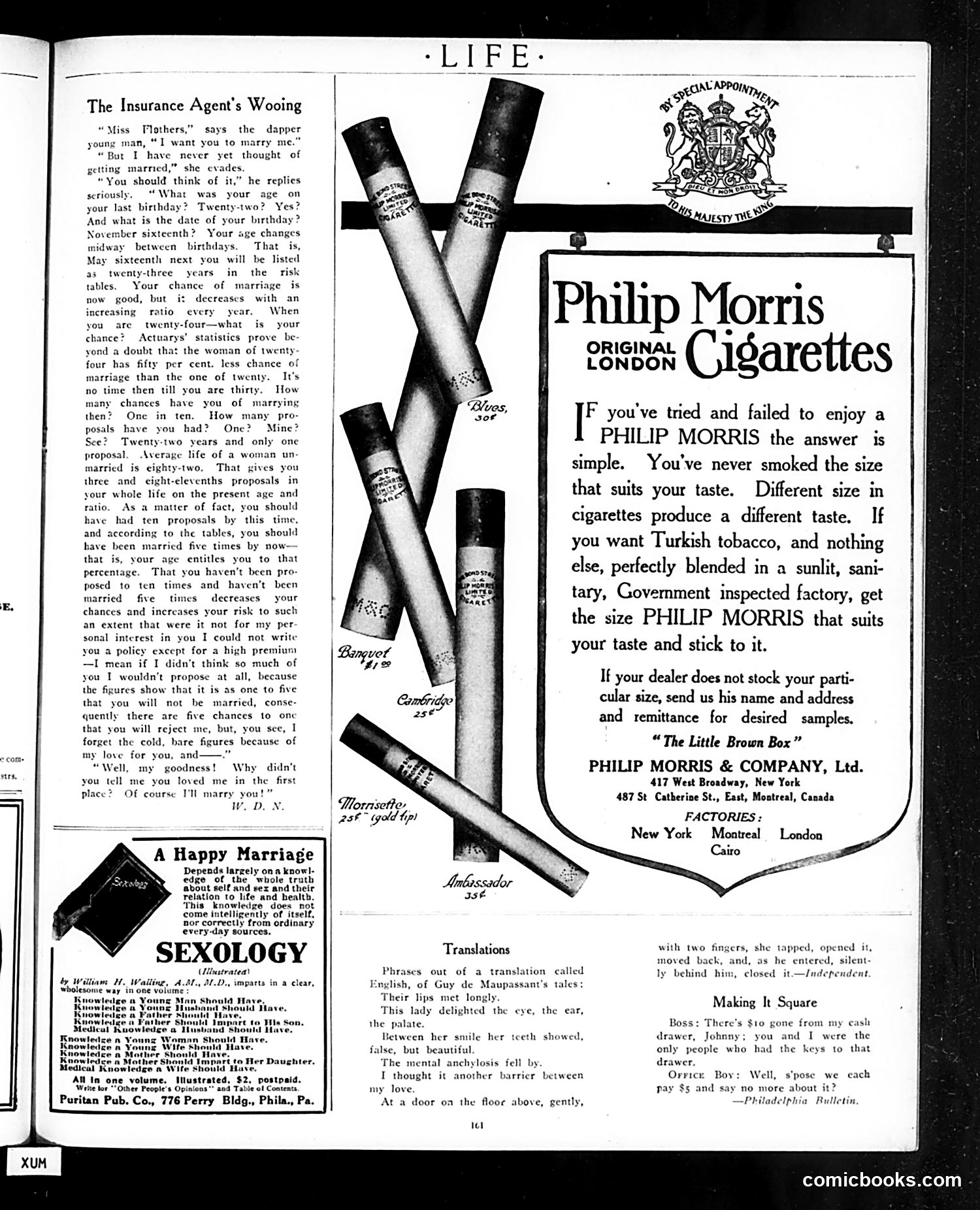
This satirical piece mocks the actuarial approach to romance. An insurance agent uses statistical tables and mortality calculations to propose marriage, arguing that the woman's unmarried status at twenty-two puts her in a declining "risk category" for matrimony. He claims she should have received ten proposals by now and emphasizes that refusing him increases her actuarial risk. The humor lies in reducing human emotion and courtship to cold insurance mathematics. The agent's "love" is presented as merely a business decision—he proposes despite unfavorable odds because he's emotionally invested. The woman, apparently won over by this absurd logic rather than genuine affection, accepts. The satire critiques how early 20th-century American business logic invaded all aspects of life, treating even marriage as a calculable risk rather than an emotional commitment. It's also gently mocking insurance salesmen as a type.
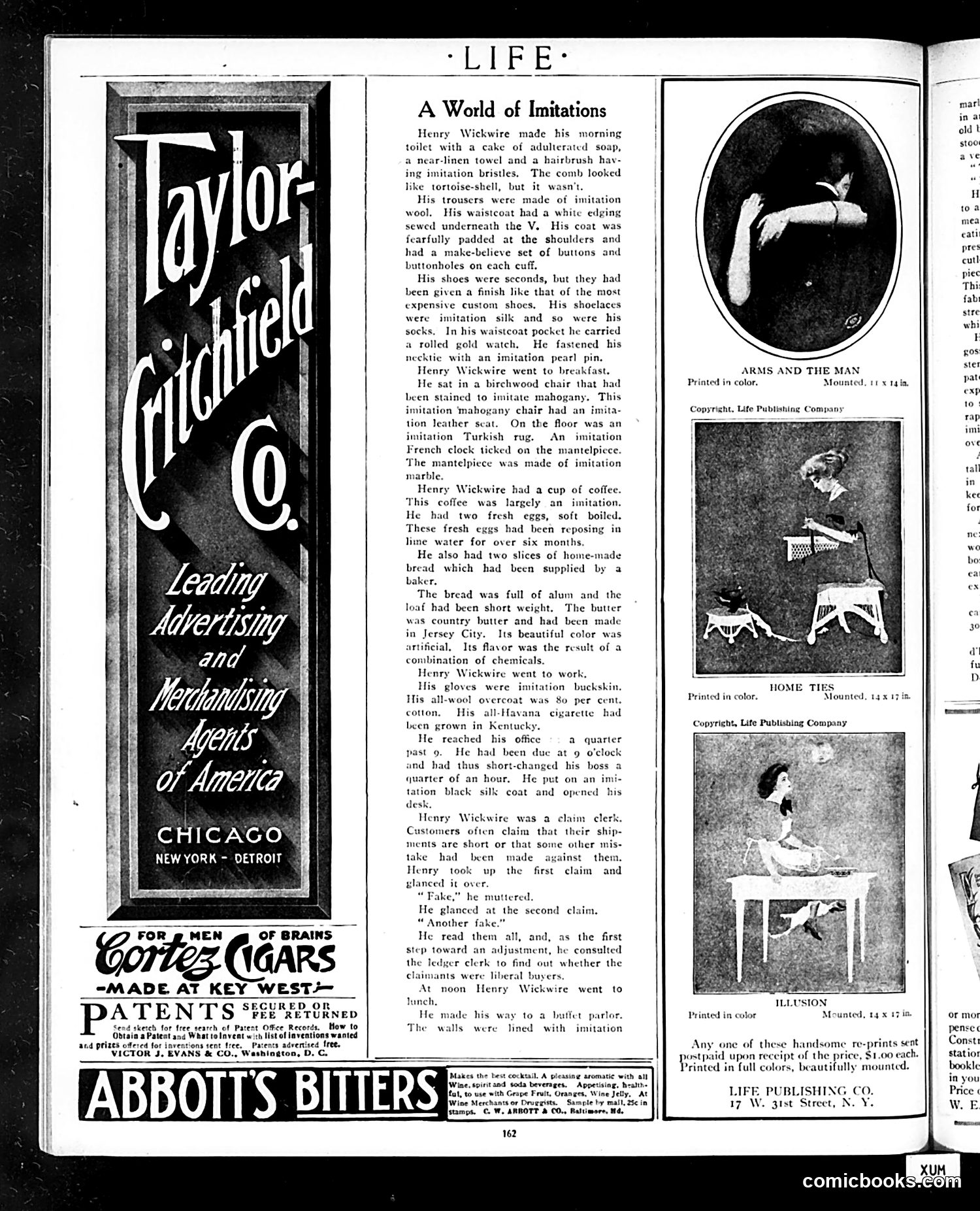
This satirical story attacks early 20th-century consumer culture and fraud. Henry Wickwire's entire life consists of fake or adulterated goods—imitation silk, "rolled gold" watches, cheap "seconds" shoes passed off as quality, counterfeit mahogany furniture, and food deliberately adulterated with chemicals and lime water to deceive buyers. The satire's bite sharpens with his hypocrisy: as a claims clerk, Wickwire dismisses customers' legitimate complaints about short shipments as "fakes," while he himself traffics in deception daily—even arriving late to work, "short-changing his boss a quarter of an hour." The piece mocks both manufacturers who peddle shoddy goods with false finishes and the consumers like Wickwire who accept (or perpetrate) this fakery. It's a commentary on widespread adulteration scandals of the era and the culture of imitation that enabled them—suggesting dishonesty had become normalized across all social levels.
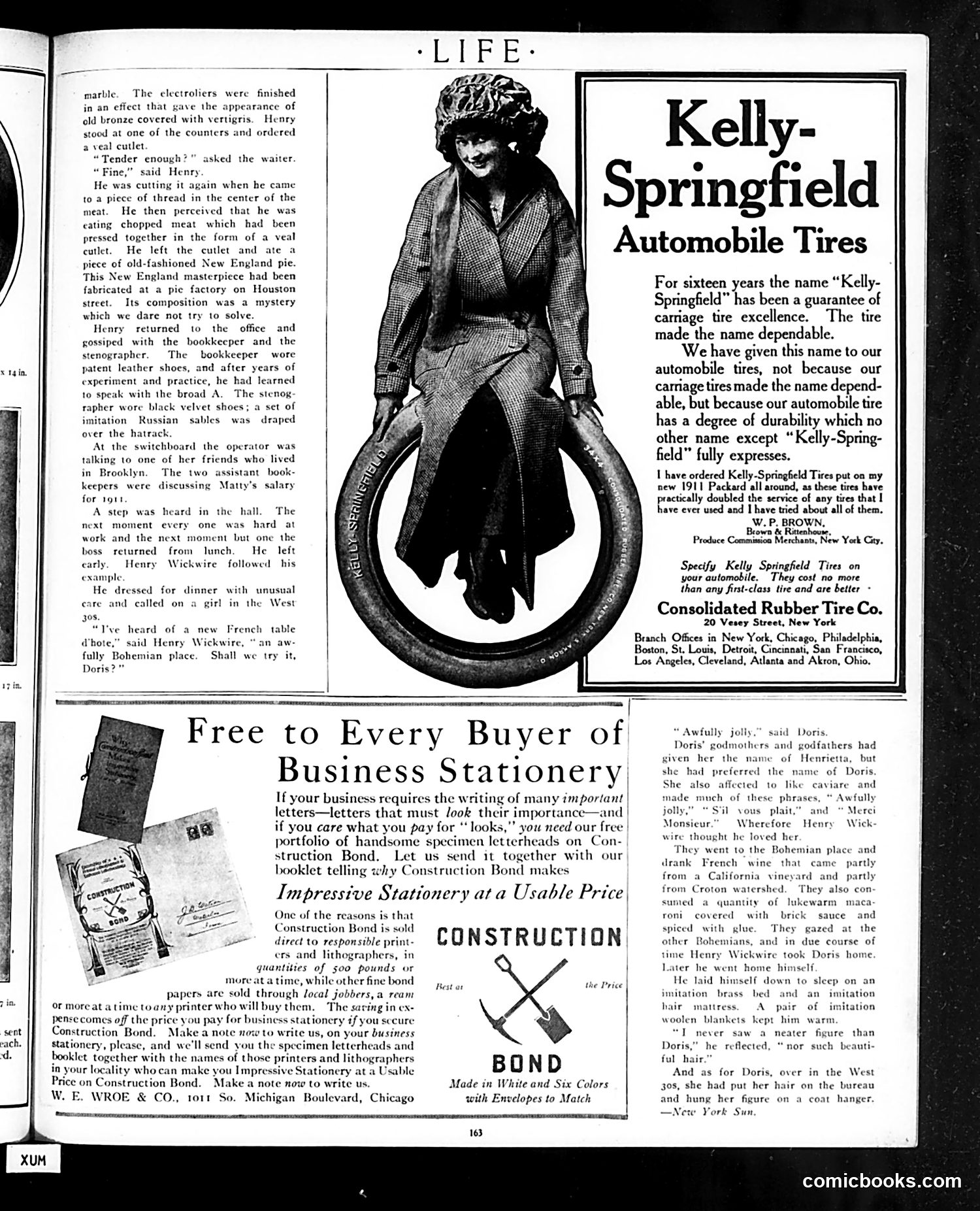
This page from *Life* magazine (circa 1911, based on references to "1911 Packard") is primarily **advertising**, not satirical content. The top half contains a serialized fiction excerpt about a character named Henry who discovers his "veal cutlet" is actually processed meat from a factory—a mild social commentary on industrial food production and fraud, presented as humorous fiction rather than editorial satire. The page features three substantial advertisements: Kelly-Springfield automobile tires (prominently featuring a woman in a tire), Construction Bond stationery, and business stationery services. These ads reflect early 1900s consumer culture priorities: automobiles, professional correspondence, and business efficiency. No political cartoons or caricatures appear on this page. The content reflects *Life*'s evolution from satirical magazine toward a publication increasingly dependent on advertising revenue.
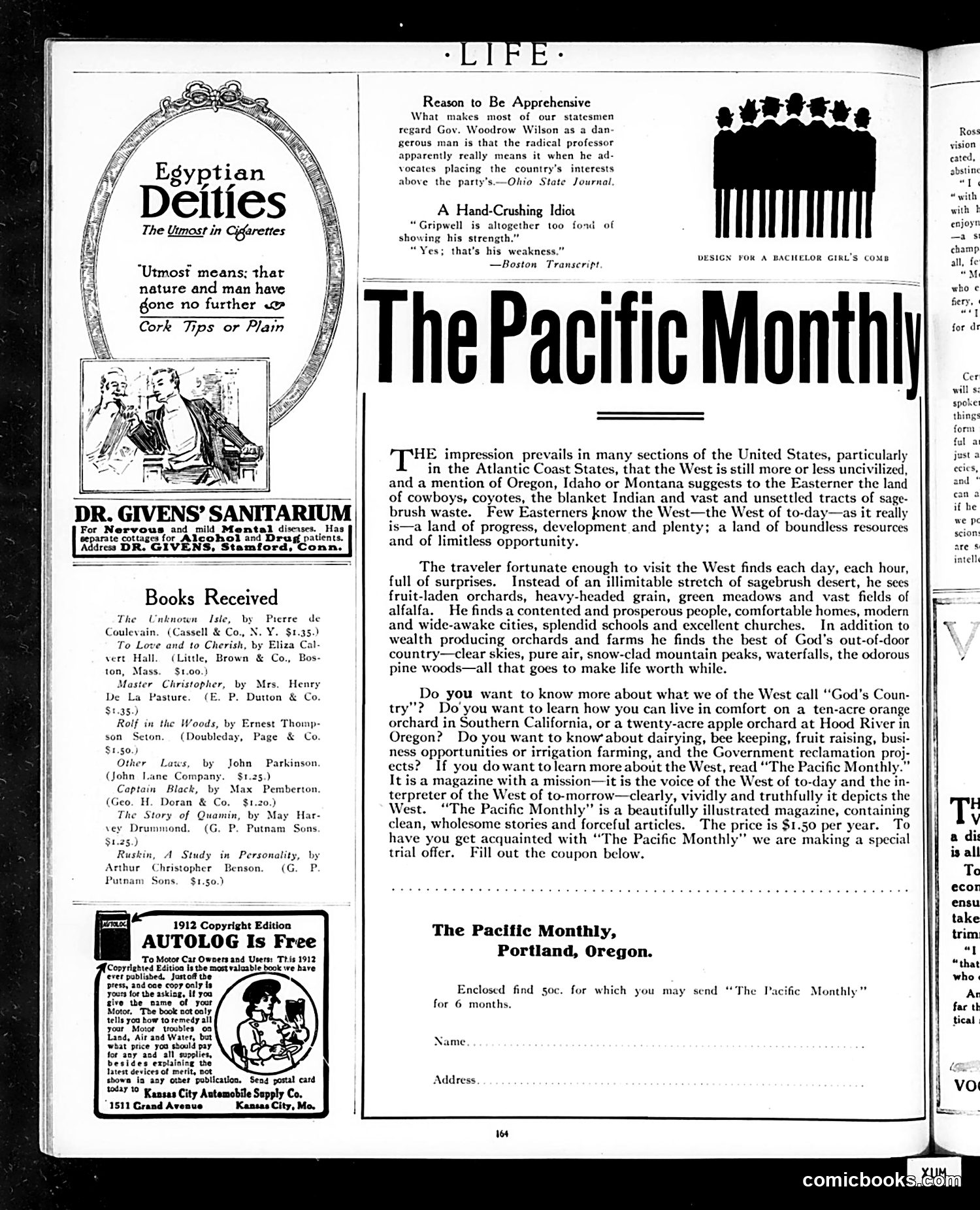
This page is primarily **advertising and promotional material** rather than satirical cartoons. The top-left features an ad for Egyptian Deities cigarettes using pseudo-Egyptian imagery—common early 1900s marketing that exploited exotic aesthetics without specific political commentary. The main content is a promotional article for *The Pacific Monthly* magazine, countering Eastern stereotypes about the American West. In 1912, Easterners viewed the West as primitive ("cowboys, coyotes, blanket Indian"), so the piece argues the region was actually developed, prosperous, and opportunity-rich. It's essentially Western boosterism—promotional propaganda aimed at attracting settlers and investment. Small joke items scattered throughout (about Gov. Woodrow Wilson being dangerously principled, and a man's "weakness" being excessive strength) are typical Life humor—brief, topical observations rather than developed satire. The page otherwise contains book reviews and automobile supply advertising, reflecting the magazine's mixed editorial-commercial format of that era.
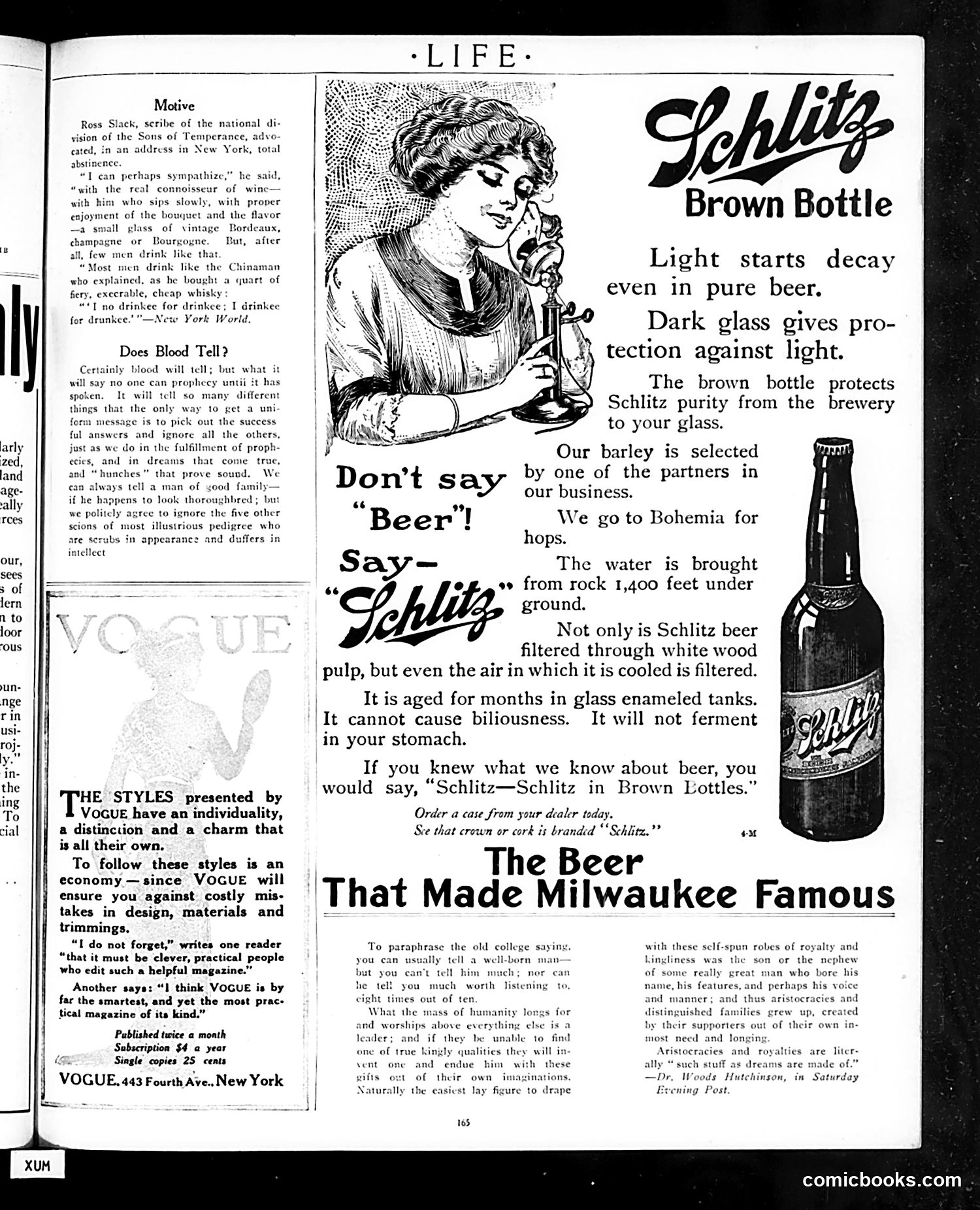
This page contains **primarily advertising** rather than editorial satire. The dominant feature is a **Schlitz Beer advertisement** occupying roughly half the page, featuring an illustrated woman holding a beer bottle and detailed marketing copy about the brown bottle's protective qualities, ingredient sourcing, and filtration process. The left side contains brief editorial pieces, including one titled "Does Blood Tell?" discussing heredity and social class—a period concern about whether ancestry determines character. There's also a small VOGUE magazine advertisement. **No political cartoon appears on this page.** The satirical elements are minimal; the "Motive" section quotes temperance advocate Ross Slack humorously, and includes a joke about a Chinaman's drinking habits (reflecting casual ethnic stereotyping common to the era). This appears to be a typical **1910s-1920s Life magazine page**, mixing light social commentary with commercial advertising—the beer ad being notable given Prohibition's historical context or anticipation.
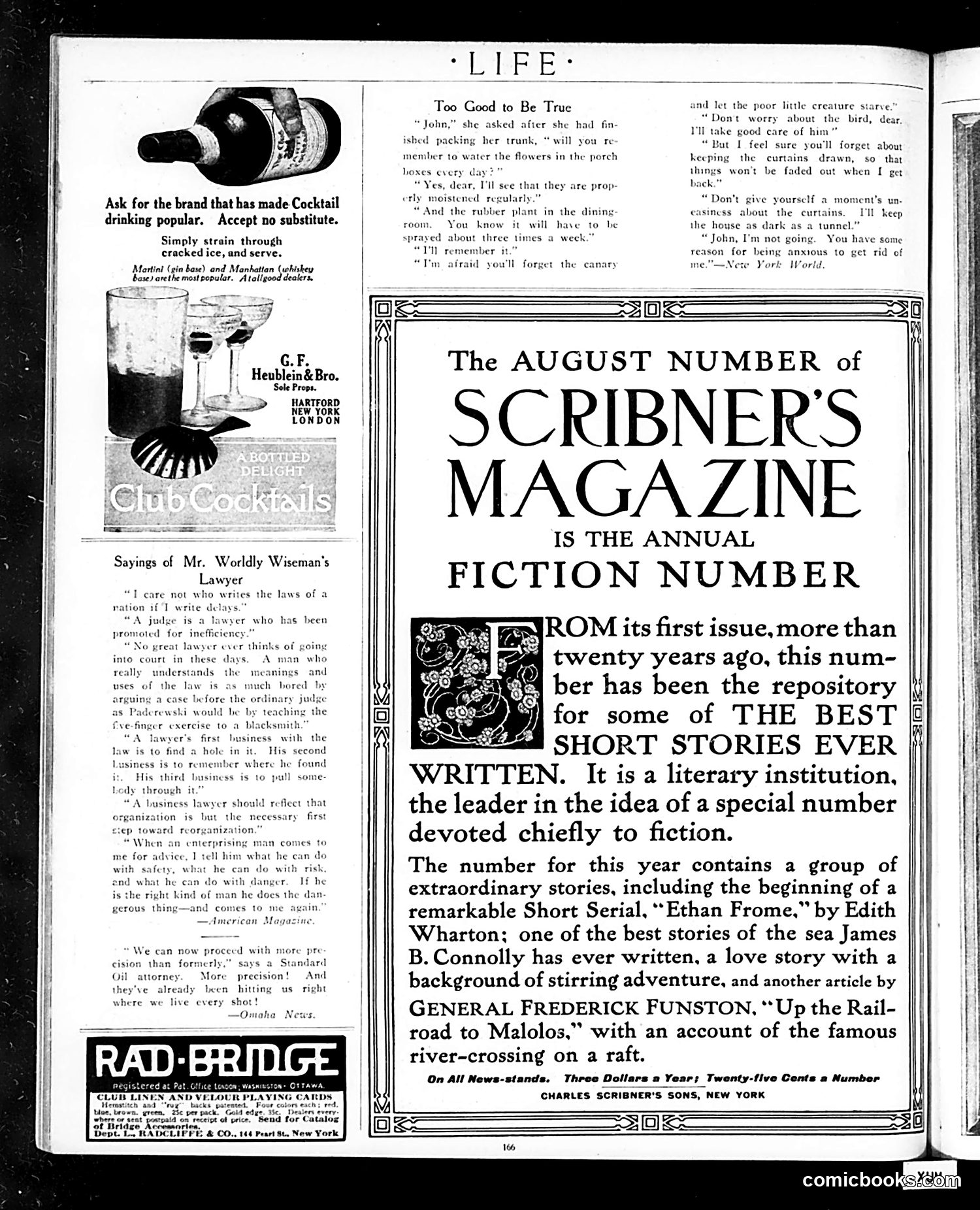
This page is primarily **advertising and editorial promotion** rather than political satire. The left side contains **liquor advertisements** (Heublein & Bro. cocktail mixers) and a **Bridge card game promotion** (Rad-Bridge). Between these is a humor column titled "Sayings of Mr. Worldly Wiseman's Lawyer"—satirizing lawyers' cynical worldviews through short quips about legal practice and business ethics. The jokes mock lawyers as amoral pragmatists. The right side is a **full-page advertisement for Scribner's Magazine's August fiction issue**, which appears to be their annual special featuring literary works by notable authors including Edith Wharton ("Ethan Frome") and General Frederick Funston. The small dialogue snippet labeled "Too Good to Be True" appears to be fiction excerpt promoting the magazine's content—a humorous domestic scene about household maintenance. **Overall**: This is a standard magazine page mixing period advertising with light satirical humor about lawyers and promoting the magazine's own content.
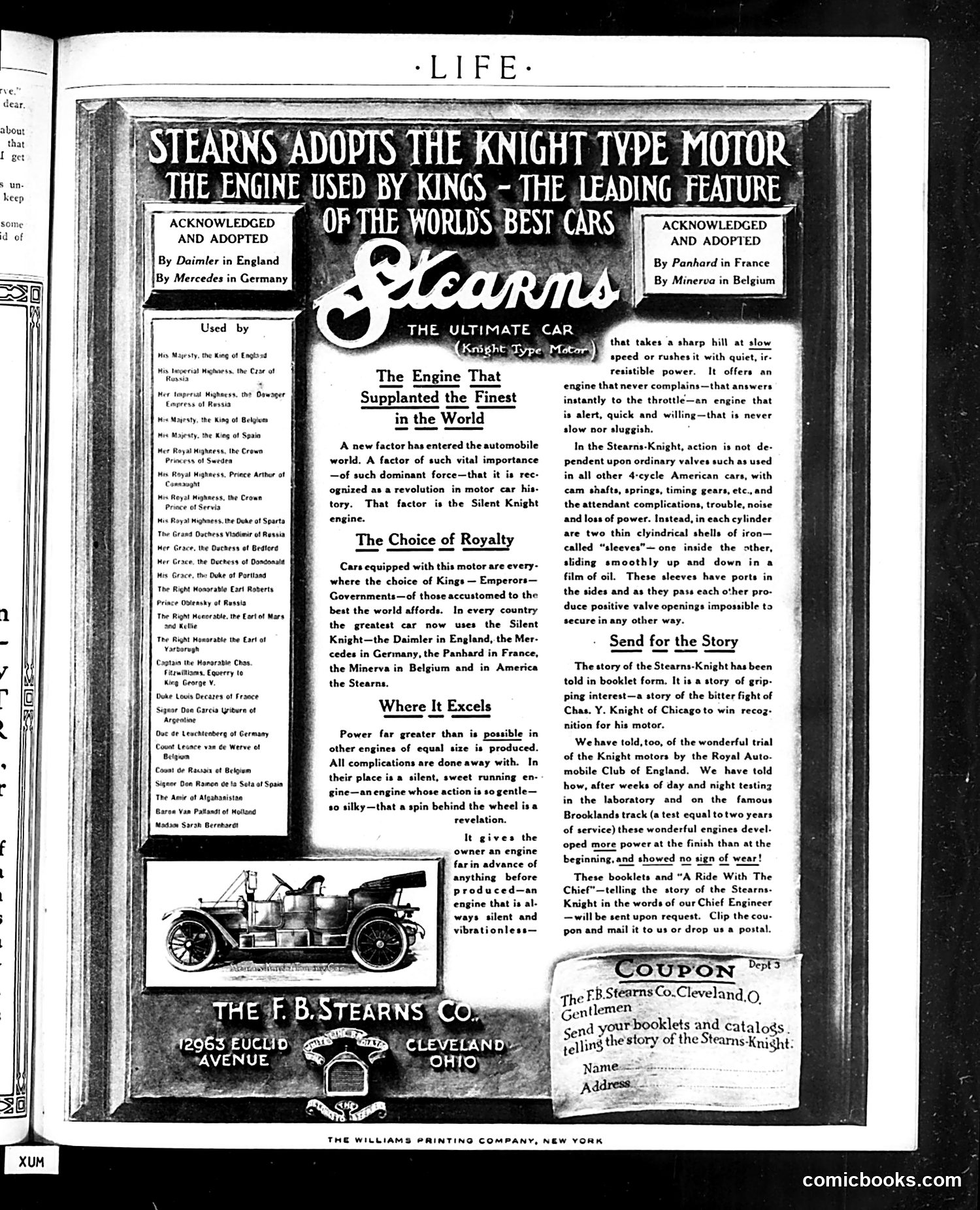
This is **not a cartoon or satire**, but a full-page **automobile advertisement** for the F.B. Stearns Company of Cleveland, Ohio. The page promotes the "Silent Knight" motor engine, claiming it was adopted by European luxury car manufacturers (Daimler, Mercedes, Panhard, Minerva) and used by royalty worldwide. The left column lists dozens of European monarchs and nobles supposedly using Knight-equipped vehicles—from the King of England to various dukes, princes, and crown royals. The ad's strategy is **aspirational marketing through royal endorsement**: by associating the Stearns with kings and emperors, it positions the car as the ultimate luxury vehicle. The repeated emphasis on silence, power, and simplicity appeals to wealthy buyers seeking prestige. The advertisement includes a coupon for requesting promotional booklets and catalogs. This represents early 20th-century advertising technique using perceived elite adoption to drive consumer desire.
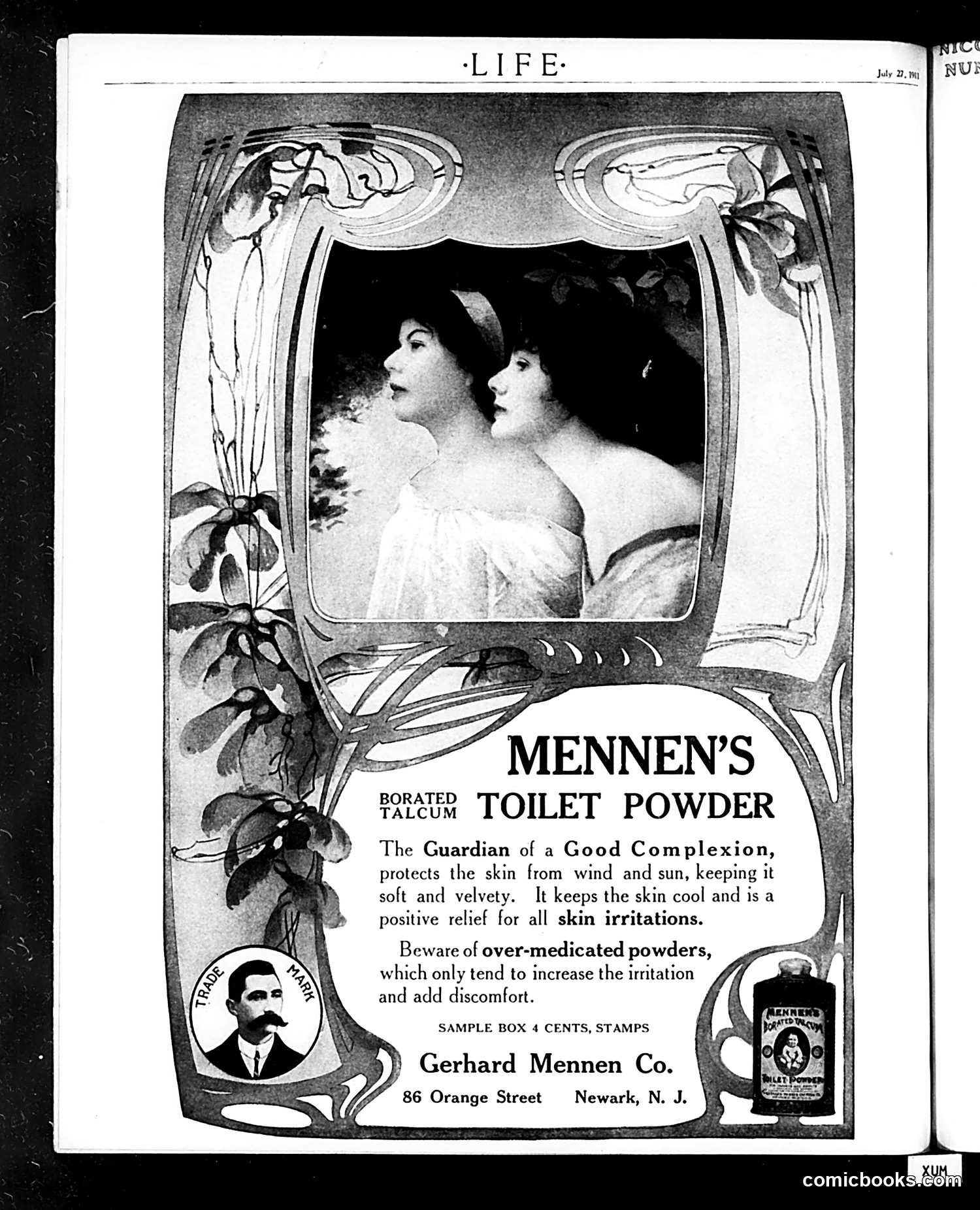
This is primarily a **full-page advertisement**, not a satirical cartoon. It advertises Mennen's Borated Talcum Toilet Powder from the Gerhard Mennen Company (Newark, N.J.). The ad features two women in an Art Nouveau-style decorative frame, appearing refined and fashionable, representing the product's appeal to beauty-conscious consumers. A portrait of what appears to be company founder Gerhard Mennen is included as a trust-building device. The advertisement's main claim—that Mennen's powder protects skin while warning against "over-medicated powders"—reflects early 20th-century beauty marketing. The "sample box 4 cents" offer was typical period advertising strategy. There is **no satirical content** visible; this is straightforward commercial promotion appearing in *Life* magazine's advertising pages.