
Life, 1911-07-27 · page 8 of 40
Life — July 27, 1911 — page 8: what you’re looking at
What you’re looking at
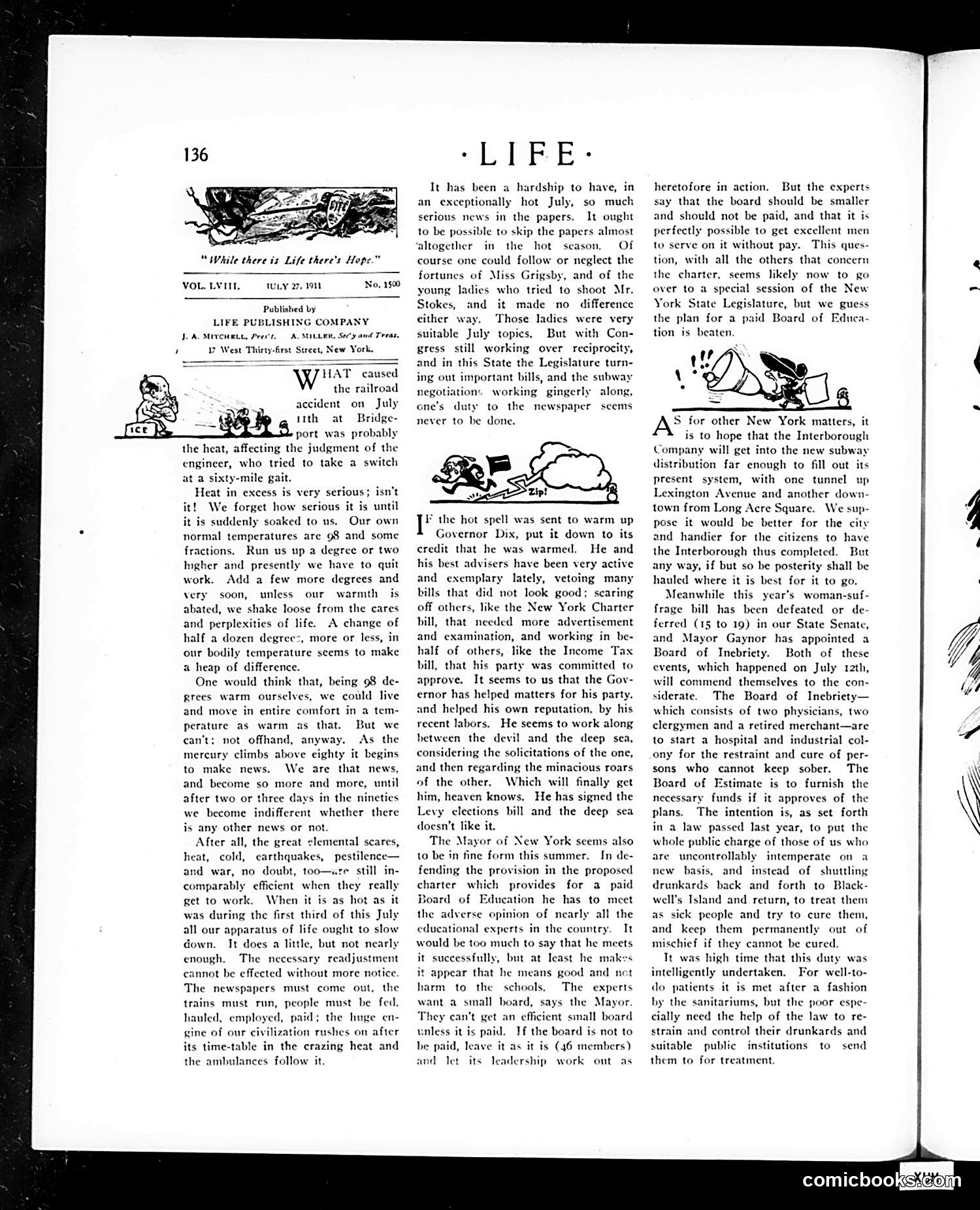
This page contains editorial commentary on New York summer politics, not primarily cartoons. The text discusses the dangerous July heat affecting judgment and work efficiency, then pivots to criticizing Governor Dis's handling of legislative matters—particularly a railroad accident on July 11th at Bridgeport. The piece attacks the Governor's credibility on multiple fronts: his vetoing of bills, his handling of the Income Tax bill, and his appointment of a Board of Education with members the editors view as unsuitable (noting it has 46 members with poor leadership). The satirical thrust is that the Governor's recent actions harm his own reputation while doing little to help the schools. The overall tone suggests editorial frustration with what they view as incompetent or self-serving governance during the hot summer months.
📄 Transcribed text from this page (OCR, searchable)
Machine-transcribed from the original scan — historical spelling and the odd misread are preserved.
“While there is Life there's Hope.” VOL. LVI, No, 1500 TWLY 77, 1911 Published by LIFE PUBLISHING COMPANY JA. Meron, Pret, See'y and Treas. West Thirty-first Street, New York. W T caused the railroad accident on July th at Bridge- port was probably the heat, affecting the judgment of the engineer, who tried to take a switch at a sixty-mile gait. Heat in excess is very serious; isn’t it! We forget how serious it is until it is suddenly soaked to us. Our own normal temperatures are 98 and some fractions. Run us up a degree or two Ingher and presently we have to quit work. Add a few more degrees and very soon, unless our warmth is abated, we shake loose from the cares and perplexities of life. A change of half a dozen degree, more or less, in our bodily temperature seems to make a heap of difference. One would think that, being 98 de- grees warm ourselves, we could live and move in entire comfort in a tem- perature as warm as that. But we can't: not offhand, anyway. As the mercury climbs above eighty it begins to make news. We are that news, and become so more and more, until after two or three days in the nineties we become indifferent whether there is any other news or not After all, the great ¢lemental scares, heat, cold, carthquakes, pestilence— and war, no doubt, too—are still in- comparably efficient when they really get to work, When it is as hot as it was during the first third of this July all our apparatus of life ought to slow down. It does a little, but not nearly enough. The necessary readjustment cannot be effected without more notice. The newspapers must come out, the trains must run, people must be fed. hauled, employed, paid; the huge en- gine of our civilization rushes on after its time-table in the crazing heat and the ambulances follow it. AL Muu *“LPPE- It has been a hardship to have, in an exceptionally hot July, so much serious news in the papers. It ought to be possible to skip the papers almost ‘altogether in the hot season, Of course one could follow or neglect the fortunes of Miss Grigsby, and of the young ladies who tried to shoot Mr. Stokes, and it made no difference cither way. Those ladics were very suitable July topics. But with Con- gress still working over reciprocity, and in this State the Legislature turn- ing out important bills, and the subway negotiations working gingerly along, one’s duty to the newspaper scems never to be done. ) ‘a the hot spell was sent to warm up Governor Dix, put it down to its credit that he was warmed. He and his best advisers have been very active and exemplary lately, vetoing many bills that did not look good; scaring off others, like the New York Charter Dill, that needed more advertisement and examination, and working in be- half of others, like the Income Tax bill, that his party was committed to approve. It seems to us that the Gov- ernor has helped matters for his party. and helped his own reputation, by his recent labors. He seems to work along between the devil and the deep sea, considering the solicitations of the one, and then regarding the minacious roars of the other, Which will finally get him, heaven knows. He has signed the Levy elections bill and the deep sea doesn’t like it. The Mayor of New York seems also to be in fine form this summer. Jn de- fending the provision in the proposed charter which provides for a paid Board of Education he has to meet the adverse opinion of nearly all the educational experts in the country. It would be too much to say that he meets it successfully, but at least he make: it appear that he means good and net harm to the schools, The experts want a small board, says the Mayor. They can’t get an efficient small board unless it is paid. If the board is not to aid, Ieave it as it is (46 members) and let its leadership work out as heretofore in action. But the experts say that the board should be smaller and should not be paid, and that it is perfectly possible to get excellent men to serve on it without pay. This ques- tion, with all the others that concern the charter, seems likely now to go over to a special session of the New York State Legislature, but we guess the plan for a paid Board of Educa- tion is beaten. for other New York matters, it is to hope that the Interborough Company will get into the new subway distribution far enough to fill out its present system, with one tunnel up Lexington Avenue and another down- town from Long Acre Square. We sup- pose it would be better for the city and handier for the citizens to have the Interborough thus completed. But any way, if but so be posterity shall be hauled where it is best for it to go. Meanwhile this year’s woman-suf- frage bill has been defeated or de- ferred (15 to 19) in our State Senate, and Mayor Gaynor has appointed a Board of Inebriety. Both of these events, which happened on July 12th, will commend themselves to the con- siderate. The Board of Inebriety— which consists of two physicians, two clergymen and a retired merchant—are to start a hospital and industrial col- ony for the restraint and cure of per- sons who cannot keep sober. The Board of Estimate is to furnish the necessary funds if it approves of the plans. The intention is, as set forth in a law passed last year, to put the whole public charge of those of us who are uncontrollably intemperate on a new basis, and instead of shuttling drunkards back and forth to Black- well’s Island and return, to treat them as sick people and try to cure them, and keep them permanently out of mischief if they cannot be cured. Tt was high time that this duty was intelligently undertaken. For well-to- do patients it is met after a fashion by the sanitariums, but the poor espe- cially need the help of the law to re- strain and control their drunkards and suitable public institutions to send them to for treatment comicbooktenr