
Life, 1911-07-27 · page 31 of 40
Life — July 27, 1911 — page 31: what you’re looking at
What you’re looking at
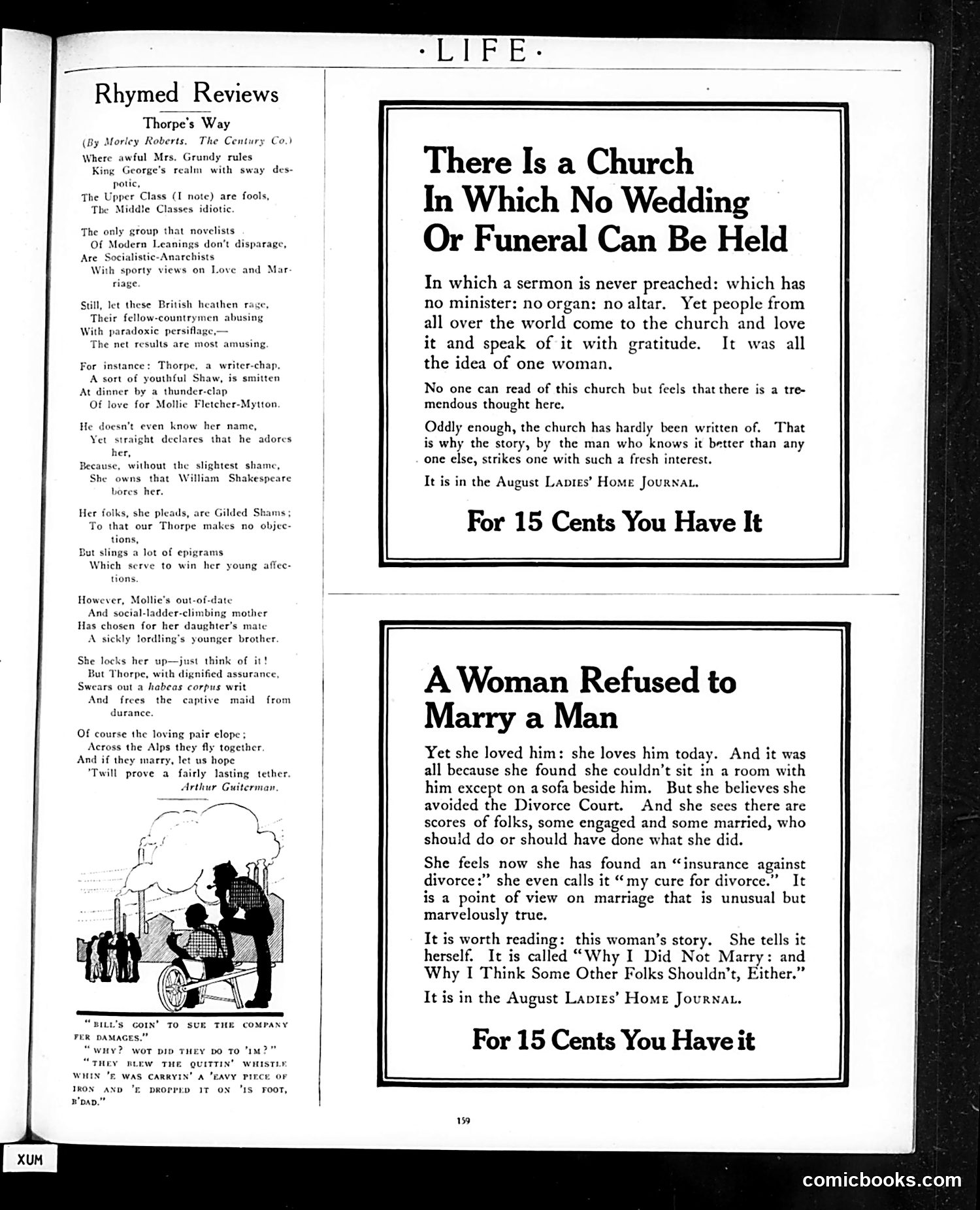
This page contains a book review, two advertisements for *Ladies' Home Journal* articles, and a cartoon. **The Rhymed Review** critiques Morley Roberts's novel *Thorpe's Way*, satirizing British social hierarchies. The reviewer mocks how the novel portrays the upper and middle classes as foolish while romanticizing socialistic-anarchist characters. The plot—a young writer falls for a woman who disdains Shakespeare, pursues her despite her mother's objections, and helps her elope—is presented as typical melodramatic fare. **The Cartoon** depicts a workplace accident: a man dropped an iron piece on his foot after being startled by a factory whistle. The dialogue jokes darkly about suing the company for damages from this self-inflicted injury, poking fun at emerging workers' compensation claims. **The Advertisements** promote two *Ladies' Home Journal* articles costing 15 cents: one about an unusual church with no sermons or minister, another about a woman who refused marriage to avoid divorce. Both sensationalize unconventional lifestyle choices as "fresh interest" for readers.
📄 Transcribed text from this page (OCR, searchable)
Machine-transcribed from the original scan — historical spelling and the odd misread are preserved.
iRhymed Reviews Thorpe’s Way (By Morley Roberts, The Century Co.) Where awful Mrs, Grundy rules King George's realm with sway des- potic, The Upper Class (I note) are fools, The Middle Classes idiotic. The only group that novelists Of Modern Leanings don't disparage, Are Socialistic-Anarchists With sporty views on Love and Mar riage. Still, let these British heathen rage, Their fellow-countrymen abusing With paradoxic persi The net results are most amusing. For instance: Thorpe, a writer-chap. A sort of youthful Shaw, is smitten At dinner by a thunder-clap Of love for Mollie Fletcher-Mytton. He doesn’t even know her name, Yet straight declares that he adores her, Because, without the slightest shame, She owns that William Shakespeare bores her. Her folks, she pleads, are Gilded Shams; To that our Thorpe makes no objec- tions, But slings a lot of epigrams Which serve to win her young affec- tions. However, Mollie's out-of-date And social-ladder-climbing mother Has chosen for her daughter’s mate A sickly lordling’s younger brother: She locks her up—just think of it! But Thorpe, with dignified assurance, Swears out a habeas corpus writ And frees the captive maid from durance. Of course the loving pair elope; Across the Alps they fly together. And if they marry, let us hope ‘Twill prove a fairly lasting tether. Arthur Guiterman TO SUE THE COMPANY “wity? wot pip THEY DO To ‘1M?” “THEY RLEW THE QUITTIN' WwHIsTLY WIHIN 'R WAS CARRYIN’ A 'EAVY PIECE OF IRON AND 'E DROPTED 1T ON ‘1S FOOT, B'paD.” There Is a Church In Which No Wedding Or Funeral Can Be Held In which a sermon is never preached: which has no minister: no organ: no altar. Yet people from all over the world come to the church and love it and speak of it with gratitude. It was all the idea of one woman. No one can read of this church but feels that there is a tre- mendous thought here. Oddly enough, the church has hardly been written of. That is why the story, by the man who knows it better than any one else, strikes one with such a fresh interest. It is in the August Laptes’ Home Journa. For 15 Cents You Have It A Woman Refused to Marry a Man Yet she loved him: she loves him today. And it was all because she found she couldn’t sit in a room with him except on a sofa beside him. But she believes she avoided the Divorce Court. And she sees there are scores of folks, some engaged and some married, who should do or should have done what she did. She feels now she has found an “insurance against divorce:” she even calls it “my cure for divorce.” It is a point of view on marriage that is unusual but marvelously true. It is worth reading: this woman’s story. She tells it herself. It is called “Why I Did Not Marry: and Why I Think Some Other Folks Shouldn’t, Either.” It is in the August Lapies’ Home Journat. For 15 Cents You Have it comicbooks.com