
A complete issue · 45 pages · 1911
Life — June 29, 1911
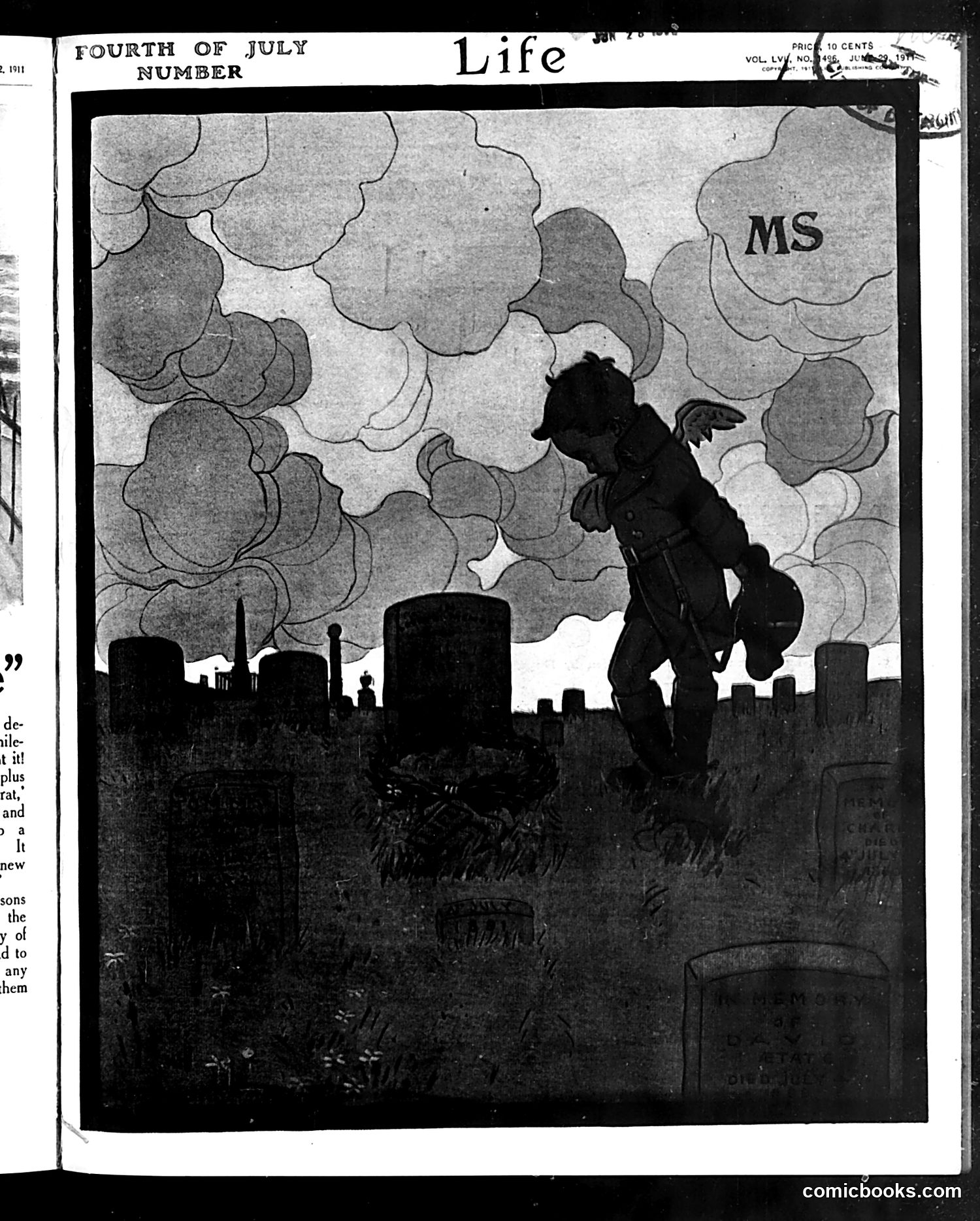
This Life magazine cover illustrates American industrial growth during the early 20th century. A silhouetted figure—appearing to be Uncle Sam or a representative of American industry—strides confidently across a graveyard toward a skyline of factories and smokestacks. Dark storm clouds loom overhead. The satire likely critiques the tension between American industrial progress and human cost: the graveyard beneath suggests casualties or consequences of rapid industrialization—worker deaths, environmental damage, or social displacement. The figure's bold stride contrasts grimly with the cemetery below, implying that Americans celebrated industrial advancement while overlooking its human toll. Published as a Fourth of July issue, this commentary challenges patriotic celebration by questioning whether progress truly serves the nation.
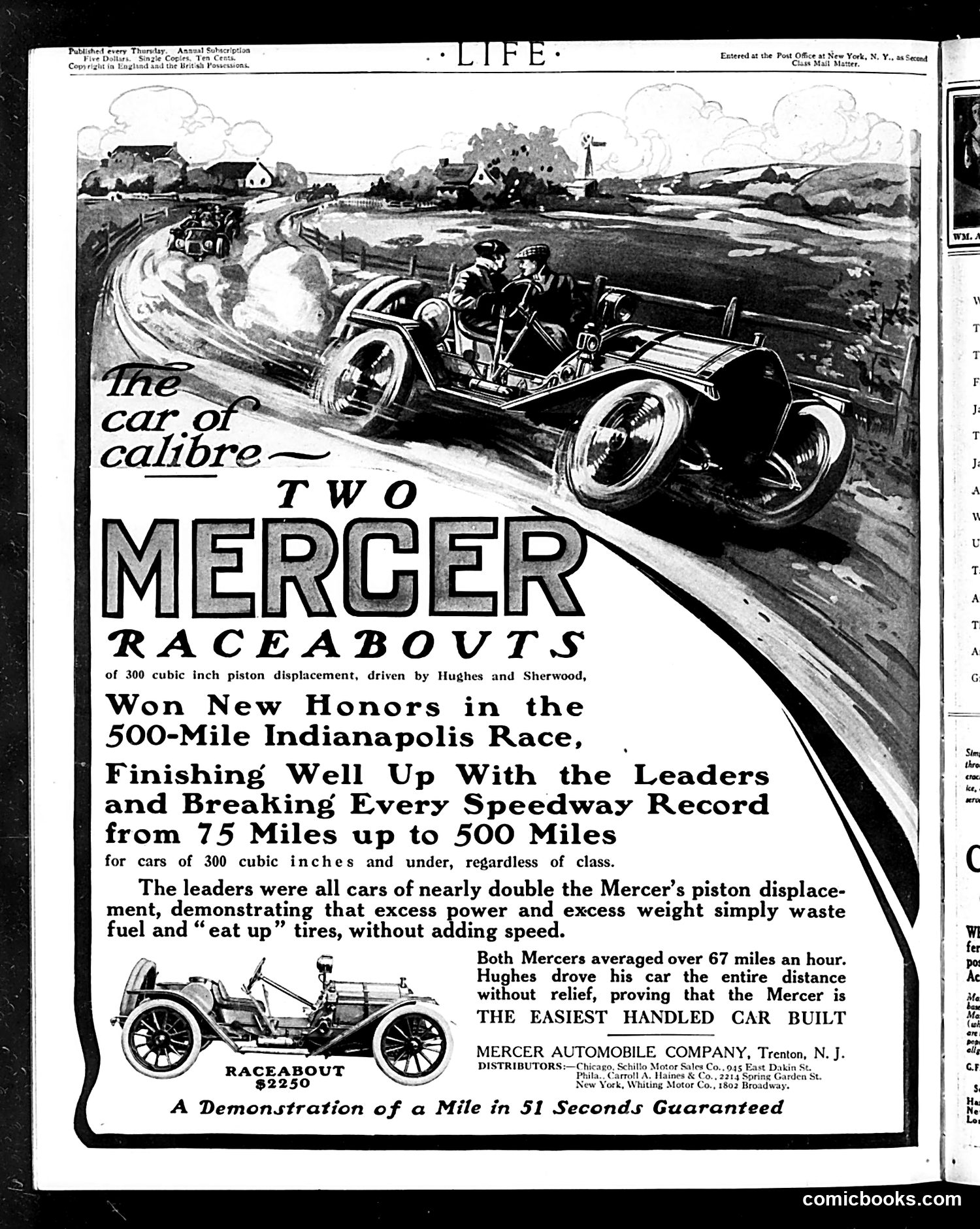
This is primarily a **Mercer Automobile advertisement**, not political satire. It showcases two Mercer raceabouts (300 cubic inch engines) driven by Hughes and Sherwood, who achieved success in the 500-Mile Indianapolis Race. The advertisement's argument is **efficiency-based engineering**: despite having smaller engines than competitor vehicles with "nearly double the Mercer's piston displacement," these cars averaged over 67 miles per hour and broke speedway records from 75 to 500 miles. The implicit message targets early-1900s automotive buyers: excess power and weight waste fuel without improving speed. The Mercer is marketed as "the easiest handled car built." The dramatic illustration emphasizes speed and control on the race track. This represents early automotive marketing using competitive racing as proof of engineering superiority.
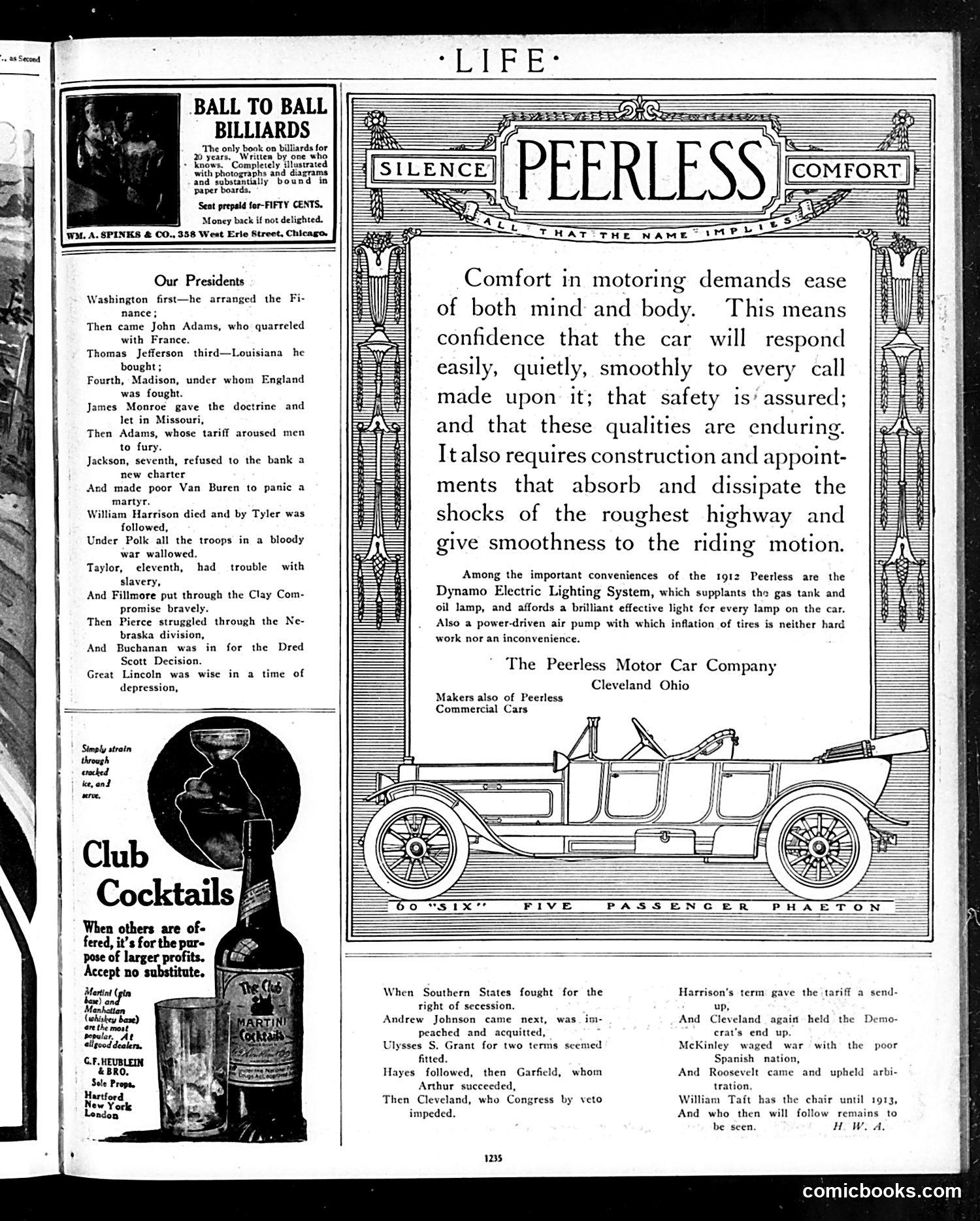
This page is primarily **advertising**, not political satire. The dominant content is a large advertisement for the Peerless Motor Car Company (Cleveland, Ohio), promoting their 1912 "Six" five-passenger vehicle. The ad emphasizes comfort, safety, smooth operation, and modern conveniences like electric lighting and a power-driven air pump. The left side contains minor ads: a billiards instruction book and Club Cocktails liqueur. Below the car ad is a poem titled "Our Presidents" that lists U.S. presidents chronologically with brief satirical descriptions of their administrations and challenges—a lighthearted historical summary rather than pointed political commentary. This appears to be a standard magazine page blending commercial advertisements with light editorial content, typical of early 20th-century Life magazine.
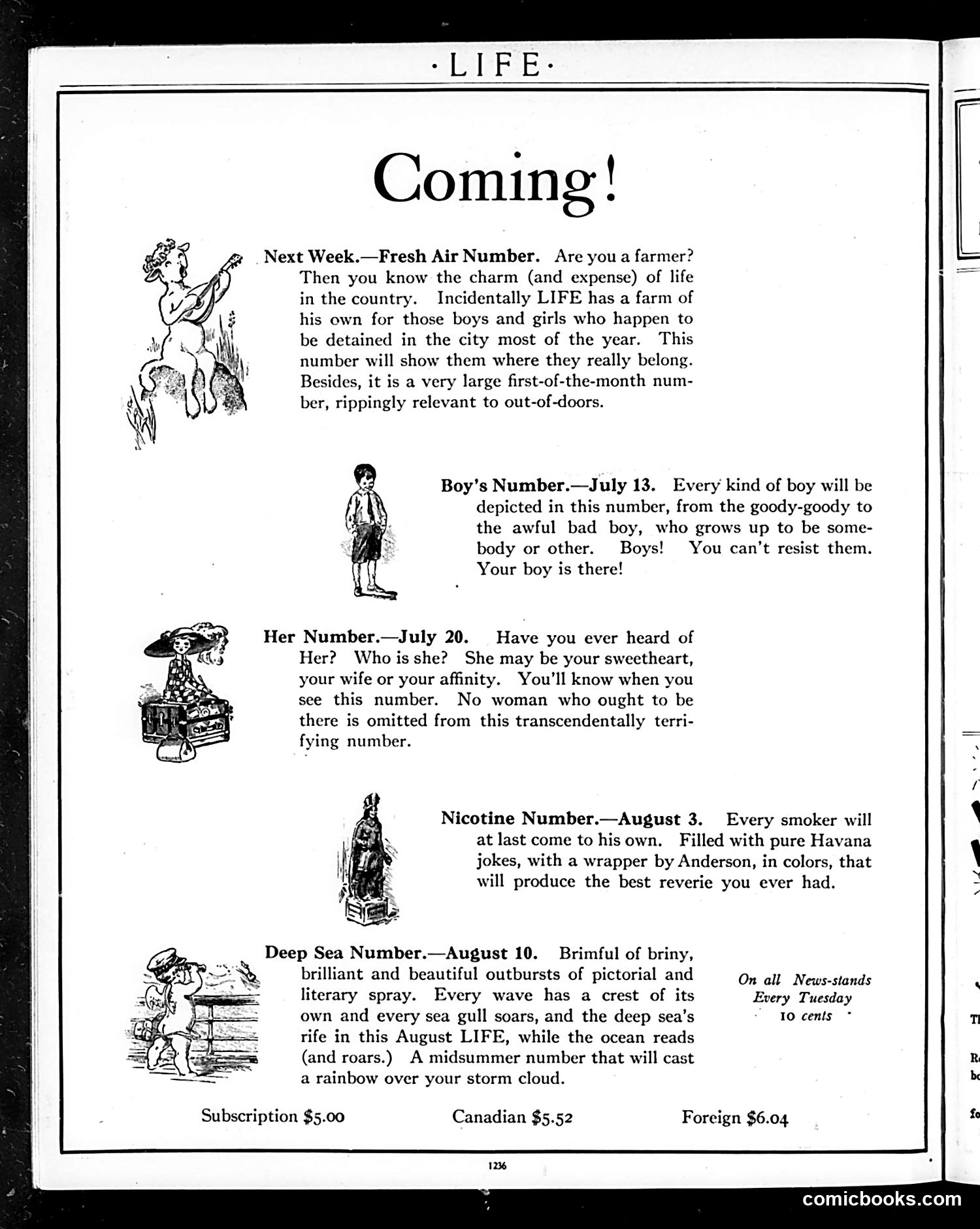
This is a promotional page for upcoming issues of *Life* magazine. The content announces five special themed editions: 1. **Fresh Air Number** (next week) — targeting farmers and rural life 2. **Boy's Number** (July 13) — depicting various boy archetypes 3. **Her Number** (July 20) — featuring women 4. **Nicotine Number** (August 3) — celebrating cigars and smoking 5. **Deep Sea Number** (August 10) — ocean-themed pictorial content The small illustrations accompanying each announcement reflect the theme (a cherub for outdoors, a boy figure, a woman with hat, a cigar bundle, and a beach scene). This is essentially advertising copy rather than satire—*Life* is promoting specialized issues to attract different reader demographics. The tone is lighthearted and promotional, typical of early 20th-century magazine marketing. Subscription prices are listed at bottom ($5.00 U.S., $5.52 Canadian, $6.04 foreign).
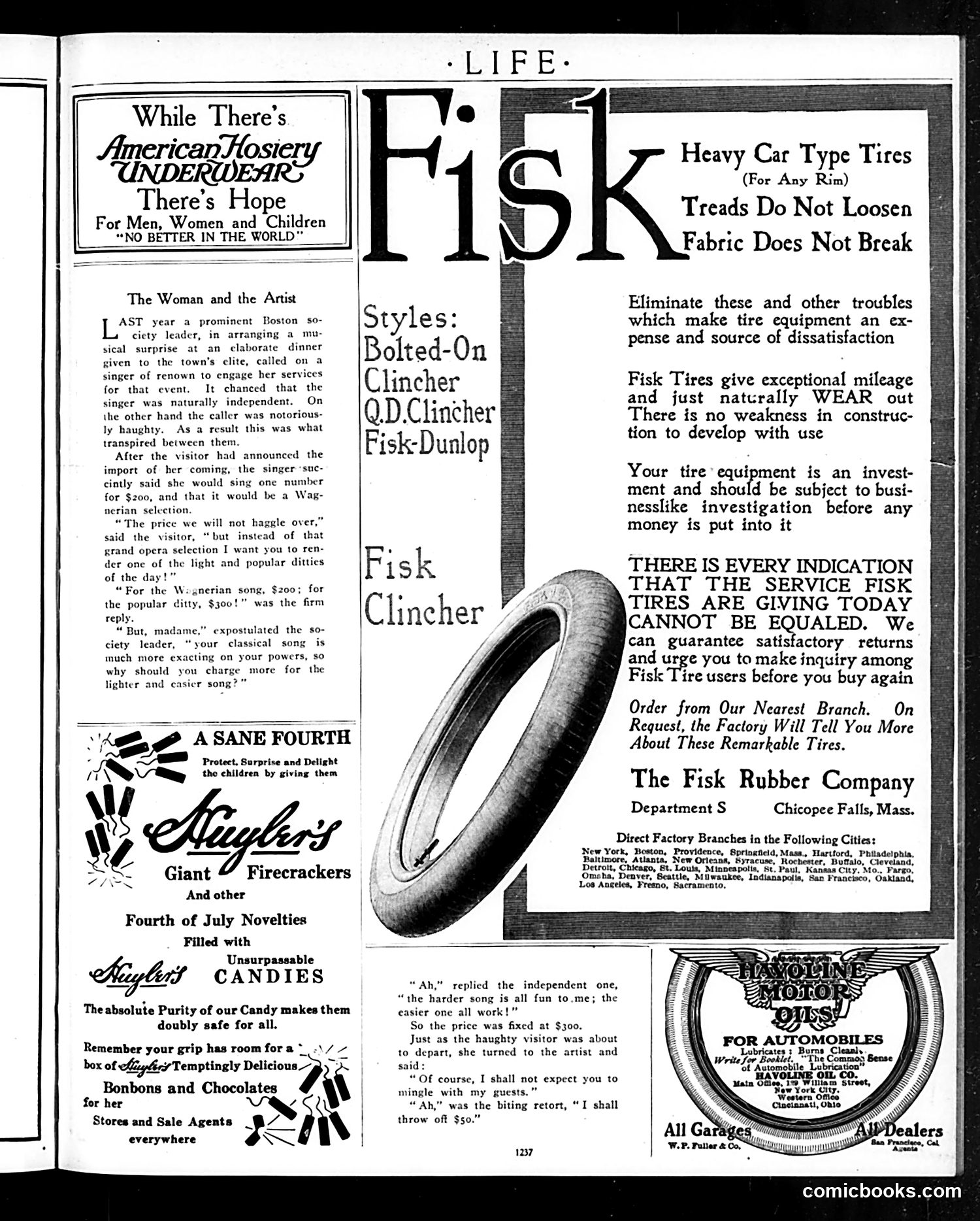
This page is primarily **advertising rather than satire or political commentary**. The main content consists of commercial ads: American Hosiery underwear, Fisk tires (featuring the famous "Fisk Clincher" product line), Stuyler's Fourth of July novelties and candies, and Gasoline Motor Oil. **"The Woman and the Artist"** is a brief humorous anecdote about a Boston society event where a singer negotiates a higher fee ($300 instead of $200) by claiming she'll perform a lighter song rather than a classical one. The joke plays on vanity and artistic pretension—the society leader values entertainment over prestige. The page reflects early 20th-century consumer culture with no apparent political satire or cartoon commentary.
This page is **not a cartoon or satire** — it's a straightforward advertisement for Packard Motor Car Company's service network, published in *Life* magazine. The ad promotes Packard's comprehensive dealer service infrastructure across America and Europe, emphasizing factory-trained technicians, parts availability, and customer support. It highlights a Paris service depot for touring customers and mentions that Packard dealers in "over eighty cities" provide consistent service quality regardless of where owners purchased their vehicles. The only stylistic element is the decorative "Packard Service" header and ornamental border typical of early 20th-century advertising design. The tagline "Ask the man who owns one" appears at the bottom—a famous Packard advertising slogan. This is product advertising, not editorial content or political commentary.
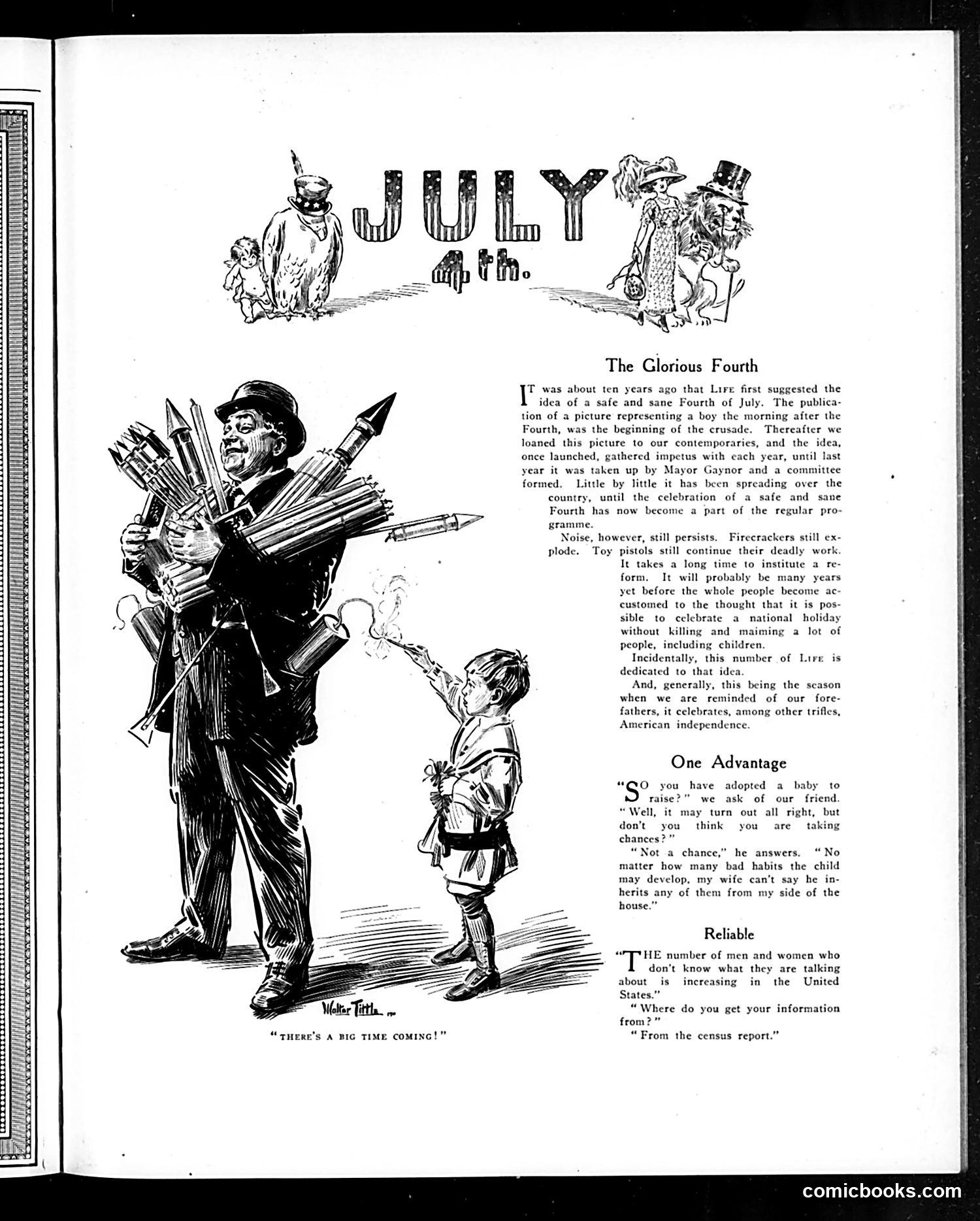
The main cartoon by Cesare Vivani depicts a caricatured German militarist (identifiable by the spiked Prussian helmet) laden with explosives, cannons, and weapons, confronted by a small American soldier/boy. The caption reads "There's a Big Time Coming!" The satire addresses American Fourth of July celebrations and their dangers. The accompanying text criticizes fireworks and explosives that kill and maim people annually, particularly children. It advocates for reforming Independence Day celebrations to be safer while maintaining the patriotic spirit. The German figure likely represents external military threats or German militarism—a topical concern during this WWI-era publication period. The contrast between the armed aggressor and the small American defender suggests American preparedness or resolve against foreign threats.
This *Life* magazine page (June 27, 1911) contains editorial commentary critiquing British royalty and American attitudes toward wealth and social status. The text discusses **King George V**, noting he costs the British public "three or four million dollars a year" yet provides minimal practical benefit—merely a "stage property." The author argues Americans shouldn't romanticize monarchy when the same wealth could improve lives directly. The piece also contrasts this with references to **wealthy Americans** (likely **Carnegie** and **Rockefeller**, mentioned by name), questioning whether their vast fortunes serve society better than royal pageantry. The satirical point: both British royalty and American industrial magnates consume enormous resources while contributing little tangible value—a critique of hereditary privilege and concentrated wealth.
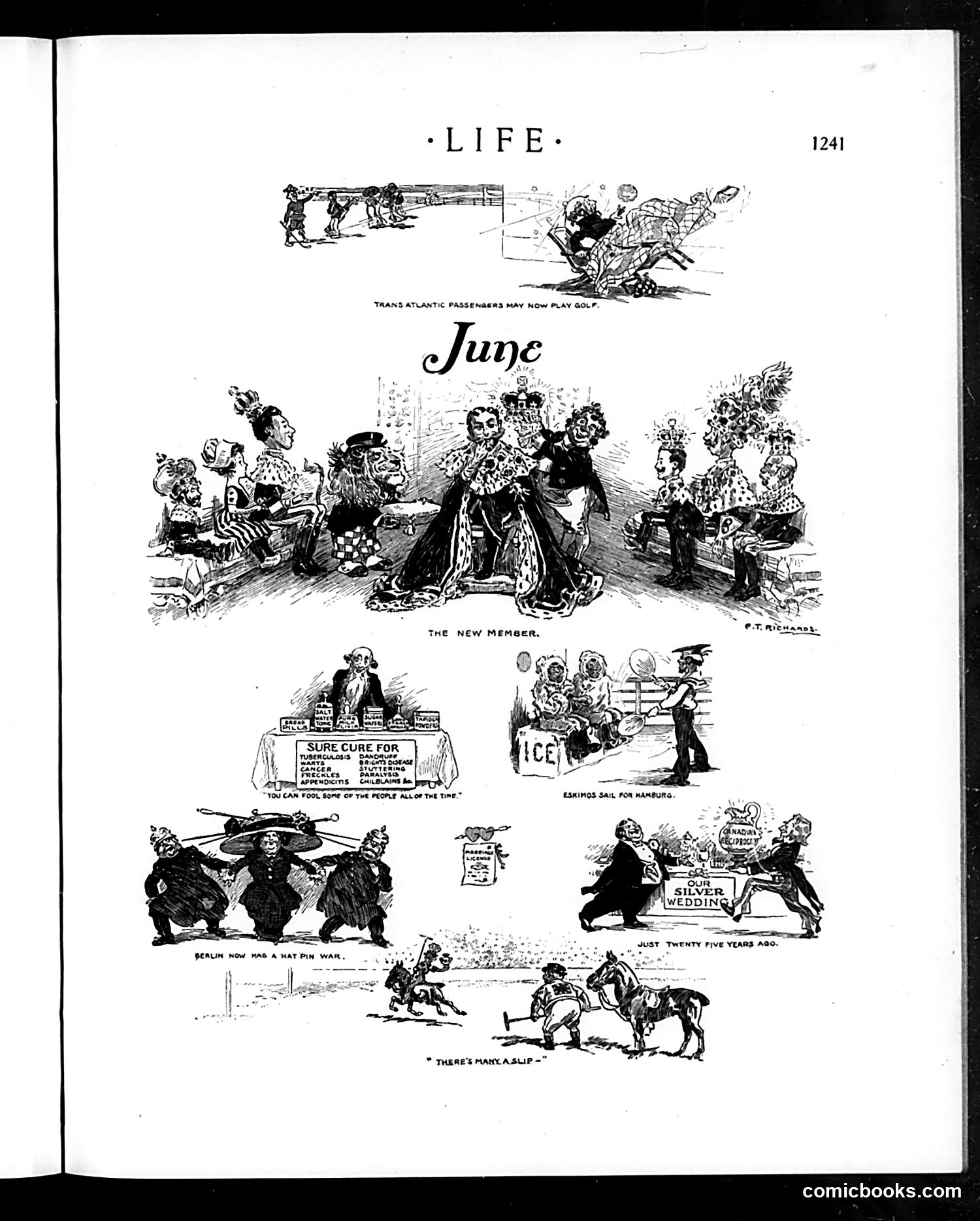
This page from *Life* magazine features several satirical cartoons about June 1913 events. "The New Member" (top) shows a regal figure being introduced to what appears to be a social or political club. Lower cartoons address contemporary issues: "Sure Cure for..." presents a quack medicine pitch (common satire target), while "Earnings sail for Hamptons" mocks wealthy leisure habits. "Berlin now has a hat pin war" references the hat pin craze—a genuine 1910s social panic about women using large pins as weapons. "Silver Wedding" appears nostalgic social commentary, and "'There's more a-slip'" references maritime or social mishaps. The overall tone satirizes upper-class society, public health quackery, and contemporary gender anxieties typical of pre-WWI American humor.
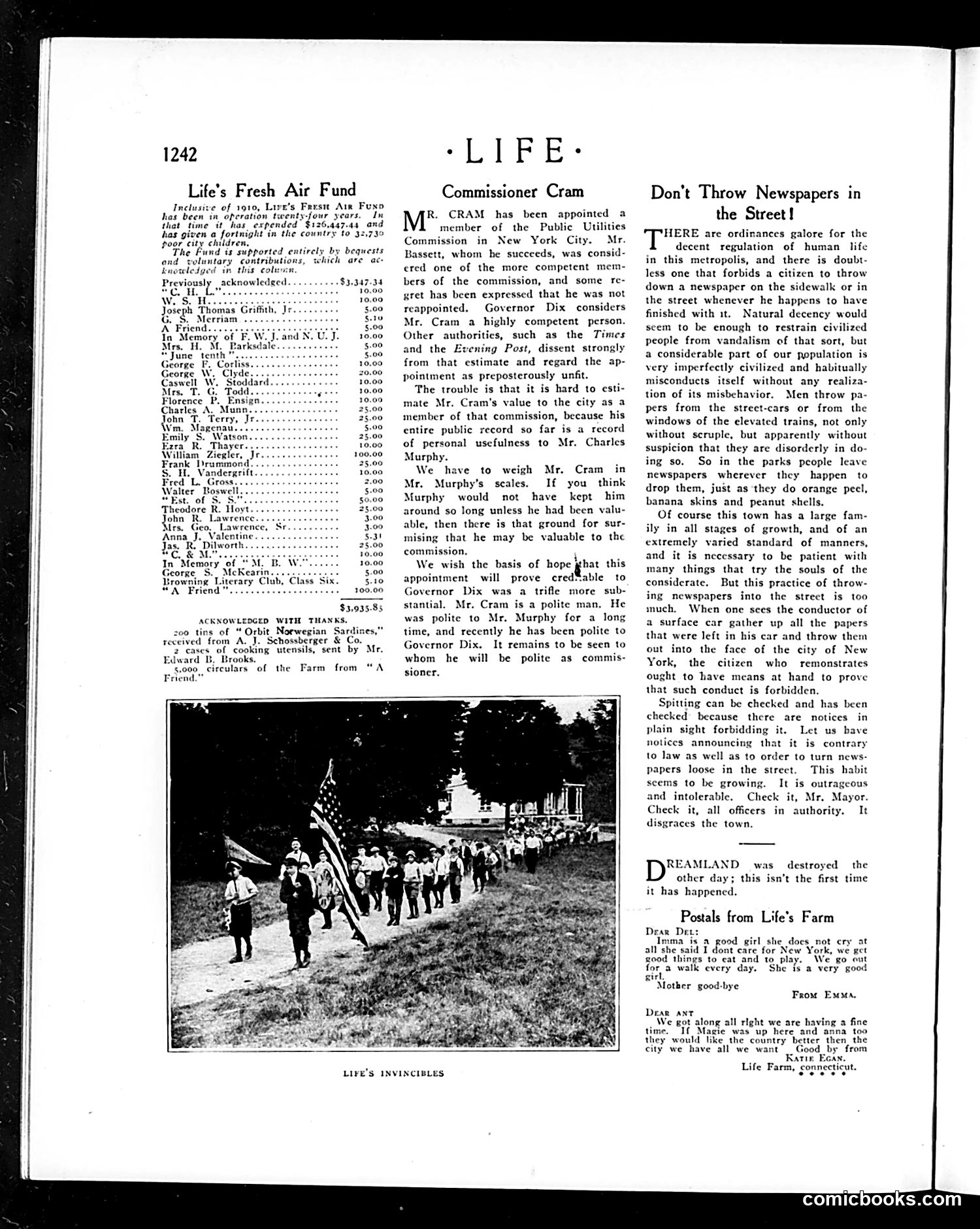
This page contains three distinct sections: **"Life's Fresh Air Fund"** (left column): A fundraising list for charitable donations supporting fresh air programs for children, a common Progressive Era initiative. **"Commissioner Cram"** (center): An article praising newly appointed Public Utilities Commission member Mr. Cram, arguing he's competent and valuable to New York City governance—explicitly defending him against newspaper criticism from the *Times* and *Evening Post*. **"Don't Throw Newspapers in the Street"** (right): A civic editorial criticizing New Yorkers for littering newspapers on sidewalks and streets, framing it as uncivilized behavior that disgraces the city. **The photograph** shows what appears to be a civic or patriotic gathering with crowds and flags, labeled "Life's Invincibles." The page reflects early 20th-century Progressive Era concerns: good governance, public health, civic responsibility, and social order.
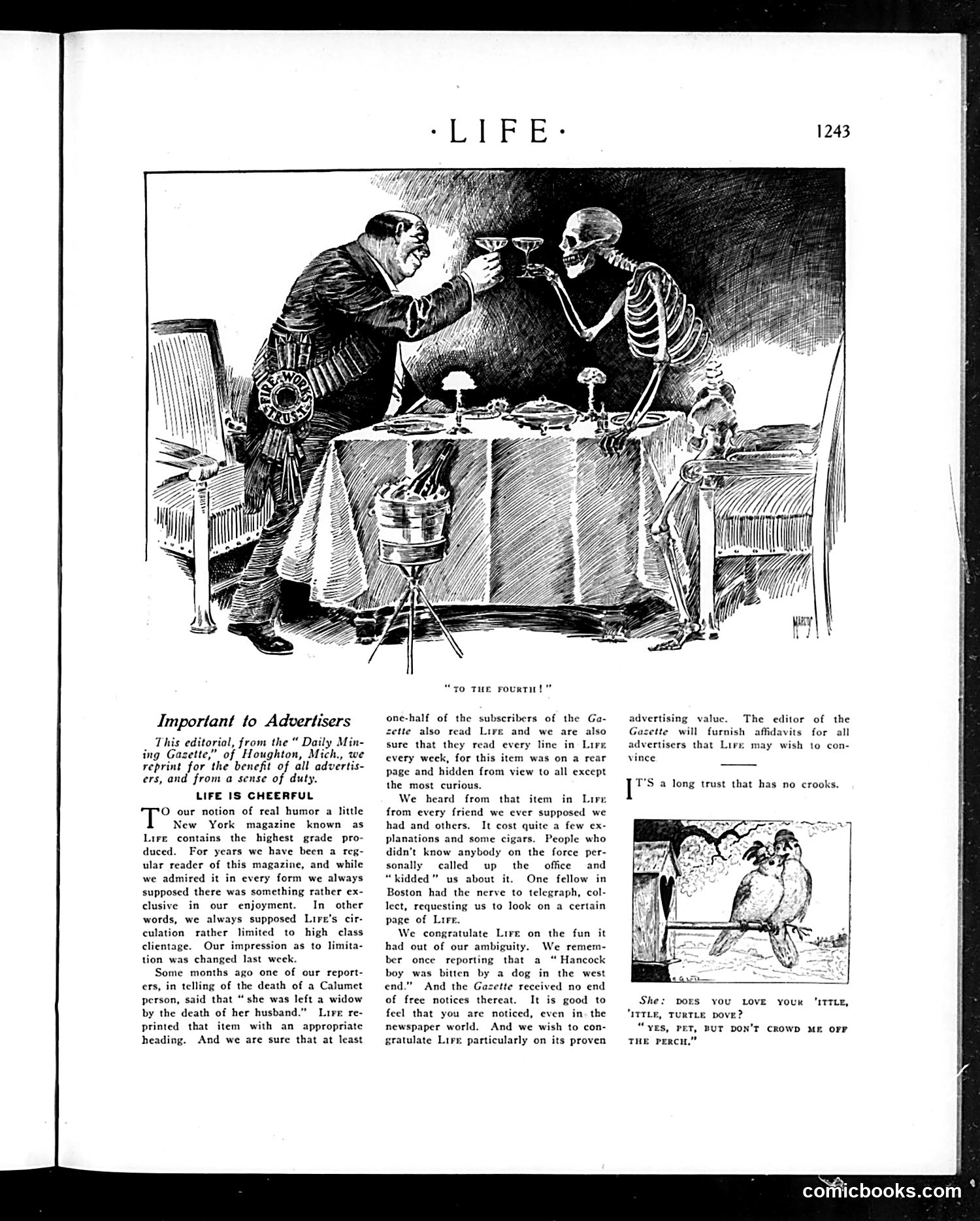
The main illustration shows a well-dressed man in military regalia toasting with a skeleton figure at a dinner table, titled "TO THE FOURTH!" **The satire:** This appears to be a memento mori scene—a darkly humorous commentary on mortality and fate. The man's formal dress and decorations suggest wealth or status, yet he's dining with Death itself, suggesting that no amount of social standing protects one from death. **The accompanying text** discusses Life magazine's editorial approach to humor, noting it aims for "real humor" rather than "high class clientage." It mentions the magazine's ambiguous or subtle jokes sometimes confuse readers—like when they reported a "Hancock boy was bitten by a dog" and received confused responses. The overall message critiques how Life's sophisticated satire can be misunderstood by audiences expecting obvious comedy.
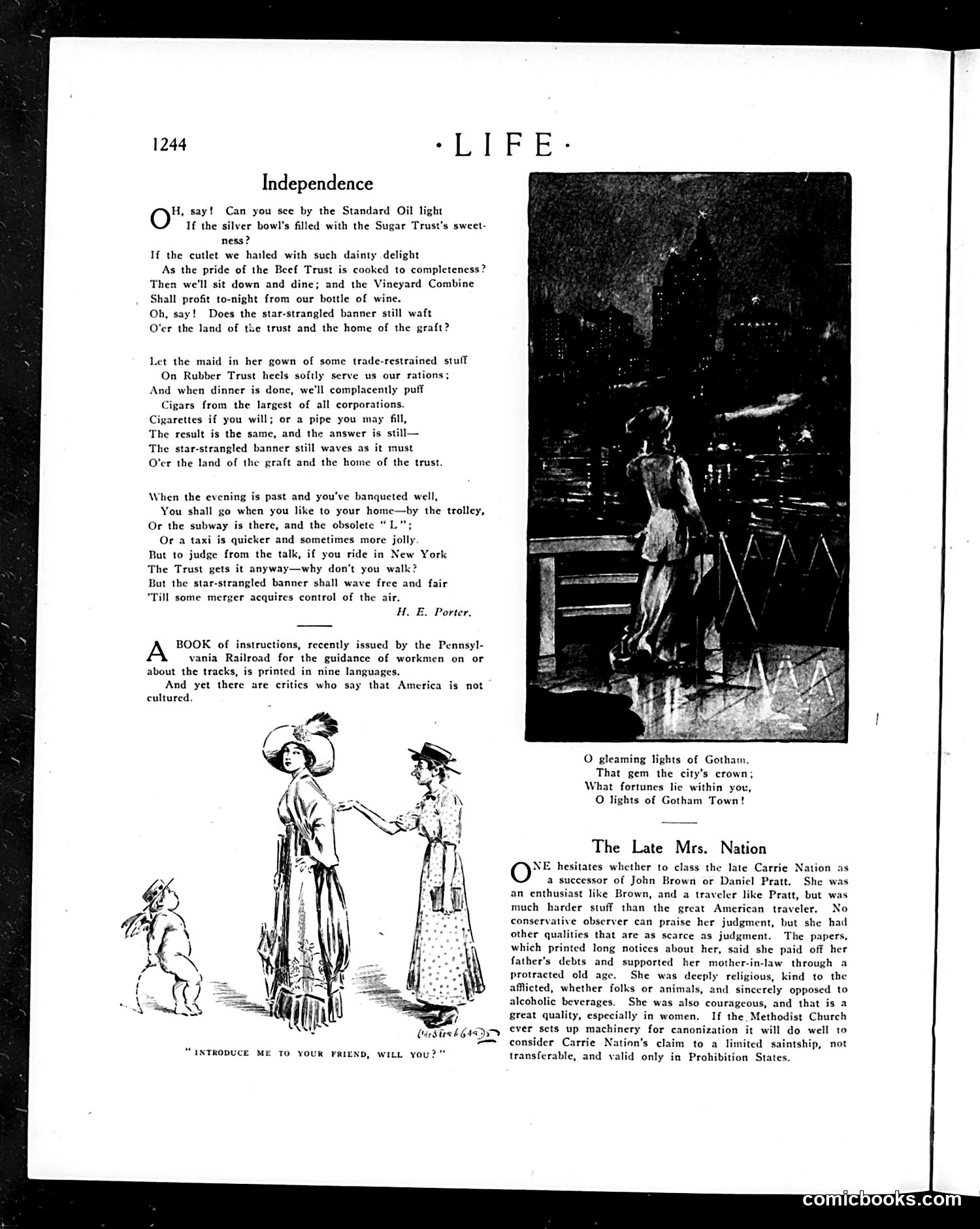
This page contains satirical poetry and commentary critiquing American corporate monopolies and wealth inequality circa the early 1900s. **"Independence" poem** (attributed to H.E. Porter): Sarcastically celebrates living under corporate "Trusts"—monopolistic businesses controlling sugar, beef, and railroads. The speaker ironically claims independence while remaining entirely dependent on these corporations for food, transportation, and even leisure (cigars, wine). The repeated refrain about the "star-strangled banner" mocks patriotic language made hollow by corporate domination. **Lower section**: Criticizes America as culturally uncultured while praising a Pennsylvania Railroad instruction manual printed in nine languages—implying America serves immigrant laborers better than native citizens. The illustration shows two women greeting, captioned "Introduce me to your friend, will you?" — likely social commentary, though the specific reference is unclear.
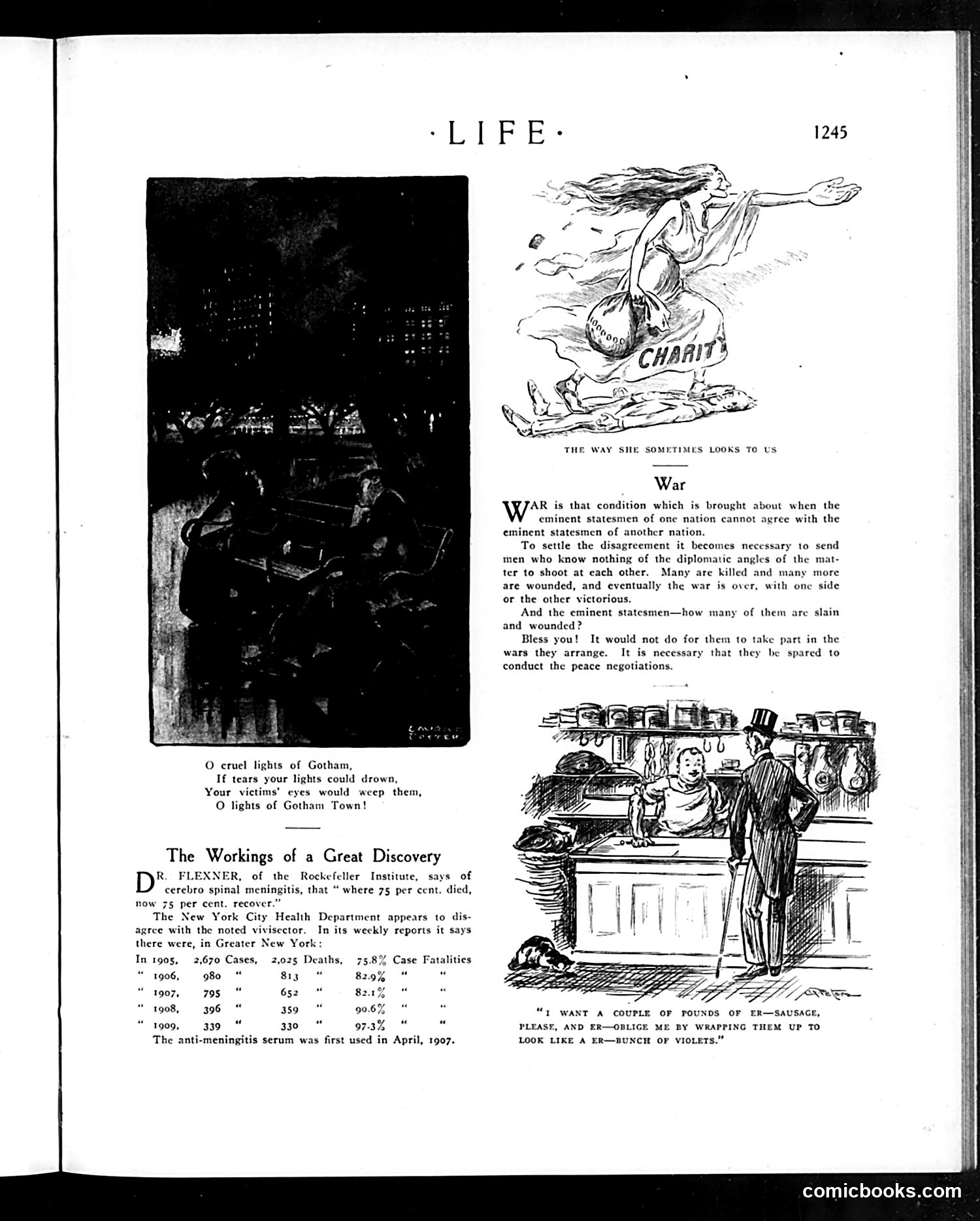
The page contains two distinct pieces: **"War" editorial** argues that eminent statesmen should be spared from military service to conduct peace negotiations, rather than risk their lives in combat. **"The Workings of a Great Discovery"** discusses meningitis mortality statistics in New York City from 1905-1909, crediting Dr. Flexner of the Rockefeller Institute with developing an anti-meningitis serum first used in April 1907. The data shows dramatic improvement: case fatalities dropped from 73.8% (1905) to 51.2% (1908), demonstrating the serum's effectiveness. The accompanying cartoon humorously depicts a butcher's shop assistant requesting sausage wrapped like flowers—a satirical visual comment unrelated to the text. The page reflects early-1900s Progressive Era optimism about scientific medicine's potential to save lives.
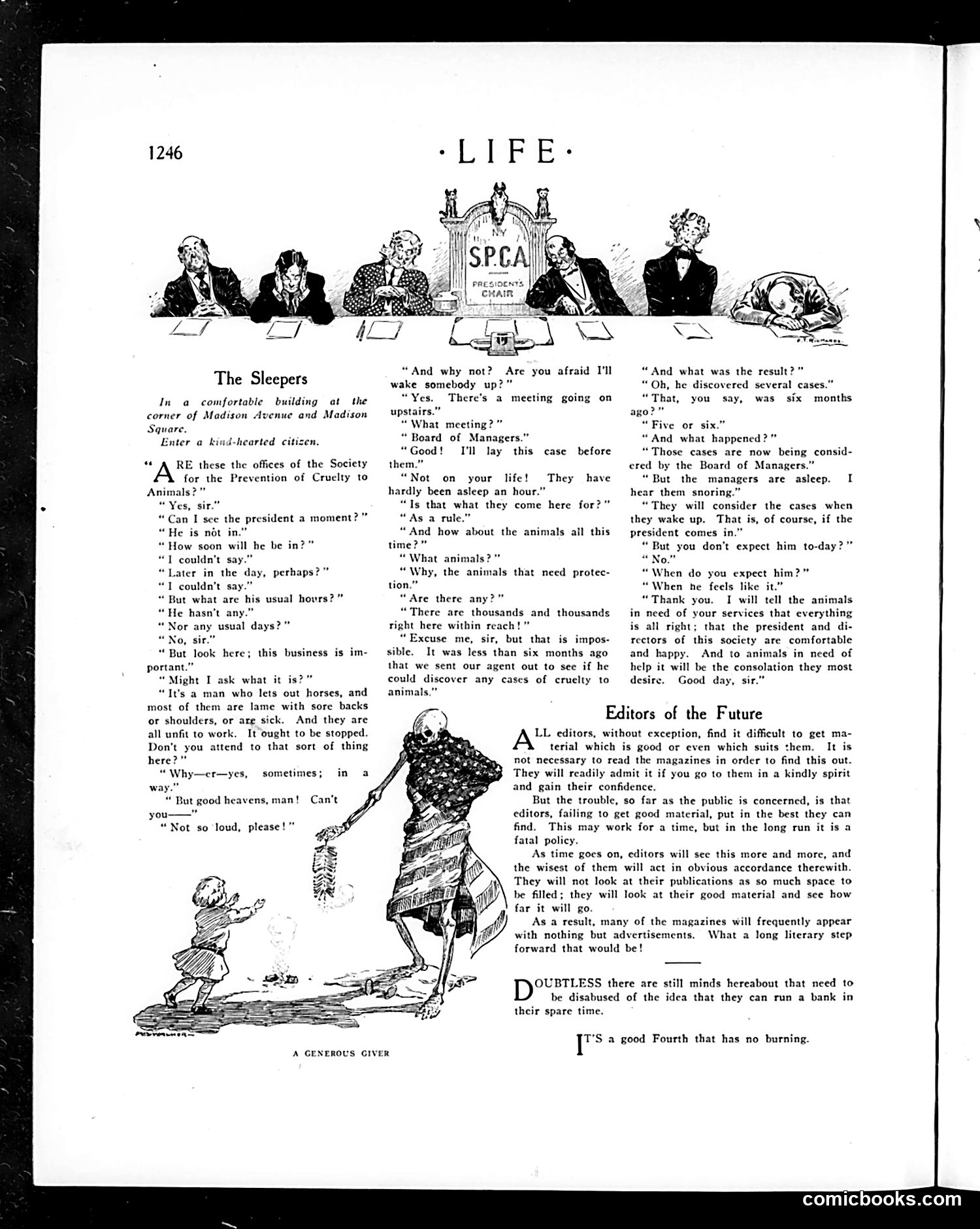
This satirical cartoon depicts a meeting of the SPCA (Society for the Prevention of Cruelty to Animals) board. The joke centers on organizational dysfunction: while the board is supposed to address animal cruelty cases, the members are literally asleep during meetings. The dialogue reveals that cases discovered six months prior remain unconsidered because the managers themselves are asleep, and decisions only occur when the president attends—which happens rarely. The cartoon mocks institutional inertia and apathy: an organization ostensibly dedicated to animal welfare is so lethargic that it cannot accomplish its basic mission. The accompanying illustration "A Generous Giver" shows skeletal figures, likely satirizing wealthy donors who give to charity while their own moral character is questionable.
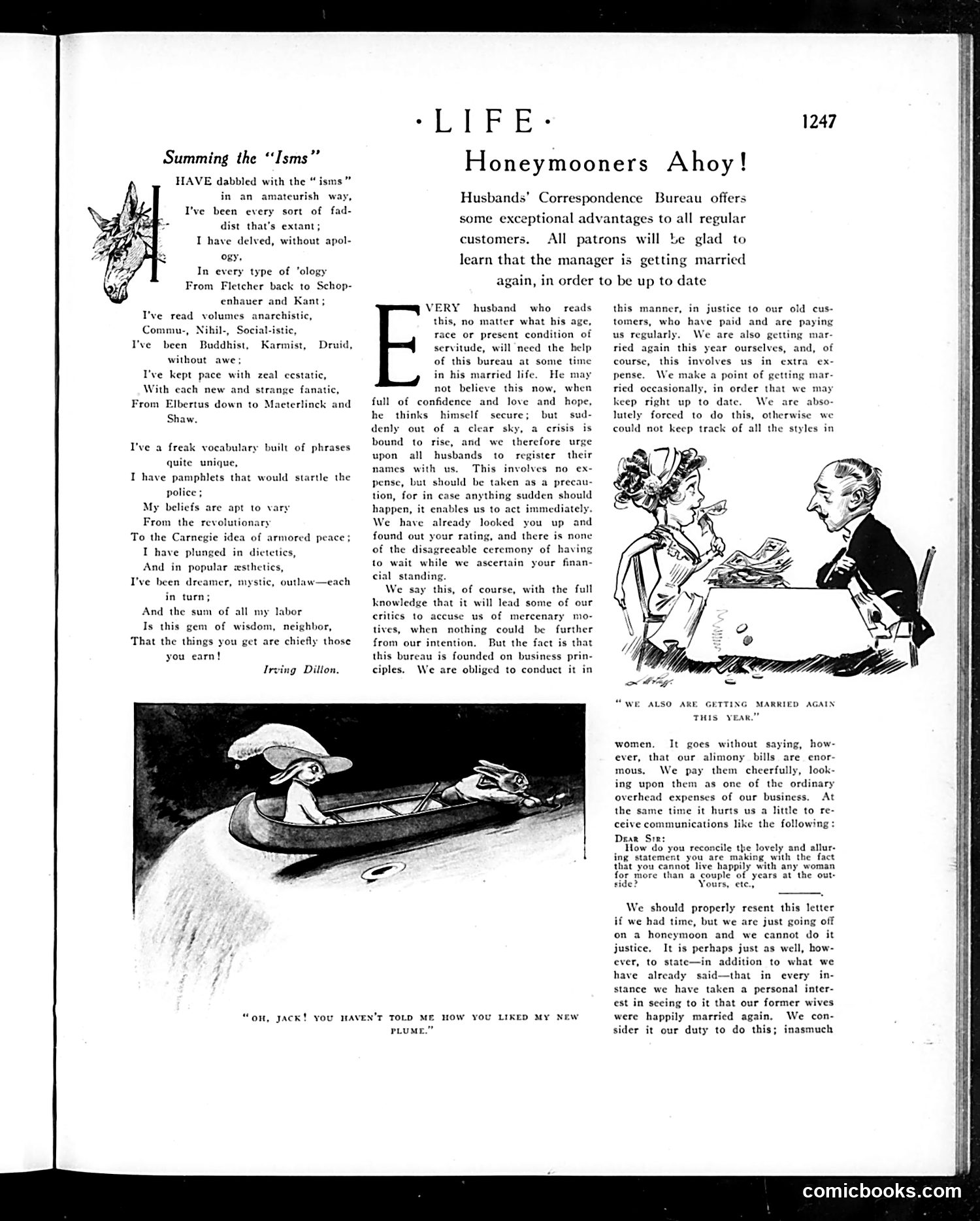
This page satirizes two distinct targets: **Left side ("Summing the 'Isms'"):** A poem mocking the author's dabbling in fashionable intellectual and philosophical movements—from anarchism to Buddhism to aestheticism. The joke: after sampling every trendy ideology, the only "wisdom" gained is the banal observation that "the things you get are chiefly those you earn." It's satire of dilettantes who chase intellectual fads without genuine conviction. **Right side ("Honeymooners Ahoy!"):** Satire of a fictional "Husbands' Correspondence Bureau"—a marital advice service whose manager constantly remarries to "stay current" with fashion. The bureau cynically justifies its own divorce-and-remarriage cycle as necessary overhead expenses, deflecting criticism about hypocrisy. The cartoon illustrates the absurdity: a man in a boat discussing another's new plume (hat), while the bureau profits from marital dysfunction it embodies. Both pieces mock 1920s culture: intellectual posturing and the era's apparent epidemic of serial marriage and divorce among the wealthy.
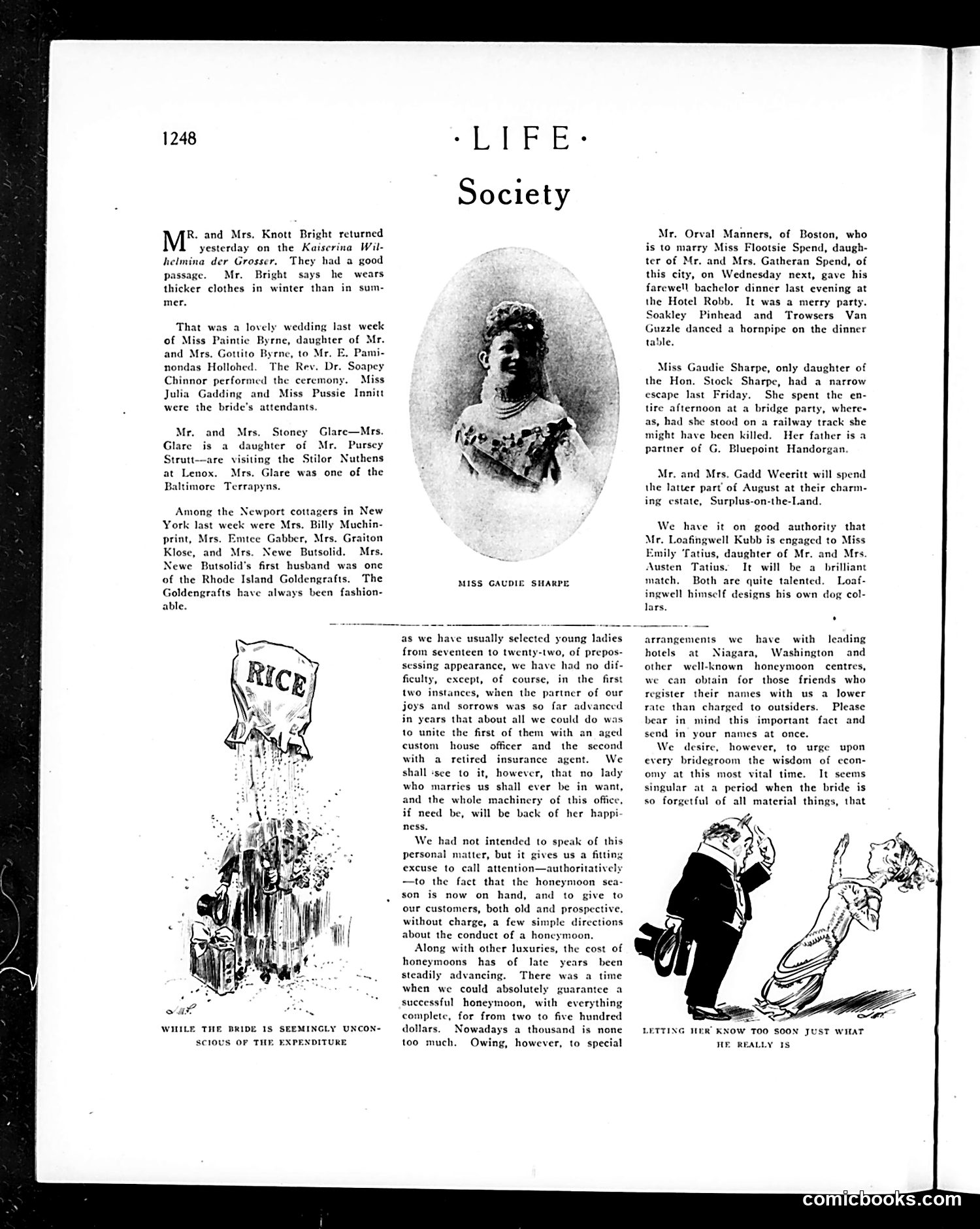
This is a society gossip page satirizing wealthy upper-class social conventions. The humor relies on deliberately absurd names ("Pussie Innitt," "Stoney Glare," "Loafingwell Kubb," "Flootsie Spend") that mock the pretentiousness of society figures. The fake pedigrees and accomplishments are equally ridiculous ("Goldengrafts have always been fashionable"). The central cartoon depicts a bride "seemingly unconscious of the expenditure"—satirizing wealthy women's indifference to honeymoon costs. The accompanying editorial ironically advises on economizing honeymoons while noting costs have risen from "$200-500 to $1,000," mocking both inflation and the culture of conspicuous consumption among the wealthy. The cartoon of a couple (captioned "Letting her know too soon just what he really is") likely jokes about post-marriage disillusionment. Overall, the page ridicules the vanity, materialism, and superficiality of high society through exaggerated names and situations.
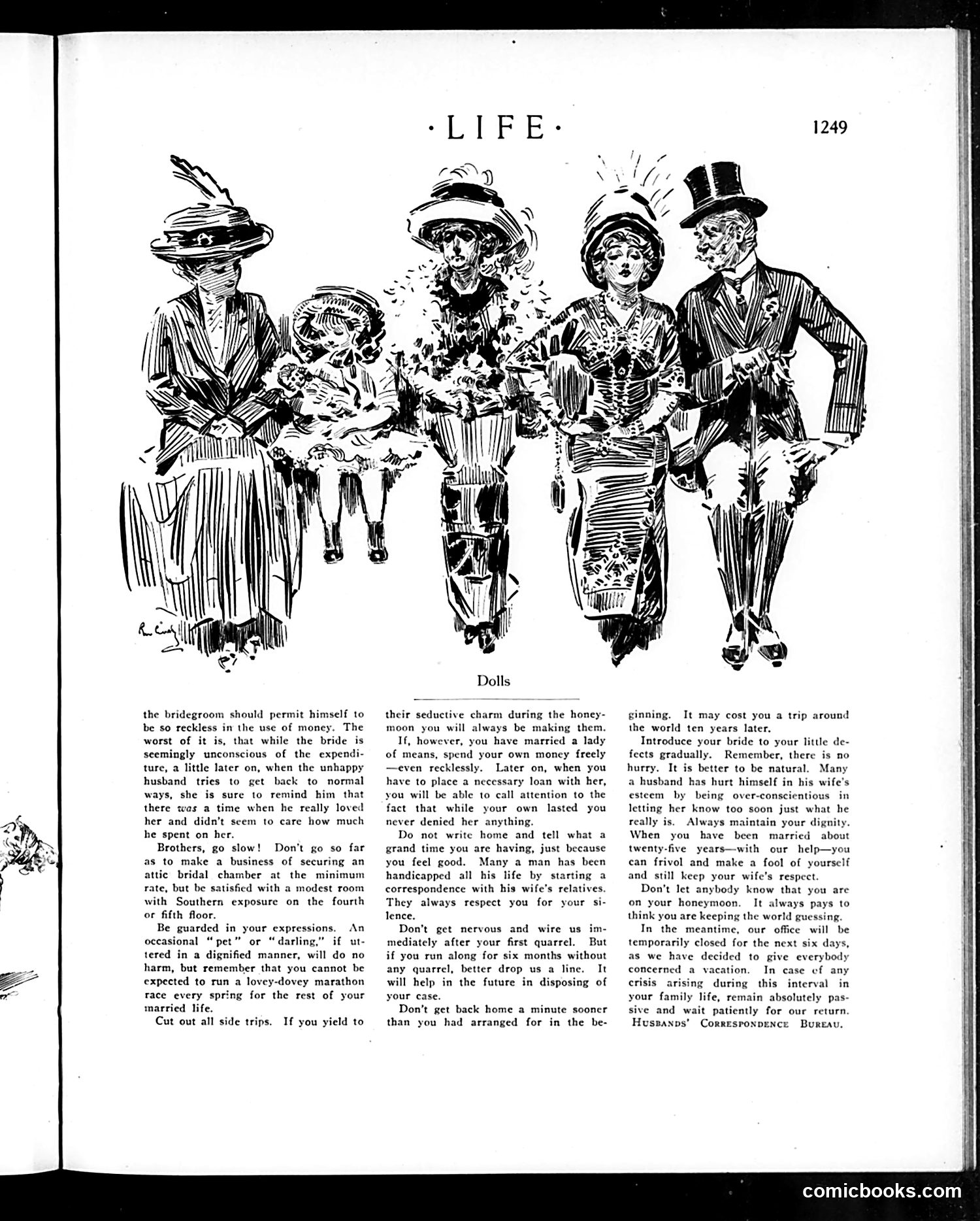
This is a satirical advice column titled "Dolls," ostensibly offering newlywed husbands guidance on honeymoon behavior and married life. The illustration shows five fashionably dressed figures from the early 1900s—likely representing different types of women or wives. The satire works through ironic, cynical "advice" that mocks both grooms' anxieties and matrimonial dynamics. It warns against excessive spending on brides, cautioning that early lavishness will be weaponized later as proof of love. Other tongue-in-cheek tips counsel emotional restraint, financial manipulation, and strategic silence with in-laws. The column's closing joke—that the "Husbands' Correspondence Bureau" is closing for vacation and readers should "remain absolutely passive" during family crises—punctures the authority of the entire advice-giving enterprise. The satire targets middle-class marital anxieties and the then-popular "advice column" genre by exposing the absurdity of reducing marriage to calculated strategies and emotional suppression.
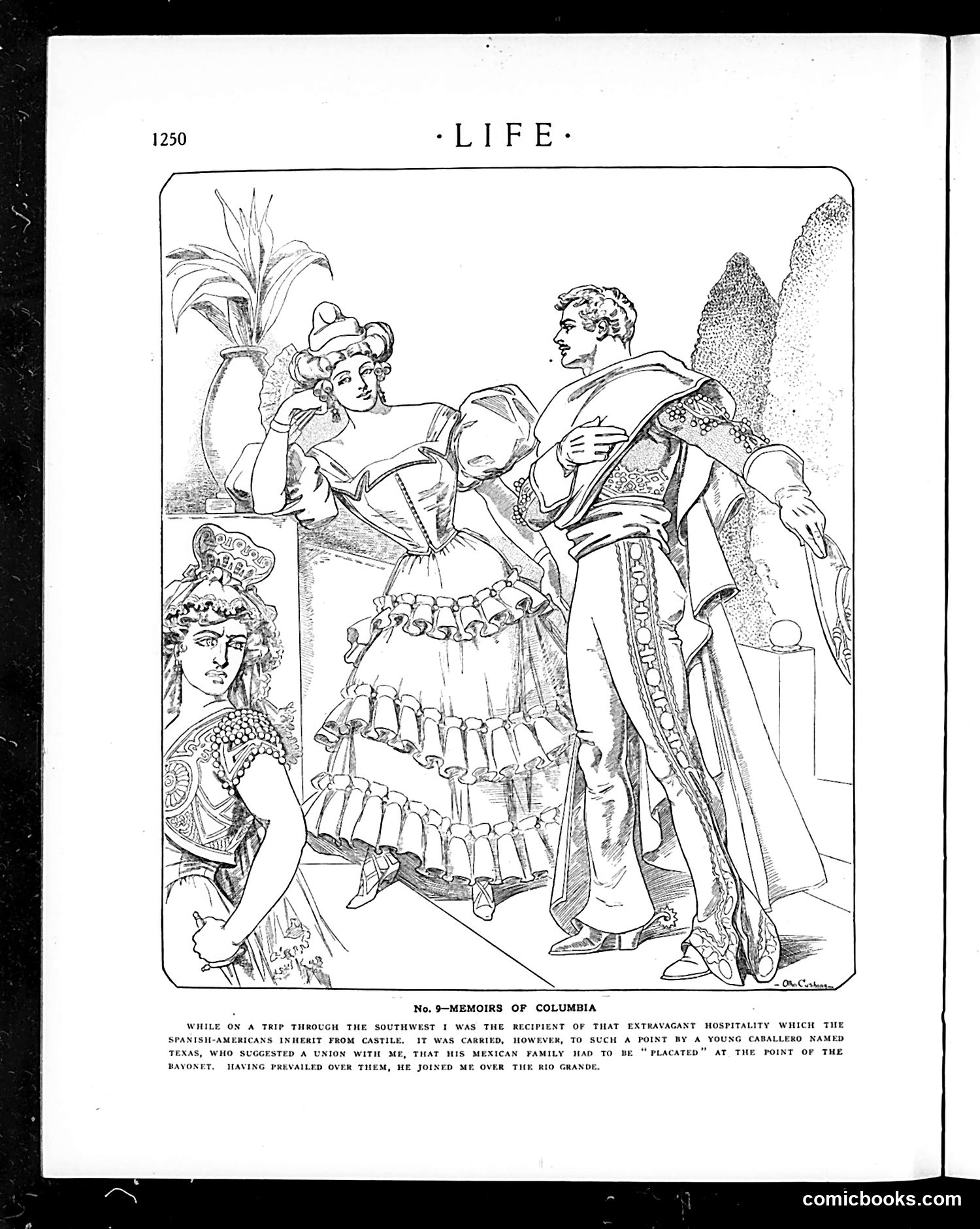
This is a satirical cartoon personifying the United States ("Columbia," the female allegorical figure on left) encountering "Texas" (depicted as a young Spanish-American caballero). The narrative describes Texas proposing union with Columbia, requiring his Mexican family to be "placated" at bayonet-point before he joins her across the Rio Grande. This references the **Texas annexation conflict (1836-1845)**: Texas's independence from Mexico, American expansionist pressures, and the military/political tension involved in incorporating Texas into the Union. The "bayonet" reference alludes to the armed disputes with Mexico this caused. The satire critiques American expansionism dressed as romantic union—what was actually military coercion presented as courtship. Columbia's elaborate dress and composed demeanor contrast with the implied violence of "placating" Mexico.
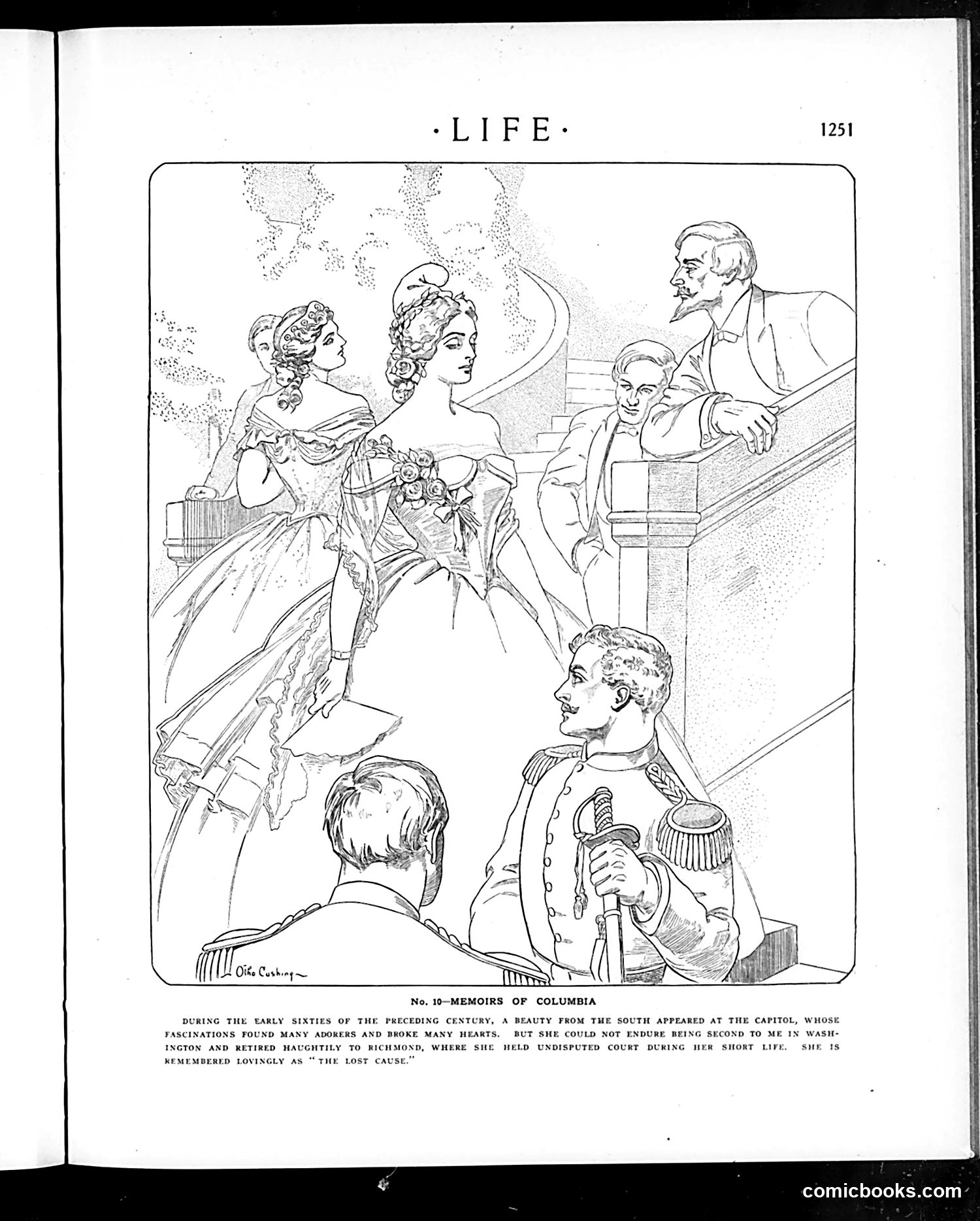
This is illustration No. 10 from a series titled "Memoirs of Columbia." The caption describes a Southern belle who appeared in Washington D.C. during the 1860s (early sixties of the preceding century), attracting many admirers. Unable to accept being second to another woman in the capital's social hierarchy, she retreated to Richmond, Virginia, where she maintained undisputed social prominence until her early death. The cartoon satirizes the antebellum South through personification: "Columbia" represents the nation, while the unnamed Southern woman represents the Confederacy itself. The phrase "remembered lovingly as 'The Lost Cause'" is the key: this is an allegory for the Southern states' brief independence (the Confederacy) and their subsequent defeat in the Civil War. The satire mocks romanticized nostalgia for the "Lost Cause"—the post-war Southern mythology glorifying the Confederacy—by presenting it as a vain woman's romantic drama rather than a serious historical tragedy.
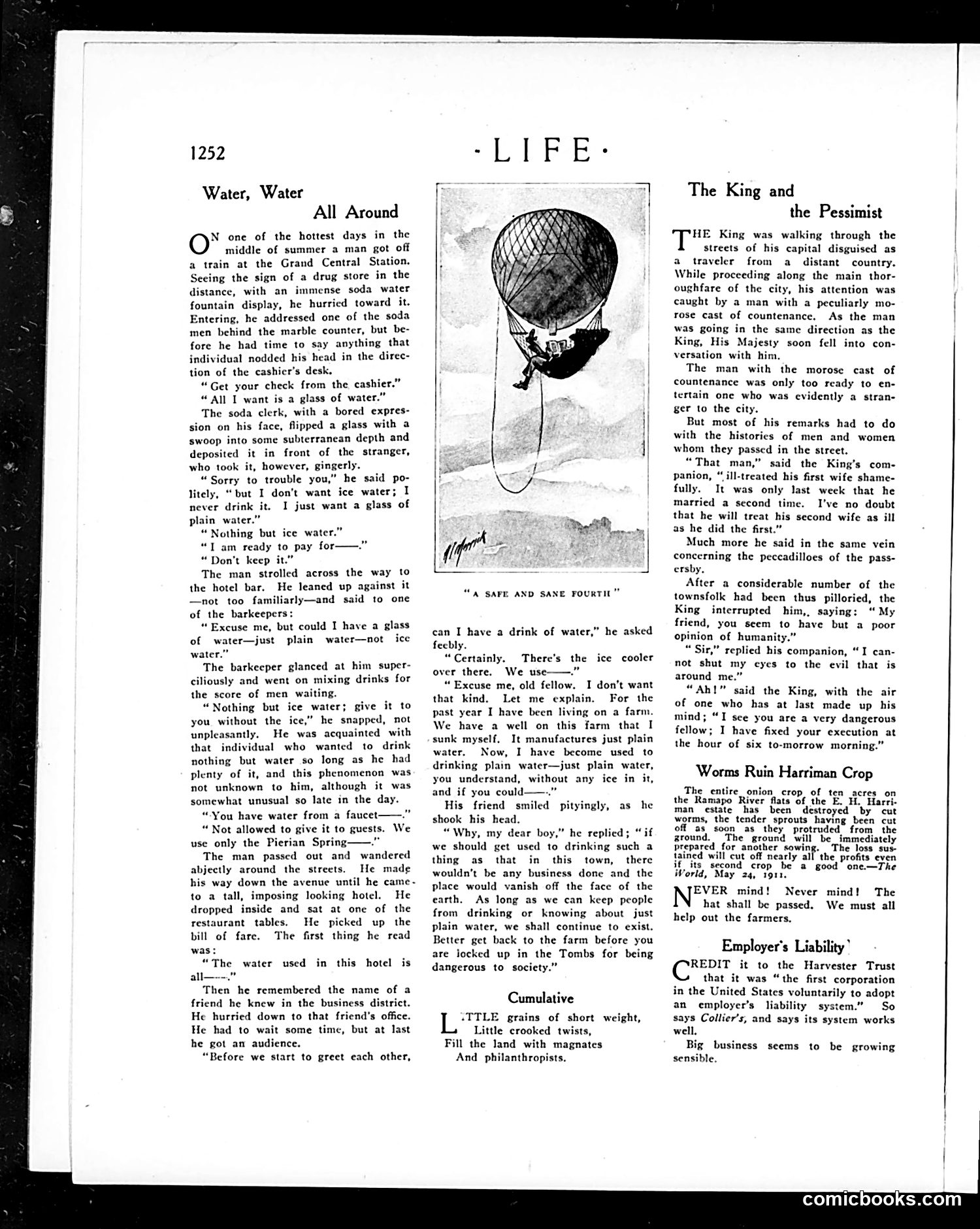
This cartoon satirizes early 1900s American commercialism and the marketing of unnecessary luxuries. A traveler seeking plain water encounters absurd resistance across New York City—a soda fountain clerk, a hotel barkeeper, and finally a businessman friend all insist only on serving ice water or proprietary "spring water." The joke mocks how businesses had convinced the public that plain tap water was beneath them, and how commerce had colonized even basic human needs. The traveler's farm background (representing simpler values) contrasts with the city's manufactured desires. The final threat about being "locked up in the Tombs for being dangerous to society" sardonically suggests that rejecting commercial products threatens the entire urban economic system. The smaller poem "Cumulative" at bottom satirizes how minor dishonest practices ("short weight," "crooked twists") accumulate to create wealthy industrialists and philanthropists—questioning the moral foundations of the era's robber barons.
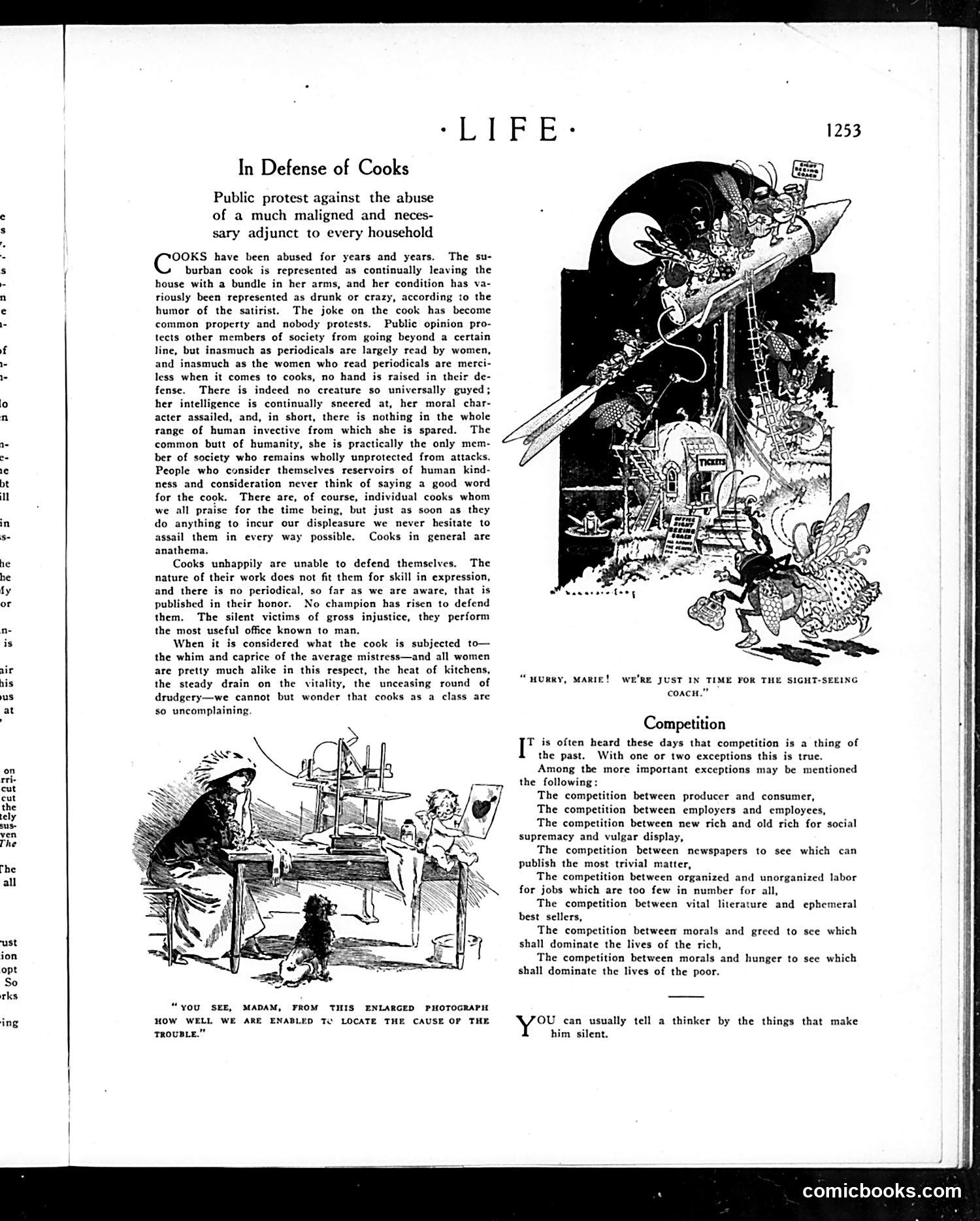
This article satirically defends domestic cooks against widespread mockery in popular culture and periodicals. The piece argues that cooks—typically working-class women—are society's most universally ridiculed group, portrayed as drunk, crazy, or incompetent, yet receive no public protection or sympathy unlike other social classes. The cartoons illustrate the cook's plight: one shows a detective examining a kitchen with magnifying glass (sardonically suggesting cooks are criminal suspects), another depicts a cook fleeing with a bundle, reinforcing the stereotype the article critiques. The accompanying "Competition" section uses biting social commentary to highlight class disparities: competition between rich and poor, morals and greed versus morals and hunger—suggesting society's priorities are fundamentally unjust. The satire's point: cooks perform essential labor under brutal conditions yet remain invisible, voiceless, and fair game for mockery that would be considered cruel if directed at other groups. The article advocates for basic human dignity and recognition of their contributions.
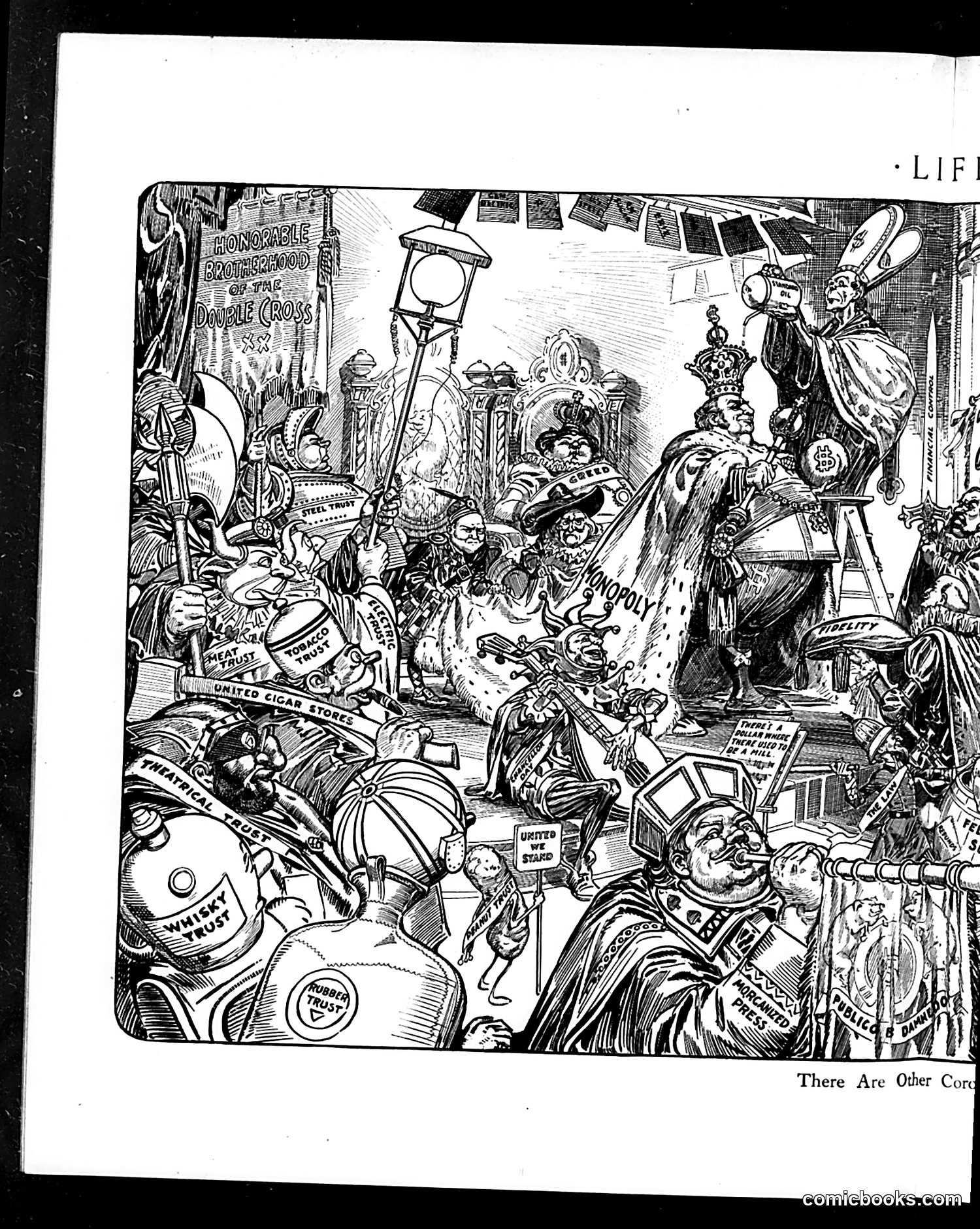
This appears to be an early 20th-century satirical illustration depicting a chaotic gathering of figures in elaborate dress and regalia. Visible labels reference "Honorable Brotherhood of the Double Cross," "United Cigar Stores," and various commercial products (whisky, tobacco). The scene shows ornately-dressed authority figures—appearing to include clergy, nobility, and business leaders—amid smaller figures and symbolic objects. The satire likely criticizes corruption among powerful institutions: religious organizations, aristocracy, and corporate interests, suggesting they conspire ("double cross") or profit together while ordinary people remain subservient. The jumbled composition emphasizes chaos and hypocrisy. Without the complete article text, I cannot identify specific individuals or pinpoint exact historical events referenced.
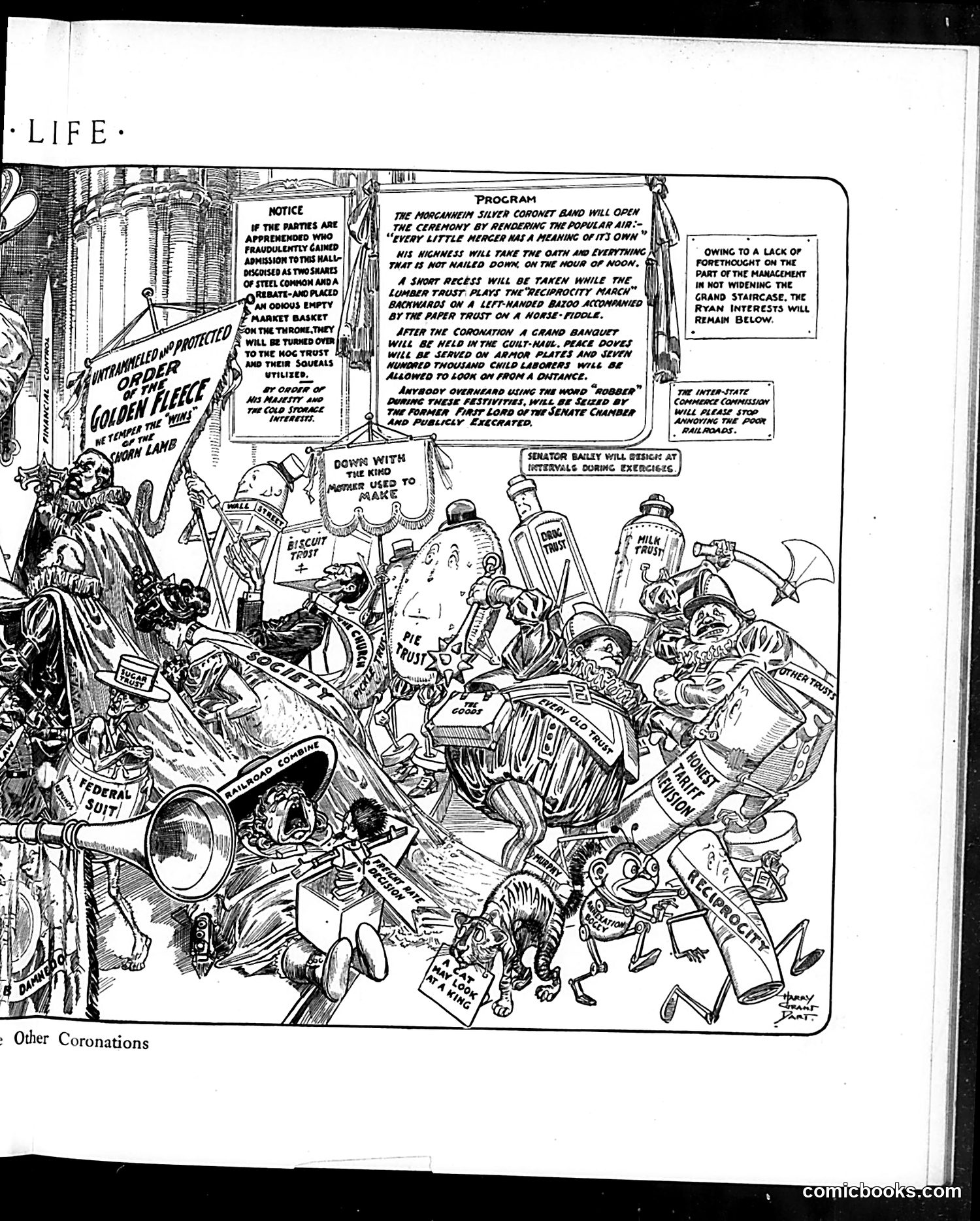
This satirical cartoon mocks American corporate monopolies by depicting them as monarchies being "crowned." The elaborate mock-program describes absurd coronation ceremonies for various trusts—the Paper Trust, Lumber Trust, Milk Trust, and others—each labeled on figures in the chaotic scene. The satire targets: - **Corporate consolidation**: Trusts are portrayed as royalty deserving ceremonial reverence, critiquing their excessive power - **"The Paper Trust"**: Referenced explicitly; appears to be a major target - **Labor exploitation**: The mention of "hundred thousand child laborers" sarcastically highlights child labor practices these monopolies enabled - **Senator Bailey**: Appears as a speaker, likely supporting these interests (unclear which Bailey without date context) - **"Reciprocity"**: References a specific trade/political debate The cartoon equates unregulated corporate power with authoritarian monarchy—suggesting these trusts ruled America like kings, beyond democratic accountability. This reflects Progressive Era anti-trust sentiment (early 1900s era).
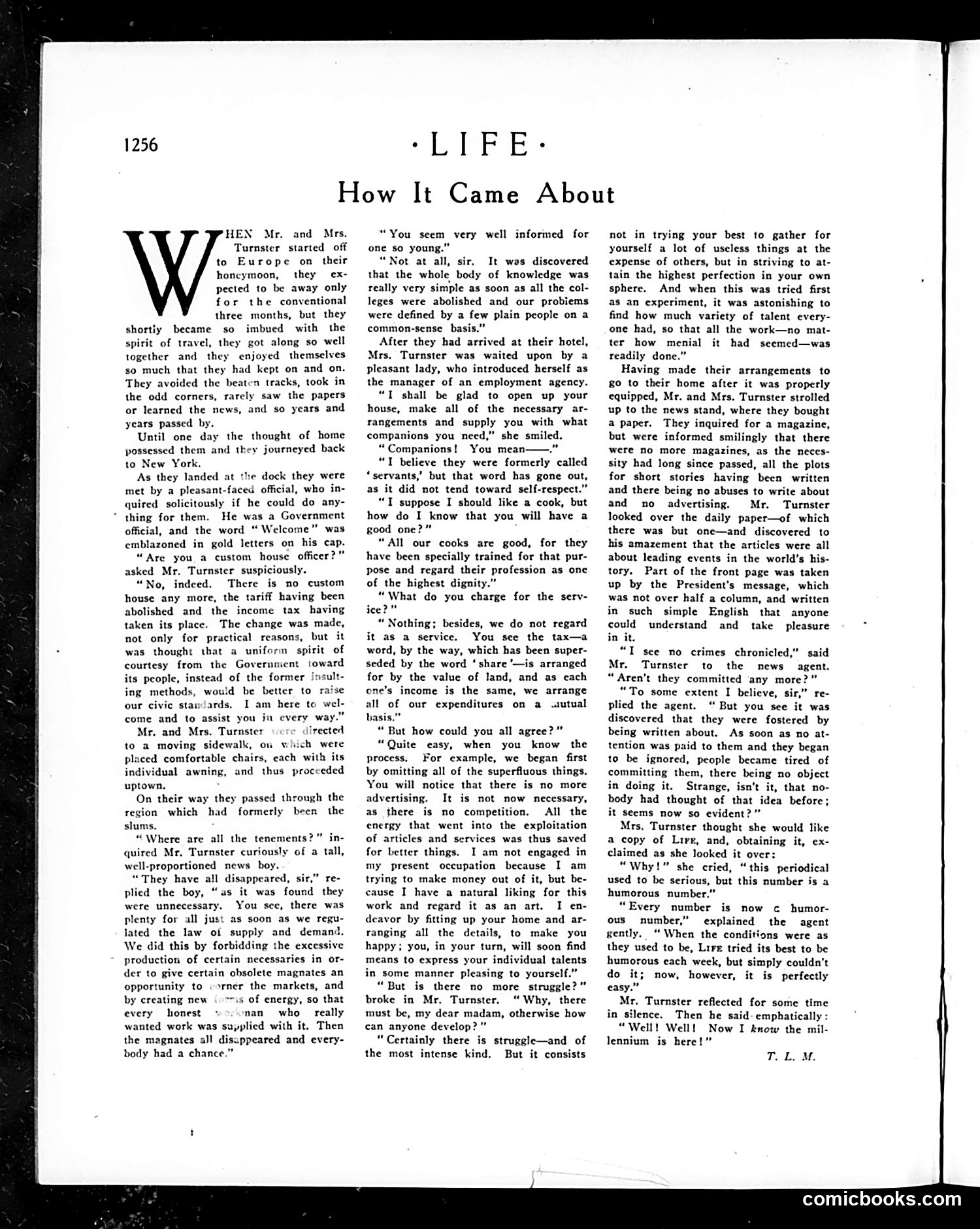
This is a utopian satirical story about Mr. and Mrs. Turnster returning to New York after years abroad, finding a transformed society. The satire targets progressive-era reforms by exaggerating them to absurdity. Key satirical points: **Government reform**: Customs houses eliminated, replaced by courteous "welcome" officials; income tax replaces tariffs. **Economic justice**: Slums disappeared; production regulated to prevent monopolies; everyone finds dignified work. **Social equality**: "Servants" rebranded as "companions"; domestic workers are professionally trained and compensated through shared taxation based on land value, not individual fees. **Education**: Colleges abolished because "knowledge was really very simple" when explained by "plain people on a common-sense basis." The humor lies in mocking idealistic reformers by showing their proposals taken to logical extremes—a world where everything is perfectly equal, dignified, and rationally organized, which the author suggests is naïvely impossible. The piece likely reflects 1910s debates over labor rights, taxation, and progressive governance.
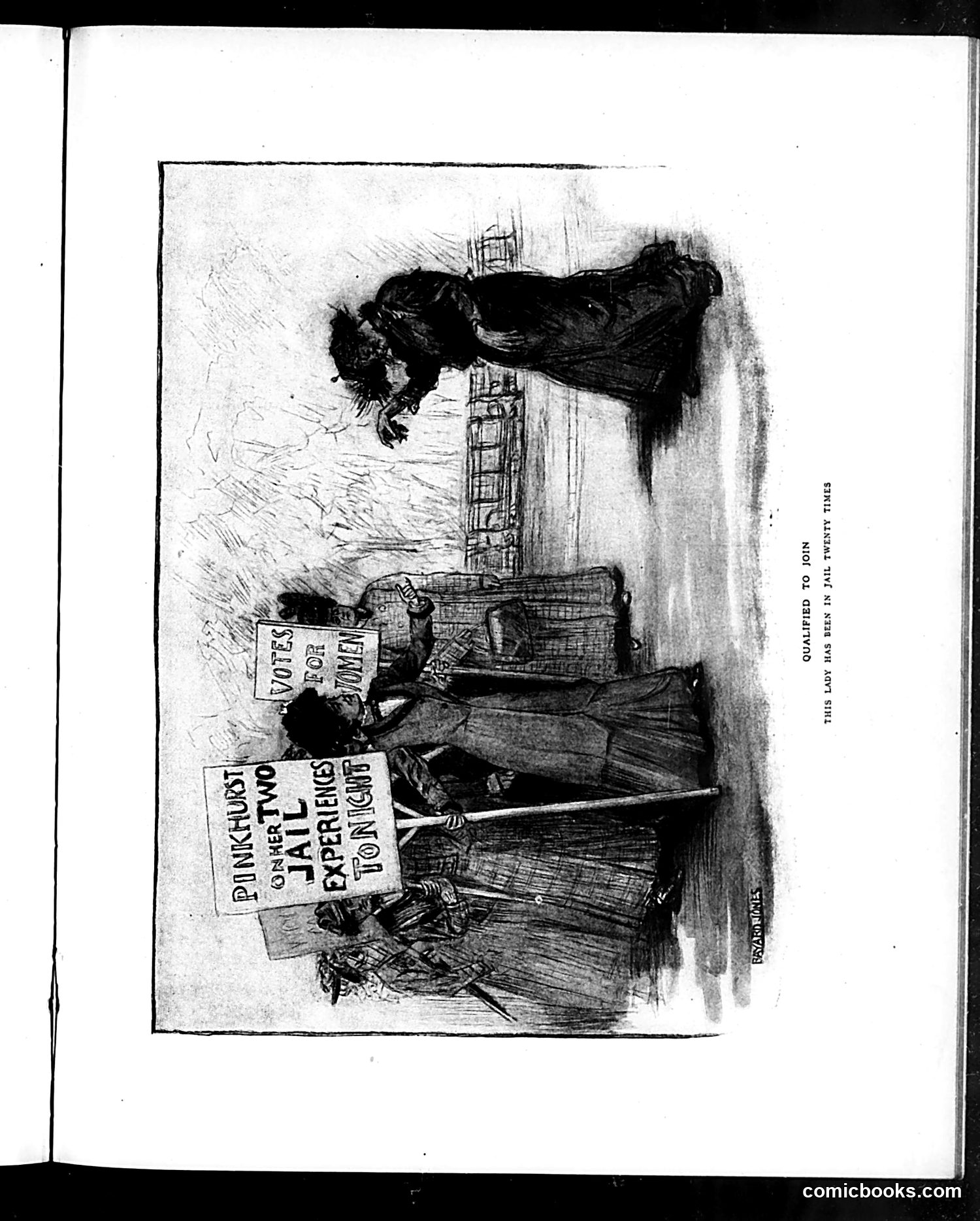
This appears to be a satirical cartoon from Life magazine, though the OCR text is largely illegible. The image shows figures interacting with what appears to be a voting booth or ballot box (visible signage includes "VOTES" and "FOR"). One figure holds a sign reading "PINKHAM'S ON SALE TWO EXPERIENCES TO NIGHT" (likely a Pinkham's patent medicine advertisement reference), while another figure appears to be at or manipulating the ballot apparatus. The cartoon likely satirizes corruption or irregularities in voting/elections, possibly referencing ballot tampering or the commercialization of politics. The patent medicine reference suggests mockery of fraudulent advertising paralleling electoral fraud. However, without clearer text or identifying context, the specific political moment or figures referenced remain unclear.
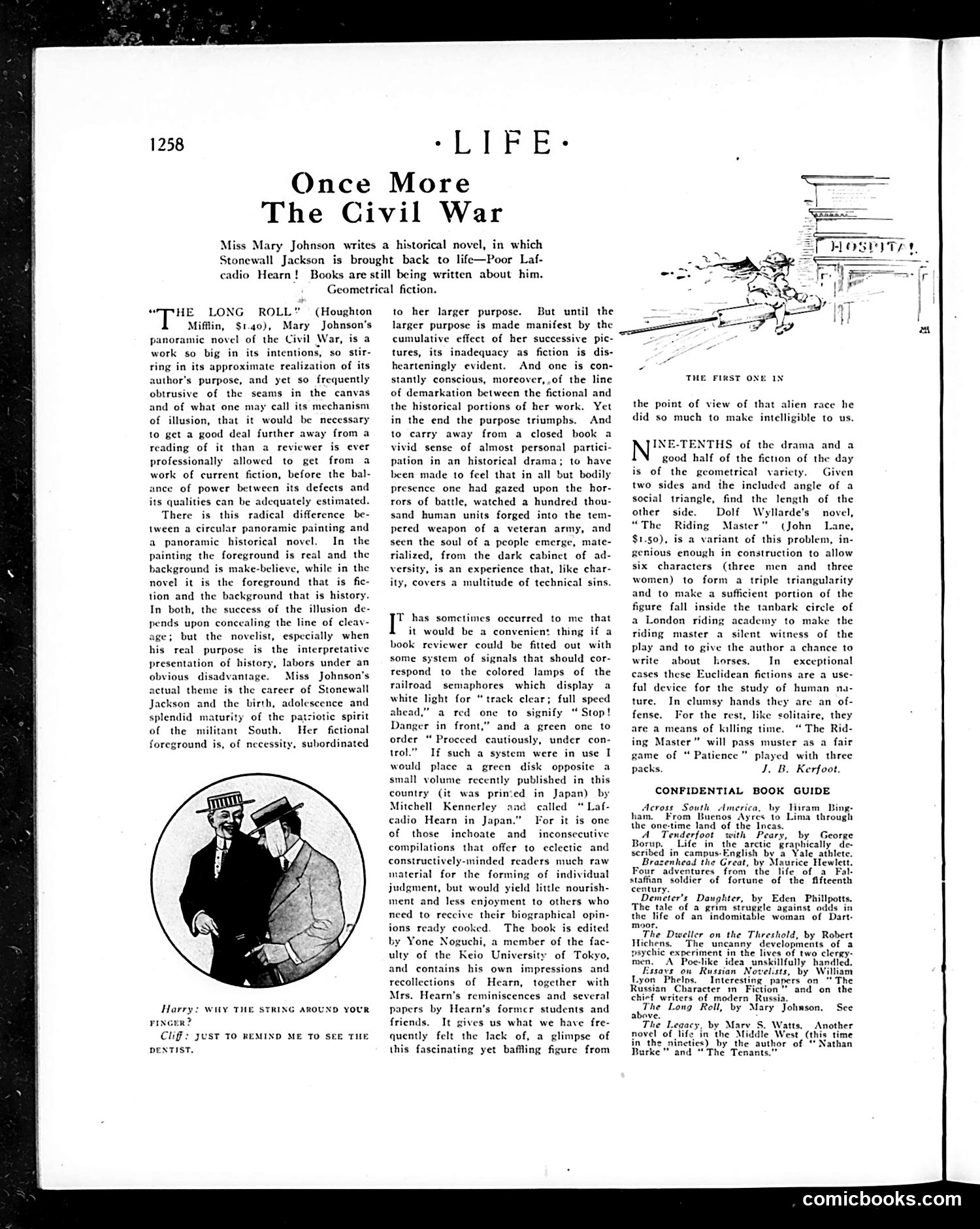
This page reviews Mary Johnson's Civil War novel *The Long Roll*, about Stonewall Jackson. The critic praises Johnson's ambition while noting structural flaws—the fictional foreground feels inadequate until the historical purpose accumulates through successive scenes. The review concludes that achieving a vivid sense of participation in the historical drama ultimately justifies the technical imperfections. The small cartoon shows two men: "Harry" asks "Clif" why he has string around his finger. Clif responds it reminds him to see the dentist. This is a simple, evergreen joke about memory aids—unrelated to the book reviews and likely filler content typical of Life magazine's satirical format. The page also briefly reviews a compilation about Lafcadio Hearn published in Japan, which the critic finds raw and unpolished but potentially useful for discerning readers.
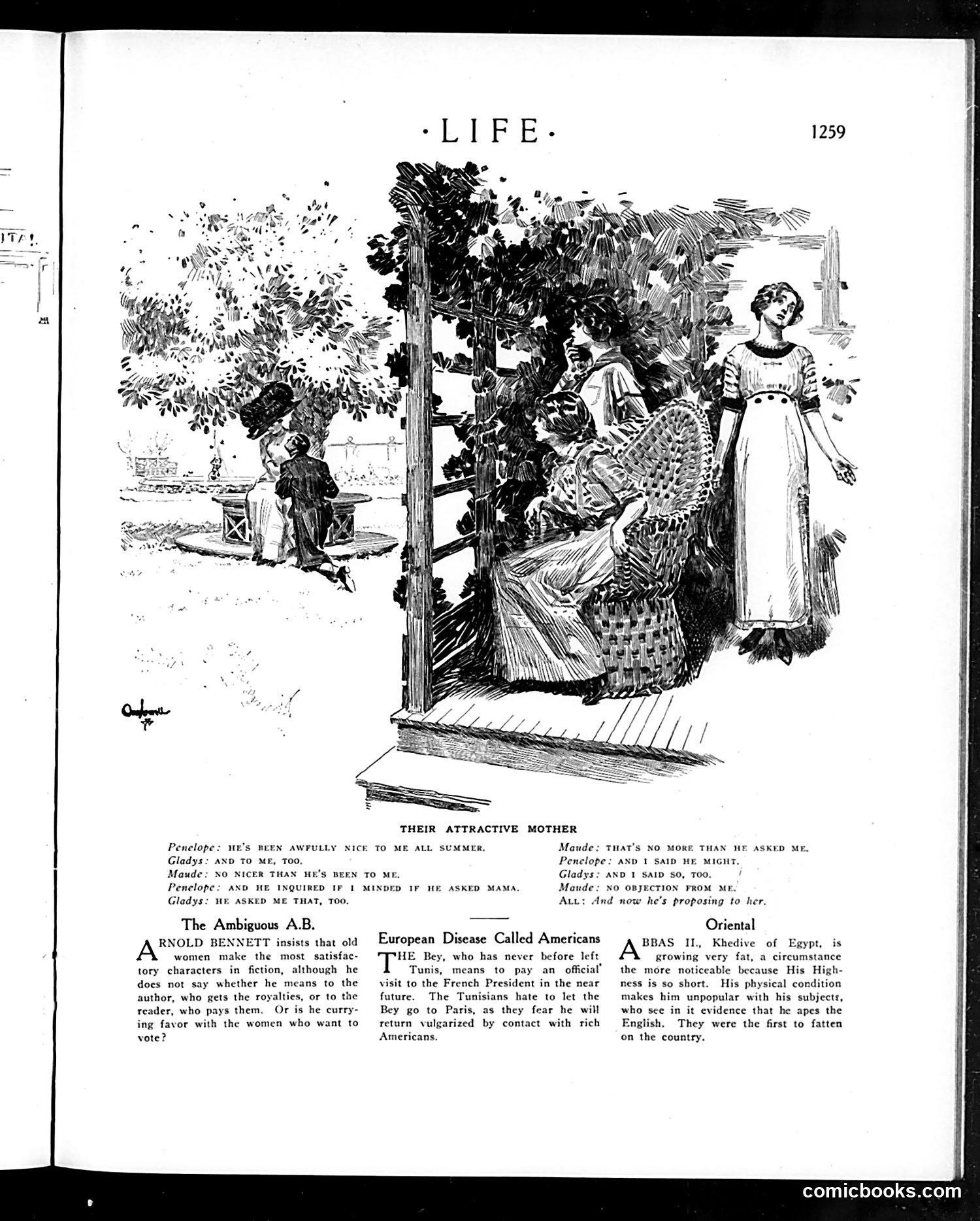
**The Main Cartoon:** This depicts a social comedy about courtship rituals. Three young women (Penelope, Gladys, and Maude) discuss a suitor who has been "awfully nice" to each of them all summer, asking their permission to propose to their mother. The joke's twist: he's now proposing to the mother instead—likely because she's wealthier or of higher social status. The satire mocks the mercenary nature of Gilded Age romance and the absurdity of suitors pursuing mothers when daughters are available. **The Three Brief Articles Below** offer satirical commentary on contemporary topics: Arnold Bennett's literary preferences regarding elderly female characters; European anxieties that wealthy American tourists corrupt foreign dignitaries (the Bey of Tunis); and the Egyptian Khedive's obesity, blamed on aping English colonial excess—a dig at both imperialism and the corrupting influence of wealth.
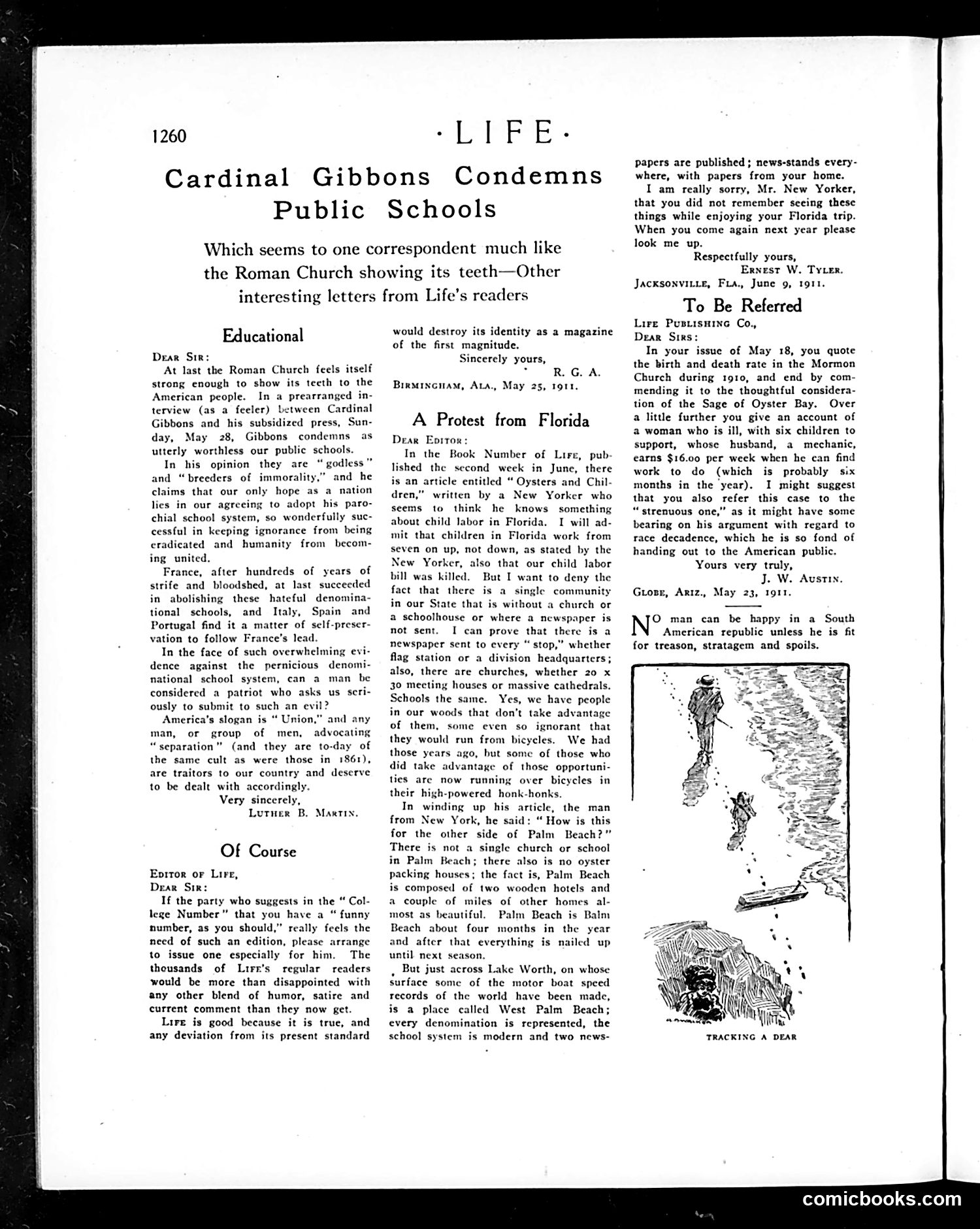
This page contains reader letters responding to Cardinal Gibbons's public criticism of American public schools. The lead letter from Luther B. Martin expresses outrage that the Roman Catholic Church—represented by Cardinal Gibbons—has attacked secular education as "godless" and "breeders of immorality," advocating instead for parochial schools. Martin frames this as dangerous sectarianism, comparing it to pre-Civil War separatism and invoking "Union" as America's founding principle. He cites France, Italy, Spain, and Portugal as models that successfully abolished denominational schools. The subsequent letters debate specific claims about Florida's educational infrastructure and child labor conditions, with a Florida correspondent defending local schools and churches against a New York writer's criticisms. The cartoon at right ("Tracking a Deer") appears unrelated to the text—likely filler or from a different section. The overall page represents Life's characteristic editorial stance: secular, progressive, anti-clerical, and wary of institutional religious influence on American public institutions.
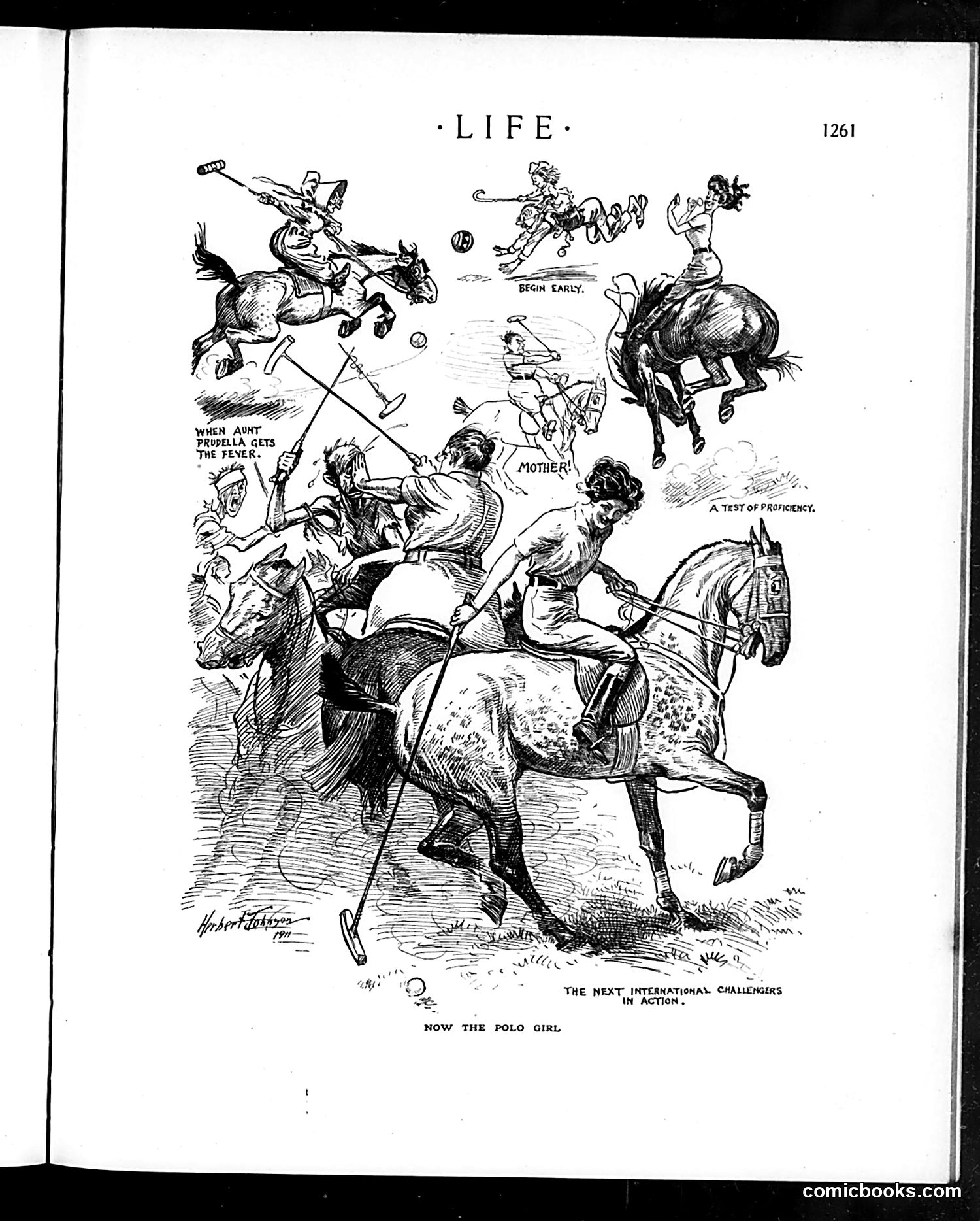
This page satirizes women's adoption of polo, a sport traditionally associated with wealthy men and international competition. The central illustration shows a woman on horseback attempting polo while chaos erupts around her—figures tumble from horses, equipment flies everywhere. The labeled vignettes mock specific scenarios: "When Aunt Prupella Gets the Fever" depicts an older woman's wild riding mishap; "Begin Early" shows aggressive training; "A Test of Proficiency" displays poor horsemanship; and "The Next International Challengers in Action" sarcastically suggests women could compete internationally. The cartoon ridicules women entering this elite male sport, emphasizing their supposed incompetence through exaggerated physical comedy. The title "The Polo Girl" treats the phenomenon as a social trend worthy of ridicule, reflecting early 20th-century anxieties about women's expanding athletic and social participation.
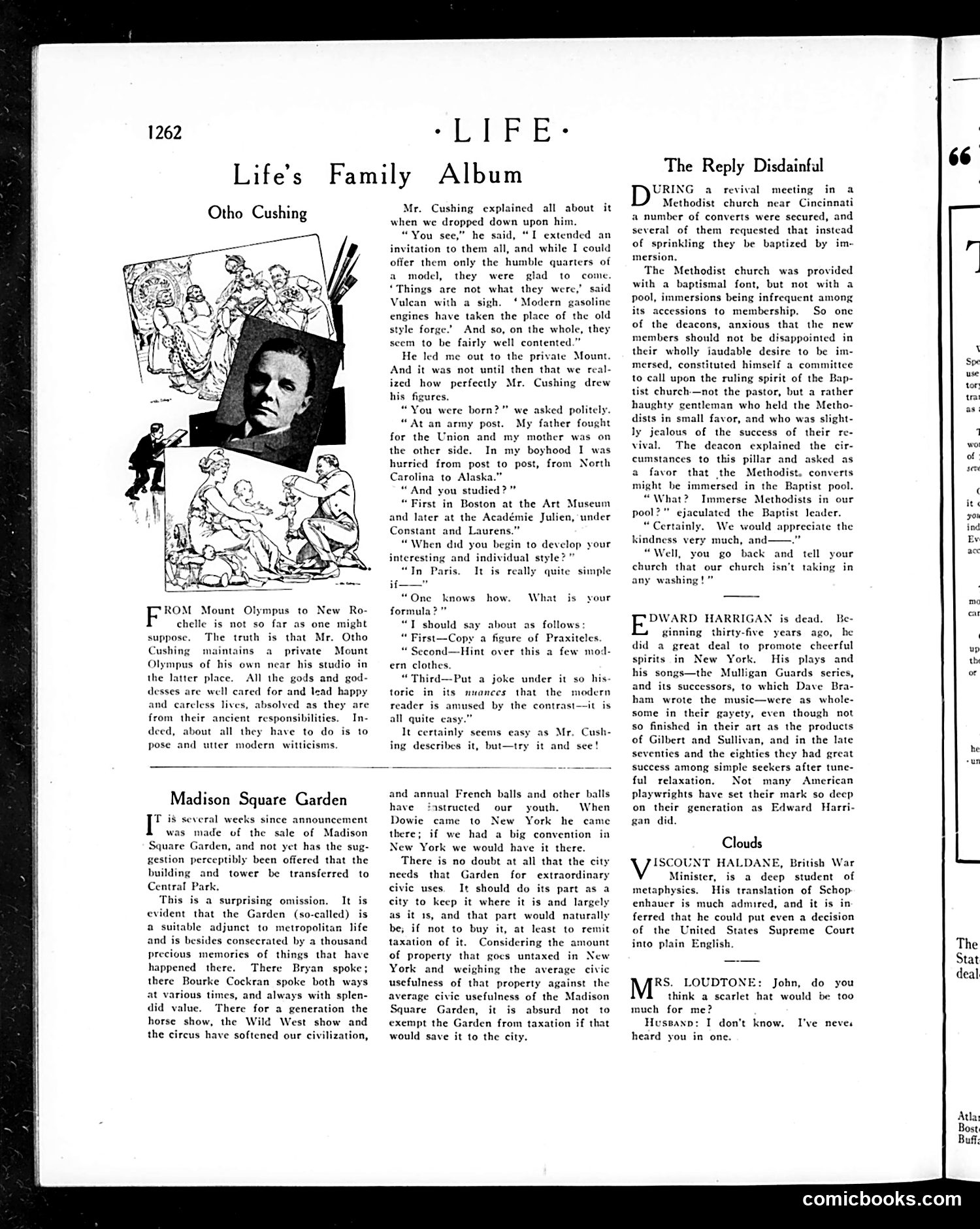
This page features two unrelated articles typical of Life's satirical content: **"Life's Family Album" (top):** Illustrates an interview with artist Otho Cushing, who maintains a private "Mount Olympus" sculpture studio near New Rochelle. The accompanying cartoon shows classical gods and goddesses posed in his studio. The satire plays on the contrast between lofty classical mythology and mundane modern life—Vulcan complains that "gasoline engines have taken the place of the old style forge." Cushing explains his artistic formula humorously: copy a classical Praxiteles figure, add modern clothes, and place it in a historically resonant context for ironic effect. **"Madison Square Garden" (bottom):** Advocates preserving Madison Square Garden by exempting it from taxation, arguing its civic and cultural importance (hosting Bryan's speeches, Bourke Cockran's oratory, horse shows, and circuses). The piece satirizes New York's neglect of historically significant public spaces. Both articles showcase Life's characteristic blend of cultural commentary and gentle mockery of American life circa 1910s.
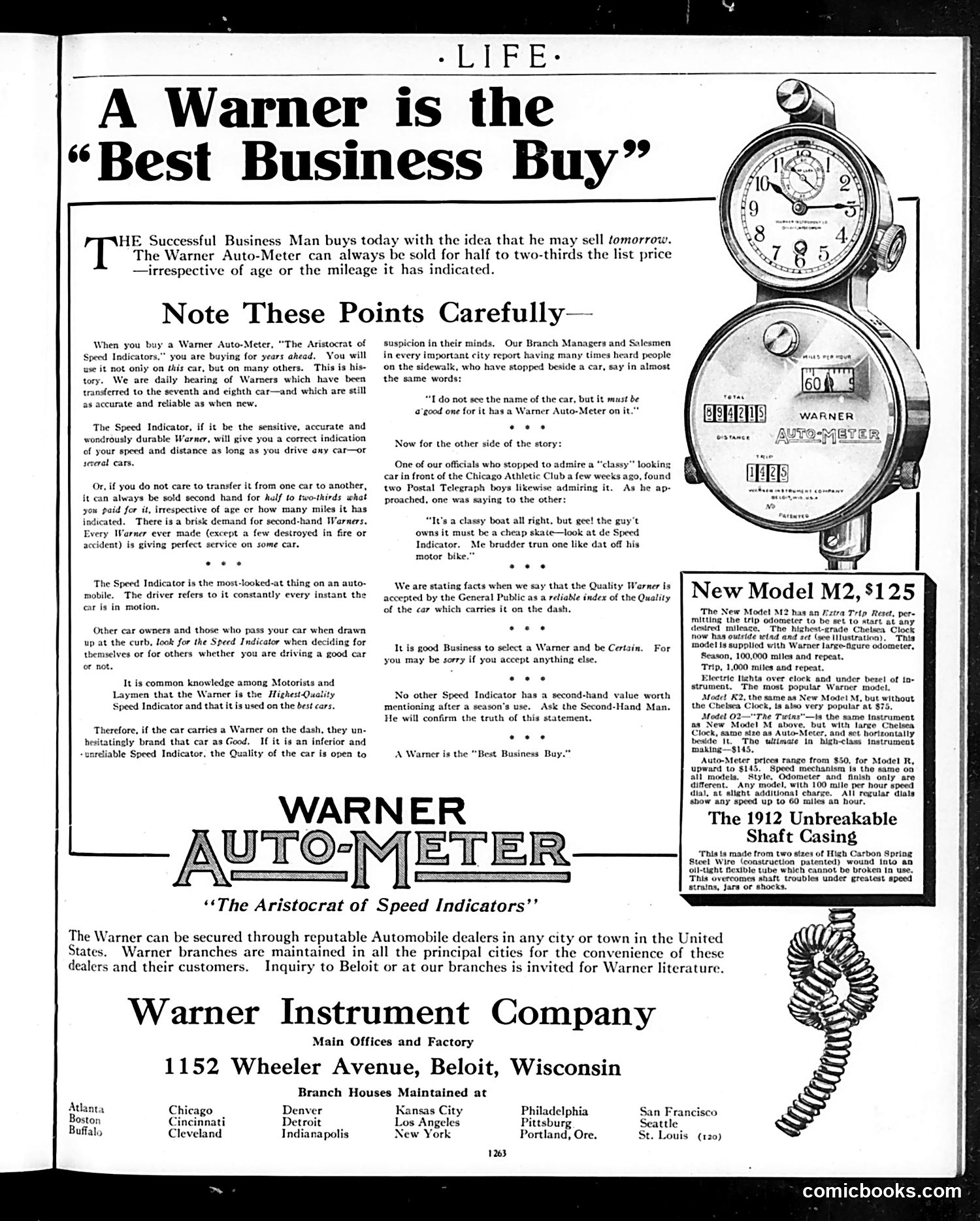
This is primarily a **product advertisement**, not political satire. The Warner Instrument Company promotes its speedometer (called a "Speed Indicator") as a reliable, prestigious car accessory. The page argues that a Warner speedometer is a sound business purchase because: it retains resale value (selling for "half to two-thirds" the original price), it transfers between vehicles, and—importantly—**it signals car quality to observers**. The ad claims that passersby judge a vehicle's worth by whether it has a Warner gauge. A brief anecdote satirizes this logic: two working-class men admiring an expensive car conclude the owner is "a cheap skate" because the speedometer appears inferior—revealing how deeply consumers associated this brand with status. The humor lies in showing that a simple instrument became a **class marker**—owning a Warner indicated wealth and good judgment, while lacking one invited social judgment. This reflects early 1900s consumer culture anxiety about visible status symbols.
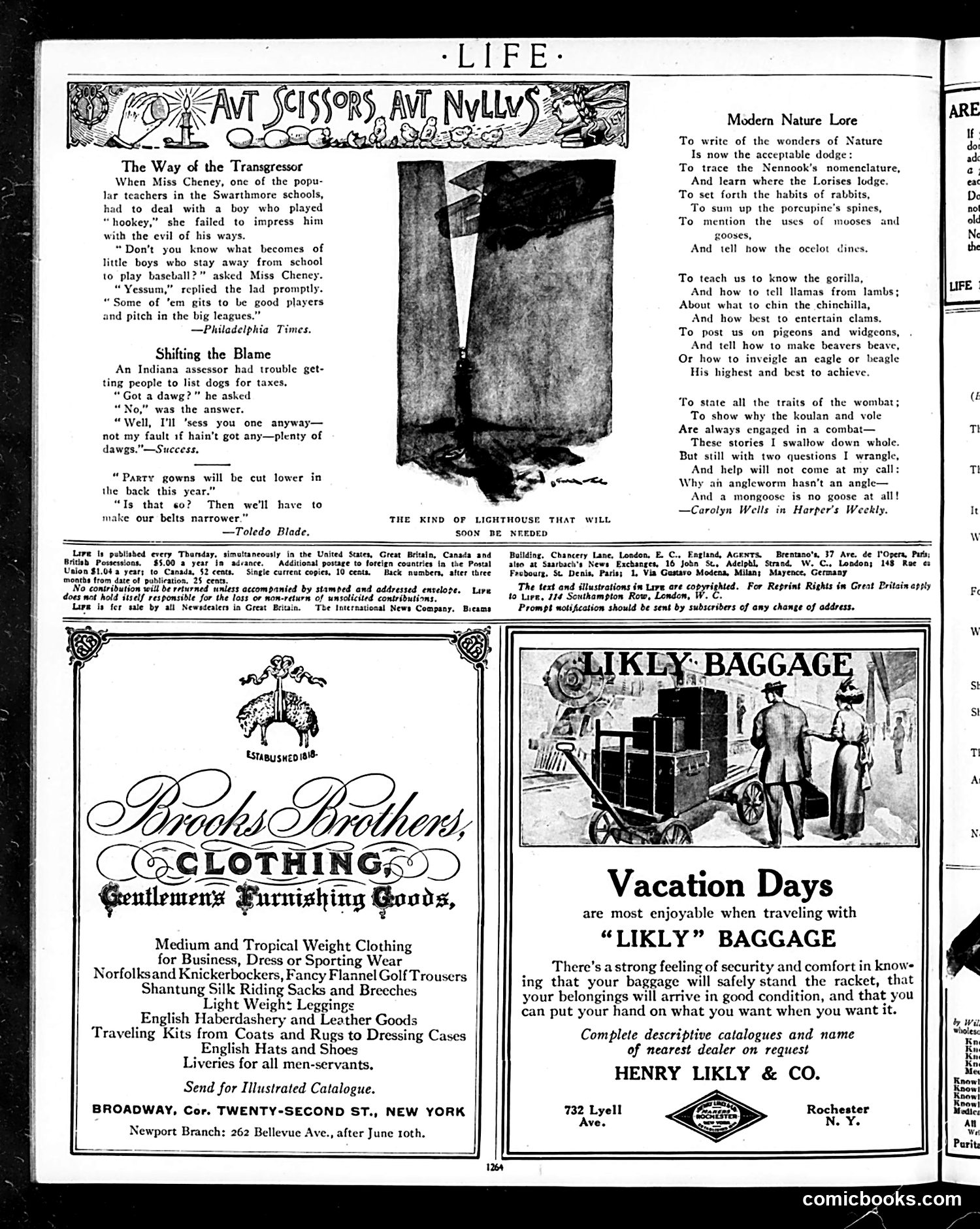
This page contains three humor pieces and period advertisements. The main content includes: **"The Way of the Transgressor"**: A joke about a teacher trying to discourage truancy by warning a boy that dropouts fare poorly—he responds that some become successful baseball players, subverting her moral lesson. **"Shifting the Blame"**: A tax assessor, unable to get residents to register their dogs, tells one man he'll assess him for a dog anyway since "it hain't got any—plenty of dawgs," humorously dodging responsibility. **"Modern Nature Lore"** (Carolyn Wells poem): Satirizes the contemporary trend of nature-writing books cataloging exotic animals and their habits. The speaker accepts all these elaborate facts but remains baffled by two simple questions: why an angleworm lacks angles, and why a mongoose isn't a goose—poking fun at overwrought nature literature versus basic logic. **The lighthouse cartoon**: Unclear without fuller context, but likely comments on maritime safety developments. The advertisements feature Brooks Brothers clothing and Likly Baggage, typical period commercial content.
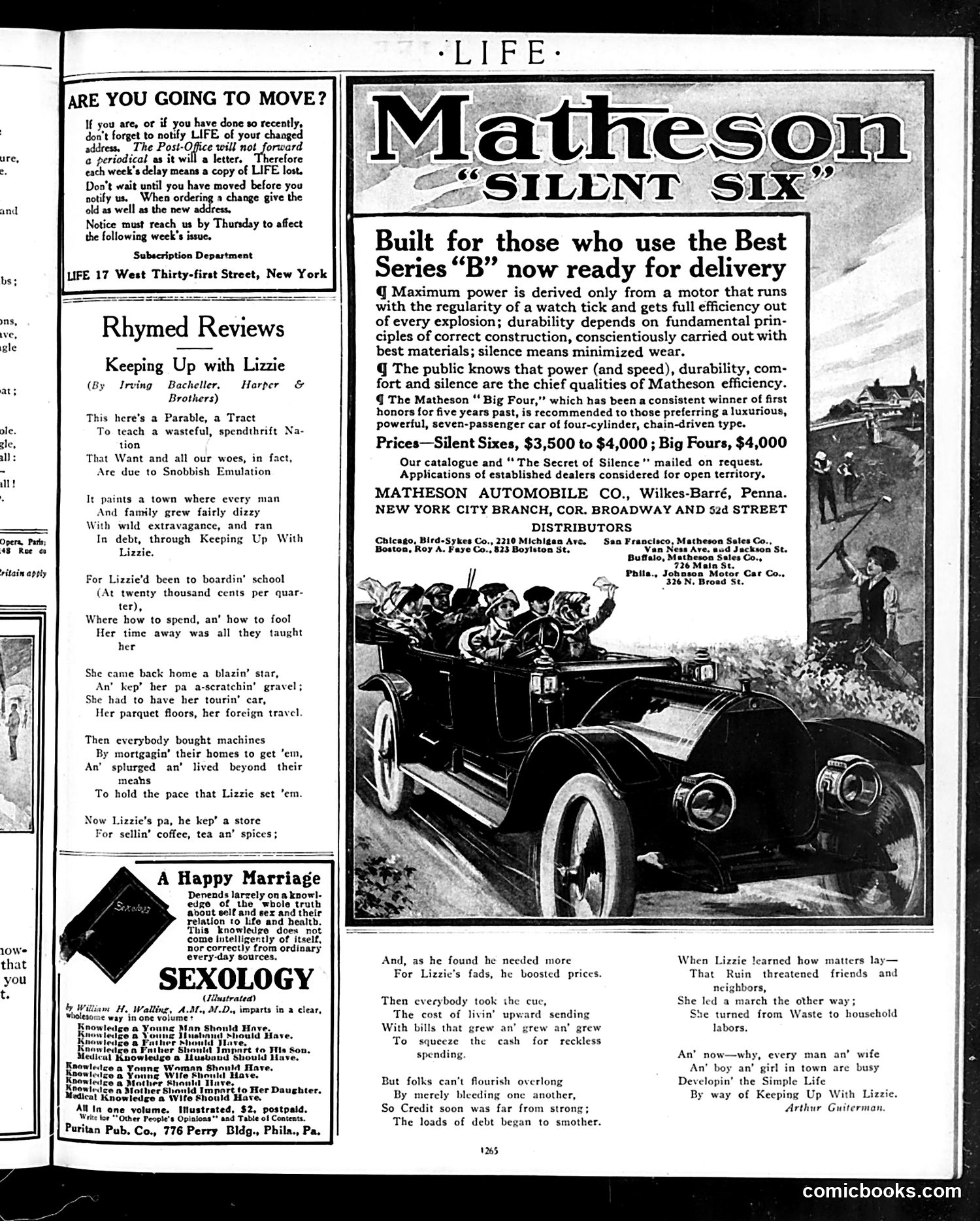
This page features a satirical poem by Irving Bacheller about American consumer culture and debt. The narrative warns against "Snobbish Emulation"—the social pressure to match neighbors' spending. The story follows a town where a wealthy girl named Lizzie returns from boarding school with extravagant tastes: a touring car, parquet floors, foreign travel. Her conspicuous consumption triggers a cascade of competitive spending among townspeople who mortgage their homes to keep pace. When her father, a coffee merchant, raises prices to fund her lifestyle, the rising cost of living spirals, ultimately forcing Lizzie to learn restraint and redirect her energy toward "household labors." The satire targets early 20th-century American materialism—the cultural obsession with status symbols and the financial ruin that results from trying to match wealthier neighbors' consumption. The poem suggests that unchecked desire for luxury and social standing creates economic harm for entire communities.
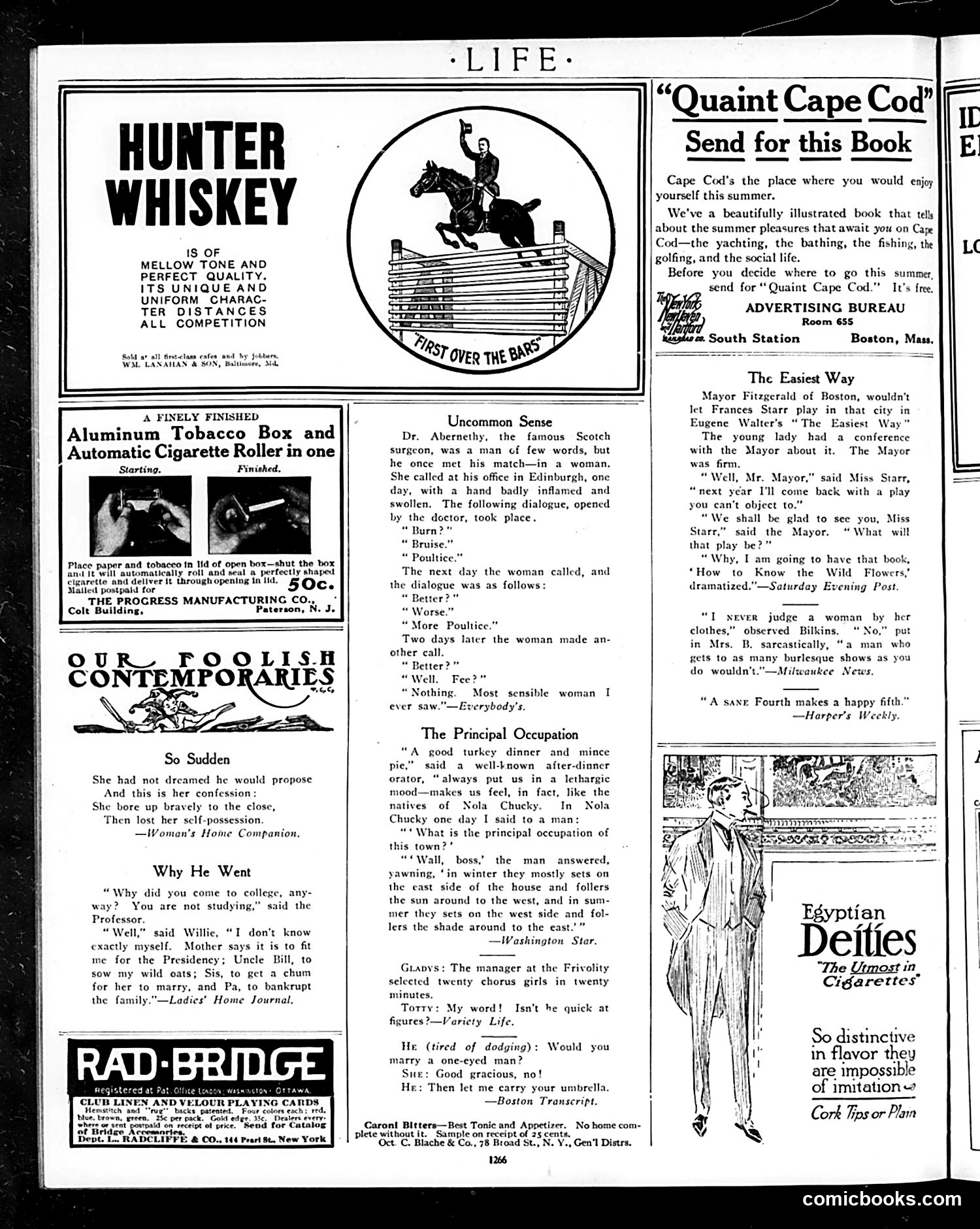
This Life magazine page is primarily **advertisements and humorous anecdotes** rather than political cartoons. The main satirical content includes: **"Why He Went"**: A joke about a college student whose family has conflicting reasons for sending him to university—his mother wants him prepared for the Presidency, his uncle wants him to "sow wild oats," his sister wants a potential brother-in-law, and his father expects bankruptcy. It mocks both parental expectations and the student's apparent lack of genuine academic purpose. **"The Easiest Way" anecdote**: References Mayor Fitzgerald of Boston's censorship of a play he deemed morally objectionable. Frances Starr's witty rejoinder—that she'll return with "How to Know the Wild Flowers" dramatized—satirizes the Mayor's prudishness by suggesting only innocent educational content would pass his moral standards. **"The Principal Occupation"**: A humorous tall tale mocking Southern lethargy, depicting townspeople who merely follow the sun's position rather than work. The remaining content consists of period advertisements for whiskey, tobacco products, playing cards, and travel guides—typical of early 1900s magazine publishing.
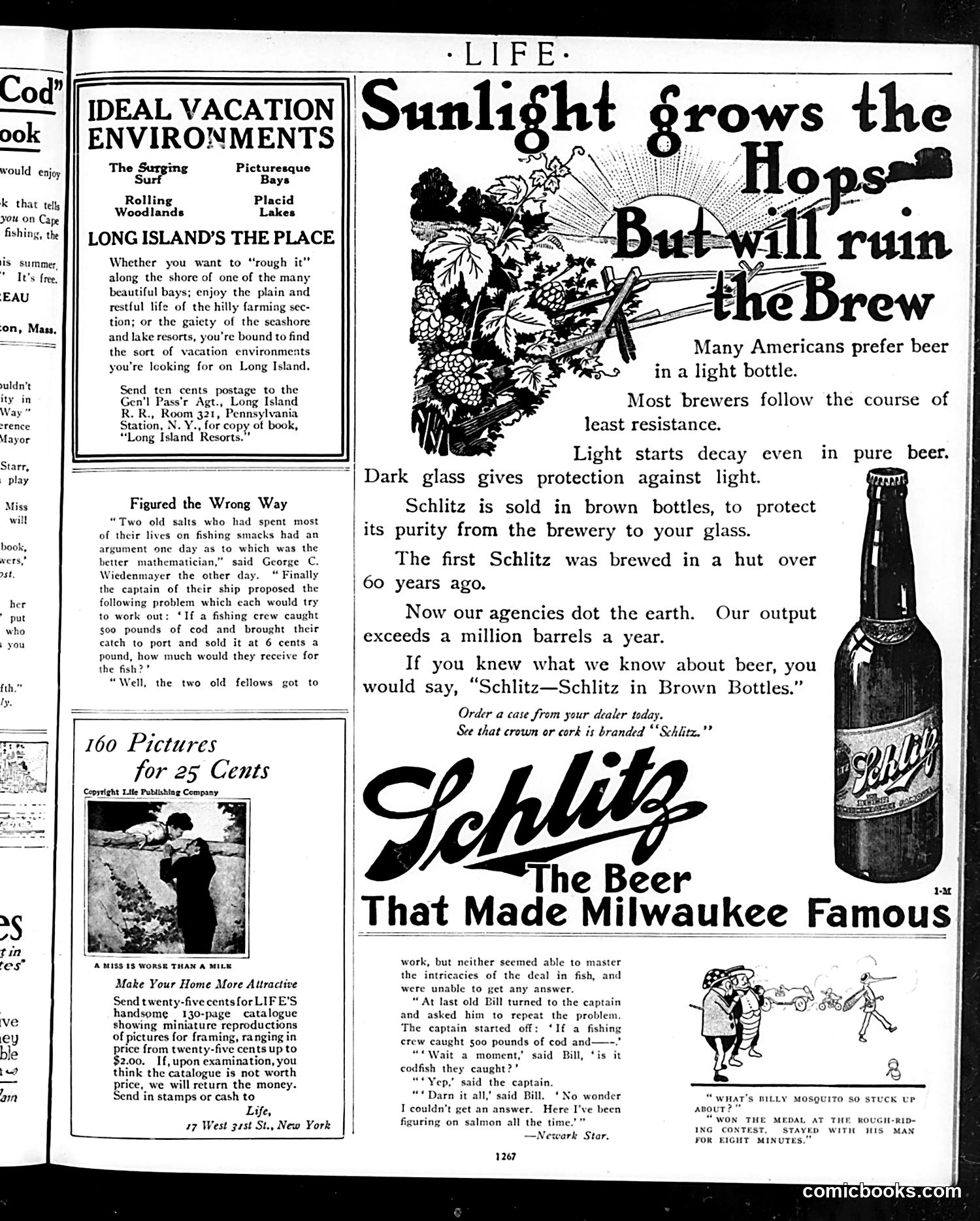
This page contains **advertising and humor content**, not political satire. **Main Advertisement:** Schlitz Beer dominates the right side, emphasizing that brown bottles protect beer from light decay. The ad claims Schlitz has been brewed for 60 years and now produces over a million barrels annually. **Humor Content:** The left side features two jokes: 1. **"Figured the Wrong Way"** — A math problem joke about two fishermen who miscalculate earnings from selling cod. The punchline: one fisherman was "figuring on salmon" instead, explaining his inability to solve the problem. It's a straightforward wordplay joke. 2. **"What's Billy Mosquito So Stuck Up About?"** — A cartoon joke where a mosquito won a "rough-riding contest" by staying on a man for eight minutes. It's a visual pun playing on the term "rough-riding." The page also advertises Long Island vacation destinations and a Life magazine picture catalog (160 pictures for 25 cents). No political commentary or social critique is present.
This satirical essay mocks health reformers and their prescriptive lifestyle advice. The author sarcastically celebrates the vision of perfect uniformity where everyone follows one man's dietary and behavioral regimen—eating only bran, dried apples, and filtered water while exercising, sleeping, and working on identical schedules. The satire targets the earnest self-help culture of the era, where reformers promised health and moral improvement through rigid rules. The author ridicules this by describing an absurdly regimented life where even "hilarity" with dried apples becomes mandatory, and people must avoid laughing at dinner to keep calm. The underlying joke: such one-size-fits-all prescriptions for living deny human individuality and natural variation. The piece advocates for accepting diverse ways of living rather than imposing standardized perfection—a critique of the era's proliferating health and self-improvement gurus.
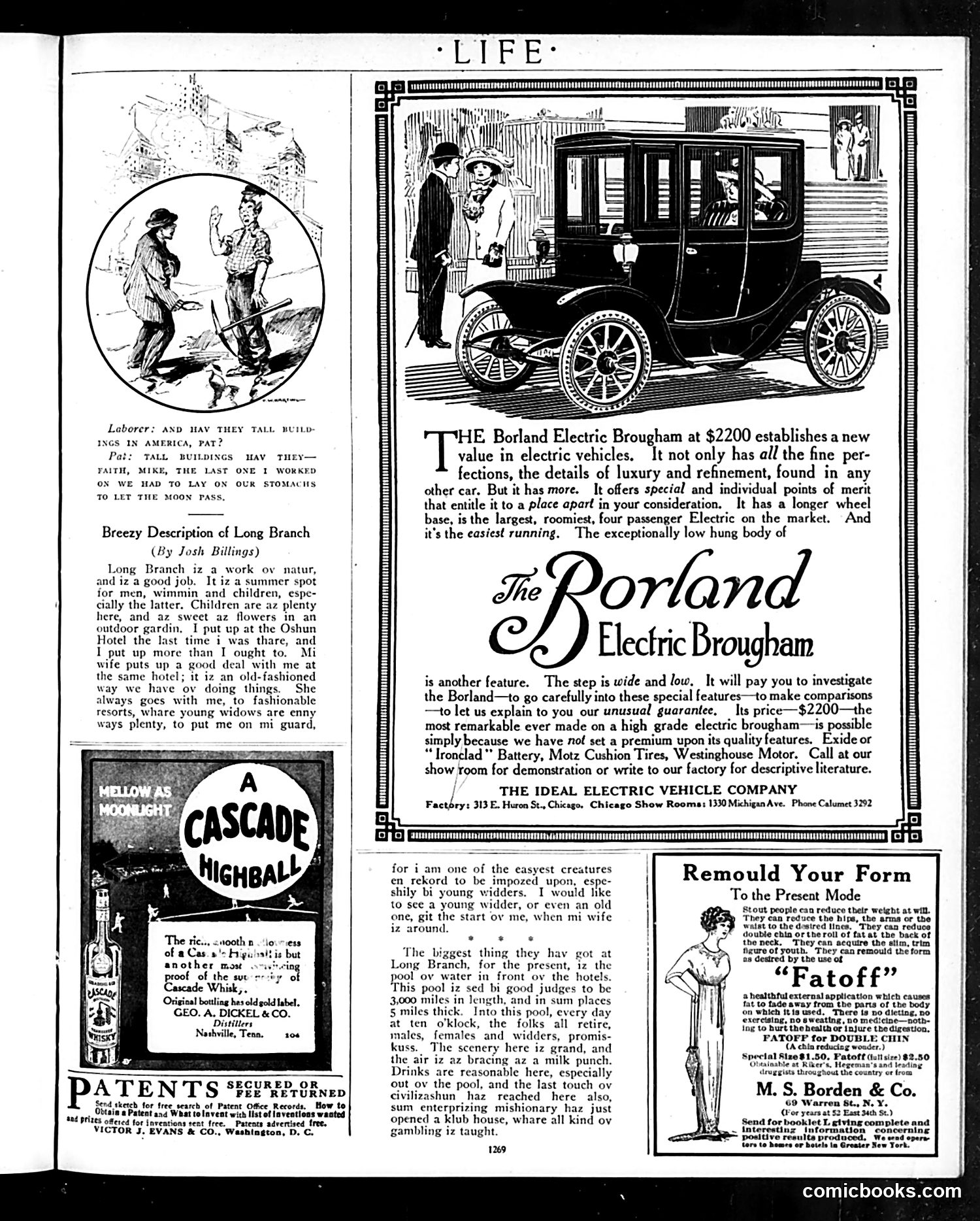
This page combines satirical commentary with early 1900s advertising. **Top Left Cartoon:** Two Irish laborers ("Laborer" and "Pat") joke about American skyscrapers being so tall they must lie flat to let the moon pass overhead. This satirizes the rapid, competitive growth of tall buildings in American cities—presenting the construction boom as absurdly excessive. **Josh Billings Essay:** A humorous, phonetically-written description of Long Branch (a New Jersey resort) by the popular 19th-century humorist. It mocks upper-class leisure culture, exaggerating the pool's size to 3,000 miles and poking fun at wealthy vacationers, young widows, and newly available gambling establishments. The dialect humor was typical of period comedy. **Advertisements:** The page includes ads for a Borland Electric Brougham automobile ($2,200), whiskey, patents, and a weight-reduction product ("Fatoff"). These reflect consumer goods marketed to the magazine's affluent readers—automobiles being a luxury novelty at this time.
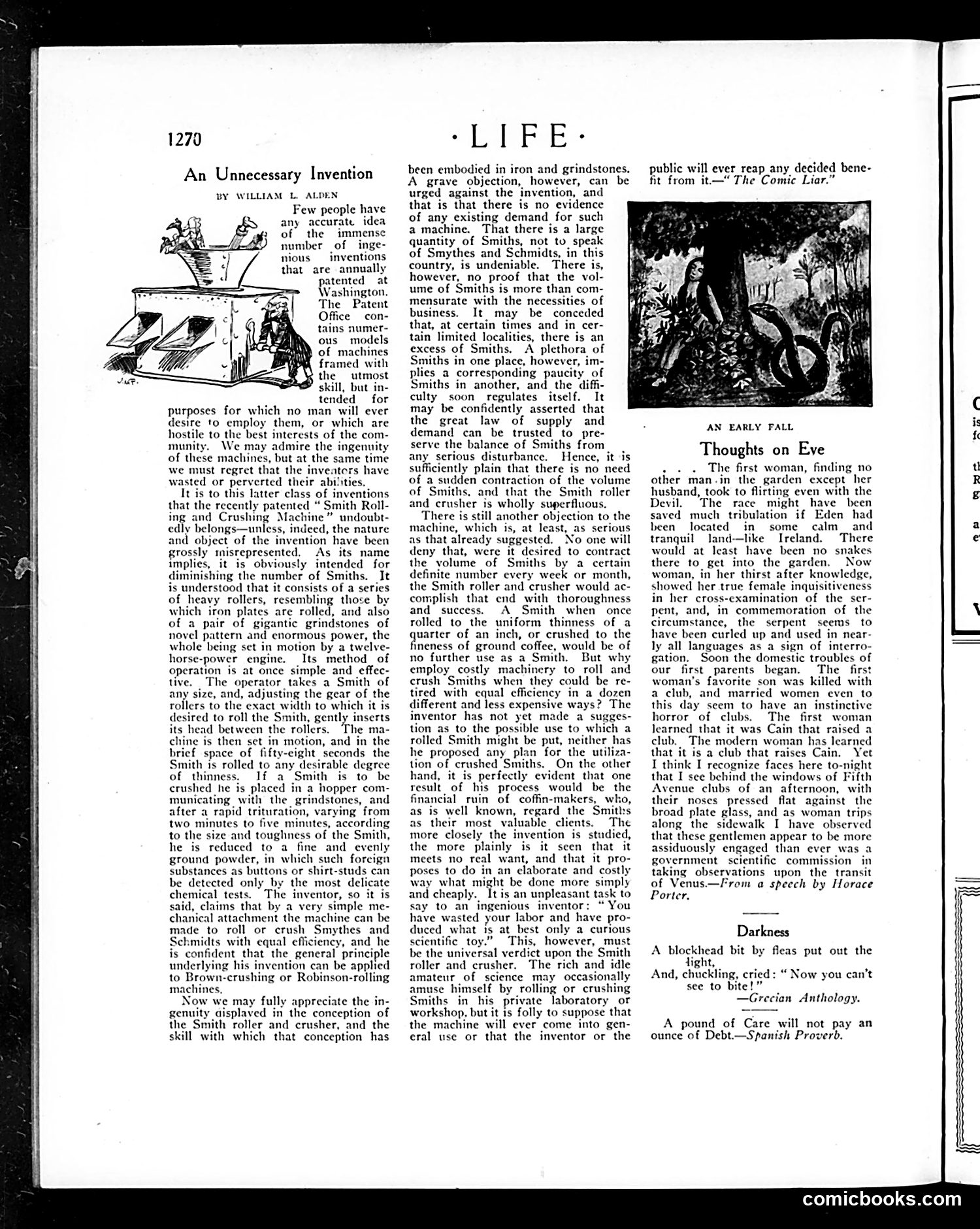
This is a humorous satire by William L. Alden mocking both frivolous patent applications and surname-based prejudice. The elaborate illustration depicts an absurd contraption—a "Smith Rolling and Crushing Machine"—designed to literally flatten or grind up people with the surname Smith (and similar names like Smythe, Schmidt). The joke operates on multiple levels: it ridicules the Patent Office for approving impractical inventions, while simultaneously lampooning ethnic or class-based discrimination disguised as economic concern. The author argues (tongue-in-cheek) that there's no actual "demand" to eliminate Smiths, and that natural market forces regulate their population adequately. The satire targets contemporary attitudes about immigration and foreign surnames, suggesting that prejudice against certain ethnic groups—identifiable by names—was being justified through pseudo-rational arguments about labor surplus. By presenting Smith-elimination as absurd, Alden implicitly critiques the discrimination underlying such reasoning. The piece exemplifies *Life* magazine's satirical style: exaggerated mechanical drawings paired with deadpan logical arguments to expose social prejudices.
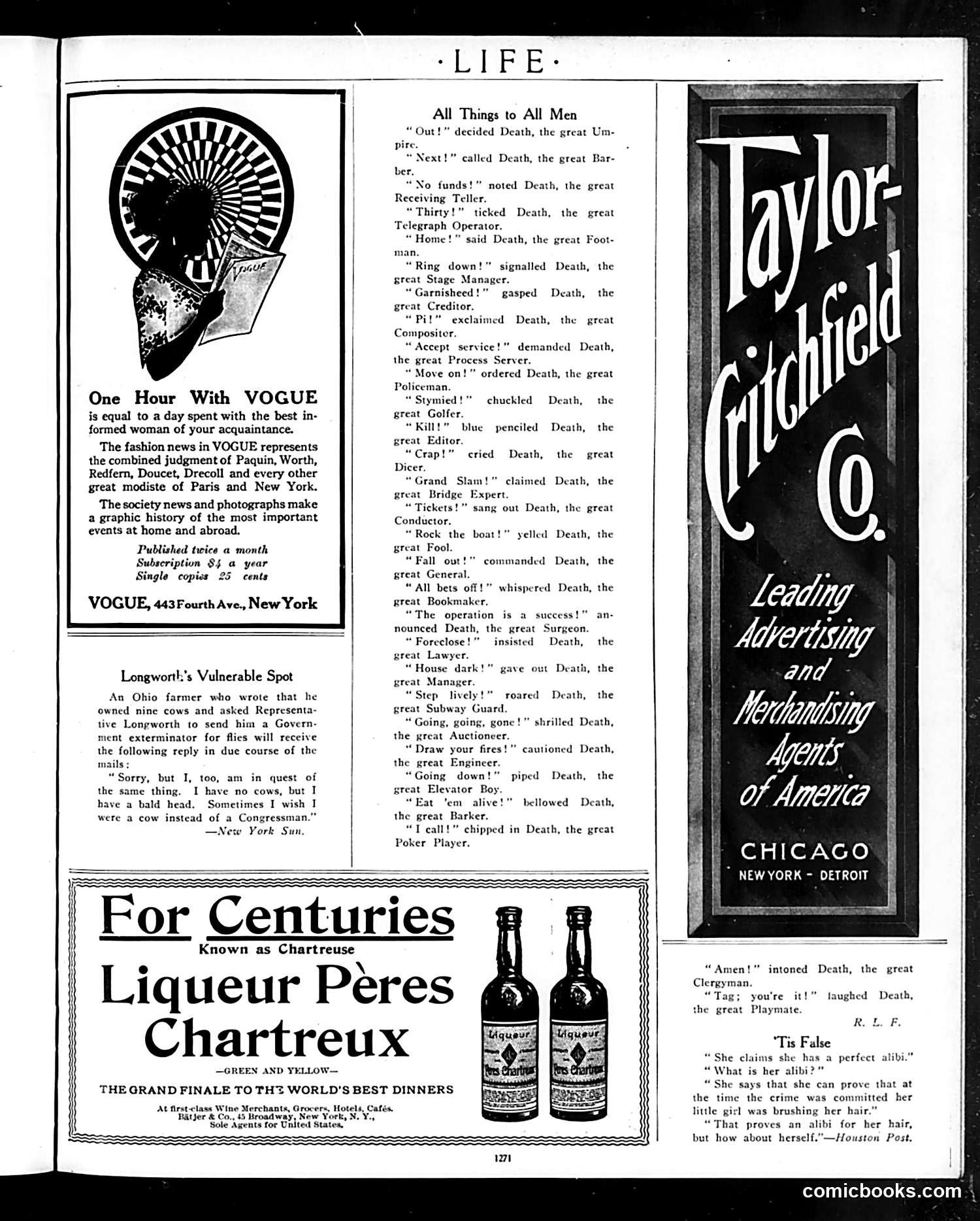
The centerpiece is a satirical poem titled "All Things to All Men," personifying Death as speaking in the professional jargon of various occupations—an umpire calling "Out!", a barber saying "Next!", a banker declaring "No funds!", a telegraph operator ticking "Thirty!", and so on through dozens of professions (lawyer, surgeon, conductor, elevator boy, etc.). The satire's point: Death is the ultimate leveler, the one universal experience cutting across all social classes and professions. Each line plays on how Death uses the characteristic language of that profession, making the concept both darkly comic and philosophically pointed—no matter your job or status, Death will eventually "call" you in your own professional vocabulary. The page also includes advertisements (Vogue magazine, liqueur) and a brief anecdote mocking Representative Longworth for claiming to lack resources while being in Congress. The overall tone is typical of Life magazine's early 20th-century satirical style: witty, socially observant, and gently darkly humorous about mortality and human pretense.
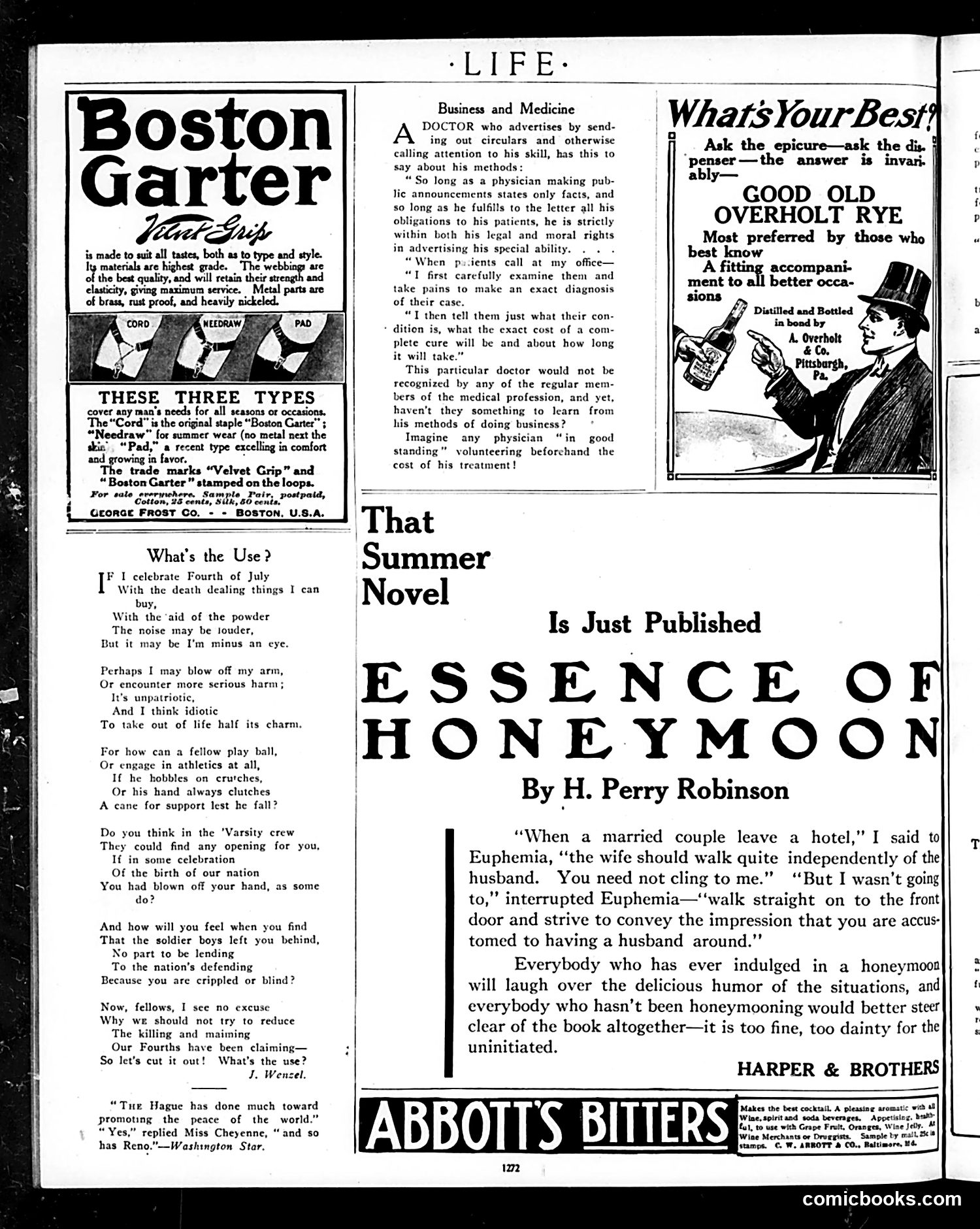
This page from Life magazine (undated but early 20th century) mixes advertisements with social commentary typical of the publication's satirical approach. **"What's the Use?"** is a cautionary poem by J. Wenzel about Fourth of July fireworks safety. It warns young men against celebrating Independence Day with dangerous explosives, arguing that losing limbs or eyesight serves neither personal nor national interest—soldiers need able-bodied men, and disabled workers cannot contribute to society. This reflects genuine public health concerns about holiday injuries. **The "Business and Medicine" section** satirizes a doctor who advertises his services and offers upfront cost estimates. The passage suggests this transparency, while ethically sound, violates medical profession norms against self-promotion. The satire questions why doctors won't adopt honest business practices. **The remaining content is advertising**: Boston Garter stockings, Overholt Rye whiskey, Abbott's Bitters, and a book advertisement for *Essence of Honeymoon*. The page reflects early-1900s American attitudes: safety concerns about holiday celebrations, professional anxieties about commercialism in medicine, and gendered assumptions about courtship and domesticity.
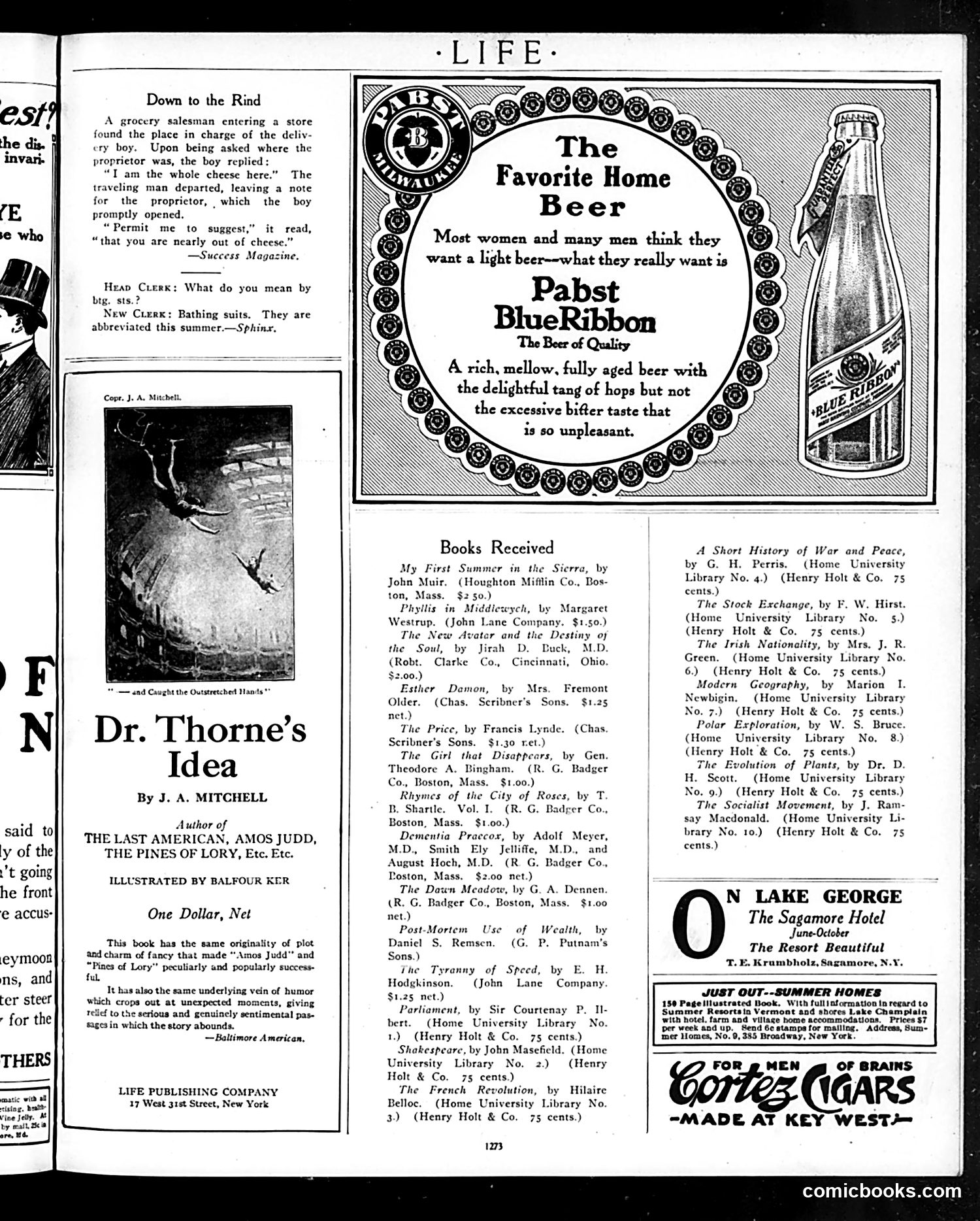
This page is primarily **advertising and book reviews** with minimal satirical content. The two brief jokes ("Down to the Rind" and the Head Clerk/New Clerk exchange) are simple wordplay with no political significance—just light humor about a delivery boy's overconfidence and abbreviated bathing suits. The dominant feature is a **Pabst Blue Ribbon beer advertisement** claiming the beer is "The Favorite Home Beer," emphasizing its "rich, mellow" quality without excessive bitterness. This reflects early 1900s beer marketing before Prohibition. The page includes a book advertisement for "Dr. Thorne's Idea" by J.A. Mitchell and an extensive "Books Received" section listing newly published works on topics like nature writing, psychology, history, and politics—typical of Life's literary coverage during this era. Additional ads promote the Sagamore Hotel on Lake George and Cortez Cigars. **No significant political cartoons or social satire appear on this page.**
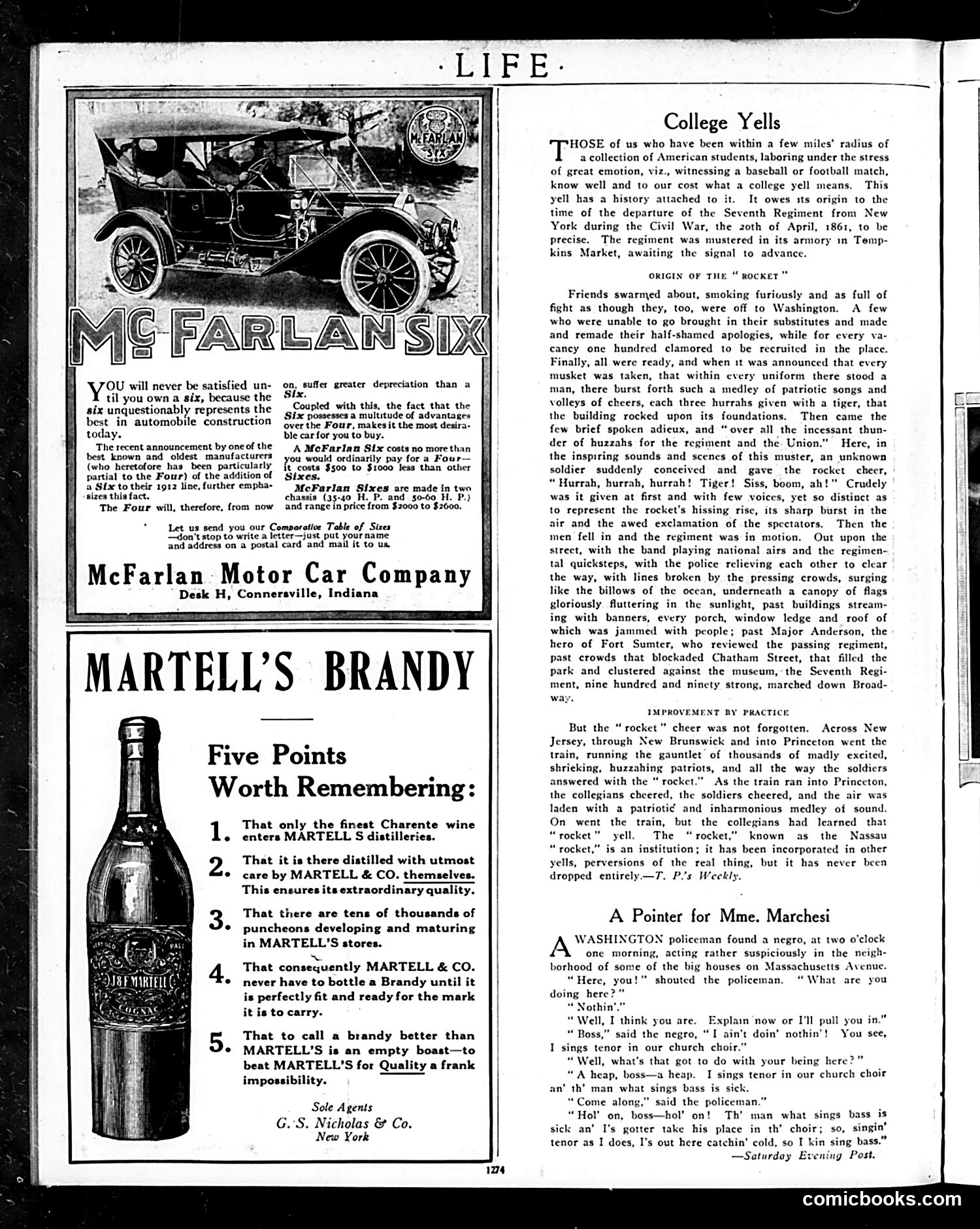
This article explains the origin of the "rocket" college cheer—a specific style of enthusiastic yelling performed at American sporting events and military gatherings. The piece traces the cheer's invention to April 20, 1861, when New York's Seventh Regiment departed for Washington during the Civil War. As the uniformed soldiers marched through the streets, an unknown soldier spontaneously created the distinctive three-part cheer: "Hurrah, hurrah, hurrah! Tiger! Siss, boom, ah!"—mimicking a rocket's ascent, explosion, and descent. The article notes this invention spread through subsequent years, adopted by college students and adapted across institutions. For modern readers, this illustrates how organized college athletic traditions (like school yells and cheers) originated in 19th-century America and became institutionalized, linking patriotic military fervor with campus culture. The "rocket" specifically represented the coordinated vocal expressions that became essential to American collegiate identity.
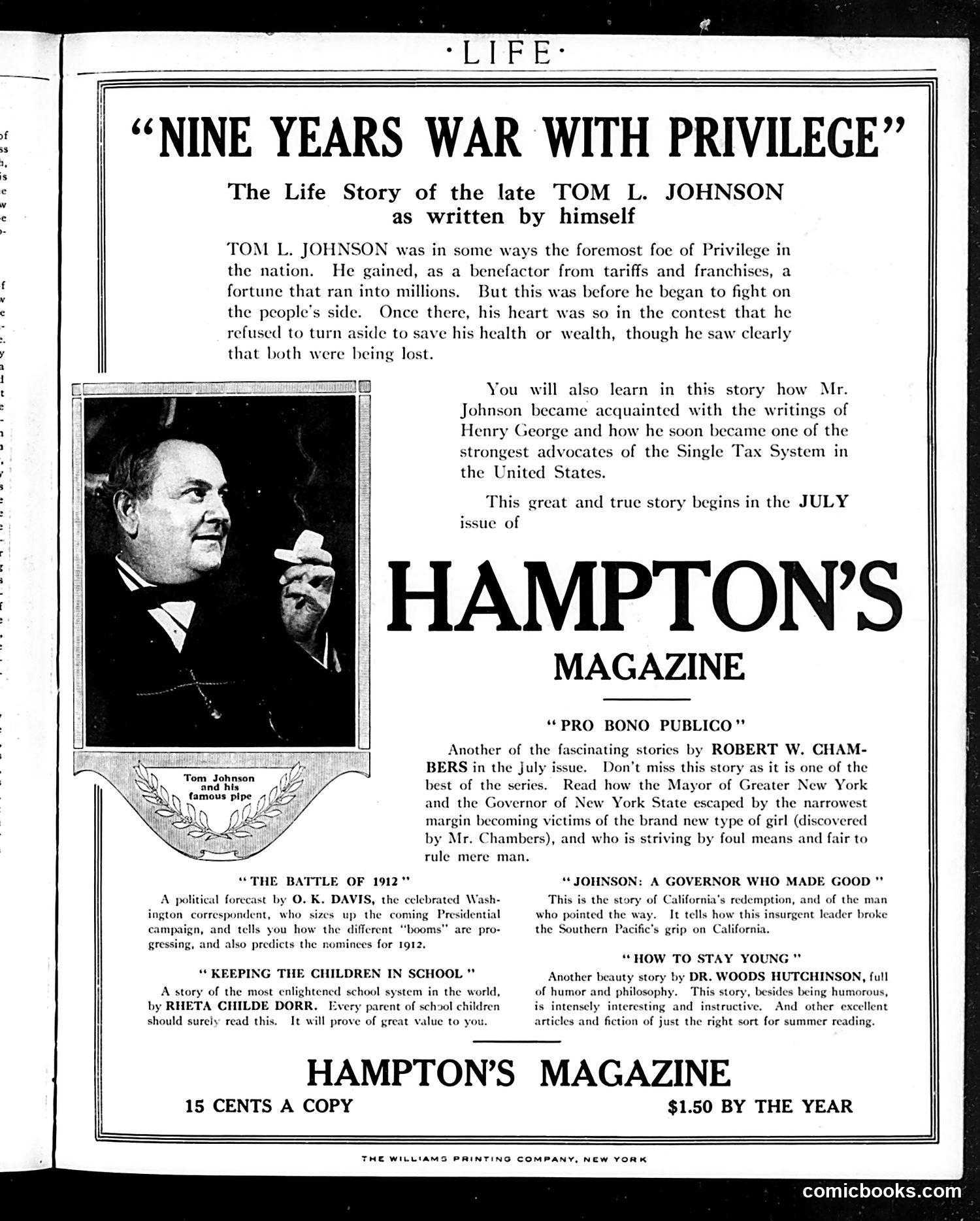
This is primarily a magazine advertisement announcing serialized content about **Tom L. Johnson**, a wealthy industrialist-turned-reformer who fought against monopolistic "privilege" (tariffs, franchises, corporate power). The portrait shows Johnson himself. The page promotes several articles in Hampton's Magazine's July issue, including: - Johnson's autobiography, emphasizing his conversion from beneficiary of privilege to crusader for the people - His advocacy for Henry George's **Single Tax System** (a progressive tax reform) - Stories about corrupt politicians and a corporate monopoly (likely the Southern Pacific Railroad in California) - Articles on education and staying young The underlying message: Johnson represents an idealized wealthy man who renounced profit to fight economic inequality and corporate corruption—a Progressive Era narrative appealing to reform-minded readers circa 1912. The advertisement positions Hampton's as a serious vehicle for muckraking journalism and social criticism, not mere entertainment.
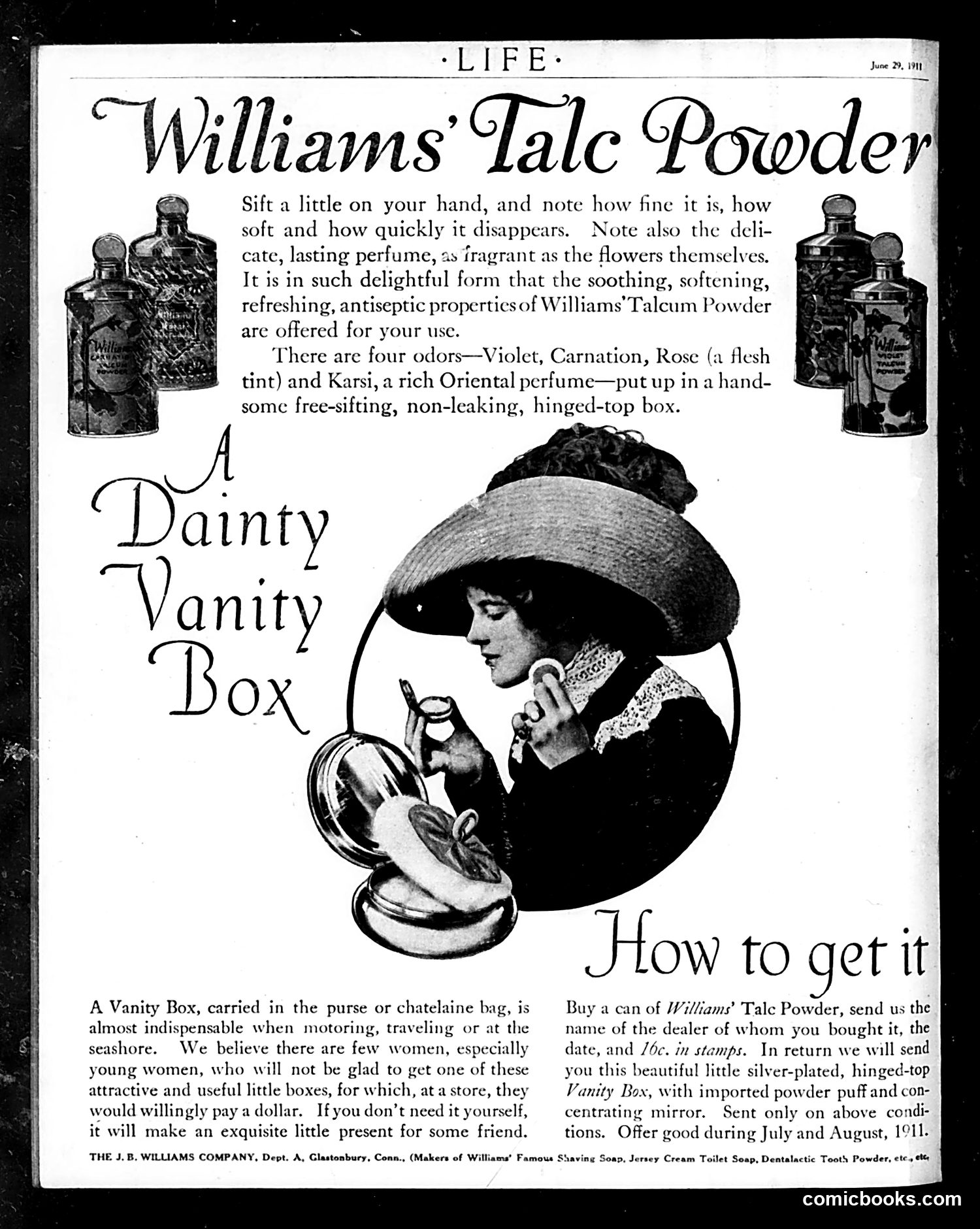
This is **not a cartoon or satire**, but rather a straightforward product advertisement from Life magazine (June 29, 1911). The page promotes Williams' Talc Powder with an illustration of a fashionably dressed woman in a large hat, applying powder. The ad emphasizes the product's fineness, softness, and four available scents (Violet, Carnation, Rose, Karsi). The promotional hook is a "Dainty Vanity Box"—a silver-plated, hinged-top compact with mirror and puff. Women could obtain it free by purchasing Williams' powder, providing proof of purchase, and sending 16 cents in stamps. The offer ran July-August 1911. The ad targets young women, emphasizing portability for travel and motoring—positioning the vanity box as both practical and a potential gift. This reflects early 20th-century marketing toward expanding female consumer culture and mobility.
I can see this is a page from *Life* magazine (dated June 29, 1911 based on the header), but the image quality is extremely poor—mostly black with minimal visible detail. The left margin shows partial text fragments and what appears to be a bottle illustration, but the main content of the page is not legible enough to identify specific cartoons, caricatures, or satirical subjects with confidence. To properly explain the political or social satire for a modern reader, I would need a clearer image where the cartoon artwork and accompanying text are actually readable. I cannot responsibly identify figures or explain references when I cannot see them clearly.