
Life, 1911-06-29 · page 42 of 45
Life — June 29, 1911 — page 42: what you’re looking at
What you’re looking at
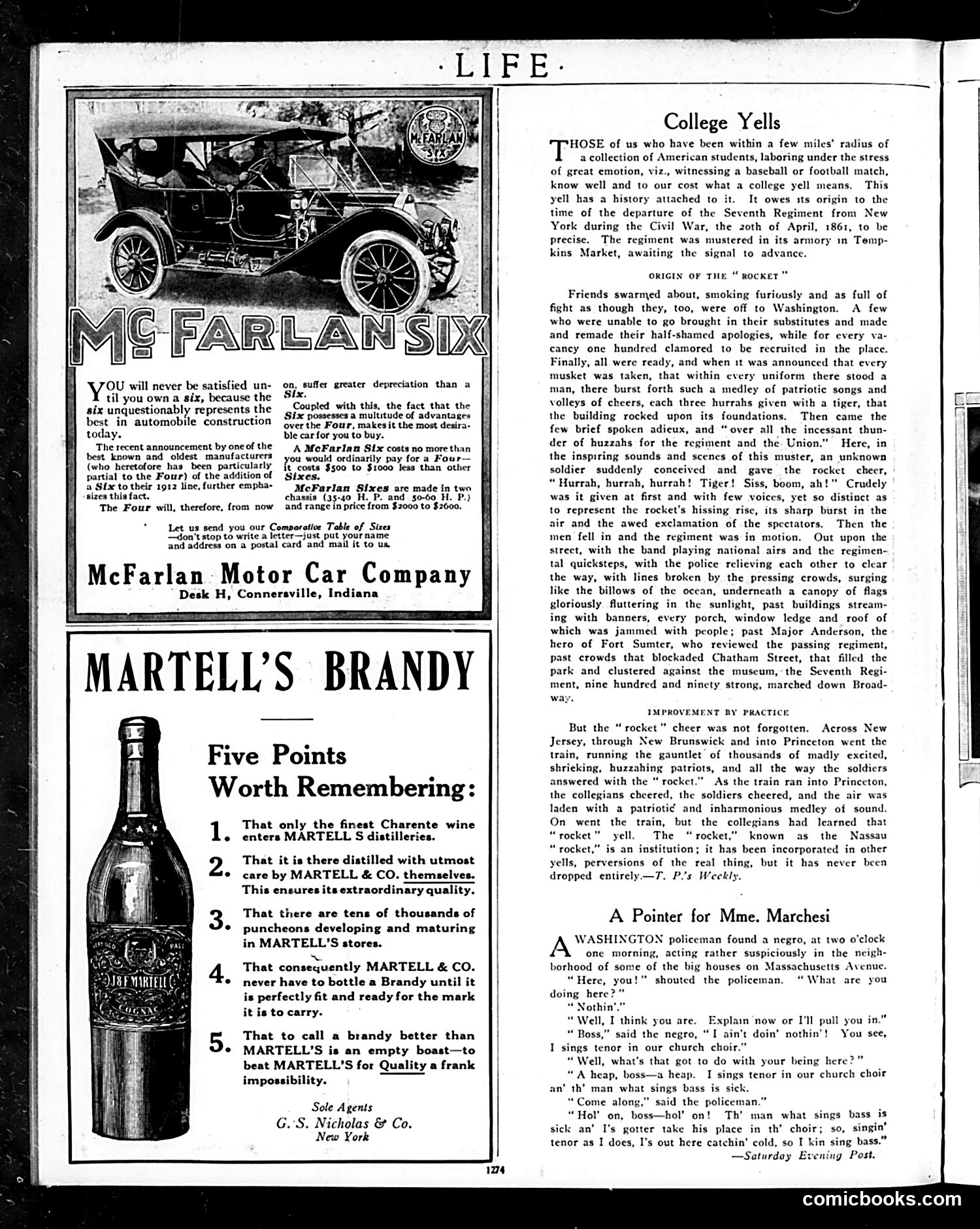
This article explains the origin of the "rocket" college cheer—a specific style of enthusiastic yelling performed at American sporting events and military gatherings. The piece traces the cheer's invention to April 20, 1861, when New York's Seventh Regiment departed for Washington during the Civil War. As the uniformed soldiers marched through the streets, an unknown soldier spontaneously created the distinctive three-part cheer: "Hurrah, hurrah, hurrah! Tiger! Siss, boom, ah!"—mimicking a rocket's ascent, explosion, and descent. The article notes this invention spread through subsequent years, adopted by college students and adapted across institutions. For modern readers, this illustrates how organized college athletic traditions (like school yells and cheers) originated in 19th-century America and became institutionalized, linking patriotic military fervor with campus culture. The "rocket" specifically represented the coordinated vocal expressions that became essential to American collegiate identity.
📄 Transcribed text from this page (OCR, searchable)
Machine-transcribed from the original scan — historical spelling and the odd misread are preserved.
College Yells HOSE of us who have been within a few miles’ radius of a collection of American students, laboring under the stress of great emotion, viz., witnessing a baseball or football match, know well and to our cost what a college yell means. This yell has a history attached to it. It owes its origin to the time of the departure of the Seventh Regiment from New York during the Civil War, the 2oth of April, 1861, to be precise. The regiment was mustered in its armory in Temp- kins Market, awaiting the signal to advance. ORIGIN OF THE “ ROCKET” Friends swarmed about, smoking furiously and as full of fight as though they, too, were off to Washington. A few who were unable to go brought in their substitutes and made and remade their half-shamed apologies, while for every va- cancy one hundred clamored to be recruited in the place. Finally, all were ready, and when it was announced that every — musket was taken, that within every uniform there stood a ‘OU will never be satisfied un- oe suffer greater depreciation than a man, there burst forth such a medley of patriotic songs and til you own a six, because the SC os sin nis, the fact that the volleys of cheers, each three hurrahs given with a tiger, that six unquestionably represents the FOUTS aice.a multitude of advantages the building rocked upon its foundations. Then came the best in automobile construction Qvyerthe Four, makes it the most desira- ei i 0 : today. ble car for you to buy, few brief spoken adieux, and “over all the incessant thun- ‘The recent announcement by oneof the A MeFarlan Six costs no morethan der of huzzahs for the regiment and the Union.” Here, in best known and oldest. manufacturers you would ordinarily pay fora Four the inspiring sounds and scenes of this muster, an unknown (who heretofore has been particularly Fe costa $500 to $1000 less than other [iI soldier suddenly conceived and gave the rocket cheer, partial to the Four) of the additionof Sixes. Bs , : . 2 Six to their 1912 line, further empha- yfeFarlan Sixes are made in two Hurrah, hurrah, hurrah! Tiger! Siss, boom, ah!” Crudely sizes this fact. chassis (35-40 H. P. and so0-60 H. P.) was it given at first and with few voices, yet so distinct as The Four will, therefore, from now and rangein price from $2000 to $2600, to represent the rocket’s hissing rise, its sharp burst in the * Let us send you our Comporative Table of Sixes air and the awed exclamation of the spectators. Then the —don't stop to write a letter—just put your name : men fell in and the regiment was in motion. Out upon the street, with the band playing national airs and the regimen- tal quicksteps, with the police relieving each other to clear McFarlan Motor Car Company the way, with lines broken by the pressing crowds, surging and address on a postal card and mail it to us Desk H, Connersville, Indiana like the billows of the ocean, underneath a canopy of flags gloriously fluttering in the sunlight, past buildings stream- ing with banners, every porch, window ledge and roof of which was jammed with people; past Major Anderson, the hero of Fort Sumter, who reviewed the passing regiment, past crowds that blockaded Chatham Street, that filled the park and clustered against the museum, the Seventh Regi- ment, nine hundred and ninety strong, marched down Broad- w IMPROVEMENT BY PRACTICE But the “rocket” cheer was not forgotten. Across New . . Jersey, through New Brunswick and into Princeton went the Five Points train, running the gauntlet’ of thousands of madly excited, shrieking, huzzahing patriots, and all the way the soldiers LS answered with the “ rocket.” As the train ran into Princeton, Worth Remembering : the collegians cheered, the soldiers cheered, and the air was laden with a patrioti¢ and inharmonious medley of sound. ‘That-only:the finest’ Charente wine On went the train, but the collegians had learned that 1. enters MARTELL S distilleries. “rocket” yell. The “rocket,” known as the Nassau “rocket,” is an institution; it has been incorporated in other That it is there distilled with utmost yells, perversions of the real thing, but it has never been care by MARTELL & CO. themselves. dropped entirely. —T7. P.’s Weekly, This eneures its extraordinary quality. That there are tens of thousands of A Pointer for Mme. Marchesi puncheons developing and maturing in MARTELL'S stores. WASHINGTON policeman found a negro, at two o'clock « one morning, acting rather suspiciously in the neigh- That consequently MARTELL & CO. borhood of some of the big houses on Massachusetts Avenue. never have to bottle a Brandy until it “Here, you!” shouted the policeman, “What are you is perfectly fit and ready for the mark c? it is to carry. | Well, I think you are. Explain now or I'll pull you in.” That to call a brandy better than “ Boss,” said the negro, “I ain't doin’ nothin’! You see, MARTELL’S is an empty boast—to I sings tenor in our church choir.” beat MARTELL’S for Quality a frank “Well, what's that got to do with your being here impossibility — “A heap, boss—a heap. I sings tenor in our church choir an’ th’ man what sings bass is sick. “Come along,” said the policeman.” a oe oe C “Hol” on, boss—hol’ on! Th’ man what sings bass is GIS. eas 0. sick an’ I's gotter take his place in th’ choir; so, singin’ oO FOF tenor as I does, I’s out here catchin’ cold, so T kin sing bass.” Saturday Evening Post. comicbooks.com