
Life, 1911-06-29 · page 24 of 45
Life — June 29, 1911 — page 24: what you’re looking at
What you’re looking at
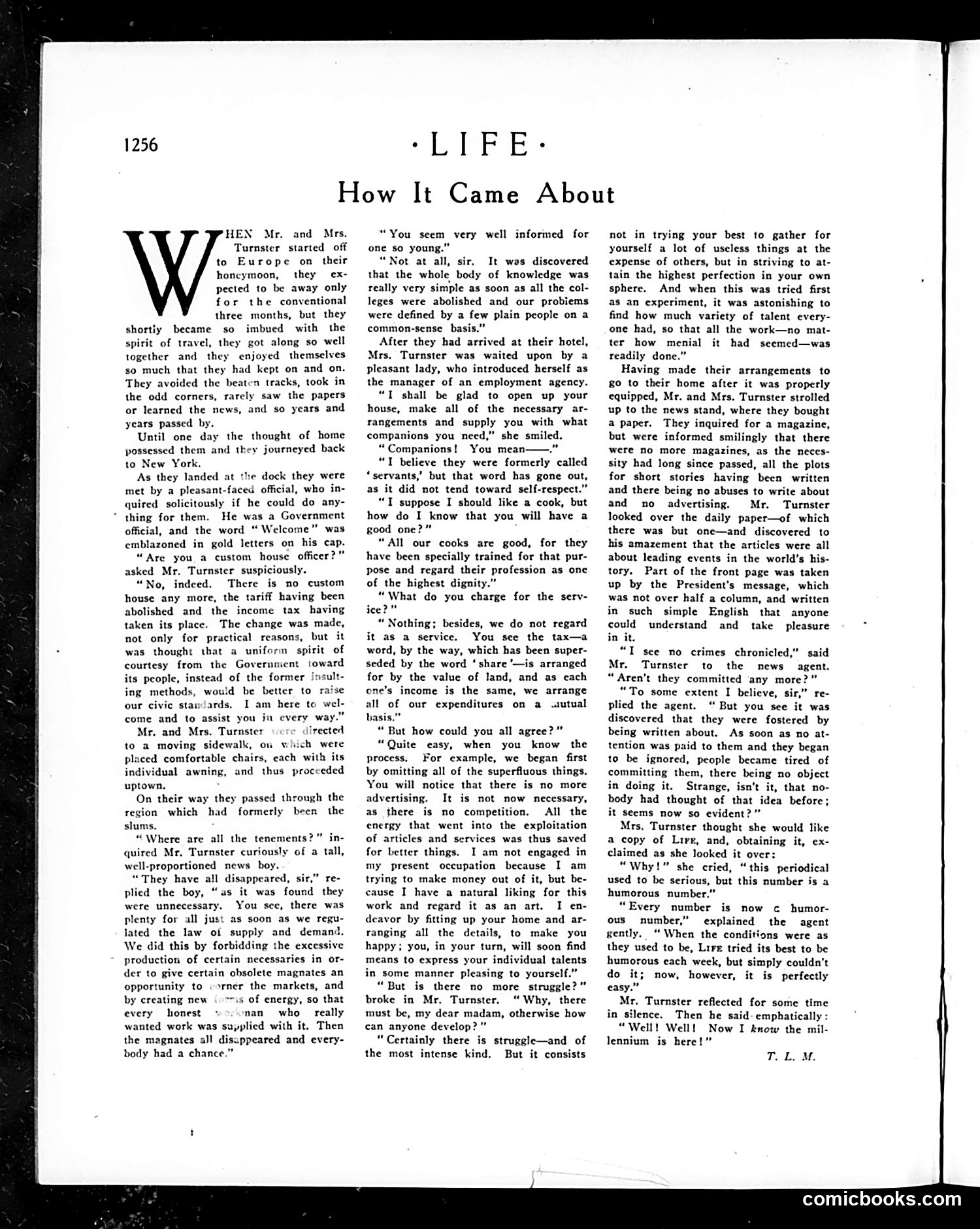
This is a utopian satirical story about Mr. and Mrs. Turnster returning to New York after years abroad, finding a transformed society. The satire targets progressive-era reforms by exaggerating them to absurdity. Key satirical points: **Government reform**: Customs houses eliminated, replaced by courteous "welcome" officials; income tax replaces tariffs. **Economic justice**: Slums disappeared; production regulated to prevent monopolies; everyone finds dignified work. **Social equality**: "Servants" rebranded as "companions"; domestic workers are professionally trained and compensated through shared taxation based on land value, not individual fees. **Education**: Colleges abolished because "knowledge was really very simple" when explained by "plain people on a common-sense basis." The humor lies in mocking idealistic reformers by showing their proposals taken to logical extremes—a world where everything is perfectly equal, dignified, and rationally organized, which the author suggests is naïvely impossible. The piece likely reflects 1910s debates over labor rights, taxation, and progressive governance.
📄 Transcribed text from this page (OCR, searchable)
Machine-transcribed from the original scan — historical spelling and the odd misread are preserved.
‘LTPP R « How It Came About HEN Mr. and Mrs. Turnster started off to Europe on their honeymoon, they ex- pected to be away only for the conventional three months, but they shortiy became so imbued with the spirit of travel, they got along so well together and they enjoyed themselves so much that they had kept on and on. They avoided the beaten tracks, took in the odd corners, rarely saw the papers or learned the news, and so years and years passed by, Until one day the thought of home possessed them and they journeyed back to New York. As they landed at the dock they were met by a pleasant-faced official, who in- quired solicitously if he could do any- thing for them. He was a Government official, and the word “Welcome” was emblazoned in gold letters on his cap. “Are you a custom house officer?” asked Mr. Turnster suspiciously. “No, indeed. There is no custom house any more, the tariff having been abolished and the income tax having taken its place. The change was made, not only for practical reasons, but it was thought that a uniform spirit of courtesy from the Government toward its people, instead of the former insult- ing methods, would be better to raise our ic standards, I am here to wel- come and to assist you in every way.” Mr. and Mrs. Turnster irected to a moving sidewalk, on which were placed comfortable chairs, each with its individual awning, and thus proceeded uptown. On their way they passed through the region which had formerly been the slums. “Where are all the tenements?” in- quired Mr. Turnster curiously of a tall, well-proportioned news boy. “They have all disappeared, sir,” re- plied the boy, “as it was found they were unnecessary. You see, there was plenty for all just as soon as we regu: lated the law of supply and dema: We did this by forbidding the excessive production of certain necessaries in or- der to give certain obsolete magnates an opportu to oorner the markets, and by creating new "is of energy, so that every honest +>. nan who really wanted work was suyplied with it. Then the magnates all disappeared and every- body had a chance.” “You seem very well informed for one so young.” “Not at all, sir, It was discovered that the whole body of knowledge was really very simple as soon as all the col- leges were abolished and our probiems were defined by a few plain people on a common-sense basis.” After they had arrived at their hotel, Mrs. Turnster was waited upon by a pleasant lady, who introduced herself as the manager of an employment agency. “T shall be glad to open up your house, make all of the necessary ar- rangements and supply you with what companions you need,” she smiled. “Companions! You mean—.” “T believe they were formerly called ‘servants,’ but that word has gone out, as it did not tend toward self-respect.” “T suppose I should like a cook, but how do I know that you will have a good one?” “All our cooks are good, for they have been specially trained for that pur- pose and regard their profession as one of the highest dignity.” “What do you charge for the serv- ice?" Nothing; besides, we do not regard it as a service. You see the tax—a word, by the way, which has been super- seded by the word ‘share ’—is arranged for by the value of land, and as cach one’s income is the same, we arrange all of our expenditures on a .autual basis.” “ But how could you all agree?” “Quite easy, when you know the process. For example, we began first by omitting all of the superfluous things. You will notice that there is no more advertising. It is not now necessary, as there is no competition. All the energy that went into the exploitation of articles and services was thus saved for better things. I am not engaged in my present occupation because I am trying to make money out of it, but be- cause I have a natural liking for this work and regard it as an art, I en- deavor by fitting up your home and ar- ranging all the details, to make you happy; you, in your turn, will soon find means to express your individual talents in some manner pleasing to yourself.” “But is there no more struggle?” broke in Mr. Turnster. “ Why, there must be, my dear madam, otherwise how can anyone develop?” “Certainly there is struggle—and of the most intense kind. But it consists not in trying your best to gather for yourself a lot of uscless things at the expense of others, but in striving to at- tain the highest perfection in your own sphere. And when this was tried first as an experiment, it was astonishing to find how much variety of talent every- one had, so that all the work—no mat- ter how menial it had seemed—was readily done.” Having made their arrangements to go to their home after it was properly equipped, Mr. and Mrs. Turnster strolled up to the news stand, where they bought a paper. They inquired for a magazine, but were informed smilingly that there were no more magazines, as the neces- sity had long since passed, all the plots for short stories having been written and there being no abuses to write about and no advertising. Mr. Turnster looked over the daily paper—of which there was but one—and discovered to his amazement that the articles were all about leading events in the world’s his- tory. Part of the front page was taken up by the President's message, which was not over half a column, and written in such simple English that anyone could understand and take pleasure in it. “TI see no crimes chronicled,” said Mr. Turnster to the news agent. “Aren't they committed any more?” “To some extent I believe, sir,” re- plied the agent. “ But you see it was discovered that they were fostered by being written about. As soon as no at- tention was paid to them and they began to be ignored, people became tired of committing them, there being no object in doing it. Strange, isn’t it, that no- body had thought of that idea before; it seems now so evident?” Mrs, Turnster thought she would like a copy of Lire, and, obtaining it, ex- claimed as she looked it over: “Why!” she cried, “this periodical used to be serious, but this number is a humorous number.” “Every number is now c humor- ous number,” explained the agent gently, “ When the conditions were as they used to be, Lrg tried its best to be humorous each week, but simply couldn't do it; now, however, it is perfectly Turnster reflected for some time nce. Then he said: emphatically : “Well! Well! Now I know the mil- lennium is here!” T. LM. comicbooks.com