
Life, 1911-06-29 · page 26 of 45
Life — June 29, 1911 — page 26: what you’re looking at
What you’re looking at
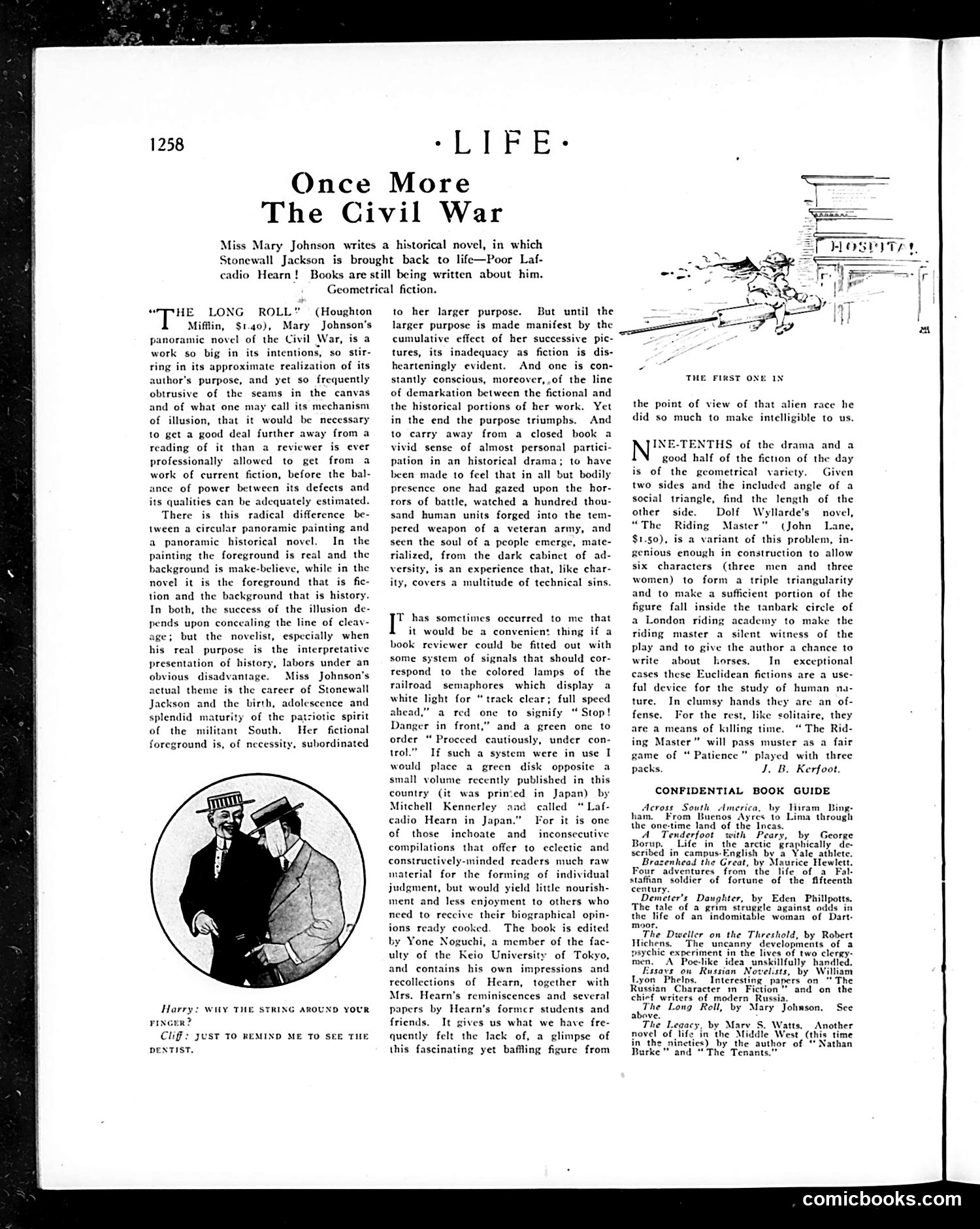
This page reviews Mary Johnson's Civil War novel *The Long Roll*, about Stonewall Jackson. The critic praises Johnson's ambition while noting structural flaws—the fictional foreground feels inadequate until the historical purpose accumulates through successive scenes. The review concludes that achieving a vivid sense of participation in the historical drama ultimately justifies the technical imperfections. The small cartoon shows two men: "Harry" asks "Clif" why he has string around his finger. Clif responds it reminds him to see the dentist. This is a simple, evergreen joke about memory aids—unrelated to the book reviews and likely filler content typical of Life magazine's satirical format. The page also briefly reviews a compilation about Lafcadio Hearn published in Japan, which the critic finds raw and unpolished but potentially useful for discerning readers.
📄 Transcribed text from this page (OCR, searchable)
Machine-transcribed from the original scan — historical spelling and the odd misread are preserved.
“LPP * Once More The Civil War Miss Mary Johnson writes a historical novel, in which Stonewall Jackson is brought back to life—Poor Laf- cadio Hearn! Books are still being written about him. Geometrical fiction. HE LONG ROLL" (Houghton Mifflin, $1.40), Mary Johnson's panoramic novel of the Civil War, is a work so big in its intentions, so. stir- ring in its approximate realization of its author's purpose, and yet so frequently obtrusive of the seams in the canvas and of what one may call its mechanism of illusion, that it would be necessary to get a good deal further away from a reading of it than a reviewer is ever professionally allowed to get from a work of current fiction, before the bal- ance of power between its defects and its qualities can be adequately estimated. There is this radical difference be- tween a circular panoramic painting and a panoramic historical novel. In the painting the foreground is real and the background is make-believe, while in the novel it is the foreground that is fic- tion and the background that is history, In both, the success of the illusion de- pends upon concealing the line of cleav- age; but the novelist, especially when his real purpose is the interpretative presentation of history, labors under an obvious disadvantage. Miss Johnson's actual theme is the career of Stonewall Jackson and the birth, adolescence and splendid maturity of the patriotic spirit of the militant South. Her fictional foreground is, of necessity, subordinated Harry: Wuy THE STRING AROUND YOUR FINGER? Clif: yust 10 REMIND Me To SEE THE DENTIST. to her larger purpose. But until the larger purpose is made manifest by the cumulative effect of her successive pic- tures, its inadequacy as fiction is dis- hearteningly evident. And one is con- stantly conscious, moreover, ,of the line of demarkation between the fictional and the historical portions of her work. Yet in the end the purpose triumphs. And to carry away from a closed book a vivid sense of almost personal partici- ion in an historical drama; to have been made to feel that in all but bodily presence one had gazed upon the hor- rors of battle, watched a hundred thou- sand human units forged into the tem- pered weapon of a veteran army, and seen the soul of a people emerge, mate- rialized, from the dark cabinct of ad- versity, is an experience that, like char- ity, covers a multitude of technical sins. T has sometimes occurred to me that it would be a convenient thing if a book reviewer could be fitted out with some system of signals that should cor- respond to the colored lamps of the railroad semaphores which display a white light for “track clear; full speed ahead,” a red one to signify “ Stop! Danger in front,” and a green one to order “Procced cautiously, under con- trol.” If such a system were in use I would place a green disk opposite a small volume recently published in this country (it was princed in Japan) by Mitchell Kennerley aad called“ Laf- cadio Hearn in Japan.” For it is one of those inchoate and inconsecutive compilations that offer to eclectic and constructively-minded readers much raw material for the forming of individual judgment, but would yield little nourish- ment and less enjoyment to others who need to receive their biographical opin- ions ready cooked. The book is edited by Yone Noguchi, a member of the fac- ulty of the Keio University of Tokyo, and contains his own impressions and recollections of Hearn, together with Mrs. Hearn’s reminiscences and several papers by Hearn’s former students and friends. It gives us what we have fre- quently felt the lack of, a glimpse of this fascinating yet baffling figure from THE FIRST ONE IN the point of view of that alien race he did so much to make intelligible to us. INE-TENTHS of the drama and a good half of the fiction of the day is of the geometrical variety. two sides and ihe included angle of a social triangle, find the length of the other side. Dolf Wyllarde’s novel, “The Riding Master” (John Lane, $1.50), is a variant of this problem, in- genious enough in construction to allow six characters (three men and three women) to form a triple triangularity and to make a sufficient portion of the figure fall inside the tanbark circle of a London riding academy to make the riding master a silent’ witness of the play and to give the author a chance to about horses. In exceptional cases these Euclidean fictions are a use- ful device for the study of human na- ture. In clumsy hands they are an of- fense. For the rest, like solitaire, they are a means of killing time. “ The Rid- ing Master” will pass muster as a fair game of “Patience” played with three packs. J. B. Kerfoot. jiven write CONFIDENTIAL BOOK GUIDE Across South America, by Viram Bing. ham. from Buenos Ayres to Lima through the one-time land of the Incas. A Tenderfoot with Peary, by George Borup, Life in the arctic graphically de- scribed in campus-English by a Yale athlete. Brazenhead the Great, by Maurice Hewlett. Four adventures from the life of a Fal: stafian soldier of fortune of the fifteenth century Demeter’s Daughter, by Eden Phillpotts. The tale of a grim struggle against odds in the life of an indomitable woman of Dart- moor. The Dweller on the Threshold, by Robert Hichens. The uncanny developments of a psychic experiment in the lives of two clergy- men. A Poe-like idea unskillfully handled. Essavs on Russian Novelists, by William Lyon Phelns. Interesting papers on‘ The Russian Character in Fiction” and on the ef writers of modern Rus The Long Roll, by Mary above. The Legacy, by Mary S. Watts, Another novel of life in the Middle West. (this time in the nineties) by the author of “Nathan Burke” and “The Tenants.” a. johmson, See comicbooks.com