
Life, 1911-06-29 · page 21 of 45
Life — June 29, 1911 — page 21: what you’re looking at
What you’re looking at
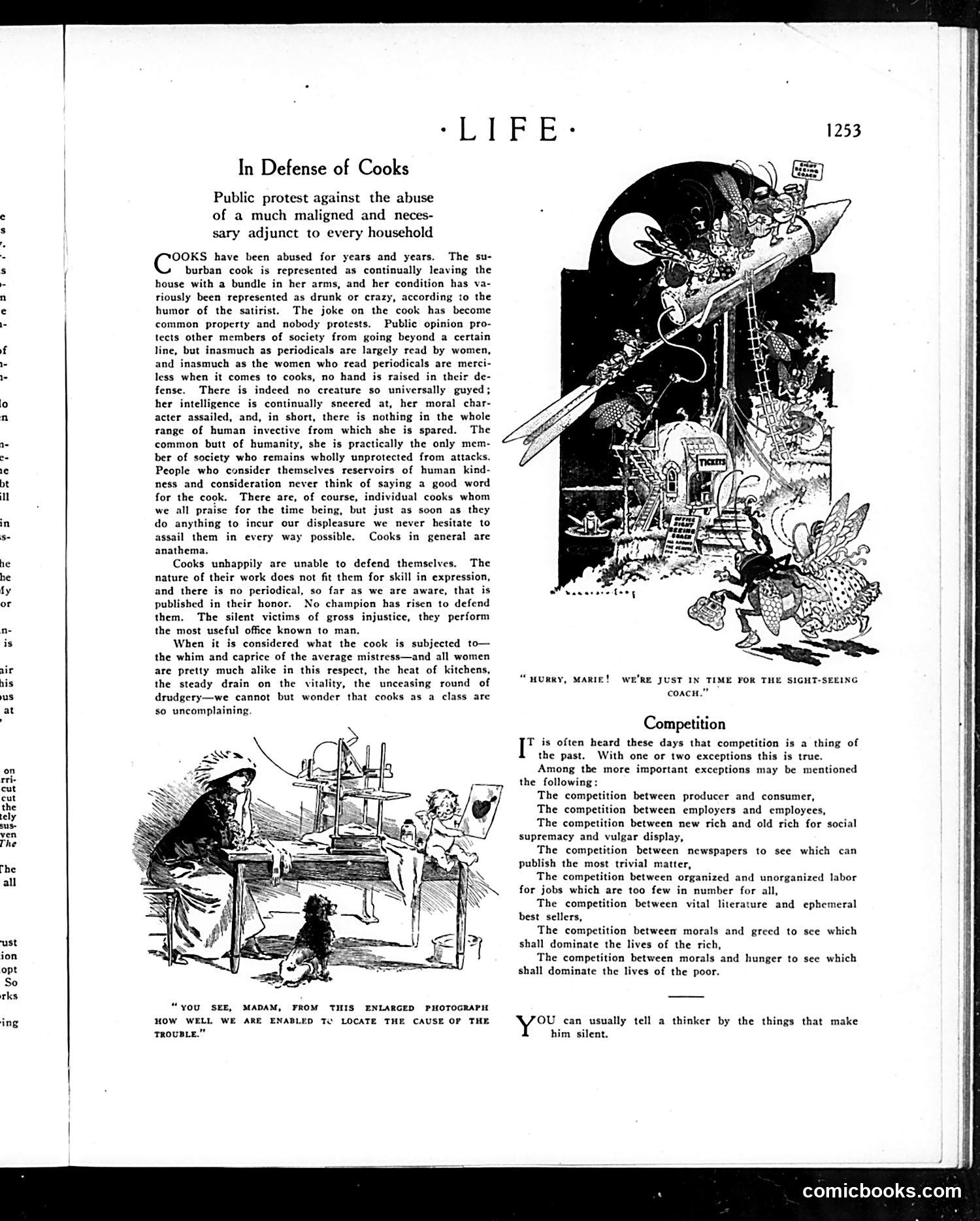
This article satirically defends domestic cooks against widespread mockery in popular culture and periodicals. The piece argues that cooks—typically working-class women—are society's most universally ridiculed group, portrayed as drunk, crazy, or incompetent, yet receive no public protection or sympathy unlike other social classes. The cartoons illustrate the cook's plight: one shows a detective examining a kitchen with magnifying glass (sardonically suggesting cooks are criminal suspects), another depicts a cook fleeing with a bundle, reinforcing the stereotype the article critiques. The accompanying "Competition" section uses biting social commentary to highlight class disparities: competition between rich and poor, morals and greed versus morals and hunger—suggesting society's priorities are fundamentally unjust. The satire's point: cooks perform essential labor under brutal conditions yet remain invisible, voiceless, and fair game for mockery that would be considered cruel if directed at other groups. The article advocates for basic human dignity and recognition of their contributions.
📄 Transcribed text from this page (OCR, searchable)
Machine-transcribed from the original scan — historical spelling and the odd misread are preserved.
a he he ly or air his ust ion opt rks ing ‘LIFE 1253 In Defense of Cooks Public protest against the abuse of a much maligned and _neces- sary adjunct to every household OOKS have been abused for years and years. The su- burban cook is represented as continually leaving the house with a bundle in her arms, and her condition has va- riously been represented as drunk or crazy, according to the humor of the satirist. The joke on the cook has become common property and nobody protests. Public opinion pro- tects other members of society from going beyond a certain line, but inasmuch as periodicals are largely read by women, and inasmuch as the women who read periodicals are merci- less when it comes to cooks, no hand is raised in their de- fense. There is indeed no creature so universally guyed; her intelligence is continually sneered at, her moral char- acter assailed, and, in short, there is nothing in the whole range of human invective from which she is spared. The common butt of humanity, she is practically the only mem- ber of society who remains wholly unprotected from attacks. People who consider themselves reservoirs of human kind- ness and consideration never think of saying a good word for the cook. There are, of course, individual cooks whom we all praise for the time being, but just as soon as they do anything to incur our displeasure we never hesitate to assail them in every way possible. Cooks in general are anathema. Cooks unhappily are unable to defend themselves. The nature of their work does not fit them for skill in expression, and there is no periodical, so far as we are aware, that is published in their honor. No champion has risen to defend them. The silent victims of gross injustice, they perform the most useful office known to man, When it is considered what the cook is subjected to— the whim and caprice of the average mistress—and all women are pretty much alike in this respect, the heat of kitchens, the steady drain on the vitality, the unceasing round of drudgery—we cannot but wonder that cooks as a class are so uncomplaining. “YoU SEE, MADAM, FROM THIS ENLARGED PHOTOGRAPIT HOW WELL WE ARE ENABLED Tc LOCATE THE CAUSE OF THE TROUBLE.” “MURRY, MARIE! WE'RE JUST IN TIME FOR THE SIGH concn.” SEEING Competition T is often heard these days that competition is a thing of the past. With one or two exceptions this is true. Among the more important exceptions may be mentioned the following: The competition between producer and consumer, The competition between employers and employees, The competition between new rich and old rich for social supremacy and vulgar display, The competition between newspapers to see which can publish the most trivial matter, The competition between organized and unorganized labor for jobs which are too few in number for all, The competition between vital literature and ephemeral best sellers, The competition between morals and greed to see which shall dominate the lives of the rich, The competition between morals and hunger to see which shall dominate the lives of the poor. OU can usually tell a thinker by the things that make him silent. ‘ comicbooks.com